Rebuilding Place in the Urban Space

"A community’s physical form, rather than its land uses, is its most intrinsic and enduring characteristic." [Katz, EPA] This blog focuses on place and placemaking and all that makes it work--historic preservation, urban design, transportation, asset-based community development, arts & cultural development, commercial district revitalization, tourism & destination development, and quality of life advocacy--along with doses of civic engagement and good governance watchdogging.

Saturday, February 28, 2026

Drinking Water Utilities Climate Risk Index

 It's an index that's been calculated, but isn't an online calculator ("Tapping into risk in America’s drinking water" Carnegie Mellon University, "Climate change risk index and municipal bond disclosures of United States drinking water utilities," Nature)

By cross-referencing 1,455 medium and large water utilities across the country with what those utilities reported in their bond disclosures (financial documents that show investors the risks associated with lending money to these utilities), the study finds a gap between the actual climate risk and the risk reported in their disclosures.

Utilities serving 67 million people were rated as high risk, but more than a third of their bonds (36%) do not mention climate change, leaving communities exposed to potentially unsafe drinking water during extreme weather events and investors unaware of hidden financial liabilities. The municipal bonds studied represent $39.3 billion in debt, most of which will mature within the next 20 years. Of that total, $9.2 billion was issued by utilities identified as having high risk to climate change, but with limited evidence of climate risk awareness.


Interestingly, in Utah there is a bill pending in the legislature calling for a tax on water use to fund big new water infrastructure projects, but the projects haven't been vetted in terms of overall water use planning ("Utah bill to address water infrastructure needs advances, but not everyone's happy with it," KSL) and they presume future water supplies which may not come to fruition, given Western drought.   

Utah has amongst the lowest water rates, because they are in part subsidized by property taxes.

‘The Lake, directed by Abby Ellis, details the precipitous decline of the Great Salt Lake.’ Photograph: Courtesy of Sundance Institute

And while not related to drinking water, but to use of water overall and the impact on the shrinking Great Salt Lake ("‘An environmental nuclear bomb’: documentary examines fight to save Great Salt Lake," "Great Salt Lake’s retreat poses a major fear: poisonous dust clouds," Guardian), the state seems to be seeking the federal government out to be the savior.  

But the federal government has negligible additional powers to act--the state has plenty ("Trump promises to work with Utah to make its salt lake ‘great again’").

From the Guardian:

The lake, often called “America’s Dead Sea” (though it is, in fact, four times larger than its counterpart in the Middle East), hit a record low in 2022, having lost 73% of its water and 60% of its surface area from excess diversion for agriculture and other water use.

The new film [The Lake] warns, in no uncertain terms, that going over the edge would spell catastrophe for the state’s public health, environment and economy.

Toxic dust clouds laden with mercury, arsenic and selenium from the desiccated lakebed would increase pollution for a city whose air quality is already worse than Los Angeles, provoking a respiratory and other cancer-related issues. Birdlife and recreation on the lake, already disappearing with its surface area – now less than 1,000 square miles, down from three times that in the 1980s – would vanish completely. The lake’s disappearance would inflict billions of dollars of economic damage on the region, imperil the lucrative extraction of minerals from the lakebed, and threaten ski conditions at the numerous resorts in the nearby mountains (including the slopes of Park City, looming over the film’s premiere).

Three years ago, Abbott, along with more than 30 other scientists, co-authored a report warning that absent major intervention, the 11,000-year-old Great Salt Lake would disappear within five years.

Labels: , , , ,

Friday, May 15, 2020

San Diego County and international border issues: sewage and pandemic

Obviously, the boundaries of national borders present interesting issues because at the local scale, the areas may be more connected than separated, especially if there are not natural boundaries like wide rivers (e.g., the Detroit River and lakes disconnect Canada from Michigan, because you have to cross by a bridge, tunnel or boat).

Customs officers stand beside a sign saying that the border is closed at the U.S.-Canadian border in Lansdowne, Ontario, on March 22. LARS HAGBERG/AFP VIA GETTY IMAGES.

The borders of both Canada and Mexico present issues in general, which wax and wane depending on the political tenor in the respective countries. 

The current US government's hyper focus on limiting immigration has exacerbated trade and other issues between the nations ("In Canada, Patience Wearing Thin Over Trump’s Antics," Foreign Policy).

In earlier times, things could be simpler. For example, at one time the streetcar line in El Paso, Texas provided service into Juárez, Mexico across the international border ("Story behind end of international streetcars in El Paso, Juárez," El Paso Times).

The service may have continued had the Mayor of El Paso been more forward thinking, especially considering the present reality that "the two cities form the world’s largest binational metroplex, with billions of dollars in trade and thousands of daily crossings by foot, car, and bus."

More recently but before the Trump Administration, a pedestrian bridge called the Cross Border Xpress was constructed providing access from the US side of the border to the Tijuana International Airport.

Earlier this year, Luxembourg instituted free public transit, even across national borders, as a transportation demand management initiative ("Luxembourg makes all public transport free," CNN). But that's a lot easier to do in Continental Europe because within the EU normally there aren't border checks, unlike between the US, Canada, and Mexico.

1.  Sewage from Tijuana.  I've written in the past about how improperly discharged sewage from Tijuana fowls beaches in San Diego County and management of embassies as properties in a local city such as Washington, DC ("International entities that affect communities: embassies; sewage," 2017).

Photo: Gregory Bull, Associated Press.

WRT the problem on the Pacific Ocean beaches in San Diego County, the minimally funded International Boundary and Water Commission doesn't have enough money to address the problem, especially as the maximum allowable grant is $5 million.

Senator Feinstein and local Congressional Representatives have garnered hundreds of millions in a special appropriation )("EPA Dedicates $300 Million to Combat Tijuana River Pollution" press release).

Interestingly, it's still not enough to address all the needs. I don't understand the failure to get enough money to fix it more completely the first time, rather than to hope for more money, somehow, later.

The San Diego Union Tribune Editorial Board is angry for another reason, indifference ("Editorial: $300 million for repairs is great, but San Diego sewage fiasco still stinks"). From the article:
For the past decade, county beaches have been fouled by Tijuana sewage spills more than 130 days a year on average. Yet the Trump and Obama administrations thought that instead of using a relative sliver of federal funding to address this crisis, inaction was OK. In 2016, Obama’s last year, the federal budget was $3.8 trillion. With the spending of an tiny fraction more than that — an increase of 0.00008% — this nightmare could have been addressed then. ...

Nevertheless, it remains perverse that the only reason that California lawmakers were able to win this funding and recognition was the Trump administration’s eagerness to round up votes to enact the United States-Mexico-Canada Agreement on trade.
2. Cross-border workers and the pandemic. There is a great deal of cross-border commerce between Tijuana, the Mexican State of Baja California, and San Diego County and Southern California more generally, including the daily crossing of the border by tens of thousands of workers. This is in both directions, although more people come from Mexico, although many of these border crossers are US citizens living in Baja California.

Failures to adequately address the coronavirus in Mexico ("Tijuana’s Already Strained Hospitals Face Shortages As Pandemic Takes Hold," KPBS-TV) have affected San Diego County.  So the Mayor of San Diego is coordinating a regional effort and the provision of extranormal assistance to Tijuana ("San Diego and Tijuana form working group to tackle cross-border coronavirus surge," SDUT). From the article:
A spokesperson for the San Diego mayor’s office said the bi-national group will likely include daily data reports and involve a multi-agency response plan that includes the U.S. Centers for Disease Control and Prevention, the Department of Homeland Security, the Federal Emergency Management Agency, police and fire agencies from San Diego and Chula Vista and the California Department of Public Health.

“San Diego and Tijuana’s longstanding binational relationship has (been) and continues to be a strength even amid one of the largest pandemics we’ve faced in a century,” Faulconer said in a statement. “COVID-19 knows no boundaries, so our border region is closely monitoring the impacts to healthcare systems on both sides of the border.” ...

Approximately 265,000 U.S. citizens live in northern Baja California, according to the San Diego mayor’s office. Many of them are essential workers who cross daily into the United States to work in hospitals, senior living homes or for public agencies, for instance.
Elsewhere.  Likely this could be an issue in cities like Brownsville, El Paso, and Laredo in Texas, Nogales, Arizona, and others across the border between the US and Mexico.

WRT the US-Canada border, Canadian authorities prefer longer restrictions as well ("Canada and the U.S. Working to Extend Border Closure to Nonessential Travel," AP).

Labels: , , , ,

Sunday, January 24, 2016

Flint and water water everywhere and not a drop to drink

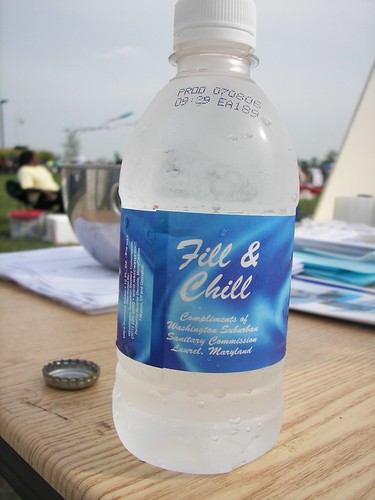
Bottle of WSSC water...from the tapA bottle of water produced by the Washington Suburban Sanitary Commission, which operates in Montgomery and Prince George's Counties in Maryland.

The Brookings Institution produced a piece, "Flint’s water crisis highlights need for infrastructure investment and innovation," arguing that what has happened in Flint with the destruction of the water system there is an illustration of failures to innovate and invest in infrastructure.

While it's convenient to use the Flint situation as an example of why we should be investing in infrastructure, it's a serious misreading of what happened in Flint.  The real issues are different ("State admits Flint did not follow federal rules designed to keep lead out of water," Michigan Public Radio; "Documents show Flint filed false reports about testing for lead in water," Flint Journal).

To me, it is an example of overreach of the execution of Republican ideology about government as "bad" by definition.

While it is true that cities that have lost their manufacturing base--and Flint is a primary example--are financial basket cases, and decaying water supply systems are susceptible to corrosion and water main breaks, and require significant new investment, the problem in Flint with the water system was the result of a sadly simple failure: the water department didn't properly treat the water with the right set of chemicals to head off corrosion and the release of harmful chemicals and particulates into the water.

The Flint water treatment plant is pictured on Thursday, April 17, 2014. The City of Flint is planning on switching from Lake Huron to the Flint River as the primary water source for city residents and businesses. Samuel Wilson | Mlive.com


Before the switch from "Detroit water" to water from the Flint River, the facility should have (1) tested Flint River water (2) to determine what combination of chemicals would limit potential problems with corrosion (3) to treat the water with (4) once the switch between water sources was made  (5) before releasing the water for distribution to customers.

But they didn't.

Flint's government is under the control of the State of Michigan, which had taken it over--appointing an "Emergency Financial Manager"--because the city was broke.  So all city government agencies including the water department, were ultimately were under the control of the state government.

It's also an example of a cover up, because the state government lied about the failure to treat the water, once the consequences could no longer be ignored.

Image from "Flint, Michigan residents fight lead poisoning of water supply," World Wide Socialist Website.

As reported by other sources, problems with the water were evident immediately after the switch.  In response to water impurities, a local hospital and a manufacturing plant secured water from other sources, particulates in the water and the impact of the particulates (from corrosion) on their processes.

Those actions should have been the trigger for the state agency overseeing water systems (the Michigan Department of Environmental Quality) to step in and ensure the water treatment facility was in fact treating the water.

Instead, they did nothing, stating that the water was being treated properly.

More than the issue of "infrastructure and innovation," the question for me is how does what happened in Flint illustrate the neoliberal narrative that the private sector and "the market" are better at "doing government business" than is the government.

Despite the change in the source of the water, there was no preordained reason for the failure of the water system in Flint.

There are thousands of municipal water systems across the country that are managed quite well.  Although water rates have risen quite a bit in the past few years because of the cost of complying with federal mandates on the treatment and discharge of storm water runoff and protecting water supplies from tampering--the cost to comply for many systems runs more than $1 billion.  So prices go up, but people blame "management," when that's not the problem (past blog entry, "How do you 'reform' a crumbling sewer line?").

DC Water water bottle refill program
When government fails it's usually the consequence of either of two things:  (1) political decisions disconnected from "evidence" but more based on ideology or (2) deliberate disinvestment and underfunding of agencies.

And when it does fail it's criticized for failure without acknowledging that funding and/or political and ideological decision making was the root cause, that government by definition isn't incapable.  But proponents of the market use such failures to prove their case that government is inept by definition.

What happened in Flint is comparable to FEMA's failure under President Bush to respond adequately to Hurricane Katrina? ("Undone by Neoliberalism," The Nation).  Or the continued inability of local government to respond adequately to flooding in England and Wales, in the face of annual reductions to their budgets by the central government ("After the floods, local government is fighting to stay afloat," Guardian).

No consequences.  Except for the fact that the Michigan Legislature is controlled by the Republican Party, shouldn't Governor Snyder be impeached?  (I don't know if Michigan has an impeachment or recall process for the position of Governor.  It should.)

Municipal water systems can be innovative.  While Brookings calls for more innovation on the part of local governments, using the Flint water system as an example, the reality is that many water agencies are innovative, in either operations or marketing, especially compared to the norm of government agency operation.

Speaking of innovation, photos of bottles of brown water drawn from the Flint water system remind me of the efforts of various municipal water systems to promote the use of tap water as opposed to bottled water sold for a profit by private firms.

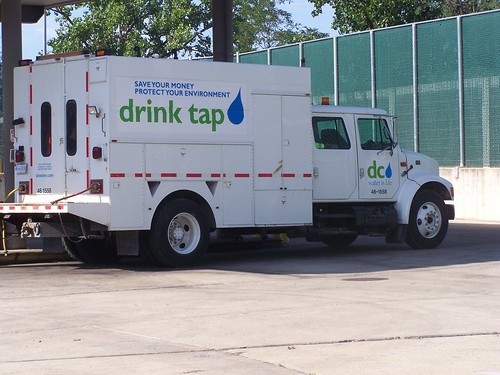
DC Water Authority truck branded with their "drink tap water" campaignIn 2006, I picked up a bottle of tap water bottled by the Washington Suburban Sanitary Commission at a festival in Prince George's County.  At the time, that was pretty innovative.

They were making the point that their water is as good as the bottled water people buy in stores and pay premium prices for--store bought bottled water is about 100 times more expensive than water from the tap.

DC Water created similar programs (Drink Tap - DC Water) (which comes from a river too, the Potomac River) promoting drinking from the tap and using tap water in your own bottle, rather than buying bottled water.

But with events in Flint, I wonder if these kinds of social marketing efforts will meet some resistance, since so many people believe water bottled by for profit companies is somehow better.

In terms of operations, agencies in California are embarking on running desalination plants and have developed significant recycling programs and diversion programs.  DC's water system has launched an energy generation system as part of its treatment process, which produces 30% of the system's power needs.

And the creation of the Karegnondi Water Authority to provide water to Mid-Michigan cities including Flint so they can get water more cheaply than from the Detroit system. is an innovation too as it is designed to create a system to serve multiple jurisdictions with a closer water source and at less cost.

Penny-wise, pound foolish.  Note that Flint would have probably been better off waiting to switch from Detroit water after the Karegnondi Water Authority system actually becomes operational, rather than 4-5 years before this system begins to deliver water.

As the adage says: "Penny wise, pound foolish."

The cost to replace piping in the Flint water system could be as much as $1.5 billion.  People have died. And hundreds if not thousands of people have been poisoned by lead, suffering permanent damage to their health.  The cost to deal with this will be considerable.

An interesting nugget from the Brookings article.  The article mentions PENNVEST, an initiative by the State of Pennsylvania to provide funding and support to local water authorities for various improvements.

Labels: , , , , , ,

Monday, January 18, 2016

Don't use the local water: Parkersburg, WV and Flint, MI

Many years ago, I saw a presentation by Eric Freidenwald-Fishman of the Metropolitan Group, on "Building Public Will."

One of the examples in the presentation was about the environmental health of rivers, and how "building public will" you need to reach people with messages that resonate in terms of their pre-existing values and interests.

The firm worked with river-related organizations (the organizations that sponsor "Riverkeeper" programs) and because rivers are the primary source of drinking water in the US, they recommended that messaging should focus on personal health and the link with rivers as a source of drinking water for their households.

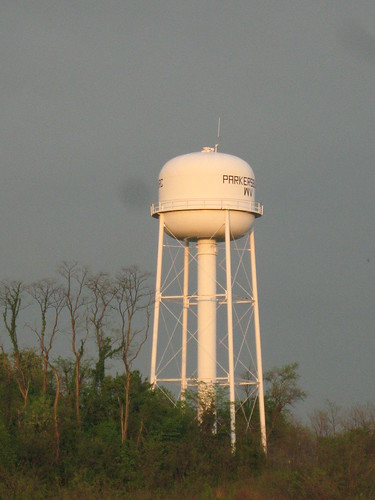
Water tower for Parkersburg, WV
Water tower in Parkersburg, WV.  Flickr photo by Daniel Westfall.

Parkersburg, WV.  A couple weeks ago, the New York Times Magazine had a blistering article ("The Lawyer Who Became DuPont's Worst Nightmare") on how Dupont Corporation's facilities in Parkersburg, WV utilized in the production of Teflon a chemical that appeared to have significant negative health effects, and for decades the company ignored this fact and improperly disposed of the chemical, so that the area water systems are mostly contaminated by it, and because the company has extraordinary power in the state, the state agency concerned with the environment and responsible for regulating chemical and mining companies is controlled by industry, and so there is no real impact.

Death clusters for both people and animals, whitewashed by the company and the state agency led a resident to reach out to a lawyer who once had relatives in the area, who he had visited when he was young.

The big element in the story is that the plaintiffs are represented by one of the nation's leading "white shoe" law firms, which historically represents the chemical industry on such matters. The lawyer was incredulous that a company could act in such improper ways as a matter of course.  While difficult internally, the law firm, Taft Stettinius and Hollister, has stuck with the case.

Flint, Michigan.  Flint is getting national attention as the EPA is stepping in to deal with the contamination of the water supply there, which resulted from the city changing from "Detroit water" (water produced by the Detroit Water and Sewer Agency supplies most of Southeastern Michigan and is drawn from Lake Huron and Lake St. Clair) to water from the Flint River.

-- "Who's to blame for Flint's water crisis? Virginia Tech researcher points the finger at MDEQ," Michigan Public Radio
-- Flint Water Study website

The reason the city switched water sources is because it was cheaper and the city is bankrupt.  While a goodly number of commenters on media sites blame "the Democrats" for driving Flint into bankruptcy, the reality is that the city is broke because for all intents and purposes, General Motors shut down most of the manufacturing plants that had been there--the company started in Flint.  At one time

Water from different sources has different chemical characteristics.  But the problem with the lead in the water isn't that somehow the Flint River is particularly contaminated so much as it is that the water from the Flint River has different chemical characteristics from the water that they had previously received from Detroit.

Chemicals are added to water in the treatment process to limit problems. It turns out that chemicals are added to water as part of the treatment process in order to reduce the likelihood of particle leaching from build up in pipes, and to reduce corrosion of water piping systems--the systems tend to be old and constructed out of a variety of types of piping ranging from iron to copper to lead, and lead piping in particular is susceptible to corrosion.  Lead is particularly harmful to health, causing brain damage and cognitive impairment.

EPA "Lead and copper rule" is designed to reduce pipe corrosion and chemical contamination in drinking water systems.  This rule requires that water systems test their water regularly and treat it to limit corrosion of piping systems.

Flint, the State, and the Michigan Department of Environmental Quality failed to create an LCR plan. When Flint switched water sources, they should have already tested the water and figured out its chemical characteristics and come up with a chemical treatment combination for the water from the Flint River, to limit leaching and other problems.  The Detroit water system, when they were providing the water to Flint, were doing this already.

They weren't treating the water at all.  They didn't do this.  That's the reason for the problem, not that Flint River water is particularly bad, but that they failed to take the most basic and necessary steps to ensure the change would be straightforward and successful, with no negative outcomes.  So the more acidic water from the river increased significantly corrosion of the water system, releasing lead and other chemicals from the piping system.


Image from "City must abandon Flint River as drinking water source amid lead crisis" Flint Journal.

They lied to EPA about having a plan. According to the timeline post on the Flint Water Study website, when queried by the EPA in response to resident complaints about water quality--many people were getting "brown water" when they turned on their faucets, Flint/MDEQ said they had an LCR plan in place and that they were treating the water with the right chemical combination to reduce leaching from the piping system. But they weren't treating the water at all.

The aftermath.  The city is providing bottled water, and the National Guard is helping to distribute it ("More National Guard Troops Move into Flint as Water Crisis Widens," NBC). The city announced that they will switch back to "Detroit water" although that isn't really the issue.

The problem is now there is significant corrosion of old pipes but they don't know where, and even flushing out the system before switching back to Detroit water might not eliminate the problem, although the expectation is that the lead levels will drop significantly after one month.

An alternative, rebuilding the water distribution system, would cost billions, and would take years.

Is this a Republican problem?  In both West Virginia and Michigan you have Republican governors and the state government apparatus is controlled by Republicans and a business-friendly agenda that de-emphasizes regulation.

In WV, local water systems, some publicly owned, some privately owned, are following the pro-business line.

In Michigan, this was more an issue of state politics in terms of the Governor's being able to appoint "emergency managers" to supersede elected officials to make extraordinary changes to improve local finances, but perhaps also as a way to show up cities, which tend to be helmed by Democrats, especially in Michigan.

In either case, the Republican anti-regulatory ideology likely influenced these outcomes.  In either case, citizens are the losers, either to corporate profits or political philosophy and ideology.

Labels: , , , ,

Saturday, September 05, 2009

Dilemmas in urbanism and suburbanism and the transect...

The transect of "urbanization" is a useful conceptual construct to help us think through land use and planning issues. There are six transect zones, ranging from nature to highly populated and/or dense districts. It's not perfect, because it is broad-brushed.
Land development Transect (new urbanism)
Transect diagram.

The Nashville/Davidson County Community Character Manual takes the transect concept but fine tunes it, with up to 7 subzones of each transect zone, based on the interaction between four primary elements (open space, neighborhoods, centers, and corridors) and the intent to preserve, enhance or create (develop) the spaces.

In the meantime, there are many incongruencies as places change such as:

1. Cougar on the loose? Park closed" from the Seattle Times.

A sign at the visitors center alerts people to Discovery Park's closure due to "credible" cougar sightings.

Enlarge this photo

KEN LAMBERT / THE SEATTLE TIMES. A sign at the visitors center alerts people to Discovery Park's closure due to "credible" cougar sightings.

2. "No One's Breaking Bread With This Wine: Some think a Fairfax County winery would preserve open space and boost tourism" and "Farm Winery Squeezes by Fairfax Zoning Law: State Board Gives Approval Over County's, Neighbors' Objections" from the Washington Post, about the creation of a winery in a more rural area of Fairfax County.

3. "Bow Hunt for Deer Debated in Leesburg: Residents Weigh Damage, Danger" from the Post.
In the Neighborhood, 1960s reading primer

Labels: , , ,

Sunday, August 30, 2009

Volunteer for National Public Lands Day, Sept. 26

From the AP story:

Some 130,000 volunteers are expected to spend National Public Lands Day, September 26th, working in parks, beaches and wildlife reserves to build trails, remove garbage and pull up invasive plants.

Many locations are also offering crafts, kid's activities, barbecues and campouts.

The event is a program of the National Environmental Education Foundation.

------

(We have "public lands" in cities too.)

Labels: , , , ,

Tuesday, July 07, 2009

San Antonio River Walk


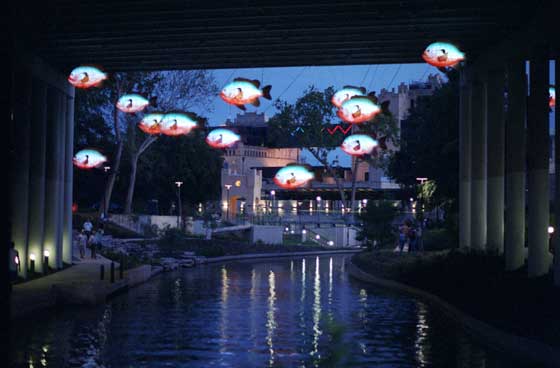
'F.I.S.H.' gotta fly: The river under the I-35 bridge, once a wasteland, is now a civic treasure. San Antonio Museum of Art terminates the view. Image from the Incident Light blog.

It's been a long time since I've been to San Antonio (I missed the relatively recent American Planning Association annual meeting there a couple years ago), and this blog entry, "Placemaking at its best: In Urban Segment of Museum Reach, designers, artists, craftsmen extend Hugman's vision for River Walk," alerts us to the expansion of the River Walk there.

The San Antonio Riverwalk is an excellent example of harvesting assets that you already have, but perhaps have seen as impediments rather than as assets. Waterfronts are a key asset of communities in the Chesapeake Bay region, and especially for DC proper, which has both the Anacostia River and the Potomac River.

-- Anacostia Watershed Society
-- Anacostia Riverwalk Trail (DC DDOT)
-- Potomac Riverkeeper
-- The Future of the Anacostia (article from the Hill Rag)

In the report that I worked on for Cambridge Maryland, we discussed the necessity of linking the downtown to the waterfront as well as listing a number of ideas on how the community could better leverage its waterfront access as a revitalization asset.

Since working there, I have become a lot more conscious of Chesapeake Bay issues and the vastness of "the water" and its centrality to the identity of the Eastern Shore.

-- Chesapeake Bay Foundation

In the old days, travel in the region was fastest by boat, and there was steamboat service connecting communities throughout the region. One of my crazy ideas is to re-create a kind of Maryland-Virginia-DC "cruise" using a steamboat or two, comparable to the cruise operation that runs on the Great Lakes.

-- A Great Lakes Cruiser Makes a Stop in Rochester from R News (Rochester, NY)
Image, Source: digital file from intermediary roll film
Steamboat at the C. & O. (Chesapeake and Ohio Railway Company) piers, Newport News, Virginia. Library of Congress photo.

Labels: ,

Tuesday, April 21, 2009

Tonight: Anacostia Waterfront Forum -- “Green Waterfront, Green Jobs, Green Living in a Green DC”

Anacostia Waterfront: Realizing the vision logo

From email:

Tuesday April 21, 2009
Open House: 6:30 p.m. - 7:00 p.m.
Forum: 7:00 p.m. - 8:30 p.m.

Martin Luther King, Jr. Library, Great Hall
901 G Street, NW

Environmental activism is sprouting up all over the District of Columbia , from the White House to the banks of the blighted Anacostia River . On Tuesday, April 21st, the third forum in the Anacostia Waterfront Forum Series will focus on what it means to “go green” in the District and why it matters to neighborhoods, businesses and families across the city.

For example, a recent District study estimates DC could produce over 169,000 “green collar job” opportunities between 2009 and 2018. The District is also tightening stormwater regulations and using innovative design and construction practices to combat sewage overflows and the impact of stormwater pollution on area streams and rivers, including the Anacostia River . A cleaner, healthier river is pivotal to the Anacostia Waterfront taking its place as one of the great urban waterfronts in the world.

The forum has a special resonance because April is designated as Green DC Month and April 22nd is recognized as Earth Day around the world.

The Anacostia Waterfront Forum is a series of public presentations that will be held every third Tuesday through June 2009 and is sponsored by the District Department of Transportation (DDOT), the Office of the Deputy Mayor for Planning and Economic Development (DMPED), the District Department of the Environment (DDOE) and the Office of Planning (OP).

-- Organization website
-- Previous presentation: Kathleen Penney 2/17/ 09: Sustainable Development, Infrastructure and the Future of the District of Columbia
-- Previous presentation: Nina Albert 3/17/09 AW Forum: Economics of Developing the Anacostia River

Labels: , , , , , ,

Wednesday, April 08, 2009

Community benefits agreements and energy considerations

This memo has gone through a number of iterations over the past few years. This version was written in February 2008 and updated in June 2008. Below is the complete version, updated to last June, with edits and expansions as of today.

One of the reasons I'm reprinting it is to have one master version with the June 2008 revision. But the other is that I just read something, "Building Green," from the April issue of Chain Store Age magazine (a trade magazine for the chain retail industry) that reiterates a point that was made below. "Green building practices" are merely good business, they are profitable for developers and store owners, and therefore when considering proffers or community benefits in the context of zoning decision-making, green building characteristics should not receive any special consideration.

From the article:

The survey, called "Green Building Market Barometer," is from Turner Construction ... Survey respondents said that green buildings enjoy lower costs than non-green buildings in three important areas:

- energy;
- overall operating expenses; and
- total life cyle over a 10-year span.

The executives also reported that green buildings have better financial performance than non-green ones in terms of:

- higher building values;
- higher asking rents; and
- greater return on investment and higher occupancy rates.

Those perceptions are confirmed by other studies...

Although 87% of the surveyed executives believed that green buildings cost more to construct, some 73% said that higher costs would be paid back through lower operating costs, with a median estimated payback period of seven years. The results indicate that many executives still believe that green construction is significantly more expensive than traditional building methods, when in fact, according to Turner, it can often be achieved with little or not premium.

For example, a review by Davis Langdon, of a wide range of studies, found that hte average construction cost premium required to achieve a moderate level of green features (equivalent to LEED SIlver certification) was only 1% to 2%.

-----------------------------

The current community benefits system is ad-hoc and the lack of transparency and structure disproportionately benefits developers at the expense of communities

Through my involvement in community land use matters since 2000, including participation on the ANC6C Planning and Zoning Committee from 2003 to 2005, I have become increasingly concerned about the lack of structure and inadequate levels of citizen participation in the negotiation of community benefits agreements generally, the lack of transparency of agreements negotiated between developers and local nonprofits deemed "community organizations" to determine how monetary benefits are spent, as well as the relatively paltry amount of benefits provided by most projects, and the failure to garner amenities in ways that could significantly contribute to substantive structural improvements in the neighborhood and at the city at large.

Doesn't anybody remember the great reporting in The Common Denominator about the community amenities agreements associated with development at Fort Lincoln, agreements that have never been effectuated, and the fact that the DC Government isn't too worked up about this? (See May 6, 2002 - News - Residents cry foul: Ft. Lincoln developer reneges on city deal that delivered land rights; June 3, 2002 - News - Fort Lincoln residents seek Norton's help; August 12, 2002 - News - Residents sue, charge Ft. Lincoln New Town developer with fraud; and May 6, 2002 - News - LBJ's 'Great Society' spawned Fort Lincoln development plan all from The Common Denominator.)

Furthermore, communities that are better organized and have resources end up getting more (or some) benefits, while under-organized communities get little to nothing in terms of benefits from new development occuring within the neighborhood. (This should be considered a violation of the 14th Amendment to the U.S. Constitution, and the provision of "equal protection under the law." But this line of inquiry has been inadequately tested through the Courts.)

Justification for community benefits/proffers

The economic justification for developer-paid community benefits/proffers is two-fold. First, adding developable square footage to the project through zoning use changes (including planned unit developments), variances, and special exceptions make a property significantly more valuable. It is reasonable to ask that a developer pay back to the community some of this increase in value.

Second, development projects too often have a "trickle down" effect. Developments are frequently touted for their revitalization benefits, but in my experience without specifically linking the project to other improvements simultaneously, it is difficult to achieve the kinds of benefits touted by the project in short to intermediate periods of time.

For example, the "overnight" success of H Street NE actually represents more than 30 years and hundreds of millions of dollars of already expended federal and city development funds. People still complain about the failure of revitalization -- "when is it going to come? -- not realizing that so much time and money has already been invested.

But part of the "failure" is the failure to coordinate investment and improvements, and to ensure that a project fully connects to the neighborhood and/or commercial district beyond the confines of the lot lines of the development.

My joke about the two office buildings on the 600 block of H Street NE is that in 20 years, the only economic development spawned by the project was one hot dog cart Monday through Friday. (They started with two but there was only enough business for one.)

This "failure to thrive" comes from the failure to link big new projects to necessary and complementary neighborhood improvements simultaneously.

At the same time, coordinating private investment with investments in public space and community capacity will make new projects more valuable more quickly, so one could argue that for certain kinds of developments, especially commercial and probably condominium development, that the money comes right back in terms of increased value. E.g., if H Street were currently a thriving commercial district, it is likely that the Akridge "Burnham Place" development would already be underway, and that the Senate Square development would have sold out, despite the housing downturn, etc.

How much are zoning changes worth?

The Zoning Commission and Office of Planning do not provide a metric for calculating how much density bonuses are worth. Some projects receive density bonuses worth tens of millions of dollars, and frequently the community benefits offered are worth significantly less than $200,000.

For the sake of argument, I suggest that the economic value of density bonuses be paid into a proffer fund at the rate of at least 10%. So added density worth $10 million would generate a minimum of $1 million in funds for proffers.

Communities must first set priorities for neighborhood improvements

Having a structured conversation about community benefits is a necessary first step in the consideration of a wider-range of public-private partnerships organized around land use and development that is designed to yield neighborhood and/or city-wide stabilization and improvement benefits.

Without such a conversation, communities give up a lot with little in the way of calculable return, judging by my experiences thus far. Most benefits agreements are paltry, and too often are little more than graft projects designed to fund an ANC Commissioner's pet projects or organizations. In the past, while rare, individual residents have received personal benefits (such as health club access to a hotel) or air conditioners.

In order to craft agreements, first neighborhoods/Wards/ANCs must work together to develop a set of neighborhood priorities, and ensure that proffers are directed only to those items which the community agrees are important.

-------
There was a letter to the editor of the Post on 4/5/2009 about the need for a canopy over the Foggy Bottom Metro Station, "Foggy Bottom Metro Needs a Canopy." It seems painfully obvious that this would be a public space improvement that should logically be funded through proffers related to the various development projects in that community, projects that are still going forward despite the recession.
------

Priority areas for funding include civic institutions (public schools, libraries, parks), transportation-mobility improvements, streetscape improvements, community history and interpretation, public art, and commercial district revitalization programs, and historic preservation-based building rehabilitation.

Contributions must be substantive, yielding long-term benefits and consequences, rather than "flash in the pan" benefits with little in the way of structural impact. For example, a project at Fort Totten in Ward 5 provided funds for improvements to a local school and library, and an offer was made to the National Park Service to fund improvements to an adjacent park.

Probably improvements to public charter schools should not be considered an acceptable proffer, because the buildings and facilities are not owned by the DC Government (and thereby held in trust for the Citizens of the District of Columbia).

Is design improvement a community benefit but not a proffer?

Another consideration is project-specific design and urban design considerations more generally. "Design" is currently considered a community benefit under the Planned Unit Development system, but almost every instance where I have been involved the benefit to the community is nonexistent and changes to the project come only after an inordinate amount of work on the part of particularly engaged residents.

This is especially important with housing developments. In the current system of development, a commercial building may have a useful life as short as 20 years. In any case, it can be "freshened up" with a new facade at some point to extend its useful life. Owner-occupied housing is likely to never change its design. The hip modern designs of today are likely to become quite dated in as soon as 10 years.

We must remember with housing developments that "what you see is what you get," forever. Fostering design improvements to projects should be an important part of the development process, although I believe personally that this type of benefit should be built into the project as a direct cost independent of the proffer system.

Participation of community development corporations in the proffer process

In the past local CDCs have received ownership positions in development projects by private developers as a community benefit. In part this was done to assure that a particular developer would win development rights from the government entity that controlled the property, such as the Redevelopment Land Agency. But the contracts for these benefits are not open to the public (for the most part) and no accountability and oversight mechanism has been built into these agreements to ensure that "community benefits" truly result from the economic interest awarded to seemingly local organizations.

This must change. No development participation should be awarded to community organizations without the provision of transparency, the provision of direct benefits to the community, and a process of oversight and accountability over such agreements.

How should a community structure its thinking about community benefits?

Proffers can be categorized as one of five types:

1. National benefits;
2. City-wide benefits;
3. Neighborhood benefits within a geographically defined area such as an ANC;
4. Building-specific design improvements; and
5. Site/area physical improvements located within a few block radius of the project, the area most impacted by the project during and after construction.

National benefits. This category covers green/environmental/LEED type requirements. Generally, these kinds of investments pay back to the developer, and for the most part are "merely" good business practices that deserve little in the way of special consideration when valuing community benefits agreements.

It is important that these types of project improvements be considered in an absolute rather than a relative manner. E.g., who cares if a gas station has a couple solar panels? And losing the embodied energy of a building through demolition can likely not be recovered through green construction practices on new construction.

However, building materials recycling could be considered a national benefit deserving of special consideration as a proffer, because the cost of deconstruction is higher than standard demolition. Construction materials make up 50% of the waste stream and much could be recovered through building deconstruction. Therefore, it could be categorized as a city-wide benefit as well.

City-wide benefits. This category relates to city-wide policy, and would cover affordable housing, DC-based employment agreements, minority contracting requirements, and transportation infrastructure investments, among others. These are public policies that serve the city more broadly, rather than the specific neighborhood in which a project is located.

Employment and contracting requirements should be considered standard business practices not deserving of special consideration. Affordable housing requirements do cost money and should be awarded consideration.

Transportation demand management practices (spaces for car sharing, secured bicycle facilities, showers [for office developments]) should have been required as part of the recent Comprehensive Plan revision but were not. ANCs could step and demand that TDM planning and facilities be required for new housing and commercial developments.

Certain of these investments could be considered community amenities to the extent that they provide neighborhood benefits beyond benefits strictly for users of the site, such as car sharing spaces where the car can be used by members not living on the property and shared parking facilities.

Funding improvements of important projects with both neighborhood and city-wide benefits could also be included within the proffer system, e.g., the rehabilitation of a cultural resource asset such as a neighborhood movie theater, deaccessioned school building, etc.

Neighborhood benefits. This category would encompass proffers that are directed to facilities, organizations, services, and residents located within the defined geographical area where the project is located. For example, affordable housing, hiring policies, and business source agreements that target neighborhood/Ward residents and businesses specifically would be considered community benefits deserving of special consideration.

So would improvements made to local public schools, parks, and libraries. Or assistance made to important neighborhood projects. (For example, in the H Street neighborhood, proffers could have been used to help fund the cost of rehabilitating the Atlas Theater.)

Other examples of neighborhood benefits would be the provision of shared parking facilities, i.e., a parking garage supporting residents but also providing access to consumers visiting an adjacent commercial district, funding of historic preservation/cultural resource surveys, paying into community development education programs at the neighborhood level, funding of commercial and neighborhood improvement projects such as:

• community heritage/history interpretation and signage programs;
• public art projects;
• business directories/maps for installation in neighborhood-commercial bus shelters;
• bus stop, treebox, street furniture, sidewalk lighting, and other streetscape/infrastructure improvements deemed important by a neighborhood;
• neighborhood marketing programs including the development of brochures, booklets, and banner programs;
• traffic calming projects including bulb outs;
• funds paid into business development programs to support the development and improvement of local retail and home-based businesses; etc.

For example, in Brookland, the east side of the station does not have a canopy over the escalator/stairs. The cost to install a canopy is $900,000, and installation of this desired facility for the east exit at the Brookland station is not currently scheduled. Proffers could fund the installation of a canopy there independent of WMATA funding streams.

Similarly, a development project on the 600 block of H Street NE has agreed to pay for the creation of a mid-block crosswalk and the cost of the installation of a traffic signal. The signal alone costs $150,000.

Building-specific design improvements. A possible improvement would be urban design additions to the project that the developer does not want to make because of value engineering desires. This is a tougher nut to crack, and could be considered a neighborhood improvement as well.

For example, I was not able to convince the developer of the 600 H project to develop the south side of the project, rear buildings which will border houses and a historic alley, to comparable to traditional rowhouses--think crappy south Fairfax new townhouses around Fort Belvoir vs. the 1890s brick rowhouses that typify Greater Capitol Hill.

Partly this was a failure due to their suburban design sensibilities, but part was over cost, as the labor cost for traditional masonry is $15/s.f., much higher than the cost of slapping up a pane of glass for a commercial building or some hideous siding.

Site/area physical improvements. This category covers activities benefiting the area immediately around the specific development activity, the area that is most impacted physically, and on a day-to-day basis, by the project both during construction, and after it is finished. This includes streetscape improvements and other enhancements.

Conclusion

Equity. Somehow, the value of proffers needs to be shared more equally between city-wide, neighborhood, and micro project improvements.

Neighborhoods with many development opportunities will benefit disproportionately from the proffer system that does not "tax" the overall revenue stream generated by proffers. Improvements in other parts of the city can be funded in part by directing a percentage of all proffers to a fund for city-wide funded projects.

Another resource. Community Benefits Agreements: Making Development Projects Accountable,

Monitoring and Enforcement. This article from the New York Times, SQUARE FEET; The Trade-Offs in Zoning Trade-Offs," discusses how important monitoring is to the maintenance of public benefits. From the article:

Since 1961, when the first density bonus was codified into city zoning law, public amenity trade-offs have proliferated. The Hearst Tower, under construction at Eighth Avenue and 57th Street, was granted a density bonus in exchange for making improvements to the Columbus Circle subway station. The Biltmore Theater on 47th Street was fully restored by the developer of a residential tower on that street.

More common, however, are spaces that have been taken over for private purposes. For example, many spaces that were created for the public have been appropriated for cafe seating, a common violation of the density bonus that was publicized by Jerold Kayden, a professor of urban planning and design at the Harvard University Graduate School of Design, in his extensive study of public spaces created in New York City since 1961.

After the study was published, the city started enforcement procedures against a number of building owners, and Professor Kayden established a small nonprofit monitoring group called Advocates for Privately Owned Public Spaces, which is financed by the Municipal Art Society. The group keeps an updated database of more than 500 public spaces, but has neither the staff nor the resources to track public amenities built by private developers that are not regulated by city zoning laws.

It is important that the proffer system be open, transparent, and trackable.

Arlington County has a capital improvements database, which is now publicly accessible. (See the past blog entry "A laudable example of municipal transparency: Arlington opens municipal construction project tracking database to the public.")

A similar kind of database needs to be created in DC that would list all properties owned by the DC Government and its instrumentalities, including publicly chartered Community Development Corporations, and any and all such proffers and community benefits agreements associated with properties/developments.

And a system needs to be set up for monitoring and tracking compliance, with reports provided annually to ANCs for all projects within their borders, as well as a master report including all projects across the city.

Labels: , , , , , , , , ,

Thursday, April 02, 2009

Some Baltimore resources

The ertswhile Nigel calls our attention to this master webpage of Baltimore sustainability resources, from the Urbanite. These ones are particularly interesting to me. Although note that in cities where you have a surplus of land supply, you need resources that help neighborhoods recapture lands as green resources. These days--well, really from 2003-2008, in a city like Washington, such lots get redeveloped with new houses.
------

Charm City Land Trusts: This organization was formed to help neighborhoods provide permanent protection for community green spaces. It has partnered with community groups at the Amazing Port Street gardens, the Kensington Community Garden, and Woodland Nguzo Saba, a green space created from vacant lots on the 3300 block of Woodland Avenue in Park Heights.

Civic Works: This nonprofit has a “Community Lot” team that helps community groups plan and install ornamental and other gardens. Civic Works also has a perennial flower and vegetable plant giveaway to community gardeners a couple of times each year.

Community Greening Resource Network: This joint program of the Parks & People Foundation and the Maryland Cooperative Extension Service provides community gardens in Baltimore City with seeds, plants, tools, networking opportunities, and educational workshops.

Be-more Productive Baltimore: The product of an Urbanite Project collaboration, Be-more Productive Baltimore “encourages Baltimore residents to take a second look at community and neighborhood spaces and re-think possibilities for green productivity.” The website includes a downloadable resource guide called The Neighborhood Diagnostic Tool.

-------
These I already know about:

Baltimore Spokes: This website/ discussion forum provides an endless stream of bike/ transit/ climate-related news and commentary

Neighborhood Design Center: This nonprofit provides pro-bono design and planning services for community-sponsored initiatives. According to the website, “Architects, planners, landscape architects, engineers, and other design professionals … donate their professional services to help groups in the initial stages of neighborhood revitalization efforts.”

One Less Car: This statewide group, based in Baltimore, “advocates for providing safe and effective transportation alternatives for all citizens through education, lobbying, and facilitation between our communities, governments, and state and local representatives.” It also sponsors a “community pace car” program, enlisting citizens to put an official sticker on their bumper—and then follow the speed limit.

Parks & People Foundation : Through the “Revitalizing Baltimore” program, a government-private-nonprofit partnership, Parks & People provides technical assistance for community greening projects, from gardens to street trees. The organization also publishes the Guide to Neighborhood Greening. Their twice-yearly Community Grants program provides small sums for neighborhood greening efforts.

Transit Riders Action Council of Metropolitan Baltimore: Formed in late 2004, TRAC calls itself “the new voice of transit riders in Baltimore … TRAC stands up for riders and fights to build a better system.” Looking to drill into the minute details of bus schedules and new Light Rail proposals? Look no further.

Labels: ,

Saturday, February 07, 2009

"The stimulus package should boldly be stimulating public transportation"

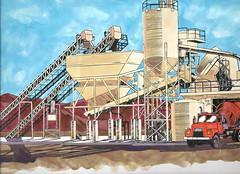
Concrete Plant
Concrete Plant, Concrete Plant Manufacturers Bureau.

From columnist Derrick Z. Jackson of the Boston Globe, in "Another gift for the auto industry":

The stimulus package should boldly be stimulating public transportation. Based on the American Automobile Association estimates of driving costs, the American Public Transportation Association calculates that Americans who rely on public transportation can save $8,368 a year. Boston leads the United States in calculated annual savings, at $12,285.

That dwarfs a $1,500 tax credit [for buying a car]. Mikulski's plan totals $11 billion. That is another bailout on top of the $17.4 billion General Motors and Chrysler received in December.

As Americans sweat out pink slips, it is insane for the Senate to seduce consumers into more debt. It goes against everything Obama promised to prop up an industry that so bitterly fought the future that the top-five selling cars of 2008 belong to Toyota, Honda, and Nissan.

Mass transit needs far more stimulus help to offset local budget cuts, but cannot get it because some say buses, trolleys, and trains are not "shovel-ready." America's automakers keep getting aid, even when a bailout is only a shovel to dig their own grave.

And Ken sends us notice of this article from Progressive Magazine, "The Myth of the Efficient Car," which makes the point that greening automobility is an oxymoron, that it is great for spending and for jobs, but lousy for the environment.

Let’s get something straight about green industry: in its basic form it means we all have to buy new stuff … lots of it. As an industrial policy that will create jobs and increase spending, it’s pretty sound. As an environmental policy, it’s largely a fraud.

Nowhere is it more disingenuous than the pursuit of the fuel-efficient car. In their effort to stave off collapse of their industry, auto executives have continually cited their efforts are building the high-efficiency cars of the future. The problem is, there are no cars of the future, and the looming catastrophe of global pollution, including climate change, will never be solved by building more cars – efficient or otherwise.

We’d desperately like to believe that there is a way to preserve our car-centered civilization, while simultaneously placating the gods of atmospheric warming. ...
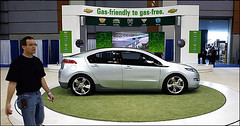
Chevrolet Volt is a plug-in hybrid vehicle being produced by General Motors.
Chevrolet Volt is a plug-in hybrid vehicle being produced by General Motors. Photo Credit: By Alex Wong -- Getty Images Photo.


Optimal mobility, economically sound policies, reducing energy use, increased demand for natural resources by the rest of the world (the U.S. consumes about 1/4 of the world's resources annually, and has but 1/16 of the world's population), and reducing carbon dioxide emissions isn't reconcilable based on an automobility+sprawl economic, transportation, and land use paradigm.

Given the likelihood of needing to make significant changes, the point that Derrick Jackson raises about the impact of reduced spending on automobiles contributing significantly to household income begins to look better and better.

It's worth reading "The Myth of the Efficient Car" because it discusses the issues of car usage, energy, and greenhouse gases from a more scientific perspective. In short, the greenest possible car still wastes a lot of energy to move people around, and is supported by an infrastructure that is wildly destructive.
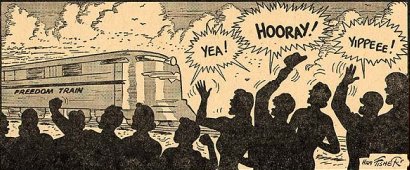
Freedom Train Comic, Joe Palooka, frame 2
Joe Palooka comic strip by Ham Fisher. (I think this was about a trip across the country, via train, of the Magna Carta.)

Labels: , , , , ,

Tuesday, December 02, 2008

An interesting idea to fund environmental cleanup of the Chesapeake Bay

I am involved in a planning project for a city on Maryland's Eastern Shore, which means I am spending more time reading and thinking about the Chesapeake Bay. If you've seen recent coverage on cleanup efforts, it seems as if the various governments have basically given up. That's an overstatement maybe, but there is no question that few of the ten year goals have been achieved.

According to "New tax district proposed to save Puget Sound " from the Seattle Times, the Puget Sound Partnership proposes a special taxing district to fund cleanup efforts. It's not a lot different from how Business Improvement Districts are funded.

From the article:

The partnership, a state agency created in 2006 to lead a revival of the ailing Sound, is preparing to ask state lawmakers to lay the foundation for a new source of money to help fund a cleanup that will cost billions of dollars.

Any public vote on a new tax could still be years away and could involve the counties that ring the Sound. The partnership won't ask people for a new tax now, given the poor state of the economy and the early stage of the cleanup effort, said David Dicks, the partnership's executive director.

But it wants lawmakers to create a local improvement district — much like Sound Transit — that could then seek a new tax when the economic and political climate is better.

When I was in Seattle last month, I came across the city's Urban Blueprint for (Chinook Salmon) Habitat Protection and Restoration. I thought that was pretty interesting, but it makes sense given that Seattle is intimately connected to and a part of the Puget Sound, and salmon run through parts of the city. This kind of connection to the land and water can't help but make Seattlites more environmentally conscious.
Salmon at Chittenden Locks, Seattle
A salmon at Chittenden Locks, Seattle.

Labels: ,

Monday, December 01, 2008

(What Boris Johnson, and many other politicos haven't yet figured out) Cities Battle Auto Dominance

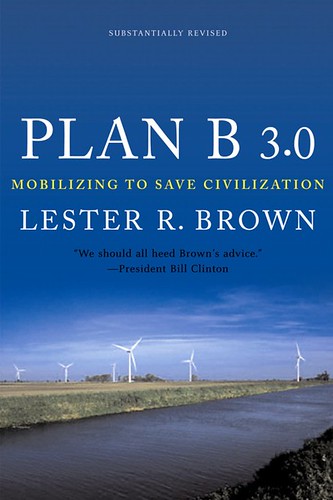
is an excerpt in the Futurist, from the book Plan B 3.0: Mobilizing to Save Civilization by Lester Brown.

Chapter 10 is on Designing Cities for People
- Introduction
- The Ecology of Cities
- Redesigning Urban Transport
- Reducing Urban Water Use
- Farming in the City
- Upgrading Squatter Settlements
- Cities for People
- Chapter 10 Data (xls)

The excerpt is summarized as:

Cities around the globe are challenging the "car-only" model through a combination of automobile taxes, urban designs, and alternative transportation initiatives. Some of the most innovative public transportation systems, those that shift huge numbers of people from cars into buses, have been developed in Curitiba (Brazil) and Bogota (Colombia). In China, Beijing is one of 20 cities developing bus rapid transit systems, and several cities in Africa are planning them. Some cities are reducing traffic congestion and air pollution by charging cars to enter the city. Meanwhile, in the US, the National Complete Streets Coalition is challenging the historic US dependence on cars. Many American communities now lack sidewalks and bike lanes, making it difficult for pedestrians and cyclists to get around safely, particularly where streets are heavily traveled. The Netherlands, the unquestioned leader among industrial countries in encouraging bicycle use, has incorporated a vision of the role of bicycles into a Bicycle Master Plan.
Books from the Earth Policy Institute - Plan B 3.0 Mobilizing to Save Civilization

Labels: , , , ,

The water quality of the Potomac River continues to decline

According to this article, "Potomac River's health getting worse" from the Cumberland Times-News, reporting on a report released by the Potomac Conservancy.

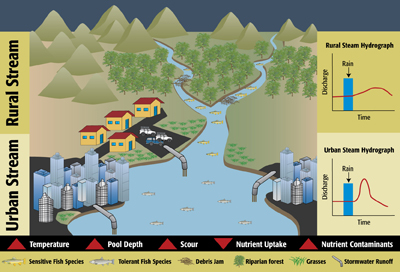
-- Effects of Diminishing Natural Ground Cover on Water Quality (graphic)

State of the Potomac River
Symptoms of a Sick Stream, image from 2008 State of the River report

Labels:

Sunday, November 30, 2008

(Lotsa) Stuff/Reading around

1. I just read a two month old issue of the Northwest Current only to learn that Georgetown University invited the community to a planning meeting on the Campus Plan. Since this was Saturday Nov. 9th, I definitely missed it.

- this article, "Georgetown University: New Preparations Begin For Campus Master Plan" discusses the process and has some links
- 2000 Campus Plan

2. Similarly, I noticed an ad for the Office of the People's Counsel "13th Energy Efficiency Expo" on Nov. 1st. Last Saturday (11/22) I attended a window and door insulation workshop outside in Lamont Park in Mt. Pleasant, sponsored by the DC Dept. of Consumer and Regulatory Affairs. It was very helpful and today we should be getting around to plastic wrapping some of our windows. Plus the Dept. of the Environment offers Home Energy Audits. And while at the DCRA workshop, I missed out on most of the Composting workshop conducted at the same time by Ed Bruske, author and one of the founders of the DC Urban Gardeners Group.

Why not all work together, and have one master "DC Green" conference every year sponsored by and organized in part by various DC government agencies, getting resources, ideas, options, and policies coordinated and focused on developing and extending best practices in DC. But including other groups, formal (i.e., Washington Parks and People) and informal (groups like Rooting DC and DC Urban Gardeners), not just government agencies.

Partly it could be like Arlington's "Car Free Diet" Expo, which works to move people away from single occupancy vehicle trips, and practical like the DCRA, composting, and OPC workshops, and broader, engaging in more topics, and working to organize people and increase their involvement in local civic affairs.

For example, the Department of Recreation and Parks in Baltimore does many things including organizing "Weed Warriors" where volunteers go to various Baltimore parks and pull weeds.

Speaking of a city being more citizen-focused, Baltimore has Greener Baltimore website and regular e-newsletter.

3. I am busier these days and have too many interests anyway to keep up on all things DC. Track Twenty-Nine is a blog by a UMD planning student who clearly is going to be a leading U.S. transportation planner after he graduates in May. He's writing more about WMATA specific things than I am, as is Greater Greater Washington.

He has two great posts, "Understanding the Blue Line Reroute" and "Streetcars, Version 2.0" on WMATA subway issues and DC streetcar issues respectively. (Even if I don't agree with all his particulars, everything he writes is thoroughly researched and very very good.)

AND, his maps are REALLY REALLY GREAT!

4. Speaking of Greater Greater Washington there is decent writing there on the historic preservation presentation on modernism, ""Persuading" or "evaluating"? Part of the problem with the analysis though is mixing places, DC preservation law is specifically related to DC and therefore doesn't necessarily consider "all" of the works within a particular architectural style or the body of work by a particular architect. Therefore, the GSA example isn't fully relevant to how DC should or does weigh similar issues, but is still worth thinking about.

5. Awhile back, the District Extra section of the Post has a piece titled "Fenty Isn't Czar Of the Rent Czar" which has a section about how DC City Council said no to Allen Lew, currently in charge of school reconstruction (ex-responsible for the construction of the Nationals Stadium) taking over responsibility for construction of Parks and Recreation facilities.

Actually I think the city is right in believing that contracting for and construction of buildings and management of the process is generally beyond the skill set of most DC agencies other than the Office of Property Management and the Department of Transportation (which builds roads, not buildings, but is still experienced in construction management).

This function should be consolidated within an agency that is focused on having expertise, not hacks, at the helm and in the line positions. The Fire Department's management of building-renovating fire stations, especially historic buildings, shows that it is easy even with the best of intentions for an agency with limited experience in construction to get overwhelmed.

6. The Post has an article on U.S. transportation policy, "From Funding to Infrastructure, New Transportation Secretary Faces A Hard Road Ahead" and the president of Amtrak, Alexander Kummant, resigned. The New York Observer had an interesting interview with him in the summer focused on expanding railroad capacity in NYC and the Northeast Corridor, "Alex Kummant, National Stationmaster."

The idea of planning mobility nationally in a substantive way (i.e., railroads for redundancy, railroads to move passengers from plane to train in particular corridors, railroad transportation within states and region) needs to happen. (Baltimore has some of the same issues as NYC with capacity limits. So does service from DC to Richmond.)

See the AP stories "Top Amtrak Executive Resigns" and "New Leader for Amtrak."

7. I can't claim I find most of the blogwriting in the region on retail to be all that insightful. The real problem comes down to volume as you need about 30,000 people to support 50,000 s.f. of retail. A decent neighborhood commercial district might be about that size or larger. So basically we have far more extant space than can be supported by the city's residential population (also note that the top 30% of households in terms of income make 50% of total consumer purchases), even when we add M-F daytime workers + visitors to the mix.

We need to work with commercial districts to harvest and leverage the opportunities that exist or in a sense, write them off, and accept that certain commercial districts such as the changing Columbia Heights or Friendship Heights (or Silver Spring, etc.) are "regional" intra-city commercial districts that provide a greater deal of retail that support a number of "satellite" neighborhoods, i.e., Ward 1's Columbia Heights supports many Ward 1 and Ward 4 neighborhoods, and those neighborhoods in turn are able to support a more limited array of service retail.

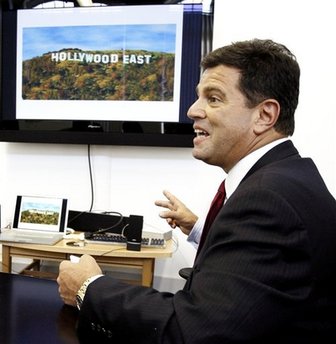
This comes to mind in part because of the AP story on the development of a film studio in Plymouth Rock, Massachusetts, "Historic Plymouth OKs building $488M movie studio." (The story ran in the Express.) It's all about agglomeration economies and having the support networks necessary to support business development and maintenance. It's going to be hard as hell for this area of Massachusetts to develop as a film center (especially when considering that Hollywood also competes with Vancouver and Toronto and even the place in Baja California, Mexico where part of the Titanic was filmed). Go with your strengths, and leverage your strengths, and admit your weaknesses and don't spend too much money trying to hide weaknesses as strengths...

In short, not all neighborhooods will be able to have thriving retail unless the city doubles in population and that is never going to happen, with or without opposition to various residential intensification projects.

-- See the webpage coverage from the Quincy Patriot-Ledger.

(And with a lot of money and connects, Hollywood East may be able to be successful. But I won't hold my breath.)
Plymouth Hollywood East
Plymouth Rock Studios executive Joseph DiLorenzo talks about the proposed movie studio complex in their Plymouth, Mass., offices Oct. 31, 2008. When built, the 240-acre studio complex will be the first independent film and television studio on the East Coast, featuring 14 soundstages, a 10-acre backlot, and all pre-production and post-production services.(AP Photo/Winslow Townson)

Labels: , , , , , ,

Tuesday, October 07, 2008

Urban green

Brandweek reports, in "U.S. Mayors Call for 'Green Revolution'" that

a new report from the U.S. Conference of Mayors calls for a "green revolution" and said if it takes place, 4.2 million new "green" jobs could be created in the country by 2038. ... "Creating green jobs is an investment we must continue to make."The forecast of more than 4 million new green jobs is based on the U.S. generating 40% of its electricity from alternative fuels (wind, solar, hydro, geothermal, biomass), 30% of fuel used in cars and light trucks coming from alternatives to gasoline and diesel that electricity use in existing buildings will drop by 35% by 2038.

The top 10 cities in the nation ranked by current green jobs and the potential number of green jobs they could have by 2038 are: New York (25,021/197,971), Washington (24,287/192,165), Houston (21,250/168,136), Los Angeles (20,136/159,321), Boston (19,799/156,660), Chicago (16,120/127,545), Philadelphia (14,379/113,772), San Francisco (13,848/109,570), San Diego (11,663/92,285) and Pittsburgh (9,627/76,174).

Report

Labels: , , ,