Rebuilding Place in the Urban Space

"A community’s physical form, rather than its land uses, is its most intrinsic and enduring characteristic." [Katz, EPA] This blog focuses on place and placemaking and all that makes it work--historic preservation, urban design, transportation, asset-based community development, arts & cultural development, commercial district revitalization, tourism & destination development, and quality of life advocacy--along with doses of civic engagement and good governance watchdogging.

Thursday, August 06, 2026

Drought in Europe dries up rivers

 This was an issue a couple of years ago with the Rhine, which I didn't realize also went into France.

People walk around a dried section of the Danube River in Budapest on July 30. Photographer: Robert Nemeti/Anadolu/Getty Images.

It's an issue now with the Danube River in Hungary and Romania, which may force the closure of nuclear power plants, because the water level is likely to drop below the intake piping ("East Europe Braces for Power Curbs With Danube at Record Low," "As the Danube Hits Record Lows, Every Centimeter of River Counts," Bloomberg, " Europe’s rivers are running dry, and the knock-on effects are disastrousS," Guardian).

In the US this is a worry with Lake Powell (Utah) and Lake Mead (Nevada), affecting hydropower electricity generation at the respective dam generating plants at each lake.  

Labels: , ,

Saturday, February 28, 2026

Drinking Water Utilities Climate Risk Index

 It's an index that's been calculated, but isn't an online calculator ("Tapping into risk in America’s drinking water" Carnegie Mellon University, "Climate change risk index and municipal bond disclosures of United States drinking water utilities," Nature)

By cross-referencing 1,455 medium and large water utilities across the country with what those utilities reported in their bond disclosures (financial documents that show investors the risks associated with lending money to these utilities), the study finds a gap between the actual climate risk and the risk reported in their disclosures.

Utilities serving 67 million people were rated as high risk, but more than a third of their bonds (36%) do not mention climate change, leaving communities exposed to potentially unsafe drinking water during extreme weather events and investors unaware of hidden financial liabilities. The municipal bonds studied represent $39.3 billion in debt, most of which will mature within the next 20 years. Of that total, $9.2 billion was issued by utilities identified as having high risk to climate change, but with limited evidence of climate risk awareness.


Interestingly, in Utah there is a bill pending in the legislature calling for a tax on water use to fund big new water infrastructure projects, but the projects haven't been vetted in terms of overall water use planning ("Utah bill to address water infrastructure needs advances, but not everyone's happy with it," KSL) and they presume future water supplies which may not come to fruition, given Western drought.   

Utah has amongst the lowest water rates, because they are in part subsidized by property taxes.

‘The Lake, directed by Abby Ellis, details the precipitous decline of the Great Salt Lake.’ Photograph: Courtesy of Sundance Institute

And while not related to drinking water, but to use of water overall and the impact on the shrinking Great Salt Lake ("‘An environmental nuclear bomb’: documentary examines fight to save Great Salt Lake," "Great Salt Lake’s retreat poses a major fear: poisonous dust clouds," Guardian), the state seems to be seeking the federal government out to be the savior.  

But the federal government has negligible additional powers to act--the state has plenty ("Trump promises to work with Utah to make its salt lake ‘great again’").

From the Guardian:

The lake, often called “America’s Dead Sea” (though it is, in fact, four times larger than its counterpart in the Middle East), hit a record low in 2022, having lost 73% of its water and 60% of its surface area from excess diversion for agriculture and other water use.

The new film [The Lake] warns, in no uncertain terms, that going over the edge would spell catastrophe for the state’s public health, environment and economy.

Toxic dust clouds laden with mercury, arsenic and selenium from the desiccated lakebed would increase pollution for a city whose air quality is already worse than Los Angeles, provoking a respiratory and other cancer-related issues. Birdlife and recreation on the lake, already disappearing with its surface area – now less than 1,000 square miles, down from three times that in the 1980s – would vanish completely. The lake’s disappearance would inflict billions of dollars of economic damage on the region, imperil the lucrative extraction of minerals from the lakebed, and threaten ski conditions at the numerous resorts in the nearby mountains (including the slopes of Park City, looming over the film’s premiere).

Three years ago, Abbott, along with more than 30 other scientists, co-authored a report warning that absent major intervention, the 11,000-year-old Great Salt Lake would disappear within five years.

Labels: , , , ,

Monday, August 18, 2025

Data centers

Aldie, VA - January 20: On what was recently farmland, Amazon data centers have been built as close as 50 feet from Loudoun Meadows houses on January 20, 2023, in Aldie, VA. As the data center industry expands its footprint in Northern Virginia, often building massive commercial structures near residential neighborhoods, communities push back with their concerns.(Photo by Jahi Chikwendiu/The Washington Post) 

From sports facilities to data centers, not all projects add to local economic activity in the way that they are touted by proponents.  Data centers don't have a lot of jobs after construction, and the facility in and of itself doesn't generate business development of other types.

Not an issue for me but they pose big issues in terms of electricity needs ("Power costs soar in PJM region as data center demand spikes," Reuters), and water.  WRT electricity, in part rates increase on all users to produce energy for data centers which is unfair.  

Also, it requires upgrade to the transmission system, which is overburdened as well.  

Because of the demand posed by data centers, adding renewable sources isn't enough.  They need to use fossil fuel generated electricity too, The water demands too are incredible, although to some extent the water can be recycled.  Here are some resources.

-- "Amazon data centers are not an investment in us," Philadelphia Inquirer

The truth is, Big Tech’s AI-fueled data center frenzy is hurtling us further and faster into environmental catastrophe. A single data center can use as much energy as an entire city. Tech corporations are demanding so much extra energy and water as they compete for AI dominance that entire coal plants scheduled for closure are being kept open.

-- "The AI Data-Center Boom Is a Job-Creation Bust," Wall Street Journal

“Data centers have rightly earned a dismal reputation of creating the lowest number of jobs per square foot in their facilities” said John Johnson, chief executive of data-center operator Patmos Hosting.

... The reality is data centers can employ more than 1,000 people in the several months or years it takes to build them, but rarely need more than one or two hundred once they open, according to Synergy chief analyst John Dinsdale. Stargate would have to be much larger than currently planned to create hundreds of thousands of construction jobs, let alone permanent ones.

-- "Tax Breaks For Data Centers Bring Few Jobs," Forbes 

Data Centers As Infrastructure Projects. As governments look to stimulate economic development, it is crucial to see the industries they are supporting for what they are—rather than what they’d like them to be. Data centers, while essential to the modern economy, do not serve as permanent and ongoing job creation engines anymore than the construction of a highway or a bridge does.

Data center construction more closely resembles infrastructure projects that provide a backbone for economic activity, rather than being viewed as economic activity itself. It is for this reason that private industry seeks to offload the cost of data center construction onto taxpayers—it is increasingly becoming merely the cost of doing business rather than a profit center or competitive advantage.

As such, it is more appropriate for public subsidies to focus on construction and development of these facilities and the infrastructure required to make use of them—rather than their ongoing operation and ownership. Investing in the construction and laying out of telecommunications infrastructure can be justified in the broader context of development in underserved areas.

Subsidizing ownership of data centers, through property and sales tax breaks for example, is less defensible. The tech companies that dominate the market for these centers are among the most valuable companies in the world, with market caps that regularly dwarf the gross domestic product of the states they are asking to foot the bill. These corporations have ample resources to manage their own operational costs without public support.

For example, building data centers as a project adjacent to enhancing digital connectivity, which in turn can attract other businesses and support economic growth, makes good policy sense. Similarly, ensuring data centers make use of renewable energy sources by subsidizing their provisioning returns broader social benefits.

Subsidizing ownership of data centers, through property and sales tax breaks for example, is less defensible. The tech companies that dominate the market for these centers are among the most valuable companies in the world, with market caps that regularly dwarf the gross domestic product of the states they are asking to foot the bill. These corporations have ample resources to manage their own operational costs without public support.

State governments should therefore reconsider their approach to supporting data centers, focusing on subsidies for the construction phase and overall improvement of internet infrastructure. Simultaneously, states must ensure that these investments are tied to clear public benefits such as job creation in the construction industry, environmental sustainability, and enhanced connectivity for under-connected communities.

-- "How a Washington Tax Break for Data Centers Snowballed Into One of the State’s Biggest Corporate Giveaways," ProPublica

-- "Beating back data centers," American Prospect

Virginia state lawmakers aiming to establish a regulatory framework have run into obstacles. The industry has established the Data Center Coalition, their own PAC, comprised of heavy hitters like Amazon, CloudHQ, Visa, and others. The coalition has been at work in the Virginia General Assembly, spending $70,500 in campaign contributions so far this year.

Several bills that would have established a set of regulations failed last session, including one proposed by Del. Josh Thomas that would have required applicants to perform site assessments that detail noise, water, agriculture, parks, registered historic sites, and forest impacts. Virigina Gov. Glenn Youngkin (R), a vocal proponent of the centers, vetoed the bill, citing infringements on local control and red tape.

... OpenAI’s GPT-4 uses as much as three 16.9-ounce bottles of water to produce a 100-word email.

-- Good Jobs First has a number of reports and articles on the subject, including "Community Benefit Agreements with Data Centers Can Help Mitigate Harms," which takes the position I do on sports facilities--if you can't beat them, get the best possible deal for the community.

-- "Data centers need to bring their own power supply, watchdog says," Bloomberg via Crain's Chicago Business

Labels: , , , , , , ,

Tuesday, January 14, 2025

City water outages happen too often

I never did write about Jackson, Mississippi's water crisis a few years, when the water treatment plant failed leaving the city's 150,000 residents high and dry (Jackson Water Crisis, NRDC).  The city is predominately black and the predominately white State Legislature stepped in in what could be considered racist ways ("The Jackson Water Crisis, the Complexity of Environmental Racism," NonProfit Quarterly). From the first citation:

The drinking water system in Jackson, Mississippi, has suffered from serious safety and reliability problems for decades. Residents have endured discolored water, low pressure, oily water, and water with floating particles. Jackson’s water previously had elevated lead levels, and its treatment plants have struggled to properly and consistently filter and disinfect the water. Despite recent attention from federal officials, including a lawsuit filed against the city of Jackson in late 2022, the water system’s problems have not been fully resolved. 

Aging infrastructure and climate change are partial causes, partly an issue of environmental justice ("Jackson water crisis: A legacy of environmental racism?," BBC).

There's no question that many water systems across the country have state of good repair needs far beyond their ability to raise funds to do the improvements.

Richmond, Virginia recently had problems with a flooded water treatment center, leading to supply problems and boil advisories ("Could city workers have stopped flooding at Richmond water treatment plant sooner? State health officials say yes," WRIC TV).

In shades of Flint Michigan, which ended up leaching lead into water after switching water suppliers without updating their chemical treatment formula, Richmond's water department hadn't replaced the part that led to the failure, for many years ("For 8 years, city put off replacement of part that caused water outage," "Read the documents: Problems with Richmond’s waterworks well-known before system collapse," Richmond Times-Dispatch).  From the first article:

Mayor Danny Avula on Thursday afternoon said that, during Monday’s power outage, the switchgear failed to automatically transfer the plant to its primary backup power source. Instead, Avula said, the plant diverted to a secondary, battery-powered source that lasted for only 45 minutes.

Officials also wanted to “replace … the existing controls in the … switchgear,” the records show.

That battery source died before power was restored to the facility, leaving valves stuck open and causing catastrophic flooding. Avula on Thursday said that the switchgear had functioned properly through many previous blackouts, but at the time he could not say, precisely, when the component had last been replaced. The solicitation issued by the city in October 2016, obtained by The Times-Dispatch, shows that officials sought “modification of the existing switchgear” to ensure it could "automatically operate” the facility.

And Prince George's and Montgomery Counties recently had water boil advisories because of an excess of broken water mains and other problems ("Water-use request lifted for Montgomery and Prince George’s counties," Washington Post).

In 2021, the Texas electricity blackouts led to water system failures too, because most didn't have backup power generators ("Texans now face a water crisis after enduring days without power," Texas Tribune).

Conclusions.  (1) a failure to plan; (2) lack of money to replace seriously aged infrastructure; (3) lack of a sense of urgency. (4) climate change.

Labels: , , , ,

Wednesday, August 24, 2022

Government innovation: Salt Lake Public Utilities develops grass seed blend that needs 30% less water

I've mentioned in the past how some water and compost treatment facilities have developed compost brands as an example of innovation in government.  Milwaukee's Milorganite is the foremost example, having been created in 1926.

Maryland Environmental Service, a state agency providing compost services, created Leafgro compost, which is available in the DC-Maryland area.

Salt Lake City Public Utilities, which runs the water system for the city and adjacent jurisdictions in Salt Lake County has taken this a step further by creating a grass blend that uses 30% less water than typical grass ("This grass can save Salt Lake City residents water and money in Utah's drought," Fox News 13 Utah).  From the article:

... the specially-created blend of grass called "SLC Turf Trade" uses at least 30% less water than others, while still looking green like it's watered daily (something you're absolutely not supposed to do in the drought)...

[The city] worked with Utah State University and the Turfgrass Water Conservation Alliance to create the special blend...

Salt Lake City Public Utilities has started selling bags of the grass seed blend to its customers — at cost — to encourage people to try it out. People can buy it for $8.50 a bag, which will cover 1,000 square feet. To install SLC Turf Trade, you will have to kill your existing lawn. But the grass seed is designed to grow quickly in the dead thatch of the old lawn.

Since Utah and the west is in the midst of a multi-decade severe drought, reducing water consumption is on the top of water agency agendas--of course, 82% of the water in the state is used by agriculture, 10% is residential, with 6% outdoor, and 4% indoor.

While xeriscaping--a drought tolerant landscape--is encouraged rather than grass, many people are resistant, so the new grass blend is an innovative way to address the problem. 

2.  I haven't been yet, but the Jordan Valley Water Conservancy District has created Conservation Garden Park to demonstrate best practices for outdoor/yard water conservation.

Labels: , , , , ,

Sunday, August 21, 2022

Privatization of municipal utility systems (water mostly)

Britain has created big problems by privatizing its water and sewage systems, abetted by minimal regulation and even more minimal fines which seem to have zero punitive power in getting the companies to follow the law.  

Since privatization, more than half the net profit has been returned as dividends to the private owners, while investment in infrastructure languishes ("Water privatization: a dirty story about profit," "Watery grave," and "Water firms exist to sustain life. They should answer to citizens, not shareholders," Guardian).

In response to the lead poisoning in the water system of Flint, Michigan, resulting from the city--in bankruptcy then and operated by a state entity--switching from "Detroit" water to local water but with a water treatment system unable to provide the right kind of water treatment--I wrote that Flint's real problem was the system of municipal finance in the US.

--  "The real lesson from Flint Michigan is about municipal finance," 2016

That system was created when the US was growing and industry was thriving, and was dependent on commercial and residential property taxes, and ever rising property values.  

Flint's economy was based on the success of General Motors manufacturing and when the company declined, it cratered local finances and property values--GM has less than 10% of the employees in Flint that it did at its peak.  It's the equivalent of a natural disaster, and very little can be done when 50%-75% of your local tax revenues disappear overnight.

Similar situations beset other communities, often smaller ones, as they face the costs of modernizing and rehabilitating infrastructure--roads, water systems, bridges, streetlights, buildings--that was constructed 50-75 years ago, and now has to be rebuilt, and the community's taxing capacity is no longer commensurate with the need.

For example, I've written about how some communities are selling their bridges to private equity concerns, and allowing the bridges to be tolled, because they can't afford to fix the bridges ("The company buying two Bay City bridges wants to connect with the community," Second Wave Media).

Similarly, water systems owned by local governments are being privatized because they can't keep up with the cost of modernization and new and more stringent environmental regulation.

Towamencin Township residents organize a petition drive to create a November ballot measure to change the township's charter in response to the town's decision to sell its public sewer system for $115.3 million to NextEra Water, a private Florida company. Photo: Charles Fox, Philadelphia Inquirer.

One of the latest examples is Towamencin Township, Pennsylvania, where they have the water treatment system out for bid, and they received a larger than normal bid from a company, NextEra Systems, that is looking to create a business line in water systems ("A Florida company’s $115 million sewer bid stuns a suburban Philly town," Philadelphia Inquirer). For obvious reasons, they accepted that bid.

They bid extranormally high, not on economic considerations, as a way to create a node for further operations.

This is comparable to what rail firms like Keolis did at the start of operations in the US.  They outbid Amtrak to operate commuter rail systems, because they were focused on building their business, not having to run the systems profitably.

Definitely the sales will result in higher bills.  Even though higher bills are inevitable because of the infrastructure needs.  But there will still be a profit percentage, which will come out of the pockets of "customers" where if the system remained owned by the local government, that wouldn't have to happen.

The solution is to have a huge federal infrastructure bank to loan local governments money to deal with infrastructure costs.  But that won't be happening any time soon.

Fortunately, as weak as it can be (e.g. Flint, King George's County, Virginia, etc.) the regulatory system in the US is better than the UK, and the EPA is funded much better, although its ability to regulate is being constrained by the conservative Supreme Court ("The Supreme Court curbed EPA’s power to regulate carbon emissions from power plants. What comes next?," Harvard School of Public Health; "Supreme Court uses 'shadow docket' to revive Trump EPA clean water rule," Reuters), and fines are so much higher in the US, that privatized water utilities are less likely to go rogue the way they do in the UK. 

From "Water firms exist to sustain life. They should answer to citizens, not shareholders":

Add in the failures of privatisation dramatised by excessive water leakages and raw sewage blighting many beaches and rivers, an impossibly overstretched NHS, and workers being badged as irresponsible for merely trying to resist dramatic cuts in their real incomes. All this has crystallised how the whole Thatcherite edifice of economic and social policy, decaying for years, is suddenly and obviously redundant. ...

A centrepiece of Thatcherism – that privatisation plus “light touch” regulation could be applied in any utility – is under siege as never before. Camilla Cavendish, head of the No 10 policy unit under David Cameron, catches the moment when she writes in the Financial Times that water privatisation as designed has failed. What matters for utilities is that they deliver the public interest of cost effectiveness, resilience, reliability and service. That cannot be said today of the universe of energy and water companies. ...

There is little evidence that laying out up to £200bn to take over every utility will bring the universal benefits needed; moreover, this is cash that could be better deployed elsewhere – on levelling up and the drive to net zero.

The better option is more forensic. Look more closely and there is an intriguing spectrum of performance. The government’s 2021 environmental evaluation of nine English water companies shows, miserably, that six receive either one or two stars. (Southern and South West, beach polluters-in-chief, are the one-star performers.) But there are three companies – Northumbrian Water, Severn Trent and United Utilities – that all earn the maximum four stars. What is needed is a regulatory, licensing and governance regime that fosters many more top-star performers, with public ownership the last resort option for the one-stars.

Importantly, the top performers all place social purpose at the heart of their business. All closely engage customers in their decision-making, variants of how the publicly owned Scottish Water, another high performer, has established an independent customer group (ICG) as a permanent independent watchdog that it closely consults and informs. This should not be the preserve of the best. Every water company should embrace a public benefit requirement along with an ICG.

Note that US municipal water systems do tend to be under-regulated too, and like Scottish Water, should have independent customer groups and adequate regulation.


Labels: , , , ,

Wednesday, June 15, 2022

Next Phase of Clustering of Business away from the Midwest

Around 2015, there were a number of instances of corporate headquarters moving to the South, such as Mercedes USA moving from New Jersey to Atlanta.  

Atlanta and Dallas were particularly successful in gaining large corporate or regional headquarters, and sadly in locations that were minimally served by transit.

Although at the same time, there has been a number of examples of corporate headquarters moving from suburban locations back to the center city, although the impact of covid on people actually coming to work versus working from home has countered that in many instances. 

-- "Could bringing premier regionally headquartered business enterprises to the Pennsylvania Avenue Corridor be key to its renewal and revitalization?," 2014
-- "A lesson that seeing is believing: Panasonic's new building in Newark, NJ as an example, positive and negative, in businesses coming back to the city center," 2015
-- "Businesses moving back to the center: not a universal trend," 2015
-- "DC, Transformational Projects Action Planning, and the Baltimore-Washington Maglev project," 2021

Relatedly is all the discussion about firms moving from California/Silicon Valley to Texas ("Companies are rapidly leaving California, study finds. Here’s where they are going " KXAN-TV), and how industries going through technological change shift their locations as well (e.g., electric vehicle battery and car/truck production to Arizona, Texas, Georgia, and potentially Oklahoma, etc.).

Although given the reality of Western drought and how manufacturing tends to require great amounts of water, I would think the Midwest has a long term competitive advantage in terms of access to water supplies. 

In May I wrote about Boeing relocating its headquarters to Northern Virginia, from Chicago, when it had already been moved from Seattle, where the company was founded and still has its largest manufacturing operations ("Boeing to move "headquarters" to Northern Virginia ").

Then a bit more than a week ago, Raytheon, another large defense manufacturer, announced it was also moving its HQ to Northern Virginia ("Raytheon will move headquarters to Arlington ," Washington Post), bringing all of the largest companies to the DC area, all but Lockheed Martin (in Montgomery County, Maryland) in Virginia.

San Antonio as a developing automotive cluster.  Around that time I came across an interesting article about the development of Greater San Antonio becoming a corporate R&D cluster, building out of industrial plants for Toyota, Navistar, and others ("Driving force: San Antonio picks up speed in auto industry," San Antonio Express-News, access with printfriendly).  

Manufacturing has moved South and West because most of the states have labor laws that make unionization of the workforce difficult, so they can offer lower wages compared to plants in the Midwest.  Over time, corporate functions are following.

The article is long and detailed, and illustrates how corporations can shift their "centers" as they develop new centers of business concentration. 

Caterpillar moving to Texas.  Yesterday's announcement that Caterpillar, the heavy equipment manufacturer once based in Peoria, Illinois, having shifted to Suburban Chicago in 2017 ("Do tax incentives pay off? : Illinois; Tennessee; Rosslyn + "The Airport Access Factor"," ) is now moving to Irving, Texas ("Caterpillar to move headquarters to Texas, marking second major corporate departure from Illinois in 6 weeks," Chicago Tribune).  

Although they do have various manufacturing operations in the state, Illinois remains much more significant. And the number of employees, 230, isn't huge.

Conclusion.  I'd say it's early to draw overarching conclusions but the trends do not look good for center cities (especially with the post-covid shift to working from home) generally and in the Midwest specifically.  Although Midwestern states with ample water supplies ought to be putting that front and center in the economic development and business recruitment positioning.

Labels: , , , , , ,

Friday, April 22, 2022

Earth Day, Saturday April 23rd

 Some communities create an Earth Week or Earth Month, not just an Earth Day.

In the DC area, one of my favorite activities is the GreenFest sponsored by Montgomery County, Maryland and this year held at Brookside Gardens.  It's a model for something I want to try to create here in Salt Lake, hopefully as soon as next year, in conjunction with my participation as a board member of Sugar House Park.

Oil dependence and transit.  WRT Earth Day issues, given the rise in oil prices as a result of uncertainty in the market created by Russia's invasion of Ukraine, there have been various articles with suggestions on what to do.  Interestingly, the International Energy Agency suggests consuming less (A 10-Point Plan to Cut Oil Use).

By contrast the Washington Post editorialized for more production ("Another energy crisis is here. The U.S. must be realistic about what’s next."), albeit for other steps as well.

-- "Oil dependence | The US as a Petro-state and gasoholic | and war," 2022

And while some states and legislators are calling for a gas tax holiday ("As states consider gas tax holidays, don't expect big savings," CNBC), Germany is making public transit practically free, charging €9/month, when a pass for transit in the core of Hamburg is normally €72/month , although they are also reducing gas taxes ("Germany unveils measures to tackle high energy prices," Die Welt).

The reality is that with the sprawl land use paradigm, it's difficult to substitute transit for driving, because it many instances, transit service doesn't measure up--it doesn't go where you need to go at all, or it takes an incredibly long time to get there, plus the distance to the final destination may be considerable.

As blog commenter charlie once said "transit's killer app is saving time and money" (paraphrased).  If it doesn't save time, and in fact costs a lot more time, people won't use it.

Transit also has great opportunity from electrification, as coastal states could generate the bulk of their electricity from off shore wind turbines and tide-based energy generation, and this energy could be used to fuel buses and trains.

2.  Cities aren't necessarily green but they are environmentally superior to suburban sprawl.  Cities use less energy than suburbs, for transport and household fueling, compared to the suburbs, even though they import goods and services, especially food.

This is discussed in the Green Metropolis argument by David Owen, first in an article in the New Yorker, and later in book form.

-- Green Metropolis: Why Living Smaller, Living Closer, And Driving Less Are The Keys To Sustainability

3.  Other environmental issues to think about:

Big Oil obfuscates about climate change.  Not that we should be surprised, but PBS Frontline has a three-part documentary on the subject ("The Guardian: ‘What we now know … they lied’: how big oil companies betrayed us all," Guardian). The first episode ran Tuesday.

Lithium recycling.  "Lithium costs a lot of money—so why aren’t we recycling lithium batteries?," Ars Technica

Household Energy Poverty. "People are struggling to pay their energy bills – here’s a simple idea that could help," Guardian.  Makes an interesting point that you could index the price of household fuels, providing a basic amount for free, and charging more, indexing price, with a rise in consumption.

"Green" Hydrogen as an alternative to gasoline and diesel fuel.  "Forget passenger cars, here’s where hydrogen make sense in transport," Ars Technica.  There's a lot of talk about green hydrogen.  It doesn't make sense for cars, but could for long distance trucking and maybe transit.

Ethanol.  To cut prices, the US has authorized a greater percentage of ethanol in the gasoline mix ("The Biden administration gives a green light to a fuel that could be even dirtier than regular gas," The Verge).  It's also not particularly good for the environment.

In the US, ethanol is made from corn, so it's not particularly energy efficient, and it raises food prices.  But corn and ethanol producers like it and it has led to an increase in incomes for corn farmers.  If the US made ethanol from waste feedstocks like in Brazil, it would be a different story from an efficiency standpoint.  There sugar cane waste is the primary feedstock.

Ethanol production in the US should be ended, but it's ensconced in the political system of the Midwest so it's pretty untouchable ("Stop the ethanol madness," Atlantic).

Parley's Creek in Sugar House Park, Salt Lake City.  Most of Salt Lake's water supply comes from snowmelt runoff from the Wasatch Mountains.

Drought. Moving from DC--tons of rain--to Salt Lake/Utah has really made me see the impact of drought, resulting from less snowfall and rain, which likely is the result of climate change.  

Some communities have stopped issuing building permits because they couldn't guarantee water supply.  Places with high rainfall and water supplies likely will have greater advantages in terms of economic and population growth going forward.

Drought and agriculture.  Over time, just because there is no other choice, water conservation will have to be a significant priority.  Eventually, it will have to include making choices about agriculture in terms of water use.  For example, Utah's greatest consumer of water is agriculture, and their primary crop is alfalfa--feed for animals--that is sold to China.  It doesn't make sense to dedicate most of the state's scarce water resources to China.

Electric cars.  Are about the environment, sort of, but not about "living smaller, living closer, and driving less."  It's a form of what I call "Next Generation Asphalt Nation" (there is a book titled Asphalt Nation by Jane Holtz).

Photo from "Shell to acquire UK’s biggest electric car charging network," The Driven.

Charging points in rowhouse neighborhoods.  But I have to say one issue I haven't thought enough about is that of providing access to high quality, safe charging infrastructure in rowhouse neighborhoods, many of which don't have on-site parking.  

I know London has been installing charging stations on light poles ("Powering ahead: six new ways to charge an electric car," Guardian), but you have to figure a way to move the cars once they are charged, so that others can use them.

The Guardian article also covers hubs in urban parking structures, installing charging infrastructure at the curbside in curbs and in street furniture (Connected Kerb), and in "street cabinets" used by cable television companies.

Hmm, while most communities are eliminating individual parking meters in favor of parking meter pay stations and numbering slots, parking meter infrastructure could be a way to deliver charging points.

Geothermal opportunities in abandoned fossil fuel wells.  Old oil and natural gas wells can be entry points for geothermal energy generation ("Clean energy is buried at the bottom of abandoned oil wells," Vox).

Labels: , , , , ,

Sunday, February 06, 2022

Climate change is already here in many US communities | "Heat Officers" versus Climate Change Officers

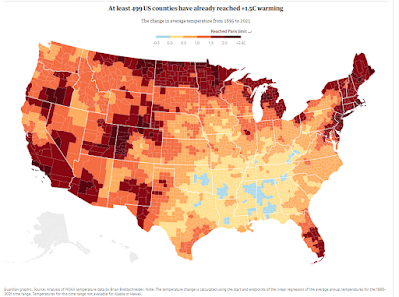
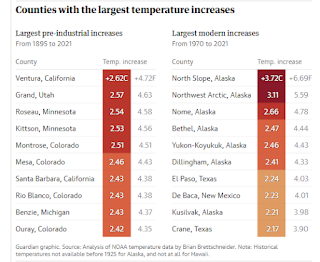
The Guardian has a chilling story, "A third of Americans are already facing above-average warming," about how many US counties (and the cities within) already are experiencing a warming of at least 1.5℃.

In the article, the map is interactive by county.

Hotter and colder temperatures, more virulent weather events, wildfires, flooding, drought conditions, sea level rise affecting coastal land, and an increase in heat- and cold-related deaths are all fallout from climate change.

Some cities are beginning to appoint "heat officers," creating positions within government to focus on climate change effects.  


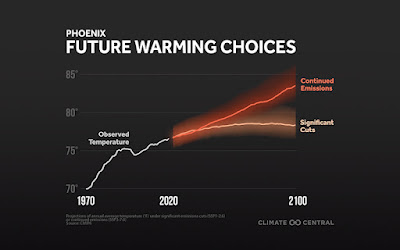
Apparently, Miami was the first city in the US to do so ("Miami’s first-ever chief heat officer on the climate issues that scare her the most—and what gives her hope," CNBC).  The Guardian has a recent story about the activities of the heat officer in Phoenix ("America’s hottest city is nearly unlivable in summer. Can cooling technologies save it?"), a city that tends to have the US's highest summer temperatures.  From the article:
Almost 200 people died from extreme heat in Phoenix in 2020 – the hottest, driest and deadliest summer on record with 53 days topping 110F (43C) compared with a previous high of 33 days. Last year there were fewer scorching days, but the death toll remained staggeringly high, with people experiencing homelessness and addictions dying disproportionately....

Last year, after another deadly summer, the mayor announced the region’s first dedicated unit to tackle the growing hazard of urban heat, which also threatens the city’s economic viability. ...

Hondula recently submitted the 2022 heat response plan to city hall, in an attempt to coordinate the existing patchwork of services. “I’m impressed by the number of programs but the death and illness numbers are moving in the wrong direction, so there’s a disconnect we need to address,” he said. “If we mean to take a hazard seriously, relying on good fortune, luck and happenstance is not the best model.”

Mitigation will be focused on trees and infrastructure, which will be led by an urban forester and a built environment expert who are yet to be hired.
-- "Planning for Extreme Heat: A National Survey of U.S. Planners," Journal of the American Planning Association 

I guess you can call them heat officers, but they are really climate change officers -- a few years ago the big term was "resilience."


For example, in Utah drought is a big issue, and Salt Lake City's efforts on reducing water consumption saved more than 2 billion gallons of water, according to the mayor ("Here’s how much water Salt Lake City residents saved this summer and what it means for next year," Salt Lake Tribune).

Although residential water use pales compared to agriculture and industrial use, and Utah in particular has few conservation systems in place for large scale water users ("Utah has a water dilemma," High Country News).  Some Utah communities have stopped approving residential building permits because they can't guarantee water supply to new housing ("First of many? Drought-stricken Utah town halts development," GreenWire).

A Climate Change Officer should be dealing with all of these effects, depending on what are the biggest problems in particular communities.

Citizenship culture in Bogota.  A previous mayor of Bogota, Andreas Mockus, initiated what he calls "citizenship culture." One of the examples was in a saving water campaign, he was filmed taking a shower with minimal water use ("Building "Citizenship Culture" in Bogota," Journal of International Affairs, 2012).  From "Academic turns city into a social experiment," Harvard Gazette:
When there was a water shortage, Mockus appeared on TV programs taking a shower and turning off the water as he soaped, asking his fellow citizens to do the same. In just two months people were using 14 percent less water, a savings that increased when people realized how much money they were also saving because of economic incentives approved by Mockus; water use is now 40 percent less than before the shortage.
Sustainability commissions as opportunities for rearticulating issues and increasing engagement.  10+ years ago, communities creating sustainability plans and citizen commissions to implement them were all the rage.  

While I am not sure how much progress has been made since, at the time I was impressed at how motivated citizens were to get involved in the issue, through commissions and other venues, and they were willing to think anew about issues that they had taken for granted, like solid waste, food waste, energy, and transportation impacts from automobility.

Labels: , , , , , ,

Sunday, November 21, 2021

Annual household energy resilience planning: a new imperative?

 For the past 10+ years, in December, I usually publish an entry on winter weather and "maintenance of way" for pedestrians, bicyclists, and transit, as most snow clearance planning and practice prioritizes motor vehicles.

-- "Snow, winter and the Sustainable Mobility City," 2019 (includes links to many previous entries)

While there is a fair amount of writing about how many households are installing generators in places where the electricity system is likely to fail, I haven't been in a situation, either in DC or Salt Lake, where utility interruption is a frequent occurrence, therefore the cost isn't justified.

But we all know what happened in Texas last February, a record cold snap, and the state's regulatory regime's failure to require winter hardening for critical supply and transmission infrastructure, in particular natural gas, led to massive failures across the state, blackouts, water system failure, and many hundreds of deaths.

-- "Talk and lying versus doing: The electricity crisis in Texas is produced by state regulatory failure"
-- Cold wave: the Texas power debacle disproportionately impacts the less well off"
-- "It's not rocket science: 10 ways to fix the Texas power grid, according to experts (From the Houston Chronicle)"
-- "October is National Energy Awareness Month"

In response, mostly the State of Texas has done very little to mandate system hardening, even though the Federal Energy Regulatory Commission once again has recommended that they do so, just as they did after a similar but less deadly event in 2011 ("Feds call for more regulation of Texas power grid, natural gas industry," Austin American-Statesman).

So what's up for Texans this winter?

The Dallas Morning News reports ("ERCOT report says Texans face steep shortfalls in power capacity if extreme event hits this winter") that the state energy coordination ERCOT, is warning Texas residents that the state is still vulnerable to catastrophic utility interruptions, if this winter is particularly cold.

Texas’ grid operator on Friday released its predictions for peak electricity use in Texas for this winter that showed steep shortfalls in power capacity in an extreme event, despite not accounting for February’s deadly freeze. 

ERCOT’s power demand projection known as the Seasonal Assessment of Resource Adequacy was already facing criticism for using data that did not account for climate change and did not take into account weather and outage data from February’s deadly winter storm. 

The main failure of the report, according to Texas A&M University professor Andrew Dessler, is that the Electric Reliability Council of Texas based projections of extreme demand on the 2011 winter event that left wide swaths of North Texas without power. 

Dessler, an atmospheric sciences professor, said the report shows that Texans have around a one-in-10 chance of seeing weather-related power outages this winter. “One in 10 years seems to me to be not a great worst-case scenario,” Dessler said. “That means that there’s a 10% chance we’re going to do worse than that.”

It's definitely criminal that the State Legislature, Governor, and regulatory authorities have basically done nothing in response to February's crisis, which also affected states outside of Texas, because they were dependent on natural gas supplies from Texas.

This means that residents that can afford it are likely to install generators ("Facing power grid anxiety, Texans are buying generators and bracing for blackouts," San Antonio Report), install converters if they have solar power systems, and buy vehicles, like the Ford F-150 truck, which if you buy the special electricity generation package can power their houses in case the utility distribution system fails, although it still needs gasoline ("Texas man uses new 2021 Ford F-150 to heat home, power appliances during blackout," Detroit Free Press).

But what about the people without the means to protect themselves by buying large stocks of water and generators?

And in any case, if water systems fail because of power interruptions, people will have to store large supplies of water as well.

======

States that frequently experience winter cold have long since weatherized their electricity generation systems.  It's the southern states, that before climate change became as serious as it has didn't worry much about "cold snaps," that haven't done this.  It's particularly important in Texas, since it is such a large energy producer.  When systems fail there, they don't just effect Texas, but all the other states that rely on Texas energy production.

Labels: , , , , , , ,

Tuesday, September 07, 2021

A waterless utopia?

 Marc Lore, a billionaire as the result of his creating Diapers.com and selling it to Amazon, and later creating a hoped for competitor to Amazon that he smartly sold off to Walmart which repositioned it (jet.com) as its online offering, proposes to create a 5 million (!!!!) population city in the Southwest called "Telosa."

Telosa.

Like a lot of crazy proposals, Lore has engaged a starchitecture firm, BIG--Bjark Ingels--to give it some legitimacy. E.g. Richard Rogers, Zaha Zadid's firm, Rem Koolhaas' firm, etc. get a lot of these kinds of commissions.

The media coverage ("The Diapers.com Guy Wants to Build a Utopian Megalopolis," Bloomberg) is focusing on Lore's proposal of a nonprofit running the city and capturing the profits from land appreciation, using the principles of Henry George, who believed that taxing land but not improvements somehow would be better than the system we use.  From the article:

Lore is particularly attracted to the strain of Georgism that involves creating a trust that holds the land in a community and uses the income it generates to fund social services. From that idea, he’s come up with the modest proposal to start a private foundation, buy 200,000 acres or so of land, probably somewhere in the American West, and build a 5 million-person city from the ground up—a Georgist utopia that will serve as a demonstration project for a new, fairer phase of capitalism.

“If you went into the desert where the land was worth nothing, or very little, and you created a foundation that owned the land, and people moved there and tax dollars built infrastructure and we built one of the greatest cities in the world, the foundation could be worth a trillion dollars,” Lore says. “And if the foundation’s mission was to take the appreciation of the land and give it back to the citizens in the form of medicine, education, affordable housing, social services: Wow, that’s it!”

I have problems understanding high faluting finance, but I just don't see how this would make much of a difference when all land is valued highly regardless of the improvements.  I guess for it to make a difference you'd have to have a Houston-like non-zoning environment, where landowners could build anything they wanted.

I don't understand that none of the articles seem to mention the #1 pesky issue that dooms this proposal to the wastebasket that holds so many press releases about initiatives that never amounted to anything: water.

The average household uses 100 gallons of water per person per day.  Plus there is out of house use of water in office buildings and businesses.  More for industrial and agriculture uses.

Note that the CNN article, "Plans for $400-billion new city in the American desert unveiled ," does mention water:

The former Walmart executive last week unveiled plans for Telosa, a sustainable metropolis that he hopes to create, from scratch, in the American desert. The ambitious 150,000-acre proposal promises eco-friendly architecture, sustainable energy production and a purportedly drought-resistant water system. A so-called "15-minute city design" will allow residents to access their workplaces, schools and amenities within a quarter-hour commute of their homes.

but provides no details.

The white rock represents the typical water line for Lake Mead at Hoover Dam.  The lake is down about 120 feet from its peak, and drops about one foot each year.  Photo: Ethan Miller, Getty Images.

The Southwest is in the midst of a mega-drought.  Water resources are diminishing to the point:

(1) where hydroelectric dams have to stop running ("Severe drought threatens Hoover dam reservoir – and water for US west," Guardian)

(2) canyons "drowned" by the creation of dams are re-emerging

(3) most communities have water use restrictions, and 

(4) the Utah towns of Oakley and Henefer have stopped approving residential building permits because they can't guarantee the house could be supplied with water ("As water wanes, two Utah towns stop building," Salt Lake Tribune).

Seven states -- California, Utah, Arizona, Colorado, Wyoming, New Mexico and Nevada – and Mexico rely on water from the Colorado River, and have to reduce water use in response to the drought's impact on water supplies.

Just because you're wealthy doesn't mean your ideas are sound.

Which is the case for the creation of 5 million person city in the Southwest United States.

Pipes containing drinking water are shown at the Poseidon Water desalination plant in Carlsbad, California, U.S., June 22, 2021. REUTERS/Mike Blake

Desalination.  Many California cities desalinate water from the Pacific Ocean to provide potable water to their residential and business customers ("Desalination advances in California despite opponents pushing for alternatives," Reuters).  Dubai gets a lot of its water this way too.

I joke that might be one of the solutions for sea level rise combined with drought, water desalination and piping the water hundreds of miles to communities and farmers desperate for water.

The desalination plant in Carlsbad, serving the San Diego County Water District, was a billion dollar project, serves about 7% of the need that Telosa would have, and only involved 10 miles of piping not thousands of miles.

It would cost many billions to do this on a scale to support Lore's city.

Labels: , , , , ,

Wednesday, May 26, 2021

It's not rocket science: 10 ways to fix the Texas power grid, according to experts (From the Houston Chronicle)


I've been putting links to good articles in the comments of the two blog entries.   

Note that one of those articles, the Wall Street Journal's "Texas Electric Bills Were $28 Billion Higher Under Deregulation," makes the point that Texas electricity deregulation has cost consumers billions, rather than saved consumers money overall.  Extend that across the country, and the deregulation argument fails, at least for electricity.


Meanwhile it's not clear that the Texas Legislature and Governor will do anything to help prevent this from happening again.  Some corporations made billions from the debacle, while others lost hundreds of millions of dollars or more.  And more than 200 people are dead, there are many billions of dollars in property damage, etc.

And this particular article, focused on the electricity system, didn't mention the need for resiliency steps for water systems, many of which were devastated by the loss of power, and the failure or nonexistence of backup power systems ("Texas water systems failed during February cold storm. Now, the challenge is making them stronger," Houston Chronicle).

1. [Generation and Transmission System] Weatherization standards.  
2. Buy reliability. 
3. On-site fuel. 
4. Label gas facilities “critical.” 
5. Housing efficiency.  [Reducing demand for electricity by consumers.]
6. Rotating outages.  [Through improvements to the grid and the creation of microgrids.  Interestingly in DC, I learned that areas are usually hardwired to particular transmission stations, rather than being able to shift to different connections by changing a switch.]
7. Invest in batteries. 
8. Drill, drill, drill. Get grid and utility operators in the habit of managing through power shortages with regular emergency drills simulating extreme weather events. 
9. Clear communication. 
10. Cheaper, not cheap electricity. While efficiency is an admirable goal, understand that a resilient power grid requires regular investment. That means paying a little more for electricity.

Labels: , , , , , , ,

Monday, March 01, 2021

Cold wave: the Texas power debacle disproportionately impacts the less well off

The media is full of articles and stories about the impact on Texans from the power outages, where as many as 4 million households were left without power in the face of bitter cold temperatures, such as this Washington Post article, "The power is back, but millions of Texans wonder what it will take to fully recover — and who will help them," which alerts us to particular tragedies such as a trailer park home to low income households having most of its water system wrecked, or people who died in part because of how the cold accentuated health conditions.

When I wrote the first piece on the failure of the Texas electricity transmission system a week ago

-- "Talk and lying versus doing: The electricity crisis in Texas is produced by state regulatory failure"

which has caused billions of dollars of damages and dozens of deaths, I thought about how to position the article, and one of the ways was "Cold Wave," as an opposite of Eric Klinenberg's book Heat Wave: A Social Autopsy of Disaster in Chicago, which I had just mentioned because it was featured in a recent program broadcast on PBS.

-- Documentary -- Cooked: Survival by Zip Code | PBS Independent Lens"
-- book review

Heat Wave studied the extranormal number of deaths in Chicago during a heat wave in 1995.  The deaths were disproportionately a result of poverty, isolation, and lack of personal and community resources.

Brett Saint rests inside a Gallery Furniture store which opened as a shelter for those in need of food, water and heat Wednesday, Feb. 17, 2021, in Houston. Millions in Texas still had no power after a historic snowfall and single-digit temperatures created a surge of demand for electricity to warm up homes unaccustomed to such extreme lows, buckling the state's power grid and causing widespread blackouts. (AP Photo/David J. Phillip)

Cold Wave is pretty much the same thing.  

HOUSTON, TX - FEBRUARY 16: Karla Perez and Esperanza Gonzalez warm up by a barbecue grill during power outage caused by the winter storm on February 16, 2021 in Houston, Texas. Winter storm Uri has brought historic cold weather, power outages and traffic accidents to Texas as storms have swept across 26 states with a mix of freezing temperatures and precipitation. (Photo by Go Nakamura/Getty Images)

While in most cases, the well off--people with more resources--do better in troubled times, in this case people lost power whether or not they were well off, although many well resourced people had previously installed back up generators, bought trucks that could also double as generators ("Texas man uses new 2021 Ford F-150 to heat home, power appliances during blackout," Detroit Free Press), the reality is that the people who are suffering the most are people who are impoverished, people of color, people with health issues, etc. 

Meanwhile, the Ted Cruzes can fly to Mexico.

Example of neoliberalism overreach at a massive scale.  Neoliberalism has been the dominant political and economic ideology of the past 45 years. It argues that the market is the best arbiter and deliverer of services of all types, that the profit motive and competition yields the best results. And that government always fails.  

Both conservatives and liberals are adherents, although conservatives tend to favor minimal to no regulation, while liberals see the need for regulation to ensure a level playing field and some protections.  Neoliberalism is a separate phenomenon from globalization.  Combined, the two increased precarity without providing much in the way of backstop.

The Texas Legislature created an electricity market with limited requirements on firms, and encouraged "race to the bottom" business models that only worked without problem in normal, not extraordinary, conditions.

Extreme cold and extreme heat lead to significantly increased prices.  But at the same time stress the minimal reliability built into the system resulting from the lack of basic resilience requirements ("How Texas’ Drive for Energy Independence Set It Up for Disaster," New York Times).

Now Texas electricity businesses are declaring bankruptcy because they don't have the money to pay the high charges that were incurred during the peak of the crisis ("Texas Energy Co-Op Files For Bankruptcy After Storm, High Bill," NPR).

Labels: , , , , , , ,

Friday, February 19, 2021

Talk and lying versus doing: The electricity crisis in Texas is produced by state regulatory failure

In 2019, Texas ran an advertising campaign in California, aimed at businesses upset by summer electricity blackouts, claiming they offered more reliable electricity sources. 

Texas is in the news this week, because extreme cold in the state has led to significant failures of the state-specific electricity generation and transmission system--75% of the state is powered through a state-exclusive grid not connected to the national electricity transmission system.

More than 40 people have died, at the peak more than 4 million households did not have electricity, and utility companies were forced to impose rolling blackouts to prevent the system from completely crashing ("Texas was "seconds and minutes" away from catastrophic monthslong blackouts, officials say," Texas Tribune). 

Photo: ABC13, Houston.

Water systems are failing both because of lack of electricity and frozen pipes. 

Residential and commercial property owners are experiencing many tens of thousands of dollars of building damage because of frozen and burst pipes.  All told the losses could total in the billions.

A failure of sustainable energy sources? At the outset, conservatives took the opportunity to blame the rolling blackouts on wind turbines, making out to be ridiculous sustainable energy policies and the proposed Green New Deal ("No, the Green New Deal Did Not Cause the Texas Power Outage," New York Magazine, "Texas shows that when you cannot govern, you lie. A lot," Washington Post).

Wind turbines function in extremely cold climates, such as Greenland, Manitoba and across the Northern United States, so long as they're weatherized.

Cold temperature weather map of the Continental United States, Tuesday February 16th, 2021.
New York Times.

No, a failure of conventional energy sources.  The reality is that the failures are primarily that of generating plants and systems using natural gas (and to some extent coal and nuclear energy).  This is because during winter, ERCOT, the electricity production and distribution coordinating authority for Texas, plans for reduced production of wind energy anyway.  More than 60% of the state's electricity in winter comes from natural gas, coal, and nuclear energy.

But ultimately the failure is due to a failure to be proactive and weatherize the Texas electricity system to be able to deal with extreme cold. The saddest thing that has come out is that similar problems, but much less worse, in 1989 and 2011 led to recommendations in studies of the electricity failures, by the Federal Energy Regulatory Commission to better weatherize their electricity production and delivery systems for extreme weather events ("The Texas grid got crushed because its operators didn’t see the need to prepare for cold weather," Post).

An extreme example of state regulatory failure. The Texas electricity failures are a regulatory failure, one that was easily preventable, had the right regulatory framework been developed ("The Texas Power Outage Started With Bad Policy," Texas Public Policy Institute).  

Not being under federal regulation wouldn't necessarily lead to any problems, if Texas had developed a strong regulatory framework to oversee electricity production.  But they failed to do so ("Don't blame Texas energy players for blackout, blame the electricity grid's irresponsible game," Houston Chronicle).

It's similar to what happened in Michigan with dam failures last summer ("Displacing a problem doesn't solve it: an example of how restrained regulation can cost millions of dollars | Flooding in Mid-Michigan from a dam break," 2020) or the lead poisoning of the Flint water system ("Don't use the local water: Parkersburg, WV and Flint, MI," 2016).

But failure to weatherize wasn't the only regulatory failure.  They built a regulatory framework that heightens rather than reduces risk.  It works when conditions are normal, but not when they aren't.  From the Houston Chronicle:

The state grants monopolies to companies to maintain the transmission lines. CenterPoint has the contract for the Houston area. 

Centerpoint is forbidden from owning generating assets or even batteries to store power along their wires. Electricity retailers manage customers and then buy, sell or trade electricity contracts. Some generators own retail operations, such as NRG Energy, which owns Reliant and other retail brands. 

The exceptions are rural cooperatives and municipally-owned utilities such as San Antonio’s CPS. They can do it all, powerplants, transmission and retail sales.

(1) In Texas, they set up a regulatory framework that prioritizes low electricity prices.  

(2) They prioritized low prices while also disincentivizing reliability.  They failed to require and incentivize weatherization for extreme cold or heat 

Kaiden Antoine, 3, stands by the stove, his family's only source of heat since their power has been out since yesterday, Tuesday, Feb. 16, 2021, at Cuney Homes in Houston. Jon Shapley, Houston Chronicle / Staff photographer.

This week, 185 Texas electricity generation plants shut down because of weather-related issues, this was about 40% of the state's generation capacity.

(3) Nor did they require firms to have standing power in reserve (buffer/redundancy).  As demand has increased, supply hasn't kept up, putting the system at risk.  

Although in this week's case, a buffer couldn't have made up for the loss of 1/3 or more of the overall power generation capacity of the system.

(4) Even worse, they created a wholesale market for electricity prices focused on one or two days in advance, rather than locking in pricing for longer periods.  This works well enough in normal operating conditions, but gyrates wildly in extranormal circumstances, which can drive utility firms or individual customers out of business.

Griddy.  For example, the firm Griddy, which charges people $10/mo. plus a charge per kilowatt hour based on the usually low wholesale prices, was charging more than $20 per kilowatt hour earlier this week, leading to daily charges for some customers of $1,000 or more, when normally the price would be about $30/month.  

I don't know how much Griddy is able to hedge prices with longer term supply contracts ("Texas freeze squeezes Macquarie-backed Griddy," Financial Review).  They say that 96.9% of the time they offer super cheap prices.  But that 3.1% of the time! can be a killer.  

I guess enough, because they haven't been forced into bankruptcy, which was what happened with the DC area firm Clean Currents, in 2014, when a single cold snap resulted in volatile wholesale prices, and they ceased operations  ("Cold and unhedged: How the polar vortex drove Clean Currents out of business ," Washington Business Journal).  From the article:

A majority of Clean Currents' on- and off-peak wind power purchases were hedged, Skulnik said, but enough were unhedged to sink the company as wholesale energy prices spiked. 

“It’s not like prices went up 20 percent, or even 50 percent,” he said. “We saw prices that went up 500 percent. We were hedged, but we were not hedged enough. We didn’t have the resources to cover the spot market prices we were being hit by.” 

 One of the region’s fastest growing companies as recently as two years ago, Clean Currents was a business that area governments were eager to host.

Even if Griddy hedges wholesale prices, they don't extend that protection to customers, pricing electricity to customers by the day and hour, based on the wholesale price ("Texas power retailer Griddy to customers in face of freeze: Please, leave us," Bloomberg). 

The Texas electricity system as a whole is set up like the Griddy business model.  Griddy customers are completely exposed, all the benefit from low prices, but also all the risk from high prices.

The same thing goes for customers in the Texas grid,  They benefit from low prices most of the time, at the expense of reliability, and occasionally experience extreme loss of power for multiple days, at great expense.  From the Houston Chronicle:

Electricity generators compete to meet the state’s power needs with the cheapest sources, whether coal, nuclear, wind, natural gas, or solar. ERCOT forecasts the expected demand weeks in advance, companies bid to provide the cheapest power, and ERCOT contracts for what it needs the day before. 

No prediction is perfect, though, so ERCOT builds in a reserve. The price paid to generators is based on the actual consumption, though, which means Texans do not pay for power they do not use. Other states pay generators to standby if needed, but not ERCOT. 

The typical price for ERCOT electricity is about $25 for a megawatt hour. But ERCOT can pay as much as $9,000 to get power providers to generate enough electricity to meet the state’s needs.

El Paso Electric Rio Grande generation plant, located in Sunland, New Mexico.

El Paso shows a different way.  By contrast, El Paso, being on the extreme western edge of Texas, is part of the Western transmission grid that the rest of Texas is not connected to.  

Plus, after the 2011 FERC recommendations, they began to more assiduously invest in winter weatherization ("Not being connected to rest of Texas helped El Paso in cold wave," El Paso Times).  From the article:

EPE spent $4.5 million to repair and better winterize its old Newman, Rio Grande and Copper power plants, EPE officials said. It also resulted in EPE’s Montana power plant and a Rio Grande plant generator, added after the 2011 freeze, to be designed to withstand below-freezing temperatures, Buraczyk said.

Unlike the rest of Texas, and granted their temperatures weren't quite as cold, El Paso Electric had no problems with providing electricity 

Climate change is making this worse, by making weather more extreme, not just during the summer months, but throughout the year, including winter.  Extreme can be more snow and cold, or less snow and cold.

Disconnected from the grid can make bad problems worse.  The Texas electricity failure this week was accentuated by its "go it alone" approach to electricity regulation and production.  Even though the loss in electricity production was a self-own, had they been connected to eastern and western grids they could have imported electricity from outside the state, making up for their regulatory failures.


But Texas isn't connected to the nationwide electricity grid.  

The state is so big it is a market unto itself, and by choosing to be disconnected from transmission interconnection systems that cross state lines, they are able to evade federal regulation.  But when for whatever reason they have need for a greater amount of electricity than they can generate, they have no ability to bring electricity in from outside the state.

Is the Texas power failure a result from a failure to "invest in infrastructure"?  Yes and no.  Yes, because the State of Texas built a regulatory framework for electricity generation and transmission that accentuated risky operation in times of extreme conditions.  And because elected officials don't focus much on long term investment in infrastructure.

No, because nothing forced them to develop a risky electricity system.  They had the means to develop a different kind of system, which would have only cost a little bit more, and it would have avoided the kinds of catastrophic risks and costs that have occurred this week.

They chose not to do so.  Even after twice being told that their system was at risk to extreme cold.  And knowing that climate change is leading to extreme weather events--rain, flooding, hurricanes, cold--that impact power systems.

Do I think Texas deserves "federal funds" to deal with the disaster?  No, I don't  It wasn't a "natural disaster."  It was a disaster created by a failure to act proactively ("Texas, the go-it-alone state, is rattled by the failure to keep the lights on," Post, "Texas electric grid is an easy fix, if lawmakers will admit their error," Houston Chronicle).  From the Chronicle article:

Most people know the lowest bidder does not always provide the most reliable product. 
Making sure a vendor can actually deliver the product also seems like common sense. 
ERCOT, the Texas electric grid manager, though, does neither of those things because Republican politicians who have controlled state regulations for two decades have failed to heed 13 years of dire warnings. Instead, they believed free-market advocates who argued financial incentives would encourage responsible planning. ... 
The solutions are easy and obvious. The present situation was first anticipated in a report in the Texas House Select Committee on Electric Generation Capacity and Environmental Effects Report published Jan. 12, 2009. ... 
Texas has the only American electricity grid with no rules for resiliency. Instead, the GOP majority argued that a system that pays higher prices when demand goes up would incentivize generators to make sure their systems work during extreme weather. ... 
Consumers need to watch closely as Texas authorities begin debating reforms. Lobbyists see an opportunity to gain subsidies for their industries. 
The reforms we need, though, are simple. 
First, connect to the rest of the country via the national grid and accept federal regulation so we can import electricity when we run out. 
Texas should also require generators to prove they are prepared for the weather events climate change will bring before they can offer their power to the wholesale market. That would reduce the risk of failure and force generators to weatherize. 
Power prices will rise, ever so slightly, but it will reduce the risk of another Texas Blackout. The Texas Blackouts prove them wrong. 
Now our political leaders are giving us misleading scapegoating, political gamesmanship and another front in the culture wars.

Why should they benefit, yet again--e.g., Texas cut funds for fighting wildfires, then asked for federal funding ("Texas wildfires: Is Rick Perry being hypocritical asking for federal aid?," Christian Science Monitor)-- from a failure to plan and operate according to best practice advice?

If the failures had their causes in federal inaction or failure, like the pandemic, the levee breaks in New Orleans, or the dam break and flooding in Midland, Michigan, and to some extent the lead in the water problem in Flint*, I'd say they had a justifiable case for federal disaster funding.

Labels: , , , , , , ,