Rebuilding Place in the Urban Space

"A community’s physical form, rather than its land uses, is its most intrinsic and enduring characteristic." [Katz, EPA] This blog focuses on place and placemaking and all that makes it work--historic preservation, urban design, transportation, asset-based community development, arts & cultural development, commercial district revitalization, tourism & destination development, and quality of life advocacy--along with doses of civic engagement and good governance watchdogging.

Monday, August 18, 2025

Data centers

Aldie, VA - January 20: On what was recently farmland, Amazon data centers have been built as close as 50 feet from Loudoun Meadows houses on January 20, 2023, in Aldie, VA. As the data center industry expands its footprint in Northern Virginia, often building massive commercial structures near residential neighborhoods, communities push back with their concerns.(Photo by Jahi Chikwendiu/The Washington Post) 

From sports facilities to data centers, not all projects add to local economic activity in the way that they are touted by proponents.  Data centers don't have a lot of jobs after construction, and the facility in and of itself doesn't generate business development of other types.

Not an issue for me but they pose big issues in terms of electricity needs ("Power costs soar in PJM region as data center demand spikes," Reuters), and water.  WRT electricity, in part rates increase on all users to produce energy for data centers which is unfair.  

Also, it requires upgrade to the transmission system, which is overburdened as well.  

Because of the demand posed by data centers, adding renewable sources isn't enough.  They need to use fossil fuel generated electricity too, The water demands too are incredible, although to some extent the water can be recycled.  Here are some resources.

-- "Amazon data centers are not an investment in us," Philadelphia Inquirer

The truth is, Big Tech’s AI-fueled data center frenzy is hurtling us further and faster into environmental catastrophe. A single data center can use as much energy as an entire city. Tech corporations are demanding so much extra energy and water as they compete for AI dominance that entire coal plants scheduled for closure are being kept open.

-- "The AI Data-Center Boom Is a Job-Creation Bust," Wall Street Journal

“Data centers have rightly earned a dismal reputation of creating the lowest number of jobs per square foot in their facilities” said John Johnson, chief executive of data-center operator Patmos Hosting.

... The reality is data centers can employ more than 1,000 people in the several months or years it takes to build them, but rarely need more than one or two hundred once they open, according to Synergy chief analyst John Dinsdale. Stargate would have to be much larger than currently planned to create hundreds of thousands of construction jobs, let alone permanent ones.

-- "Tax Breaks For Data Centers Bring Few Jobs," Forbes 

Data Centers As Infrastructure Projects. As governments look to stimulate economic development, it is crucial to see the industries they are supporting for what they are—rather than what they’d like them to be. Data centers, while essential to the modern economy, do not serve as permanent and ongoing job creation engines anymore than the construction of a highway or a bridge does.

Data center construction more closely resembles infrastructure projects that provide a backbone for economic activity, rather than being viewed as economic activity itself. It is for this reason that private industry seeks to offload the cost of data center construction onto taxpayers—it is increasingly becoming merely the cost of doing business rather than a profit center or competitive advantage.

As such, it is more appropriate for public subsidies to focus on construction and development of these facilities and the infrastructure required to make use of them—rather than their ongoing operation and ownership. Investing in the construction and laying out of telecommunications infrastructure can be justified in the broader context of development in underserved areas.

Subsidizing ownership of data centers, through property and sales tax breaks for example, is less defensible. The tech companies that dominate the market for these centers are among the most valuable companies in the world, with market caps that regularly dwarf the gross domestic product of the states they are asking to foot the bill. These corporations have ample resources to manage their own operational costs without public support.

For example, building data centers as a project adjacent to enhancing digital connectivity, which in turn can attract other businesses and support economic growth, makes good policy sense. Similarly, ensuring data centers make use of renewable energy sources by subsidizing their provisioning returns broader social benefits.

Subsidizing ownership of data centers, through property and sales tax breaks for example, is less defensible. The tech companies that dominate the market for these centers are among the most valuable companies in the world, with market caps that regularly dwarf the gross domestic product of the states they are asking to foot the bill. These corporations have ample resources to manage their own operational costs without public support.

State governments should therefore reconsider their approach to supporting data centers, focusing on subsidies for the construction phase and overall improvement of internet infrastructure. Simultaneously, states must ensure that these investments are tied to clear public benefits such as job creation in the construction industry, environmental sustainability, and enhanced connectivity for under-connected communities.

-- "How a Washington Tax Break for Data Centers Snowballed Into One of the State’s Biggest Corporate Giveaways," ProPublica

-- "Beating back data centers," American Prospect

Virginia state lawmakers aiming to establish a regulatory framework have run into obstacles. The industry has established the Data Center Coalition, their own PAC, comprised of heavy hitters like Amazon, CloudHQ, Visa, and others. The coalition has been at work in the Virginia General Assembly, spending $70,500 in campaign contributions so far this year.

Several bills that would have established a set of regulations failed last session, including one proposed by Del. Josh Thomas that would have required applicants to perform site assessments that detail noise, water, agriculture, parks, registered historic sites, and forest impacts. Virigina Gov. Glenn Youngkin (R), a vocal proponent of the centers, vetoed the bill, citing infringements on local control and red tape.

... OpenAI’s GPT-4 uses as much as three 16.9-ounce bottles of water to produce a 100-word email.

-- Good Jobs First has a number of reports and articles on the subject, including "Community Benefit Agreements with Data Centers Can Help Mitigate Harms," which takes the position I do on sports facilities--if you can't beat them, get the best possible deal for the community.

-- "Data centers need to bring their own power supply, watchdog says," Bloomberg via Crain's Chicago Business

Labels: , , , , , , ,

Thursday, October 21, 2021

October is National Energy Awareness Month

I didn't know that a number of years ago, the US Department of Energy designated October as National Energy Awareness Month.  

It's particularly appropriate this year given:

  • the need to improve the reliability of the energy grid more generally and increased stress due to the rise in renewable energy sources and electrification of motor vehicles 
  • heat wave related energy blackouts and deaths of people without air conditioning (blog entry)
  • cold wave related energy blackouts, especially in Texas (blog entry)
  • how failures in Texas this past winter led to massive price escalation throughout the Midwest because of natural gas production and distribution
  • big increases in energy prices being likely this winter
  • the seeming failure of energy grid privatization in Puerto Rico ("Who's to blame for Puerto Rico's power crisis? It's complicated, a report shows," NBC News), etc.
We'll see if this time Texas follows the recommendations of the Federal Energy Regulatory Commission concerning system reliability ("Feds call for more regulation of Texas power grid, natural gas industry," Austin American-Statesman).

The UK in particular and Europe more generally faces significant energy price escalation for a variety of reasons: (1) increased demand; (2) a drop off of investment in response to demand declines during the pandemic; (3) teething pains in the transition from fossil fuels to renewable energy sources; (4) fall off in renewable energy production, etc. ("Europe's energy crisis: Continent 'too reliant on gas,' says von der Leyen," Euronews).

(Separately, the UK has a Brexit-induced gasoline shortage, because there aren't enough truck drivers to take fuel to stations.  Although there is plenty of fuel. AP photo.)

For similar reasons, it's expected that energy prices will rise in the US this winter as well ("Home heating costs set to spike this winter amid global energy crunch," Sinclair Television, "U.S. home heating bills expected to surge this winter, EIA says," Reuters).  From Reuters:

Last year energy prices plunged to multi-year lows due to coronavirus demand destruction, particularly natural gas, the most popular U.S. heating fuel, which hit a 25-year-low. 

Depending where people live, the EIA said residential costs will rise to about $11-$14 per thousand cubic feet (mcf) for natural gas, about $2.50-$3.50 per gallon for propane, and $3.39 per gallon for heating oil. 

That compares with last winter's residential costs of around $8-$12 per mcf for natural gas, $1.50-$2.50 per gallon for propane, and $2.55 per gallon for heating oil.

Photo: "Insulate Britain: Who are the protesters and why do they keep blocking roads?," Big Issue.

In response to price rises in the UK, the advocacy group Insulate Britain has been demonstrating by shutting down major freeways ("Who are Insulate Britain and what do they want?," Guardian). 

More recent UK government home energy conservation programs failed and were cancelled ("Green deal scheme did not deliver energy savings, audit finds," Guardian). 

Photographer unknown.

The forthcoming rise in utility bills this winter  re-raises the issue of energy poverty.  

It would be very beneficial to have a massive home energy conservation initiative as part of a "Green New Deal" and President Biden's Build Back Better initiative which is having a hard time making it through Congress between the Republicans and the Democratic-lite Senators Sinema and Manchin.

Sadly, I doubt that energy conservation is much on the mind of Senator Manchin given how he earns millions each year from his investments in coal ("Joe Manchin’s ‘blind trust’ is an utter farce," Philadelphia Inquirer).

Photo: "Coming Up ‘Down the Hill’ On Peoria’s South Side," Belt Magazine.

Earlier in the year, I was shocked at an article in the Washington Post about people in Peoria's South Side neighborhood with monthly utility bills over $1,000 in the winter months, and I was surprised about reporting on how many low income households pay higher utility rates with "deregulation" rather than lower rates.

Energy conservation assistance programs for low income households should be an element of neighborhood improvement programs.  In response, I added "Local neighborhood stabilization programs: Part 5 | Adding energy conservation programs, with the PUSH Buffalo Green Development Zone as a model," which suggests systematic energy conservation programs to address equity and energy poverty programs in low income communities, to my series of articles on creating neighborhood revitalization initiatives ("A once 'wonderful' part of Peoria eroded with blight and crime. Why these residents stayed," Peoria Journal-Star).

It's also a way to provide job opportunities.

But I forgot to mention the importance of trees in addressing summer heat.  The New York Times has a couple of important pieces on inequitable distribution of trees in cities ("Since When Have Trees Existed Only for Rich Americans?" and "Why an East Harlem Street Is 31 Degrees Hotter Than Central Park West") and the contribution to the heat island effect.  

Also see this blog entry and "Boston’s ‘heat islands’ turn lower-income neighborhoods from hot to insufferable," Boston Globe. (Although I remember high income areas of San Francisco being without many trees also, due to small lots and virtually 100% lot coverage by buildings.)

My piece on energy conservation as an element of neighborhood revitalization didn't mention the tree canopy as a way to address summer heat island issues, which will be of increasing importance going forward.  Therefore, tree planting programs should be an element of such programs as well.

The next time I re-write "Local neighborhood stabilization programs: Part 5 | Adding energy conservation programs, with the PUSH Buffalo Green Development Zone as a model" I'll add a section on a massive tree planting program.

Labels: , , , , , , , ,

Thursday, June 17, 2021

Local neighborhood stabilization programs: Part 5 | Adding energy conservation programs, with the PUSH Buffalo Green Development Zone as a model

-- "The need for a "national" neighborhood stabilization program comparable to the Main Street program for commercial districts: Part I (Overall)"
-- "To be successful, local neighborhood stabilization programs need a packaged set of robust remedies: Part 2"
-- "Creating 'community safety partnership neighborhood management programs as a management and mitigation strategy for public nuisance programs: Part 3 (like homeless shelters)"
-- "A case in Gloucester, Massachusetts as an illustration of the need for systematic neighborhood monitoring and stabilization initiatives: Part 4 (the Curcuru Family)"
-- "Local neighborhood stabilization programs: Part 5 | Adding energy conservation programs, with the PUSH Buffalo Green Development Zone as a model," 2021

In August 2020, I wrote a series of pieces about the need for focused neighborhood stabilization and improvement programs, particularly in weak market neighborhoods.  It recommended as a proposed model the reworking of the Main Street commercial district revitalization approach, but for neighborhoods, which the State of Pennsylvania has already done, calling it "Elm Street." 

-- Elm Street program, Pennsylvania Downtown Center
-- Elm Street Managers Handbook
-- Chambersburg Elm Street Neighborhood Plan 

Part 2 discusses packaging a set of remedies, so the programs can act expeditiously. To do that programs need to collect data and information and create maps showing the condition and state of properties, and identify potential solutions, including organizing community volunteer and self help/DIY initiatives such as the "Paint Ypsilanti" initiative that helped residents in the Depot Town neighborhood, when their houses were in need of a new paint job.

Part 3 discussed creating focused "community safety partnership" initiatives to manage and mitigate nuisances, and Part 4 discussed a particular example in Gloucester, Massachusetts involving shaming of a household that needed help in order to maintain their house and property which is large, old, and in need of serious maintenance.

Unfortunately, unlike how the "Main Street" commercial district revitalization program was fostered by the National Trust for Historic Preservation, because they saw it as a way to help preserve historic buildings and towns, there just isn't a good national organization out there set up to take on, develop, and "spread" the Elm Street Approach across the county.

(Note that the Main Street model was developed from an initiative in Corning, New York, which started in 1964!!!!!!, where the town realized that to compete with new shopping malls, they ought to manage their downtown similarly, and they hired a downtown manager.  It still took 15 years from that point to develop the Main Street program.)

Energy efficiency programs to support low income residents.  There's nothing new about energy efficiency programs.  Most states have them.  HUD has programs that support energy efficiency retrofitting for seniors and low income households.  So do the Department of Energy including its Weatherization and Intergovernmental Programs Office and the Environmental Protection Agency.  Even the USDA's Rural Development Program.  There are plenty of examples of nonprofit or social enterprise organizations working in this space.

-- Low-Income Energy Efficiency: A Pathway to Clean, Affordable Energy for All, Environmental Defense Fund
-- "Study Highlights Energy Burden for Households and How Energy Efficiency Can Help," Natural Resources Defense Council
-- ADVANCING ENERGY EFFICIENCY IN DEVELOPING COUNTRIES: Lessons Learned from Low-Income Residential Experiences in Industrialized Countries, National Renewable Energy Laboratory
-- Energy Efficiency for Low Income Households, European Parliament
-- "Low-Income Households Pay A Lot For Energy. Efficiency Can Help Cut Costs," Alliance to Save Energy

El Paso Electric Power plant.

Although it has been getting a renewed focus lately, because energy efficiency is seen as reducing electricity demand enough to take the edge off of load and generation problems resulting from extreme weather such as what happened in Texas in February ("Cold wave: the Texas power debacle disproportionately impacts the less well off") and currently, with hotter temperatures ("Gov. Greg Abbott downplays electric grid concerns as Texans are told to conserve," KXAN-TV).


While it could be a stand-alone piece, since reading some pieces about how Baltimore's low income residents tend to have very expensive electricity plans ("Retail electricity deregulation mostly benefits companies at the expense of consumers" and "Why the Poor in Baltimore Face Such Crushing ‘Energy Burdens’," Inside Climate News) and a terrible story about low income people in Peoria having $4,000+ electricity bills ("OFF THE GRID: A flood of federal aid often fails to reach America’s poorest families," Washington Post), I think a fifth piece should be added to this series, because energy efficiency issues are particularly pressing in low income neighborhoods.

Helping people avoid $4,000+ electricity bills is a way to reduce the financial precariousness of low income households.

Minnesota Power Pyramid of Conservation, residential version

Other reporting.  Since the March piece ("Retail electricity deregulation mostly benefits companies at the expense of consumers") there's been more reporting on this topic, supporting the idea of a renewed emphasis on energy conservation as a strategy to support low income households..  

Low income households use more energy and pay more.  First, a study ("Measuring social equity in urban energy use and interventions using fine-scale data") published in the Proceedings of the National Academy of Sciences finds that low income households and people of color spend significantly greater amounts on energy than higher income households ("Tackling 'Energy Justice' Requires Better Data. These Researchers Are On It," NPR).  From the article:

The researchers found that in low-income communities, homes averaged 25 to 60 percent more energy use per square foot than higher-income neighborhoods. And within all income groups except for the very wealthiest, non-white neighborhoods consistently used more electricity per square foot than mostly-white neighborhoods. The results were even starker during winter and summer heating and cooling seasons.

"This study unpacks income and racial inequality in the energy system within U.S. cities, and gives utilities a way to measure it, so that they can fix the problem," says Ramaswami, a professor of civil and environmental engineering at Princeton University who's the lead investigator and corresponding author of the study. It's part of a larger project funded by the National Science Foundation to promote 'equity first' infrastructure transitions in cities.

This seems to confirm the real world experiences reported in Baltimore and Peoria.

Energy conservation programs don't do a good job reaching low income households.  Second, Yvonne Abraham, a columnist at the Boston Globe, writes ("Energy efficiency is a low-hanging fruit to combat climate change. So why can’t everyone get access to it?") that energy efficiency programs in Massachusetts tend to extraordinarily benefit higher income households, that lower income households need more help, more outreach in order to reap the benefits.  From the article:

Though Mass Save is available to every ratepayer in the Commonwealth, those who live in affluent towns are more likely to take advantage of it: Participation in places like Bolton, Carlisle, and Hingham is up to seven times greater than in Lawrence, Fall River, and New Bedford. 

 “The program as designed works really well for single-family homeowners who have money to spend to make their homes more efficient, and who speak English,” said Eugenia Gibbons, Boston director of climate policy at Health Care Without Harm. For others, not so much. 

 It takes time, trust, and money to participate in Mass Save: time to apply for a visit and to meet with a consultant; trust that the energy utility, which administers the program, is really offering you something for free, with no catch; and money to pay your share of the subsidized insulation and boiler bills. All three are in short supply in places where blue collar workers, immigrants, and renters are concentrated. Language barriers widen the gap...

Those who live in less advantaged places need Mass Save the most: They’re spending as much as 15 percent of their disposable income on energy bills; they tend to live in older, draftier, less energy-efficient housing; and they suffer from poorer air quality and its attendant maladies, including asthma. 

We have to fix this, and not just for the sake of the underserved people who are paying into the system but not getting its benefits, though that is reason enough. Reducing fuel consumption anywhere in the Commonwealth serves everyone: It is crucial to our quality of life, and the planet’s survival.

It turns out a recent effort in the UK to promote energy conservation both as a jobs program and to reduce household energy costs was junked soon into the program because of mismanagement ("UK government scraps green homes grant after six months," Guardian).

This point is similar to those made in Parts 2 and 4 of the series, that there need to be programs packaged to implement and deliver revitalization solutions at the district/neighborhood and household scales, and that the programs need to be very proactive in trying to reach people.  

Not unlike the current issues with vaccination and the reticent, although the issues are subtly different, but also just in the ways the programs are designed.  For example, USA Today reports on success in Minnesota and failures in Michigan, which come down to how the programs were designed ("Michigan bet big on mass vaccine events for COVID-19. It didn’t work out as hoped").

Provide heat pumps?  Third, a piece in the Guardian ("Poorer households in UK should get free heat pumps, say experts") suggests that one way to promote energy efficiency for low income households is to just give people heat pumps.  From the article:

Households on low incomes should be supplied with free heat pumps in order to kickstart the market for low-carbon heating equipment and meet the UK’s climate targets, experts have told the government. 

 Heat pumps can currently cost thousands of pounds to install, but the more that are installed, the faster that cost is likely to come down. They are widely regarded as the best way to replace the UK’s gas boilers and reduce carbon dioxide emissions from homes...

About 14% of the UK’s greenhouse gas emissions come from heating the UK’s poor housing stock, most of which is also draughty and energy inefficient. The group also called for insulation to be made available to people on low incomes.

It reminds me of programs focused on assisting people in transitioning from coal furnaces and ovens to gas and electricity.  Utility firms to this day have programs that finance the purchase of furnaces, etc.

PUSH Buffalo Green Development Zone as a neighborhood revitalization model also. There should be renewed and refocused attention paid to energy conservation programs benefiting low income households.  One example is the PUSH Buffalo community organization's Green Development Zone.  The GDZ is comparable to various "ecovillage" initiatives (I can think of some in DC, Cleveland, and elsewhere) in the 1990s and early 2000s, as a revitalization effort.

It's designed to promote green jobs, equity, to achieve environmental goals, etc.  It's also a way to deliver energy conservation programs in low income neighborhoods (PUSH Buffalo’s Green Development Zone: a Model for New Economy Community Development, Building A “Community Growth Machine”: The Green Development Zone as a Model for a New Neighborhood Economy).

You could argue that the Green Development Zone is:

1.  another way to position a neighborhood-based stabilization and revitalization initiative and deliver programs ("HOW PUSH BUFFALO MODELS HOLISTIC, EQUITABLE AND GREEN COMMUNITY DEVELOPMENT," NCRP)

2.  that can be integrated with the "Elm Street Approach" that the series suggests

3.  with a greater focus on building economic benefits within the neighborhood for the residents (Community Economic Development Handbook: Strategies and Tools to Revitalize Your Neighborhood  by Mihailo Temali, "Lessons from CNN story on Allentown, Pennsylvania,") and 

4.  while building into the program more directly, equity and environmental justice.

Note there are other examples, including the Evergreen Energy Solutions division of Evergreen Cooperatives in Cleveland, which also has a focus on solar energy.

Most states require utilities to provide programming along these lines (Supporting Low-Income Energy Efficiency: A Guide for Utility Regulators, American Council for an Energy Efficient Economy), and that's great, but the idea here is to implement programs at scale in terms of neighborhoods, districts, cities and counties.

Labels: , , , , , , , , ,

Thursday, March 18, 2021

Retail electricity deregulation mostly benefits companies at the expense of consumers

 Just before the recent weather related debacle in Texas ("Talk and lying versus doing: The electricity crisis in Texas is produced by state regulatory failure" and "Cold wave: the Texas power debacle disproportionately impacts the less well off"), I was surprised to read a story about how many low income households in Baltimore were paying extremely high electricity rates as a result of deregulation ("Why the Poor in Baltimore Face Such Crushing ‘Energy Burdens’," Inside Climate News), which I meant to write about.

From the article:

Nationwide, low-income individuals like Jenkins—defined as those making less than 200 percent of the federal poverty level, or $25,760 per year before taxes in 2021—can put anywhere from 10 to 20 percent of their earnings toward energy costs and sometimes far more, according to a recent report by the American Council for an Energy-Efficient Economy, a Washington, D.C.-based think tank. 

This exceedingly common, but often overlooked, reality can perpetuate cycles of poverty and lead to personal or familial ruin. 

By contrast the average household spends just 3.1 percent of its income on energy, although that ratio ranges widely depending on geographic location and the type of fuel used, the ACEEE study found. Researchers typically consider anything over 6 percent to be an unaffordable energy burden regardless of income. The report also found that energy burdens in Baltimore can be especially heavy, as 25 percent of low-income residents there spent more than 21.7 percent of their 2017 income on energy.

Apparently, through various deceptive marketing programs, and sometimes short term inducements, people end up switching to higher priced providers ("Maryland Thought Deregulating Utilities Would Lower Rates. It’s Cost the State’s Residents Hundreds of Millions of Dollars.," Inside Climate News)

In our household, I'm the person who deals with energy choice, and I was proud of the great rate we got in DC, 7.5 cents/kwH (from a BG&E subsidiary, which happens to be owned by the same company), which is a couple cents cheaper than the standard rate.

I never understood how people could be deceived, so long as they knew the base rate from the utility distributer, in DC's case that is PEPCo, and it usually ran from 8.9 cents to 9.4 cents.  

Now it's even lower, less than 7 cents/kwH, with a slight upcharge during the winter months, according to the comparison information compiled by the DC Public Service Commission, the utility regulator.

Many resellers offer a short term lower rate, but don't commit to the lower rate for the entire contract period.  Therefore, don't pick them.

The reality as a recent WSJ article disclosed ("Deregulation Aimed to Lower Home-Power Bills. For Many, It Didn’t"), is that most consumers pay more for electricity (and natural gas) as a result of deregulation, rather than save money.  We shouldn't be surprised.  Deregulation is mostly for the benefit of business, not consumers.

And like in Baltimore, low information consumers, often minorities, bore the brunt of the higher costs.  From the article:

From 2010 to 2019, retail electricity providers in 13 states and the District of Columbia charged $19.2 billion more than what regulated utilities would have.

A quick review of the DC PSC information finds only one or two companies from more than one dozen that offer rates comparable to PEPCO's base rate.  Although some offer a greater percentage of renewable energy sources, at a higher cost, and some people may be willing to pay a higher rate, because of their concerns about climate change.

There is an op-ed in the Baltimore Sun by former Governor Parris Glendening, saying utility deregulation had been a mistake ("Energy deregulation was a mistake in Maryland").

WRT Texas, interestingly, a Dallas Morning News consumer columnist, Dave Lieber, writing "The Watchdog" feature, had pointed out the serious problems with the way that Texas' electricity market was set up and managed for years, to no avail.

-- "No surprise Texas’ electricity system is a national laughingstock. Only customers cared, until now"

When I first came to DC in the late 1980s, and worked for a consumer group, back then many newspapers had reporters assigned to a "consumer beat," and they covered issues like these regularly.  Now very few newspapers provide this kind of oversight on a regular basis.

Although as Dave Lieber proved, even with attention, many businesses fail to change their practices.

Another example, Warren Buffett's predatory finance operation for mobile homes ("The Mobile-Home Trap," Seattle Times).

Labels: , , , , , , ,

Tuesday, February 04, 2014

Clean energy is not without risks: Clean Currents goes out of business

There was a firm, Clean Currents, that bought wind-generated electricty and sold it to customers in DC, Maryland, Virginia, feeding the electricity into the service grid.

As the cost of electricity on spot markets has shot up as much as 500% during the polar cold snap, they were inadequately hedged and declared bankruptcy.

-- "Clean Currents turns off its lights after January's polar vortex spiked energy prices," Washington Post
-- "Cold and unhedged: How the polar vortex drove Clean Currents out of business," Business Journals
-- "Clean Currents wins Washington Business Journal Green Business of the Year," press release, 2010

Similarly, post-Fukushima responses in Germany and other countries that led to cessation of the use of nuclear power and substitution with "clean" energy has led to significant price increases ("After Fukushima: Could Germany's nuclear gamble backfire?," CNN).

Labels: , ,

Monday, October 15, 2012

A negative unintended consequence of district energy systems

There has been a lot of talk in DC about the creation of dispersed district energy production systems, where sub-districts of the city have their own electric generation plant, using natural gas as the feedstock.  This provides a variety of environmental benefits, reduces energy loss via transmission, etc.

Among other places, district energy plants will be implemented at The Wharf development in Southwest, independently of what might happen in the Southwest DC "Ecodistrict," which has a generating plant owned by the Federal Government (and to service non-federal buildings, laws will have to be changed), in the redevelopment of the Walter Reed Medical Campus in Upper Northwest DC, which already has a power plant, and in the creation of buildings above I-395, between Massachusetts Avenue NW and E Street NE, in the development called Capitol Crossing.

One of the advantages of the electrical infrastructure system is that the costs of adding and maintaining the infrastructure are spread out amongst all of the utility company's customers.  And typically, commercial customers--those most likely to be motivated and have the means to create their own power generation systems are more profitable to service than residential customers.

But the greater the number of commercial customers extracted from the grid, the smaller the number of customers over which infrastructure costs are amortized, increasing the cost of maintaining the infrastructure on the remaining base of customers.

Not to mention that the loss of commercial customers will lead to rate increases for the remaining customer base, in order to maintain profitability for the local utility.

Labels: , , ,

Monday, July 02, 2012

More severe weather and electrical power outages

BETHESDA, MD - JULY 1:  A Pepco employee works to stabilize power lines damaged in a massive storm that swept through the region Friday night, July 1, 2012 in Bethesda, Maryland. Although crews are at work repairing systems, there are still almost a million people in the greater Washington, DC area without power.Getty Images logoGETTY IMAGES 1 DAY AGOBETHESDA, MD - JULY 1: A Pepco employee works to stabilize power lines damaged in a massive storm that swept through the region Friday night, July 1, 2012 in Bethesda, Maryland. Although crews are at work repairing systems, there are still almost a million people in the greater Washington, DC area without power.

While people like Virginia Attorney General Ken Cuccinelli continue to argue against the existence of the phenomenon of "global warming," it appears that "storm events" are becoming "more violent," although there is no question that this could be a cycle.

Still, in my experience, rain storms in DC are much worse, on a more regular basis, from microbursts to derechos, compared to Michigan, where I grew up, although that could be a weather cycle issue admittedly.

-------------------------
Updated: today's Post has a story on the issue, "Storm rekindles questions about ‘undergrounding’ power lines," with some data about reliability and costs.
-------------------------

The "derecho" windstorm-thunderstorm was particularly violent in upper Northwest DC and many trees and power lines were down, traffic signals were (and are still) out and in the greater region, at the height of the problem one million households were without power.  Now PEPCO, the company active in DC and the Maryland suburbs, says that they can't guarantee everything will be fixed until Friday.

Now, for the most part, my particular household--even though Ward 4 has been hit hard--is fine.  We experienced less than one minute of power outage.  But half of the houses on our block, but behind us on Peabody Street, have been out of electricity since the storm (our next door neighbors saw the transformer blow, I didn't).

The Post has a story about people in Chevy Chase ("In Chevy Chase, the haves and have-nots") and sharing access to electric power from neighbors with to neighbors without.

On our block, we have a kind of "intimate anonymity"--I recognize our alley side neighbors well enough to wave when we see them, but I don't know them, I only talk to them a couple times/year.  We don't have a block club.  We know our neighbors on either side of us the best (and we are lucky, both households are totally awesome).

We'd probably offer electricity if asked, although we'd worry about the strength of our 80 year old house's electrical system, which occasionally trips circuit breakers as it is--and it would be about 200 feet from our electric box to the rear of the houses on the back side of our black.

Why not underground more electrical infrastructure?

From a "planning" standpoint, which is what this blog is about, the increased severity of weather and the resultant widespread power outages raises the issue of electrical infrastructure and how to provide the service.

In DC, in the so-called L'Enfant City, wire infrastructure is not allowed to be placed in the visible public space on face blocks, so electric lines are underground.  While not perfect and there are still outages in places like Capitol Hill from time to time, for the most part, the area doesn't haven't to worry about the impact of severe weather on their electric service.

There is the general issue of needing to upgrade infrastructure that is decades old and needs to be upgraded with increases in restaurants, apartment and condominium buildings, streetcars, etc.

Utility companies aren't incentivized to spend more money on more reliable distribution infrastructure to households and businesses

Still, I can't claim there is a better argument for more undergrounding of electrical distribution infrastructure than the current problems resulting from the most recent storm.

Electric utilities--Pepco is not exceptional in this--don't like to underground their infrastructure because it costs more and is harder to fix.  On the other hand, underground electrical infrastructure is generally much more reliable and less subject to outages.

What is the economic cost of 1 million households and businesses without power?

Reduced availability of slack and/or redundant resources to maintain infrastructure


I am not going to criticize Pepco and other firms for the fact that they just don't have crews and equipment waiting around on the off chance there will be a problem.  This is why they have mutual assistance agreements with other utility companies.  

But the basic problem is that in a world where there is increasingly "less financial slack" to have redundant assets--people and equipment--but instead to operate "lean" in every way, there is little allowance in the "supply chain" for responses to catastrophic events.  Instead, the only response is chaos-stoppage and eventually restarting as the system "reboots" after days or weeks of rebuilding and reconstruction (cf. the impact of the tsunami on the Japanese manufacturing sectors has been immense, even including a slow down in the provision of new subway cars to the WMATA system).

Because for the most part electric utilities are not responsible for the economic losses to customers that result from storms, this cost is not monetized, so the utility companies aren't "incentivized" to underground more of their infrastructure.

Clearly that needs to change.


Undergrounding would help save trees


More undergrounding would cut down on those complaints about Pepco butchering the tree infrastructure as well ("Pepco's Aggressive Tree Cutting" from the Montgomery Countryside Alliance), if more of the system in high population areas, was re-installed underground.


Image: Palisades Citizens Association.  (I bet these days they are complaining about power outages.)

Municipal/local government ownership and maintenance of electric distribution infrastructure as an option

Montgomery County Councilman Roger Berliner responded to other power outages by suggesting that the County purchase and operate the electricity distribution system, with the idea that without a profit motive, instead the "profits" could be directed to better maintenance and system improvements.  He was roundly criticized by business interests for this proposal, but I think in many respects, he was right.  See the past blog entries "Press piling on Montgomery County's utility dreams" and "More on utilities owned by local governments."

Although while there are many examples of superlative municipal and government-owned utilities, there are also many examples of horrid, corrupt, inefficient operation as well.

Then again, I guess you could say the same about the "investor-owned" utility companies as well.

Labels: , , , , , , , ,

Friday, February 03, 2012

More Connecticut communities looking at municipal option for utility delivery

After the debacle of October's freak winter snowstorm which paralyzed parts of the Northeast for days, and had hundreds of thousands of Connecticut residents without electrical power for as much as 10 days, the fallout cost the president of Connecticut Power & Light his job and now the issue has been taken a step further as the Connecticut State Legislature is holding hearings about how communities can go about creating their own local utilities. See "Groups mull over idea of more community-owned utilities" from the New Haven Register.

When Montgomery County Councilman Phil Andrews floated a similar idea with regard to Pepco and Montgomery County, due to the rampant service failures experienced there, local newspapers (the Gazette opinion columnists, Washington Examiner) excoriated the idea. See "Press piling on Montgomery County's utility dreams."

Labels: , , , ,

Friday, November 18, 2011

More on electric utility companies

This is an issue in the DC-Maryland region because the major power company operating around DC, Pepco (Potomac Electric Power Company) has an abysmal record for maintenance over the past few years, and as a result, the company, and therefore its customers, experience far more power outages, for longer periods of time, compared to the customers of the best operating electric utility companies elsewhere in the U.S.

It's also led to a proposal in Montgomery County, Maryland, for the county to take over the infrastructure and business of electric power distribution there--a proposal which hasn't gone over well in the media and the business community.

With the unexpected snow storm in late October, the northeastern part of the U.S. got stomped by snow, and millions of people experienced electric power outages, especially in Connecticut. Unlike with the debacle with Pepco (which is benefiting newspapers because Pepco continues to buy newspaper ads to communicate with their customers), the failure to execute appears to have cost the leader of Connecticut Light and Power his job. See "CL&P President and COO Jeffrey Butler resigns in wake of storm outages" from the New Haven Register.

Labels: , ,

Tuesday, November 08, 2011

More on utilities owned by local governments (cities and counties)

In the face of many power outages and maintenance failures on the part of investor-owned Pepco, Montgomery County Councilman Roger Berliner's proposed that the County take over electric power distribution within the county to better focus resources on maintenance.

This proposal has been widely derided. See the past blog entry, "Press piling on Montgomery County's utility dreams."

Interestingly, a Reuters opinion piece published in the New York Times, "The Troubling Connecticut Power Failure," points out that while investor-owned Connecticut Light & Power has hundreds of thousands of customers without power, still, after unexpected early snowstorms, the municipally-owned utility in Norwich, Connecticut has fewer than 500 of its 22,000 customers without power.

From the article:

Yet according to regulatory filings, Connecticut Light and Power cut its maintenance spending by 26 percent, from $130 million in 2008 to $96.5 million last year. Put simply, that seems to suggest that one in every four trees that could have been trimmed was left untouched, though the company says the maintenance line was depressed by a deferral of expenses for accounting purposes. ...

In contrast to Connecticut Light and Power, Norwich’s electric unit last year increased operations and maintenance spending by 11 percent, to $2.9 million. Put another way, in 2010 Norwich allocated about $132 a customer to this line item in its accounts. Connecticut Light and Power reported maintenance, unadjusted for deferred expenses, of $96.5 million, or around $78 per client.

It helps that the Norwich utilities are not slaves to the profit motive — though they hand 10 percent of gross revenue to the city. Last year, before paying this slice to the city, the electricity division made just a 3.6 percent operating profit margin on its $52.3 million of revenue. The Connecticut Light and Power division of Northeast, meanwhile, booked $3 billion of revenue last year and reported an operating margin nearly five times the size of Norwich’s. But it surely also helps that Norwich Public Utilities’ general manager, 12 linemen and five commissioners live in the community, drive the local roads, see the overhanging branches and bump into their customers at the Norwichtown Mall. That’s a rare kind of accountability.


It's an example that shows why having locally-owned utilities are worth objective consideration rather than knee-jerk condemnation.

Not that it would be easy to create. Especially in this political climate.

Labels: , , , ,

Friday, September 16, 2011

Press piling on Montgomery County's utility dreams

-------------
Updated
-------------
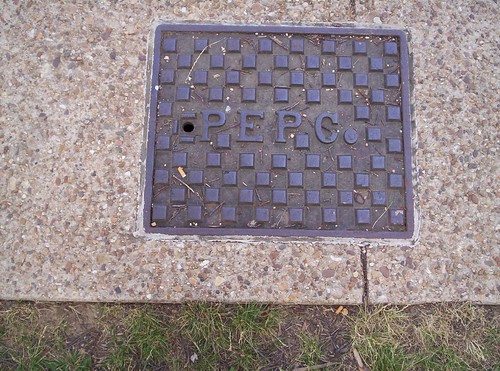
Pepco manhole cover, 4th St. NW on National Mall
A Pepco utility cover in a sidewalk in the National Mall area. The company was originally created to provide electricity for streetcar systems.

Government owned utilities such as the Tennessee Valley Authority were created in part because of a belief that the private sector companies charged too much, and also to serve areas that were underserved.

Of course, failure of utility holding companies during the Great Depression didn't help the reputation of privately owned utility companies either.

Still, the private sector utility field has always pushed hard against government owned utilities. They don't like the counter-example that these organizations provide.

As Mayor of Cleveland, much of the political animus surrounding Dennis Kucinich was his unwillingness to sell the city-owned utility company (which is still owned by the city today).

After the Enron debacle, local governments looked at the idea of purchasing Portland General Electric, a utility company owned by Enron, to convert to a citizen-owned entity, but business interests weren't favorable, and the concept was scuttled once a private offer materialized.

Because municipal utility companies have always been denigrated by private sector "investor-owned" utility companies, it shouldn't be a surprise that Barry Rascovar of the Gazette of Politics and Business, in "Don't let government run power companies" and the Examiner, in "Mopco would be even worse than Pepco," have editorialized against Montgomery County, Maryland's dreams, led by Councilman Roger Berliner, to take over Pepco's utility power distribution assets and run the utility, in response to frequent maintenance and power failures by the company.

While it is true that some locally owned government utilities, like Philadelphia Gas Works have been known to be founts of political patronage and corruption, the reality is that there are some really good examples (and remember there aren't many examples of government-owned utilities in the U.S.) of some exemplary government owned utility operations.

Protection against price manipulation

The deregulation of electricity production and distribution in most U.S. states in the 1980s and 1990s, which led to the decoupling of power generation from the distribution and delivery infrastructure makes it difficult for a govt. owned utility to make much difference in how utilities are operated are today.

However, the experience of the Los Angeles Dept. of Power and Water during the Enron-driven manipulation of electricity supplies in California, which led to the bankruptcy of Pacific Gas & Electric, and the near bankruptcy of Southern California Edison is instructive. When you own your own power generation plants and you don't manage your system to maximize profit and manipulate markets, customers are protected.

Other innovative local government utilities

Other interesting examples are Seattle City Light and the local power boards that serve particular areas within the Tennessee Valley Authority service area. Seattle City Light supports payment counters in municipal service buildings throughout Seattle, and has other policies which support streetscape and other local improvements.

The Electric Power Board in Chattanooga is leading the way nationally in the creation of a local "Smart Grid," which in the Chattanooga region includes piggybacking on the the electricity distribution infrastructure to deliver high speed broadband services (150Mbps minimum) to every household and business.

Locally, in the comments, spookiness pointed out that the City of Manassas in Virginia provides electric service within the city, and because much of the infrastructure is underground, it's less likely to be subject to weather-related power outages. The department also provides water and sewer services. (I'll have to find out more about the history of this service.)

Electricity co-operatives

During the Depression, one of the initiatives of the federal government was the support of creation of member-owned co-operatives in rural areas to create distribution systems and deliver electricity to member-customers, to serve areas that were not otherwise served by utility companies. There are two types of co-operatives, those that serve the customers, and then collectively co-operatives may join together to own distribution and power generation infrastructure.

Cable television

There are some examples of municipally-owned cable television organizations which deliver cable television services directly to citizen-customers. San Bruno, California and Russell, Massachusetts are two examples of city-provided cable television services.

Broadband/High-speed Internet services

There are many examples of city and state departments being set up to provide broadband Internet services. Iowa's statewide network in the 1990s was one of the earliest examples. These initiatives tend to be fought vociferously by cable television and telephony interests. As mentioned above, EPB is delivering these services to its customers in Greater Chattanooga, Tennessee.

But, because the the frequent changes in the technological requirements and/or capabilities (e.g., broadband vs. wireless), providing this kind of service can be problematic. There have been failed/unsuccessful operations as well.

Water

And for good or ill, in much of the country, including the DC-MD-VA region, local water and sewer services tend to be provided by government agencies. The need for massive upgrades to the sewer infrastructure due to changes in EPA regulations has made for serious budget problems, because political appointees to boards tend to want to keep rates down, and millions and billions of dollars are required to fund the EPA-required improvements.

In DC, there have been problems at times with the quality of management of DCWASA now called DC Water, although under current director George Hawkins, the organization has implemented smart branding and other initiatives.

Washington Suburban Sanitary Commission, which is a joint agency for Montgomery and Prince George's Counties, is typically deadlocked over MoCo vs. PGCo interests and the agency doesn't function very well at the management level.

In Falls Church, Virginia, the city owned water agency charged non-city customers significantly higher rates, and is now being forced to rebate the overcharges.

So area water delivery services might not be a good example in terms of supporting a bid for a citizen owned electricity agency in Montgomery County.

No reason for citizen owned utility agencies to cut back on maintenance to increase profits and pay dividends

However, it could be that not having the profit imperative, the need to pay dividends, and manage stock prices, a government owned operation wouldn't stint on maintenance, which appears to be what PEPCO had been doing, although in the face of regulatory fire and criticism, they're refocusing.

Note that this is dependent on whether or not the agency fully controls its revenues. If the general city government can sweep off "profits," government owned utilities can have problems with their budgets and may be forced to reduce spending on vital services.
Farola
Flickr photo by Daquella Manera.

Citizen-owned utilities won't pay stratospheric executive salaries

Similarly, there is no way that a government-owned utility would pay the leaders of the "department" the close to $3 million (about $900,000 in salary, the rest in stock options and other considerations) received by Joseph Rigby, Chairman of Pepco Holdings. Mayo Shattuck, the Chairman of the company that owns Baltimore Gas & Electric, received almost $16 million in compensation in 2010.

Granted both companies are larger than just their local operations. But that's still a lot of "overhead" to carry, overhead that wouldn't be built into government agency utility organizations and the pricing of the delivery of electricity.

Are area local governments innovative enough to deliver high quality utility services?

That's an open question. Montgomery County Government doesn't stick out as being particularly innovative and skillful at delivering these kinds of services, although it does run a nationally-respected suburban bus service that is one of the more highly used suburban bus services in the U.S.

Still, the idea shouldn't be rejected out of hand.

Just as the TVA provides an example for how to run utility "companies" differently (granted, not always better), the same goes for municipal/county government managed utility functions, although again, the example of WSSC is troubling, although because it is a bi-county agency, it is set up from the outset for these kinds of failures, whereas an intra-county operation wouldn't have the same problems.

Yes, financing the acquisition of the infrastructure is an issue, and yes, the State Legislature will have to approve new legislation allowing it, but these are relatively minor issues when it comes down to it.

And, it's not like Pepco has done such a great job that they warrant a pass on the idea.

Labels: , ,

Tuesday, August 30, 2011

Undergrounding utilities

This has been an issue in DC, in areas outside of the original "L"enfant City" where there is a ban on overhead wires.

While not perfect, generally the part of the city with undergrounded electrical infrastructure has more reliable service. Plus it looks better, which has been an issue in commercial districts such as Brookland.

In DC, PEPCO claims it costs about $22 million/mile to underground electricity service, although that figure is about 20 times higher than other studies from around the country.

Post-Hurricane/Tropical Storm Irene the issue of undergrounding utilities has come up again in Virginia, and the Richmond Times-Dispatch ("Move to underground power lines unlikely") provides a link to a 2005 study by the Virginia Corporation Commission that is pretty definitive.


The study states that the cost of undergrounding everything is exorbitant, and makes the point that while service is generally more reliable, the cost of maintaining underground infrastructure is 58% higher, plus it takes 5-7 hours longer per repair, compared to above-ground infrastructure.

It does point out that Dominion Power has a program where each year they focus on substantive improvement to the 10 most consistent power faults in their system, and the course of action for correction can include undergrounding.

Labels: , , ,

Tuesday, January 27, 2009

What I mean about the government impulse...

-------
updated with new content at the end
------

A compassionate government-owned utility company probably would cease utility shutoffs during the winter. And many places have regulations preventing utility shutoffs in winter anyway. Not Michigan's municipally-owned Bay City Electric Light-Power. See the AP story, "93-year-old froze to death, owed big utility bill." From the article:

A 93-year-old man froze to death inside his home just days after the municipal power company restricted his use of electricity because of unpaid bills, officials said. ... Schur owed Bay City Electric Light & Power more than $1,000 in unpaid electric bills, Bay City Manager Robert Belleman told The Associated Press on Monday.

A city utility worker had installed a "limiter" device to restrict the use of electricity at Schur's home on Jan. 13, Belleman said. The device limits power reaching a home and blows out like a fuse if consumption rises past a set level. Power is not restored until the device is reset. ...

Schur's body was discovered by neighbor George Pauwels Jr. "His furnace was not running, the insides of his windows were full of ice the morning we found him," Pauwels told the newspaper.

Belleman said city workers keep the limiter on houses for 10 days, then shut off power entirely if the homeowner hasn't paid utility bills or arranged to do so. He said Bay City Electric Light & Power's policies will be reviewed, but he didn't believe the city did anything wrong.

"I've said this before and some of my colleagues have said this: Neighbors need to keep an eye on neighbors," Belleman said. "When they think there's something wrong, they should contact the appropriate agency or city department."

In a different National Journal article there is this quote, about presidents, but it is no less apt about government at all levels, but people in power generally:

Presidents make two kinds of mistakes: diagnosing the wrong illness and prescribing the wrong medicine.

I don't think I'm up for working for the city manager of Bay City, Michigan.
------
Not that utilities are expected to be social workers, but a $1,000 unpaid bill, for an older person, can also be thought of as an indicator of a need for more careful and nuanced intervention--remember those old Dominion Power television commercials about their program for alerting relatives about unpaid utility bills?

I remember reading a piece in the New York Times, it might have been this, "Catching Seniors Before They Fall - The New Old Age Blog," that said that the "common occurrence" of falls by older people should be considered a potential indicator of other medical issues:

What the experts do know is that effective fall prevention requires three elements, which the Southern California research consortium is attempting to evaluate more closely: a physical examination and risk assessment conducted by a doctor or other medical professional, a progressive exercise regime implemented by a physical therapist, and an analysis and remediation of potential hazards in the home conducted by an occupational therapist.

The medical exam is designed to check risk factors like poor vision, overmedication, muscle weakness, gait or balance problems, and a history of earlier falls. The exercise piece aims to improve muscle strength and endurance in the legs, hips and trunk, which affect postural alignment and stability while walking. Home modification may include grab bars in the bathroom, handrails or ramps near stairways, wider doorways for walkers or wheelchairs, and the removal of stray power cords or throw rugs.

So much for an unpaid utility bill being seen as an indicator of the need for more nuanced intervention. The Dominion Power commercial ended showing the parents driving in an RV with a bumper sticker something like "we're spending our kids inheiritance." Unfortunately, that's not what happened with Mr. Schur.

Also see "Serenity In Emergencies: A Silver Spring ER Aims to Serve Older Patients " from today's Post about extra training in geriatric care for personnel at Holy Cross Hospital in Silver Spring and "Friendship Heights in Front Ranks of Senior Care" also from the Post.

Labels: , ,

Monday, December 01, 2008

Maryland's Public Service Commission shows some gumption

Rather than just roll over on the takeover of Constellation Energy (which owns Baltimore Gas & Electric, the major electricity service provider in the Baltimore region), according to Jay Hancock in the Baltimore Sun, "That Constellation deal is far from done," the oversight commission will be calling for significant protection of the public's interest in the "investor-owned" utility.

With regard to DC's PSC, I don't think they are very hard-headed with Pepco, at least as far as dealing with the community is concerned.

For example, Pepco has been a pain in the a** with regard to powering up SmartBike DC stations, as well as selling some land-access rights for the Metropolitan Branch Trail.

And with regard to the Brookland neighborhood's quest to have the utility lines "undergrounded" on 12th Street NE, Pepco has provided an estimated cost that is about 20 times greater than the industry average ($22.5 million vs. about $1.5 million).

Where's the DC PSC?

Labels: ,