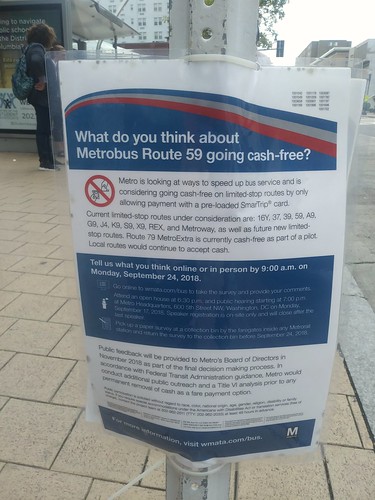
I didn't write about it, but last Monday was the deadline to submit comments about WMATA's plans to go cashless on the limited stop bus services, to reduce dwell time, both from taking cash for fares or adding cash to a SmarTrip card, which is a cumbersome and time consuming process at the fare machine on the buses.
--
Printed survey
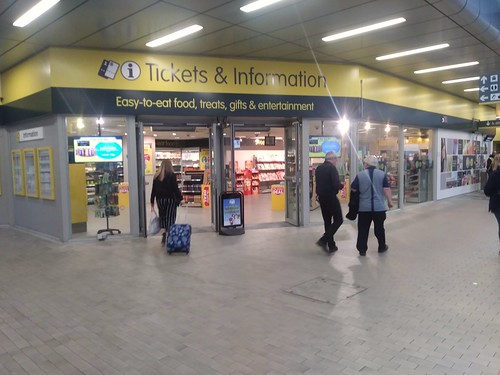
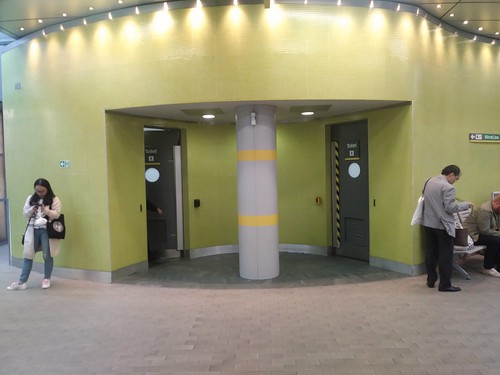
I answered the online survey and submitted a brief set of "comments." Mostly the submission was photos of marketing by Transport for London about places where people can put money cash or credit on their Oyster cards, outside or or external to transit stations.
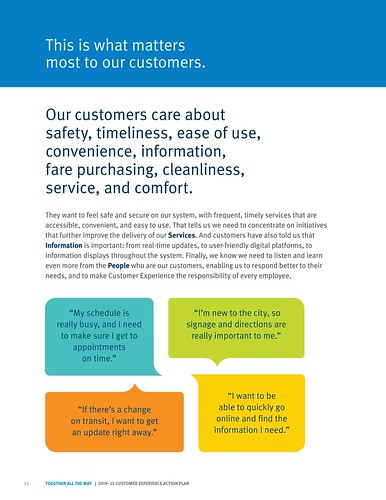
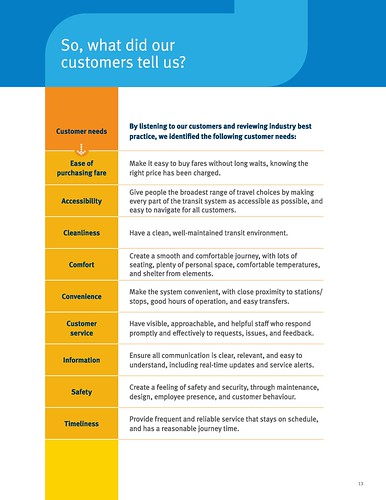
User experience. While I support moving to cashless to speed up bus service, I argued that moving to cashless without having fare card machines outside of train stations and greater attention paid to locations where riders can put money on their SmarTrip cards in more convenient ways does riders a disservice. Access to farecard services outside of the Metrorail system is the primary point as it relates to "user experience."
(The sections on:
The London Underground (Transport System) as a Design Artifact
Transit Systems and Legibility
Connectivity and access as questions of usability in mobility planning
Wayfinding
Overuse of the subway map concept as a way of representing information
from the entry "
World Usability Day," discuss "transit user experience" matters in greater depth.)
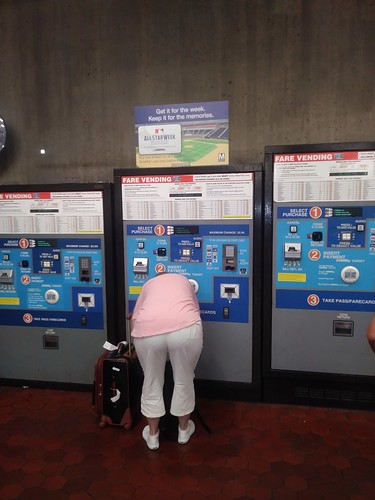
Machines for buying Metrocards and adding money to them (either cash or credit) are only located within Metrorail stations.
Farecard machines aren't present on the surface at major bus stops where lines intersect--although the big hulking machines could be replaced by smaller ATM-like machines for non-station locations.
Note the the Transport for London ticket machine in the center of the picture above. It's small enough to be able to be built into building facades, just like an ATM. (One issue with stand-alone machines is security. And admittedly, one issue with machines outside of Metrorail stations is the cost to service and operate them.)
Some retail stores service SmarTrip cards. While there aren't WMATA fare machines outside of transit stations, it is possible to put money on cards at CVS Pharmacy, Giant Supermarkets, and Walmart stores, and certain other outlets. Some sell the cards too (Giant, Walmart primarily).
Earlier this year CVS threatened to stop doing so because of problems working with WMATA ("
CVS Agrees to Continue Selling Metro's SmarTrip Cards," NBC4).
It used to be that there was SmarTrip signage on some of the storefronts. Even when present the materials aren't particularly noticeable.
Yesterday, I looked at the facades of five CVS stores in DC and Silver Spring, Maryland and didn't see any signage for the SmarTrip card program. And Giant has a decal at the entryway stating all the non-grocery services they provide (selling stamps, etc.) and this decal does not list selling or adding money to SmarTrip cards.
Transport for London's marketing of off-transit Oyster card services. That's why I submitted images from London.
Like this storefront in Hackney Borough on the Mare Street pedestrian mall, about one block from the Hackney Central London Overground Station. Note the lighted sign reproductions of the Oyster card, communicating very clearly that the store offers Oyster-related services.
One of the marketing programs for off-site Oyster card money-adding services is called "Oyster Ticket Stop" and TfL provides a variety of graphic design treatments for affixing to storefronts.
Some materials refer to this service not as a "Ticket Stop" but a "Oyster Card Top-up"
Other stores even provide walk up windows.
Note that these are independent stores, not chains, and chain stores, with their own brand design requirements aren't likely to go for the same treatment, which in the examples shown above, tend to be garish.
But it is possible to do something tasteful, such as this "Moneygram" sign posted in a window at a CVS store in Silver Spring.
Oyster Ticket Stop sites incorporated into transit mapping. Unfortunately, I forgot to mention in the submission that station wayfinding signage and area map brochures for London train stations stations also show the location of Oyster Ticket Stops. I can't remember if this extends to the maps in bus shelters. Ticket Stop locations are not included on the Legible London wayfinding signage system (Bus stops are indicated.)
Wayfinding Map brochure, Continuing Your Journey from Highbury & Islington London Underground Station
The ability to put money on fare cards outside of Metrorail stations needs to be heavily and creatively marketed. One example is the "Orca To Go" program in Greater Seattle.
Billboard on the introduction of limited stop bus service in Los Angeles, branded MetroRapid, c. 2003
And this should include advertising within the transit system at stations and on buses and trains.
In the surface transit network, locations where SmarTrip cards can be purchased and/or serviced should be indicated on WMATA maps at bus shelters and in dedicated signage at bus stops.
Airports. I neglected to mention that there should be farecard machines at the BWI and Dulles Airports, since both are served by Metrobus but without the ability to buy a farecard. Although technically this isn't part of the proposed expansion of the cashless bus program, although it is related to the general question of ensuring access to SmarTrip cards at main points within the system.
Actually at BWI, since there is a light rail station there (I haven't used it, I'll check it out the next time I'm there), you could buy a CharmCard and use it on Metrobus because the CharmCard and SmarTrip cards are inter-operable, meaning they can be used on transit in either Baltimore or the Washington area.
But that element of the transit card isn't well marketed, e.g., at BWI Airport the transit fare card should be marketed as usable on both Washington and Baltimore local transit systems.
(Baltimore) MTA farecard machine
Still, the bus stops at BWI are located away from the light rail station and so additional fare card machines should be made available in the surface mobility service area.
Like what Montreal's transit system does. The Trudeau Airport is served by bus but not rail. They call the bus the "747."
Of course, when the Dulles Metrorail station opens this won't be an issue any longer.
Labels: bus transit, customer service, design method, mobility as a service (MaaS), sustainable mobility platform, transit marketing, transportation planning, user experience