Rebuilding Place in the Urban Space

"A community’s physical form, rather than its land uses, is its most intrinsic and enduring characteristic." [Katz, EPA] This blog focuses on place and placemaking and all that makes it work--historic preservation, urban design, transportation, asset-based community development, arts & cultural development, commercial district revitalization, tourism & destination development, and quality of life advocacy--along with doses of civic engagement and good governance watchdogging.

Tuesday, September 30, 2025

State-based inter city bus services

Needless to say, Iowa's Burlington Trailways bus services are much truncated compared to this 1940s route map.

The Des Moines Register reports, "Iowa-based Burlington Trailways to end intercity bus service and lay off 79 workers," that the state-based Burlington Trailways inter city bus line is ceasing transit services.  According to the article:

Iowa-based Burlington Trailways is ending its intercity bus routes, resulting in 79 layoffs across six locations. The company cited rising insurance costs and inconsistent federal grants as reasons for the service cuts. Burlington Trailways will continue to operate its tour and charter bus services.

I guess it's not a priority for Iowa to plan for inter city bus services on a regional and statewide basis.

Same with Michigan, decades ago I needed to get to my parents house in Oakland County from Ann Arbor, to borrow a car, because mine was out of service.  To make it happen I had to take an airport shuttle bus from Ann Arbor to the airport and from the airport to Birmingham.  

(There had been off and on bus service from Ann Arbor and other major university towns in the state, but I guess around this time those services had been abandoned.)  Today, more coordinated inter city bus service is present in the state through Michigan Trailways, and Greyhound.  Maybe some service from Coach/Flix

A long time ago when I was opining about transportation planning at multiple scales ("Reprint (with editing): The Meta-Regional Transit Network," [2009]), a commenter made the point that I didn't include inter city bus service.  

She was right.  It was a big omission.  Sadly, transportation planning across the US often ignores this mode, as it is privately provided--although in some states services have some state funding, and there is the complementary Amtrak Thruway bus service operative in many areas.  

Stations, stops and services can be abysmal, especially since in the bankruptcy takeover of Greyhound they separated the bus lines from the bus terminals.

A bus stop for the San Joaquins Amtrak service in Claremont, California.

A few years ago, when Greyhound was up for sale, I suggested that Amtrak buy it, and create a national-regional rail and inter-city bus system.  

I based it on Japan's organization of its railway services into 7 regionally-based Japan Railway (JR) companies.  They don't do bus too, but in the US context I think it makes sense.

-- "Two train/regional transit ideas: Part 1 | Amtrak should acquire Greyhound," (2021)

A lot of states provide some funding but it can be hit or miss.  Colorado takes it to another level with statewide planned, funded and branded service called Bustang.  

I think Virginia Tech started a service called Breeze providing service from its campus to major destinations in certain parts of the state, but now it's run by the state.

I was just on the Oregon Coast for a vacation and was surprised to find out that the state (not surprisingly as Oregon is a transportation practice and planning leader) funds a bunch of services across the state, many focused on providing access to Portland.

-- NW Connector
-- Point
-- Columbia Area Transit

Airports.  Another scale and need for inter city bus service that I've written about is for airports.  Some do it in a more systematic way--LAX, Boston, O'Hare--but not many.  

This is an area that MPOs should address when planning transit access at a wide scale.

The entry, "Las Cruces (NM) Airport Master Plan | Airport Master Planning," has a pretty comprehensive list of links to past blog entries on the topic.

Labels: , , , ,

Wednesday, July 16, 2025

Coast-to-Coast High-Speed Rail Route Proposed Between Los Angeles and New York


Newsweek reports on the above proposal, submitted as a letter of inquiry to Amtrak by:

AmeriStarRail, a startup specializing in high-speed and intermodal passenger rail, pitched a partnership with Amtrak to launch the "Transcontinental Chief," a high-speed rail route that would run between Los Angeles and New York in under 72 hours.

I have written up similar ideas in the past.  

The thing is now I am convinced, from the 'why can't we have nice things' department that because Republicans don't believe in the concepts of public goods, public investment, and climate change, that something like this won't ever happen in my lifetime ("Trump administration pulls billions in funding for high-speed rail project; state leaders call decision ‘illegal’," Los Angeles Times, "Train linking Twin Cities, Duluth in doubt as D.C. Republicans try to yank money for passenger rail," Minneapolis Star-Tribune, "'Derailed' tells the story of the Wisconsin high-speed rail line that wasn't," The Capital Times).

Plus, HSR makes more sense for shorter trips, like DC to Boston, not New York City to Los Angeles.  There are other issues too ("Whither (wither) high-speed rail?," "California HSR: Seven Deadly Mistake," Railway Age).

Plus I think we need to think about this in terms of the major nodes on this line in turn supporting the development of robust regional rail services, along the lines of what I suggested here:

-- "Two train/regional transit ideas: Part 1 | Amtrak should acquire Greyhound," (2021), based on the organization and delivery of railroad passenger services in Japan.  And it should further include inter-city bus services where rail service is hindered.

That's in keeping with Amtrak ridership being focused in major corridors like DC to Boston or San Diego to Los Angeles.

Note that some people suggest that AmeriStarRail is merely an attempt to privatize Amtrak.

The new route would replace Amtrak's Southwest Chief and Pennsylvanian lines and rely on existing infrastructure from host railroads, including BNSF, Norfolk Southern and New Jersey Transit. 

Unlike past rail startups that have required federal funding, AmeriStarRail says its model is entirely privately funded. The company has presented the proposal to President Donald Trump, Secretary of Transportation Sean Duffy and members of Congress.

Note that a study of VIA Rail passenger services suggest that transcontinental trips by rail produce more GHG than air travel ("Why the train may not be the greenest way to travel across Canada," CBC-TV).  

So the focus in the US should be on replacing shorter distance air travel with the train.  Except competition and lobbying from airlines and airports--most publicly owned anyway.

Under the Biden Administration Amtrak and the Federal Railroad Administration produced a master plan for developing a more robust passenger system (MORE TRAINS. MORE CITIES. Better Service), based on the concept of focusing on regional/multi-state services.

=====

-- "Moving Forward—At Restricted Speed," Railway Age

Labels: , , , , , ,

Sunday, June 16, 2024

Megabus bankruptcy: merge inter-city bus services with Amtrak

 Mass transit that is privately run has been on a downward spiral for decades.  In the 1970s, railroads gave up their passenger services to Amtrak.  Privately owned bus systems, primarily Greyhound and Trailways, shrunk their systems, increased prices, and lost ridership.

In the 1990s, on the East Coast inter-city bus services grew because of "Chinatown buses," buses that ran between Chinatowns in Boston, New York, Philadelphia, DC, and to some extent Richmond.

The for profit carriers saw this and created new services, such as Bolt Bus and Megabus to provide service in high transit corridors like DC-Boston.  Then some of the companies branched out, created multistate regional hub services such as out of Chicago.

The Philadelphia Streets Department just moved the city's main Megabus stop from Arch Street to the newly reconstructed Schuylkill Avenue, a block south of 30th Street Station. But riders still wait on a sidewalk with no amenities. Inga Saffron / Staff

There's been a bunch of private equity activity, I haven't kept up.  

The last major switchover involved private equity selling off the real estate--terminals--leaving the riders and services to fend for themselves.  This has been covered some by the media ("Regional and multi-state inter city bus transportation. Thanksgiving is a time of big travel.," 2023). Especially by the Philadephia Inquirer ("Philly’s failure to improve conditions for intercity bus riders is an equity issue," "It’s time for Philly to build a proper bus station. Here are six possible locations.").

From the second PI article:

That’s good to hear because Philadelphia, like many American cities, has long undervalued the importance of its intercity buses. While SEPTA, Amtrak, Philadelphia International Airport, and the area interstates all receive government funding, long-distance bus service is privately run and operates with virtually no public subsidies, even though it serves a much poorer population. I never ceased to be amazed at the extreme contrast between the dismal, bunker-like space at Greyhound’s rented Filbert Street terminal and Amtrak’s soaring waiting room at Gray 30th Street Station. 

After the federal government deregulated the bus industry in 1982, some carriers stopped using the bus station and began picking up customers at sidewalk stops. The general lack of respect for this low-cost bus service may explain why the Streets Department thought it could dump Greyhound’s operation on Market Street with no amenities for travelers. 

Carroll and Mondlak told me that the city now sees intercity buses as a crucial part of Philadelphia’s transportation network, as important as trains, planes and highways. Besides ensuring that residents have access to an affordable form of long-distance transportation, they believe that intercity bus service also supports Philadelphia’s vital hospitality industry.

Cities and states should step in to ensure there is adequate shelter-terminal service provided to riders, in part as a transportation demand management effort.

Joseph Schweiterman, a professor at DePaul's Chaddick Institute, is one of the only professors who focuses on intercity bus.

Like how many states are investing in passenger rail expansion, Colorado is probably the most active state in developing an inter-city bus network at the state scale.  Bustang is the normal ineration, with winter service focused on skiing separately branded as Snowstand.

Because the US doesn't have a national transit plan, we don't have a plan for inter-city bus service.  

National Greyhound map/ad, 1941

I argued a few years ago, when Greyhound was for sale, that Amtrak should buy it.

-- "Two train/regional transit ideas: Part 1 | Amtrak should acquire Greyhound," 2021

Granted these are services of last resort, and the federal government is so far from being able to work in a bipartisanship way to ensure national transit service (thank you Republicans), but as far as national transit planning and equity is concerned it seems the way to go.

Especially since Megabus, owned by Coach USA, and Coach USA declared bankruptcy ("'A great alternative’: Riders fret over the future of low-cost Megabus after bankruptcy," Pittsburgh Post-Gazette), "sBus Carrier Coach USA Goes Bankrupt After Ridership Drops," Bloomberg).  From the PPG:

The bankruptcy comes just two years after Megabus added 22 new destinations from Pittsburgh to Central Pennsylvania and southern New York through a partnership with Fullington Trailways, a motor coach carrier based in Clearfield. 

The new service added routes to Indiana, Punxsutawney, State College and Bradford in Pennsylvania and Olean and Buffalo in New York, among other locations. The agreement also expanded Megabus service from Philadelphia (11 new cities), Harrisburg (9), State College (18) and New York City (14). 

 The low-cost bus service was a immediate hit with Pittsburghers when it arrived in the city in 2011. According to the Megabus website, a one-way ticket to New York City now costs $50, while a ticket across the state to Philadelphia is just $25. Reducing routes and facilities would bring less accessibility to riders, said Lexie Ditchkus, 27, of Scranton.

Coach USA is subdivided into 25 distinct businesses, and has entered purchase agreements with affiliates of The Renco Group, Inc. and AVALON Transportation, LLC for 16 of them, according to the company’s news release. The sales should “ensure uninterrupted passenger transportation,” according to court documents. 

Megabus is in the process of being sold, but no company has officially pursued purchase agreements. It will operate on an “ordinary course” pending the court’s decision. If a transaction does not occur, routes may be limited, according to the court document.

It's not like we don't know how this story goes.  Because of relatively short distances in Europe and less car ownership, private bus systems (which bought many of the companies in the US) are more economically viable.

Inter-city bus service should be combined with Amtrak, and a national transit system should be maintained and improved.

Labels: , , , , , , ,

Friday, November 24, 2023

Regional and multi-state inter city bus transportation. Thanksgiving is a time of big travel.

 This was in the Thanksgiving entry, but should be separated out.

==========

One overlooked segment in regional transportation planning is inter-city bus service/travel. 

Blog entries

Resources
-- "Building a better bus hub at Union Station," Washington Post, 2011
-- "The Navigator: Greyhound, leaving passengers out in the cold," Washington Post Travel Section, 2014
-- Intercity Bus Program Strategic Direction Report, Texas Department of Transportation, 2019
-- "Emergent Curbside Intercity Bus Industry: Chinatown and Beyond," Transportation Research Record, 2009
-- "The Curbside Bus Industry: A New Era of Bus Travel, masters thesis by Eileen Collins The Chaddick Institute for Metropolitan Development at DePaul University in Chicago has done a fair amount of research as well, in part focusing on the Midwest. -- Intercity Bus Research webpage
-- The Return of the Intercity Bus: The Decline and Recovery of Scheduled Service to American Cities, 1960 - 2007

Greyhound is the major US company, and over the last ten years it's been owned by foreign firms.  The previous owner sold off the real estate--many inner city terminals are big and worth a lot as redevelopment opportunities.  

Abandoned Greyhound bus terminal in Oakland, California.  Many stations were built during the era of art deco architecture and have wonderful details.

As terminals close, buses stop on the street, people queue outside with no protections.  Professor Joseph Schweiterman of DePaul University is rare in that he tracks this form of transportation and he wrote about it for MSNBC News ("Thanksgiving is a stressful time to travel. Why it may get worse for these passengers.").  

From the article: 
The past few months have been tough for many passengers using bus stations and curbside spots across the country. Amid a worsening bus station crisis, some city officials have become downright hostile to the key service because of perceptions that it causes theft, loitering and loss of neighborhood aesthetics. While dozens of airport terminal improvements are providing new conveniences for flyers, and as new federal dollars flow for train upgrades, more and more riders of intercity buses are, quite literally, being left out in the cold. 

... On Greyhound, the bus travel giant that reaches more U.S. cities than any other line, stations with spacious and climate-controlled waiting rooms have been shuttered in Charlottesville, Virginia, Cincinnati and Columbus, Ohio; Erie and Philadelphia, Pennsylvania; Knoxville, Tennessee; Louisville, Kentucky; Portland, Oregon, and Tampa, Florida. This has forced lines to move to curbside spots or more remote locations separated from downtown. Greyhound and its partners have suspended service entirely from two state capitals, Jackson, Mississippi, and Little Rock, Arkansas, because of their inability to find workable stations. Concern is high that Greyhound stations in Chicago; Charlotte, North Carolina; Cleveland; Dallas, and Kansas City, Missouri, could be the next to go. 

This crisis is unfolding as intercity bus lines more broadly seem to be enjoying a post-pandemic bounce... More people ride intercity buses than trains, but the lack of high-quality station arrangements raises questions about the mode’s future opportunities.

Three factors are at the root of the crisis. Many municipal governments, once allies, have adopted aggressive not-in-my-backyard stances toward intercity buses, fueled by the perception that bus stations may be unsafe places that generate criminal activity. Adding to this problem, dozens of stations came into the fold of a private real-estate holding company...

Meanwhile, many City Halls appear indifferent, highlighting the lack of clout bus travelers have in policymaking. ... Meanwhile, many City Halls appear indifferent, highlighting the lack of clout bus travelers have in policymaking.

Common sense dictates that intercity bus lines start using public transit terminals with around-the-clock security, restrooms and indoor waiting areas. The federal government has made giving intercity bus lines “reasonable access” to these facilities a funding requirement.
What to do about bus rider customer experience.  Note in my typology on the transit network at multiple scales ("Reprint (with editing): The Meta-Regional Transit Network," 2009), a commenter had to point out to me that I failed to include buses.  I have written about this from time to time, including problems with the set up at DC's Union Station, by comparing it to Toronto and Montreal ("Union Station bus terminal, DC," 2011).

Great 1950s brochure on the Port Authority Bus Terminal in NYC.  Flickr photo by Karen Yang (also see the brochure cover and back panel.)

There are a few examples I've come across where inter city buses are incorporated into existing public transit stations, although it isn't always done well.  DC's Union Station, Charlottesville, even the Silver Spring Transit Center are examples.  Hatmburg's bus terminal is adjacent to the main train station.  In Liverpool they have a separate intercity bus station, a number of blocks away from the main train station  and adjacent local public bus station, and but it's run by the local transit authority.  In Essen, the inter city buses stage at the back of the station.  (That's where I first saw bike racks placed on the back of intercity buses.)

One way to build stronger support for this, at least in core metropolitan areas, where commuter bus service exists, is to include better services for both commuter bus passengers and inter city bus passengers.  Similar to the decline in amenities and customer experience for inter city bus, commuter buses tend to use the public transit shelter infrastructure.
 
A start would be to require center cities to include provisions for inter city bus transit and services into local transportation plans, and for states to have equivalent plans.

Colorado may be the national leader, as it has created a statewide inter city bus transportation program called Bustang (with a derivative called Snowstang for ski service).  I don't know how it works though at the nexus of street, bus, terminal, and passengers.  And the state is still served by for profit bus services.  

Union Station Denver's underground bus terminal is used by public transit buses, I don't think inter city bus.  Design wise it's a great example of how a bus terminal can be integrated into transit stations.  Although this rendering is more lively than the actual.


SOM press release, 2014

When Greyhound was last up for sale, I suggested that Amtrak buy it ("Two train/regional transit ideas: Part 1 | Amtrak should acquire Greyhound," 2021).  Amtrak does provide some inter city bus service, called Amtrak Thruway, to fill in access gaps to its route network, even in outstate Maryland.

Labels: , , , ,

Monday, April 26, 2021

Two train/regional transit ideas: Part 1 | Amtrak should acquire Greyhound

Building from my writings on railroad transportation primarily in the DC area, including the DC State Rail Planning process in 2015 and both built on and led to other pieces arguing for transformation:

-- "A regional railroad passenger transportation vision for DC, MD, VA, WV and parts of PA," 2006
-- "Regional transportation planning and fixed rail service," 2009
-- "Why don't Maryland and West Virginia think about expanding MARC into a true regional system?
-- "One big idea: Getting MARC and Metrorail to integrate fares, stations, and marketing systems, using London Overground as an example," 2015
--  "A new backbone for the regional transit system: merging the MARC Penn and VRE Fredericksburg Lines," 2017
-- "A brief comment on ground transportation at National Airport vis a vis VRE rail service," 2016
-- "A "Transformational Projects Action Plan" for a statewide passenger railroad program in Maryland," 2019
-- "The ability to develop around transit stations is conditional on land use and mobility context," 2012

along with learning about the privatization and organizational of railroad passenger services in Japan, I have a partially written series about re-articulating train service planning and operations at the national and multi-state scale.  

Amtrak expansion as part of the President Biden infrastructure program.  It's too bad it wasn't ready in advance of the recent promotion of expanded Amtrak service as part of the Biden infrastructure initiative ("At 50, Amtrak could get the transformational makeover it needs," Seattle Times).  

Joe Biden, then-presidential nominee, campaigns at the Amtrak station in Alliance, Ohio, on Sept. 30. Biden — our most famous Amtrak rider — is proposing an $80 billion infusion in railroads. 
(Gabriela Bhaskar / The New York Times,

From the Boston.com article "Here’s what Amtrak’s vision for 2035 looks like for New England":

Biden’s sweeping $2 trillion infrastructure plan calls for a total of $80 billion in new rail funding to address Amtrak’s repair backlog, modernize the Northeast Corridor, improve existing corridors, connect new cities, and enhance programs to support passenger and freight rail safety, efficiency, and electrification, according to the White House. 
With that funding, Amtrak — which is publicly funded and privately operated — said Wednesday that it would be able to execute on many of those goals, including improving Northeast Corridor trip times and expanding service to underserved communities across the nation. 
The proposal would be the first major expansion in the 50-year history of the agency, which was approaching profitability prior to the COVID-19 pandemic. Since its creation in 1971, Amtrak has barely seen any changes to its route map and has faced local opposition to expansion in some parts of the country, as The New York Times recently reported. However, Amtrak CEO Bill Flynn said Wednesday that Biden’s plan could finally set those plans in motion. 
“Amtrak has a bold vision to bring energy-efficient, world-class intercity rail service to up to 160 new communities across the nation, as we also invest in our fleet and stations across the U.S.,” Flynn said. “With this federal investment, Amtrak will create jobs and improve equity across cities, regions, and the entire country – and we are ready to deliver.”

JR/Japan Railway as a model

The privatization and reorganization of Japan Railway is my model.  Announced in the late 1980s, and implemented in phases in the 1990s, the company was broken up into 6 regionally-based companies, and a seventh company for Freight, with interconnected services across regions ("Lessons from Railway Privatization in Japan," Tokyo Review, "The Privatization of Japan Railways and Japan Post: Why, How, and Now," Asian Development Bank, "Privatization of JNR, 30 years on," Japan Times).  

As a government corporation, Japan National Railways was ponderous and losing money and the government didn't want to continue to fund massive debts.  Not all of the companies are privatized, because some aren't profitable.  Besides a much greater focus on the customer and marketing, a major change with privatization was allowing the companies to be active property developers and operators of related businesses, which provides as much as 33% to 60% of total revenues of firms like JR East and JR Kyushu.  City-centered railway companies are better positioned to take advantage of such opportunities, while more rural-oriented companies suffer from declining population, competition with the automobile, etc., and require ongoing subsidy.

The JR services are "trunk line," foundational services, and are complemented by a large number of what they call "third sector" rail passenger services, which are a mix of privately owned and operated and publicly-supported rail lines. (There is also inter city bus service, not affiliated with JR.)  The Shinkansen train services, the first high speed rail services in the world, compete with airlines and provide premium service.

While some of the non JR services are fairly large companies, most are quite small and very localized.  

All of the rail companies, JR and third sector, work heavily to market their services, create special tourist trains, and work with local communities on economic development and tourism promotion ventures.  

In fact, such promotion used to be quite common with US railroad companies in the 20th century, promoting tourism, business development, residential recruitment, etc.

Most US railway companies (and major gas station companies) had tourism departments.

Creating multi-state regional transit districts.  I propose creating six regional transit districts across the Continental United States, with national (cross district) and regional Amtrak services as the foundation, complemented by the creation and extension of railroad services within and across the states, further complemented by inter city bus services, but also water-based ferry transit where appropriate (e.g., in parts of New England, Washington State, California, Maryland, etc.).

My six regions for a national and regional railroad transportation plan*

This organization of the regional districts isn't "final."  A study of mobility flows between states should determine the distribution of states across the mobility districts.  For example, maybe Arizona and Nevada should be with the Coastal region, or Arizona and New Mexico with the Intermountain region, etc.  Or perhaps some states should participate in two regions, depending on the nature of their mobility flow.

Many of the ideas promoted by Amtrak as part of their 2035 initiative work well within that framework, which still extends beyond what Amtrak is approaching ("Amtrak unveils ‘Connects US’ map that suggests new corridors," Trains Magazine).


New Amtrak vision map for 2035

Map of what Amtrak expansion would look like in New England

New service denoted in light blue; enhanced service marked in yellow

Intra-state and multi-state railroad expansion initiatives should be integrated into this program, comparable to how Japan's "third sector" railroads either complement JR services or in some cases compete with them (e.g., Keikyū  has five lines totaling 87km, 73 stations, and over 1 million daily riders pre-pandemic).

Proposals for passenger rail expansion in Michigan not involving Amtrak.

For example, expanding MBTA beyond Greater Boston, even into New York State ("East-west Rail: Massachusetts Department of Transportation angers public after recommending further studies weeks before final report," WBUR/NPR), expanding Metro-North beyond Greater New York into other parts of New York State, my concept for a statewide passenger railroad program in Maryland, and various existing efforts like Amtrak Cascades, Amtrak California, Amtrak Virginia ("Virginia, Amtrak, CSX Advance $3.7B Rail Initiative," Railway Age), the Maine Downeaster, Brightline plans in Florida ("Brightline has summer deadline for agreement of route from Orlando to Tampa," WESH-TV) and California-Las Vegas ("Brightline CEO: Vegas-to-LA high-speed rail line still on track to break ground in 2021," Reno Gazette-Journal), etc.

Rebuilding a national rail/bus transit network: Merge Amtrak and Greyhound

Greyhound national bus route map

While the forthcoming series on the rearticulation of rail transport focuses on the train, the reality is that it is about transit planning and operation at a large multi-state and national scale.  

To work, it places rail at the foundation, complemented by inter-city bus and ferries, as appropriate, to create a wide and deep mobility network that is not car dependent.  

(Although a big focus within building the viability for rail is to replace short distance airplane travel with train trips, and to electrify to the extent possible the rail network, on climate change grounds.  Coastal states like Massachusetts, Connecticut, Maryland, etc., have a great opportunity to reduce greenhouse gas emissions through shifting to train passenger use and electrification.)

Inter city bus is a neglected area of transportation planning.  Because bus services are mostly privately operated, there isn't a lot of public transportation planning for that mode.  

The Chaddick Institute at DePaul University is rare in that it pays attention to and produces research and writing on the inter city bus system.

Colorado's "Bustang" program is probably the best if not only example of planning and delivering inter city bus service at the state scale, with a focus of linking rural areas to major cities ("CDOT happy with Bustang ridership during COVID," Daily Sentinel).

Greyhound's owner would like to sell.  The media reports that First Group, the UK transit operator that tried to make a go of it in the US through three divisions: school transportation; transit agency service operation; and Greyhound; has sold its bus and transit division and wants to sell Greyhound, but has no takers ("FirstGroup sells bulk of US transport business in $4bn deal," Guardian).

A Greyhound bus on H Street NE in Washington, DC, after leaving Union Station.  Photo: Bill Clark, CQ/Roll Call.

Greyhound's acquisition would be a great opportunity to integrate the inter-city transit network into a more seamless system. If Amtrak were truly visionary and about regional and national transit, not just railroad passenger service, it would make sense to merge the companies, with the aim of creating the kind of national transit system I envision (which used to exist anyway, through the combination of the various railroad passenger services and their interconnections, complemented by bus services from Greyhound and Trailways--national providers, and local and regional providers).

But unfortunately it's a stretch.  Note that this is a "Transformational Projects Action Plan" concept at a massive scale.  Sadly, I don't think either the federal government generally or Amtrak specifically have within them the ability to seize such an opportunity.  The federal government is not known for its innovativeness and entrepreneurship although there are plenty of examples when it has done just that.

Amtrak was set up to be a "maintainer" of rail service, basically as a way to offload the expense of passenger service from freight-focused railroads increasingly in financial trouble, with a mandate for managed decline, complicated by difficult budget issues and political maneuvering within Congress, not to mention lobbying by private transportation organizations, especially airlines, to keep it uncompetitive ("Amtrak 2035 Map: Hopes and Challenges," Railway Age).

Amtrak system, 1978.

Amtrak is already a nonprofit corporation, so its corporate form isn't the issue, as much as its crippled mandate, funding, and political and other forms of competition.

Labels: , , , , , ,

Wednesday, September 14, 2016

Rome 2 Rio is an incredible website integrating all forms of mobility to get from one place to another--globally!

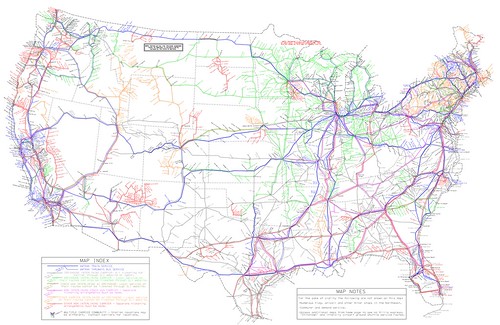
US intercity bus service map produced by Michael Buiting.AIBRA bus and Amtrak map, 2014-01-15

In a back and forth set of comments spurred by Larry Littlefield's post which in passing discussed inter city bus service in New York State, we were talking about bus route network maps.

In the old days, railroads and intercity bus systems like Greyhound and Trailways published complete maps of their route systems.

Now it's very hard to find such maps. Michael Buiting produced one on his own.  See the past blog entry, "Inter-city bus services are typically a gap in transportation planning."  The entry references some academic research and other writings on the subject.

Larry said you can't find these kinds of maps for Coach USA/Megabus services at the scale of a state or region, let alone a complete network map.

Yes you can plug in stuff online, but you can't get a sense of the full system and all its possibilities, counter to "the old days."  (Similarly, regularly published complete guides for railroad passenger and airline service provided this function, showing all available services.)

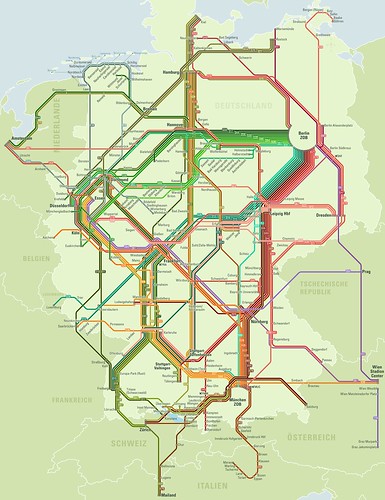
Mein Fernbus/Flixbus, Germany.  I mentioned that when I was in Germany, I saw a variety of intercity bus companies in service, near train stations in Essen and Hamburg.  (In Hamburg the Intercity bus terminal, ZOB, is in close proximity to the train station.)

Because some of the Mein Fernbuses I saw had rear-mounted bike racks, I looked into their services more--note they have since merged into Flixbus.

They publish route maps comparable to the maps once published by Greyhound and Trailways, even differentiating between their day and night networks, but I like best an earlier version of their night map (below).
Older version, Mein Fernbus night bus network map
It turns out their website and computing systems are developed by stfalcon, a Ukrainian firm.

Were I in charge of finding a programming team to set this up for a transit system, they'd be one of the contenders, clearly.  This webpage discusses the work stfalcon has done for Mein Fernbus.

Rome2Rio Global Travel Planning website. While tracking done some URLs, I came across Rome2Rio, a travel search and ticketing website that has managed to integrate airplanes, trains, intercity bus, ferry, local transit services, and taxis into one system.

It's pretty remarkable.

US and Canadian inter city bus service map, based on route information collected by Rome2Rio.

But they don't have a function where you can produce and print out master route systems maps as a website user, although on occasion they have blogged about doing it themselves, such as when they added US and Canadian inter city bus coverage to their system.

Wanderu.  Note I have mentioned/used Wanderu to do bus trip planning in the US, as they have a master set of information.  But Rome2Rio takes integration and mode coverage to a whole new level.

Labels: , , , , , , , ,

Sunday, March 02, 2014

Intercity bus services are typically a gap in transportation planning

NotionsCapital reminded me of the recent coverage ("This Map Shows How To Get Anywhere You Want In America Without Taking A Plane," Fast Company) of the effort by Michael Buiting, operating as the "American Intercity Bus Riders Association," to create a map of the Continental United States showing most of the intercity bus line connections and how it intertwines with Amtrak (but not metropolitan railroad commuter systems), producing a map that shows "how to get around the US without taking a plan," and as importantly showing how to get around to small communities that lack airport or train service.

The map does look like an old style railroad map from 80-100 years ago, showing the various local passenger railroad services operating across the country.

Intercity buses are usually ignored by transportation planning.  While this map has been written up elsewhere already, it's important for us to take the opportunity to consider that inter-city bus service generally isn't actively addressed by transportation planning at national, multi-state, and regional scales, other than at the local level as a matter of regulation and siting.  

Local authorities address issues such as where the buses pick up and drop off passengers, charging fees for charter buses entering the city, making sure that they can be parked (DC DOT Tour Bus Parking webpage) in ways that don't create problems, vehicle safety, etc.--but generally don't take up  transit access and system issues.

I made that mistake too in my discussion of transportation planning here, "Second iteration, idealized national network for high speed rail passenger service,"where a commenter pointed out I left off intercity bus services.

The map also motivates me to separate out and add to the right sidebar a dedicated section of "Dr. Transit's Intercity Bus Links."

Station and stop accommodations are often substandard.  I have been meaning to write about this because last year the Post travel section had an important article, "The Navigator: Greyhound, leaving passengers out in the cold," about the dearth of standards for "station and stop accommodations" for intercity bus services.  From the article:
Singh’s experience offers a glimpse into a corner of the travel industry that receives practically no coverage or concern from the travel media: the conditions faced by hundreds of thousands of people who travel by bus.

After Singh’s motorcoach, which originated in Minneapolis, left them at the station, the passengers huddled together outside the closed building. Singh opened his luggage and added layer upon layer of clothes in an effort to keep warm. ...

“Greyhound terminals and agencies are open when buses are scheduled to arrive or depart,” she said, adding, “We will work with the interline carriers to help ensure that their hours are consistent with the scheduled arrivals and departures.”

Singh has been waiting a while to hear that. In February, he launched a petition on Change.org asking Greyhound to keep its terminals open, and this policy shift seems to address the loophole. It’s one that has existed for a while now, and it’s one that I should have exposed years ago.

This is exacerbated by the fact that most of the new intercity bus services don't use stations but provide service at the curb, and this can be very chaotic.

Megabus bus stop with sign, New York City. A Megabus boarding site on 34th Street in Manhattan. It serves 90 cities, compared with 40 two years ago. Ruby Washington/The New York Times.

Curbside bus services and rising demand for intercity bus service.  While Greyhound and Trailways have been operating as national intercity bus systems for many decades, those systems have tended in recent years to focus on transporting lower income passengers as higher income long haul passengers take planes.

The rebirth of intercity bus service serving different demographics was a response to the so-called "Chinatown" bus services, which originally were created to bus Chinese restaurant workers between Chinatowns (such as between Philadelphia, New York, Washington, and Boston) and casinos.   Non-Chinese started riding the buses as well and ridership grew considerably ("The Indomitable Chinatown Bus," New York Magazine).

The chaos and problems associated with Chinatown bus service ("Federal Officials Shut Down 26 Bus Operators," New York Times), created an opportunity for the major bus companies to step in and offer comparable services, but with more reliability and amenities like wifi access. 

Major bus companies--BoltBus is a nonunion carrier owned by Greyhound and CoachUSA created Megabus--are now leading this market, both in the Northeast corridor and in other parts of the country ("Buses fastest-growing form of intercity travel," USA Today).

Research studies.  The Institute for Public Administration (IPA) at the University of Delaware has been researching the "curbside bus industry," called such because the new services often don't operate out of terminals but pick and drop people off at curbside stops near train stations and subway stations, and they have produced a report and a masters thesis on the subject:

-- Curbside Intercity Bus Industry: Research of Transportation Policy Opportunities and Challenges
-- The Curbside Bus Industry: A New Era of Bus Travel, masters thesis by Eileen Collins

The Chaddick Institute for Metropolitan Development at DePaul University in Chicago has done a fair amount of research as well, in part focusing on the Midwest.

-- Intercity Bus Research webpage
-- The Return of the Intercity Bus: The Decline and Recovery of Scheduled Service to American Cities, 1960 - 2007

Integrating intercity bus services into local transit infrastructure.  In "the old days," when bus service was more widely used, many communities had bus terminals, most often provided, owned, and managed by Greyhound or Trailways operators.  Back then, with privately operated transit systems, it was rare for transit services--railroad or bus--to coordinated their service from a single station.  (Washington's "Union" Station was an exception for railroad service.)

But as ridership declined, many of these terminals have been closed. Some larger cities like Toronto, Montreal, and New York City do still provide support for intercity bus terminals, but in the US, operators can't be forced to use these facilities.

The Salt Lake City Intermodal Hub connects Amtrak, commuter rail, light rail, bus, and intercity bus transit services.  Wikipedia photo.

In some communities, intercity bus lines work with local transit services for access to a main station, which provides for better service for patrons but at the same time, can create problems as intercity bus terminals tend to have some loitering, vagrancy, and crime issues.

That's why in Baltimore relocating the Greyhound terminal next to Penn Station was ultimately unsuccessful ("Mayor vetoes city bus terminal," Baltimore Sun, 2001). In DC, the services have been relocated to Union Station after many years of hoping for it, in large part because the Greyhound terminal--located about 5 blocks from Union Station--was worth more as a redevelopment site.

But many places provide minimal accommodations for people traveling by intercity bus and this should be addressed at the scale of metropolitan, regional, and multi-state transportation planning.

Bus departures screen, Gare D'autocars, Montreal.  Wikipedia photo.

Improving station accommodations.   I have argued that the bus services need to be better integrated into Union Station than they have been ("Union Station bus terminal"), such as with coordination departure and arrival information displays, such as are provided at the intercity bus terminal in Montreal.

Conclusion.  It would be nice to see more support for the efforts of Michael Buiting-American Intercity Bus Riders Association, not just for the creation of a map, as well as greater focus by planners on some of the issues that he and others raise with regard to the quality, breadth, and depth of intercity transit as it relates to buses.

Labels: , , , , ,