Rebuilding Place in the Urban Space

"A community’s physical form, rather than its land uses, is its most intrinsic and enduring characteristic." [Katz, EPA] This blog focuses on place and placemaking and all that makes it work--historic preservation, urban design, transportation, asset-based community development, arts & cultural development, commercial district revitalization, tourism & destination development, and quality of life advocacy--along with doses of civic engagement and good governance watchdogging.

Thursday, August 06, 2026

Drought in Europe dries up rivers

 This was an issue a couple of years ago with the Rhine, which I didn't realize also went into France.

People walk around a dried section of the Danube River in Budapest on July 30. Photographer: Robert Nemeti/Anadolu/Getty Images.

It's an issue now with the Danube River in Hungary and Romania, which may force the closure of nuclear power plants, because the water level is likely to drop below the intake piping ("East Europe Braces for Power Curbs With Danube at Record Low," "As the Danube Hits Record Lows, Every Centimeter of River Counts," Bloomberg, " Europe’s rivers are running dry, and the knock-on effects are disastrousS," Guardian).

In the US this is a worry with Lake Powell (Utah) and Lake Mead (Nevada), affecting hydropower electricity generation at the respective dam generating plants at each lake.  

Labels: , ,

Thursday, June 17, 2021

Local neighborhood stabilization programs: Part 5 | Adding energy conservation programs, with the PUSH Buffalo Green Development Zone as a model

-- "The need for a "national" neighborhood stabilization program comparable to the Main Street program for commercial districts: Part I (Overall)"
-- "To be successful, local neighborhood stabilization programs need a packaged set of robust remedies: Part 2"
-- "Creating 'community safety partnership neighborhood management programs as a management and mitigation strategy for public nuisance programs: Part 3 (like homeless shelters)"
-- "A case in Gloucester, Massachusetts as an illustration of the need for systematic neighborhood monitoring and stabilization initiatives: Part 4 (the Curcuru Family)"
-- "Local neighborhood stabilization programs: Part 5 | Adding energy conservation programs, with the PUSH Buffalo Green Development Zone as a model," 2021

In August 2020, I wrote a series of pieces about the need for focused neighborhood stabilization and improvement programs, particularly in weak market neighborhoods.  It recommended as a proposed model the reworking of the Main Street commercial district revitalization approach, but for neighborhoods, which the State of Pennsylvania has already done, calling it "Elm Street." 

-- Elm Street program, Pennsylvania Downtown Center
-- Elm Street Managers Handbook
-- Chambersburg Elm Street Neighborhood Plan 

Part 2 discusses packaging a set of remedies, so the programs can act expeditiously. To do that programs need to collect data and information and create maps showing the condition and state of properties, and identify potential solutions, including organizing community volunteer and self help/DIY initiatives such as the "Paint Ypsilanti" initiative that helped residents in the Depot Town neighborhood, when their houses were in need of a new paint job.

Part 3 discussed creating focused "community safety partnership" initiatives to manage and mitigate nuisances, and Part 4 discussed a particular example in Gloucester, Massachusetts involving shaming of a household that needed help in order to maintain their house and property which is large, old, and in need of serious maintenance.

Unfortunately, unlike how the "Main Street" commercial district revitalization program was fostered by the National Trust for Historic Preservation, because they saw it as a way to help preserve historic buildings and towns, there just isn't a good national organization out there set up to take on, develop, and "spread" the Elm Street Approach across the county.

(Note that the Main Street model was developed from an initiative in Corning, New York, which started in 1964!!!!!!, where the town realized that to compete with new shopping malls, they ought to manage their downtown similarly, and they hired a downtown manager.  It still took 15 years from that point to develop the Main Street program.)

Energy efficiency programs to support low income residents.  There's nothing new about energy efficiency programs.  Most states have them.  HUD has programs that support energy efficiency retrofitting for seniors and low income households.  So do the Department of Energy including its Weatherization and Intergovernmental Programs Office and the Environmental Protection Agency.  Even the USDA's Rural Development Program.  There are plenty of examples of nonprofit or social enterprise organizations working in this space.

-- Low-Income Energy Efficiency: A Pathway to Clean, Affordable Energy for All, Environmental Defense Fund
-- "Study Highlights Energy Burden for Households and How Energy Efficiency Can Help," Natural Resources Defense Council
-- ADVANCING ENERGY EFFICIENCY IN DEVELOPING COUNTRIES: Lessons Learned from Low-Income Residential Experiences in Industrialized Countries, National Renewable Energy Laboratory
-- Energy Efficiency for Low Income Households, European Parliament
-- "Low-Income Households Pay A Lot For Energy. Efficiency Can Help Cut Costs," Alliance to Save Energy

El Paso Electric Power plant.

Although it has been getting a renewed focus lately, because energy efficiency is seen as reducing electricity demand enough to take the edge off of load and generation problems resulting from extreme weather such as what happened in Texas in February ("Cold wave: the Texas power debacle disproportionately impacts the less well off") and currently, with hotter temperatures ("Gov. Greg Abbott downplays electric grid concerns as Texans are told to conserve," KXAN-TV).


While it could be a stand-alone piece, since reading some pieces about how Baltimore's low income residents tend to have very expensive electricity plans ("Retail electricity deregulation mostly benefits companies at the expense of consumers" and "Why the Poor in Baltimore Face Such Crushing ‘Energy Burdens’," Inside Climate News) and a terrible story about low income people in Peoria having $4,000+ electricity bills ("OFF THE GRID: A flood of federal aid often fails to reach America’s poorest families," Washington Post), I think a fifth piece should be added to this series, because energy efficiency issues are particularly pressing in low income neighborhoods.

Helping people avoid $4,000+ electricity bills is a way to reduce the financial precariousness of low income households.

Minnesota Power Pyramid of Conservation, residential version

Other reporting.  Since the March piece ("Retail electricity deregulation mostly benefits companies at the expense of consumers") there's been more reporting on this topic, supporting the idea of a renewed emphasis on energy conservation as a strategy to support low income households..  

Low income households use more energy and pay more.  First, a study ("Measuring social equity in urban energy use and interventions using fine-scale data") published in the Proceedings of the National Academy of Sciences finds that low income households and people of color spend significantly greater amounts on energy than higher income households ("Tackling 'Energy Justice' Requires Better Data. These Researchers Are On It," NPR).  From the article:

The researchers found that in low-income communities, homes averaged 25 to 60 percent more energy use per square foot than higher-income neighborhoods. And within all income groups except for the very wealthiest, non-white neighborhoods consistently used more electricity per square foot than mostly-white neighborhoods. The results were even starker during winter and summer heating and cooling seasons.

"This study unpacks income and racial inequality in the energy system within U.S. cities, and gives utilities a way to measure it, so that they can fix the problem," says Ramaswami, a professor of civil and environmental engineering at Princeton University who's the lead investigator and corresponding author of the study. It's part of a larger project funded by the National Science Foundation to promote 'equity first' infrastructure transitions in cities.

This seems to confirm the real world experiences reported in Baltimore and Peoria.

Energy conservation programs don't do a good job reaching low income households.  Second, Yvonne Abraham, a columnist at the Boston Globe, writes ("Energy efficiency is a low-hanging fruit to combat climate change. So why can’t everyone get access to it?") that energy efficiency programs in Massachusetts tend to extraordinarily benefit higher income households, that lower income households need more help, more outreach in order to reap the benefits.  From the article:

Though Mass Save is available to every ratepayer in the Commonwealth, those who live in affluent towns are more likely to take advantage of it: Participation in places like Bolton, Carlisle, and Hingham is up to seven times greater than in Lawrence, Fall River, and New Bedford. 

 “The program as designed works really well for single-family homeowners who have money to spend to make their homes more efficient, and who speak English,” said Eugenia Gibbons, Boston director of climate policy at Health Care Without Harm. For others, not so much. 

 It takes time, trust, and money to participate in Mass Save: time to apply for a visit and to meet with a consultant; trust that the energy utility, which administers the program, is really offering you something for free, with no catch; and money to pay your share of the subsidized insulation and boiler bills. All three are in short supply in places where blue collar workers, immigrants, and renters are concentrated. Language barriers widen the gap...

Those who live in less advantaged places need Mass Save the most: They’re spending as much as 15 percent of their disposable income on energy bills; they tend to live in older, draftier, less energy-efficient housing; and they suffer from poorer air quality and its attendant maladies, including asthma. 

We have to fix this, and not just for the sake of the underserved people who are paying into the system but not getting its benefits, though that is reason enough. Reducing fuel consumption anywhere in the Commonwealth serves everyone: It is crucial to our quality of life, and the planet’s survival.

It turns out a recent effort in the UK to promote energy conservation both as a jobs program and to reduce household energy costs was junked soon into the program because of mismanagement ("UK government scraps green homes grant after six months," Guardian).

This point is similar to those made in Parts 2 and 4 of the series, that there need to be programs packaged to implement and deliver revitalization solutions at the district/neighborhood and household scales, and that the programs need to be very proactive in trying to reach people.  

Not unlike the current issues with vaccination and the reticent, although the issues are subtly different, but also just in the ways the programs are designed.  For example, USA Today reports on success in Minnesota and failures in Michigan, which come down to how the programs were designed ("Michigan bet big on mass vaccine events for COVID-19. It didn’t work out as hoped").

Provide heat pumps?  Third, a piece in the Guardian ("Poorer households in UK should get free heat pumps, say experts") suggests that one way to promote energy efficiency for low income households is to just give people heat pumps.  From the article:

Households on low incomes should be supplied with free heat pumps in order to kickstart the market for low-carbon heating equipment and meet the UK’s climate targets, experts have told the government. 

 Heat pumps can currently cost thousands of pounds to install, but the more that are installed, the faster that cost is likely to come down. They are widely regarded as the best way to replace the UK’s gas boilers and reduce carbon dioxide emissions from homes...

About 14% of the UK’s greenhouse gas emissions come from heating the UK’s poor housing stock, most of which is also draughty and energy inefficient. The group also called for insulation to be made available to people on low incomes.

It reminds me of programs focused on assisting people in transitioning from coal furnaces and ovens to gas and electricity.  Utility firms to this day have programs that finance the purchase of furnaces, etc.

PUSH Buffalo Green Development Zone as a neighborhood revitalization model also. There should be renewed and refocused attention paid to energy conservation programs benefiting low income households.  One example is the PUSH Buffalo community organization's Green Development Zone.  The GDZ is comparable to various "ecovillage" initiatives (I can think of some in DC, Cleveland, and elsewhere) in the 1990s and early 2000s, as a revitalization effort.

It's designed to promote green jobs, equity, to achieve environmental goals, etc.  It's also a way to deliver energy conservation programs in low income neighborhoods (PUSH Buffalo’s Green Development Zone: a Model for New Economy Community Development, Building A “Community Growth Machine”: The Green Development Zone as a Model for a New Neighborhood Economy).

You could argue that the Green Development Zone is:

1.  another way to position a neighborhood-based stabilization and revitalization initiative and deliver programs ("HOW PUSH BUFFALO MODELS HOLISTIC, EQUITABLE AND GREEN COMMUNITY DEVELOPMENT," NCRP)

2.  that can be integrated with the "Elm Street Approach" that the series suggests

3.  with a greater focus on building economic benefits within the neighborhood for the residents (Community Economic Development Handbook: Strategies and Tools to Revitalize Your Neighborhood  by Mihailo Temali, "Lessons from CNN story on Allentown, Pennsylvania,") and 

4.  while building into the program more directly, equity and environmental justice.

Note there are other examples, including the Evergreen Energy Solutions division of Evergreen Cooperatives in Cleveland, which also has a focus on solar energy.

Most states require utilities to provide programming along these lines (Supporting Low-Income Energy Efficiency: A Guide for Utility Regulators, American Council for an Energy Efficient Economy), and that's great, but the idea here is to implement programs at scale in terms of neighborhoods, districts, cities and counties.

Labels: , , , , , , , , ,

Thursday, March 18, 2021

Retail electricity deregulation mostly benefits companies at the expense of consumers

 Just before the recent weather related debacle in Texas ("Talk and lying versus doing: The electricity crisis in Texas is produced by state regulatory failure" and "Cold wave: the Texas power debacle disproportionately impacts the less well off"), I was surprised to read a story about how many low income households in Baltimore were paying extremely high electricity rates as a result of deregulation ("Why the Poor in Baltimore Face Such Crushing ‘Energy Burdens’," Inside Climate News), which I meant to write about.

From the article:

Nationwide, low-income individuals like Jenkins—defined as those making less than 200 percent of the federal poverty level, or $25,760 per year before taxes in 2021—can put anywhere from 10 to 20 percent of their earnings toward energy costs and sometimes far more, according to a recent report by the American Council for an Energy-Efficient Economy, a Washington, D.C.-based think tank. 

This exceedingly common, but often overlooked, reality can perpetuate cycles of poverty and lead to personal or familial ruin. 

By contrast the average household spends just 3.1 percent of its income on energy, although that ratio ranges widely depending on geographic location and the type of fuel used, the ACEEE study found. Researchers typically consider anything over 6 percent to be an unaffordable energy burden regardless of income. The report also found that energy burdens in Baltimore can be especially heavy, as 25 percent of low-income residents there spent more than 21.7 percent of their 2017 income on energy.

Apparently, through various deceptive marketing programs, and sometimes short term inducements, people end up switching to higher priced providers ("Maryland Thought Deregulating Utilities Would Lower Rates. It’s Cost the State’s Residents Hundreds of Millions of Dollars.," Inside Climate News)

In our household, I'm the person who deals with energy choice, and I was proud of the great rate we got in DC, 7.5 cents/kwH (from a BG&E subsidiary, which happens to be owned by the same company), which is a couple cents cheaper than the standard rate.

I never understood how people could be deceived, so long as they knew the base rate from the utility distributer, in DC's case that is PEPCo, and it usually ran from 8.9 cents to 9.4 cents.  

Now it's even lower, less than 7 cents/kwH, with a slight upcharge during the winter months, according to the comparison information compiled by the DC Public Service Commission, the utility regulator.

Many resellers offer a short term lower rate, but don't commit to the lower rate for the entire contract period.  Therefore, don't pick them.

The reality as a recent WSJ article disclosed ("Deregulation Aimed to Lower Home-Power Bills. For Many, It Didn’t"), is that most consumers pay more for electricity (and natural gas) as a result of deregulation, rather than save money.  We shouldn't be surprised.  Deregulation is mostly for the benefit of business, not consumers.

And like in Baltimore, low information consumers, often minorities, bore the brunt of the higher costs.  From the article:

From 2010 to 2019, retail electricity providers in 13 states and the District of Columbia charged $19.2 billion more than what regulated utilities would have.

A quick review of the DC PSC information finds only one or two companies from more than one dozen that offer rates comparable to PEPCO's base rate.  Although some offer a greater percentage of renewable energy sources, at a higher cost, and some people may be willing to pay a higher rate, because of their concerns about climate change.

There is an op-ed in the Baltimore Sun by former Governor Parris Glendening, saying utility deregulation had been a mistake ("Energy deregulation was a mistake in Maryland").

WRT Texas, interestingly, a Dallas Morning News consumer columnist, Dave Lieber, writing "The Watchdog" feature, had pointed out the serious problems with the way that Texas' electricity market was set up and managed for years, to no avail.

-- "No surprise Texas’ electricity system is a national laughingstock. Only customers cared, until now"

When I first came to DC in the late 1980s, and worked for a consumer group, back then many newspapers had reporters assigned to a "consumer beat," and they covered issues like these regularly.  Now very few newspapers provide this kind of oversight on a regular basis.

Although as Dave Lieber proved, even with attention, many businesses fail to change their practices.

Another example, Warren Buffett's predatory finance operation for mobile homes ("The Mobile-Home Trap," Seattle Times).

Labels: , , , , , , ,

Wednesday, June 19, 2013

Public space and electric charging

I have written before about how policy in the DC Public Library System and the Chicago Cultural Center forbids patrons from connecting a digital device to an electric outlet.

Similarly, last November, in Sarasota Florida a homeless man was arrested for plugging his cellphone into an outlet at a public park ("Homeless man arrested for charging phone in park," Sarasota Herald-Tribune).

Meanwhile, in some airports there are specially created electric outlet stations. Samsung (press release has done this at 13 airports, as well as on college campuses and other major public buildings.  And many libraries do have enlightened policies about the use of electrical outlets.

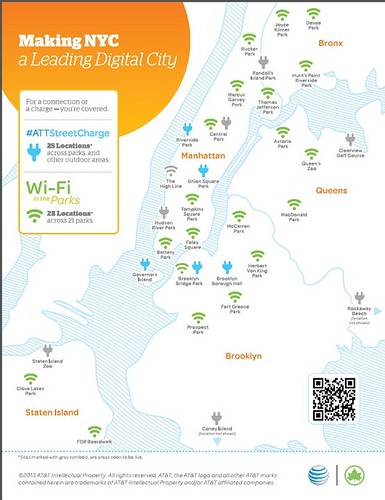
In New York City, AT&T, in association with the City, is introducing 25 solar-powered charging stations in public spaces including parks and beaches.  (press release)

The system is called AT&T Street Charge.

It was done in part to build resiliency in the face of storms and power outages.


Map of locations for AT&T Street Charge chargers
AT&T Street Charge

Labels: , , , , ,

Tuesday, April 02, 2013

Multiunit apartment building in San Diego will offer free solar-generated electricity

See "New apartments offer free solar power: Fenton's latest project powered by plenty of photovoltaics" from the San Diego Union-Tribune.

From the article:

Solterra, H.G. Fenton's 114-unit apartment project nearing completion in Scripps Ranch, boasts a saltwater pool, games-filled clubhouse and stand-up tanning salon. But what may prove to be the deal closer when the luxury project opens in May is free electricity to residents.

In San Diego County's first such "net-zero" energy project, enough solar power cells are being installed to produce all the energy needed for average users as well as the common areas at the 4-acre site just east of Interstate 15 at Mira Mesa Boulevard. If residents don't exceed the average use projected, they can expect a rebate check in the mail.

Company President Mike Neal said even at a time when vacancies are dropping, there is still stiff competition for landlords to attract tenants, especially in the luxury market. "We want them to choose us," he said.

I have heard of some examples of how solar-generated electricity on senior and affordable housing developments in Tempe, Arizona (Encore on Farmer) and DC (Sheridan Station), has been used as a way to fund the provision of programming and other amenities, because of the lower operations costs.

But this takes the concept to a new level.

Labels: , ,

Friday, February 03, 2012

More Connecticut communities looking at municipal option for utility delivery

After the debacle of October's freak winter snowstorm which paralyzed parts of the Northeast for days, and had hundreds of thousands of Connecticut residents without electrical power for as much as 10 days, the fallout cost the president of Connecticut Power & Light his job and now the issue has been taken a step further as the Connecticut State Legislature is holding hearings about how communities can go about creating their own local utilities. See "Groups mull over idea of more community-owned utilities" from the New Haven Register.

When Montgomery County Councilman Phil Andrews floated a similar idea with regard to Pepco and Montgomery County, due to the rampant service failures experienced there, local newspapers (the Gazette opinion columnists, Washington Examiner) excoriated the idea. See "Press piling on Montgomery County's utility dreams."

Labels: , , , ,

Saturday, November 26, 2011

Undergrounding electric utility lines

This is an issue in DC generally, in areas of the city that are outside of the original "L'enfant city," where there is a ban on overhead wires being placed along streets, and in the nearby counties, in response to frequent storm-related power outages.

Residents in the Brookland neighborhood, in a completely back-a**ed way, tried to make this an issue during the streetscape renovation planning and construction process there, but by not working with the planners and other government officials during the planning process (mostly the active residents focused on denigrating the planners) they didn't achieve their goal. Instead, they raised this when the streetscape was being constructed, and some particularly litigious and obstreperous residents sued the city (to no avail).

Of course, Pepco didn't make it any easier, because they say it costs about $22 million per mile to underground electric wires--a price that is about 12-15 times higher than national averages.

Paradise Valley in Greater Phoenix has been, over the past 20 years, undergrounding their electric and telephone wire infrastructure "making way for more unobstructed views" according to "Paradise Valley close to its goal of burying all utility lines" from the Arizona Republic.

Note that to do this--they've completed 55 miles and have 3 miles to go--it's paid for partly by the city and residents through a special taxing district, and the rest from the local utility. From the article:

He said the undergrounding costs over the years have totaled more than $12 million from Arizona Public Service Co. and $15 million from the town. ...

Residents in a designated district are assessed a fee that helps subsidize the costs, LeMarr said. In 2009, the property owners in District 6 paid $160,000 for the undergrounding.

LeMarr said residents favor the project, but the economic downturn slowed its progress.

"Some residents in this district have been waiting four years for this leg to be completed," he said. "We're committed to this project, and over the years, we've never wavered."

The town has an agreement with APS, which serves most of Paradise Valley, to bury the lines. In areas not served by APS, the town works with Salt River Project on individual removal and undergrounding projects.


The Paradise Valley process demonstates the need to have all parties--residents, the local government, and the local utilities--on board from the outset, otherwise it is impossible to achieve the goal, as any one uncommitted stakeholder can scuttle the attempt.

Labels: , ,

Friday, September 26, 2008

Automobile related economic development in the 21st Century

Last Sunday, I wrote incredulously about the proposal by Councilmember Brown, chair of the DC City Council Committee on Economic Development, to put multiple car dealerships in the old Hecht's Warehouse in Ivy City (on New York Avenue NE).

I didn't get into how the U.S. automobile industry is failing, I did discuss how cars take up valuable space in the city's land inventory. Nor did I really discuss what's going on with oil prices...
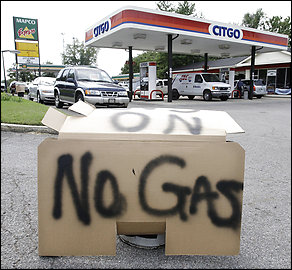
A Nashville station out of gas.
A Nashville station out of gas. Hurricanes knocked offshore production out of service in the Gulf of Mexico, disrupting regional supply. (By Mark Humphrey -- Associated Press)
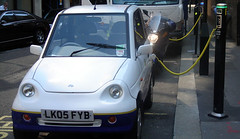
EDF juice point, Westminster, London
Economic development in Westminster borough, London, where EDF has installed on-street electricity meters for recharging electric vehicles. Photo by Smart Planet.

Meanwhile, Electricite de France, the company that seems to have been screwed out of buying the company by Chairman Mayo Shattuck of Constellation Energy, the company that owns the local utility (mostly serving Baltimore and its environs, but reaching out into Howard County, maybe even the far reaches of Montgomery County?) Baltimore Gas & Electric, which instead sold out to Warren Buffett for less money, has introduced on-street electricity "juice points" for electric cars in Westminster, London. See "Westminster City Council juices up electric cars" from Smart Planet and "Plug-in hybrid boosts electric motoring" from the BBC.

I guess this is the difference between a City Council (DC) that is backwards looking rather than forward looking (Westminster borough, London).

Labels: , , , , ,

Friday, July 04, 2008

Energy costs change many things

1. Maybe mills will come back, or at least electricity from water power in rivers. Great Falls could be a great energy source, etc. See "In an Age of Fossil Fuel, Returning to the Water for Electricity," from the New York Times.

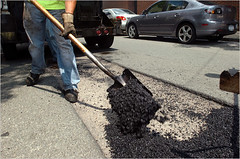
2. Asphalt, the most common road material, also contains petroleum. It's cost is going up as the price of oil rises. See "Cost of Asphalt Rises, Affecting Repaving," from the New York Times.
New asphalt being applied on Westmoreland Avenue in White Plains
Alan Zale for The New York Times. New asphalt being applied on Westmoreland Avenue in White Plains.

Labels: , ,