Rebuilding Place in the Urban Space

"A community’s physical form, rather than its land uses, is its most intrinsic and enduring characteristic." [Katz, EPA] This blog focuses on place and placemaking and all that makes it work--historic preservation, urban design, transportation, asset-based community development, arts & cultural development, commercial district revitalization, tourism & destination development, and quality of life advocacy--along with doses of civic engagement and good governance watchdogging.

Monday, January 06, 2020

Top Transportation Stories of 2019

I can't claim this is the most comprehensive of lists.  It's been a very busy year for me with some major changes, and so I have been blogging a lot less and "mentally" I haven't been on top of tracking topics systematically.

After a certain point, this isn't necessarily in ranked order.   The ordering presented tries to balance significance in terms of policy and the number of people impacted.

Grounded 737s
Southwest Airlines Boeing 737 MAX aircraft are parked on the tarmac after being grounded, at the Southern California Logistics Airport in Victorville, California. MARK RALSTON/AFP/Getty Images.


1.  The massive organizational, design, manufacturing, and engineering failures with Boeing's 737Max airplane, and the related regulatory failures by the Federal Aviation Administration, resulting in two catastrophic plane crashes killing 346, the subsequent grounding of the planes, the cost to airlines, and now the cost to the suppliers and workers as manufacturing of the plan has been halted, pending the re-authorization of the plane as safe to fly.

-- "The Long-Forgotten Flight That Sent Boeing Off Course: A company once driven by engineers became driven by finance," The Atlantic
-- "Flying too closely - Regulatory capture may be responsible for Boeing's recent problems," Economist

2.  Resistance to climate change/air quality measures that increase the cost of fuel or restrict vehicle access to city centers.  France's gillets jaunes demonstrations ("Who are the gilets jaunes and what do they want?," Guardian") and new conservative city council in Madrid's reversal of the adoption of an LEV zone in the city center ("Madrid's low emission zone identified as one of the most effective in the EU," Eltis; "As Cities Limit Traffic Pollution, Madrid Reverses a Driving Ban," New York Times) although this was reversed after wide criticism ("Madrid low emission zone reinstated after protests," BBC News) but the administration came back and will introduce a plan that still rolls back the program ("Madrid to ease low-emissions zone restrictions: More cars, lower parking fees," El Pais") are examples.

But some banks are adding climate change considerations to loan evaluation processes ("
The Energy 202: Goldman Sachs rules out financing for Arctic drilling. Will other U.S. banks follow?
," Washington Post).

3.  The continued disruptive effects of ride hailing on the urban mobility system include:
-- airports (LAX, SFO, Logan; "Uber, Lyft to stop Phoenix airport trips over higher fees," AP) reorganizing ground transportation, separating ride hailing vehicles from the street side arrival and departures traffic lanes, because of congestion
-- the death of Super Shuttle, the system of vans that took people to and from airports
-- continued financial losses for the companies
-- and traditional taxi firms and drivers
-- continued issues with safety and regulation (Uber loses its license to operate in London, again)
-- surcharges on rides.

4. E-commerce and impact of fast, frequent, multiple deliveries on cities. Frequent purchasing, the shifting of our picking and transporting purchases home to third parties, fast shipping even same day service has tremendous consequences in cities especially adding significant congestion, increasing the number of traffic accidents and deaths, etc. ("1.5 Million Packages a Day," New York Times).

 According to Professor José Holguín-Verasat at the Rensselaer Polytechnic Institute's Center of Excellence for Sustainable Urban Freight Systems, deliveries by passenger vehicles including small vans generate seven times more emissions compared to more traditional methods, such as electrically powered UPS vehicles ("Online Shopping Was Supposed to Keep People Out of Traffic. It Only Made Things Worse," Time).

FedEx  worker sorts packages in Upper East Side, Manhattan
FedEx worker sorts packages in Upper East Side, Manhattan. Photo: Brittainy Newman, NYT.

A Toronto Star reporter went undercover, working 8 shifts as a package delivery for an firm contracted to handle same day deliveries, "I went undercover as an Amazon delivery driver. Here’s what I learned about the hidden costs of free shipping."

Relatedly, there is the issue of package theft, which is massively on the rise ("90000 Packages Disappear Daily in NYC Is Help on the Way?," NYT), the use of Ring videos as a way to catch thieves, etc.

5.  New York City's adoption of a high profile bus "exclusive" roadway on 14th Street.  This matters because it's high profile, prevailing despite significant opposition including lawsuits, and will lead to similar deployments elsewhere in the city and likely across the country.

And it's proven all the naysayers wrong, with significant improvements in speed, adding riders, and not having that much negative impact on congestion on other streets, despite regular automobile traffic being displaced ("Speaking of "Just Do It": A 14th Street bus transit mall for Manhattan" and "New York's 14th Street, San Francisco's Market Street (and Toronto's King Street): When major cities adopt innovative practice it makes it easier for other cities to do something similar.")
L Project: 14th Street Transit Priority
This is an example of my line that "world class cities give, they don't just take."  By that I mean they push better practice forward, making hard choices, and this gives other cities the confidence to implement similar practices.

New York City is not the first city to do this.  Paris wasn't the first city to do bike share.  Paris was the first city to do bike share on a massive scale, making it highly visible and a world-wide phenomenon.

However, New York City's initiative to give street space back to pedestrians, first in the Times Square-Broadway corridor, through "pilots" which lead to permanent changes to street and pavement treatments, has led to similar transformational projects across the U.S. ("attle for a New Times Square: An Excerpt from Streetfight," Urban Land).

6.  The passage of a congestion zone and surcharge pricing for Manhattan.  (This would be ranked higher except it hasn't taken effect.)  An attempt to do this during with the support of the Bush Administration during the rule of Mayor Bloomberg was scotched by opposition in the State Legislature.  This year, with the support of new Democratic Party majorities in the House and Senate, it passed, although it won't take effect until 2021 at the earliest.

I think it passed because the Governor recognizes the huge financial requirements for the MTA transit system outspan the capacity of current tax and other revenue streams ("MTA Capital Program: The Devil Is In The Details," Railway Age).  Before he had been opposed.

Stockholm, London, and Singapore are noteworthy existing examples.  London and other cities are creating "low emissions zones," with restrictions on cars pumping out high emissions.

7.  Bay City, Michigan selling its bridges, which will be tolled, because they can't afford to fix them ("Bay City Commission approves selling 2 drawbridges to private company," Bay City Times).  This is as important as "free transit" or congestion pricing in what it communicates about the cost of maintaining infrastructure and how smaller units of government have limited options for coming up with the money to do so. From the article:
“I’ve heard a lot of comments today, I’ve heard a lot of comments for four years. And this is probably the hardest decision I’ve probably ever had to make in my entire life. What I’m about to do tonight with my fellow commissioners is vote on something that could change the city forever," Commissioner Brentt Brunner said before the vote took place.

United Bridge Partners will pay Bay City a total of $5 million — $2 million when the agreement is signed and $3 million when ownership of the bridges is transferred. ...
The company will shoulder the multimillion dollar cost of repairing Liberty Bridge and replacing Independence Bridge with a new span.

Tolls will be implemented after work on both the Liberty and Independence bridges is completed, according to United Bridge Partner’s plan.
8.  Car technology: electric vehicles and autonomous vehicles.  The adoption period for both EVs and AVs is likely to be a lot longer than all the media coverage indicates.  EVs are more expensive to buy and gasoline is still relatively cheap.  The complexity of driverless car technology in most road settings is far higher than most people have realized, and it is not likely to be deployed on a wider scale in non-Interstate freeway settings until the 2030s.

9.  Virginia's announcement of a big deal with CSX which will allow a significant expansion of passenger rail, especially between Richmond and Washington, DC ("Virginia, CSX, Amtrak Get Serious About Passenger Rail," Railway Age).  A lot of the significant developments in expansion of passenger rail are at the regional and state scales.  Amtrak as the "national passenger rail system" has been designed for failure ("Amtrak Survived Richard Nixon—Can It Overcome Donald Trump?," Wired), although it is on the verge of turning  a profit.  This is a premier example of how to move a state's rail agenda forward.

(Also see the past blog entry "A "Transformational Projects Action Plan" for a statewide passenger railroad program in Maryland").

Other significant railroad-related items include the 150th Anniversary of the completion of the Transcontinental Railroad in May; Amtrak's cancellation of the traditional dining car on certain routes; Amtrak turning a profit; and the private Brightline railroad service in Florida is going to add stations to certain cities, with cities paying towards stations, and has negotiations underway to have a station at Disney World, the state's #1 tourist attraction.  Plus the continued service failures of NJ Transit and expansion planning for PATH.

10.  Maybe more HOT lanes for DC's Maryland suburbs isn't a top issue, it's gone back and forth and is now in 2020, moving forward again, after it seemed in December that the project was being sidelined.  What stands out for me is how the "traffic congestion program" for HOT lanes involves zero in the way of transportation demand management and transit expansion.  It's all about cars.

So much for being concerned about climate change.

11.  Another disruptive effect of ride hailing is the death of one way car sharing in the US and Canada, because the main provider, ShareNow--formerly Car2Go, announced it would be shutting down at the end of February 2020. (However, Free2Move, a subsidiary of Groupe PSA, does have a single operation in DC. Could they expand?)

From the Financial Times article, "German automakers do U-turn on car-sharing push":
“There are potentially ‘disrupting’ business models that rely on car usage rather than car ownership,” Mr Zipse said in a speech to analysts. “But they are focused on very specific areas with high population densities to ensure high utilisation rates.”

“In our three main markets — Europe, China and USA — only a small fraction of people and of our customers live in these super-urban areas,” he continued. “For those who do, in the premium segment, owning a car remains a matter of convenience and privacy. This is our target group.”
I made a similar point in these blog entries, "Further updates to the Sustainable Mobility Platform Framework" and "DC is a market leader in Mobility as a Service (MaaS)." Car sharing is awesome when you have the right conditions: short distances between residential districts and activity and employment destinations; tight parking inventories; reasonably dense population; the need for access to a car but at less than the amount of time justifying car ownership, etc.

More on this in a separate blog entry.

12.  The ups and downs of micromobility.  Micromobility is the new term of art for e-scooters, bike share, and e-bikes.  I am doubtful that it can be the kind of widely adopted service that is touted.  For the same reasons listed as why one way car share is difficult to make successful, alternative transportation modes work very well in specific conditions requiring population density and relatively short distances between origin and destination.  Most U.S. cities lack those conditions.

Plus, electric powered bikes and scooters require a significant infrastructure to stay in operation and the cost becomes so high that the cost to use the micromode is equal or greater than ride hailing ("Uber is trying to make bikes and scooters a profitable business," Fox5 San Diego).

Also there is the issue of "wrangling" scooters especially.  Many users "park" them haphazardly in the public space, creating problems for pedestrians.

Lime is offering a $5/week pass in Baltimore.

13.  If we count "regular" bikes as micromobility, which we should, apparently bike sales are down but revenues are steady because people are buying more expensive bikes.  But I wonder, outside of major cities, how much "biking for transportation" is going on?  I don't see a lot of it in places I've been traveling in lately, like Los Angeles and Orange Counties, California or Salt Lake City, Utah.

But some package delivery firms are starting to deploy cargo bikes on a wider basis ("Here Come New York's Cargo Bikes," New York Times).  Again, in areas with what I call the preconditions for the sustainable mobility platform.

Relatedly, the way you can tell that there is a wider uptake of biking for transportation is the use of a wider range of bikes by riders, cargo bikes for trips to the supermarket and taking the kids to school, etc.  I do believe, at least in the core, especially Greater Capitol Hill, that there is greater biking uptake based on the wide range of bike vehicles I had been seeing.

14.  Lots and lots of coverage about refocusing attention on bus transit.   One such example is the book Better Buses, Better Cities, published by Island Press.

Which I promise to review this month, finally, alongside another Island Press tome,  TRAINS, BUSES, PEOPLE, by Christof Spieler.

A couple of other examples of coverage on bus transit issues includes bus shelters ("A shelter may be on its way to your TTC bus stop," Toronto Star), shade ("‘Turn Off the Sunshine’: Why Shade Is a Mark of Privilege in Los Angeles," New York Times), and wi-fi ("Free Wi-Fi now available across MATA fleet," Memphis Business Journal).

15.  Free transit. In late 2018, Luxembourg announced it would shift to 100% free transit, including certain connections from neighboring countries, as a congestion fighting measure.  Currently, they are planning the rollout, which will take effect in March 2020 ("The cost of Luxembourg's free public transport plan," BBC News).

Recently, Kansas City, Missouri announced it would move to a free transit paradigm. ("Revisiting free transit in the wake of the decision in Kansas City").  Olympia, Washington started free transit on January 1st, arguing that farebox revenue made such a small proportion of revenues--2%--that it wasn't worth paying for a fare equipment upgrade ("Olympia becomes largest city in Pacific Northwest to offer free public transit," The Hill).

Lawrence, Massachusetts has made three intra-city bus routes free, which excites the Boston Globe ("In Boston, let's make the bus free").

The issue for me is that I'd rather there be a focus on better, faster transit, and financial subsidy for low income riders, instead of making a whole transit system free.  Even systems that are relatively successful have plenty of opportunities for improvement.
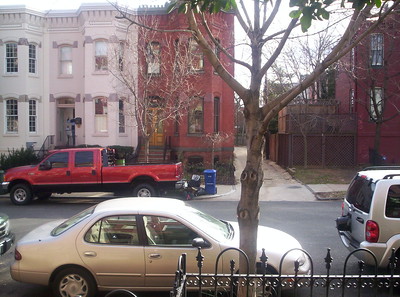
The Ford F-350 is wider than the typical Capitol Hill rowhouse
16.  Pedestrian deaths from car crashes are rising ("Pedestrian Deaths Reach Highest Level In Decades," NPR).  Brilliant reporting in the Toronto Star finds a direct correlation between declining traffic enforcement as measured by the number of tickets issued and crashes and deaths ("U of Toronto expert attributes dozens of deaths to decline in Toronto police traffic ticketing").

Probably it's also due to the prevalence of bigger cars, as a preponderance of consumers shift to SUVs and trucks ("Low Rates, Cheap Gas and Deeper Debt Sustain Car Buying Boom," New York Times). From the article:
The auto industry has been on a roll for a decade, and its resurgence shows few signs of coming to a halt — at least for now.

Strong employment, low interest rates and robust consumer confidence combined last year to extend a record run of auto sales.

Americans are also continuing to buy ever bigger cars, at prices escalating faster than the overall inflation rate. And they are taking on more debt to do so. ...

Low fuel prices have also helped. The average retail price of regular gasoline was at $2.57 this week and has not been above $3 in more than five years, according to the Energy Information Administration.

That helps explain why consumers continued gravitating toward pickup trucks, sport utility vehicles and other roomy models, offsetting another steep fall in sales of sedans and compacts. Nearly two out of every three new models purchased last year were classified as light trucks — which includes minivans and even some small, S.U.V.-shaped cars.
And speeding because of relatively stable gas prices not encouraging parsimony when driving.  Bigger vehicles driven faster are more deadly in a crash.

17.  Toronto's old streetcars were retired in December, as the city has finally received enough new vehicles ("Why I’ll miss Toronto’s old CLRV streetcars," Toronto Star).  Toronto doesn't get a lot of attention for the fact that it (along with Boston and San Francisco) is North America's preeminent example of an existing somewhat robust streetcar system, not unlike Brussels, Melbourne, or Zurich (Philadelphia also has a number of still operational streetcar lines, but not as extensive a network as these other cities).  There are about 180,000 daily riders on Toronto's ten streetcar routes.
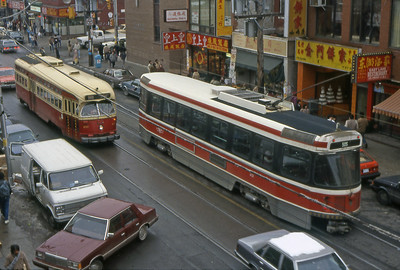
Vintage photo of Toronto streetcars, both PCC and CLRVs (Canadian Light Rail Vehicles)
Vintage photo of Toronto streetcars, both PCC and CLRVs (Canadian Light Rail Vehicles), makes clear the much larger capacity of the CLRV.

Toronto's King Streetcar line carries 84,000 riders daily, and more recently has been the subject of a streetcar prioritization over motor vehicle traffic that has improved trip times and brought more riders to the line. According to the article a streetcar has the capacity equivalent to three buses.

=====
Other very important issues include:

-- Iran's bombing of Saudi oil fields and the subsequent listing on the stock exchange of the Saudi oil company, Aramco
-- large supplies of oil, driven by fracking
-- the merger of Groupe PSA and Fiat Chrysler, after FCA had first considered a deal with Renault-Nissan
-- bankruptcy of trucking companies in the U.S.
-- the impact of the decline of coal shipping on the financial picture of freight railroads
-- accessibility in general, in transit, in tourist destinations ("Machu Picchu now wheelchair accessible," Artnet).
-- microtransit services ("Cities Struggle to Boost Ridership With ‘Uber for Transit’ Schemes," Wired)

Labels: , , , , , ,

Monday, October 08, 2018

Revisiting stories: Night-time safety: rethinking lighting in the context of a walking community and Detroit's reduction in pedestrian deaths from lighting upgrades

I wrote about this in 2014 ("Night-time safety: rethinking lighting in the context of a walking community" and "Lighting as an element of urban design and community identity: Cleveland chandelier + Chicago lighting design framework plan design competition").

The basic idea is that in the context of an 18- or 24-hour city, you need to plan specifically and in a structured fashion for the night-time daypart, and that means planning for lighting. The Eindhoven Netherlands lighting master plan takes this further, by defining six categories of light:

  • urban lighting (streets, public areas)
  • buildings and objects
  • art (indoor and outdoor)
  • events and festivals
  • information
  • advertising.
Since then, I also came across a lighting master plan from the City of Bath in the UK.  Bath is noteworthy for being the pilot system of modern integrated urban wayfinding systems.

-- Bath City Centre Lighting Strategy

LED conversion to save money.  Otherwise, the focus of most local governments is streetlight upgrading to LED to save money by using less electricity ("Webinar on street lighting: LEDs, networks: Thursday March 9th").

This has got many residents up in arms because of recommendations by a committee of the American Medical Association about the Kelvin frequency of LEDs and the fact that manufactured LED lighting tends to be at higher frequencies ("When the lights go on in DC, will they be too bright?," WTOP; "Takoma Park looks to new LED lights to save money, energy," Washington Post).

Smart City initiatives/Streetlights as networks.  Some but not all local governments are also looking at conversion projects as a way to reposition streetlights as networks, and incorporate other elements.  For example, DC would like to use new streetlight systems as a way to deliver wi-fi and incorporate Shot Spotter and other public safety technologies.

-- "Smart street lighting is driving smart city projects," SmartCities World

Streetlights as electric car charging devices.  London ("Want an electric car charge point on the street outside your house? There's a £2.5m pot, but the catch is you have to apply though your council," This is Money) and Los Angeles are two of the cities looking at this.

Streetlight conversion as an element of public safety.  Streetsblog USA calls our attention to Detroit ("Detroit Streetlight Effort Dramatically Reduces Ped Deaths") where likely the streetlight conversion was driven by saving money, but is positioned primarily as a public safety initiative. The city claims a 95% decrease in annual pedestrian deaths -- from 24 to 1 -- because of the change.

Communicating benefits: public safety versus saving money as the primary message for streetlight upgrades.  One of the most important books I read on marketing and message was called Strategic Marketing for Not-For-Profit Organizations.  Its primary point is that all organizations have three publics: input which give you resources; throughput which does the work of the organization (staff); and output to whom the organization's actions are directed.  And that you should differentiate your marketing depending on which public you're addressing.

Too often government agencies don't differentiate in messaging across the publics or test what type of messaging resonates best.  Saving money is a great benefit, but might not be the most important message.

... just as the presentations around the report Building Public Will make the point that the best message for clean rivers isn't environmental stewardship but more focused on public health and the fact that most drinking water comes from rivers.

The lesson is to figure out the best message that resonates with the public, not based on how you think the public should be acting and behaving ("take care of the environment" vs. clean drinking water or "historic preservation is a good thing to do" vs. it.makes your house worth more, etc.)

Labels: , , , , , ,

Friday, March 30, 2018

US now a laggard nation when it comes to automobile emissions and efficiency

Many newspapers have reported on EPA's proposal to cut fuel efficiency requirements for automobiles ("EPA poised to scrap fuel economy targets that are key to curbing global warming — setting up clash with California," Los Angeles Times).

This is very interesting because it is counter to what is happening in other nations.

Another example that the US seriously lags best practice under the Trump Administration.

-- "Scott Pruitt's Dirty Politics," New Yorker Magazine


Norway, an oil producer, announced that by 2030, no gasoline or diesel cars can be sold (also see "Gas Stations Get Ready for the Electric Future," Bloomberg).  India set the same deadline of 2030 and the UK, 2040, and it is an oil producer too.

China has made a similar announcement, without a deadline, but in the meantime, to fight smog it has banned the future sale of more than 500 car models determined to be highly polluting ("China, Moving to Cut Emissions, Halts Production of 500 Car Models," New York Times).

The Netherlands, one of many European countries that taxes gasoline very highly, announced that effective in 2025, only electric cars can be sold.

Copenhagen plans to ban diesel and gasoline cars by 2019. Oxford by 2020 ("Oxford aims for world's first zero emissions zone with petrol car ban," Guardian).

The mayors of London, Los Angeles, Paris, Mexico City, Seattle, Copenhagen, Barcelona, Vancouver, Milan, Quito, Cape Town and Auckland ("The mayors of London, LA, Paris and Seattle pledge to ban gasoline and diesel vehicles by 2030," AP) have announced similar plans, with a deadline of 2030.

Oxford in the UK has proposed the world's first "zero emissions zone" in the city center, and will gradually roll out and expand the district, starting with six streets ("Oxford aims for world's first zero emissions zone with petrol car ban," Guardian; "Oxford city centre car ban - should it go ahead?," Oxford Mail).  It includes buses and taxis.

-- Zero emission zone, Oxford

Germany.  Meanwhile, Berlin and four other German cities are going to test the provision of free transit as an air quality measure ("Germany considers to fight pollution with free public transportation," Washington Post). And German cities are looking to ban diesel cars too, for air quality reasons, even though the country is a major automobile manufacturer ("Diesel cars can be banned from German cities, court rules," Reuters).

Labels: , , , , , , ,

Sunday, March 11, 2018

Chattanooga as an e-car platform

Last week, I suggested Car2Go car sharing as a way to drive the development of an e-car charging system across a city ("Electric vehicles and city charging infrastructures: could car sharing be a way to drive changes more quickly?"). 

Note that I didn't use Brooklyn and Queens as an example, even though Car2Go is operative there today.  When asked about this by I colleague, I wrote:
My reservation is that it's not best to try to do something innovative but difficult in a place where it is already extraordinarily difficult to do anything. In other words, try to pick a place to start off with where you can be wildly successful and where opposition is likely to be muted.

E.g., DC tried to do streetcar in Anacostia but the area has pretty contentious if not noxious thinking about politics, "the neighborhood," transit, and public resources. So that area has zero streetcar and DC shifted to H Street NE. It delayed launch, but East of the River, by at 6 years. I was at a WMATA conference in Nov. 2006, where a DDOT person confidently said they'd be starting streetcar service in Anacostia the next year.

I should have said this about NYC:

After figuring this out in places where the constraints are fewer, like DC and Seattle, then take on a space with extraordinarily difficult infrastructure challenges like NYC, specifically Brooklyn and Queens where Car2Go operates.

OTOH, you could counter with Autolib, which was launched in Paris, which is just as tough a place to do it.

The difference though between NYC today and Paris then at the launch of Autolib is the support of the top elected officials, and the overall greater commitment in Europe towards dealing with the environment and climate change.

Autolib was an initiative of the then mayor. And today the Paris mayor is just as committed to the environment and clean air. Did you see that Paris will be giving incentive payments towards the purchase of bikes, cargo bikes, and e-bikes to people who agree to give up their cars, as part of clean air initiatives. That's an indicator of the difference between Paris and today's NYC.

These days, the current mayor of NYC doesn't seem to be particularly engaged when it comes to sustainable mobility generally, and he's not a rah rah kind of person on stuff that isn't social justice related.
Anyway, like the BlueIndy program in Indianapolis and the GreenSpot program in Jersey City, it seems as if Chattanooga is developing a similar program, according to GovTech ("Chattanooga pushes multimodal to solve its transportation problems").

But I don't think it's an example that is quantumly different at a system scale because it's pretty small when it comes down to it, but a bit more marginally interesting because the transit agency is adding a solar farm to power it--even though it seems somewhat duplicative as the region is known for cheap hydroelectric.  From the article:
The Chattanooga Area Regional Transportation Authority (CARTA) is constructing an 80-kilowatt solar farm, the installation of 64 electric-vehicle charging ports spread across 22 sites and a car-sharing program powered by battery-electric Nissan LEAFs. ...  
“With interest from an electric-vehicle car-share operator, CARTA entered into a funding agreement with TVA in February 2014 to provide for a minimum of 40 charging ports and a 20-vehicle car-share program ...

The car-share portion of the project is operated by Green Commuter, a membership-based car-sharing platform based in Los Angeles. Members rent the car for the time they need it, while the company pays for electricity to recharge the vehicles, as well as maintenance, parking and insurance costs. Rates are $7 an hour or $45 a day.
20 cars isn't that big a deal, almost not big enough to even acknowledge, although it is significant from the standpoint of smaller cities, as Chattanooga has about 180,000 residents.

The BlueIndy program has 230 vehicles. Granted, Indianapolis has five times the population of Chattanooga, but still, a program with 230 electrically powered vehicles is of a size that's significantly noticeable.

In DC, Car2Go has a 600 car fleet, albeit none are electric.

Multimodal vs. the concept of the sustainable mobility platform
.  The other thing that I don't think is as useful is to think about this in terms of "multimodalness." Yes, different modes are multiple.  But the issue is to integrate the sustainable modes into a system. 

Some refer to this as "transportation as a service" or "mobility as a service," although they aren't necessarily focused on all the services being "sustainable."

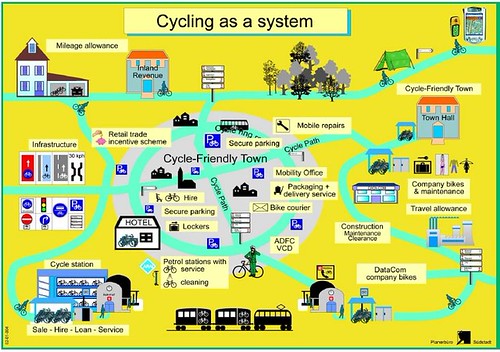
I prefer to call this the sustainable mobility platform ("Dolly micro-move app as an element of the Sustainable Mobility Platform" and "Free access to cargo bikes/e-cargo bikes as part of a mobility hub/sustainable mobility platform"), extending the concept from a diagram from an old national bicycle plan for Germany.

Bicycle Traffic as a system, diagram, German National Bicycle Plan, 2002-2012

Sustainable Mobility Platform Elements

I continue to work out where to place the various rungs on the ladder.  It's easier if you split it out according to trip distance.  These are the elements:

-- Walking
-- Scooters/Skateboards
-- Cycling
---- secure bike parking, air pumps, repair stands
---- access to trailers
---- tandems
---- cargo bikes
---- e-bikes
---- special populations ("Two men leading an effort to provide bikes to homeless," WLOX-TV)
-- Bicycle sharing
---- community system
---- building/campus (e.g., hotel, office building, university, office complex)
---- special populations ("New bike share program gives One80 Place's homeless a way around the city," WCIV-TV)
-- Segways/electric wheels
-- Delivery services (e.g., Dolly; UPS, FedEx, etc.) and package pickup points
-- Transit
---- various bus, streetcar, light rail, heavy rail, railroad services
---- network scale (regional, metropolitan, city; primary, secondary, tertiary)
---- intra-district(Baltimore Circulator, Circulators, San Diego FRED Shuttle); tertiary network (Tempe Orbit)
---- shuttle services (school, employer, residential)
---- microtransit either private (Bridg, Chariot, Israeli sheruts) or public (AC Transit FLEX pilot project, "The newest battleground between public transit and Uber, Lyft is an unlikely one," San Jose Mercury News)
---- van pools (longer distance) (vride)
---- shared taxi type services at edges of the transit system (taxi collectif in Montreal) or intra-district (Via, UberPool, Lyft Line) either publicly subsidized ("Mass transit gets boost from ridesharing," USA Today; "Uber and Lyft Want to Replace Public Buses," Bloomberg) or not
-- Taxis/Ride hailing
---- single trips (equivalent of "single occupant vehicle trips")
-- Car sharing
---- one-way (car2go)
---- two-way (Zipcar, Enterprise)
---- inclusion of a variety of vehicles in fleets to accommodate multiple uses (Zipcar)
---- electric car sharing systems
-- Scooters
---- scooter sharing (Scoot in SF)
-- Car pooling
-- Car rental

Somehow too the system support elements need to be woven into the framework, such as the charging stations, IT services, intelligent transportation systems, apps, etc.

Another way too to think about this is that the enabling infrastructure of a city's mobility system: streets and sidewalks; is the operating system for mobility but also placemaking and quality of life.

Labels: , , , , , , ,

Wednesday, March 07, 2018

Electric vehicles and city charging infrastructures: could car sharing be a way to drive changes more quickly?

Electric Avenue in Portland has five charging spaces.  There are fees to use the chargers, which include 4 DC fast chargers with CHAdeMO and Combo plugs, and two AC Level 2 terminals.


In 2014, I wrote a piece "Electric vehicles and critical mass," about the general issue of how to support the more widespread adoption of electric cars. The article discussed electric vehicle associations as promoters as well as Portland's "Electric Avenue," a street block remade over with e-charging infrastructure.

Since 2014 there have been many advancements concerning e-cars making the need for the development of a more widespread charging infrastructure within cities:
One of the policy drivers emphasizing electric cars is it reduces demand for oil sales and the impact on countries often at odds with the United States foreign policy establishment, like Russia, Iran, Saudi Arabia, and Venezuela ("The electric car industry could take a bite out of oil demand," CNBC). 

In Norway, a large oil producing company, the state oil firm and a major Canadian-based convenience store chain are experimenting with how to reposition "gas stations" ("Gas Stations Get Ready for the Electric Future," Bloomberg; "Couche-Tard looks to Norway for guidance to adapt to electric cars," CBC-TV) in the face of an automobile industry that shifts to electric cars.

And electric cars require little maintenance, putting pressure on auto repair firms and employment ("Will electric vehicles doom your neighborhood auto mechanic," Chicago Tribune).

I am aware of various electric vehicle car sharing schemes, such as in Paris, which I first wrote about in 2011 ("World class cities and the development of new transportation technologies: Paris and electric cars") and Blue Indy ("BlueIndy car-sharing program striving to be in black by 2020," Indianapolis Business Journal) in Indianapolis, which is run by the same firm, Bolloré Group, using the same cars as in Paris, and the Green Spot program in Jersey City ("Eco-friendly car-sharing service opens in Jersey City," Jersey Journal).

But I hadn't really thought about more wide spread car sharing programs as a way to drive the propagation of an e-vehicle charging network across a city, especially given the failure of Car2Go's electric vehicle program in San Diego ("Car2Go switching electric cars to gas in San Diego" and "Car2go ceases San Diego operations," San Diego Union-Tribune).  Note that I drove an E-Car2Go in San Diego and it was a dream to drive.

In my 2011 blog entry I wrote:
If you study the diffusion of innovation (see Diffusion of Innovations by Everett Rogers), in response to the Fox News story about Ecotality, I'd argue that it takes time to introduce new technologies, and it takes time to develop the critical mass of users and support services to make using the new, in this case mobility, technology, practical. (In fact, biking as transportation has some of the same issues.)

With the auto industry, it took about 30 years to truly scale up, and in that time a network of roads had to be created, a system of garages/repair facilities, gas stations, a dealer network, places to stay if you traveled (motels), road maps, etc. in order to be able to get around beyond your immediate neighborhood. Relatedly, the technology of the automobile had to be improved so that you didn't need to be a mechanic yourself in order to keep it running.
The problem doing e-car share in a place like Indianapolis is that it doesn't have a well developed platform for sustainable mobility. Transit is a hard sell there.  Car sharing, let alone using electric vehicles, is that much harder to promote. My sense is that Bolloré Group chose to go there because they were invited, not because they were thinking "what is the best place we can go to in the U.S. to launch our system in the best possible way there is to accelerate adoption of this program?"

Even San Diego probably lacks the right density and relatively short distances between residential areas and activity centers to make car sharing (or bike sharing) work, even though the city has a widespread rail and bus based transit network.

On the other hand, there are cities like DC which have deeper sustainable mobility platforms as well as experience with and success in car sharing.

I happen to be a fervent believer in the Car2Go one-way car sharing program because the small cars are particularly easy to park a definite plus in constrained parking situations.

But in the US, Mercedes stopped selling gasoline powered versions, although they are continuing to sell the electric motor version ("Mercedes to stop selling gas-powered Smart car in the U.S.," USA Today). 

Does that mean that in the future the small car2go vehicles will be discontinued, making the car2go car share "competitive advantage" of being able to park in space constrained places go away?

Electric Car2Go in Stuttgart.

Could e-car sharing be a way to push the development of e-charging, but in a city with better conditions supporting e-car adoption.  To keep small cars as part of the Car2Go car sharing fleet, the company could switch to the electric versions, if a city has the charging network necessary to support it.

The reality is that no city has a widespread charging network capable of supporting 600 (DC), 750 (Seattle),or 1,100 (Vancouver) cars, each requiring a charge at least a couple times/week, needing to access electricity charging in public spaces.

Why not use such a car sharing network of vehicles as a way to drive improvements to the e-charging infrastructure across a city?

Car2Go cities like Portland, Seattle, and Washington would be the best place to try this, although Car2Go has already removed SmartCars from the fleet there.  New York is probably too tough and Columbus and Denver, like San Diego or Indianapolis, don't have the right support conditions although Columbus is just starting to provide free bus passes to downtown workers ("45,000 Downtown Columbus Workers Eligible for Free Bus Passes," Associated Press).

Interestingly, this idea is comparable to how the electricity generation industry got started.  It was expensive to wire individual houses, so instead companies focused on getting large industrial customers.  One such customer was streetcar firms, which is why electricity companies often owned streetcar companies too, until the practice was outlawed.

Having large customers led to the installation of basic utility infrastructure, and once that was in place, it became much cheaper to provide electricity connections to the housing districts that lay in between power plants and large industrial customers.

This likely is the right model for the creation of widespread e-vehicle charging systems, with larger (relatively speaking) customers, car sharing firms maybe complemented by other business users, driving the development of e-charging networks ("From Firm to Networked Systems," Thomas P. Hughes, The Business History Review, Vol. 79, No. 3 (Autumn, 2005), pp. 587-593).

Environment America report on cities and electric car infrastructure.  Last month, Environment America released a report, Plugging In: Readying America’s Cities for the Arrival of Electric Vehicles, on what cities need to do to support the widespread adoption of electric cars. 

There is a good discussion about the different types of chargers, what cities are doing, and yes, that car sharing can be a way to drive e-car use forward, using Indianapolis as an example.

Streetlight modernization programs as a way to drive e-charging network development.  Many cities are looking to modernize streetlights to save energy and add other features such as wifi, public safety elements, traffic monitoring, etc.  The Environment America report mentions London and Los Angeles as examples of using streetlights for e-charging.

The report mentions a program in London that will install charging points on streetlights called the "On-street Residential Chargepoint Scheme" and a fund to pay for it ("Want an electric car charge point on the street outside your house? There's a £2.5m pot, but the catch is you have to apply though your council," This is Money).

The Urbicity equipment in use in London.

The London program has been developed by a German firm Ubitricity, which is working with various boroughs to install charging equipment in streetlights, paid for in part through simultaneous upgrades to the lights with LEDs, and the anticipated cost savings ("London street lamps are being turned into electric car charging points," Independent).

The advantage of using existing streetlight "networks" is that separate infrastructure doesn't have to be created which further clutters the sidewalk and curb zone. While the basic connections that can be installed cheaply are not particularly fast charging, it is a way to deploy much more quickly ("How We Could Put An EV Charging Station On Every Lamp Post: The key: use regular outlets instead of high-speed charging stations,"Fast Company).

Let's face it, the charging points on the street can be somewhat ungainly. From the article:
Owners of hybrid and electric cars can order a charging cable with an in-built electricity meter and will be able to charge their vehicles using lampposts in areas of Barnes, Hounslow, Twickenham, Kensington and Westminster.

The charging points offer a solution to the challenges of installing dedicated EV parking bays and removing parking spaces from the general supply, by giving residents who do not have access to off street parking the opportunity to charge their cars locally. However, the sockets offer lower power charging.
Los Angeles is testing such a pole too ("Los Angeles has a streetlight that can charge your car," Government Technology).  So far, LA's Bureau of Streetlighting has installed 82 car charging points.

Cutting costs by offering car sharing users the opportunity to be "ambassadors." Bike sharing systems in Paris and New York City have programs that reward users for rebalancing bikes to challenging locations. CitiBike calls its program Bike Angels ("New York's Citi Bike pays riders to make it run better," Slate; "Hacking the Citi Bike Points System, New Yorker Magazine).

The early car sharing service Flexcar which was merged into Zipcar had a similar program, rewarding users for putting gas in the car, etc.  When Zipcar took Flexcar over, they dropped the perks.

E-car sharing operations could train a set of members as ambassador-chargers empowered with the ability to take cars to locations where they can be charged, to aid system up-time, in return for similar kinds of rewards.  This makes it cheaper for a company to deploy the cars, which require more careful monitoring and refueling to stay charged. And paying people to do that costs a lot of money--and increases the cost to use the service.

Such a network in DC would also include Arlington.  The DC Car2Go system includes Arlington County, Virginia.  I don't know if the 600 car number refers to both DC and Arlington, or DC only.  The license in Arlington allows for a total of 100 vehicles, but cars in DC can be driven to and left in Arlington and vice versa.

Ideally an electric car based Car2Go network could be extended to the Bethesda and Silver Spring town centers in Montgomery County and Alexandria as well, creating a more extensive "platform" for sustainable mobility but in terms of the one way car sharing element and for a public e-charging network.

Labels: , , , , , ,

Wednesday, January 08, 2014

Electric vehicles and critical mass


Frequently I write about biking and sustainable transportation infrastructure more generally, in terms of the necessity of creating a full spectrum of support facilities, in order to make biking and transit sound, efficient and practical choices.

Left: a slide from one of my presentations that depicts some of the elements (besides roads) of the system that supports automobility: fueling stations; repair stations; lodging; restaurants; maps.

The same thing was done for the automobile, and it took decades to create the necessary infrastructure, to the point where automobility is the dominant mode in the US.

In the comments on the recent entry on electric vehicles ("") Charlie made the point that DC could develop a greater preponderance of support infrastructure.

Separately, Barbara, a member of the Oregon Electric Vehicle Association, commented (and we had a separate e-conversation as well) about the various actions underway in Portland that in fact are leading to the development of a critical mass of users, infrastructure, and visibility and awareness.

Her example illustrates Charlie's point (and my own lack of vision...)

Right: electric Car2Go vehicles in Portland.  Image by Jon Rousseau.

She writes:
EVs won't solve all of our transportation problems, but reducing dependence on foreign oil is possible, and so is reducing auto pollution.

In case you aren't familiar, Portland OR is one of the leaders in rolling out EV's and EV infrastructure. Oregon Electric Vehicle Association has been active here for quite some time, and represents the individual driver population. Drive Oregon is a new organization, and is organizing and representing the commercial EV field. Locally, Staples has several all-electric delivery trucks. We have charging stations all over town, as part of both the US Dept of Energy's rollout program and the State of Oregon's rollout program. Downtown near Portland State University we have Electric Avenue, one-block reserved for EV charging only. And AAA has added EV-emergency-charging to several of their trucks in the area.  ...
Each summer OEVA.org sponsors EV Celebration Day; typically it is a Saturday in July, and held at Pioneer Courthouse Square ("Portland's Living Room").  I believe the 2014 event will take place the weekend of July 5.  It's a chance for the public to look at all kinds of EVs, private and commercial, from conversions to Teslas, and talk to EV owners.
This is a great example of the point about building a system to support various modes being necessary for take up.  Another element is how Car2Go, the one-way car sharing program, has introduced some electric vehicles into their Portland fleet.

Each of the parking spaces on the block designated Electric Avenue has access to electric charging.

It also demonstrates that Portland continues to be a leader in sustainable transportation, starting in the 1960s, when they decided to tear down a riverfront freeway and began to develop the foundations of its commitment to a new transportation paradigm focused on sustainability and quality places,. 

Each step they have taken since builds on previous steps and they continue to expand this vision, paradigm, and practice.

Portland was one of the first cities in the US to begin building a modern light rail system, the first to deploy modern streetcars, a national leader in the development of bicycle infrastructure--they have the highest number of bike commuters in the US--the first to deploy a modern aerial tram as part of its transit infrastructure, etc.--so that each project is not only complete in itself, but contributes and strengthens and extends the sustainable mobility system.

With regard to Electric Avenue, which is a short term project, see "Electric Avenue experiment may continue" from the Portland Tribune and "Portland Plans for Transit All Powered by Electricity" from the New York Times.   From the PT article:
"Electric Avenue has provided an important service to early adopters of electric vehicles, an opportunity for project partners to explore issues related to charging infrastructure in the public right of way, and a showcase for newly developed products," reads on Oct. 17 letter to the city from PSU.
This is in contrast to most cities where practice is more focused on creating individualized projects that fail to contribute to a greater whole.

Not that there aren't growing pains, even in Portland.  Barbara writes further:
A current and unresolved issue is interacting with the different charging stations.  Each vendor has its own approach to this.  Some require you to use their card key; others have you type in your email address on the screen.  As a result, users have to carry a LOT of different card keys so you can use whichever charger is available when you need it.  Over time this may smooth out into one "BankAmeriCard" approach, but right now it's a hassle.
 
Another issue with EV charging is that while your EV is charging, if you leave the vehicle to eat or shop, attend a meeting, or whatever, and some other EV driver pulls in and wants to charge, sometimes that other driver UNPLUGS your car and starts charging their car.  Users are trying to work out a way of communicating to one another an etiquette about this.  But some people are just jerks and don't care how much they might be inconveniencing you by unplugging your car.  Especially if you have already paid for a charging session (by the "session" not by the unit of time or KwH consumed).  At least Nissan has a feature allowing your Leaf to notify your iPhone that you've been unplugged.
Image by Jon Rousseau.

Updating my mobility shed concept for electric vehicle infrastructure.  In my unsuccessful attempt to become a bike share mogul, we were working with a European company that developed the capability of integrating bike share into an intelligent transportation system platform, that could include parking meters, electric vehicle charging, e-bikes, other forms of bike parking, etc.  But the contracting process used by cities militates against proposing something different from what is already being done.

But I need to update my writings on what I call the mobility shed ("Updating the mobilityshed / mobility shed concept") for electric vehicles along the lines of what they are doing in Portland.

Although it is "merely" another example of how to create the right conditions necessary to support behavior change, rather than addressing various elements in fits and starts and in a discoordinated fashion.

Other diagrams of a systems approach to transportation modes and integrated services.

German bike plan system diagram


Kyocera electric bike system diagram


Open parking system diagram for ITS

Labels: , , , ,

Sunday, January 05, 2014

Creating new mobility paradigms: electric cars edition

For various reasons, I don't think electric cars are "the solution" to climate change.

The real "solution" is a lot less driving, and greater use of sustainable mobility modes--walking, biking, and transit.  

Which is what is discussed in the book Green Metropolis, that sustainability is best accomplished by spatial organization, concentration, and density.

Plus, the technology and rare earth minerals required to make electric batteries cost effective are expensive, and the cost of creating and supporting batteries may make the return on investment for electric vehicles perennially negative, except for tax credits and other subsidies.

Unless, like in Europe the taxes on gasoline are very high, which makes alternative fuels competitive, when gasoline costs about $8/gallon.
GE graphic depicting the infrastructure system required to support widespread use of electric cars.

Creating a system to support electric vehicles

But regardless, for electric vehicles to make sense, a support system has to be created, just as one was created to support the gasoline-powered motor vehicle.  The issue is creating the system, the death of Shai Agassi's idea notwithstanding ("Shai Agassi Weighs In On The Lessons Of Tesla & Electric Cars").

Bumps along the way

1.  Man arrested for using 5 cents of electricity at a public school charging station.  See the AP story "Father arrested for charging his electric car at school.  He spent 15 hours in jail.  Eventually, the charges were dropped.  From the article:
It's not clear how much electricity he used in charging his car, but Kamooneh said it was likely to have been worth only a few pennies. The former university professor turned investment advisor told ABC News: 'I'm waiting for them to arrest water drinkers and cell phone chargers.'
2.  Electric cars depreciate faster than gasoline-powered cars.   See "Depreciation hits electric cars hard" from USA Today.

An interesting tv ad from Nissan

Nissan has a good ad, called "Errands" that's meant to address what is called "range anxiety"--that people will be traveling such a distance that goes beyond the charging range of an electric vehicle.  It makes the point that most people drive 29 miles or less per day.  I've only seen it once though.

I like the graphics in this about typical trips, and think that the same basic concepts pertain to sustainable mobility, and could be used in an ad that sells sustainability.


Municipalities are looking at alternative fuel vehicles to save money

See "States look to alternative fuel vehicles for efficiencies" from the Washington Post and "Hyattsville cost-saving effort sparks plan for electric cars" from the Gazette.

Labels: , , , ,

Tuesday, October 23, 2012

When government bugs me: scooter edition

I have lists and lists of topics I intend to write about, one is about electric cars and the mobility shed.

My old writings on the mobility shed provides a kind of hierarchy of modes in terms of their impact from the standpoint of sustainability.
Mobility shed diagram
Mobility shed conceptual diagram.

In the 2007 entry "The mobility shed revisited" I list a bunch of categories, and note the mobility shed is at the transit station/transportation management district scale.  Below I've reordered the list some and added some sub-modes.  The hierarchy per se is based on the distance of a typical trip or the maximum trip length or specialty trip need that can be accommodated.

• walking
- rollerblade
- skateboard
• bicycling
- standard
- utility bicycling
- electric
- bikeshare
• Segways?
• transit
- shared taxi/jitney (intra-neighborhood)
- bus
- rapid bus
- streetcar
- light rail
- subway/heavy rail 
• car sharing 
• taxis 
• scooters/Vespas
• Motorcycles
• driving
- car (usually big)
- cars (usually many in a household)
- electric/hybrid
• railroad passenger services

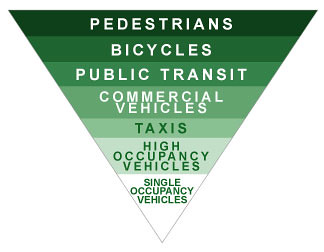
transportation hierarchyAnother way to think about it is in terms of the Transportation Alternatives sustainable transportation hierarchy diagram.   In short, active transportation modes like walking and biking + skateboards and rollerblading are the best, transit is next best, shared vehicles next, and so forth.

The reason that I have problems with the promotion of electric and hybrid vehicles is that as motor vehicles they still take up a lot of space, even though there are other benefits from their use, not to mention the very real environmental costs involved in building batteries and the battery support infrastructure.

From an urban standpoint, electric cars are just another way to greenwash car ownership and make it seem palatable.  As cars they are still space hogs competing for very scarce public space resources.

So while an electric car is better than a regular car, in terms of greenhouse gas emissions, from the standpoint of sustainable transportation it's not that great.

Walking and biking are best, transit is very good, shared vehicle use is better than owning your own vehicle, and if you are going to own a vehicle, I'd rather promote scooters and such over an electric vehicle, at least as a center city mobility strategy.

Where that comes up is that yesterday, the DC City Council committee on transportation had a hearing on "motor scooters."  I didn't attend the hearing because I was testifying at another hearing held at the same time, on the commercial district revitalization plan for Central 14th Street NW, so all I have to go on is the Washington Examiner story "District to crack down on motor scooters."

From the article:

The new rules would also require all scooter drivers to wear a helmet and eye protection and would bar them from parking on the sidewalk, something now illegal for only some scooters.

Scooter owner and fitness instructor Rebecca Bly was tired of getting $100 tickets for parking her scooter on the sidewalk, so she moved it to the street -- only to have it stolen.

But ironically, I have been thinking about the issue of scooter promotion, marketing, and accommodation for awhile (in terms of the discussion above), and even talked to a scooter owner about it yesterday, when she was unlocking her vehicle in Columbia Heights.


In short, scooters are a better choice in a multi-modal sustainable transportation paradigm than motor vehicles and we ought to be promoting them as a co-equal mode, and that means appropriate accommodations, not just restrictions.


One way to accommodate motor scooters is to make "bike" corrals bigger, and allocate a portion, at least in some neighborhoods, to motor scooters.

I don't think that was the intention at this bike corral at "City Hall" (the John Wilson District Building on Pennsylvania Avenue NW) but that is what has happened.

Bike corral on Thomas Jefferson Street NW in GeorgetownRight: a typical bike corral isn't set up for motor scooters, although depending on how tightly the corral is constrained at the ends with pylons, a scooter could be parked at either end of the rack.

The area for this particular corral is larger than the bike parking rack, and scooter users have used the available space, not always properly (note the leftmost vehicle parked in part in the right of way), to park their vehicles.  I can't think of a better illustration of the need to accommodate such vehicles and how we aren't really doing it so far.

And we ought to be promoting scooter use--yes including registration, licensing, and insurance requirements--more than automobile use, from the standpoint of more sustainable transportation choices. 

Unless special parking is provided, in the competition for scarce parking space on the street--especially in dense neighborhoods like Columbia Heights--scooters are likely to most often lose out to automobiles.

The Council hearing on motor scooters is but one more illustration of the need to have a comprehensive transportation plan, including an element on Parking and Curbside Management, rather than to legislate transportation policy in bits and pieces.

I know that DDOT is about to embark on a transportation vision master plan creation process, but with all the various initiatives at the Council level, from taxi policy to performance parking, I think it will be difficult to force the reconsideration of these various transportation policies and regulations in a concerted, structured, and systematic fashion.

Labels: , , , ,

Friday, May 04, 2012

Tomorrow: UCLA, UC Davis host world conference on electric vehicles and cities in Los Angeles


Image: Concept for solar charging station for electric bicycles, from Kyocera.

(Note that later next week, powerpoints and videos from the presentations will be made available on the organizational website) From email:

-- Conference website


The UCLA Luskin Center for Innovation and the UC Davis Plug-In Hybrid and Electric Vehicle Research Center host the World Electric Vehicle Cities and Ecosystems Conference, which will explore best practices and innovative solutions for the deployment of plug-in electric vehicles in cities throughout the world. 
 
The one-day conference brings together more than 300 government leaders, business executives and nonprofit directors from a variety of countries, including Australia, China, England, France, Japan, Germany, the Netherlands, Portugal, Sweden, Spain and the United States. 
 
The event will include panels on designing parking and roads for EVs; financing and maintaining charging stations; using EVs in public transportation; and EV goals for nonprofits, foundations and governments, among others topics, and will feature the release of the much-anticipated EV City Casebook, which provides a look at the global EV movement by detailing policies and programs in 16 cities around the globe. 
 
In addition, the Global Electric Vehicle Insight Exchange, an international knowledge-sharing consortium that tracks worldwide EV-deployment progress, will be announced, as will the World EV Cities and Ecosystems web portal, which serves as a central hub for collaborative EV-deployment and research efforts and disseminates best EV-deployment practices to global stakeholders.  
 
Keynote speakers at the conference will include:  David Sandalow, Assistant secretary of policy and international affairs for the U.S. Department of Energy and Thomas Becker, Vice president of government affairs for BMW 
 
WHEN:
8 a.m.–5:30 p.m., Saturday, May 5
 
WHERE:
J.W. Marriott hotel at LA Live (map)
900 W. Olympic Blvd., Los Angeles, CA 90015  

Labels: , , ,