Rebuilding Place in the Urban Space

"A community’s physical form, rather than its land uses, is its most intrinsic and enduring characteristic." [Katz, EPA] This blog focuses on place and placemaking and all that makes it work--historic preservation, urban design, transportation, asset-based community development, arts & cultural development, commercial district revitalization, tourism & destination development, and quality of life advocacy--along with doses of civic engagement and good governance watchdogging.

Thursday, August 08, 2024

Revisiting: Need for social marketing initiatives around installation of neighborhood traffic calming initiatives: Salt Lake City

In June I wrote "Need for social marketing initiatives around installation of neighborhood traffic calming initiatives: Salt Lake City," about animus about a traffic safety initiative in my neighborhood.  I made the point that car-centric people don't understand how imprinted they are with automobile dependence, and their unwillingness to consider other modes (walking, biking, transit) and users, in this case all the kids who live in the vicinity of this oversized intersection.

But I also made the point that the City Transportation Department could have handled outreach a lot better--basically they didn't do any.  I sent a pdf of the blog entry to the Department Director, and they responded.

These are photos of a couple of outreach devices they deployed, including a signboard in the roundabout and a flyer dropped off at area houses.


And just this week, the City Transportation Department continued to refine the street markings, in keeping with the idea that the roundabout is a prototype, a test.

Labels: , , , , , , ,

Wednesday, July 17, 2024

Revisiting assistance programs to get people biking: 26 programs

I have always been big on differentiation in analyzing places and programs, but lately I've become aware that I may not be as thorough as I could be.

I've written hundreds of blog entries about bicycling and how to promote it as a real form of transportation, focused on but not limited to DC, which is a perfect city for it.

A big point I make with bicycling is that given the automobile dependency that's been fostered on the US given the predominate land use and transportation development paradigm, is that people have to be assisted in making the shift from driving to mostly bicycling.
Building infrastructure isn't enough.  Even great infrastructure can be empty much of the time.  If anything, that's an indicator that people need help to make the change.

Granted for "biking most of the time" a lot of conditions have to be congruent including distance from origin to destination, topography, weather.

I have a piece, "Revisiting assistance programs to get people biking: 18 programs," and speaking of differentiation what I realize it that it should be organized in terms of mass/district/place based supports versus what we might call individualized and personal biking.

An example might be living in Capitol Hill, DC and riding around on various errands, trips to work, for recreation etc., within your neighborhood, versus living 4.5 miles direct to the University of Maryland, and riding there.  

Similarly, Capitol Hill has dozens of bike sharing stations, while the route from Takoma Park to University of Maryland does not.  In Manor Park, there are few bike sharing stations, so having your own bike makes the most sense.

==========

That entry updates "Revisiting assistance programs to get people biking: 18 programs," with the addition of more programs, which I have included below, marked by an asterisk, but without adding much in the way of additional text.

Critical Mass of Riders/Place/District

1. Creating "sustainable mobility stores." Relatedly providing support and subsidies to bicycle shops.

3.  Cycling training

9.  Bike sharing programs ought to be an obvious opportunity for promoting cycling take up.

10.  Discounted bike sharing memberships on a means-tested basis.

12.  Campus specific bike share programs.  

Ciclavia in December 2014.  Los Angeles Times photo.

19.** Open Streets Programs/Community Cycling Promotion programs at the neighborhood and community scale, including promotion of biking through affinity groups.  I've written about both a lot but somehow neglected to include this as part of the comprehensive list.

Neighborhood and district rides at one scale, whole community rides at the others.  I am always amazed to see photos of such events and say "where did all the bikes come from?" because you don't see that many bicyclists riding to work or on errands.

20.**  Electric bike discount programs.  This has the advantage of "expanding" the distance and radius of the area in which someone is willing to bike.  Research shows it can shift people in significant ways from cars.

21.**  Free bicycle share trips to extend transit trips to reaching your final destination.  Columbia SC (bus) transit does this, as does Bogota. (First mile/last mile connection and access issues.)
23.**  Bike bus programs.  Often deployed in conjunction with "bike to school programs" ("I Started a Bike Bus, and You Can Too," Wired, 8 routes for the Montclair Bike Bus in New Jersey, "A cool way to get kids to school -- the bike bus" Boston Globe, ""‘It’s a bit of freedom’: traffic-stopping tech helps Glasgow school’s bike bus on its way"," Guardian).

Bike bus in Brooklyn.  Video at Reddit.

25.** Expansion and Improvement of Trails. Until I rode a trail for some distance after 20 years of  mostly being a street rider, I didn't realize how much mental energy is spent while street riding on safety measures and defensive cycling.  Separation from cars encourages more people to bike.  It lets you "shed" that mental load.

-- "Denver and Rio Grande Rail Trail in Davis County, Utah: a great foundation, full of (missed) opportunity" 2022

26.** Bike (sustainable mobility) Festivals.  I've written about college bike weeks and the Bike Rodeo that used to be sponsored by Utah Transit Authority.  Sometimes an Open Streets program includes some of these features.  Obviously it's a way to get people consider sustainable mobility.


More recently, Washington Area Bicyclists Association has sponsored such events for seniors specifically ("Older adult transportation block party").

Individually-focused

1. Creating "sustainable mobility stores".  Relatedly providing support and subsidies to bicycle shops.

2.  Cycle Borrowing programs.

3.  Cycling training

4.  Bike safety training for children AND YOUTH.

5.  Integrating cycling promotion programs into public recreation centers.  

6.  Other demographic focused cycling initiatives.

7.  Senior cycling promotion programs.

8.  Bikes as tools for improving access to jobs.

11.  Cycle access programs on college campuses and by large employers.

13.  Employer and college-assisted buying programs.

14.  Credit union loans to buy bikes.

15.  Bike donations for children.

16.  Bike bundling programs in public housing.

17.  Donating abandoned and unclaimed bikes to programs serving low income populations.

18.  Short term on-site bicycle provision.

19.** Open Streets Programs/Community Cycling Promotion programs at the neighborhood and community scale, including promotion of biking through affinity groups.  I've written about both a lot but somehow neglected to include this item in this listing.   

Neighborhood and district rides at one scale, whole community rides at the others.  I am always amazed to see photos of such events and say "where did all the bikes come from?"  This item is listed in this section more for affinity groups and community rides.

20.**  Electric bike discount programs.  This has the advantage of "expanding" the size of a district a person is willing to bike it.  Research demonstrates it's a good way to shift trips away from the car.

22.** Secure bicycle parking systems at the city and metropolitan scale ("Another mention of the idea of creating a network of metropolitan scale secure bicycle parking facilities").  Again something I write about a lot that should be integrated into this list.

24.**  Provision of secure bicycle parking, and lockers and showers in destination districts.  Zoning requirements to build them in office buildings and campuses of a certain size.  Or as a proffer/ community benefit. 

25.** Expansion and Improvement of Trails. I didn't realize until I rode a trail as opposed to street riding, how much mental energy is spent while street riding on safety measures and defensive cycling.  Separation from cars encourages more people to bike.

26.** Bike (sustainable mobility) Festivals.  I've written about college bike weeks and the Bike Rodeo that used to be sponsored by Utah Transit Authority.  Sometimes an Open Streets program includes some of these features.  Obviously it's a way to get people consider sustainable mobility.

More recently, Washington Area Bicyclists Association has sponsored such events for seniors specifically ("Older adult transportation block party").

Labels: , , , , , ,

Thursday, September 29, 2022

Poorly thought out transit marketing

 I write from time to time about transit marketing and public communications wrt transportation, like messaging on not drinking and driving, and how it usually isn't particularly good.  Some agencies do a particularly good job though (although maybe it's just that the bar for good is so low?).

METRA, the commuter railroad in Greater Chicago seems to have forgotten that some people use railroads as a way to commit suicide ("Metra billboard sparks alternative, grim interpretation on social media," Chicago Sun-Times).

It would have been easy to do a clear billboard showing lots of traffic versus an easy train ride. But the ad is dowdy, text and a boring image of a train locomotive with the Metra logo.

The 405 Freeway during rush hour in Los Angeles, California. The US consumes about a fifth of the world’s oil output © Patrick T Fallon/AFP/Getty Images.

And the environmental benefits are another selling point.

Image: AA1Car.


Labels: , , ,

Tuesday, June 22, 2021

Why not get a bike?: 'He walked 17 miles a day to work until a stranger gave him a ride and changed his life forever'

There is an article, "He walked 17 miles a day to work until a stranger gave him a ride and changed his life forever," another one of those "person walks many miles daily to and from work, a person sees him, sets up a funding account and the person gets a car, etc. in reward for his perseverance" stories that comes up every so often (cf. "Heart and sole: Detroiter walks 21 miles in work commute" and "'Walking man' settles into new life, friends, waist size," Detroit Free Press).  From the first article:

Michael Lynn was running some errands on June 15 on a hot Oklahoma day when he noticed a shirtless young man walking down the side of a service road. Sensing that the man needed some assistance he pulled up beside him and asked if he needed a ride. 

The young man, Donte Franklin, 20, replied, "Yes, sir!" Donte was doing his daily, eight-mile walk to the Buffalo Wild Wings on the other side of town where he works as a chef. After his shift, he does the same long, eight-mile walk back home. 

To make it to work on time, Donte has to leave the house three hours before his shift starts. He walks an average of five and a half hours a day to and from work. And yet, "I haven't missed a shift at all," Donte told Fox News, adding that he's never been late.

While I think this is great, when I read these stories my first reaction is "why didn't this person get a bicycle?"  

I'm not the only one who has figured this out ("Spring Hill church, helping-hand organization delivering free bikes to homeless, low-income," Suncoast News, "Volunteering Enables Low-Income Ohioans to Get Their Own Two Wheels," Nation Swell, Bikes for All program, Seattle Bike Works, "Henrico church provides bikes to hundreds of low-income families," NBC12, Richmond).


Graphics from the Streetsblog post, "Low-Income Americans Walk and Bike to Work the Most"

His 2.5 hour walk would be a 40 minute bike trip.

I first wrote about this kind of stuff maybe in 2005 or 2006, after reading one or more articles about people reliant on bus transit getting to work hours before their shift, to be sure they'd be on time, given the vagaries of the bus system.

I started biking for transportation in 1990 for exactly this reason, to get to work faster and more reliably than if I were taking transit or walking (I did often walk to work when I first moved to DC, it was 2.3 miles each way).  Biking gave me more and better control of my time.

(And when I worked in Baltimore County, I didn't buy a car because it wasn't a permanent job.  I cycled to Union Station -- 5 miles -- took the train to Baltimore, 35 miles -- first took a bus, and then got another bike to ride from Penn Station to Towson, 8 miles -- and the return each day, although when I was tired, sometimes at night I'd take the Metro home from Union Station to Takoma.)

In "Revisiting assistance programs to get people biking: 18 programs" I list model programs to assist people in making the transition to biking as transportation.  

#8 is Bikes as tools for improving access to jobs.  The Community Cycling Center of Portland has a program that outfits low income residents with bikes and all the requisite support equipment and training, so that they can cycle safely to work.  They've done this for 20 years! ("Ten years of Create a Commuter, Part 1" and "Ten years of Create a Commuter, Part 2," "This Bike is My New Best Friend").

According to the Richmond Times-Dispatch ("Notable Gifts: Capital One donates 20 bikes, gear"), Capital One has supported a similar program there. From the article: 

Twenty bicycles donated by Capital One will provide greater access to jobs for participants in the Workforce Pipeline Program at Richmond’s Center for Workforce Innovation. Capital One volunteers assembled the bicycles with assistance from RideRichmond. Capital One donations also provided safety gear such as helmets for the riders and lights and locks for the bikes. 

... A regional study found that nearly 1,000 additional businesses and 18,000 additional jobs are located within 1.5 miles of the end of the bus line, Manion said. “We have had several participants that have lost jobs or been unable to get jobs because of this short distance."

The Sibley Bike Depot in Minneapolis-St. Paul is shifting from a youth-focused program to broadening its programming to include low income household access to biking for transportation ("Sibley Bike Depot introduces low-income adults to bicycling’s joys," St. Paul Pioneer-Press).

And in Canada where the Squeaky Wheels Bicycle Cooperative has a similar program ("How London, Ont., low-income essential workers are getting free bikes for their commutes," CBC-TV).

#2 is Cycle Borrowing Programs, where communities in London have programs that will lend people bicycles, locks, and helmets for a month or more, so that they can experiment with bicycling for transportation without having to first commit to buying.

#5 is Integrating Community Cycling Programs into community recreation centers.  There are bike co-ops and youth programs nonprofits.  Why not give such programs space in community recreation centers instead of them having to pay rent, and include training, community rides, and other programs as part of it.

-- "Low-income NYC high school students should get free bicycles, Citi Bike memberships: Comptroller Stringer," New York Daily News

#10 is Discounted memberships in bike sharing programs on a means tested basis.  In places with bike sharing programs, it would seem that low income people would be avid users of the system ("Study says look at price and incentives to get low-income residents on bike share," "New Study Finds Low-Income Workers Rely More on Bike Share," Better Bike Share Partnership).


Boston, Minnesota, and Chicago bicycle sharing programs offer discounted memberships for $5/year, a significant discount.  

Montgomery County, Maryland offers free membership to those who qualify, which was rolled into a broader "Capital Bikeshare for All" program similar to Boston and Chicago at $5, but still free for Montgomery County residents who qualify.  It includes free access to e-bikes for up to a 60 minute ride.  (Still, it shouldn't have taken 10 years to create such a program...)  Cincinnati has a free membership program too.

The bike sharing program in Salt Lake City is offering $1 memberships this year to "essential employees" as a post-pandemic inducement ("GREENbike offers $1 annual pass to essential workers in 2021," Utah Business).

#14 is Credit Union loans to Buy Bikes.  Community cycling programs could work with local credit unions to create programs to assist people in purchasing bikes, establishing credit, getting back accounts, etc.  

Virginia Credit Union, Unitus of Oregon, Providence Federal Credit Union in Oregon, the Clean Energy Credit Union for e-bikes, Affinity Plus in Minneapolis-St. Paul, Community Powered Federal Credit Union in Delaware, the UMass Five College Credit Union in Massachusetts, and the Seattle Credit Union are some of the credit unions offering this option.

#16 is Creating Bike Bundling Programs in Public Housing.  This is an idea I've had for 10 years or so, building a bike, lock and helmet into apartment leases, with the inclusion of high quality, secure bike parking on site.  But I've never managed to convince a public housing authority to try it.


#17 is Donating abandoned and unclaimed bikes to programs serving low income populations.  A number of places, including Boston, do this.  LA MTA started doing this too, with abandoned bicycles on its properties.

Although Montgomery County, Maryland does a variant, actively seeking donated bikes for this purpose.

NEW #19.  Adding bike access to transit trips to get to your final destination.  The Medellin transit system links to the city bike share system, so that a transit user can use a bike to finish their trip.  

The Comet bus system in Columbia, South Carolina is the only system I know that does this in the US ("Transit as a mobility integrator," Mass Transit Magazine).


Conclusion.  These kinds of initiatives should be much more widespread and combined into a "program."

And it would give bicycling, often seen as a "white thing" ("What riding my bike has taught me about white privilege," Quartz) a way to deliver equity and access in concrete and effective ways.

Although I have always been troubled by the white-black thing and biking  I started biking in part because of my own limited income--biking's cheaper than transit, at least in the DC area--and like my original point in this piece, wondering why people wouldn't get a bike to save themselves hours of time each day, saw biking as practical and utilitarian, not in racial terms.  People's self interest, regardless of race, ought to be propelling them to biking as a solution to transportation needs.

But maybe a lot of outreach is needed to make this connection ("SF’s low-income residents remain unsure about regional bike-sharing program," Mission Local, "Nice Ride loans out 140 bikes in low-income neighborhoods," St. Paul Pioneer-Press).  Although as argued here ad infinitum, such promotion and outreach is necessary for sustainable mobility in general, at least in the US.

Buying a car changes life positively versus the Sustainable Mobility Platform and mode layering.  There is an article in Gizmodo ("Buying a Car Improved My Life. It Shouldn't Have") about a guy in Baltimore writing about how a car made his life easier in Baltimore, despite Baltimore's acceptable Walk Score (65%) where he lived.  

Baltimore is pretty spread out, the blocks can be big, and transit infrequent.  While he bought a car, depending on the nature of his travel, he could have just as easily and for a lot less money, bought a bike, and had an equivalent improvement in his quality of life.

DC (and SF, Manhattan, Brooklyn and Inner Queens, parts of Boston and Chicago, etc.) shows the value of what I call the "Sustainable Mobility Platform" (also see "DC is a market leader in Mobility as a Service (MaaS)"). 

But to be fair, Baltimore is not one of those cities.

DC starts off with an urban design of the grid of blocks and streets, designed during the era of the Walking City, when mostly people walked.  

This urban design is equally supportive of transit and biking ("Transportation and Urban Form: Stages in the Spatial Evolution of the American Metropolis," Peter Muller).

This urban design is the framework for the Sustainable Mobility Platform (which extends from what I originally laid out years ago as the transit shed/transitshed and mobility shed/mobilityshed, built on the term  "commutershed" by Robert Cervero).

(For more detailed discussion about how urban form can or may not support compact development and sustainable mobility see "GROWING SMART BY LINKING TRANSPORTATION AND URBAN DEVELOPMENT," Robert Cervero, Virginia Environmental Law Journal, 19:3 (2000).)

By layering walking, biking, transit--different modes and services (bus, streetcar, light rail, subway, railroad)--for trips of varying lengths ("Intra-neighborhood (tertiary) transit revisited"), one way and two way car share, delivery, taxi and ride hailing, and the occasional car rental, you can construct a life where car ownership is not required, and you can use the money you save by avoiding owning a car for other things, like paying a mortgage.

But, most cities don't have this kind of framework in place. And few people have experience in living this way.  And the predominate land use and mobility paradigm doesn't support it. 

Have you noticed that most performance car ads are set in cities, with no traffic?

So when you mention biking or transit as a viable mode, they are totally flummoxed and resistant, because it is not part of their experience.  And they sure are unfamiliar with car sharing.

And a sustainable mobility framework is actively opposed by the interests focused on the maintenance of oil consumption and sprawl.

And surprisingly by residents, who believe that non-automobile centric mobility somehow calls into question their life and lifestyle choices, so they oppose sustainable mobility vociferously ("DC as a suburban agenda dominated city" "Car culture and automobilty: 5 stories of inside the box thinking,").

Labels: , , , , , , ,

Monday, February 01, 2021

"You are traffic" campaign

I write from time to time about public communications and marketing campaigns about traffic and traffic safety ("Safe driving: April is National Distracted Driving Awareness Month").  Mostly, I find such programs too perfunctory, but there are some outliers, really good approaches and campaigns.


I consider myself fortunate to have lived in a couple places--Ann Arbor and Washington, DC--where it is possible to live in a manner where owning a car isn't required as the dominant land use and transportation planning paradigm in the US is based on automobile-dependence.  (A few other cities--Boston, the core in Chicago and Philadephia, some small cities in New Jersey like Hoboken and Jersey City, etc.--also make it possible to live a sustainable mobility centric lifestyle.)

I only heard about the "You are the traffic" billboards and posters recently (""You’re Not in Traffic, You Are Traffic."," Tree Hugger).

Translink Northern Ireland Railways


Labels: , , , , , ,

Friday, August 21, 2020

Suburban Maryland Purple Line light rail as an already successful economic development driver

The Purple Line is in the news because the contractors have served notice that they want to exit the deal, because they argue that the State of Maryland is not negotiating in good faith about the cost consequences of project changes and delays ("Just a reminder that what are called "public private partnerships" are contracts, not partnerships," "Design-Build Team Makes Decision to Leave Maryland Purple Line Rail Project," Engineering News-Record).


Washington Post graphic showing the route of the line.

Tomorrow is the day that the contractors and the State are supposed to resolve the issue, although the courts ruled that the company has to maintain operations during the negotiating period, at least until mid-September.

The comments on articles in the Washington Post are mostly negative, that the state should drop the project, although a few argue that it merely indicates that privatization/public-private partnerships are usually fraught with peril, that the prime contractor, Bechtel, is enmeshed in big problems elsewhere which influences this project, with the suggestion that the State of Maryland should take over the project.

Basque Country based CAF is the member of the Purple Line consortium tasked with providing the light rail vehicles.  The Urbos tram is particularly design forward.

DC and Metropolitan Washington as (formerly) best practice in transit use.  What has floored me about opposition to the project all along is that it is disconnected from reality, as the DC area is a best practice example of the success of heavy rail transit, complemented by bus service--at least previous to the recent service quality crash brought on by a failure to perform anticipatory maintenance and rebuilding as the system aged.

Instead they waited until they had no other choice, and the resulting service degradation significantly reduced ridership.  And that was even before the pandemic, which reduced ridership even further.

Before the service degradation, DC had the second highest ridership of any US transit system, other than that in very dense New York City.

And economic development.  It can take decades to see economic development changes resulting from investments and expansion of transit infrastructure.

(Although now, with more experience and understanding, spillover economic development tends to occur more quickly.)

It took 20+ years to begin to see the significant improvements in DC's core and surrounding neighborhoods, resulting from the opening of Metrorail starting in 1976.

It took 20-25 years to see similar fruits of transit oriented development in Arlington County's Wilson Boulevard corridor.

It took another 10 years to begin to see revitalization improvement move out to the next tier of transit stations in the city, serving neighborhoods like Columbia Heights, Petworth, and Fort Totten.

DC's resurgence--in the last decade the city has added 100,000 new residents--is due in large part to the development of heavy rail transit, and in particular the creation of a multi-line network, as opposed to a couple lines.

The Purple Line as a suburban revitalization tool.  The addition of light rail to the transit network, especially in a manner which improves the connectedness of the network--the Purple Line will connect five legs of the Metrorail system in Montgomery and Prince George's County as well as all three MARC railroad passenger lines--will increase the utility and usefulness of the overall network, leading to ridership increases.


Less well appreciated is how the Purple Line will provide intensification benefits to the suburbs, in particular the "inner suburb" sections of Montgomery and Prince George's Counties, comparable to revitalization energy spurred by the Metrorail in DC and Arlington's Wilson Boulevard corridor.

-- "Transforming Inner-Ring Suburbs with Walkable Mixed-Use Development," Urban Land Magazine

Although I argue success could be even been greater, had the transit systems planned improvements in other parts of the network simultaneously.  This is true both for the transit systems, and the counties, especially Prince George's County, which hasn't fully committed to transit oriented development, but instead equivocates and defaults towards automobility (even if they don't think so).

-- "Setting the stage for the Purple Line light rail line to be an overwhelming success: Part 1 | simultaneously introduce improvements to other elements of the transit network," 2017
-- Part 2 |   the program (macro changes)
-- Part 3 |   influences
-- Part 4 |   Making over New Carrollton as a transit-centric urban center and Prince George's County's "New Downtown"
-- PL #5: Creating a Silver Spring "Sustainable Mobility District"
-- Part 6 |  Creating a transportation development authority in Montgomery and Prince George's County to effectuate placemaking, retail development, and housing programs in association with the Purple Line
-- Part 7 | Using the Purple Line to rebrand Montgomery and Prince George's Counties as Design Forward
-- "Revisiting the Purple Line (series) and a more complete program of complementary improvements to the transit network," 2019


H Street streetcar as a economic development driver.  Separately, I have a series of articles on the H Street streetcar in DC, making the point that while it is pretty much a planning failure because of errors by the Department of Transportation and the city's elected officials, it has been a massive success in terms of economic development, sparking the most intense development within any corridor in the city that is not directly served by Metrorail.

Arguably, about $1 billion in new development has been either spurred or accelerated by the streetcar.

The additional property, sales, and personal and corporate income taxes resulting from this development will more than pay for the streetcar, and provides a wide variety of neighborhood improvements.

-- "DC streetcars move to simulated service: passenger service expected within a couple months: DC streetcars part 1," 2015
-- "DC and streetcars #2: STREETCARS ARE ABOUT TRANSIT, just in a different way from how most people are accustomed to thinking about it," 2015
-- "DC and streetcars #3: More discussion (from almost two years ago)," 2015
-- "DC and streetcars #4: from the standpoint of stoking real estate development, the line is incredibly successful and it isn't even in service yet, and now that development is extending eastward past 15th Street," 2015
-- "Update on the DC Streetcar program on the verge of launching Sunday service," 2016
-- "Update/revision of H Street transit oriented real estate development table," 2016

Purple Line is already increasing property values.  That's why an op-ed in last weekend's Washington Post, "The Purple Line is creating value — don’t blow it up now," which made the point that the PL has already led to significant property value increases in the corridor, is so important. From the article:
Despite the twists and turns of the Purple Line’s development, there already have been large increases in property values near planned stops. In a new investigation of the project’s impact on property prices, former Washingtonians David Corcino, Eric Parolin and I find that house prices are up roughly 10 percent for properties within half a mile of planned Purple Line stops, relative to properties farther away. Rather than needing decades to reflect this new transportation option, as a  recent opinion piece urging the project’s cancellation mistakenly asserted, the area has already seen tremendous shifts in the local property market that reflect the expected value of this transit investment for residents.
Fortunately the state is committed to continuing the project.  To just walk away from the PL would be a massive waste of money and economic development failure, especially as the unfinished line is already reshaping the area's development patterns.

Note that even though Republican Governor Hogan is pretty much against transit--this tends to be true even of allegedly "moderate" Republicans--according to the WTOP story "Purple Line construction continues as squabble remains unresolved" the state is committed to finishing the project.

The state and Montgomery and Prince George's County need to improve Purple Line messaging.  DC's officials have bobbled messaging on the streetcar and continue to restrict its ability to expand and become more useful and economically successful.

Montgomery and Prince George's Counties need to be clear in explaining the benefits from transit and the benefits of the Purple Line and the addition of light rail to the transit network.  The counties need to step up on this because the State is not likely to.

Crowds walk through a mock-up of a Metro Railcar (1968). Credit: WMATA Photograph by Larry Levine

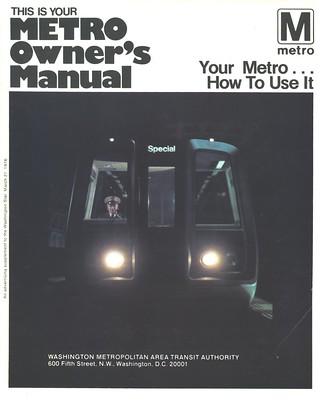
Rebuild the consensus for transit, Market the Purple Line now.  In the run up to Metrorail, WMATA did a lot of interesting outreach, including exhibits on the National Mall and the publication of a guide on how to use transit that was inserted as advertising in the then large circulating local newspapers.

After the Metrorail crash in 2009, I argued that given that the Metrorail system was then more than 30 years old, and much of the population of the metropolitan area wasn't around when the consensus for building it was created, that it was time to build a new consensus for transit and what it is supposed to accomplish in the Washington Metropolitan Area.  I made a similar point in advance of the system's 40th anniversary in 2016

-- "WMATA 40th anniversary in 2016 as an opportunity for assessment"

Metro (WMATA) Owner's Manual: Your Metro...How to Use It, cover
Metro (WMATA) Owner's Manual: Your Metro...How to Use It, cover. Advertising supplement to the Washington Star, 3/21/1976.

 Arguably, a lot of the opposition to transit expansion--light rail in Suburban Maryland, streetcar in DC and Arlington--is an indicator of the need to rebuild that consensus understanding of transit, the value of transit expansion.

It's not like we don't have ample proof of the value.

As David Miller, former mayor of Toronto used to say, "you can't have a transit city without continually expanding transit."

I wonder if CAF (which has an office in DC) would be willing to bring over in advance a couple of the light rail vehicles that will be deployed on the Purple Line, for use in an ongoing marketing program.

Some transit infographics, whichcould be models for a pro-Purple Line campaign.

Graphic by American Public Transportation Association and the National Association of Realtors

From Moving Forward, an independent journalism project produced by Discourse Media. Data and analysis by George Poulos.

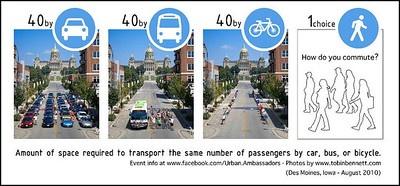
Amount of space required to transport the user the same number of passengers by car, bus, or bicycle
I think all communities should produce their own version of this poster, which shows the space efficiency of transit, walking and biking, compared to driving.


Equity as a marketing challenge. These days, a frequent criticism of investment in transit infrastructure is that rising property values leads to displacement and gentrification ("Transit-oriented development and gentrification: a systematic review," Transport Reviews, 2019). That is true.

Image from "The scales of gentrification," Planning Magazine, 2018.  Caption: Activists block Chicago's The 606 trail in 2016 to protest gentrification and displacement. Photo by Tyler Lariviere.

So transit agencies, working with local governments, need to come up with a program to address that. I recommend creating what I call a "Transportation Renewal District" in association with new transit projects.

-- "Purple line planning in suburban Maryland as an opportunity to integrate place and people focused initiatives into delivery of new transit systems," 2014
-- "Quick follow up to the Purple Line piece about creating a Transportation Renewal District and selling bonds to fund equitable development," 2014
-- "Beyond the Tracks: Purple Line community development conference this Friday, March 21st," 2014

The TRD would function like an urban renewal district. You sell bonds--tax increment financing--against anticipated new tax revenue and use the monies in part to buy, hold, and develop property in ways that support equity planning goals--affordable housing, etc.

Labels: , , , , , ,

Sunday, April 12, 2020

Outdoor signage explaining social distancing, Salt Lake City

Salt Lake City Department of Parks and Public Lands signage explaining social distancing rules
Salt Lake City Department of Parks and Public Lands signage explaining social distancing rules at one of the entrances to Fairmount Park. 

Parks are open, but certain facilities, in particular playgrounds, are taped off to prevent access.  I was shocked to see people playing paddleball at outdoor courts earlier in the week.

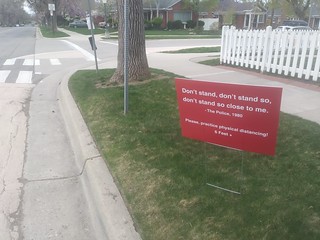
Social distancing yard sign, Salt Lake City, using the lyrics from a song by "The Police" -- don't stand, don't stand so, don't stand so close to me."

Social distancing yard sign, Salt Lake City, using the lyrics from a song by "The Police" -- don't stand, don't stand so, don't stand so close to me."  With separate sign on how to get a sign
This might be the residence of the sign creator.

Some places have closed parks because people haven't been following social distance guidance.  For example, this weekend Mayor Garcetti of Los Angeles preemptively closed all city parks for Easter Weekend on the presumption that too many people would violate rules concerning the size of gatherings and social distancing.

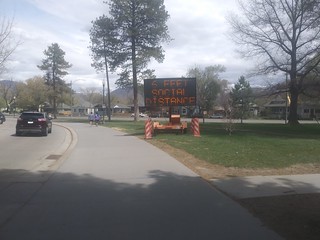
At Liberty Park in Salt Lake City, the Parks Department is using highway message signs to reinforce the need for social distancing, otherwise the parks will close.
"Keep Our Parks Open" message, Highway sign message board, Liberty Park, Salt Lake City

"6 Feet Social Distance" message, Highway sign message board, Liberty Park, Salt Lake City

One of the fenced off areas at Liberty Park is an outdoor fountain featuring water from a natural spring.  The normal set up even features a water fountain for dogs.
The natural springs water fountain at Liberty Park, Salt Lake City, includes a water fountain for dogs

Labels: ,

Monday, March 16, 2020

Quotes exemplifying political leadership, or not

From the 2017 March for Science protest.

From Franklin D. Roosevelt’s first inaugural address in 1933, at the height of the Great Depression:
“So, first of all, let me assert my firm belief that the only thing we have to fear is … fear itself.”
Winston Churchill in 1940, as the United Kingdom military retreated from France (Dunkirk), brought back to the UK in large part by citizen boaters, with the fear of a Nazi invasion:
“Never in the field of human conflict was so much owed by so many to so few.”
And President John F. Kennedy, during the Cold War between the US and the USSR:
“And so, my fellow Americans: ask not what your country can do for you — ask what you can do for your country.”
JFK also created the Peace Corps...

President Trump:
"No I don't take responsibility at all."

WRT President Trump's overall statement, it seemingly isn't really problematic. He doesn't take responsibility, stating that the government is incapable of creating lab tests quickly in extranormal situations, that you need the private sector to do it ("I ran the White House pandemic office. Trump closed it," Washington Post.

That's not true. Other countries and other government agencies like the World Health Organization developed tests and systems just fine.  Although others did not.

Charlie shares with us a great article from the Financial Times, "Containing coronavirus: lessons from Asia," although because it is an article normally behind a paywall, it might not work.

It discusses best practice response by Taiwan, South Korea, Hong Kong, and Singapore.

Because these countries dealt with SARS and MERS, they maintained epidemic response systems which were allowed to atrophy in the US.

The piece cites a medical journal article on the Taiwan response to Covid-19, "Response to COVID-19 in Taiwan: Big Data Analytics, New Technology, and Proactive Testing," Journal of the American Medical Association.

Labels: , , , , ,

Digital advertising promoting positive health behaviors to ward off Coronavirus


A coronavirus public service announcement is displayed on the scoreboard prior to Inter Miami and D.C. United playing at Audi Field on March 7, 2020 in Washington, DC. (Photo by Patrick Smith/Getty Images). 

 Since this photo was taken, professional sports leagues have suspended their seasons, and events of this size in stadiums and arenas have been banned in most major cities across the US and increasingly in other countries.


A billboard on the A194 in South Shields warns motorists of the symptoms of coronavirus and gives advice on what to do if they feel ill


Coronavirus campaign by the British government on billboards in Wood Green, north London Matthew Chattle—Barcroft Media via Getty Images. "Government coranavirus ad campaign to take over TV, social media, print and and billboards," i news


An NHS coronavirus information sign at Heathrow Airport in London today; Heathrow said the number of passengers travelling through the airport fell by 4.8 per cent year-on-year in February due to the impact of coronavirus.


Highway message board in Southern California.  Photo: Getty Images.  


Munich airport: The sign reads "Wash your hands, keep a distance, cough into your elbow."


A billboard advising people to be responsible and stay home is seen at the almost empty Preciados Street, due to the coronavirus outbreak, in central Madrid, Spain, March 14, 2020. AP photo?


A billboard near the Crosstown Expressway on Friday, March 13, 2020, displays information about the coronavirus and the hotline set up by the City of Corpus Christi and local health district. (Photo: Courtney Sacco/Corpus Christi Caller-Times)


The Outdoor Advertising Association of America has developed a set of open access public service messages on Coronavirus in standard digital formats.


Lamar Advertising is one of the firms participating in the OAAA program.  

Labels: , , , , ,