Rebuilding Place in the Urban Space

"A community’s physical form, rather than its land uses, is its most intrinsic and enduring characteristic." [Katz, EPA] This blog focuses on place and placemaking and all that makes it work--historic preservation, urban design, transportation, asset-based community development, arts & cultural development, commercial district revitalization, tourism & destination development, and quality of life advocacy--along with doses of civic engagement and good governance watchdogging.

Wednesday, March 13, 2024

Gaps in Parks Master Planning: Part Three | Planning for Climate Change/Environment

 Gaps in park master planning frameworks


But while I have written a bunch about parks and transportational access, I didn't think to include that as another topic in the series.  The challenge is to ensure that as many parks as possible are accessible by transit.  This, and other forms of accessibility, should be covered in a parks master plan.

====

-- The State of the Great Outdoors: America’s Parks, Public Lands, and Recreation Resources, Resources for the Future (2009) 
-- Addressing 21st Century Conservation Challenges to Benefit Our People, Economy, and Environment, Conservation Conversations

Climate change and national parks.  Parks with extraordinary  environmental features face big losses in the face of sustained heat.

Many of the signature parks operated by the National Park Service will sustain serious damage from climate change and managers will have to make hard choices about what elements of parks can survive and what will have to be abandoned ("Resist, accept, direct framework").

-- Green Parks Plan: Advancing the National Park Service Mission Through Sustainable Operations, third edition, NPS
-- Planning for a Changing Climate, NPS
-- Climate change in National Parks brochure
-- Park visitation and climate change, NPS
-- Parks and Climate Change, National Parks Conservation Association
- "Some U.S. national parks are trying to go carbon-free. What does that mean for visitors?," National Geographic
-- "What to Save? Climate Change Forces Brutal Choices at National Parks," New York Times
-- Plan for Climate-Smart Cities, Trust for Public Land
-- "Saving our national parks could save us too," Salt Lake Magazine
-- "How the climate crisis is forever changing our national parks," CNN

State Parks and Climate Change


Webinar: Climate Change and State Parks

Local/City/Urban Parks and Climate Change

-- How Cities Use Parks for Climate Change Management, American Planning Association
-- Parks as a climate solution, TPL
-- (Parks) adapting to climate change: Working with nature to transition our urban environment, Plante&Cité
-- Implementing Eco-Management: Concepts and practice for more nature in the city, Plante&Cité
-- "The carbon sequestration potential of urban public parks of densely populated cities to improve environmental sustainability," Sustainable Energy Technologies and Assessments
-- "50 Grades of Shade," Bulletin of the American Meteorological Society

According to the Trust for Public Land (The Power of Parks to Address Climate Change, webpage, report) parks are good at greening.

  • Eighty-five percent of cities are adapting parks and recreation facilities to address climate change
  • Eighty percent are enlisting parks to counter urban heat
  • Seventy-six percent are improving surfaces to reduce flooding and runoff from rains
  • Twenty percent are actively managing parks and woodlands to sequester carbon dioxide, the main greenhouse gas responsible for climate change. 
  • Other cities are managing parks to reduce the risk of wildfire, restoring shorelines to absorb storm surges, and opting for renewable sources of energy. 
  • Cooling green space is not equitably distributed, however. Trust for Public Land analyzed the 100 most populous cities and found that the neighborhoods where most residents identify as people of color had access to an average of 43 percent less park acreage than predominantly white neighborhoods.
If 85% of cities are addressing parks and climate change, then my thesis that this is a gap in parks master planning practice is wrong.  OTOH, it's a micro versus macro scale issue.  And the reality is that the day to day operations requirements and the increased demand from the public for both more parks and more activities and facilities makes dealing with long term issues, like climate change, difficult.  

  • During heat waves now and in the future urban microclimates put human health at risk.
  • Intercepting solar radiation is the most effective way to reduce the heat load on people.
  • Reducing air temperature is the second most effective way to reduce heat loads
  • Evidence-based climate-responsive design can make parks more thermally comfortable.

Elements of a Cultural Landscape Report, from the NPS brochure on Cultural Landscapes

Planning at the landscape scale for Sugar House Park: the cultural landscape.  A way to tie the various planning approaches together is to use the cultural landscape planning framework, which looks at sites in a variety of ways.

For the purposes of Sugar House Park we should focus on the elements of land, vegetation, buildings, and history.

-- "Gaps in Parks Master Planning: Part Eight | Second stage planning for parks using the cultural landscape framework"

Parley's Creek and its watershed.  In the 1800s, Salt Lake City got control of most of the water rights on nearby federal lands--the canyons--which are mostly controlled by the US Forest Service.  

Water rights are controlled by Salt Lake City Public Utilities, which defines watersheds in terms of the production of culinary water, not the flow to the Great Salt Lake.

Parley's Creek and a pond are part of the Park, and part of the Jordan River watershed, which flows into the Great Salt Lake.

To SLCPU, the "watershed" ends at the mouth of the canyon and its water treatment plant.  The Creek's contribution beyond the Canyon to "the general watershed" comes from water discharges into the Creek, but past the Canyon, much of the Creek derives from storm water.  And these days we don't get a lot of rain.


Within the park the Creek is mostly daylighted, with a small section not, because it was contaminated when the site was a prison.  The Creek Management Plan provides a number of recommendations for the Creek within the Park.  But not much has been addressed since the plan was released in 2010!

As we gear up to do a new round of master planning, one element will be the Creek and pond.  

The Park is implementing a wayfinding and interpretation signage system, so we have an opportunity to do some watershed interpretation.  

On our list of things to do, we are organizing a kind of symposium of the area river and creek stakeholders so that we start moving on Creek issues.  The state has the Jordan River Commission, and the advocacy group, the Seven Canyons Trust, works on creek daylighting issues throughout the County.

There are good models for better practice.  Nearby Fairmont Park, run by the city, has done a lot with their portion of the Creek.  Fairmont has springs, which feed a fishing pond.  Fitts Park in the City of South Salt Lake, which includes Mill Creek, has done nice stabilization work around their creek too.  

Flooding/Flood control
.  In the 1980s, Salt Lake City experienced major flooding because higher than normal temperatures led to premature snow melt.

(Trent Nelson | The Salt Lake Tribune) High water levels in Salt Lake City's Sugar House Park on Wednesday, April 26, 2023.

As a result, Sugar House Park was rebuilt in part as a flood control structure.  When snowmelt is high, Public Utilities will do water discharges so that the reservoirs don't overflow.  

We don't have issues at the scale of a coastal city like Boston (Climate Ready Action Plan), but sometimes parts of the park may close because of risk management planning and flood control.  Fortunately this is an infrequent occurrence.  Last year there was flooding at the park, resulting in road closure ("Flooding at Sugar House Park means the pond is working as planned," Salt Lake Tribune). 

Water conservation. The park is a lot of grass and trees and we water it.  I need to find out about the ability to use recycled water.  I don't think Salt Lake City is set up for it.  

Parks serve many people, therefore should remain a priority for water use, compared to other institutional users.  But we need to be efficient.  We are planning to add various monitoring sensors and upgrade the irrigation system ($1 million minimum) and other equipment to address this.  

We need to collect and present information on water conservation and irrigation in our plans, on the website, etc.

Turf and plants.  Grass uses a lot of water.  Two years ago, Salt Lake City Public Utilities introduced a turf blend that uses 30% less water ("SLC's drought tolerant turf is such a hit, other communities in Utah want some," Utah NPR).  

That's something to look at, but then we have a lot of grass we'd need to dig up.  One option could be to convert some sections of the park to meadow.

-- "Urban park visitor preferences for vegetation – An on-site qualitative research study," Plants, People, Planet

Trees/arboretum.  Trees: serve as shade devices, are an equity issue, and provide environmental benefits ("‘Turn Off the Sunshine’: Why Shade Is a Mark of Privilege in Los Angeles" and "How Decades of Racist Housing Policy Left Neighborhoods Sweltering," New York Times)

Planting new trees is important but faces challenges because of heat and water (Landscaping for shade, US DOE, "How Much Can Forests Fight Climate Change? A Sensor in Space Has Answers.," New York Times, "What About the Trees? Trees as Nature-Based “Shade Sails”," American Journal of Public Health, Your tree planting companion, TEAGSAC Urban Forestry Department, Ireland, "Cities Are Good at Planting Trees. They’re Not So Good at Keeping Them," Walrus).

Tree planting as a city equity measure is an important priority of the Salt Lake Mayor.

Infographic about the climate change impact of tree planting 
as part of a bus rapid transit project in Cleveland.

Over the next year we are looking to become accredited as an arboretum, which provides another opportunity for environmental interpretation, improve tree cover, do fundraising, etc.  

-- American Forests
-- TreeUtah
-- ArborDay, April 26
-- National Park City Foundation
-- International Day of Forests, March 21


-- Community Forests: A path to prosperity and connection, TPL
-- "Cities Nationwide Combat Climate Change With Urban Forests," Governing
-- "Since When Have Trees Existed Only for Rich Americans?,"  New York Times
--  "Befriending Trees to Lower a City's Temperature," New York Times
-- "Why trees in Los Angeles are political, cherished, underfunded and controversial," Los Angeles Daily News

A TreeUtah event in Fairmont Park, Salt Lake City

-- "Northeast Ohio cities work to reverse history and impacts of tree canopy loss," Ideastream/NPR
-- "Mature trees are key to liveable cities – housing intensification plans must ensure they survive," Guardian
-- "‘I’m glowing’: scientists are unlocking secrets of why forests make us happy," Guardian
-- "It takes more than trees to build a livable city," Vox
-- "How America Is Making Tree Equity a Climate Solution for Cities," TIME Magazine
-- "The surprising way that millions of new trees could transform America," National Geographic

Creating an arboretum within the park is an opportunity to develop some great guides, brochures, education programs, etc. for interpretation.

Unfortunately, as more organizations shift to digital presentation, there is no longer access to the often great materials produced in the past.  The quality of today's brochures pale by comparison.

Plus, most state and local sites don't do a very good job of putting their documents online to begin with

One of my ideas is to develop an online database of such historical documents.  The closest we have is the database of the National Park Service's online brochures for the parks, as well as other materials.  NPS archives don't have everything, but remain an incredible resource.

Fauna/biodiversity.  Participating in the Bridge Park initiative 10 years ago ("Revisiting the 11th Street Bridge Park project as an opportunity rather than a folly: a new revitalization agenda for East of the River, DC"), I was struck by how one of the design teams focused on providing food not just for people, but for flora and fauna in and along the Anacostia River.

SHP is pretty sculpted.  Lawns are well maintained without much in the way of leaf litter or other elements that support insects and other fauna  ("Species richness in urban parks and its drivers: A review of empirical evidence," "City parks vs. natural areas - is it possible to preserve a natural level of bee richness and abundance in a city park?," Urban Ecosystems). 

This is a problem for residential property too ("The ‘no mow’ movement could transform our lawns," Washington Post).  From the article:
Mowing grass too short can cut the tops off flowering plants, creating lawns that are inhospitable for pollinators seeking habitats in which to feed, rest and nest, experts say. Keeping your lawn neat and trim not only is resource-intensive but can also affect its overall health. 

 British Wildlife Photography awards. Hidden Britain Runner-up 
Flower crab spider and Honey bee, Lee Mill, Devon by Lucien Harris

... creating a pollinator lawn will take a bit more thought than just letting grass grow freely, experts say. “If you have a traditional lawn, letting the grass grow to a foot tall or whatever it would be at the end of May is no value whatsoever,” says Susan Carpenter, native plant garden curator at the University of Wisconsin-Madison Arboretum. Grass that long could be harmful to lawn health and become a mowing nightmare.
The park has some insects ("What urban nature really means for insect biodiversity," Horizon: The EU research and information magazine), birds ("Urban parks are a refuge for birds in park-poor areas," Frontiers in Ecology and Evolution), and maybe some small animals like raccoons.

To expand fauna diversity, perhaps we should install bat houses and beehives.  We do have a community garden, and are looking to create another.

Of the entire park, only a small section along the Creek is "more wild."  

Mows to Meadow Project in Philadelphia's Fairmount Park is converting some grass areas to meadows planted with native plants.

We may wish to stop mowing some parts of the park to increase opportunities for fauna ("Meadow Developing in Flagstaff Park to Restore Habitat," Cambridge, Massachusetts).

The south side of the park abuts the I-80 freeway so it's very noisy.  

Long term, we could deal with UDOT to increase plantings on the abutting embankment to support fauna (Roadside Best Management Practices that Benefit Pollinators, FHWA) and reduce noise (that section of freeway used to be part of the park).  

How much do we manage the park for people and for fauna is a question definitely not posed by the existing master plan.

Ducks and dogs as disease vectors
.  Sadly, because of the pond, the park has a hell of a lot of ducks.

Which end up contributing e. coli to the Jordan River watershed, which in turn flows into the Great Salt Lake.  

Who knew e. coli could be a park management issue.  

Errant dog owners who don't clean up after their pets are big contributors too.

Plus people feed inappropriate food like bread to the ducks.  We have signs up, but it doesn't matter.

Carbon neutrality/greenhouse gas emissions, etc..  Ellinikon Park (designer website, Ellinikon Experience Park website), under construction in Athens, Greece has the goal of being carbon neutral--increase carbon sequestration, limit or avoid emissions, and reuse embodied carbon--but it will take 35 years to accomplish.  ("Carbon-First Design: The Ellinikon Metropolitan Park in Athens," ASLA).


Should that be a goal for Sugar House Park?  While grass clippings are left on the grass, we don't compost from trees and shrubs.  That's an issue.  Can we improve our energy use?  We are bystanders to the Salt Lake Valley's air quality problems ("Reaching for Air: The Salt Lake Valley’s pollution problem can be solved. Will Utah leaders act?" and "Reaching for Air: The price Utahns pay for poor air quality," Salt Lake Tribune) but by planting more trees, etc., we can help on that score.

Transportation demand management.  Despite all the media coverage about how environmentally-conscious Utah is, the fact is that the predominate land use and transportation planning paradigm is sprawl.  While there is a transit system that is decent for what it is, but most everyone drives.

Motor vehicles significantly contribute to the air quality problem.  A lot of patrons come to the park by car.  Can we reduce our park's contribution to the problem by working to improve biking and transit options for getting to the park?

Klyde Warren Park over Woodall Rodgers Freeway, Dallas (History).

Noise/Freeway decking/capping.  To deal with aesthetics, noise, and opportunity, I have a crazy idea to deck/cap the freeway section like Klyde Warren Park in Dallas or the Big Dig in Boston.  

Many cities are pursuing such projects ("Philly’s other big I-95 project to start: A cap with an 11.5-acre waterfront park, South St. pedestrian bridge," Philadelphia Inquirer, "Feds grant $450 million toward I-5 freeway caps in North Portland’s Albina district," Portland Oregonian," "Interstate 5 in Downtown Seattle: Put a Lid on It?," Seattle Met).

Because the section next to the park (it was part of the park before the freeway was built) is so big--40 acres--it presents better opportunities compared to most other cities.  It would cost hundreds of millions and take at least a decade to plan and build.

Climate change effects on park visitors

Hubert H. Humphrey Memorial Park, Pacoima, California. Thermal radar shows the differences in heat on a basketball court after reflective paint coatings were applied. 

Sun and heat.  Parks need to acknowledge heat and climate as issues that can suppress park use.  For example, brutal heat in July and August means kids probably stay inside. 

We have an open basketball court at Sugar House Park, and last summer I went up to some teens and asked them questions about what they thought about the amenities.

They mentioned shade was an issue commenting how they liked the trees that were there.  I came back with suggestions like an additional (perhaps temporary) small shade structure, misters, and adding more trees as shade devices--we can take out a bit of asphalt and add trees.  They also mentioned their desire for a water bottle filler at the nearby restrooms. 


Reflective paint to reduce thermal effects.  Special reflective paints are a way to reduce the effect of heat on roads--the park loop road includes separated walking and biking lanes, concrete pads, courts and other facilities ("As heat waves increase, Los Angeles is coating some streets with ‘cool pavement’," Los Angeles Times, "This L.A. neighborhood's 'cool pavements' help it beat the intense heat," NBC).

Shade screens and misters. A park in South Salt Lake, Fitts Park, has a shade screen over their playground, and it makes a significant different in heat between shade and sun.  Surprisingly, shade screens are few and far between.  

Phoenix and some other cities have developed community shade plans with parks and open spaces being key to responding to the challenges presented.

-- Tree and Shade master plan, Phoenix

Playground equipment gets super hot in the sun.  The Washington Post had a great article, "Kids getting burned on swings and slides? Here’s how to fix it," about research on heat and playgrounds.

-- Guide to Climate Friendly Playgrounds, Western Sydney University
-- "Outdoor playgrounds and climate change: Importance of surface materials and shade to extend play time and prevent burn injuries," Building and Environment (2022)

Shade screens can make a 20° or more difference between shade and direct sunlight.

Hydration. An issue.  Should we have more water stations?  It turns out over 80% of the park's budget is spent on utilities including "culinary water."

Kurt Amuedo, a third grader at University Park Elementary in Denver, Colorado, displays poster protesting air pollution for Earth Day. Denver Post.

Climate change as an opportunity for civic engagement within parks and parks systems

Sustainability education.  Dealing with climate change as it effects a local park is the opportunity for teaching and learning about the environment.  

Repositioning environmental issues around sustainability leads to renewed interest and innovative approaches to issues.

 When I worked in Baltimore County in 2009/2010, I was struck by the rise in interest and involvement in sustainability.  At the time many communities were creating sustainability plans, colleges and universities and other institutions renewed their environmental initiatives around sustainability, communities like Baltimore created sustainability commissions.  There was definitely a participation boost.

We can categorize participation as external or internal:

  • External: "ambassador" programs that engage with patrons, treating the park campus as an outdoor classroom and holding workshops for students, events like Montgomery County's GreenFest 
  • Internal: planting trees, doing park clean ups, conducting citizen science projects like measuring water quality in Parley's Creek

Sugar House Park has a "Garden Center," that has been under-active.  We can reposition it around Gardening and the Environment, add a slew of activities and programs, making it a leading node within a network of top notch outdoor education centers in the Salt Lake Valley. 

Labels: , , , , , , , ,

Monday, August 21, 2023

Article on climate change and playgrounds

Fitts Park.

A Washington Post article, "Kids getting burned on swings and slides? Here’s how to fix it," cites the work of researchers at Western Australia University, published in the paper "Outdoor playgrounds and climate change."  

They've also produced what looks to be a very good Guide to Climate-Friendly Playgrounds.

They find that shade has a tremendous effect on reducing temperatures at playgrounds.  

Main playground at Sugar House Park.  (A second playground needs much more serious refurbishment, which is a project for down the road.)

Interestingly, this is an issue that I want Sugar House Park in Salt Lake City to deal with.  Adding a shade screen and misters to some of our facilities is on the agenda for the next capital planning cycle.

There is at least one park in Salt Lake County that has a shade screen for its playground, Fitts Park in the City of South Salt Lake. So far that's the only one I can find.

Sadly, I went through Las Vegas a couple times in May but didn't think to check out their parks, as many have shade screens and other devices at addressing the effect of heat.

I also want to add misters, to a set of basketball courts too.  Long term, we need to think more carefully about "growing" trees as shade devices in focused ways.

Canyon Rim Park, Salt Lake County Parks.

There is a playground at Canyon Rim Park in Millcreek, Utah that is well nestled in trees so that a shade screen isn't required.

Note this is also an issue with transit.  Las Vegas has misters on sidewalks, as does Palm Springs, California.  Phoenix has deployed misters in bus shelters.  

And I've seen a couple examples of fans being included in bus shelters also ("Metro testing solar powered fans in future bus shelters," Houston Chronicle).

Also see "Park system ratings for 2023 | Trust for Public Land ParkScore® rating system."

Labels: , , ,

Sunday, February 06, 2022

Climate change is already here in many US communities | "Heat Officers" versus Climate Change Officers

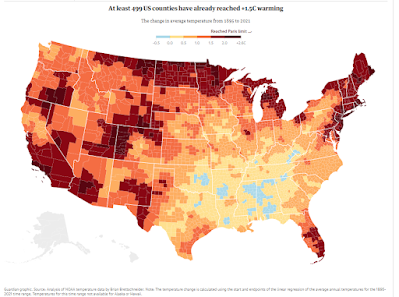
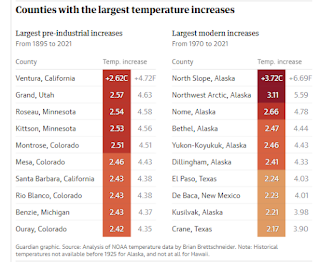
The Guardian has a chilling story, "A third of Americans are already facing above-average warming," about how many US counties (and the cities within) already are experiencing a warming of at least 1.5℃.

In the article, the map is interactive by county.

Hotter and colder temperatures, more virulent weather events, wildfires, flooding, drought conditions, sea level rise affecting coastal land, and an increase in heat- and cold-related deaths are all fallout from climate change.

Some cities are beginning to appoint "heat officers," creating positions within government to focus on climate change effects.  


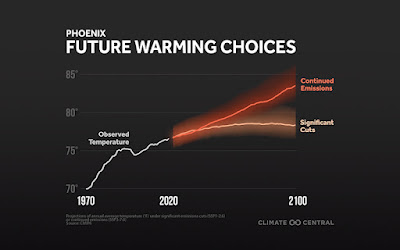
Apparently, Miami was the first city in the US to do so ("Miami’s first-ever chief heat officer on the climate issues that scare her the most—and what gives her hope," CNBC).  The Guardian has a recent story about the activities of the heat officer in Phoenix ("America’s hottest city is nearly unlivable in summer. Can cooling technologies save it?"), a city that tends to have the US's highest summer temperatures.  From the article:
Almost 200 people died from extreme heat in Phoenix in 2020 – the hottest, driest and deadliest summer on record with 53 days topping 110F (43C) compared with a previous high of 33 days. Last year there were fewer scorching days, but the death toll remained staggeringly high, with people experiencing homelessness and addictions dying disproportionately....

Last year, after another deadly summer, the mayor announced the region’s first dedicated unit to tackle the growing hazard of urban heat, which also threatens the city’s economic viability. ...

Hondula recently submitted the 2022 heat response plan to city hall, in an attempt to coordinate the existing patchwork of services. “I’m impressed by the number of programs but the death and illness numbers are moving in the wrong direction, so there’s a disconnect we need to address,” he said. “If we mean to take a hazard seriously, relying on good fortune, luck and happenstance is not the best model.”

Mitigation will be focused on trees and infrastructure, which will be led by an urban forester and a built environment expert who are yet to be hired.
-- "Planning for Extreme Heat: A National Survey of U.S. Planners," Journal of the American Planning Association 

I guess you can call them heat officers, but they are really climate change officers -- a few years ago the big term was "resilience."


For example, in Utah drought is a big issue, and Salt Lake City's efforts on reducing water consumption saved more than 2 billion gallons of water, according to the mayor ("Here’s how much water Salt Lake City residents saved this summer and what it means for next year," Salt Lake Tribune).

Although residential water use pales compared to agriculture and industrial use, and Utah in particular has few conservation systems in place for large scale water users ("Utah has a water dilemma," High Country News).  Some Utah communities have stopped approving residential building permits because they can't guarantee water supply to new housing ("First of many? Drought-stricken Utah town halts development," GreenWire).

A Climate Change Officer should be dealing with all of these effects, depending on what are the biggest problems in particular communities.

Citizenship culture in Bogota.  A previous mayor of Bogota, Andreas Mockus, initiated what he calls "citizenship culture." One of the examples was in a saving water campaign, he was filmed taking a shower with minimal water use ("Building "Citizenship Culture" in Bogota," Journal of International Affairs, 2012).  From "Academic turns city into a social experiment," Harvard Gazette:
When there was a water shortage, Mockus appeared on TV programs taking a shower and turning off the water as he soaped, asking his fellow citizens to do the same. In just two months people were using 14 percent less water, a savings that increased when people realized how much money they were also saving because of economic incentives approved by Mockus; water use is now 40 percent less than before the shortage.
Sustainability commissions as opportunities for rearticulating issues and increasing engagement.  10+ years ago, communities creating sustainability plans and citizen commissions to implement them were all the rage.  

While I am not sure how much progress has been made since, at the time I was impressed at how motivated citizens were to get involved in the issue, through commissions and other venues, and they were willing to think anew about issues that they had taken for granted, like solid waste, food waste, energy, and transportation impacts from automobility.

Labels: , , , , , ,

Wednesday, March 21, 2018

Winter storm management

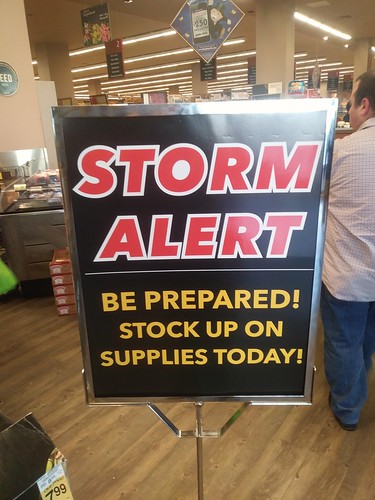
Storm Alert sign in a Safeway supermarketNormally, each year I do an advance piece in December about storm management and the impact of storms on transportation and transit, and the need for cities especially to rebalance some snow clearance efforts towards walking and bicycling routes, and facilitating safe access to transit.

I didn't do that this year, and frankly, in the DC area there hasn't been that much snow, although the Northeast has been hit hard from time to time, including today, whereas DC has a bit of snow by comparison.

-- "Preparing for winter weather in advance of winter," 2016
-- "A "maintenance of way" agenda for the walking and transit city," 2010
-- "Snow reminds us of the necessity of a "maintenance of way" agenda," 2013
-- "Testimony on the Winter Sidewalk Safety Amendment Act of 2011," 2011
-- "Level of service and maintenance requirements in planning #2: winter maintenance of bike paths," 2012
-- "Night-time safety: rethinking lighting in the context of a walking community," 2014
-- "Planning for Winter Weather," 2015
-- "Who knew?: there is a Winter Cycling Federation and annual conference," 2015

Of course, every year there can be new developments.

-- "DC lawmaker says recent snowfall caused by 'Rothschilds controlling the climate'," Washington Post

Labels: , , , , , , , , ,

Tuesday, June 06, 2017

Pittsburgh area elected leaders publish ad in local newspaper, affirming commitment to addressing climate change

PennEnvironment, a statewide citizens advocacy group focused on environmental matters in the State of Pennsylvania, alerts us to how elected officials from the City of Pittsburgh, Allegheny County,  local representatives in the State Legislature, and the Congressman representing Pittsburgh, Mike Doyle, put together an advertisement running in today's Pittsburgh Post-Gazette, affirming their commitment to addressing climate change through responsible and responsive local actions. 

Below is an image of the ad.


I'm not always a fan of federalism and subsidiarity, because "state's rights" can be used as a way to restrict freedoms and do the wrong thing, rather than to respect freedoms and do the right thing.

Fortunately, the reality is that despite President Trump's repudiation of the Paris Climate Agreement, federalism and subsidiarity the basic economics of energy production and renewable energy, and the risk management necessity of planning for resiliency in the face of more severe weather events, most reputable businesses many of our states, cities, and counties, and us as individuals will continue to take actions that aim to reduce greenhouse gas emissions.

But it does mean at least in the intermediate term that we're not likely to see an increase in the federal gasoline excise tax--which could be the biggest force for change in terms of fuels used for motor vehicles--cars and trucks account for 25% of oil consumption, nor advances in regulations and programs aimed at generating pro-environmental outcomes:

- the Trump Administration reversed a regulation that forbade coal ash discharges into rivers--and rivers are the primary source of the nation's drinking water
- the Trump Administration aims to shrink the EPA
- the Trump Administration keeps proposing to practically eliminate programs to improve the water quality and other environmental elements of the Chesapeake Bay and the Great Lakes
- the Trump Administration proposes to give federal lands to the states, so that these public lands can be "developed"
etc.

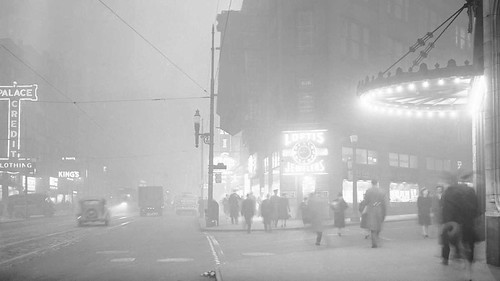
Pittsburgh's history of environmental degradation.  Ironically given the ad mentioned above, and not mentioned in the ad at all, is Pittsburgh is a classic historical example of the impact of industrial practices which paid no heed to environmental protection. 

The city's air quality was so bad as a result of the release of pollutants into the air from steel production that typically, stores and streetlights had to be used during what should have been daytime.

See "A Revitalized Pittsburgh Says the President Used a Rusty Metaphor," New York Times.
Day time smog in Pittsburgh, !944
Midday in downtown Pittsburgh in 1944. As thick smog blanketed the city, drivers used their headlights, and storekeepers switched on their signs. Photo: Walter Stein, Associated Press.

Labels: , , , ,

Friday, March 17, 2017

Interesting transit map #1: NYC Subway system underground service network

Winter weather wreaks havoc on above-ground transportation systems.

I have argued in the past that it would have been worth building more of the Metrorail system underground to ensure that it would function in bad winter weather.

At the time the system was built, that didn't seem necessary, but as Global Warming makes weather more unpredictable and violent, circumstances may be changing (not that we can go back and rebuild the system).

Of course, DC is not Montreal, which has a fully underground subway system which functions in all weather conditions.  (In fact, I am a bit skeptical of the proposed multi-line light rail system there, because it won't necessarily be resilient in the face of big winter snows.  See "Caisse's REM light-rail project: 3 stations added to proposed route through Downtown Montreal," Montreal Gazette.

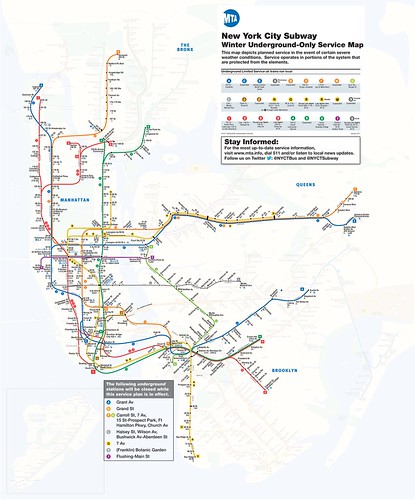
While this past week we got some snow which bollixed things up a bit, it was 1/3 to 1/4 of the amount of snow that fell in NYC.  In advance of the storm, MTA announced that the subway system would shift to underground only operations, and they published a map showing that network.
NYC Subway 2017 Winter Underground Subway Service Map

Labels: , , , ,

Thursday, February 11, 2016

Focusing on what's most important: snow on cars or snow on sidewalks?

(I know, this is a photo from Europe...)

A number of legislators in New York State have introduced bills to institute fines on motor vehicle operators for not clearing snow off their vehicles, and then driving, with the likelihood of the snow flying off their cars.

From the Rochester Democrat & Chronicle article "Snow on car? Some lawmakers want a fine":

At least four separate bills in the state Legislature would hit motorists with a fine if they fail to clear snow and ice off their vehicles before hitting the road, following the lead of New Jersey and Connecticut, which have implemented similar policies.
Supporters of a fine say it would deter motorists from driving their snow-covered cars, which pose a danger to other drivers who could find themselves in the line of flying ice or debris. ...

Mayer's bill is the most comprehensive of the proposals, laying out a system of fines and a fund to provide for areas on the state Thruway where truckers can clean off their vehicles.

Non-commercial motorists would be hit with a fine of $150 to $800 if they are found operating a vehicle with more than 3 inches of snow or ice on it. A trucker would face a $450 to $1,250 fine. Drivers who are disabled wouldn't be subject to a fine.

The money would go into a fund, which would be used to pay for an awareness campaign, the Thruway clean-off spots and grants for trucking companies to purchase ice-clearing equipment.
While I think this initiative does show the priorities of elected officials as it relates to the transportation network amidst the general unwillingness to fine people for not clearing sidewalks ("Despite laws, progress on snow removal is uneven," Washington Post) it happens that the City of Rochester New York independently has a system for clearing sidewalks of snow throughout the city, including in residential areas. (The exclusion of disabled drivers from the requirement defeats the purpose of the bill though, as snow flying off a car happens regardless.)

-- City of Rochester | Sidewalk Snow Removal

The City of Rochester contracts for sidewalk removal, clearing to a width of 5 feet, but not exceeding that width in commercial districts.  Photo from Rochester Subway blog.

The city clears snow once it gets to 4 inches--so property owners are responsible for clearing snowfalls of less than 4 inches--and has 878 miles of sidewalks. They organize clearance by creating sidewalk snow clearance routes each 15 miles long and say it takes about 5 hours to clear each route.

The cost is covered by what the city calls an "embellishment fee," which is an add-on to property taxes, and is based on the width of the street frontage.

Although some argue that the program doesn't go far enough and should provide additional clearance to the full width of the sidewalk to the curb in commercial districts and the application of special clearance practices for bus stops ("Clearing Rochester’s Sidewalks of Snow is Not a Problem, It’s an Opportunity," Rochester Subway blog).

Note that inadequate dew removal from a car's windshield contributed to the death of a bicyclist in Maryland in 2011 ("Motorist cited in bicycle fatality: Hollywood woman's ticket charges negligent driving," Southern Maryland News). That driver ended up paying a fine around $300.  The consequences from causing death can be pretty cheap.

Labels: , , ,

Tuesday, January 26, 2016

Fully underground subway systems are more resilient

The Metrorail heavy rail transit system is a mix of underground and above-ground sections.  In the worst winter weather conditions, in the past they have hunkered down and only run the part of the system that is fully underground, within DC (although some sections in the suburbs are also underground, primarily the Orange Line in Arlington County, Virginia).

The last couple storms, including the one this past weekend, they have shut down the entire system for a time, not even running the underground section, because of fears that potential power outages could strand trains and riders.

The underground portion of the Metrorail system that can run during major snow events.  Map graphic by Peter Dovak for Greater Greater Washington.

I am not criticizing WMATA for shutting down, even though it turned out we didn't have widespread power outages (likely because the snow was soft and powdery).

You can try to keep the system running for as long as possible but on the backside, it means more downtime as the system works through the recovery period.

With an anticipatory shutdown, there is more uptime overall.

Still, with the benefit of hindsight, it's unfortunate that more parts of the system weren't built underground.

For example, if the section of the Red Line from Union Station to Silver Spring (between Silver Spring and Wheaton actually) had been built underground, then the entire east leg of the Red Line could operate during the worst of winter storms.

Light snow on Metrorail tracks in the median of Rte. 7 in Fairfax County, when the system was under construction.  Photo by Chuck Samuelson, Dulles Corridor Metrorail Project.

Similarly, the new Silver Line segment in Fairfax County was built above-ground and in aerial sections for great lengths.  In the snowstorm--at least 20 inches in most places, and more than 2 feet in others--It turned out to be the most vulnerable section of the system and will be the last to be fully operational as the system reopens.

Too bad that winter-time resilience wasn't one of the factors considered in the debate over whether or not to build the Silver Line underground ("Rail Tunnel Debate Raises Larger Issue," Washington Post, 2006).  It would have cost much more, true, but would have been able to operate in adverse conditions.

STM in Montreal is the best example in North America of building a heavy rail system completely underground, which they did in part because the city experiences some of the worst winter weather conditions on the continent.   As a result, the Montreal heavy rail system is much more resilient than heavy rail systems like DC's.

The system has 68 stations over 40 miles of track and mostly operates within the City of Montreal, although there are two extensions outside of the city, to Laval and Longueuil. The system has about 1.25 million riders daily.

-- Using public transit in winter | Société de transport de Montréal

Ironically, because the system was built entirely underground and train cars are not exposed to weather--rain, snow, or sun--the cars were not built to be weatherproof.  (That means no air conditioning either.)

Two lessons for transit system design engineering derived from hindsight concerning the Metrorail system. (1) Fully underground systems are more resilient in adverse winter weather conditions. (2) Two track systems--one in each direction--lack redundancy, at least one additional track would allow for express service and more efficient operations when tracks or trains are not functioning.

Labels: , , , , ,

Monday, September 21, 2015

Who knew?: there is a Winter Cycling Federation and annual conference

Big biking cities like Minneapolis and Montreal work to support year-round cycling, despite winter conditions which bring a lot of snow.

For example, Minneapolis' bike master plans have sections on maintenance, including during winter conditions--with 24-hour snow clearance from major bikeways, while a couple years ago, Montreal designated a primary winter bike lane network, the Reseau Blanc, with commitments for expeditious snow clearance.

But these cities are exceptional.  Despite the focus of many cities on sustainable mobility, the commitment hasn't translated into thinking and acting differently as it relates to maintaining facilities in all weather and visibility conditions ("Night-time safety: rethinking lighting in the context of a walking community").

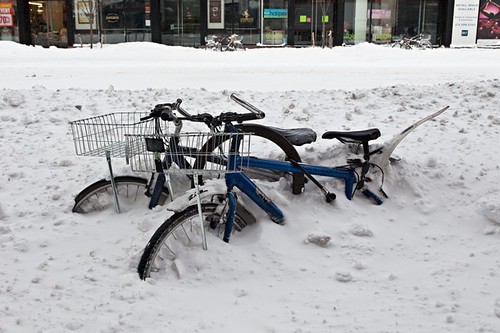
Bicycles stuck in the aftermath of a snowstormBikes are buried underneath a pile of snow on Columbus Avenue on December 27, 2010 in New York City. A blizzard pounded the East Coast of the United States delivering 20 inches of snow to New York City while snarling post-Christmas travel.  (Photo by Andrew Burton/Getty Images)

As winter approaches each year, I tend to write a couple features on the topic of snow clearance, but more toward the idea of how planning and implementing sustainable mobility practices needs to be a 24/7/365 activity, not only for rush hour or great weather.

-- A "maintenance of way" agenda for the walking and transit city (2010)
-- Agenda setting: snow clearance in the walking-biking-transit city (2014)
-- Cataloging the various failures to remove snow in the walking/transit/bicycling city (2015)

I just came across information about the Winter Cycling Federation, an organization dedicated to promoting cycling in the winter months.  The organization sponsors an annual conference, the Winter Cycling Congress for cities with winter climate issues that affect sustainable mobility/cycling.

This year, the Congress was in Leeuwarden, The Netherlands, and next year, from February 2nd-4th, 2016, it will be in Minneapolis, the first time the event will be held in the US.

Labels: , , , , , ,

Tuesday, February 17, 2015

Today DC shut down (including Metrobus service) in response to four inches of snow

Meanwhile in the past couple months, Boston has received more than 6 feet of snow and Michigan is "frozen" over according to this National Weather Service photo.

I do understand the value of anticipatory planning.

Given that MBTA estimates that it will take them a month without snow to dig out and clear all of the snow blockages--they are paying people $30/hour to dig out railroad tracks--it's easier to open back up if you do a measured shutdown.

But the reality is for the most part, the DC area doesn't get hit all that hard by snow.  The two back-to-back snowstorms in February 2010 were an exception.

And one of the competitive advantages of a city--excepting snow on the level of a Montreal normally ("Montreal does great job ridding itself of snow - but it takes time and costs a fortune," Attleboro Sun Chronicle) or Boston this year (Minneapolis gets hit badly as well)--is being able to get around despite snow and other adverse weather conditions because of the mobility efficiencies produced by proximity and density.

Also see "A "maintenance of way" agenda for the walking and transit city."

Photo of a graffiti-ed MBTA system map ("Boston Mess Transit") from Facebook.

Labels: , , , ,

Tuesday, February 04, 2014

Automobility dependence only works in perfect conditions

1.  Cheap gas.
2.  Lots of roads, and ideally, not too many people, because there are severe capacity constraints with regard to congestion.
3.  Perfect weather.
4.  No accidents.

The paralysis of Atlanta as a result of two inches of snow without closing schools or anything else is a perfect example that dependence on non-resilient forms of transportation can be problematic.

January 28, 2014 Atlanta: Traffic inches along the Connector as snow blankets the Metro on Tuesday afternoon January 28, 2014 as seen from the Pryor Street overpass.  BEN GRAY / BGRAY@AJC.COM


In this aerial photo, traffic is snarled along the I-285 perimeter north of the metro area after a winter snow storm in Atlanta, Georgia, on January 29, 2014. Georgia Governor Nathan Deal said early Wednesday that the National Guard was sending military Humvees onto Atlanta’s snarled freeway system in an attempt to move stranded school buses and get food and water to people. Georgia State Patrol troopers headed to schools where children were hunkered down early Wednesday after spending the night there, and transportation crews continued to treat roads and bring gas to motorists, Deal said. (AP Photo/David Tulis

Labels: , , ,