Rebuilding Place in the Urban Space

"A community’s physical form, rather than its land uses, is its most intrinsic and enduring characteristic." [Katz, EPA] This blog focuses on place and placemaking and all that makes it work--historic preservation, urban design, transportation, asset-based community development, arts & cultural development, commercial district revitalization, tourism & destination development, and quality of life advocacy--along with doses of civic engagement and good governance watchdogging.

Tuesday, September 11, 2018

"Facilities planning" for special communities: Cuties LGBTQ coffee shop in Los Angeles

Last week, I wrote a piece ("Revisiting stories: cultural planning and the need for arts-based community development corporations as real estate operators") updating earlier writings with recommendations about discipline-specific planning for the arts.

You can make the same general points about all types of communities.

Cuties Coffee co-owners Virginia Bauman, left, and Iris Bainum-Houle, right, founded the shop a year ago as an LGBTQ community space. (Nick Agro / For The Times)

The Los Angeles Times has an article, "Can L.A.'s only LGBTQ-focused coffee shop survive?," about Cuties, a coffee shop in East Hollywood, and how financial difficulties threaten its continued existence.

Interestingly, it's not unlike the discussion about "rent metrics" and business models that I made in other pieces as cited in "New York Times special section: The Empty Storefronts of New York." The running costs for the coffee shop are $12,000/month including rent, labor, and supplies. They aren't generating that much revenue.

The article mentions Bluestockings bookstore and cafe in NYC, which is a collective, run on more of a volunteer basis, so that its labor costs are much lower. But the organizers don't want to do that, because they want to provide decent wages in a community where some find it hard to find decent jobs.

From a business model standpoint, Cuties needs to be open to other ways of organizing.  Especially if they want to survive.

It seems like they have some options:

(1) organize more like a membership group, with a monthly fee in addition to revenues generated by purchases;
(2) organize as a community co-operative/collective, with a mix of employees and member volunteers (food co-ops do this).

From the article:
... the pair wanted to create a casual hangout that’s welcoming to all members of the LGBTQ community, regardless of age or gender identity.

Such spaces are scarce.

In most cities, the lion’s share of LGBTQ-centered establishments are bars and clubs that primarily cater to gay men who are cisgender, meaning their gender identity matches the sex they were assigned at birth. Greater L.A. is no exception. Although West Hollywood is nationally renowned as a mecca for gay men, that’s not necessarily the case for lesbians or transgender people.

Given this void, Cuties has quickly become the daytime darling of L.A.’s queer social ecosystem. But despite a loyal customer base, Cuties — the only LGBTQ-focused coffee shop in L.A. — is fighting to stay open.
Community planning for community maintenance.  It's possible to apply the same kind of approach I espouse in cultural planning to LGBTQ and ethnic communities.  From the LAT article:
The importance of casual gathering spaces for LGBTQ people should not be underestimated, even in a largely progressive city such as L.A., said Petra Doan, a professor of urban planning at Florida State University who studies the development and demise of LGBTQ neighborhoods.

“If you’re trans or a butch lesbian or a femme gay man, you’re going to have experiences of discrimination no matter how accepting in general California is,” said Doan, who is a transgender woman. As a tall person with a deep voice, she said she gets misgendered by every third or fourth person she meets.

“After a while, that begins to eat away at my sense of self,” Doan said, “and I need to spend time somewhere I can process and talk to people who understand what that’s like.”
Although I did write about this in April, "Community associations, centers and hubs: organizing at what scale." One of the examples in that piece is organizing to create an LGBTQ community hub in Austin, Texas.

As special communities become deconcentrated, extra-normal planning assistance to maintain the existence of community anchors, including businesses, is likely necessary.

This comes up a lot in terms of maintaining community culture and identity in the face of significant community change, such as that associated with the demographic changes that come from "gentrification."

Labels: , , ,

Sunday, April 15, 2018

Community associations, centers and hubs: organizing at what scale

When you think about it, the discussion about space and facilities needs for artists and artistic disciplines in "Arts, Culture Districts, and Revitalization" is comparable to thinking about organizing community more generally, at various scales.  From that blog entry:
In their paper on creative infrastructure, Cultural Infrastructure: An Integral Component of Canadian Communities, the Creative City Network of Canada outlines six types of creative space, and four of the six: multi-use hubs; incubators; multi-sector convergence projects; and production habitats; are anchors, a set of either cross-disciplinary or discipline-specific facilities and programs that support the development of art, artists, partnerships, networking, connections, and cultural production.

Building the capacity of artists and organizations through these types of investment supports local economic and community building objectives, and improves the likelihood of success for all types of cultural initiatives. There are many examples of these types of facilities across North America (just not in DC) that serve as examples that you can consider for your own communities. 
1. Calgary.  Last month, our e-correspondent Nigel called my attention to a fascinating article about community associations in Calgary, Alberta ("Community association planning committees a hidden gem?," Calgary Herald). 

While I intend to do a follow up interview and a separate blog entry, the example is relevant here.  The city has a deep network of community/neighborhood associations--151 to be exact and of these 95 have "planning committees."

They are supported by a capacity building system through the pan-community organization Federation of Calgary Communities, which has two urban planners on staff to assist neighborhood groups, a wide ranging technical assistance and training program, and even an affiliation agreement with a community credit union that members of the associations can join. 

-- The 2017-2018 FCC Workshop Guide is 20 pages long.

Interestingly, most of the community associations have physical buildings as centers.  I think the associations tend to run the kinds of community recreational centers that in other places would be run by the city or county.

2. LGBTQ community in Austin, Texas. Mostly, we think of community associations as being geographically specific. I've written about urban church matters ("Churches, community, religion, change"), and how megachurches are an example of organizing a church on the metropolitan rather than the neighborhood scale.

There's an interesting article, "Does Austin Need an LGBTQ Center? A look at the city's lack of a queer community hub," in the Austin Chronicle suggesting the need for an LGBTQ "community hub," which is another example of organizing "community" at a wider scale. From the article:
The histories of queer communities across the country are diverse, but many major metropolitan areas house LGBTQ Centers that connect individuals to the greater community as well as resources they might be in need of – such as HIV support, case management, mental health services, and queer-friendly job listings. They also provide a safe gathering space and often feature local LGBTQ+ artists.

But despite plenty of attempts to create one, Austin still does not have a center. As it turns out, efforts have been made to fundraise for one on multiple occasions, and a few even got off the ground. In 1996, Cornerstone – the city’s last center – opened its doors. The space housed the queer-friendly Metropolitan Community Church of Austin and queer youth organization Out Youth. Originally, the plan was to provide space for other nonprofits as well as host parties and events for the queer community. That vision was never fully realized, as Cornerstone closed just a year later.

Carrie Bills, one of Cornerstone’s founding members, recalls their fundraising efforts starting off strong, but says it just “petered out from lack of support.” She concludes, “It was difficult to get people together, to keep it up. And eventually it just, sadly, had to go.”
It's easier to organize specific communities when geography and space make simpler the defining the community. 

DC's gay community had been centered around Dupont Circle, and Whitman-Walker Clinic and Center was a key anchor ("As others leave, Whitman-Walker moves to new luxury offices on 14th Street" and "How one nonprofit is using D.C.'s luxury rental market to serve its low income clients," Washington Post), along with the Lambda Rising, the LGBTQ-focused bookstore ("Book Store To End Chapter Of Gay Life," WAMU/NPR) and bars and restaurants.

As the gay lifestyle became less controversial, at least in forward thinking cities (e.g., "The Geography of Tolerance," CityLab) having "defensible space" and defined communities became less important.  But as the community dispersed, community-supporting institutions withered. The establishments that relied upon gay-relevant commerce have closed ("Sale of Phase 1 ends 45-year run of lesbian bar," Washington Blade), while Whitman-Walker survives because they own property and because as an institution their client base is not neighborhood-specific.

Maybe that's why it's difficult for Austin to develop a community hub for its LGBTQ community, because it is dispersed.  The article discusses that, in terms of "gayborhoods," which Austin doesn't have.  From the article:
... Gayborhoods formed across the U.S. during times of great crises for the LGBTQ community – when queer people were denied access to well-paying jobs, safety, and healthcare. Many community centers arose within these neighborhoods, particularly during the Eighties AIDS crisis. Austin’s exponential growth, however, didn’t begin until the mid 2000s, long after these crises had softened (or at the very least evolved into more subtle issues of neglect and homophobia). ...

The lack of a queer neighborhood not only means there has never really been a centralized push for a center, but also that any center that might be established now will likely be difficult to access for some members of Austin’s LGBTQ community. 
According to the article, there are two efforts to create a hub.  One is more about creating a traditional physical facility, while the other is focused on stitching together a network of services, by better coordinating existing organizations.


3. Dream of Detroit Muslim Community. Another example, which I haven't gotten around to writing about, is the development in Detroit of an Islamic community centered around its house of worship ("Can This Muslim Community Create a Model for Rebuilding Detroit?," The Nation). From the article:
Waverly Street, for all its blight, had one singular draw for a young, activist-minded Muslim couple: A few lots east of their new house was the Muslim Center, a mosque that had long served Detroit’s black Muslim community. By the time Crain and Gómez got there, it was the tenacious, healthy heart of a dying neighborhood. What had started in 1985 as a prayer room in an old bank building was by then an expanse of offices and classrooms surrounding a cavernous gym used for craft fairs and as a soup kitchen. The HUDA Free Clinic had moved across the street after outgrowing its first office, and clinic employees had planted rows of vegetables, fruits, and herbs—the HUDA Urban Garden—in an empty lot, providing clients with homeopathic remedies or, more often, free groceries. A new prayer room accommodated hundreds of worshippers, while the original masjid had become the Halal Jazz Cafe, the brainchild of Imam Abdullah El-Amin, a beloved leader at the center and one of its founders.

But while the Muslim Center had grown, the neighborhood around it deteriorated, and few of the people who prayed there lived nearby. ... To some people, though, this neglect offered an opportunity. Perhaps Waverly Street wasn’t blighted, but simply unimagined: a blank slate for an ideal neighborhood, one filled with Muslim families and Muslim-friendly businesses—albeit open to anyone—and with the Muslim Center as its spiritual and social core. The liquor stores and drug houses—two curses, they thought, of a struggling Detroit—would be absent, and the community so close-knit that crime would naturally fade away.

To mold this vision into reality, two groups—the Detroit-based Neighborly Needs and the suburban Indus Community Action Network, or iCAN—formed a nonprofit in 2012 called Dream of Detroit (tagline: “A Detroit Revival Engaging American Muslims”). They set their sights on 20 lots and started collecting donations, recruiting volunteers, and organizing fund-raisers within the metro area’s Muslim community. Crain took on a voluntary role as project manager (his day job is with MoveOn.org, and Dream is why he and Gómez settled their young family here. It is also why even the people who wondered how long they’d be able to hack it have begun thinking about moving there themselves.
Space and neighborhoods in the "New Detroit" are now much more easily remade because there is so much vacant land. 

There are still various religious communities which see advantages in living in close proximity.

Communities that see value in being able to reproduce this space have few roadblocks against proceeding, because there are few alternative uses clamoring for the space.

Conclusion. The basic question is about is "how to maintain a community?" at whatever scale. The difficulties of maintaining community organizations of all types aren't so aren't specific to LGBTQ communities, churches, or community and neighborhood groups.

Achieving and maintaining critical mass is difficult even in the best of circumstances. And so is maintaining interest.

That's what really struck me in the article about community associations in Calgary, in how the writer made the point that the most active associations tend to be in those neighborhoods grappling with big issues, especially development, and the neighborhoods where not much going on aren't particularly active.

There is the separate challenge of how to maintain communities that aren't geographically bounded.  Megachurches offer one such example which is worthy of study. 

As an example, the Whitman-Walker Clinic is more of a service organization (a clinic, pharmacy, etc.) rather than a community hub.  Maybe in those places where more "hub type" programs are needed, they can be built around such an organization as an anchor.

Labels: , , ,

Thursday, January 04, 2018

An element of the system of upward pricing of residential real estate/reproduction of urban space

An element of the system of upward pricing of residential real estate
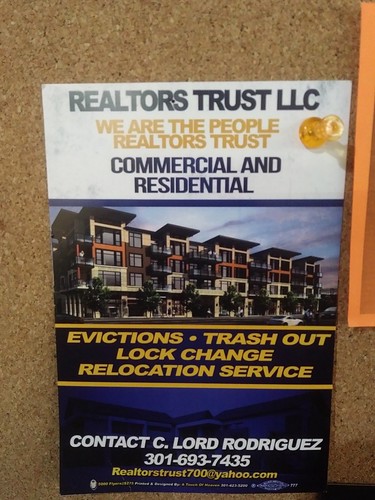
I came across this postcard posted on the bulletin board of a supermarket in Petworth around when I was writing this piece in December, "The nature of high value (strong) residential real estate markets," and DC specifically, but I forgot to use this photo as an illustration of how the process of reproduction of space and neighborhoods works. There are companies that specialize in emptying houses of tenants...

Separately, my neighborhood is involved in a discussion because the old Takoma Theatre was bought by a regional real estate developer. What this did was change the nature of the property, from one with a local/neighborhood-based owner, focused on serving the neighborhood, to one that is part of the system of regional real estate property development.

This is what urban sociologists call the reproduction of space.

For this property it significantly increases the asking price for rent, the financing changes the nature of who is considered as possible tenants, the likelihood of independent uses drops significantly, etc.

Anyway, they have a lease for a clinic and are asking that the requirements for first floor space for retail be significantly relaxed.

It will be interesting to see how this plays out. But in the discussion on the neighborhood e-list, I pointed out that once the property was purchased by a company active in the regional real estate market system, things changed.

Still, by having a coherent position (not a certainty) the neighborhood will be able to extract concessions in return for agreeing to a zoning exception.

But getting to that point is very difficult. It's why in my writings on community benefits agreements, I call for the creation of neighborhood-scale consensus priorities through planning processes more generally, and the use of this information when negotiating zoning changes, to yield structural improvements, rather than always dealing with ad hoc processes.

Labels: , , , ,

Friday, March 11, 2011

Reproducing DC's culinary reputation around national actors

The City Paper has an article about food tours in the city, "Tourist Traipse: D.C. Culinary Walking Tours." As far as visiting places that somehow are unique, food-wise, it didn't seem as if any such places were uncovered. From the article:

All the same, the tension around what constitutes local authenticity is something of a constant among the burgeoning number of food-oriented local tours. It’s easy enough to understand why. In 2008, Destination DC, the District’s official tourism marketing organization, conducted a poll about perceptions of Washington. Although 58 percent of U.S. travelers either agreed or strongly agreed that D.C. was the kind of place where you could find elegant restaurants that were known for their top chefs (nearby Philadelphia scored 55 percent), only 28 percent of respondents thought D.C. was a destination with unique local foods (compared to Philly’s 47 percent). ...

In the intervening years, several factors have changed, according to Destination DC’s director of communication, Rebecca Pawlowski—most of them relating as much to the televisual as to the culinary. “Having Top Chef film a season here—as well as having contestants from the area on Top Chef and The Next Food Network Star—helps highlight the District as a culinary destination,” she says. She also points to the influx of celebrity chef–driven restaurants—such Wolfgang Puck's The Source, Michael Mina's Bourbon S, and Alain Ducasse’s Adour—and the out-of-towners who earned their fame here, like José Andrés and Michel Richard.

What's interesting in the second quoted paragraph is that DC's being highlighted as a culinary destination comes as a result of the same kinds of changes that have made DC's central business district an international real estate investment market.

If you think of this in terms of the discussion of centre-periphery in sociology, then it makes sense that DC is now a peripheral or secondary restaurant market, being reproduced by centre actors who are opening restaurants as an extension of their activities in other more relevant markets.

(This isn't a 100% phenomenon. "DC" chefs like Michel Richard and Jose Andres are part of the national industry, and are opening restaurants in other major markets including Los Angeles and Las Vegas.)

Really, what's happening is that DC's culinary business environment is being reshaped as another branch of an increasingly nationalized restaurant-culinary scene through money and national media (magazines, television, etc.), notwithstanding places like Ben's Chili Bowl, the Maine Avenue Seafood Market, Dancing Crab, or the Florida Market retail-wholesale food distribution complex.

Another factor is that suburban outmigration and the relative speed of neighborhood change in the city has already made over ethnic districts which may have included German, Italian, Greek, or Chinese ethnicities. What's left in DC is an "old" original ethnic restaurant here or there, such as the recently (maybe 2-3 years ago) closed AV Ristorante, which was a lingering vestige of Downtown's Italian areas, or Old German Restaurant on H Street NW.

Other local foods include Southern and African-American cuisines ("soul food") and Chesapeake Bay related seafood--for example the city once was criss-crossed with Oyster houses. I suppose the local chain Cameron's, which sells cooked seafood, is a kind of continuation of oyster houses, along with some crab houses. And over the past 20-30 years, as Ethiopian immigrants came to the area (as a result of strife in that part of Africa.)

A lot of the energy in local cuisines comes from immigrants. But the pattern of immigration in the region has bypassed the city out of a reflection of suburban outmigration and relatively high rents in the city, so rather than immigrating to the city, more people have moved directly to the suburbs, skipping over the city entirely.

This is why you have an incredibly vibrant Asian community in Fairfax County (e.g., the same City Paper issue has a full page ad of restaurants and stores in the Eden Center), or significant Peruvian Chicken establishments in Arlington County and in Langley Park on the border of Montgomery and Prince George's Counties, while DC's "Chinatown" has been reproduced, more or less, into Gallery Place.

There has been some interesting articles in the New York Times over the past few months that touch on this same issue, including this piece about the vibrance of ethnic cuisine in suburban Indianapolis ("In Indianapolis, the World Comes to Eat") and how Little Italy in Manhattan has been subsumed, more or less, into Chinatown ("New York's Little Italy, Littler by the Year").

Labels: , ,