Rebuilding Place in the Urban Space

"A community’s physical form, rather than its land uses, is its most intrinsic and enduring characteristic." [Katz, EPA] This blog focuses on place and placemaking and all that makes it work--historic preservation, urban design, transportation, asset-based community development, arts & cultural development, commercial district revitalization, tourism & destination development, and quality of life advocacy--along with doses of civic engagement and good governance watchdogging.

Monday, February 03, 2025

African American History Month and Transportation: February 4th | Transit Equity Day

Janis Scott smiles as the Route 68 bus leaves her on the Texas Southern University campus while on her way to an exhibit at the University Museum on Feb. 2, 2012, in Houston. Scott, familiar to many Houston residents as the "bus lady," died Monday, Dec. 9, in Houston. Photo: Johnny Hanson/Houston Chronicle

The battles over transportation access were central to the Civil Rights movement.  Transit Equity Day, set by the American Public Transportation Association as February 4th, during African American/Black History Month, is one way to acknowledge this.  Also see Labor Network for Sustainability.

Trump Administration derides equity as an analytical construct.  It's great that transit agencies are taking this step to link African-American and transportation history.  It's a sad but necessary story. 

-- U.S. DOT’s Updated Equity Action Plan: Key Takeaways and Recommendations by the Transportation Equity Caucus, NRDC (2024)

Especially as the Trump Administration demonizes "diversity, equity and inclusion" matters ("US DOT New Head Announces End To Diversity, Equity & Inclusion Policies," Simple Flying).  The fact is, racism happened/happens.  It's a fundamental part of the American story too.

-- Diversity, Equity and Inclusion, American Public Transportation Association

Advocates are figures of today, not merely historical figures.  While we're more familiar with Rosa Parks and Montgomery, Alabama, she wasn't the first black activist fighting transportation discrimination and she won't be the last.  Last fall, the Houston Chronicle ran an obituary on one of Houston's foremost transit advocates, "Janis Scott, Houston's 'bus lady,' arts patron and tireless advocate for public transit, dies at 73."  She was a leading member of the area transit advocacy group, LINK Houston.

An earlier interview is one of the links in a four part series on transit equity by the Rice University Kinder Institute for Urban Research:

Part 1: “Racism has shaped public transit, and it’s riddled with inequities” 
Part 2: “What transit agencies get wrong about equity, and how to get it right” 
Part 3: “What transit equity means to a transit-dependent rider in a car-centric city” 
Part 4: “To tackle pandemic racism, we need to take action, not just take to social media”

Hillsborough Area Regional Transit (Florida) does a nice job with wraps celebrating black transportation history.

======

Some agencies are providing free transit access for the day, such as in Santa Monica.  In the DC area, that includes Montgomery County.

The Boston Globe has a localized feature, "Legacy of the Green Book travel guide in New England," on the Green Book.  Today though, transit equity isn't just an issue of race ("Transit Equity Day highlights the need for transit in rural communities," Transportation for America).

Below reprints the entry from last year.  There are some edits and expansions to the original text.

Transit Equity Day in honor of Rosa Parks.  Many transit authorities are providing free transit service on Sunday February 4th, in honor of the Montgomery Bus Boycott, spearheaded by Rosa Parks, which led to the desegregation of bus service in that city and led to changes throughout the South, through a process that sadly took many years.  

Parks' birthday is the date chosen for Transit Equity Day.

Interestingly, like a lot of history, Rosa Parks wasn't the first to do this, not even in Montgomery, Alabama ("Before Rosa Parks, There Was Claudette Colvin," NPR).  But when a concerted organizing campaign was developed, she was chosen to be the face.

Sometime ago, I came across some journal articles about boycotts against streetcar segregation around the turn of the century in the South, including Richmond ("Right to Ride: Streetcar Boycotts and African-American Citizenship in the Age of Plessy v. Ferguson," book review).

DC.  Despite DC being run by the federal government, mostly under the oversight of racist Southern Congressman, the city's transit system was not segregated ("Black activists' post-emancipation battle for D.C.'s city streetcars," book excerpt) as a result of post-Civil War organizing, when Congress still leaned pro-emancipation.  Hiring remained segregated ("The Fight Against Capital Transit's Jim Crow Hiring: 1941-55," Washington Area Spark).

Bus Fare Boycott, 1965/1966.  A future Mayor of DC, Marion Barry intended to get a PhD but instead  came to DC to set up a chapter on civil rights organizing for the Student Nonviolent Coordinating Committee.  One of his campaigns was a bus boycott in response to a fare increase ("Marion Barry Leads Bus Boycott," WETA/PBS).  From the article:

... Barry saw the bus company’s raised rates as a direct hit to low income people in the District, who were mostly African American. On November 8, 1965, D.C. Transit appealed to the Washington Metro Area Transit Commission to increase fares from 20 cents to 25 cents a ride. 

The hearing was held in the Interstate Commerce Commercial Building (now one of the Environmental Protection Agency buildings) at 12th St. and Constitution Ave NW. The small room in which the meeting took place must have soon felt even smaller as uninvited guests showed up; SNCC crashed the party, bringing around 100 colleagues and associates. Speakers from SNCC made it clear that if the fare increase were to occur, a boycott would follow. 

... The main focus was on the Benning Road routes, which served mostly African-Americans. Organizers arranged a transportation system for boycotters: “[R]iders will be offered free volunteer car-pool and bus service to and from their jobs under an extensive plan utilizing four major car assembly points: 45 neighborhood rider substations in stores and churches; 200 volunteer cars and drivers; 20 church donated ‘freedom busses’ and more than 250 neighborhood workers” Barry explained.

... the boycott made a strong impression. Causing a loss of about $30,000 in a single day, it served as a harsh warning to D.C. Transit about the financial impacts a longer demonstration could have on the company. Officials backed down and the fare increase did not go into effect. Barry celebrated the victory, saying that the boycott showed “the people have power.  

Greyhound bus cultural interpretation "board" on the side of the Freedom Rides Museum, Montgomery, Alabama. Photo by Michael Harding

Inter-city bus segregation.  There's a terrible story of the beating of soldier Isaac Woolard returning home from military service, on an inter-city bus in 1946 for not sitting in the back, he was blinded, beaten by a police officer.  

While President Truman was no integrationist he was appalled by how this man who served his country was treated and it led him to take on more of a civil rights agenda, including desegregation of the military ("The Blinding of Isaac Woolard," American Experience, PBS).

The history of the Civil Rights Movement is intimately linked to transportation access, segregation on transit and in transit stations, Bus Boycotts not just in Montgomery, the Freedom Riders quest to desegregate inter-city bus service, violence associated with these protests, etc. 

PBS has programs on the Freedom Riders. It'd be nice to do repeat showings during Black History Month. 

A lens on transit equity.  There is the rise in the number of communities taking an equity lens to government policies and programs, including urban and transportation planning ("Baltimore transit equity study spotlights racial disparities around neighborhoods," Washington Post, "Boston’s fare-free bus pilot program sets the stage for transit equity, advocates say," WGBH/NPR).

Although for some time, transit agencies receiving federal monies were already supposed to be doing this, and they weren't.  

That's changing.  

Former DC planner-engineer and now transit official in Houston, Victoria O. Davis, authored a book, Inclusive Transportation: A Manifesto for Repairing Divided Communities. published by Island Press, on these issues.

I've written a bunch of pieces about certain elements of this over the past decade.  For example,  "Making bus service sexy and more equitable" (2012) discusses how investment in bus systems, network breadth and depth, and streetcars is a benefit for the transit dependent.  

Low income fare discounts ("WMATA to consider lower cost/free transit pass for low income riders," 2020) and incremental pass payment systems, which more transit agencies are starting to implement now too ("13 Reasons Why Transit Agencies Around the World are Choosing Fare Payments-as-a-Service (FPaaS) Platforms for Fare Collection," Masabi).

From Ride On Zero & Reduced Fare Study (Montgomery County Maryland):

... it is not uncommon for low-income users to pay single-trip fares despite the existence of a monthly pass that may provide a more cost-effective means. This can often be the result of limited financial flexibility to afford the up-front cost of the monthly pass. Under this alternative, such users may become even more disinclined to pursue the monthly pass product.

Transportation Equity Day versus Transit Equity Day.   I'd actually honor a broader "Transportation Equity Day," if it were up to me, to address transportation issues beyond transit.  Here are some other topics vitally important to the intertwined story of transportation history and African-American history.

John Lewis (right) with fellow protesters at the Edmund Pettus Bridge in Selma, Ala., 1965. Credit: Alabama Department of Archives and History. Donated by Alabama Media Group. Photo by Tom Lankford, Birmingham News. Photo courtesy of Magnolia Pictures.

Protest in the public space.  It goes without saying that public protest was often held in public spaces, on streets and bridges, through public marches.  

A march on the Pettus Bridge in Selma, Alabama ending in police violence is considered a watershed moment in the Civil Rights movement as parts of it were televised and justice minded people couldn't ignore the reality of segregation.

From "Thousands rally in downtown Los Angeles, shut down 101 Freeway to protest Trump’s immigration policies," Los Angeles Times.  Thousands of people gathered Sunday in downtown Los Angeles to demonstrate for immigration rights, blocking lanes on the 101 Freeway at times.

That transportation infrastructure is still being used in this way in today's protests, like shutting down freeways for George Floyd and anti-Trump Administration marches should not be a surprise.  Unlike today's protestors, those in Selma stayed on the sidewalk!

The expressway was built directly on top of Claiborne Avenue in the late 1960s – ripping up the oak trees and tearing apart a street sometimes called the ‘Main Street of Black New Orleans’. Photograph: Gerald Herbert/AP

Freeway placement divides black communities. An element is how urban freeways were often built through minority neighborhoods ("America's Highway System Is a Monument to Environmental Racism and a History of Inequity," KQED/PBS, "A Brief History Of How Racism Shaped Interstate Highways," NPR, "The racist history of America's interstate highway boom," LA Times, "Could the US highways that split communities on racial lines finally fall?," Guardian).  Other urban renewal initiatives didn't help.

More recently the Biden Administration developed an initiative to fund measures to rebuild connections and address manufactured disparities within disconnected communities ("Transit projects receive more than $1 billion in federal grants designed to reconnect communities," Mass Transit).

Urban design and minority communities.  Traditionally, minority communities face all types of disinvestment, in housing, community amenities, and in mobility infrastructure--streets, sidewalks ("Socioeconomic and racial disparities of sidewalk quality in a traditional rust belt city," SSM Population Health, 2021) including access to transit ("It's not just sidewalks and money, spatial form and density influence the propensity to walk," 2009).

Angie Schmitt writes about this in terms of pedestrian safety, Right of Way: Race, Class and the Silent Crisis of Pedestrian Deaths in America, also published by the great Island Press.

Transit access is more complicated even because "choice riders"--people with cars--see transit more as a social service, not a vital community service.

Another indicator is tree cover, which significantly lags ("Since When Have Trees Existed Only for Rich Americans?," New York Times).  Urban forestry is usually a responsibility for city transportation agencies.

I have thoughts on this in "What is an inclusive city?" (2013) but I can't say it's super specific.  

When I worked on issues in DC I used to say that I wanted every block to be great, and I've made advances in thinking about planning for equity

-- "An outline for integrated equity planning: concepts and programs," 2017
-- "Equity planning: an update," 2020
-- "Social urbanism and equity planning as a way to address crime, violence, and persistent poverty: (not in) DC," 2021

In South America, a foundational element of "social urbanism," a planning approach to public investment that improves communities is in enhancing transportation in transformational ways.  For example, gondolas and escalators to better reach neighborhoods with challenging topographical issues, and bike sharing to enhance first mile/last mile access.  For example, in Bogota, transit users can end their trip on a free bike sharing ride.

David Barth's diagram on the public realm as an interconnected system is great.  But could do better on indicating how the realm is linked through mobility networks.

My more recent writings that communities need urban design and walkable community plans ("Planning for place/urban design/neighborhoods versus planning for transportation modes: new 17th Street NW bike lanes | Walkable community planning versus "pedestrian" planning") and investment in placemaking elements

-- "Extending the "Signature Streets" concept to "Signature Streets and Spaces"," 2020
-- "From more space to socially distance to a systematic program for pedestrian districts (Park City (Utah) Main Street Car Free on Sundays)," 2020
-- "Why doesn't every big city in North America have its own Las Ramblas?," 2020
-- "Diversity Plaza, Queens, a pedestrian exclusive block," 2020
;--"Bus stops as neighborhood focal points and opportunities for placemaking," ) 

are most applicable to these issues.

Driving While Black: African American Travel and the Road to Civil Rights

Individual car ownership as freedom.  For people with the means, privately owned cars were a step towards a kind of freedom from segregated transit ("How Automobiles Helped Power the Civil Rights Movement," Smithsonian, "How Cars Changed Black Life In America," KERA-FM/NPR).  

OTOH, the freedom was circumscribed as black motor vehicle operators had to wend their way through racist traffic enforcement and segregated public accommodations.

Negro Motorist Green Book and public accommodations laws and enforcement.  This book was a guide to safe places for services, gas, eating and overnight stays for African-Americans traveling on the roads in segregated places.  

Negro Travelers' Green Book, 1956. Digital collections, University of South Carolina. Complete scan.

-- "Lighting the Way | When the Way is Dark," Exhibit, Smithsonian Institution
-- "Navigating the Green Book," New York Public Library
-- "An atlas of self-reliance: The Negro Motorist's Green Book (1937-1964)," National Museum of American History).

It wasn't until the mid-1950s when significant gains began to be made in laws concerning the desegregation of public accommodations beyond transit--co-equal access to restaurants, motels, stores, etc.--which led to the Green Book no longer being as necessary. It ceased publication in the late 1960s.

I hate to admit, given all the gas station road maps I've collected over the years, that I am just now realizing that all of the images of people, gas station attendants, etc., only feature whites.

In an interview with travel historian Gretchen Sorin, Spencer Crew recalled traveling in his parents’ car in the 1950s: “that big old car was like a cocoon,” he remembered. “We didn’t know anything except what we saw out the side windows. We could hardly see over the back of the front seat. Our parents protected us from all the racist stuff along the road." Photo titled "Mr. Lifsey presenting Oldsmobile to raffle winner, April 1955." Scurlock Studio Records, ca. 1905-1994, Archives Center, National Museum of American History.

Traffic safety and the black community ("Racial disparities in traffic fatalities much wider than previously known," Harvard).

A new study by Boston University School of Public Health (BUSPH) and Harvard T.H. Chan School of Public Health has found that Black and Hispanic Americans are disproportionately affected by traffic-related deaths—and that these disparities in fatalities are larger than previous estimates show. 

Published in the American Journal of Preventive Medicine on Tuesday, June 7, 2022, the study found that travel distances vary among racial/ethnic groups when walking, cycling, or driving—and when these differences in activity levels are taken into account, Black Americans had the highest traffic fatality rate per mile traveled and across all modes, followed by Hispanics, Whites, and Asians. 

An out of control vehicle crashed into a gas station on Florida Avenue NE in Washington, DC, killing a patron.  Photo: Fox5DC

These disparities were particularly stark for walking and cycling, and during evening hours. The study provides a more accurate assessment of racial/ethnic disparities in traffic deaths than previous traffic mortality studies, which have not accounted for these differences in travel distances, and thus, underestimated both the traffic-related risks and deaths that Black and Hispanic Americans experience. 

These findings may also point to structural racism within the US transportation system, the researchers say.

Disparities in enforcement.  Researchers like Gregory Shill ("Should law subsidize driving?," "Reckless Driving Isn't Just a Design Problem," Atlantic) state that social justice initiatives limiting enforcement against POC ("If Black Lives Really Matter, We Must End Traffic Stops!," William & Mary Institute of Race, Gender and Social Justice, "What Traffic Enforcement Without Police Could Look Like," The Appeal, "Traffic Without the Police," Stanford Law Review) actually hurt the same communities more, because of the deleterious impact of crashes, deaths, and reckless driving. 

There is no question though that there is structural racism embodied in traffic enforcement ("The racial composition of road users, traffic citations, and police stops," Proceedings of the National Academies of of Sciences).

School busing and desegregation is yet another issue.  I was just a bit too young to be conscious of bombing of buses in Pontiac, Michigan in 1971 ("On this day in 1971: KKK bombs empty Pontiac buses set to racially integrate schools," Michigan Advance).  

African American Boycott in favor of the desegregation of Boston Schools, February 26, 1964. (Photo James Fraser photograph collection, Northeastern University, Boston.)

I lived in Detroit at the time, but in 6th and 7th grade I did attend Pontiac Schools, after desegregation.  In Detroit, I attended schools that were segregated based on demographically homogeneous neighborhoods.

PBS has a great documentary of the battles over "busing" focusing on Boston.  

-- "The Busing Battleground: The Decades-Long Road to School Desegregation," American Experience, PBS

-- "It was a war zone: Busing in Boston," WBUR/NPR

I really need to read Common Ground, by J. Anthony Lukacs, about the battle over busing in Boston.

Transportation History interpretation and presentation.  FWIW, I think transit agencies should have a public history interpretation program, including on issues of race, that is displayed at stations, on transit vehicles, etc., 24/7/365.  

This guidebook published by the National Park Service, is useful for selecting sites that interpret this history.

-- Civil Rights in America: Racial Desegregation of Public Accommodations, African-American Theme Studies, National Park Service

US Civil Rights Trail.  Is a broad heritage trail of significant sites and events in civil rights history.  Encompassing 15 states in the Southeast, it could be worth considering creating a sub-trail that is transportation specific.

Brotherhood of Sleeping Car Porters.  The members of this union worked as attendants on the sleeper cars for overnight train service.  These cars weren't owned by the railroads, but by the Pullman Company of Chicago (Pullman Porters, NPS).  

National A. Philip Randolph Pullman Porter Museum, located at the corner of 104th and Maryland Ave. NPS Photo/Ve'Amber D. Miller

Many ended up being civil rights organizers indirectly protected by the travel within their job.  Many ensured that black newspapers like the Baltimore Afro-American, Chicago Defender, and the Pittsburgh Courier were distributed throughout the South.

To push civil rights forward during WWII, the Brotherhood planned a "March on Washington", which was cancelled at the behest of FDR in return for concessions.  The Brotherhood later took part in the 1963 March on Washington ("The Brotherhood of Sleeping Car Porters: The Civil Rights Movement," masters thesis). 

Labels: , , , , , , , ,

Friday, February 02, 2024

Transit equity day, Sunday 2/4/24, in honor of Black History Month, Rosa Parks, and the significance of transportation history to African-American History

-- "Transit equity day, Sunday 2/4/24, in honor of Black History Month, Rosa Parks, and the significance of transportation history to African-American History," 2024
-- "Three ideas about presentation of African American History in the context of Black History Month | reprint with an addition about the US Civil Rights Trail (versus the Dixieland Trail)," 2024

February is Black History Month, and over the years I've written some pieces about the nexus of black history and urban and transportation planning. 

-- "Black History Month and the New Jim Crow," 2020
-- "Two ideas about presentation of African American History in the context of Black History Month," 2020
-- "African American History Month and Urban Planning," 2019

National Archives photo of a pretty much empty bus during the Montgomery Bus Boycott.

Transit Equity Day in honor of Rosa Parks.  Many transit authorities are providing free transit service on Sunday February 4th, in honor of the Montgomery Bus Boycott, spearheaded by Rosa Parks, which led to the desegregation of bus service in that city and led to changes throughout the South, through a process that sadly took many years.  

Parks' birthday is the date chosen for Transit Equity Day.

It's great that transit agencies are taking this step to link African-American and transportation history.  It's a sad story but a necessary one.

-- Diversity, Equity and Inclusion, American Public Transportation Association

Interestingly, like a lot of history, Rosa Parks wasn't the first to do this, not even in Montgomery, Alabama ("Before Rosa Parks, There Was Claudette Colvin," NPR).  But when a concerted organizing campaign was developed, she was chosen to be the face and spearhead out front.

Sometime ago, I came across some journal articles about boycotts against streetcar segregation around the turn of the century in the South, including Richmond ("Right to Ride: Streetcar Boycotts and African-American Citizenship in the Age of Plessy v. Ferguson," book review).

DC.  Despite DC being run by the federal government, mostly under the oversight of racist Southern Congressman in the 20th Century, the city's transit system was not segregated ("Black activists' post-emancipation battle for D.C.'s city streetcars," book excerpt) as a result of post-Civil War organizing, when Congress still leaned pro-emancipation.  Hiring remained segregated ("The Fight Against Capital Transit's Jim Crow Hiring: 1941-55," Washington Area Spark).

Bus Fare Boycott, 1965/1966.  A future Mayor of DC, Marion Barry intended to get a PhD but instead  came to DC to set up a chapter on civil rights organizing for the Student Nonviolent Coordinating Committee.  One of his campaigns was a bus boycott in response to a fare increase ("Marion Barry Leads Bus Boycott," WETA/PBS).  From the article:

... Barry saw the bus company’s raised rates as a direct hit to low income people in the District, who were mostly African American. On November 8, 1965, D.C. Transit appealed to the Washington Metro Area Transit Commission to increase fares from 20 cents to 25 cents a ride. 

The hearing was held in the Interstate Commerce Commercial Building (now one of the Environmental Protection Agency buildings) at 12th St. and Constitution Ave NW. The small room in which the meeting took place must have soon felt even smaller as uninvited guests showed up; SNCC crashed the party, bringing around 100 colleagues and associates. Speakers from SNCC made it clear that if the fare increase were to occur, a boycott would follow. 

... The main focus was on the Benning Road routes, which served mostly African-Americans. Organizers arranged a transportation system for boycotters: “[R]iders will be offered free volunteer car-pool and bus service to and from their jobs under an extensive plan utilizing four major car assembly points: 45 neighborhood rider substations in stores and churches; 200 volunteer cars and drivers; 20 church donated ‘freedom busses’ and more than 250 neighborhood workers” Barry explained.

... the boycott made a strong impression. Causing a loss of about $30,000 in a single day, it served as a harsh warning to D.C. Transit about the financial impacts a longer demonstration could have on the company. Officials backed down and the fare increase did not go into effect. Barry celebrated the victory, saying that the boycott showed “the people have power.  

Greyhound bus cultural interpretation "board" on the side of the Freedom Rides Museum, Montgomery, Alabama. Photo by Michael Harding

Inter-city bus segregation.  There's a terrible story of the beating of soldier Isaac Woolard returning home from military service, on an inter-city bus in 1946 for not sitting in the back, he was blinded, beaten by a police officer.  

While President Truman was no integrationist he was appalled by how this man who served his country was treated and it led him to take on more of a civil rights agenda, including desegregation of the military ("The Blinding of Isaac Woolard," American Experience, PBS).

The history of the Civil Rights Movement is intimately linked to transportation access, segregation on transit and in transit stations, Bus Boycotts no just in Montgomery, the Freedom Riders quest to desegregate inter-city bus service, violence associated with these protests, etc. 

PBS has programs on the Freedom Riders. It'd be nice to do repeat showings during Black History Month. 

A lens on transit equity.  There is the rise in the number of communities taking an equity lens to government policies and programs, including urban and transportation planning ("Baltimore transit equity study spotlights racial disparities around neighborhoods," Washington Post, "Boston’s fare-free bus pilot program sets the stage for transit equity, advocates say," WGBH/NPR).

Although for some time, transit agencies receiving federal monies were already supposed to be doing this, and they weren't.  

That's changing.  

Former DC planner-engineer and now transit official in Houston, Victoria O. Davis, authored a book, Inclusive Transportation: A Manifesto for Repairing Divided Communities. published by Island Press, on these issues.

I've written a bunch of pieces about certain elements of this over the past decade.  For example,  "Making bus service sexy and more equitable" (2012) discusses how investment in bus systems, network breadth and depth, and streetcars is a benefit for the transit dependent.  

Low income fare discounts ("WMATA to consider lower cost/free transit pass for low income riders," 2020) and incremental pass payment systems, which more transit agencies are starting to implement now too ("13 Reasons Why Transit Agencies Around the World are Choosing Fare Payments-as-a-Service (FPaaS) Platforms for Fare Collection," Masabi).

From Ride On Zero & Reduced Fare Study (Montgomery County Maryland):

... it is not uncommon for low-income users to pay single-trip fares despite the existence of a monthly pass that may provide a more cost-effective means. This can often be the result of limited financial flexibility to afford the up-front cost of the monthly pass. Under this alternative, such users may become even more disinclined to pursue the monthly pass product.

Transportation Equity Day versus Transit Equity Day.   I'd actually honor "Transportation Equity Day," if it were up to me, to address these issues more broadly.  Here are some other topics vitally important to the intertwined story of transportation history and African-American history.

The expressway was built directly on top of Claiborne Avenue in the late 1960s – ripping up the oak trees and tearing apart a street sometimes called the ‘Main Street of Black New Orleans’. Photograph: Gerald Herbert/AP

Freeway placement divides black communities. An element is how urban freeways were often built through minority neighborhoods ("America's Highway System Is a Monument to Environmental Racism and a History of Inequity," KQED/PBS, "A Brief History Of How Racism Shaped Interstate Highways," NPR, "The racist history of America's interstate highway boom," LA Times, "Could the US highways that split communities on racial lines finally fall?," Guardian).  Other urban renewal initiatives didn't help.

Urban design and minority communities.  Traditionally, minority communities face all types of disinvestment, in housing, community amenities, and in mobility infrastructure--streets, sidewalks ("Socioeconomic and racial disparities of sidewalk quality in a traditional rust belt city," SSM Population Health, 2021) including access to transit ("It's not just sidewalks and money, spatial form and density influence the propensity to walk," 2009).

Angie Schmitt writes about this in terms of pedestrian safety, Right of Way: Race, Class and the Silent Crisis of Pedestrian Deaths in America, also published by the great Island Press.

Transit access is more complicated even because "choice riders"--people with cars--see transit more as a social service, not a vital community service.

Another indicator is tree cover, which significantly lags ("Since When Have Trees Existed Only for Rich Americans?," New York Times).  

I have thoughts on this in "What is an inclusive city?" (2013) but I can't say it's super specific.  

When I worked on issues in DC I used to say that I wanted every block to be great, and I've made advances in thinking about planning for equity

-- "An outline for integrated equity planning: concepts and programs," 2017
-- "Equity planning: an update," 2020
-- "Social urbanism and equity planning as a way to address crime, violence, and persistent poverty: (not in) DC," 2021

David Barth's diagram on the public realm as an interconnected system is great.  But could do better on indicating how the realm is linked through mobility networks.

My more recent writings that communities need urban design and walkable community plans ("Planning for place/urban design/neighborhoods versus planning for transportation modes: new 17th Street NW bike lanes | Walkable community planning versus "pedestrian" planning") and investment in placemaking elements

-- "Extending the "Signature Streets" concept to "Signature Streets and Spaces"," 2020
-- "From more space to socially distance to a systematic program for pedestrian districts (Park City (Utah) Main Street Car Free on Sundays)," 2020
-- "Why doesn't every big city in North America have its own Las Ramblas?," 2020
-- "Diversity Plaza, Queens, a pedestrian exclusive block," 2020
;--"Bus stops as neighborhood focal points and opportunities for placemaking," ) 

are most applicable to these issues.

Traffic safety and the black community. Is yet another issue ("Racial disparities in traffic fatalities much wider than previously known," Harvard).

A new study by Boston University School of Public Health (BUSPH) and Harvard T.H. Chan School of Public Health has found that Black and Hispanic Americans are disproportionately affected by traffic-related deaths—and that these disparities in fatalities are larger than previous estimates show. 

Published in the American Journal of Preventive Medicine on Tuesday, June 7, 2022, the study found that travel distances vary among racial/ethnic groups when walking, cycling, or driving—and when these differences in activity levels are taken into account, Black Americans had the highest traffic fatality rate per mile traveled and across all modes, followed by Hispanics, Whites, and Asians. 

An out of control vehicle crashed into a gas station on Florida Avenue NE in Washington, DC, killing a patron.  Photo: Fox5DC

These disparities were particularly stark for walking and cycling, and during evening hours. The study provides a more accurate assessment of racial/ethnic disparities in traffic deaths than previous traffic mortality studies, which have not accounted for these differences in travel distances, and thus, underestimated both the traffic-related risks and deaths that Black and Hispanic Americans experience. 

These findings may also point to structural racism within the US transportation system, the researchers say.

Negro Travelers' Green Book, 1956. Digital collections, University of South Carolina. Complete scan.

Negro Motorist Green Book and public accommodations laws and enforcement.  This book was published as a guide to safe places for services, gas, eating and overnight stays for African-Americans traveling on the roads in segregated places.  

-- "Lighting the Way | When the Way is Dark," Exhibit, Smithsonian Institution

-- "Navigating the Green Book," New York Public Library

-- "An atlas of self-reliance: The Negro Motorist's Green Book (1937-1964)," National Museum of American History).

It wasn't til the mid-1950s when significant gains began to be made in laws concerning the desegregation of public accommodations beyond transit--co-equal access to restaurants, motels, stores, etc.--which led to the Green Book no longer being as necessary.

I hate to admit, given all the gas station road maps I've collected over the years, that I am just now realizing that all of the images of people, gas station attendants, etc., only feature white people.

In an interview with travel historian Gretchen Sorin, Spencer Crew recalled traveling in his parents’ car in the 1950s: “that big old car was like a cocoon,” he remembered. “We didn’t know anything except what we saw out the side windows. We could hardly see over the back of the front seat. Our parents protected us from all the racist stuff along the road." Photo titled "Mr. Lifsey presenting Oldsmobile to raffle winner, April 1955." Scurlock Studio Records, ca. 1905-1994, Archives Center, National Museum of American History.

This guidebook for the National Park Service, and other organizations, in selecting sites that interpret this history.

-- Civil Rights in America: Racial Desegregation of Public Accommodations, African-American Theme Studies, National Park Service

School busing and desegregation is yet another issue.  I was just a bit too young to be conscious of bombing of buses in Pontiac, Michigan in 1971 ("On this day in 1971: KKK bombs empty Pontiac buses set to racially integrate schools," Michigan Advance).  

African American Boycott in favor of the desegregation of Boston Schools, February 26, 1964. (Photo James Fraser photograph collection, Northeastern University, Boston.)

I lived in Detroit at the time, but in 6th and 7th grade I did attend Pontiac Schools, after desegregation.  In Detroit, I attended "segregated schools.

PBS has a great documentary of the battles over "busing" focusing on Boston.  

-- "The Busing Battleground: The Decades-Long Road to School Desegregation," American Experience, PBS

-- "It was a war zone: Busing in Boston," WBUR/NPR

I really need to read Common Ground, by J. Anthony Lukacs, about the battle over busing in Boston.

Bicycling as transportation and the black community.  This will come in a separate entry.

Labels: , , , , , , , ,

Friday, February 04, 2022

Black/African-American History Month and Urban Planning

 Over the years, I've written entries during African American/Black History Month, about the nexus of black history and urban and transportation planning. 

-- "Black History Month and the New Jim Crow," 2020
-- "Two ideas about presentation of African American History in the context of Black History Month," 2020
-- "African American History Month and Urban Planning," 2019

While those pieces hold up well, there's definitely new material.

The boogeyman of critical race theory/"race books"/school boards.  CRT started out as an academic approach to the study of law and American legal institutions, although you can use the same term to refer to the study of racism and segregation as an element of American society ("Before you rage against critical race theory, it might be helpful to know what it is," Seattle Times).

Conservatives have made this a huge issue, and making it out to be something reshaping K-12 education.  There are dozens of efforts in State Legislatures across the country to ban the teaching of CRT ("Why are states banning critical race theory?," Brookings).

There are related efforts to ban books ("Read the Books That Schools Want to Ban," The Atlantic).

And the ability of parents to influence school boards, get books banned (and masking) has been a successful wedge issue, which contributed to the success of Glenn Youngkin winning the Governorship in Virginia last November ("How will fights about race and suburban schools change education politics?," Chalkbeat).

The history of federally imposed housing segregation.  Last year I read  The Color of Law: A Forgotten History of How Our Government Segregated America.

It's a damning overview of how segregation and discrimination has been "baked in" to US housing policy. 

Reading it, no one can deny the reality of structural racism.

Transit equity.  There is the rise in the number of communities taking an equity lens to government policies and programs, including urban and transportation planning ("Baltimore transit equity study spotlights racial disparities around neighborhoods," Washington Post, "Boston’s fare-free bus pilot program sets the stage for transit equity, advocates say," WGBH/NPR).

Although for some time, transit agencies receiving federal monies were already supposed to be doing this, and they weren't.  That's changed.

Free and discounted transit pricing isa related response.

Team Henry Enterprises is contracted to dismantle the pedestals throughout the city that once held Confederate monuments. The first pedestal, where Matthew F. Maury stood on Monument Avenue, came down Tuesday. Photo by Regina H. Boone

Confederate monuments.  The push to remove Confederate monuments continues ("Monuments as public art, historiography, and change," 2020).  

This has been ongoing, and was discussed in the 2019 entry, but it's more pronounced, including the removal of monuments even of the Robert E. Lee statue on Monument Avenue in Richmond, Virginia ("Confederate pedestals out," Richmond Free Press).  

And the renaming of streets that have been named after prominent Confederate figures ("3 Charlotte streets officially drop names tied to slavery, Confederacy," WSOC-TV), 

Energy and the environment.  Energy equity is another relevant to Black history and urban planning too.  

-- "Local neighborhood stabilization programs: Part 5 | Adding energy conservation programs, with the PUSH Buffalo Green Development Zone as a model," 2021

The comments thread includes links to a number of relevant aspects of the issue.

====

Philadelphia has just created an equity advisory commission ("Philly names Environmental Justice Advisory Commission to address ‘racially biased and discriminatory policies’," Philadelphia Inquirer).

Labels: , , , , , , , , ,

Sunday, April 07, 2019

This was a bicycle mobility promotion concept I tried to sell to one of the DC area's biggest apartment managers*, to no avail

* They are also a big developer

====
After the failure trying to push this idea of what I call "bike provision" -- the bundling of a bike, lock, and helmet into a lease for an apartment, along with some sort of on-site access to bike maintenance and high quality bicycle parking -- to a major apartment development and management firm, located on a multi-use trail, starting in 2011, but with a couple of iterations later, I was really pissed to (1) go to an Urban Land Institute presentation and see the mention of a related program in Seattle; (2) followed by the publication of a report by the Urban Land Institute on best practice bicycle related elements in development projects, Active Transportation and Real Estate: The Next Frontier. (Although the Seattle project did do one thing I didn't suggest, was to include extra large elevators, the better to accommodate bikes.)

... I struggle over thinking that I must just be absolutely terrible at explaining things (selling), because I push ideas to seemingly leading, innovative companies and they don't bite.

Although I did learn some important stuff about (1) how when you try to talk to a company about this in advance of ground breaking it's too early; (2) by the time they're ready to talk about it, near the end of construction, it's too late; (3) especially because of how they contract for interior finishings, e.g., bike racks are "metal" and they contract with one firm to do "all the metal"; and (4) by that time, various buildings may be sold off even though they are managed under one name and management firm, but each new owner needs to sign off on something like this and usually they aren't in the mental innovation position of being able to do so.

Baltimore Collegetown Bicycle Route sign (cropped)... Notions Capital calls our attention to the new Wheelhouse Apartments building in Baltimore, ("Rent an apartment, get a bike: Baltimore developers pitch a new, carless way to live," Baltimore Sun). From the article:
When tenants begin signing leases for apartments in the Wheelhouse in Federal Hill this July, the landlord plans to give them a bike along with the keys.

The developer of the 28-unit, five-story complex on South Charles Street, 28 Walker, hopes to discourage tenants from even owning cars and needing a place to park.

“We’re taking a step further than providing a bike room,” said Scott Slosson, development director for 28 Walker. “We’re giving everyone a bike.” Slosson said that will remove “a major barrier for people who maybe just moved here, haven’t ridden in awhile, want a bike but don’t know what to buy. ...We don’t think anyone living here will have a car.”

Around the country, developers like 28 Walker have decided it’s good business to build close to bike lanes and trails, as well as public transit. Their buildings often offer places to store, fix and wash bicycles as amenities beyond a pool, pool table — or parking space.
Ironically, the same company I am complaining about had two projects in Baltimore around the same time, for which I also suggested this kind of implementation.

All of the projects were a minimum of 10x larger than the Wheelhouse Apartments.

I've also made the same suggestion to some big public/social housing operators too, with a similar lack of understanding/response.

Labels: , , , ,

Tuesday, March 19, 2019

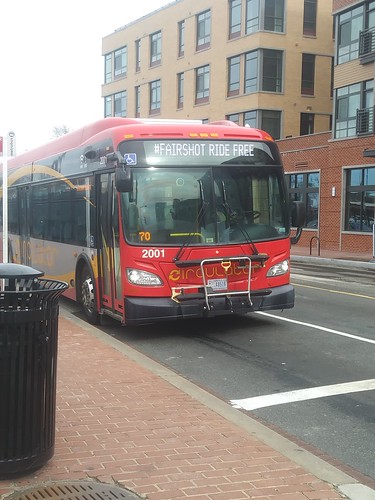
Revisiting "Should surface transit be free?" given DC's announcement the Circulator bus service will be free

D.C. Circulator busAt the Mayor's State of the City address, she announced ("Bowser proposes commercial tax increase to pay for affordable housing," Washington Post) that the DC Circulator bus service will now be free.  From the article:
She announced that the city would permanently eliminate the $1 fare on the popular D.C. Circulator bus system, after experimenting with free rides in February and March. “For working people, it adds up,” Bowser said, noting that she has been stopped in the store checkout line and at dinners by people who gushed about the free bus rides. The free rides cost the city about $250,000 a month, officials said.
Last December, Luxembourg announced it will make transit free ("Luxembourg to become first country to make all public transport free").  That blog entry discusses various free transit initiatives, such as:

Talinn, Estonia has had free transit for a number of years.  A handful of cities--Calgary, Pittsburgh, and Salt Lake City--still have free transit zones in their Downtowns as a congestion reduction measure. A number of resort communities also provide no cost transit service as a congestion management tool.

Baltimore has a free Circulator service as well, which is designed to provide intra-city transit especially in the core and highly visited zones, to complement the inter-city regionally oriented service profile of the bus system serving the city and abutting counties ("Charm City Circulator's new operator has not trained all drivers, faces persistent bus shortage," Baltimore Sun).

It's paid for by a tax on parking, but that hasn't generated enough revenue and so they've had to make up funding with other sources.

Recently, workers in Downtown Columbus have been given access to free bus passes as a congestion measure.

Here and there are various particular free bus services, including Circulators of various sorts. Salt Lake City has a free bus line to the State Capitol (Route 500 - State Capitol Free Fare Zone, which extends outside of the city's free fare zone.

Photo: Jesse Acosta, WBUR-FM/NPR, "MBTA Begins Early-Morning Bus Service Pilot Program."

Boston City Councillors suggest one route be converted to free fare. Just last week, two Boston councilmembers proposed that a specific bus route be turned into a free service ("Two Boston city councilors want to make the Route 28 Bus free," Boston Globe). From the article:
Boston City Councilor Michelle Wu, one of the outspoken advocates in the charge against the price hike, says it’s time for the “next step:” a public discussion on how to ultimately make one of the busiest bus routes in the city, free of charge.

The Route 28 Bus, making stops between Mattapan and Ruggles Station, carries around 12,000 riders on weekdays. The majority of passengers are low-income residents without cars and almost half don’t have a driver’s license, Wu told her fellow councilors this week. ...

“This would be a measure that would also ensure people have no barriers to access that economic opportunity corridor,” Wu said during a meeting Wednesday, where she and Councilor Kim Janey filed their request for a hearing on the proposal. “This is the route I think we need to have the conversation about.”
While what Mayor Bowswer has done or what Boston councillors are proposing are nice things to do, I don't necessarily think it's the right thing to do.

As rich as it is, DC still has more things it would like to do than it has money a/k/a limited financial resources and constraints. Therefore, it makes sense to direct those resources in ways that have the greatest return and impact.

Most of the Circulator bus routes in the city are what I call political bus service. From a usage standpoint, they don't experience particularly high ridership. But most neighborhoods want the service because the cost of the fare (until the speech) is half that of regular Metrobus service.

The bus lines that have the highest ridership are in the core, and like the Baltimore routes are designed to provide intra-city coverage that the trunkline Metrobus lines don't really do. But most of those riders can afford to pay for the service.

One of the downsides of congestion-management focused free transit service is that the beneficiaries tend to be the well off, because they are the ones working white collar jobs in the core (although there are also service jobs too).

I wrote about some of these issues a little over two years ago, "Is making surface transit free the best transit investment DC can make?." The rest of this post is drawn from that, but revised.

How the city provides bus service. Basically, DC has four types of bus service.

(1) high frequency service on major arterials, like the bus service on 16th Street NW (S bus) or H Street-Benning Road (X bus), serving major activity centers and transit stations, and usually not extending beyond DC's borders, with the exception of the 70s bus line, which terminates in Silver Spring;

(2) neighborhood-to-neighborhood bus service between various activity centers and transit stations (like the 62 bus between Takoma and Petworth Stations or the H8 bus which goes from Mount Pleasant to the Columbia Heights Metrorail Station then to the Brookland Metrorail Station and then to the Rhode Island Metrorail Station);

(3) the Circulator service downtown and in some neighborhoods; and

(4) private shuttle services between subway stations and campuses, mostly for the universities like Georgetown and Howard, the Washington Hospital Center, although many federal government agencies run shuttle services too.

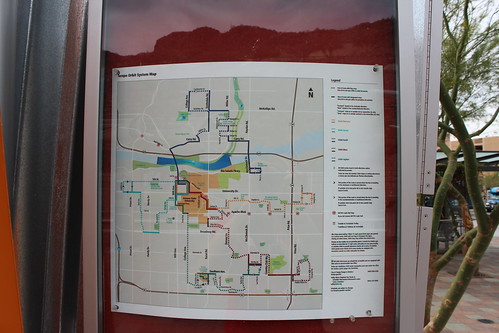
Orbit MapMap, Tempe Orbit intra-neighborhood bus service.  

To better serve the differing needs of communities, based on transit station proximity, density, and need, I have argued that the city needs to redefine how it provides transit, including the provision of intra-neighborhood service in certain neighborhoods.

I've written about this too in the context of my various "transportation wish lists," ("Transportation Wish List: 2015 edition, part one, the original list" and "Part two, new ideas").

The fact is that outside of the service in Downtown and that serving the National Mall during tourist season, for the most part Circulator bus routes duplicate service provided by existing Metrobus routes.

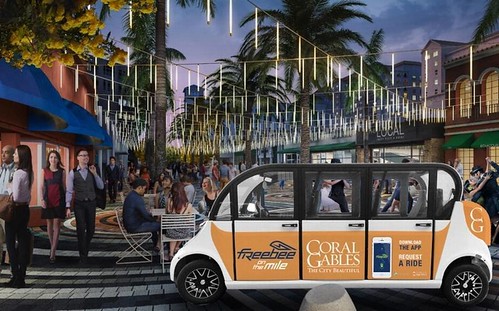
Freebee shuttle (tertiary transit), Coral Gables, Florida, Miami-Dade CountyRendering, intra-neighborhood Freebee Shuttle, Coral Gables, Florida.

While I no longer think that DC's transit planning priority should be making surface transit free, the decision by Mayor Bowser should spur us to think about what outcomes do we want from the city transit network and its surface component. and how and what kinds of investments should DC be making concerning improvements in surface transit service.

Free transit is expensive. As an intellectual exercise, I think it's worth considering free transit. But as an op-ed in Planetizen shows ("Why Is Fare-Free Transit The Exception Rather Than The Rule?") it works in places where overall there isn't that much demand for transit, and in small, constrained places, such as in resort towns. In larger cities, where transit is heavily used, the cost is considerable and difficult for local government budgets to absorb.

Whereas most communities do not have free transit service for primary and secondary routes, some cities like Tempe and Scottsdale in Arizona or the Town of Friendship Heights in Maryland have free intra-neighborhood services that move people from neighborhoods to activity centers and transit stations, but these services complement the broader transit network.

San Francisco considered it (but they have refused to release the final report), but found the increase in the amount of equipment required was beyond the budget. See "Free ride? Fat chance: Muni fares will stay," San Francisco Chronicle.

Note that the free weekly in the Vancouver, BC region, had a nice series on free transit. See "No Fares! Series," Tyee.

Are there better investments we could make in bus transit over making Circulator buses free?

In the metropolitan area, DC generally has the highest ridership buses (although one of those lines originates in Silver Spring, Maryland) with multiple lines having daily ridership between 13,000 and 22,000 riders.  But just because we have many high ridership lines it doesn't mean the system is perfect.

The original piece lists seven points.  But from the standpoint of providing free transit specifically, there are only two points that really matter.  Making these changes rather than making the DC Circulator bus routes free would have a lot more and more focused impact.

1.  Discounting transit for low income residents.  Rather than providing free transit to a lot of people who have the means to pay for it we should be prioritizing subsidizing transit service for people of limited means.

I am embarrassed to say that in my various "Transportation Wish Lists" I never listed this as a priority. 

(Although, it should be funded as a social service measure rather than a cost to the transit system, and separately and as an addition to monies for the transit system currently appropriated by the jurisdictions.)

While WMATA provides discounted fares for seniors, but not on a means-tested basis, and both DC and Montgomery County provide free or reduced price transit passes for schoolchildren, the DC area does not have a systematic program reducing the cost of transit for the impoverished.

The subsidized fare program offered by SF MUNI is called the Lifeline Pass, and it's half the cost of a regular monthly pass (their regular fare monthly pass is still very very cheap compared to peer systems), and people must be income qualified to be able to get the pass.

King County Metro in Seattle has a similar program. Hubway, Boston's bike share program has a similar framework for their low income access program.

More and more cities are creating such programs including Calgary, Denver ("Denver Approves Low-Income Discount for Transit Riders," NextCity), Halifax, Nova Scotia, Minneapolis ("Metro Transit will offer $1 fare for low-income riders," St. Paul Pioneer Press), Portland, Oregon ("Low Income Fares Begin," Portland Observer)), Lincoln, Nebraska and Los Angeles County, etc.

New York City Council pushed Mayor De Blasio to create a similar system, although it won't include single rides, only week and monthly passes.

Edmonton pay as you go and capping for low income riders.  However, Edmonton has proposed that could create the equivalent of a "pay as you go" capping feature for low income riders, which is the method I'd recommend implementing.

For low income riders who can't afford to buy a monthly pass in advance, the "rate capper" will work over the course of an entire month, and once a rider pays in fares the equivalent of the cost of a monthly pass, the discounted price of the pass -- and "free" travel for the rest of the month kicks in ("New smart cards for Edmonton Transit boast a 'social justice' edge," Edmonton Journal).
From the article:
People with steady jobs and good paycheques are the most likely to buy a monthly pass. They have cash on hand at the beginning of the month.

Those who might need their last nickel just to keep the lights on are the most likely to pay cash for every trip. It means they pay $3.25 per ride, more money for the same service.

That’s one reason Ken Koropeski is excited about Smart Fare.

With a card and an online account, the system can track how many times a person uses transit during a 30-day period, said Koropeski, director of special projects for Edmonton Transit. No one would have to commit to a monthly pass on Day 1. Instead, the system could automatically track use and once the rider hits that monthly maximum, all other rides are free.

“When you have capping, it has inherent benefits for people with low income,” said Koropeski.
Rather than spending $3 million making the Circulator free better that we spend $3 million on low income transit passes.

2.  Create intra-neighborhood transit (bus) services so that people can get to and from local services, commercial districts, schools, libraries, and to and from transit stations without having to drive. This includes delivery services of "freight" such as groceries.

In various writings, I call this "tertiary" service/tertiary transit network (based on the Arlington County framework in their transportation plan, which defines a primary and secondary transit network).  And it's not like we don't have a form of this now, at least within the city. Most neighborhoods have access to some bus service, although many people may not use it because it is circuitous or because they feel that the bus service is beneath them.

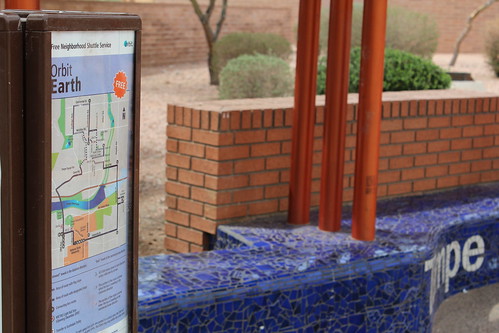
Orbit EarthThere are many models for what I consider intra-district transit service: including various tourist oriented transit services in places like Savannah or Laguna Beach; the Tempe In Motion bus services in Tempe, Arizona, which serves residents; the Baltimore Circulator which complements metropolitan bus service to Downtown by MTA with intra-district bus service; the FRED service of electric mini-shuttles in Downtown San Diego, Santa Monica, Anaheim, and various communities on Long Island and in and around Miami.

While I no longer recommend making all surface transit free, I do see the value in making tertiary network transit services free. That would take people to and from major transit stations, commercial districts, supermarkets, etc., and home, but wouldn't be free for outside of the neighborhood travel. See "Intra-neighborhood (tertiary) transit revisited because of new San Diego service," for a more complete discussion.

======
Other items from "Is making surface transit free the best transit investment DC can make?
  • Double deck buses as a repositioning device
  • Creating a system of priority bus lanes
  • Add Night Owl bus service on subway routes during the periods when the system is closed
  • Line extensions/creations.  One example would be the extension of the 30s line from its terminus at Friendship Heights on the DC/Maryland border northward to at least Friendship Heights.  Another would be service on Connecticut Avenue and Rhode Island Avenue that is more comparable to the trunkline services on major arterials such as 14th or 16th Streets, H Street, or Georgia Avenue.  Both of these services should extend some distance into Maryland
  • Other improvements.  An extensive list of other improvements, such as to bus stop waiting environments, is discussed in the entry "Making bus service sexy and more equitable."
Plus

Labels: , , , , , , ,