Rebuilding Place in the Urban Space

"A community’s physical form, rather than its land uses, is its most intrinsic and enduring characteristic." [Katz, EPA] This blog focuses on place and placemaking and all that makes it work--historic preservation, urban design, transportation, asset-based community development, arts & cultural development, commercial district revitalization, tourism & destination development, and quality of life advocacy--along with doses of civic engagement and good governance watchdogging.

Saturday, April 24, 2021

Independent Bookstore Day is today


-- Indiebound website lists participants

Although we never need an excuse to buy a book, why not do so tomorrow, at an independent bookstore.

Many are offering special incentives.

2. Red Emma's is a bookstore in Baltimore with a left bent that is organized as a business cooperative, so that it is employee owned.  It's had a "peripatetic" existence, moving from the Mount Vernon neighborhood to an amazing space on North Avenue in the Station North Arts District and back to the Mount Vernon neighborhood.

They've just announced they've bought their own buildings ("Baltimore’s Red Emma’s is moving again, this time to a ‘forever home’ of its own in Waverly," Baltimore Sun) in an example of what I call BTMFBA ("BTMFBA: the best way to ward off artist or retail displacement is to buy the building," 2016) in the Waverly neighborhood, which is home to one of my favorite farmers markets and the awesome Pete's Diner.

Red Emma's is one of the examples in "Update: Neighborhood libraries as nodes in a neighborhood and city-wide network of cultural assets

," as a multifaceted space -- the North Avenue store had a cafe, space serving the cafe could also be used for meetings, presentations, and author talks, the bookstore, and a separate private meeting space.  According to their press release, the two buildings will be renovated into a:

a multi-level community coffeehouse, bookstore, and social center,

Congratulations!

Salt Lake City-County Building, 2013.

3.  Bookstores as hubs/community centers for cultural communities.  There was an article ("Utahn launches crowdfunding campaign to bring a ‘queer little bookstore’ to Salt Lake City") in the Salt Lake Tribune earlier in the week about the desire on the part of Kathryn Mahoney and others to create a LGBTQ bookstore.  

At first, I was a bit skeptical, because the heyday of such bookstores in major cities has long since passed ("Book Store To End Chapter Of Gay Life," WAMU/NPR, 2009, "How Are There Only Three Lesbian Bars in New York City?," New York Times).

Then again, Salt Lake City isn't a major metropolis like NYC or DC or Montreal ("Gone ‘underground’? Lesbian visibility and the consolidation of queer space in Montréal," Social and Cultural Geography, 2006), so there is an even more compelling need for such "retailers," and more importantly, for community spaces e.g., a "social center," which I have written about in terms of cultural communities and "facilities planning."

-- ""Facilities planning" for special communities: Cuties LGBTQ coffee shop in Los Angeles," 2018
-- "Community associations, centers and hubs: organizing at what scale," 2018

Sarah Rafael García.  Photo by Juliana Rico.

And this extends to other communities, such as Latinos.  

There's a great popup Latino bookstore in Downtown Santa Ana, called LibroMobile which  in part a response to the closure of the area's foundational Latino bookstore in 2016 ("End of an era: Librería Martínez bookstore in Santa Ana becoming cultural and educational center," Orange County Register).  It's both an outside cart and an indoor space.  

Some of the times I went, I had great conversations with the proprietor, Sarah Rafael García, an author, community educator, and performance ethnographer ("A Novel Bookstore Settles Down," Alta), and once with her husband, who wrote his dissertation on Chicano Park in San Diego,

The discussion in the journal article  "The Library and Its Place in Cultural Memory: The Grande Bibliothèque du Québec in the Construction of Social and Cultural Identity," about the National Quebecois library in Montreal (and others around Quebec) is relevant in how it discusses retention and communication of knowledge and media as an element of support for cultural communities.  

For similar reasons, there are many Francophone bookstores in Montreal.  And ironically, why English language bookstores in Montreal are similarly special ("De Stiil is an unlikely thriving bookstore in the Plateau," Montreal Gazette).

Previous entries on cultural planning and bookstores:

-- "Cultural plans should have an element on culture-related retail," 2018
-- "Newsstands closing in San Diego and Seattle: revisiting cultural retail planning for books and periodicals," 2019
-- "City of San Francisco gives targeted business development grants to bookstores," 2018

4.  Plus, Lawrence Ferlinghetti, the author and proprietor of City Lights Bookstore in San Francisco, died in February ("Lawrence Ferlinghetti’s place in San Francisco literary history," San Francisco Chronicle).  It's an awesome bookstore, and like many, has had some financial issues, but stayed open because of Ferlinghetti's commitment. He also created a publishing firm with the same name.

5.  Ken Sanders Books, Salt Lake.  People who watch "Antiques Roadshow" on PBS might have noticed Ken Sanders as a valuation expert for books and ephemera.  His used bookstore in Salt Lake is in a corridor that faces redevelopment, and his store needs to relocate ("Ken Sanders’ Salt Lake City bookstore will likely close next year," Salt Lake Tribune).

(I've suggested that he move to the Trolley Square development, home also to Weller Books.  That could create a "bookstore tourism" destination and there is a lot of vacant space in the retail center, so there is justification for a lower than normal rate.)

Labels: , ,

Sunday, March 08, 2020

Revisiting cultural plans having elements for retail: music instrument stores

I've written about this a few times, including:

--  "Cultural plans should have an element on culture-related retail," 2018
-- "Newsstands closing in San Diego and Seattle: revisiting cultural retail planning for books and periodicals," 2019

I've mentioned record stores, which often are places for small concerts, I should kick myself for not mentioning the importance of music instrument stores.  The National Association of Music Merchants is the trade association for such stores.

Washington Post photo by John Kelly

... and at one time, music score stores, see "The song is about to end at Dale Music, a top spot for buying sheet music," Washington Post).

In the DC area, one such shop is Chuck Levin's Washington Music Center, in Wheaton, Maryland but once located on H Street NE in DC.

And the House of Musical Traditions in Takoma Park, Maryland doesn't just sell instruments, but has an active program promoting music.

Stores focusing on the piano are in serious decline ("Piano Stores Closing As Fewer Kids Taking Up Instrument," Billboard Magazine).

In Logan, Utah there is the KSM Music Store, featured in a Salt Lake Weekly story, "Building Bridges" (which reminded me of my omission) or in Salt Lake City not only are there many instrument shops, such as Acoustic Music SLC which sells instruments, provides lesson and instruction, and holds small concerts, there is the Violin Making School of America.

While depending on the area there are plenty of such stores, culture plans should recognize the importance of various types of cultural-focused retail from book stores to music instrument stores, and include the possibility of support for this type of retail as needed.

Labels: , , ,

Monday, December 16, 2019

Newsstands closing in San Diego and Seattle: revisiting cultural retail planning for books and periodicals

In my "series" of entries about cultural planning, a couple discuss retail as an element.

-- "Cultural plans should have an element on culture-related retail," 2018

A bookstore related subsidy program was created in San Francisco ("San Francisco Independent Bookstores Get a Financial Boost," KQED). The Drama Book Shop was purchased by personages in the theater field including Lin-Manuel Miranda ("Drama Book Shop Sets a Fresh Start in a New Locale," New York Times). The City of Beijing has an active bookstore support program ("Beijing bookstores get millions in subsidies," CGTN).

I've mentioned the retail initiative by the SEMAEST community development corporation in Paris, which supports the maintenance of lower priced retail space, for independently owned retail  ("Emmanuelle Hoss, new managing director of the Semaest, a real estate company in the city of Paris," LSA).

And how the Salt Lake Film Society, which runs cinema programming in a new construction facility as well as the historic Tower Theatre in the 9th and 9th neighborhood, also runs a video rental shop out of the Tower ("Why Tower Theater Video Rentals Thrive While Blockbusters Rentals Fail," Utah Stories).

I am a huge fan of periodical stands.  These days, about the best available selection--no newspapers--is presented by Barnes & Noble, if they have a store in your town.

While newsstands were common in every major city, this is no longer the case today.

Berenice Abbott – “Newsstand, 32nd Street and Third Avenue, Manhattan” (1935)

There are still vestiges of stores dedicated to periodicals, such as Vroman's in Pasadena, California, a stand in the Los Angeles Farmers Market, and stores in New York City, including on-street newsstands, although they are on the decline ("End of the classic newsstand," Forgotten New York).

And of course, the shops in airports and train stations, many run by Hudson Group.

Some of Montreal's French language bookstores have great periodical sections, which makes sense because they are dedicated to presenting the French language in an otherwise Anglophone country.

I still remember newsstands in Downtown Detroit when I was a child, and I am a huge consumer of newspapers, magazines, and journals today.  Over the past 10 years or so, two of DC's three major newsstands, where you could get newspapers from across the country and magazines from around the world, have also closed.

First and Pike News, the landmark newsstand at Pike Place Market, will close at the end of December. (Alan Berner / The Seattle Times)

San Diego and Seattle newsstands to close.  Recent reports state that signature newsstands in San Diego ("Bad news: Paras Newsstand's final days," San Diego Union-Tribune) and at the Pike Place Market, Seattle ("End of an era: Beloved Pike Place newsstand to close," KOMO-TV; "Extra! Extra! Pike Place Market newsstand to close after 40 years," Seattle Times) are closing, as fewer people buy printed copies of magazines and newspapers.

Salt Lake Tribune to go nonprofit. The nonprofit model is starting to creep into the newspaper world ("In historic shift, The Salt Lake Tribune gets IRS approval to become a nonprofit" Salt Lake Tribune).

What about newsstands (and specialty bookstores) as part of library programming? The video rental store by the Salt Lake Film Society shows the way.

In a program concept I developed as a proposal for the DC Library ("Civic assets and mixed use: Central Library edition"), I suggested that a ground level bookstore/newsstand could be incorporated with periodicals presented in the "facade," just as how increasingly restaurants are installing garage doors so that they can open out to the street.

This idea of harvesting the opportunity to program libraries as more multifaceted cultural spaces is further developed in this piece, "Update: Neighborhood libraries as nodes in a neighborhood and city-wide network of cultural assets."

Definitely a newsstand concept should be included as part of this kind of planning approach.  Although such a function can probably only be successful at central libraries or large regionally serving branches, located in active commercial districts.

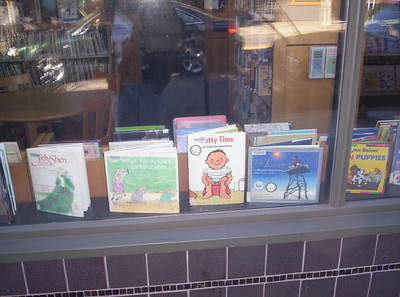
While not including a bookselling space, the Portland library branch in the Nob Hill commercial district actively merchandises its windows.
Northwest Public Library, NW 23rd Avenue, Portland

Many of the "Idea Store" libraries in the Tower Hamlets borough of London are located in busy commercial districts.  It looks like this branch on Crisp Street has inset retailers with facades open to the street on one side of the building.
Idea Store, Chrisp Street, II

Separately, on the backside of the BANQ library--a provincial library which also functions as Montreal's central library--they have a "booksellers alley" with small stalls rented out inexpensively to the sellers of books, periodicals, and ephemera ("The Allée des Bouquinistes Returns, May 17 Through October 19").

Allée des Bouquinistes, Montreal on the backside of the Montreal Central Library.

Many central libraries have small gift shop stores.

Some more actively sell used and sometimes new books in spaces within the library as a fundraising program, such as at the San Diego Central Library, where the Friends of the Central Library run a quality used bookstore open every day, which helps to activate the library space in a more retail fashion.

Open six days/week, the used bookstore fundraising operation at the Orange County Public Library branch in San Juan Capistrano is marketed by city tourism and commercial district promotions as the city's only bookstore.

The since closed Willesden Green Library in London--shut down as a result of austerity cuts to local government budgets--rented space to an independent bookstore ("The Willesden Bookshop that inspired Zadie Smith faces closure," Guardian).

Arts book sales too need a push from planning.  A great arts and design bookstore is something else that should be addressed in the context of creating community cultural plans.

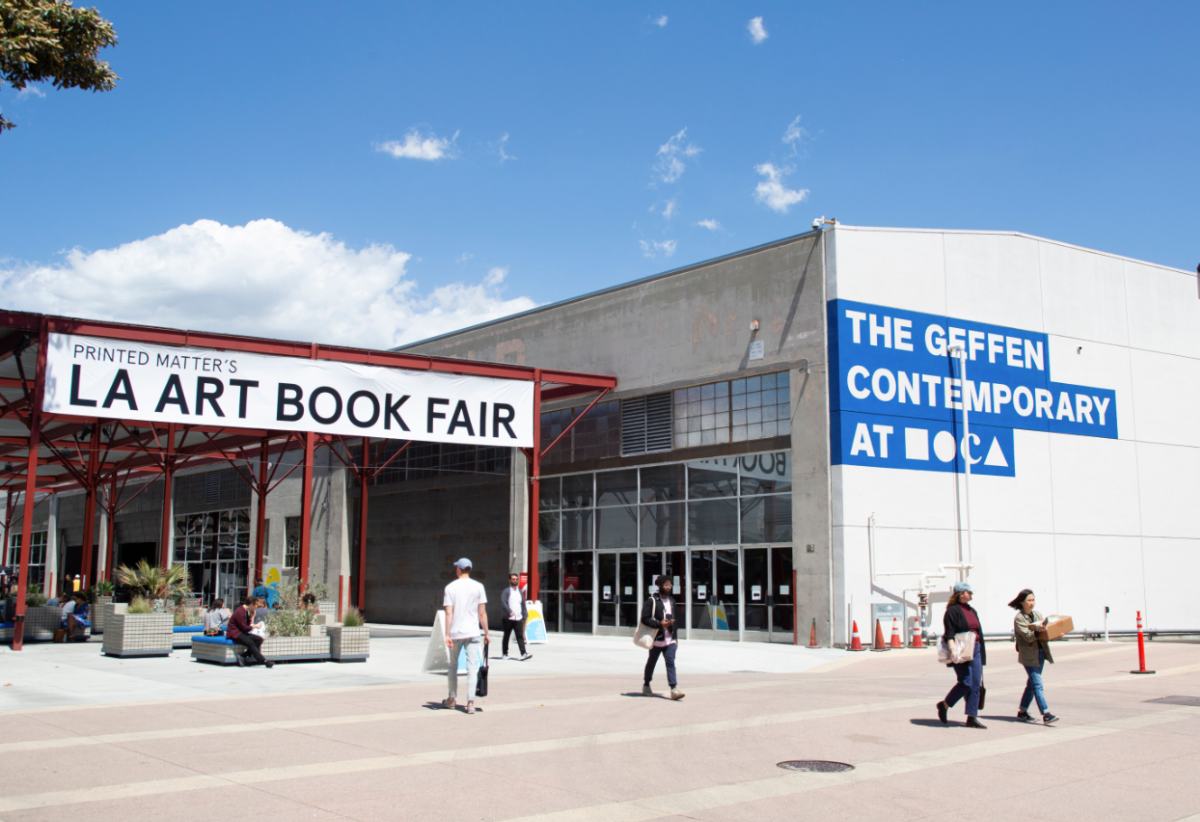
Some communities have arts book fairs at least once/year, and some museums maintain great "book shops" dedicated to art and design titles, as part of their museum store operations.

-- LA Art Book Fair
-- NY Art Book Fair

The Heinz History Center in Pittsburgh not only has one of the city's visitor centers, but a great locally-focused gift shop and bookstore.

Some local chapters of the American Institute of Architects have bookstores dedicated to architecture and design titles.  Sadly, after a 42 year run, the Philadelphia AIA bookstore closed last year ("So long, AIA Bookstore," PhillyVoice).

The Pyramid Arts Center in Hyattsville, Maryland has a small library for use by its members. A museum in Rochester, Minnesota, I seem to recall, has a similar collection for use by artists.  The V&A in London has an arts library.  There is a performing arts music library as well as a VHS collection of plays at the Lincoln Center.  There are multiple music libraries across London.

The Rizzoli Publishing House, which focuses on arts books publishing, maintains a dedicated store in New York City.

The Taschen arts publishing firm has multiple stores in the US and Europe.

Department stores used to be well known for having great book departments.  Selfridges in London still has a great book department, but it only sells art books.

And the Modern West Art Gallery at the Bogue Foundry Arts complex in Salt Lake City has a section of its space dedicated to selling titles from the Taschen arts books publishing house.

DC had a dedicated arts bookseller, Franz Bader, but it closed in 2007 ("Franz Bader turns final page, closes bookstore," Washington Business Journal

Labels: , , ,

Thursday, April 30, 2015

Independent Bookstore Day, Saturday May 2nd


Bookstores are what Ray Oldenburg calls "third places" and like libraries, are part of the informational and intellectual glue that support more intelligent participation in society.

In the right settings, books too can be a "social bridge" just like dogs and children, sparking interaction between people who might not otherwise know each other.

Bookstores too are part of the declining cultural infrastructure that Scott Timberg writes about in Culture Crash: The Killing of the Creative Class ("'Culture Crash' examines the crisis in the creative industry," Los Angeles Times).

Timberg makes the point that since so many cultural workers pursue creative endeavors without making much money, they've worked on the side in places like record stores, book stores, restaurants, etc., and as those businesses fade away, people lose the means to support their creative efforts.

In line with Record Store Day, which was a few weeks ago, and Small Business Saturday, the holiday shopping day held the first Saturday after Thanksgiving, and aimed at getting people to do holiday shopping at small, locally owned, independent businesses, last year's California Bookstore Day has gone nationwide and expanded into this year's Independent Bookstore Day.

More than 300 stores are participating across the country, including Upshur Street Books in the Petworth neighborhood of DC.  The store opened last summer, and just received a nice write up in the Washington City Paper ("How a Dead Tree Bookstore Survives in Petworth").

They'll be opening early on Saturday, and have a number of deals and special events scheduled.

Upshur Street Books is "unusual" in that it is a retail offering delivered by a restauranteur.  But he is able to leverage business acumen across multiple properties, and by having it close to other operations, presumably there are some business economies of scale which help to reduce operating costs.

In the past blog entry "Food co-ops as potential anchors of "ethical commercial districts"," I discussed how the Weaver's Way Food Co-op in the small Mount Airy commercial district in Philadelphia anchors the district in a manner which supports other independent retailers who may have a hard time surviving in a normal market, but have advantages co-locating by a business that relies on "ethical" or values-motivated customers.

One of the stores there is the Big Blue Marble Bookstore, which while a bit bigger, is similar to the store on Upshur Street.  Restauranteurs like Paul Ruppert, "making a stand" in a particular location could have a kind of comparable anchoring impact to a food co-op, especially when they extend their operations to non-food retail.


Labels: , , , ,

Wednesday, February 16, 2011

Borders Bankruptcy leads to store closings in DC, MD, and VA

The bankruptcy of the Borders Company will result in the closing of 200 stores across the United States. In the DC region, stores in DC at 18th and L Street NW Downtown and in Friendship Heights on Wisconsin Avenue will be closing (another store downtown closed a couple years ago), as will stores in Bowie, on Rockville Pike/Kensington and the Boulevard at Cap Centre in Largo in Maryland, and in Vienna in Northern Virginia (other stores are closing elsewhere in Virginia).

Labels: , ,