Rebuilding Place in the Urban Space

"A community’s physical form, rather than its land uses, is its most intrinsic and enduring characteristic." [Katz, EPA] This blog focuses on place and placemaking and all that makes it work--historic preservation, urban design, transportation, asset-based community development, arts & cultural development, commercial district revitalization, tourism & destination development, and quality of life advocacy--along with doses of civic engagement and good governance watchdogging.

Monday, December 29, 2025

Big transit/sustainable mobility stories of 2025

Obviously this isn't everything.  But what sticks out to me.

=========

Congestion pricing in NYC.  In January I wrote that the introduction of congestion pricing in NYC was already the biggest ground transportation story of the year ("The most momentous transportation story of 2025 has already occurred: imposition of NYC's congestion zone").  Basically the results are in ("New York's Congestion Pricing Is Working. Five Charts Show Hows," Bloomberg).  It's working exactly the way it's supposed to.

As far as business effect goes, I worried about business relocation.  That may or may not be an issue.  But visitation to the core of Manhattan is up, and so are sales tax revenues, and reduction in storefront vacancies.  Plus MTA has $500+ million to invest in transit.

Protesters demonstrate outside New York Gov. Kathy Hochul's Manhattan office. Yuki Iwamura/AP

We have to remember that the Trump Administration is still fighting the congestion zone in court ("New York’s Congestion Pricing Succeeds as Trump Fights to End It," Newsweek).

That Gov. Hochul cancelled it ("The Politics That Derailed Congestion Pricing in New York," New Yorker), then reversed course, in part because of sustained public opposition to her decision ("‘Slap in the face’: outrage after New York governor halts congestion pricing," Guardian).  In the end, the price dropped from $15 to $9.

The second biggest story is ongoing financial crises for most transit systems, whose business models were crushed by covid and the shift to work from home.  Many systems have half or fewer the number of riders pre-2020.  And special federal funds for transit were increased under Biden, and not under Trump.

-- "San Diego transit at a crossroads? MTS boasts robust ridership recovery — but faces financial crisis," San Diego Union Tribune

In the SF Bay area, a referendum campaign is underway for two ballot measures to provide additional funding to all types of transit in the region.

Chicago area systems are getting a $1.5 billion payment from the state for the next few years ("Illinois enacts $1.5 billion plan to stabilize Transit and Avoid Service Reductions," Governing).

Philadelphia still needs a long term solution for SEPTA funding, as the Republican dominated State Legislature isn't particularly interested ("SEPTA got stopgap relief, but still needs a sustainable long-term solution," Philadelphia Inquirer, "Credit Shapiro for more SEPTA funds, but still need long-term fix,"  Philadelphia Tribune).  Etc.

Trump Administration uses crime incidents to demean and defund transit.  Using one-off terrible crimes to say transit is unsafe ("US threatens to withhold funds from Boston, Chicago transit agencies," Reuters, "Trump administration threatens to pull New York transit funds as it questions anti-crime efforts," AP, "Deadly stabbing on Charlotte train highlights America's transit safety challenges," ABC11), the Trump Administration used this event as an excuse to suggest defunding transit ("Trump Admin Issues New Threat After Charlotte Train Killing," Newsweek).

Transportation Secretary Sean Duffy said, “Safety needs to be the top priority of elected officials. Citizens don’t want federal dollars going to public transportation that local leaders refuse to keep safe!”

The fact is, transit is safer than driving ("We Need a Reality Check on Crime, Safety and Transit," "New York City’s Subway Is Actually Safer Than Your Car," Bloomberg).  

As one of the implementers of broken windows policing in NYC said, "there are always going to be high profile one-off incidents, regardless of the overall program of crime suppression."

Unforgiving Places: The Unexpected Origins of American Gun Violence, University of Chicago Press.

The big thing is the availability of guns ("A fighting chance: A new book challenges conventional wisdom on gun violence and suggests new approaches to solving the problem." University of Chicago Magazine), such as in LA ("Person fatally shot on L.A. Metro bus in Exposition Park," LA Times), where a fight between young adults erupted in gun violence and death on a bus.  

DC has a problem on the Metrorail system.  NYC has a problem with people who have extreme mental health issues.  SEPTA a problem with gun violence.

Problems in Minneapolis ("Metro Transit boosts uniformed security presence on light-rail trains," "What a week’s worth of rider text messages reveals about Metro Transit’s problems," Minneapolis Star-Tribune) and Seattle ("How Seattle-area transit is pushing back against crime," ), etc.

I still haven't gotten around to opining about how the BART system in San Francisco is using urban design interventions to improve safety at transit stations ("Can BART bring a Civic Center-style revival to another dilapidated S.F. station?," SF Chronicle).

Fare evasion countermeasures.  NYC, DC, and SF are installing much more difficult to evade emergency exit systems.

USDOT: all in for roads but not road safety.  Changing the funding criteria and basically eliminating transit infrastructure funding going forward ("T4America statement on USDOT proposal to eliminate federal transit funding"), same with sustainable mobility ("Trump Cancels Trail, Bike-Lane Grants Deemed ‘Hostile’ to Cars," Bloomberg) in favor of roads.  

Lots of road safety projects were cancelled because they think safety and diversity of users meaning not just automobile operators, are "woke."

Bike share growth in Toronto.

Bike share use in NYC, Washington, DC, Toronto ("How Bike Share Toronto got big — and what it will take to keep rolling," Toronto Today, "How Bike Share went from death’s door to one of Toronto’s fastest-growing ways to travel," Toronto Star) and Boston ("Bluebikes’ popularity has skyrocketed. This map shows where they are used most and where they lag," Boston Globe) is exploding.  

 DC's system launched in 2010, so it seems to me that it takes a long time to reach critical mass (see Diffusion of Innovation, ("Bikeshare Beat: Capital Bikeshare records over 6.1 million rides in 2024, fastest growing system in US," Greater Greater Washington and "Citi Bike, 10 Years Old and Part of New York’s Street Life," New York Times).  

-- "Shared Mobility's Role in Sustainable Mobility: Past, Present, and Future," Annual Review in Environment and Resources

Sadly, in many places, systems are minimally used or have shuttered operations, including high profile cities like Minneapolis ("Nice Ride shuts down pioneering Minneapolis bike share program," Minnesota Public Radio).  

It's important to figure out what separates successful places from the unsuccessful ones, to increase biking uptake.

Bike Share Toronto 2024 Business Review

One factor obviously is infrastructure along with urban form. Scale too.  

Plus, E-bikes have made a big difference too.  Although in response, cost per trip is higher.  I was always critical about e-bikes in the flat core of a city ("(Still) tired of mis-understanding of the potential for e-bikes," 2015) but it's not for me to say how people "should be using" bikes.

And of course, whether or not there is public subsidy as part of an overall transportation planning program.  Systems relying on sponsorship, like Minneapolis, fall apart when they can't replace sponsors.

-- Better Bike Share Partnership

Matt Elliott, a columnist for the Toronto Star warns us that as systems are successful, depending on the operator, they can focus more on extracting more revenue from riders, rather than improving the system ("Why dark clouds loom over Bike Share Toronto, despite its undeniable success," 2030 Bike Share Toronto Growth Strategy - Ride More, Connect More, Toronto Parking Authority, Presentation).

Here’s the problem. The TPA report, after justifiably bragging about its recent success, spends much of the rest of the document laying out ways to extract more money from the Bike Share riders who have contributed to that success. That includes “new revenue streams” like “loyalty programs, digital advertising networks, feature upsells, and advanced reservations.” It reads like a road map that could easily lead to what the tech writer Cory Doctorow has colourfully called “enshittification” — the process whereby online platforms and services decline over time as they change from focusing on what benefits users to what benefits their bottom line.

You know it when you see it. It usually starts when a service that previously offered a reasonable price and a good user experience begins constantly trying to sell you on their Premium Extra VIP Plus program while also showing unskippable ads for weight-loss drugs.

This decline can be an insidious process that starts with good intentions. For instance, Bike Share has had problems with dock and bike availability, especially at peak times of day. From the TPA’s perspective, allowing people to reserve a bike in advance for a small fee might seem like a good way to ease frustration. For users, however, a much better approach would be to add more bikes and docks in areas with high demand.

A swarm of Lime Bikes in London.

Note that the Economist argues dockless bike share is a key component to the success of bike share in London ("London has become a cycling city It shows how dockless-electric bikes could transform cities").

They argue that London is a cycling city now because of dockless bike share.).  

If one secret is making the bikes really electric, the other seems to be making them really dockless. Previously, bike-hire schemes offered a patchy service: it was often hard to find a bike and it could take ages to find a designated parking space. Today, London’s operators have more bikes. But critically they have negotiated relaxed parking rules, including on residential streets, meaning their fleets fan out widely. Lime claims that 97% of Londoners in its service area live within a two-minute walk of one of their bikes. As with Uber, it thinks users open the app if they know convenience is only a few minutes away.

This is run by operators separate from the TfL operated bike share system.   But parking and storage can be a big mess.

Slow as molasses new transit lines in Toronto ("Why does Toronto insist on taking the ‘rapid’ out of rapid transit?," Toronto Star), "City, TTC taking steps to improve service speed of Finch West LRT, Chow says," CBC).  They won't give streetcars priority over cars.

... But any Torontonian will tell you that just because the line is there on the map doesn’t mean it will get you where you need to be in any kind of hurry. Toronto has the distinction of running the slowest streetcar system in the world.

This is because the city and the TTC don’t consider it any kind of priority to make rapid transit rapid. They design these lines and choose how to operate them to ensure they are slow. On purpose. If that wasn’t clear before, it has become so in the debates at the TTC board and city council that have followed Torontonians’ astonished rage at the sloth-like performance of our new $3.5 billion LRT line.

Authorities decided to put 18 stops on an 11-kilometre route. They decided the vehicles should travel below 25 km/h (less than half the speed of the traffic beside them) through intersections and when approaching stations, assuring they will never get up to a decent speed. They decided the vehicles should stop endlessly at red lights and also be forced to wait for single-occupant vehicles make left turns or U-turns. They decided, quietly, that instead of the promised 33 minutes for a trip across the line, 48 minutes was a reasonable stretch goal — something to aim for after the slower “soft launch.”

Note that this is an issue for bus systems in most places as well.  Cars get the priority.  That should change.  Transit vehicles move far more people. 

Montreal REM expansion in Canada.  The REM is what some people call "light metro," and is a new complement ("Montreal’s New Rail Line Is the Future" Canada has forgotten how to build fast, cheap transit. A new megaproject has the fix," Maclean's), to the famed Montreal subway system, built and funded by the provincial pension system as an investment.  

But the thing is that it is above ground in most places.  Montreal's subway is 100% underground, so it can operate during terrible snowstorms.  Not the REM.  

Although to me, REM is a ripoff of government.  They get paid 75 cents per kilometer per passenger traveled per ride for 99 years.  That seems like a lot of money to me.  A 10km trip costs $7.50 Canadian ($5.45 US) to the government.  A good deal for the Pension Fund.  It would have been cheaper for local government to pay.  Financing through third parties is always more expensive.

DC dumping the streetcar ("DC makes yet another bad decision about streetcars: will replace the one line with a so called "fancy" bus | The Vision Thing," "Budget cut means D.C. Streetcar will shut down in March," Washington Post).  

This is the endgame for a poor planning process from "start" (not the initial planning) to finish.  I joke that DC and Seattle started streetcar planning in 2003.  Seattle got the first line in 2007.  DC in 2014.  

Also, the city received an unsolicited offer from the private sector to run and grow the system (that's how it's done in Portland, Oregon, home in the US to the first modern streetcar).  But they blew it off.

What could have been: "The DC Streetcar May Run to Benning Road Metro in 2026," DC Urban Turf.

As DC plans to build a new stadium for the NFL football team, the current streetcar alignment is adjacent, and could have been leveraged to provide service within the campus as a complement to bus and subway service, and link to more subway stations as another mobility alternative.

Relatedly, Minnesota's pathetic Northstar commuter railroad is closing--by not extending it to St. Cloud it wasn't particularly useful ("Minnesota's Northstar Commuter Rail to Be Replaced by Expanded Bus Service Network," Hoodline), cities in the Dallas Area Rapid Transit system are trying to opt out--an anti-transit State Government doesn't have DART's back ("So You Want to Leave DART?," D Magazine), and plenty of communities, like Illinois, refuse transit extension to their communities ("Huntley backs out of planned Metra station for new passenger train service between Rockford and Chicago," Lake County Scanner).

Electric bicycles.  E-bikes, unlike electric cars, do actually shift environmental metrics by reducing car trips ("For some parents, minivans are out and e-bikes are in," Boston Globe, "The best bike gets you out of your car," Bicycling, "How electric bikes reduce car use," Transportation Research: Part D), whereas EVs replace gasoline car trips, still creating traffic congestion and maintaining automobile dominance in the transportation planning paradigm.  But the lack of standards for equipment, safety, weight etc. create problems.

Safety/We need national standards.  Many communities are beginning to regulate electric bikes more closely in the face of deaths and accidents ("Molly’s Last Ride Twelve-year-old Molly Steinsapir crashed onto the pavement from a Rad Power e-bike and never woke up. With a poorly regulated e-bike industry, who is responsible when a child dies?," Bicycling).  

And complaints of reckless riding by pedestrians and motor vehicles operators.  Many in the micromobility world criticize this regulatory action, saying that accidents and deaths are still worse when it comes to motor vehicles.  Sure.  

True.  But working to reduce needless deaths wrt road safety (e.g., Vision Zero) should be the priority.  E bikes don't get a pass  ("14 year old riding an ebike on the sidewalk AT 25MPH, hits woman, she gets traumatic brain injury," Minneapolis Star-Tribune, "Santee poised to ban e-bikes for children under 12 City will work with schools, community to educate them about the tougher regulations," San Diego Union-Tribune, "Toronto is looking at licences for e-bikes. Here’s why that may be better for delivery riders — and pedestrians," Toronto Star, "It’s getting hard to ignore e-bikes’ dangers: If drivers of cars are responsible for their crashes, drivers of e-bikes are responsible for theirs," Boston Globe).

Plus, because of the weight of an e-bike (too much for me right now), brakes need frequent adjustment.

So should standardization of rules across the US.  Many types of electric "bikes" are more akin to motorcycles, capable of speeds much higher than a typical "analog" bicycle, say the super riders can do 20mph.  Duffers like me, more like 12 mph.  There are even electric "bikes" that go faster than 28mph.  Those aren't bikes, they are mopeds/motorcycles.

Bankruptcy.  Not unlike the beginnings of the auto industry, the new technology of electricity powered bikes leads to lots of new entrants.  But there are far more entrants than there is demand.  

A few years ago a technology leading e bike company, Van Moof, went out of business, stranding users.  Although it was acquired and restarted by a firm specializing in sports equipment.

Rad Power Bikes, a company which has set up stores around the country, but is based in Seattle, just declared bankruptcy ("Seattle e-bike pioneer files bankruptcy, owes millions," Seattle Times).  And I'd been looking at that company for a bike, because I like the design.

Gondolas in Paris: the Transit City paradigm.  Paris, which continues to expand its system of train, subway, and tram (light rail) transit ("Map of the Grand Paris Express, Europe’s Larctgest Transit Expansion Project," The Urbanist), has added gondolas to the mix ("Europe’s longest urban cable car is unveiled over dazzling capital city," Metro UK, "In the Île-de-France region, a cable car to reduce urban inequalities," Le Monde).

The new line, the first of its kind in the French capital, has been designed to connect the city’s isolated outskirts, poorly served by trains and buses, to the Métro network. At 4.5 kilometres long, the route links Métro Line 8 in Créteil to Villa Nova in Villeneuve-Saint-Georges, and passes through Limeil-Brevannes and Valenton on the way.

The cable car system — which features 105 gondolas with 10 seats each — is expected to carry around 11,000 passengers per day above Parisian streets. While the new cable car is the longest in Europe, it still lags behind the longest in the world, which connects the Bolivian cities of La Paz and El Alto over 20 miles.

Although to be fair, projected ridership is equivalent to a medium usage bus line.  OTOH, offering much faster trips and greater access and connectedness on "social urbanism" grounds.

The Le Monde article makes clear it took a long time, about 20 years, from idea to fruition.   But it was also implemented.  It's an example of the idea that to be a "Transit City" you have to keep investing in and where practical and needed, building new infrastructure.

Meanwhile proposals in DC for connection between the Rosslyn Metrorail station and Georgetown, Staten Island to New Jersey ("Bayonne mayor gives aerial gondola plan a thumbs up," Staten Island Advance) and Los Angeles ("Metro votes to approve Dodger Stadium gondola project despite protests," Los Angeles Times) languish.

Passengers wait Saturday at the new Star Lake Station. (Karen Ducey / The Seattle Times)

Transit expansions.  Are still happening, with projects that predate the Trump Administration.  One notable is Seattle ("New light rail stations open with South King County party," Seattle Times).  Each expansion generates a lot of new ridership, much more than say the Silver Line did for Metrorail in Suburban Virginia.

Last year’s extension to Lynnwood opened up the northern suburbs; this year’s stretch into Redmond welded together the tech-heavy Eastside; and now the jump to Federal Way is anticipated to be a boon for workers and students in South King County.

Up to 23,000 riders a day are expected to board or exit a train at the three new stations, boosting ridership along that 1 Line spine from the current 110,000 daily average. The Eastside’s 2 Line carries about 10,000 passengers a day, but its popularity is expected to grow once it connects with the 1 Line next year.

It's an example of how I say that transit infrastructure, done right, can have the speediest return on public investment, so it should be seen as an economic development measure.

Vision Zero/Road Safety.  For another entry, this is too long as it is.

Labels: , , , , ,

Wednesday, March 12, 2025

Why Europe is going car free?

 Early in my days of pro center city advocacy, I was somewhat troubled about how advocates jumped on the ideas of Hans Monderman and the woonerf or shared street, streets designed to mix motor vehicles, pedestrians and cyclists, as a way to slow traffic and better balance mobility between the car and non motorized forms.

It wasn't because I don't believe in making pedestrian and bike trips better, but because the US physical environment is so dominated by the car and much of the nation's urban form, outside of the cities built up to the streetcar era ("Transportation and Urban Form: Stages in the Spatial Evolution of the American Metropolis") is shaped for the car.  In short, a woonerf, at least in the US, will still be dominated by the car, and worse, by mixing different types of traffic, it will create new conflicts.  

One place you see this in DC is at the Wharf, both on the boardwalk where there can be vehicles, and in the outer perimeter where there is a separate bicycle path, but it is crossed frequently by pedestrians getting to the sidewalk.  

For the boardwalk, they probably should have made all the service access underground.  WRT the cycletrack, it probably should have been further out into the street right of way.

There is an article in the Washington Post, "Why Europe is going ‘car free’," about congestion zones and low emissions zones for cars, (but not so much discussion of pedestrian districts in most major cities, which is a distinguishing condition between US cities and European ones).  That Europe is going car free while the US is not.

In one way, it's another example in the US of what I call "next generation asphalt nation," that instead of aiming to shift more traffic to sustainable modes, we are focusing on electric cars and maybe hydrogen powered heavy trucks, to be more environmentally conscious, when not driving is the best choice for the environment--note this is happening some as people switch from cars to electric bikes.

The amazing thing about so much of Europe is that it retains the "streetcar era" and "walking city era" urban form.  So you can go "car free" because your life is not harnessed to the car the way it is in the US--92% of all trips involve a car.

In short the author is making the same mistake as woonerf opponents.  Promote better policies where they can work.  Don't try to adopt other treatments without consideration and adaptation.

For example, people in DC talk about a congestion zone pricing scheme.  But DC, especially with the Trump Administration's destruction of government, has so many commercial district competitors in  the metropolitan area: Montgomery, Fairfax, Arlington, and Loudoun Counties, and Alexandria City, that businesses could easily pick up and leave.  That's much harder to do in NYC or London.

====

This came up today in the Park in SLC for which I am on the board.  A graduate student doing a design study of the park suggested grade separation of the walking and bicycle paths--the park is a one way loop road with smaller lanes for walking and biking, a motor vehicle lane, and a parking lane.  It works pretty well.


Parc La Fontaine, Montreal

I am embarrassed to say this didn't occur to me. It will probably take at least 5 years to try to pull off.  But it's worth trying.

Labels: , , , , ,

Thursday, February 27, 2025

"... road redesigns are always going to be controversial and challenging in an urban landscape designed for, but now overwhelmed by, cars"

From the Los Angeles Times article, "Culver City, don’t roll back your ambitious safe street redesign" which describes how a more conservative city government is considering rolling back an especially successful road diet-sustainable mobility balancing effort that has supported denser housing development, more users of transit, bicycling and walking, with minimal discomfort for motor vehicle operators of a two minute longer trip in the evening.

The project, called Move Culver City, was a 1.3 mile pilot project, quickly built for relatively low cost with paint, removable planters and plastic bollards. The goal was to test the theory that if people are given quality transportation choices, they will use them.

A review of the project after a year found an 18% increase in people walking and 32% more people biking through the area. At the intersection of Culver Boulevard and Main Street, the number of bikes counted. nearly doubled. Bus travel became faster and ridership increased more on the corridor compared to citywide. People said they were biking, walking and taking transit more often in the area, according to the review. They felt safer, more comfortable and noticed fewer speeding cars.

The MOVE Culver City initiative reconfigures traffic lanes downtown. (Citizens of the Planet / UCG / Universal Images Group) 

As for traffic? It moved faster in the morning hours, and in the evening it took drivers about two minutes longer to pass through the area. Two minutes. That’s a minor inconvenience. It certainly seems like a fair trade off to make the corridor safer and more convenient for alternative modes of transportation — which was the purpose of the project.

The city couldn’t widen any more streets (and that doesn’t solve traffic anyway) or build more single-family subdivisions. City officials decided to create a denser, transit-friendly, walkable, bikeable center that would allow more people to live in the city and give commuters more options to get to their jobs. The vast majority of Culver City is still car-centric, but this small section shows how urban Los Angeles can build more affordable, equitable and environmentally responsible communities.

Yet even the modest encroachment of Move Culver City may be too much for opponents of the project, who seem particularly offended by the bus lane. There is a proposal to add back a car lane and make buses and bicyclists share a lane, which would dissuade all but the most confident cyclists and slow the buses, thus making alternative modes of transportation a lot less appealing. And for what? So some drivers can get to their destination two minutes faster.

Also see "Cars don’t have to rule Culver City, or the future of L.A. transit," LAT. Interestingly, the local high school newspaper gets it even if elected officials and automobile dependent folks do not, "MOVE Culver City: Rethinking Urban Mobility in the Heart of Screenland," Culver City High Centaurian.

US Department of Transportation backs down on sustainable mobility/Complete Streets programming.  Meanwhile, the US DOT has removed its webpage on Complete Streets principles ("‘Complete Streets’ Webpage Falls Prey To Trump Purge," Streetsblog).  Note my Signature Streets concept is more expansive ("Extending the "Signature Streets" concept to "Signature Streets and Spaces"," 2020).

-- Complete Streets webpage, US DOT, via archive.org

It's not the end of the world.  It's still accessible, and there are plenty of other resources around the web, including guidebooks from NACTO:

-- Urban Design Guide, web version, book purchase
-- Urban Bikeway Design Guide
-- Transit Street Design Guide

And it should be no surprise because Trump and his Republican agenda is backwards looking, favoring the automobile.  But it does indicate the agency, at least under Trump, will be moving back towards privileging the automobile.

And in Utah, in yet another example of state government preemption of local control ("Red-state Republicans are dogpiling on blue cities," Washington Post), State Senator Wayne Harper, who doesn't represent Salt Lake City, is moving a bill to put a one year moratorium on Salt Lake City's livable streets-sustainable mobility initiatives "so they can be studied" ("Salt Lake City’s plans to build safer streets may hit a dead end — at least for a while," Salt Lake Tribune).

Salt Lake is a leading innovator in traffic calming, bike lanes, trails, and sustainable mobility initiatives, although I think they could do even more.  And, umm, such interventions are already studied before being implemented.  From the article:

A late addition to transportation-focused SB195 calls for a roughly yearlong moratorium on new road projects that aim to reduce or slow down traffic on streets in Utah’s capital. The bill, introduced by Sen. Wayne Harper, R-Taylorsville, passed the GOP-dominated Senate on Thursday along party lines, 19-6, with six Democrats opposing the measure.

The moratorium would run from May 2025 to March 2026 as state transportation officials study all the traffic-calming projects the city had implemented or planned to build from July 2015 to July 2035.

Republicans have a supermajority in the Legislature and zero compunction against preemption of local governance, so it's a slam dunk the law will pass.

Planning and building for the city you want to be versus planning for the past.  I guess we'll see how oriented UDOT is to sustainable mobility. My experience is that they are pretty good, with Trax and bus transit, and the MoveUtah initiative among others.  But still it wastes a year.  And maybe UDOT will buckle.

When I was reading the SLT article, I was thinking, "Salt Lake City is planning and implementing urban design measures for the city it wants to be," while legislators like Pearson must be totally in thrall to the reality of the Salt Lake Valley's sprawl paradigm.

The same thing goes for Culver City, do you plan for the future, or for the past?

Freeway widening versus congestion pricing.  Also see "Widening Highways Doesn’t Fix Traffic. Here’s What Can," Scientific American.

Interstate 45 is getting a $13-billion makeover in Houston. The project aims to reduce congestion by adding new lanes—a common story for the many highway expansions that are constantly happening across the U.S. In nearby Austin, Tex., I-35 is being widened as part of a $4.5-billion project, for example, and near Sacramento, Calif., an expansion of I-80 for close to $500 million is underway. A planned project that involves a major expansion of the New Jersey Turnpike will cost $10.7 billion.

Despite the massive price tags, these projects likely won’t reduce congestion for long. That’s because of a phenomenon that transportation researchers call induced demand: in areas with a lot of pent-up demand for driving, any new capacity from added lanes gets filled up quickly.

Photo: Art Wager, Getty Images.

 After a widening project, “congestion gets better for a little bit..., and then we’re back to where we were. And then somebody says, ‘Oh, we’ve got to widen again,’” says Susan Handy, a transportation engineer at the University of California, Davis. “So how far is it going to go?”

... Widening roads has been the go-to strategy for reducing congestion for at least a century, Handy says. It sounds logical and intuitive: if you have a limited supply of something in high demand, such as the ability to drive on a particular stretch of road, increasing the supply by adding new lanes should make that experience available to more people.

But increasing the supply of something also drops its cost—which can encourage more people to take advantage of it. More supply sometimes induces demand, or at least it allows more of any pent-up demand to be expressed. “Adding capacity makes driving cheaper from the standpoint of travel time and inconvenience and annoyance,” Handy says. More people might opt to drive on the road involved, which can eventually cause congestion to rebound. 

Fortunately for people stuck in traffic today, congestion pricing programs are short-term solutions that work like “escape valves” on congestion, and they’re being implemented across the country. Unlike widening, which decreases the cost of driving and thus causes demand to rebound, congestion pricing regulates the cost of driving in a particular area or lane to tamp down on traffic, Burris explains. Some, such as the program recently rolled out in New York City, include tolls for entering a certain high-volume area. London, Stockholm and Oslo also have similar programs.

Trump says no to congestion pricing.  While they are likely to lose, the Trump Administration aims to cancel New York City's recently introduced congestion zone toll ("Trump Wants Congestion Pricing Dead by March 21. New York Won’t Budge," New York Times).  Which only after a month, is successful in reducing traffic and raising money to be used for transportation improvements.

=======

Disclosure: Sugar House Park was in the process of working with City DOT to convert the right most lane of 2100 South abutting the park with an extended sidewalk and bike lane.  We'll get to do it.  But now it won't likely be realized until after 2030, and I term off the board in 2030.

Current condition (I want to plant the median too.)


Median strip sunflower plantings, Guardsman Drive, Salt Lake City

900 East abutting Fairmont Park

Extension of the 9-Line Trail, 900 South, abutting Liberty Park

I also want to do a special intersection treatment at one of the street crossings


Broad Museum, Los Angeles, Public art crosswalk by Carlos Cruz-Diez

And plant-related improvements to bus shelters (currently there aren't shelters, just stops)


Labels: , , , , ,

Tuesday, January 07, 2025

The most momentous transportation story of 2025 has already occurred: imposition of NYC's congestion zone

We know about congestion zones from cities like London and Stockholm, where motor vehicle operators pay a toll charge for entering the city core.  London has an additional ultra low emissions zone too.

A few years ago, NYC had considered creating one, but the state stopped them.  They've been studying the issue for some time, a date was set ("A $15 toll to drive into part of New York has been approved, a first for a U.S. city," AP) and the Governor of New York stopped this iteration as well ("L.A. hoped to learn from NYC’s congestion pricing rollout. Now what?," Los Angeles Times) for fear it could swing votes to Republicans, only to go on to agree after the election.  From Bloomberg article "NYC Congestion Pricing Takes Effect After Years of Delays":

Then, a tolling structure had to be created. Rates needed to be high enough to discourage driving and shift motorists to public transit, but not so burdensome that they crippled local businesses and the broader economy. About three weeks before the plan was supposed to start last June, New York Governor Kathy Hochul said an initial $15 charge was too large and paused its launch.

Congestion pricing scanners above First Avenue at East 60th Street in Midtown Manhattan on Sunday morning. Drivers will be tolled via E-ZPass or license plate readers. Credit: Karsten Moran for The New York Times

The fees, which will support the Metropolitan Transportation Authority (NYC Subway and buses, LIRR and Metro-North trains), went into effect yesterday, January 6th ("What New York’s congestion charge could teach the rest of America," Economist).

The scheme is modelled partly on that of London, where since 2003 a daily charge (currently £15, or $19) has reduced the number of cars, improved air quality and funded transit upgrades. New York’s version costs $9 for most drivers (with different rates for lorries and low-income New Yorkers). The zone includes Manhattan’s central business district, south of 61st Street, and most of the roads, tunnels and bridges that connect surrounding areas (see map). The Metropolitan Transportation Authority, which oversees the city’s transport system and some suburban lines, hopes that the scheme will reduce traffic in these areas by 10-20% (traffic in central London fell by 18% in the first year). Revenues from the congestion charge are earmarked for much-needed improvements to New York’s ageing subway and other public-transport systems.

Also see:

-- "New York first US city to have congestion charge," BBC
-- "New York City Welcomes Congestion Pricing With Fanfare and Complaints," New York Times
-- "Here’s why no one escapes NYC’s controversial congestion toll — not even locals without cars," New York Post
-- "First in nation zone toll designed to raise $1 billion per year in NYC," Clark County Today
-- "NYC congestion pricing program has launched, tolling drivers entering 60th Street and below in Manhattan," Newsday
-- "The Funniest and Most Notable Reactions to Congestion Pricing," New York Magazine

I'm surprised there is an overnight toll, since traffic then is significantly reduced.

Congestion pricing sign along the westbound Long Island Expressway approaching Van Dam Street in Queens on Sunday. Credit: Newsday/James Carbone

Effect on central business district, will businesses relocate to areas outside of the congestion zone? While I agree theoretically in this form of transportation demand management, and not only does it reduce congestion but has positive effects on the environment, I do worry that post-covid, where the office market has been so diminished, that a congestion toll could accentuate negative effects on the city's central business district.

When your CBD doesn't have much competition a congestion zone toll is less of a worry vis a vis competition for commercial activity.


New York Post graphic.

State of New Jersey against.  NJ fought the toll because they argued it would disproportionately affect their citizens ("Greenlight for congestion pricing as judge rules against New Jersey," Newsday).  Surburbanites don't like it either.  From the Toronto Star article:

Siemiatycki also acknowledged that road pricing is an unpopular idea in suburban areas while taking off road tolls, expanding highway networks and cutting bike lanes have “an effective political wedge.” “We do have to acknowledge that the approach that they’re following is popular. The problem is it hasn’t been effective. I mean congestion has gotten worse during their six years in office,” Siemiatycki said. “It might be good policy, but it’s not good politics,” he said.

Could a NYC congestion toll also support transit network improvements between NJ and NYC, not just NYC?  OTOH, I wish that the congestion toll would also be used to improve NJ-related transit such as: (1) extension of at least one NYC subway line into NJ; (2) building a subway on Bergenline Avenue; (3) creation of fixed rail transit from NJ to Staten Island; (4) working to merge NJ Transit trains with Metro North and LIRR trains to have through running trains, improving the system overall; (5) investments in PATH; etc.

A congestion zone for DC?  People suggest a congestion zone for DC and it has been mentioned in documents by the City's' DOT.  But especially since covid, and transit usage is less than half of what it was before, that there are too many other competitive districts: Alexandria, Arlington, Bethesda, Tysons, the I-70 corridor; etc., for the city to go it alone.  Especially since the Republican federal government will aim to further reduce the number of agencies and workers in DC.

Maybe if the fee also supported other transportational improvements, not just serving DC, it could work.  E.g., merging VRE and MARC, having MARC service in Montgomery County be bi-directional, etc.

World class cities as examples for others: will NYC's congestion charge lead to such an adoption elsewhere.  I suppose there are many such articles, but I found three, about the possibility of their cities imposing congestion fees, emboldened by the action in NYC.

-- "Jammed and polluted Mumbai needs congestion fee, a la NYC: Experts," Times of India
-- "New York City has imposed a congestion charge on drivers entering Manhattan. Should Toronto follow suit?," Toronto Star

I have a line that "world class cities don't just take, they give," in that when they adopt best practice it empowers other places to do something similar.  This goes with London with the congestion charge, even though it was preceded by Stockholm in Europe and Singapore.  Similarly, Paris wasn't the first city to adopt bicycle sharing, but it was the first study to introduce it on a huge scale, which empowered other cities to adopt bicycle sharing as well.

Labels: , , ,

Wednesday, March 30, 2022

Will congestion charges work (in smaller cities)?

 -- "A Test for Congestion Charges in Smaller Cities" is a Bloomberg CityLab article.

The idea of congestion charges is to assess a daily fee on motor vehicles entering the highest in demand, "most congested" parts of a city, most typically its central business district.  The intent is to use the revenues generated to fund transit and other sustainable mobility improvements, as well as to encourage motor vehicle operators to shift to transit to avoid the fee.

For congestion charges to work in center cities, the business districts can't be susceptible to competition and poaching from neighboring jurisdictions.  

(Separately, some European cities have introduced a separate charge based on CO2 emissions.  See "London introduces Ultra Low Emissions Zone for vehicles with charges up to $130," ABC News.)

FWIW, I don't think congestion charges will work in smaller cities, at least in the US, because for the most part metropolitan areas are super de-concentrated.  And the quality of transit options tends to be sub-par.

The article is about Oxford, England, which is imposing a low emissions vehicle charge, not a congestion charge technically.  But Oxford is probably an exception to the general rule, because of the dominant university.  It's not like Oxford University will move out of Oxford to the suburbs. 

In short the issue has to do with monocentric versus polycentric development patterns.  Monocentric places will be able to impose congestion charges not worrying that it will induce and support business recruiting by alternative commercial districts.  It will be much harder to induce compliance in polycentric areas subject to inter-city competition.  

See Cities in Full for a more detailed discussion of monocentric versus polycentric development patterns wrt both center cities and transit systems.

AP photo, London.

Instead, there is intra-metropolitan competition and the polycentric pattern of business district development--e.g., in the DC area you have business centers in Crystal City (now called National Landing), Rosslyn and Ballston in Arlington County, Alexandria, not just in Potomac Yard/National Landing but elsewhere, multiple centers in Fairfax County but especially Tysons, Reston, and Fair Lakes, Bethesda and the I-270 Corridor in Montgomery County, with lesser centers in Rockville, Silver Spring, and Wheaton, to some extent in New Carrollton in Prince George's County, and independent centers in Loudoun County around Dulles Airport, Ashburn, etc.

Looking west on Lee Highway in Arlington, lines of cars split between taking Interstate 66 or staying on Lee Highway during rush hour on Dec. 4, 2017. (Jahi Chikwendiu/The Washington Post)

Any of these jurisdictions would be tempted to and would use congestion charges (tolling) in DC as a way to recruit DC-based businesses.  

For example, it is argued that one reason that Virginia has added tolling to I-66, a major route to DC, is to encourage firms to relocate to Northern Virginia from DC, as a way for their employees to be able to avoid driving into DC and paying a toll ("Did Va. Gov. McAuliffe and his transportation team mislead I-66 commuters on tolling? Not really, but his team could have been more clear," Washington Post).

New York City.  As it is, New York City approved a congestion charge, which with the delays as a result of the covid-induced migration from office buildings to working at home, is slated to take effect next year ("Congestion Pricing Is Coming to New York. Everyone Has an Opinion," New York Times).

I'm not sure that post-covid, a congestion charge will work in NYC, the one city heretofore in the U.S. that I thought it would work in.

But I think it should probably be pushed out later, because Manhattan's office districts have been pummeled by that outmigration.  A congestion charge will give non-transit users one more reason not to go back to the office.

And even Manhattan faces competition from other parts of New York City like Long Island City, the suburban office district in Westchester, New York north of the city, districts in Connecticut, and in New Jersey, especially Jersey City, which developed a strong positioning as "back office" support for New York City's financial services businesses (a role first played by Long Island City).

Even Manhattan isn't quite as comparable to London, Stockholm, or Singapore, which don't have the kind of polycentric activity center development pattern common to the US.

Suburban districts may have a better position for imposing congestion charges.  Ironically, it may be places like Tysons in Fairfax County, Virginia (versus DC), Greater Palo Alto in the San Francisco Bay region ("Mapping the Polycentric Metropolis: journeys to work in the Bay Area," Under the Raedar) (versus San Francisco), even Bellevue in Suburban Washington (versus Seattle) or the Buckhead District in Atlanta, have a better position for imposing such charges compared to the central business districts (Downtown) in the center cities in those metropolitan areas.

Congestion zones are too small to have the desired effect?  A separate Bloomberg article ("What Comes After London’s Congestion Charge?") argues that the London congestion charge isn't doing enough to limit negative environmental effects, because the zone to which the charge applies is too small relative the London metropolitan area.  It recommends a broader "road journey" charge.

Labels: , , , , ,

Tuesday, March 20, 2018

Revisiting stories: the L Subway Shutdown in NYC and what to do

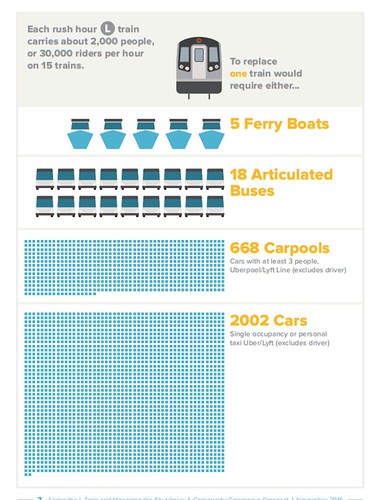
Capacity of different transit modes
In the 2016 post, "RPA/Transit Riders Alliance proposal to respond to the L Subway shutdown includes a dedicated transitway on 14th Street in Manhattan" I recommended, based on the recommendations of the Regional Plan Association that to deal with commuters not able to use the L Subway during its maintenance shutdown to:

1.  Make 14th Street in Manhattan a bus priority transitway, removing most automobile traffic, which is what RPA recommended

2. Using bi-articulated buses on a "temporary basis," because these large buses have capacity for up to 180 passengers. Although the RPA did not make this recommendation.  Note that in the US such buses aren't allowed on public streets, although they seem to do just fine in other countries.


Based on this report from the Village Voice, "Are There Better L-Train Shutdown Solutions? City Didn’t Study Them," I would argue that NYC's failure to go to that length:

-- dedicated transit 24/7 instead of only some of time
-- and the use of the largest capacity buses possible

will come back to haunt them.

There are four major high profile sustainable mobility "experiments" potentially underway in the US, Canada, and London, which have the ability to shape the willingness and risk-taking abilities of other transit and transportation agencies to be innovative and daring in other settings:

1. The King Street streetcar prioritization in Toronto, Ontario ("King Street streetcar, Toronto (and Seattle's urban mobility planning)."  Ridership has increased by 25%, on an investment of less than $2 million ("King St. pilot boosting streetcar ridership: TTC," Toronto Star)

2. The pedestrianization of Oxford Street in London, simultaneous with the addition of Crossrail service to the area and expected major increases in the number of daily visitors ("Oxford Street transformation to get underway by December 2018 as TfL and Westminster City Council launch consultation" and "Four changes that need to happen before Oxford Street can be pedestrianised," City A.M.; "London's Oxford Street bus routes cut by 40%," BBC; "Oxford Street stores call on Mayor Sadiq Khan to tone down traffic ban," Evening Standard)

3. Serious consideration of creating a congestion charge in New York City ("How much does it cost to unclog NYC's streets," Wired Magazine; "Congestion pricing plan for cabs, Uber, Lyft, outlined in NY Assembly budget proposal," <AM NY)

4. Dealing with the maintenance shutdown of the L Subway Line in NYC.

I am reasonably confident of the efforts in Toronto and London, but not New York City, especially because Mayor DeBlasio doesn't seem particularly motivated when it comes to transit or sustainable mobility matters, because the NY State Legislature isn't likely to support a congestion charge based on past actions and new reports say the legislature is still unfavorable ("Prospects dim for congestion tolls in New York City," AP), and Governor Cuomo is more interested in pushing a possible presidential candidacy and spiting Mayor DeBlasio.

Labels: , , , , ,

Tuesday, July 02, 2013

Road building, induced demand, and tolls

It's a well accepted principle in transportation planning that if you build more roads and lanes, after a period of congestion improvement, congestion again increases as more people make more trips.  This is called "induced demand."

Right: graphic on length of time improvements from driving trips on the I-495.  Source: Inrix Traffic. Laris Karklis and Bonnie Berkowitz/The Washingon Post.

So it's possible that the report in the Washington Post ("Drivers see less congestion on area roads") that with the addition of High Occupancy Toll lanes in Northern Virginia and the tolled Inter County Connector in northern Montgomery County, along with general declines in driving per capita ("The End of Car Culture" from the New York Times) that pre-date the recession, is merely a blip resulting from current conditions, and one can't extend from it--especially if/when the economy picks up.

On the other hand, I wonder if there is a wrinkle to the general induced demand argument.

It's true that as long as it's basically free to consume a resource once you have acquired the means to do so (in this case a car) people will consume as much of it as they can.

Toll rate sign, I-495, Northern VirginiaCongestion is a non-cash expense that influences decisions people make about when and how and whether or not to make trips.

A perfect example is recounted in the Post article, describing how a woman working in Rosslyn got a job much closer to home.  This is a positive benefit of congestion as it "encourages" (choice) people making better decisions about how to use their time, where to work, to take transportation costs into account when making choices, etc.  From the article:

“It absolutely was a factor,” said Jennifer Hoh, describing her decision to take a job with a 20-minute rush-hour commute in Reston. It took about an hour and a half on traffic-snarled roads to reach her previous job in Rosslyn.  “Now work is a nine-hour day,” she said. “When I was in Rosslyn, the commute made it a 12-hour day.”

But what if the increase in road capacity is tolled, rather than free?

Can selective road expansion reduce congestion without necessarily increasing demand and the overall number of trips?

It's a question worthy of more study.  With regard to the article there are four issues and I guess you'd have to do more complex statistical analysis to separate out the effects:

1.  reduced driving overall;
2.  reduced driving due to the economic downturn;
3.  people making better location decisions concerning trip times/length;
4.  additional road capacity that is tolled as opposed to being untolled.

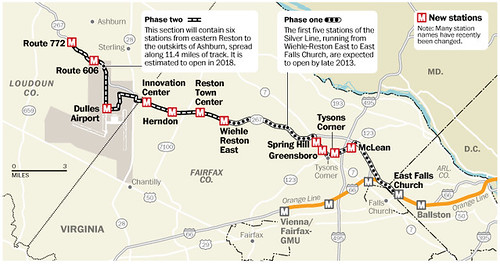
Silver Line heavy rail, WMATA, line alignment and routing mapRight: Silver Line station map.  Washington Post graphic.

And an additional factor is being introduced to the region, with the provision of direct subway connection to the Tysons Corner area, the largest employment center in the metropolitan area outside of DC.  While it will take a couple years to play out, having subway connections to that area will increase the number of trips but also will shift some trips to transit, thereby contributing to congestion reduction as well.

This is the case even though the trip time to get to Tysons by transit will be long and not cheap (especially during rush periods).

From the New York Times article:

But America’s love affair with its vehicles seems to be cooling. When adjusted for population growth, the number of miles driven in the United States peaked in 2005 and dropped steadily thereafter, according to an analysis by Doug Short of Advisor Perspectives, an investment research company. As of April 2013, the number of miles driven per person was nearly 9 percent below the peak and equal to where the country was in January 1995. Part of the explanation certainly lies in the recession, because cash-strapped Americans could not afford new cars, and the unemployed weren’t going to work anyway. But by many measures the decrease in driving preceded the downturn and appears to be persisting now that recovery is under way. The next few years will be telling.

“What most intrigues me is that rates of car ownership per household and per person started to come down two to three years before the downturn,” said Michael Sivak, who studies the trend and who is a research professor at the University of Michigan’s Transportation Research Institute. “I think that means something more fundamental is going on.”

Labels: , , ,

Sunday, March 27, 2011

Tolls and HOT Lanes and real usage

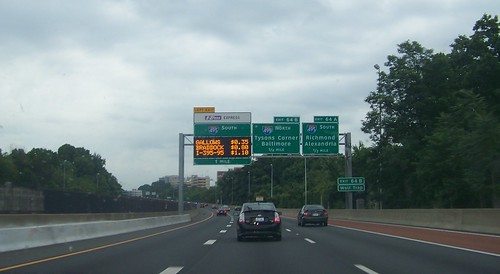
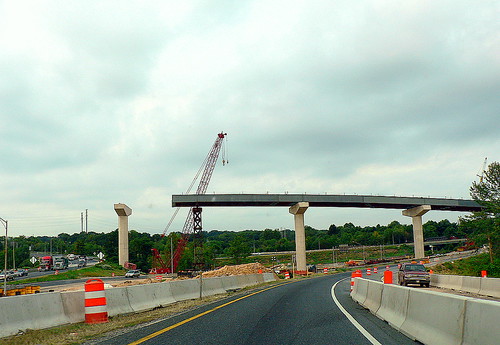
We went up to Philadelphia to do something (more about that later) and on the way back yesterday, we commented about all the freeway construction north of Baltimore, where HOT--high occupancy toll--lanes are being constructed up to about White Marsh.
The I-95 Express Toll Lanes project
Flickr photo by Gary Hymes.

I said something about Republican ideology, Bob Ehrlich (the former governor of Maryland, who approved the project), and lack of real demand (see this 2003 article from the Baltimore Sun, "Highway planners revisiting HOT lanes: Solo drivers could pay to avoid congestion"). Suzanne opined what will happen when the lanes are constructed and enough revenue isn't generated and the bills for construction have to be paid?"

The Takoma Park Patch (an AOL e-publication), reports in "Commuters Flee Intercounty Connector After Toll Charges Begin," that as the tolls have kicked in for the Inter County Connector in Upper Montgomery County, usage of the road has dropped as much as 62% during peak hours.


Granted usage will rise over time, and as the project is completed. But toll roads are a tough sell when most roads don't have tolls.

Ideology doesn't always pay the bills.

Labels: , , ,