Rebuilding Place in the Urban Space

"A community’s physical form, rather than its land uses, is its most intrinsic and enduring characteristic." [Katz, EPA] This blog focuses on place and placemaking and all that makes it work--historic preservation, urban design, transportation, asset-based community development, arts & cultural development, commercial district revitalization, tourism & destination development, and quality of life advocacy--along with doses of civic engagement and good governance watchdogging.

Wednesday, March 30, 2022

Will congestion charges work (in smaller cities)?

 -- "A Test for Congestion Charges in Smaller Cities" is a Bloomberg CityLab article.

The idea of congestion charges is to assess a daily fee on motor vehicles entering the highest in demand, "most congested" parts of a city, most typically its central business district.  The intent is to use the revenues generated to fund transit and other sustainable mobility improvements, as well as to encourage motor vehicle operators to shift to transit to avoid the fee.

For congestion charges to work in center cities, the business districts can't be susceptible to competition and poaching from neighboring jurisdictions.  

(Separately, some European cities have introduced a separate charge based on CO2 emissions.  See "London introduces Ultra Low Emissions Zone for vehicles with charges up to $130," ABC News.)

FWIW, I don't think congestion charges will work in smaller cities, at least in the US, because for the most part metropolitan areas are super de-concentrated.  And the quality of transit options tends to be sub-par.

The article is about Oxford, England, which is imposing a low emissions vehicle charge, not a congestion charge technically.  But Oxford is probably an exception to the general rule, because of the dominant university.  It's not like Oxford University will move out of Oxford to the suburbs. 

In short the issue has to do with monocentric versus polycentric development patterns.  Monocentric places will be able to impose congestion charges not worrying that it will induce and support business recruiting by alternative commercial districts.  It will be much harder to induce compliance in polycentric areas subject to inter-city competition.  

See Cities in Full for a more detailed discussion of monocentric versus polycentric development patterns wrt both center cities and transit systems.

AP photo, London.

Instead, there is intra-metropolitan competition and the polycentric pattern of business district development--e.g., in the DC area you have business centers in Crystal City (now called National Landing), Rosslyn and Ballston in Arlington County, Alexandria, not just in Potomac Yard/National Landing but elsewhere, multiple centers in Fairfax County but especially Tysons, Reston, and Fair Lakes, Bethesda and the I-270 Corridor in Montgomery County, with lesser centers in Rockville, Silver Spring, and Wheaton, to some extent in New Carrollton in Prince George's County, and independent centers in Loudoun County around Dulles Airport, Ashburn, etc.

Looking west on Lee Highway in Arlington, lines of cars split between taking Interstate 66 or staying on Lee Highway during rush hour on Dec. 4, 2017. (Jahi Chikwendiu/The Washington Post)

Any of these jurisdictions would be tempted to and would use congestion charges (tolling) in DC as a way to recruit DC-based businesses.  

For example, it is argued that one reason that Virginia has added tolling to I-66, a major route to DC, is to encourage firms to relocate to Northern Virginia from DC, as a way for their employees to be able to avoid driving into DC and paying a toll ("Did Va. Gov. McAuliffe and his transportation team mislead I-66 commuters on tolling? Not really, but his team could have been more clear," Washington Post).

New York City.  As it is, New York City approved a congestion charge, which with the delays as a result of the covid-induced migration from office buildings to working at home, is slated to take effect next year ("Congestion Pricing Is Coming to New York. Everyone Has an Opinion," New York Times).

I'm not sure that post-covid, a congestion charge will work in NYC, the one city heretofore in the U.S. that I thought it would work in.

But I think it should probably be pushed out later, because Manhattan's office districts have been pummeled by that outmigration.  A congestion charge will give non-transit users one more reason not to go back to the office.

And even Manhattan faces competition from other parts of New York City like Long Island City, the suburban office district in Westchester, New York north of the city, districts in Connecticut, and in New Jersey, especially Jersey City, which developed a strong positioning as "back office" support for New York City's financial services businesses (a role first played by Long Island City).

Even Manhattan isn't quite as comparable to London, Stockholm, or Singapore, which don't have the kind of polycentric activity center development pattern common to the US.

Suburban districts may have a better position for imposing congestion charges.  Ironically, it may be places like Tysons in Fairfax County, Virginia (versus DC), Greater Palo Alto in the San Francisco Bay region ("Mapping the Polycentric Metropolis: journeys to work in the Bay Area," Under the Raedar) (versus San Francisco), even Bellevue in Suburban Washington (versus Seattle) or the Buckhead District in Atlanta, have a better position for imposing such charges compared to the central business districts (Downtown) in the center cities in those metropolitan areas.

Congestion zones are too small to have the desired effect?  A separate Bloomberg article ("What Comes After London’s Congestion Charge?") argues that the London congestion charge isn't doing enough to limit negative environmental effects, because the zone to which the charge applies is too small relative the London metropolitan area.  It recommends a broader "road journey" charge.

Labels: , , , , ,

Friday, May 17, 2019

For DC, a congestion charge is not the way to go

One problem with a congestion charge, federal government vehicles probably would be exempt, and foreign embassies and organizations like the World Bank probably wouldn't pay.  Daily Mail photo, "Foreign embassies owe £75m in unpaid London congestion charges and U.S. diplomatic staff have racked up the most debt with fines totalling £8.1m."

WAMU-FM/NPR reports that DC City Council has allocated money to study the imposition of a congestion charge ("Should D.C. Toll Streets During Peak Traffic Periods? Council Wants To Study ‘Congestion Pricing’").

Congestion charges have two different purposes.

(1) reduce traffic by inducing people to shift trips to other modes or to not make trips altogether.  (And by reducing traffic, they help to speed up the remaining traffic, including surface bus transit.)

This is done through the classic recommendations of instituting a "tax" where spillover costs are not normally captured within pricing.

(2) provide an additional source of funding for transportation projects, ideally prioritizing sustainable mobility initiatives.

First, much of the metropolitan area's "worst" congestion is in the suburbs, and is on highways, not in DC proper, although getting to and from DC is one of the contributing factors.

-- "3 DC-area roads make list of America's 50 worst traffic bottlenecks," Fox5

Most studies that rank "DC" bad for traffic call the entire metropolitan area after the center city.  The fact is that DC does have a problem with congestion on certain streets in the core (K Street, I Street primarily) the reality is that most of the streets in the core aren't that congested.

Transit--Metrorail primarily despite its current problems--works!
Washington Capitals fans at the Gallery Place Metrorail Station
Washington Capitals fans exiting the Metrorail system.  One great thing about having the city's main arena in the core, served by 3 subway lines directly, and just a few blocks from 3 more lines, is how even a preponderance of suburbanites take transit to events held there.

I make this statement by the fact that during rush hour, it's possible to run red lights on a bicycle without any fear of oncoming traffic.

The major exception is the main commuter arteries such as 16th Street, Blair Road, Rhode Island Avenue, New York Avenue (itself congested because of the way it connects I-95 and I-695 for through trips to Virginia and Maryland). Although, some of this traffic would be interdicted I supposed by people switching to other modes in response to a congestion charge in Downtown.

Second, and most importantly, for DC to successfully levy a congestion charge, it has to be inalterably the #1 destination in the region for commerce subject to minimal competition for business relocation.

That's the case in cities like Singapore, Stockholm, or London, which have already instituted congestion charges, or New York City for Lower Manhattan, which has agreed to include a congestion charge going forward--not because they care that much about congestion, but because they need a funding source for rehabilitating the New York City Subway system.

I don't think it's the case for DC.  Especially with the current federal administration and its willingness to eliminate agencies altogether or move them outside of DC and the DC metropolitan area.

My paralyzing fear is that Maryland and Virginia would actively market business relocation against DC, making the point that you can get to their business districts without having to pay a congestion charge.

I don't think either state or its jurisdictions can really be trusted on this.

In fact, when I saw a presentation by the then planning director of Arlington County at the National Building Museum in 2002, I went up to him afterwards and suggested he retitle his presentation "how to kill DC."  That continues to be the case, given how Crystal City has just landed Amazon as a major tenant and Rosslyn has been landing corporate headquarters such as Nestle Foods.

Granted, you can argue that high occupancy tolls are a form of congestion charge. But some argue that the reason that Virginia made I-66 within the Beltway a toll road is to encourage businesses to relocate to Virginia from DC, thereby being able to get to and from a new location without tolls.

Alternative one: transit withholding taxIf the point of doing a congestion charge is raising funds, what I have recommended for years, but the federal government would have to agree, and it would be helpful for the suburbs to agree too, would be a transportation withholding tax.

It's done in France--providing a majority of the operating funding for transit service (France has successful light rail systems in many of its regional cities, not just in Paris), as well as certain areas of Oregon (Portland, Eugene), and for the MTA system in New York State (although I argue there it is too gross-grained, out-state residents served by railroads should pay less than core residents served by the subway--instead the same rate is assessed across the board).

-- "Commuter/mobility tax discussion for DC," 2012
-- "Metrolinx Toronto: 25 potential tools to fund transit-transportation infrastructure," 2013

Alternative two: commuter tunnel and transitway networkIf the point of a congestion charge is interdicting nasty traffic, in addition to investing in more and better transit, I have argued for the creation of some roadway tunnels on commuter arteries, e.g., North Capitol-Blair Road, to shift commuter traffic away from surface streets, because it has deleterious impact on the quality of neighborhood life.

These would be covered by tolls, not unlike HOT lanes. Maybe they wouldn't fully pay their way, but by shifting through traffic away from neighborhoods, it could be a cost worth subsidizing.
I-695 in DC looking west from 4th Street SW
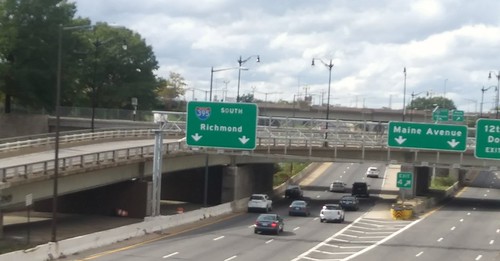
The Southeast-Southwest Freeway (I-695) in DC looking west from 4th Street SW.


The program should include dedicated transitways.  DC will be testing some Downtown, and has implemented them on and off on 7th Street/Georgia Avenue NW. (Bus advocates in London argue that with dedicated transitways, bus throughput improvements would be even greater.)

-- "Dedicated bus lanes coming to H and I streets this summer," Washington Post
-- "It's been a drawn out process, but DC is in the process of creating transitways on 16th Street NW," 2017

This program could also include some road decking, such as on North Capitol Street and the Southeast-Southwest Freeway.

-- "Tunnelized road projects for DC and the Carmel Tunnel, Haifa, Israel example--tolls," 2011
-- "London Mayor proposes roadway tunnels to divert surface motor vehicle traffic and congestion" 2016
-- "Maryland HOT lane study versus "corridor management" and regional scaled transportation planning," 2018
-- "Who knew? There's been a freeway deck in Oak Park, Michigan over I-696 for almost 30 years," 2018

I haven't written about it, but tunnelizing DC-295/The Anacostia Freeway, would be a boon to the quality of life and economic potential of a large section of the city East of the River.
Anacostia Freeway (DC 295)


This video by Bossi of DC 295 has unrelated sound.  I'd turn it off before listening, unless you want to listen to an old Diane Rehm radio broadcast.

If we had true metropolitan transportation planning, the Maryland HOT lane study could be coordinated with a DC tunnel/decking study.  For example commuter tunnels on 16th Street and Georgia Avenue would make sense to be integrated into the Maryland system.

-- "Here's a look at who's using Northern Virginia's 495 and 95 Express Lanes," Washington Post, 2018
-- "Poll: 61 percent of D.C.-area residents favor plan to add toll lanes to Beltway, I-270," Washington Post

Labels: , , , , , , ,