Rebuilding Place in the Urban Space

"A community’s physical form, rather than its land uses, is its most intrinsic and enduring characteristic." [Katz, EPA] This blog focuses on place and placemaking and all that makes it work--historic preservation, urban design, transportation, asset-based community development, arts & cultural development, commercial district revitalization, tourism & destination development, and quality of life advocacy--along with doses of civic engagement and good governance watchdogging.

Monday, September 23, 2024

GGW suggestion on making 90 bus line primary on its streets: bus on top, tunnel below?

While I haven't written for awhile, I have been thinking about things at a bigger scale, which will come out in some of the next entries.

As I get older, I become a little less doctrinaire, and given that in the US 92% of all trips are by car, I've resigned myself to having to accommodate them.  This is less the case in DC than SLC--which is the epitome of sprawl--but it's still an issue in DC.

Even though in DC on the major routes, bus riders make up a significant amount of the total people "throughput" on the street--e.g. on H Street NE, at least pre-covid, 40% of people throughput was by bus, via 300 bus trips, it's tough to corral automobiles, especially because most of the city, except the core is shaped by the automobility paradigm ("DC as a suburban agenda dominated city," 2013).

BeyondDC suggests in a GGW post, "One change to transform DC travel: Make the 90 bus truly awesome," that because the 90 bus line is the only major crosstown route, its uniqueness means that it should get priority on its streets.  

This is a problem because at many points the street is super narrow for an arterial

While it's unique as a crosstown route for buses, the same goes for the route in terms of motor vehicle traffic. 

And while I think the proposal is meritable, it's probably too controversial to ever get approved.

Not that my counter proposal is any easier....

In "Tunnelized road projects for DC and the Carmel Tunnel, Haifa, Israel example--tolls" (2011) and "DC and "city repair" of the urban grid," (2020) I suggest that a series of DC streets be "tunnelized and tolled" to separate commuter traffic from local traffic.  

It would facilitate faster travel for commuters--helping to maintain the relevance of Downtown as a regionally significant commercial district--it would also reduce the negative effect of commuter traffic on residents and neighborhoods.

Flickr photo by Elyse Horvath.

The 90s busline roadway could be brought into that proposed underground road network.  

It could get great urban design treatment on the surface where the bus would still run, because of frequent stops, while the tunnel would focus on satisfying longer trips.

With the tunnel, the surface street could become a kind of transit/sustainable mobility mall, at least in certain sections, using my Signature Streets model, the My Figueroa project in LA, etc..  

And you could run articulated buses to increase capacity.

Spitalerstraßße transit mall, Hamburg, Germany.  
Bi-articulated buses (3 sections) are allowed on the street


Image by BeyondDC.  50 foot road right of way with bus service in the middle of the street

Labels: , , , , , ,

Friday, October 02, 2020

DC and "city repair" of the urban grid

I have written a bunch of pieces about tunneling commuter arteries and decking over freeways and principal arterials that too often scar the city, split neighborhoods, and foul up the street grid developed by L'Enfant.

-- "Who knew? There's been a freeway deck in Oak Park, Michigan over I-696 for almost 30 years" (2018) 

-- "London Mayor proposes roadway tunnels to divert surface motor vehicle traffic and congestion," (2016) 

-- "Tunnelized road projects for DC and the Carmel Tunnel, Haifa, Israel example--tolls," (2011) 

-- "Maglev as an opportunity for DC to underground through traffic on New York Avenue," (2020) 

-- "Yes, public and nonprofit investments in the city spur further reinvestment and change: is this a bad thing or a complicated thing?" (2019)

Boston: before and after the Big Dig.  AP photo.

A number of cities around the world have done this in various ways -- getting rid of freeways more generally (San Francisco's Embarcadero Freeway, Milwaukee, Boston's Big Dig, Seattle's Highway 99, albeit because of earthquake risk), along waterfronts (Portland, Oregon) or restoring rivers that had been covered up (Seoul) and/or tunnelizing major freeways (Marseille, Thessaloniki, Madrid) -- or have proposed doing so.

Note that this is expensive to do, but might be cheaper than the cost of rebuilding freeways at the end of their useful life.  Generally, it's "affordable" in central business districts with high property values, when "new land" created supports new high intensity development.

And I just mentioned Utrecht's now completed program to restore sections of the city's ring canal that had been converted to below grade roadways.

Building a deck over a couple blocks of the I-395 Freeway, between Massachusetts Avenue and D Streets NW.  Here the freeway was wide enough to allow for the construction of multiple large buildings, in an area of high value.

And DC has decked some sections of the I-395 Freeway, including the most recent "Capitol Crossing" project.

Foggy Bottom as an opportunity.  Greater Greater Washington reprinted an entry that discusses a 1997 proposal to do this in Foggy Bottom, which is cut up by arterial tunnels, a stub of I-66, and the Whitehurst Freeway.  Kennedy Center, the performing arts complex, is a kind of an island in the midst of roadways.

-- "What if Kennedy Center was [sic] part of Downtown DC?"

When I suggested that decking be employed with regard to the Southeast-Southwest Freeway, I was definitely remiss in not mentioning the similar opportunity in Foggy Bottom. (Although the FB article doesn't discuss the poor placement of Kennedy Center from the standpoint of what Jane Jacobs called "mixed primary use" and her example of the creation of a standalone arts district in the Oakland neighborhood in Pittsburgh, rather than downtown.)


Portland's City Repair urban design advocacy group.  I use the term "city repair" in honor of the City Repair organization in Portland, Oregon.

A "repaired" intersection in Portland.

They focus on "repairing" city streets with the aim of supporting walking and biking, converting the streets from their hitherto overwhelming focus on motor vehicles.

-- video

Cities should create "Urban Design Opportunity Plans."  Most cities have plenty of opportunities for "city repair" and urban design advocacy agendas for such, applying the "Transformational Projects Action Planning" approach, should be developed, at the city-wide scale  more generally, and at the neighborhood scale, like the way I suggested for the Dupont Circle neighborhood in DC or Silver Spring, Maryland:

-- "Planning urban design improvements at the neighborhood scale: Dupont Circle, DC" (2019) 

--  "More about making 17th Street between P and R a pedestrian space on weekends" (2019) 

 -- PL #5: Creating a Silver Spring "Sustainable Mobility District" (2017)

 - Part 1: Setting the stage - Part 2: Program items 1- 9 - Part 3: Program items 10-18 

 - Part 4: Conclusion

or what Alexandria, Virginia is doing around its waterfront, at the foot of King Street, or for more pedestrianized areas within cities like Las Ramblas in Barcelona or the plaza program in New York City.

Labels: , , , , , ,

Friday, May 17, 2019

For DC, a congestion charge is not the way to go

One problem with a congestion charge, federal government vehicles probably would be exempt, and foreign embassies and organizations like the World Bank probably wouldn't pay.  Daily Mail photo, "Foreign embassies owe £75m in unpaid London congestion charges and U.S. diplomatic staff have racked up the most debt with fines totalling £8.1m."

WAMU-FM/NPR reports that DC City Council has allocated money to study the imposition of a congestion charge ("Should D.C. Toll Streets During Peak Traffic Periods? Council Wants To Study ‘Congestion Pricing’").

Congestion charges have two different purposes.

(1) reduce traffic by inducing people to shift trips to other modes or to not make trips altogether.  (And by reducing traffic, they help to speed up the remaining traffic, including surface bus transit.)

This is done through the classic recommendations of instituting a "tax" where spillover costs are not normally captured within pricing.

(2) provide an additional source of funding for transportation projects, ideally prioritizing sustainable mobility initiatives.

First, much of the metropolitan area's "worst" congestion is in the suburbs, and is on highways, not in DC proper, although getting to and from DC is one of the contributing factors.

-- "3 DC-area roads make list of America's 50 worst traffic bottlenecks," Fox5

Most studies that rank "DC" bad for traffic call the entire metropolitan area after the center city.  The fact is that DC does have a problem with congestion on certain streets in the core (K Street, I Street primarily) the reality is that most of the streets in the core aren't that congested.

Transit--Metrorail primarily despite its current problems--works!
Washington Capitals fans at the Gallery Place Metrorail Station
Washington Capitals fans exiting the Metrorail system.  One great thing about having the city's main arena in the core, served by 3 subway lines directly, and just a few blocks from 3 more lines, is how even a preponderance of suburbanites take transit to events held there.

I make this statement by the fact that during rush hour, it's possible to run red lights on a bicycle without any fear of oncoming traffic.

The major exception is the main commuter arteries such as 16th Street, Blair Road, Rhode Island Avenue, New York Avenue (itself congested because of the way it connects I-95 and I-695 for through trips to Virginia and Maryland). Although, some of this traffic would be interdicted I supposed by people switching to other modes in response to a congestion charge in Downtown.

Second, and most importantly, for DC to successfully levy a congestion charge, it has to be inalterably the #1 destination in the region for commerce subject to minimal competition for business relocation.

That's the case in cities like Singapore, Stockholm, or London, which have already instituted congestion charges, or New York City for Lower Manhattan, which has agreed to include a congestion charge going forward--not because they care that much about congestion, but because they need a funding source for rehabilitating the New York City Subway system.

I don't think it's the case for DC.  Especially with the current federal administration and its willingness to eliminate agencies altogether or move them outside of DC and the DC metropolitan area.

My paralyzing fear is that Maryland and Virginia would actively market business relocation against DC, making the point that you can get to their business districts without having to pay a congestion charge.

I don't think either state or its jurisdictions can really be trusted on this.

In fact, when I saw a presentation by the then planning director of Arlington County at the National Building Museum in 2002, I went up to him afterwards and suggested he retitle his presentation "how to kill DC."  That continues to be the case, given how Crystal City has just landed Amazon as a major tenant and Rosslyn has been landing corporate headquarters such as Nestle Foods.

Granted, you can argue that high occupancy tolls are a form of congestion charge. But some argue that the reason that Virginia made I-66 within the Beltway a toll road is to encourage businesses to relocate to Virginia from DC, thereby being able to get to and from a new location without tolls.

Alternative one: transit withholding taxIf the point of doing a congestion charge is raising funds, what I have recommended for years, but the federal government would have to agree, and it would be helpful for the suburbs to agree too, would be a transportation withholding tax.

It's done in France--providing a majority of the operating funding for transit service (France has successful light rail systems in many of its regional cities, not just in Paris), as well as certain areas of Oregon (Portland, Eugene), and for the MTA system in New York State (although I argue there it is too gross-grained, out-state residents served by railroads should pay less than core residents served by the subway--instead the same rate is assessed across the board).

-- "Commuter/mobility tax discussion for DC," 2012
-- "Metrolinx Toronto: 25 potential tools to fund transit-transportation infrastructure," 2013

Alternative two: commuter tunnel and transitway networkIf the point of a congestion charge is interdicting nasty traffic, in addition to investing in more and better transit, I have argued for the creation of some roadway tunnels on commuter arteries, e.g., North Capitol-Blair Road, to shift commuter traffic away from surface streets, because it has deleterious impact on the quality of neighborhood life.

These would be covered by tolls, not unlike HOT lanes. Maybe they wouldn't fully pay their way, but by shifting through traffic away from neighborhoods, it could be a cost worth subsidizing.
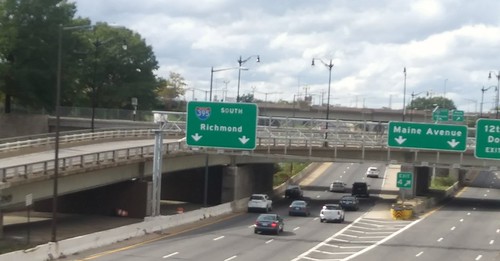
I-695 in DC looking west from 4th Street SW
The Southeast-Southwest Freeway (I-695) in DC looking west from 4th Street SW.


The program should include dedicated transitways.  DC will be testing some Downtown, and has implemented them on and off on 7th Street/Georgia Avenue NW. (Bus advocates in London argue that with dedicated transitways, bus throughput improvements would be even greater.)

-- "Dedicated bus lanes coming to H and I streets this summer," Washington Post
-- "It's been a drawn out process, but DC is in the process of creating transitways on 16th Street NW," 2017

This program could also include some road decking, such as on North Capitol Street and the Southeast-Southwest Freeway.

-- "Tunnelized road projects for DC and the Carmel Tunnel, Haifa, Israel example--tolls," 2011
-- "London Mayor proposes roadway tunnels to divert surface motor vehicle traffic and congestion" 2016
-- "Maryland HOT lane study versus "corridor management" and regional scaled transportation planning," 2018
-- "Who knew? There's been a freeway deck in Oak Park, Michigan over I-696 for almost 30 years," 2018

I haven't written about it, but tunnelizing DC-295/The Anacostia Freeway, would be a boon to the quality of life and economic potential of a large section of the city East of the River.
Anacostia Freeway (DC 295)


This video by Bossi of DC 295 has unrelated sound.  I'd turn it off before listening, unless you want to listen to an old Diane Rehm radio broadcast.

If we had true metropolitan transportation planning, the Maryland HOT lane study could be coordinated with a DC tunnel/decking study.  For example commuter tunnels on 16th Street and Georgia Avenue would make sense to be integrated into the Maryland system.

-- "Here's a look at who's using Northern Virginia's 495 and 95 Express Lanes," Washington Post, 2018
-- "Poll: 61 percent of D.C.-area residents favor plan to add toll lanes to Beltway, I-270," Washington Post

Labels: , , , , , , ,

Tuesday, February 09, 2016

London Mayor proposes roadway tunnels to divert surface motor vehicle traffic and congestion

Central Artery before and after, Boston.  

According to the Guardian ("Boris Johnson unveils road tunnel plans to ease London congestion"). From the article:
“Around eight of every 10 journeys in London are made using our roads – whether by car, taxi, motorbike, bus, cycle, foot or freight – which is why it is vital that we think big. We must deliver long-term solutions that will not just make the most of the space we have for road users but bring environmental and amenity improvemhistents to local areas.” ...

He added: “By pushing forward strategic initiatives we are outlining today, we will lay the foundation for the next wave of improvements to everyone’s experience of the road network across the city.”

The major road tunnels are based on the strategies pursued in Stockholm and Boston, although the latter’s “Big Dig” proved difficult, costly and controversial. The success of flyunders in transforming parts of cities such as Madrid, where its inner ring road was partially buried, may make the smaller projects more viable. TfL believes a 1.3km tunnel at Barking could create a new neighbourhood of 5,000 homes in a blighted area, and that either tolls or the housing could make the project pay for itself.
Who knew that there is the International Tunneling and Underground Space Association?

-- "Urban Road Tunnels," ITA
-- "MADRID CALLE 30: AN URBAN TRANSFORMATION PROJECT"

I mention this because I have suggested this in the North Capitol-Blair Road corridor in DC, and support it for through traffic on New York Avenue (the equivalent of a connection between I-95 through DC to Virginia)--this is not my idea originally, it was suggested in the New York Avenue Transportation Study about ten years ago. 16th Street NW would be another corridor where this is worth considering.

The justification is that the negative impacts on abutting neighborhoods are significant and worthy of mitigation.  The underground trip would be faster and therefore should be worthwhile for users, thereby justifying toll charges for the privilege.  See "Tunnelized road projects for DC and the Carmel Tunnel, Haifa, Israel example--tolls."

I didn't know about the Madrid example. Marseille removed a highway along the waterfront by shifting it to an underused rail tunnel. Thessaloniki built a tunnel around its historic waterfront to divert surface/through traffic and create a more pedestrian-centric environment along the waterfront.

In Long Beach, an undergrounded rail tunnel, the Alameda Corridor, was built to facilitate freight movement between the port and the freight railway system.

It could have been interesting to have also built a tunnel for truck traffic between the port and the highway system, since the road system is inundated with truck traffic generated by the port.

Miami is creating such a facility, the N.W. 25th Street Viaduct Project, between the Miami Airport's cargo hub and the local freeway system (pictured at left).*

Of course, Boston's "Big Dig" or Central Artery Freeway is another example ("10 years later, did the Big Dig deliver?," Boston Globe) although it is not tolled.

Note that the tunnel underpasses in various places in the city, such as at Massachusetts Avenue and Thomas Circle for the roadway system and on North Capitol Street between M Street and Rhode Island Avenue, were early attempts to facilitate traffic movement but without providing simultaneous improvements in conditions for neighborhoods and the urban street fabric.

Capitol Crossing, before.  

The Capitol Crossing development, which will deck over of the I-395 freeway between Masachusetts Avenue and D Street NE is an example of decking over an existing facility, without creating a new tunnel.


Reknitting the street grid in Washington by decking over more of I-395.

==========

* Separately, I wonder if the Long Bridge reconstruction project--the bridge carries passenger railroad, freight railroad, and subway trains over the Potomac River between Southwest DC and Arlington County--should add lanes for a bi-directional dedicated busway.

It could serve National Airport when the subway is closed as well as tour bus traffic and other bus traffic to and from DC.

Labels: , , , , , ,




