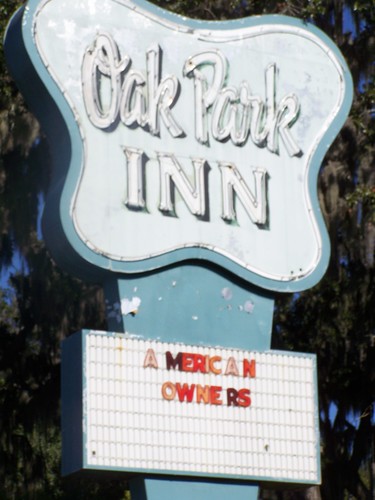
Closed motel where the marquee pushed the "locally owned" trope.
The Washington Post reports, in "D.C. developers seek subsidies to build 2 more Marriott hotels," that property developers building the conference hotel adjacent to DC's Convention Center are asking for $35 million in tax incentives to build two smaller lower price point hotel properties adjacent to the conference hotel.
Actually, I am in favor of conference hotels generally, because when you have to split up big associations between hotels (like what the American Planning Association had to do in DC in 2005), events in the "secondary" hotel property tend to get the shaft in terms of attendee patronage. It just doesn't work.
And I like the idea of offering inter-connected hotels with various price points, because it allows you to serve a variety of market segments and capture more of the visitor business overall--some people might not come because the hotel prices are too high and others (like me) seek out lower priced options such as bed & breakfasts or other discount options, even hostels.
The real problem is that most cities do not create comprehensive "accommodations" plans to address this and related issues.
And when you don't have a plan, you don't have a good way of addressing various one-off requests comprehensively, including prioritization.
(Although this is a problem with DC's TIF program generally--it's actually abominable, because there is no one central point in the city government where requests are received and evaluated and addressed.)
In commercial district revitalization framework plans I did for Brunswick, GA and Cambridge, MD, one of the recommendations I made for each is that the communities need to develop a broader and complete "accommodations" plan as part of the economic development element of the city's comprehensive/master plan.
I don't think I've ever come across such a component in master/comprehensive plans in the U.S., but it's something that has occurred to me over the years because most communities don't offer a complete array or set of accommodations to visitors. At least for communities that are tourist destinations, it ought to behoove them to think more comprehensively about this to better meet the needs of various market segments.
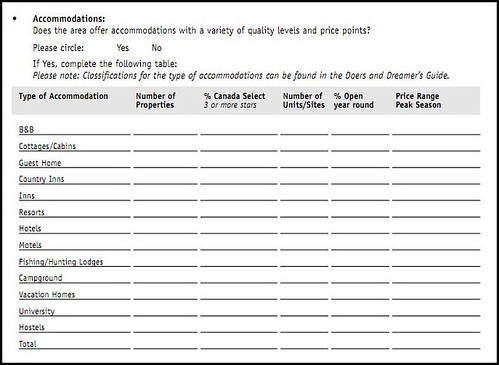
Accommodations plan worksheet, Nova Scotia Tourism Destination Areas Workbook. This is pretty simple, but it's more a scoping/current conditions assessment. It's not at the detail of a full-blown economic development plan.
Such accommodations plans should include hotels, motels, conference facilities, bed & breakfast, boutique inns, and depending on the market, hostels and campground facilities, at a variety of price points.
This is from the Brunswick plan:
The provision of accommodations within a community has nuances that are not always considered. The type and quality of the hotel brands that are present says things about the market and how the community is perceived. This was shown jokingly in the movie Total Recall when a Best Western brand was displayed on a hotel located in a low income neighborhood, while Hilton Hotels was the brand pictured in the more up-scale precincts of the Planet Mars.
In Glynn County, some of the most exclusive hotels and other accommodations are located on the islands--Sea Island Resort is world-renowned. For the most part accommodations located within the City of Brunswick are low end brands of national chains. (And motels located within Glynn County on I-95 are referred to as being in the City of Brunswick.) A now closed and dilapidated Days Inn is one of the most prominent buildings as a driver enters Gloucester Street from Highway 17 to travel downtown, creating a terrible impression, one that belies the beauty of buildings, parks, and streets located but a few blocks away.
Glynn County has a great demand for hotel-motel accommodations, not only because of tourism, but to provide rooms for students attending courses and training at the Federal Law Enforcement Training Center. While large room blocks are reserved throughout the year to serve this market, for the most part these are at significantly discounted rates--price, not quality of the experience, being the most important factor. There is no question that hotels developed as part of Liberty Harbor will be a welcome addition to the city's array of hotels, and will fill in a gap for higher end offerings. ...
Recommendation: That the City and DDA consider broadening the scope of the Downtown Hotel Market Study being conducted currently, and develop a broader accommodations development plan, as part of the Economic Development Element in the Comprehensive Plan, through the inclusion within a Destination Development Plan of an element on accommodations.
The price point issue is important for DC because the properties here tend to be more expensive, so a lot of people visit "DC," and spend most of their tourist visit in DC (with the exception of visiting Mount Vernon, Arlington Cemetery, and Alexandria) but their overnight stays in hotels/motels are outside the city (where they visit the U.S. Capitol, White House, National Mall, Smithsonian Museums, National Gallery, and Georgetown) so those communities get the bulk of the occupancy taxes generated by visitors.
In fact, Montgomery County, Maryland used to have a promotion program promoting visits to DC as "DC Days, Montgomery nights," playing off the fact that certain segments, especially families, seek cheaper accommodations in the suburbs while visiting DC. See the past entry, "
Marketing the local experience that is also DC."
That's why the point by the developers asking for the TIF support is worth considering. The high cost of accommodations in DC is a key issue identified in travel economic impact and tourism research conducted for
Destination DC.
(Note that a huge chunk of DC's hotel visitorship is generated by business related to the U.S. government including trade associations and lobbying. Actually some of the strongest months in DC tourism are February/March--spring lobbying, and October--the real start of the year's Congressional session after summer recess.)
But there is another element that needs to be considered in terms of responding to requests by developers for hotel-property-related government incentives and inducements.
Most hotel properties are not locally owned. And most of the money spent on hotel rooms is spent on debt service.
So much of the money generated by a "room night" other than that spent within the hotel or on hotel staff (housekeeping and other maintenance functions, food & beverage staff, etc.) is repatriated to the property owner, as well as a percentage that is paid to the hotel management company (e.g., Hilton or Marriott--used to be based in DC, they are in Gaithersburg now, and in fact, Marriott started in DC with a hot dog and root beer stand, or Choice Hotels, etc.).
While it happens that many of the major hotel/motel branding and management companies are based in the DC region, they are not based in DC proper, so these profits don't trickle down much to DC proper.
I haven't seen an economic multiplier study of hotel (accommodations) properties based on local vs. non-local ownership, and such a study is required to determine whether or not the return on investment from government subsidies pays off.
Now, we have to recognize that hotel stays support other business within the city such as at retail, restaurants, and other attractions. But more differentiated economic impact studies are in order to get better numbers and a sense of the success or failure of government incentives to generate deeper and broader economic development.
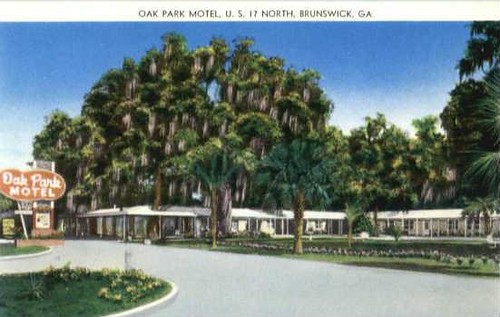 The Oak Park Motel in better days. Postcard image.