Rebuilding Place in the Urban Space

"A community’s physical form, rather than its land uses, is its most intrinsic and enduring characteristic." [Katz, EPA] This blog focuses on place and placemaking and all that makes it work--historic preservation, urban design, transportation, asset-based community development, arts & cultural development, commercial district revitalization, tourism & destination development, and quality of life advocacy--along with doses of civic engagement and good governance watchdogging.

Saturday, April 18, 2009

Quote(s) of the day

From "Standing in the Way of Smart Urban Development‎," the "Shaping the City" column by Roger Lewis, in today's Post.

First paragraph of the story:

Some residents of the District cling to a suburban mentality. This mentality, coupled with government mismanagement, can obstruct desirable redevelopment. For the city to evolve, residents' attitudes and government performance must change.

Second to last paragraph:

The missed Tenleytown opportunity shows that developer competitions are not always the right approach for complicated civic projects. And it shows once again that the city needs a competent, proactive agency that can independently finance and implement redevelopment of public property.

Last paragraph:

Much suburban fabric is relatively static. Much urban fabric is relatively dynamic, changing as circumstances change. Living in cities means accepting and even embracing change. Living in America's capital city should be no exception.

Since I write about this broad topic so much, there is no need to say any more in this entry.

Labels: , , , ,

Wednesday, November 21, 2007

Are you a young urban narcissist? (yunnie)

I don't really agree with the blog entry from Vanishing New York about Young Urban Narcissists. In the past, Dan M. has made the point that these days most people grow up and live in suburbs, so of course, how they approach the world is patterned by this. (It's what I call the dominant planning paradigm of the last 50 years, deconcentration, single use zones connected by automobility.)

But the entry is funny with some great overwritten photographs, and the point about suburbanizing the cities, while one that many have made, cannot ever be ignored.

Labels: , ,

Saturday, September 01, 2007

YIMBYs from Brooklyn to DC -- Thinking about Community Participation in Shaping Development

--------
Reprinted from April 2005
--------

Otis White writes "The Urban Notebook" column for Governing Magazine and produces an e-newsletter as part of his Civic Strategies consulting practice. He wrote this today:

Beyond Negative and Provincial
YIMBY Power

People who study power in cities will tell you that it's shifting away from the business community and toward neighborhood associations. Problem is, these grassroots organizations aren't up to the task in most places. They're far too negative and provincial to wield real power. But there are exceptions. Take what happened recently in the Park Slope area of New York's borough of Brooklyn. Or, better yet, let Aaron Naparstek tell you.

Naparstek is a writer who's active in a group called Park Slope Neighbors. Park Slope is a "classic brownstone New York City neighborhood," Naparstek said recently, whose Fifth Avenue has become a "vibrant, mixed-use, pedestrian-oriented neighborhood Main Street of restaurants, hardware stores, groceries and various other neighborhood services."

Recently, a bank company announced it was placing a branch on Fifth Avenue in a spot that once had a gas station. The neighborhood needs a bank, Naparstek said, but not the building that the bank had in mind: a "standard, cookie-cutter, suburban-style, drive-through" branch. It was the drive-through, of course, that hit the neighborhood's hot button. "It was so wrong," Naparstek said. "It felt like the very type of design that killed so many Main Streets around the country." What to do? Oppose the branch on the grounds that it would cause more traffic congestion, endanger pedestrians and set back the neighborhood's progress.

But here's where Park Slope Neighbors took a slightly different tack. In its campaign, it didn't vilify the bank company. In fact, the opposite: The group made it clear that, if the design could be changed, the branch would be welcomed with open arms - and Park Street Neighbors would lead the parade. Naparstek calls this "YIMBY activism" (for "yes in my back yard").

It's activism, he said, that's "positive, rational and unemotional." Better yet, it worked. The bank changed the design, and neighborhood activists showered the company with credit for its responsiveness. It even arranged a press conference at which it presented the bank with what Naparstek described as "a big, cheesy deposit slip" representing the group's intent to open an account there. "We promised that if they changed their design, we'd open our first account there," he said. "The press loved it and a lot of good vibes were generated for the bank."
Park Slope Neighbors website.
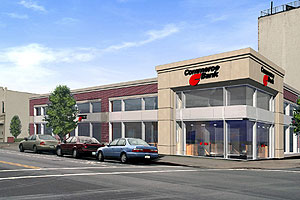
commercebank
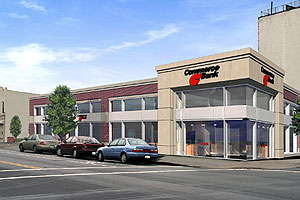
Rendering of the "victory" in Park Slope.

On the pro-urb email list, Larry Felton Johnson (there is a link to his blog in the sidebar), wrote this:

This whole incident had a really nice outcome. It also demonstrated the value of the urban oriented web logs (blogs) in rapidly spreading interesting news. As events unfolded the blog network was getting frequent updates, including interaction with Aaron Naparstek and others in the neighborhood. One of my own posts consisted of corrections by a Park Slope resident who had been involved early, but at that point wasjust following at the local level. Otis White follows the "urblogs" closely, and reviews them. I suspect this article is a result of his keeping his finger on that pulse.
_____

Actually, I sent notice of this Park Slope happening to the pro-urb list first, because I had
read about it in the New York Press when I was in NYC in December. See this for an update on the story in a March issue of New York Press.

Anyway, this dovetails with something that I have been mulling over since last Saturday, when I popped into part of the planning meeting for the baseball stadium-South Capitol area, the process that is being co-led by the Anacostia Waterfront Corporation, DC's Office of Planning, and the DC Department of Transportation. (I mentioned this meeting in a blog entry last Friday.)

The Post reported on the meeting in the Sunday paper, with this headline "Residents Near Stadium Offer Tips, Voice Fears: D.C. Demonstrators Seek Direct Input." I got there late, so I missed the demonstration. By the way, all the materials generated by the workshop will be put up on the Public Space Forum website for the project by the beginning of next week.

After the meeting, I talked with some people for as long as 90 minutes about neighborhood planning, citizen involvement in the process, how under-funded agencies such as the NCRC look to various projects to develop income streams and how this can lead to significant uncorrectable compromises, planning, review of development projects, etc. The pro-urb posting has "forced" me to put together these thoughts.

In DC, we have what are called "Advisory Neighborhood Commissions" which are elected neighborhood councils that do a variety of things, including making recommendations with regard to planning, zoning, and licensing matters, when review is required ("matter of right" developments are not reviewed, only those matters that involve zoning changes, large tract review, variances, exceptions, or where review is specified).

But the "city" doesn't provide much in the way of training resources to these entities and they can be excellent, good, average, bad, or really bad (fisticuffs, embezzlement, etc.). Because of problems over the years, the amount of money allocated to these entities (for community organization grants, etc.) has been drastically reduced, and the city government doesn't provide office space or other infrastructure support, although various agencies occasionally accomodate these entities, but in a non-systematic way. They also don't usually interact with each other, share best practices amongst the various ANCs, and build organizational and community capacity on a neighborhood and city-wide basis. (I wrote about this in a March entry about "Neighborhood Planning".)

Well, lately I have been thinking that we (my ANC, which includes a swath of downtown) pretty much approve of everything that comes before us. Maybe we tweak it, and get something in return, but usually, the developers get what they want.

There are some exceptions, such as historic designations, which can change projects significantly, or out and out fights against particular projects which can either result in a stalemate and/or victory (BP gas station, which now that the market has changed, the property is too valuable and it will become a mixed use non-gas station development, after five years of community organizing) or a big loss (Station Place is an ugly, anti-urban design federally leased building that was greased through the system by the company's choice of architect and that architect's connections within the system).
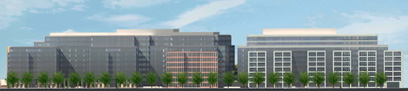
stationplace
Station Place on 2nd Street NE, Washington, DC.

The complex is designed by Kevin Roche, a Pritzker Architecture Prize winner. Roche's design of an urban brutalist building in New Haven Connecticut led Vincent Scully to become committed to historic preservation. Certainly Roche's friendship with J. Carter Brown didn't hurt this project when it came before the Commission of Fine Arts. (Design, setback, connections to the neighborhood, how the building fronts on H Street, the possibility of retail at 2nd and F as part of the building were all issues raised by the community that we by and large, lost. The building, in my opinion, looks worse in person.)

Maybe this is because in the city we are "desperate" for investment, and I guess various neighborhoods around the city differ--particularly the neighborhoods in Ward 3, along Wisconsin Avenue, which have been organizing against an intensification of land usage along the Avenue, particularly around the Metro stations.
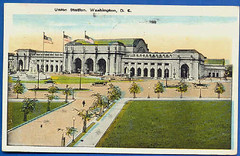
unionstationpostcard2
Station Place backs up to the Daniel Burnham-designed Union Station, which was planned and built as a result of the Senate Park Commission (McMillan) plan of 1901, and was one of the first examples of the "City Beautiful" movement in the United States.

In comparison, my neighborhood is more "urban" but less dense than Dupont Circle and similar neighborhoods, and is within the L'Enfant Plan area, so the idea of density and connectedness isn't completely foreign, even if most of the residents still have a suburban sensibility as far as development is concerned.

The issue really then is over "good" or "quality" development vs. "bad" or "ugly" development as well as developing a base of knowledge or awareness about the broader issues, when there isn't a training infrastructure to provide it. (This idea could be expanded by discussing Molotch's work on environmental and preservation organizing to maintain "use values of place" vs. "exchange values of place," and where it is successful and where it isn't, and whether or not such movements are able to develop in the first place. See Building Rules and Urban Fortunes: A Political Economy of Place.)

(Note: if the Park Slope Commerce Bank branch as rendered is a victory, then I think that Brooklyn and Park Slope needs some remedial design education. I would still be raising a lot of issues of that pretty average design.)

Anyway, individuals with knowledge or interest and a willingness to participate on ANC "Planning and Zoning" committees (the titles vary by ANC) make a big difference in the quality and impact of the ANC's participation on such matters.

In our Ward, we have 4 ANCs, two including mine deal with the H Street neighborhood that I always write about (although they include territory up to East Capitol Street), one focuses on "Capitol Hill" and the other on SW DC, the area that was urban renewaled in the 1950s...

Well the ANC in the Southwest quadrant of DC is the one that has to deal in particular with it becoming a zone of "intensification of use" because, directly east and south of downtown (jumping the National Mall) and north and south of Union Station is the only place where the city can grow in an intense, commercial, downtown-like fashion.
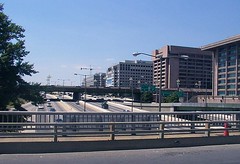
swfreeway03
Urban brutalism in Southwest DC, along the Southeast-Southwest Freeway. Photo from BeyondDC.

But that ANC has no committees that allow for the tapping of the expertise of community residents. And various "hotheads" as Commissioners take anti-development positions that face it, won't fly in a city that is committed to the development agenda. But as a result, the ANC and more importantly, the residents that ANC Commissioners purport to represent, are cut out from having meaningful substantive involvement in the process, getting improvements, benefits, etc.

I suppose, fundamentally, this is difference of magnitude in comparison to one small development site. The NCPC South Capitol plan rendering shows the elimination of a huge swath of SW neighborhood (building stock from the early 1900s) in favor of big albeit mixed use buildings.

Balancing the needs of a "residential" Washington as opposed to the needs of the "Federal City" of Washington is at times, a great dilemma, with no easy resolution.

Labels: , , ,

Unlearning continues at a furious pace

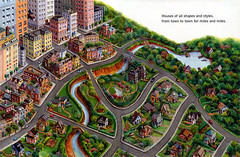
1. Stuart Sirota has coined the term "inward suburbanization" to describe the process of suburbanizing urban places. This relates to the transect idea from New Urbanism, that you put the right kind of building form in the appropriate place.
Illustration from The House Book by Keith DuQuette

2. The current issue of Dupont Current (not available on line) has a story about Commerce Bank building a suburban styled branch in Tenleytown.
commercebank
See "Commerce Bank breaks ground on Washington branches" and "Banking on branches," from the Washington Business Journal and "Area Gets An All-Day Bank Fight" from the Post about Commerce Bank's expansion strategy. The founder of the company still owns Burger King franchises and it shaped his approach to the banking business.

But the fast food sensibility also shaped their focus on design. And while a Commerce Bank official likens their approach to Starbucks, the latter company is fine with historic buildings, whereas Commerce Bank doesn't seem to be similarly minded.

3. This is frustrating because this problem keeps happening around the city--it happened in Georgetown, except that Georgetown has an extra level of and stronger design review process than regular DC historic districts.

4. And I wrote about this problem in Brooklyn, with Commerce Bank, a couple years ago. See "YIMBYs from Brooklyn to DC -- Thinking about Community Participation in Shaping Development." (Actually, I am gonna reprint this entry next.)

Why don't we learn that design review is important everywhere? And that urban forms are the appropriate building forms for a city like Washington, DC.

5. Also see "A Retailer's Lament: Influx of Bank Branches," a 2005 blog entry.

6. This is a book I want to read...
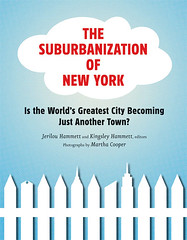
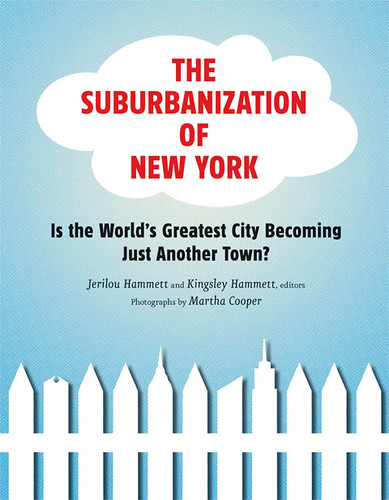
The Suburbanization of New York: Is the World's Greatest City Becoming Just Another Town?; Edited by Jerilou Hammett and Kingsley Hammett; Princeton Architectural Press; $24.95.

Labels: , , ,

Thursday, April 28, 2005

YIMBYs from Brooklyn to DC -- Thinking about Community Participation in Shaping Development

Otis White writes "The Urban Notebook" column for Governing Magazine and produces an e-newsletter as part of his Civic Strategies consulting practice. He wrote this today:

Beyond Negative and Provincial
YIMBY Power

People who study power in cities will tell you that it's shifting away from the business community and toward neighborhood associations. Problem is, these grassroots organizations aren't up to the task in most places. They're far too negative and provincial to wield real power. But there are exceptions. Take what happened recently in the Park Slope area of New York's borough of Brooklyn. Or, better yet, let Aaron Naparstek tell you.

Naparstek is a writer who's active in a group called Park Slope Neighbors. Park Slope is a "classic brownstone New York City neighborhood," Naparstek said recently, whose Fifth Avenue has become a "vibrant, mixed-use, pedestrian-oriented neighborhood Main Street of restaurants, hardware stores, groceries and various other neighborhood services."

Recently, a bank company announced it was placing a branch on Fifth Avenue in a spot that once had a gas station. The neighborhood needs a bank, Naparstek said, but not the building that the bank had in mind: a "standard, cookie-cutter, suburban-style, drive-through" branch. It was the drive-through, of course, that hit the neighborhood's hot button. "It was so wrong," Naparstek said. "It felt like the very type of design that killed so many Main Streets around the country." What to do? Oppose the branch on the grounds that it would cause more traffic congestion, endanger pedestrians and set back the neighborhood's progress.

But here's where Park Slope Neighbors took a slightly different tack. In its campaign, it didn't vilify the bank company. In fact, the opposite: The group made it clear that, if the design could be changed, the branch would be welcomed with open arms - and Park Street Neighbors would lead the parade. Naparstek calls this "YIMBY activism" (for "yes in my back yard").

It's activism, he said, that's "positive, rational and unemotional." Better yet, it worked. The bank changed the design, and neighborhood activists showered the company with credit for its responsiveness. It even arranged a press conference at which it presented the bank with what Naparstek described as "a big, cheesy deposit slip" representing the group's intent to open an account there. "We promised that if they changed their design, we'd open our first account there," he said. "The press loved it and a lot of good vibes were generated for the bank."
Park Slope Neighbors website.
commercebank
Rendering of the "victory" in Park Slope.

On the pro-urb email list, Larry Felton Johnson (there is a link to his blog in the sidebar), wrote this:

This whole incident had a really nice outcome. It also demonstrated the value of the urban oriented web logs (blogs) in rapidly spreading interesting news. As events unfolded the blog network was getting frequent updates, including interaction with Aaron Naparstek and others in the neighborhood. One of my own posts consisted of corrections by a Park Slope resident who had been involved early, but at that point wasjust following at the local level. Otis White follows the "urblogs" closely, and reviews them. I suspect this article is a result of his keeping his finger on that pulse.
_____

Actually, I sent notice of this Park Slope happening to the pro-urb list first, because I had
read about it in the New York Press when I was in NYC in December. See this for an update on the story in a March issue of New York Press.

Anyway, this dovetails with something that I have been mulling over since last Saturday, when I popped into part of the planning meeting for the baseball stadium-South Capitol area, the process that is being co-led by the Anacostia Waterfront Corporation, DC's Office of Planning, and the DC Department of Transportation. (I mentioned this meeting in a blog entry last Friday.)

The Post reported on the meeting in the Sunday paper, with this headline "Residents Near Stadium Offer Tips, Voice Fears: D.C. Demonstrators Seek Direct Input." I got there late, so I missed the demonstration. By the way, all the materials generated by the workshop will be put up on the Public Space Forum website for the project by the beginning of next week.

After the meeting, I talked with some people for as long as 90 minutes about neighborhood planning, citizen involvement in the process, how under-funded agencies such as the NCRC look to various projects to develop income streams and how this can lead to significant uncorrectable compromises, planning, review of development projects, etc. The pro-urb posting has "forced" me to put together these thoughts.

In DC, we have what are called "Advisory Neighborhood Commissions" which are elected neighborhood councils that do a variety of things, including making recommendations with regard to planning, zoning, and licensing matters, when review is required ("matter of right" developments are not reviewed, only those matters that involve zoning changes, large tract review, variances, exceptions, or where review is specified).

But the "city" doesn't provide much in the way of training resources to these entities and they can be excellent, good, average, bad, or really bad (fisticuffs, embezzlement, etc.). Because of problems over the years, the amount of money allocated to these entities (for community organization grants, etc.) has been drastically reduced, and the city government doesn't provide office space or other infrastructure support, although various agencies occasionally accomodate these entities, but in a non-systematic way. They also don't usually interact with each other, share best practices amongst the various ANCs, and build organizational and community capacity on a neighborhood and city-wide basis. (I wrote about this in a March entry about "Neighborhood Planning".)

Well, lately I have been thinking that we (my ANC, which includes a swath of downtown) pretty much approve of everything that comes before us. Maybe we tweak it, and get something in return, but usually, the developers get what they want.

There are some exceptions, such as historic designations, which can change projects significantly, or out and out fights against particular projects which can either result in a stalemate and/or victory (BP gas station, which now that the market has changed, the property is too valuable and it will become a mixed use non-gas station development, after five years of community organizing) or a big loss (Station Place is an ugly, anti-urban design federally leased building that was greased through the system by the company's choice of architect and that architect's connections within the system).
stationplace
Station Place on 2nd Street NE, Washington, DC.

The complex is designed by Kevin Roche, a Pritzker Architecture Prize winner. Roche's design of an urban brutalist building in New Haven Connecticut led Vincent Scully to become committed to historic preservation. Certainly Roche's friendship with J. Carter Brown didn't hurt this project when it came before the Commission of Fine Arts. (Design, setback, connections to the neighborhood, how the building fronts on H Street, the possibility of retail at 2nd and F as part of the building were all issues raised by the community that we by and large, lost. The building, in my opinion, looks worse in person.)

Maybe this is because in the city we are "desperate" for investment, and I guess various neighborhoods around the city differ--particularly the neighborhoods in Ward 3, along Wisconsin Avenue, which have been organizing against an intensification of land usage along the Avenue, particularly around the Metro stations.
unionstationpostcard2
Station Place backs up to the Daniel Burnham-designed Union Station, which was planned and built as a result of the Senate Park Commission (McMillan) plan of 1901, and was one of the first examples of the "City Beautiful" movement in the United States.

In comparison, my neighborhood is more "urban" but less dense than Dupont Circle and similar neighborhoods, and is within the L'Enfant Plan area, so the idea of density and connectedness isn't completely foreign, even if most of the residents still have a suburban sensibility as far as development is concerned.

The issue really then is over "good" or "quality" development vs. "bad" or "ugly" development as well as developing a base of knowledge or awareness about the broader issues, when there isn't a training infrastructure to provide it. (This idea could be expanded by discussing Molotch's work on environmental and preservation organizing to maintain "use values of place" vs. "exchange values of place," and where it is successful and where it isn't, and whether or not such movements are able to develop in the first place. See Building Rules and Urban Fortunes: A Political Economy of Place.)

(Note: if the Park Slope Commerce Bank branch as rendered is a victory, then I think that Brooklyn and Park Slope needs some remedial design education. I would still be raising a lot of issues of that pretty average design.)

Anyway, individuals with knowledge or interest and a willingness to participate on ANC "Planning and Zoning" committees (the titles vary by ANC) make a big difference in the quality and impact of the ANC's participation on such matters.

In our Ward, we have 4 ANCs, two including mine deal with the H Street neighborhood that I always write about (although they include territory up to East Capitol Street), one focuses on "Capitol Hill" and the other on SW DC, the area that was urban renewaled in the 1950s...

Well the ANC in the Southwest quadrant of DC is the one that has to deal in particular with it becoming a zone of "intensification of use" because, directly east and south of downtown (jumping the National Mall) and north and south of Union Station is the only place where the city can grow in an intense, commercial, downtown-like fashion.
swfreeway03
Urban brutalism in Southwest DC, along the Southeast-Southwest Freeway. Photo from BeyondDC.

But that ANC has no committees that allow for the tapping of the expertise of community residents. And various "hotheads" as Commissioners take anti-development positions that face it, won't fly in a city that is committed to the development agenda. But as a result, the ANC and more importantly, the residents that ANC Commissioners purport to represent, are cut out from having meaningful substantive involvement in the process, getting improvements, benefits, etc.

I suppose, fundamentally, this is difference of magnitude in comparison to one small development site. The NCPC South Capitol plan rendering shows the elimination of a huge swath of SW neighborhood (building stock from the early 1900s) in favor of big albeit mixed use buildings.

Balancing the needs of a "residential" Washington as opposed to the needs of the "Federal City" of Washington is at times, a great dilemma, with no easy resolution.

Labels: , , ,