Rebuilding Place in the Urban Space

"A community’s physical form, rather than its land uses, is its most intrinsic and enduring characteristic." [Katz, EPA] This blog focuses on place and placemaking and all that makes it work--historic preservation, urban design, transportation, asset-based community development, arts & cultural development, commercial district revitalization, tourism & destination development, and quality of life advocacy--along with doses of civic engagement and good governance watchdogging.

Monday, August 24, 2020

Corporate real estate is a cutthroat business

I remember back during the Great Financial Crisis, when there was lots of writing and talk about the moral obligation to pay your mortgage ("Faced with an underwater mortgage: the moral choice to pay," Christian Science Monitor), about the contradiction of big firms like Related Companies "walking away" from loans, by "giving the keys to the property back to the loan holder" ("Commercial Property Owners Choose to Default," Wall Street Journal).

From the WSJ article:
Companies such as Macerich Co., Vornado Realty Trust and Simon Property Group Inc. have recently stopped making mortgage payments to put pressure on lenders to restructure debts. In many cases they have walked away, sending keys to properties whose values had fallen far below the mortgage amounts, a process known as "jingle mail." These companies all have piles of cash to make the payments. They are simply opting to default because they believe it makes good business sense.
From the CSM article:
Call it what you will – a “strategic default” or simply cutting one’s losses in a business decision – this trend to walk away is creating an erosion of trustworthiness, and not just for the financial industry. It is a creeping moral crisis that needs a solution soon.

Yes, under certain circumstances and in those states where lenders have limited rights to go after a walk-away’s assets, a default can make sense – in an amoral calculation of personal finances. A buyer took a risk by assuming a rise in home prices and failed, similar to a failed business or a speculator in commodities.

Yet if more Americans get used to being deadbeats in a heartbeat, it will lead to higher interest rates and create other hurdles for those want to buy a residence and honor their contract. It would also create more uncertainty for still-wobbly banks and put a drag on the economic recovery, helping keep unemployment high.
While a program to modify home mortgages was developed, most of the banks didn't handle it very well, many people didn't get modifications, and millions of houses went into foreclosure. 

And speaking of taking advantage of new investment opportunities, a number of capital investment firms bought single family houses in bulk from banks, and now rent them out, changing the nature of residential housing market more generally.

A lot of the anger that has affected politics since 2008 was the idea that regular people weren't helped very much during this time, that most of the government "help" went to corporations, and the officers of these corporations faced no consequences.

There's an article in Bloomberg about what's going on in the commercial property market now, with big firms walking away from some mortgages and properties, while still raising funds for new endeavors.   In these cases, "it's just business," proving that residential mortgage owners are treated much differently from big capital.

From "Real estate investors skip paying loans while raising billions":
Some of the largest real estate investors are walking away from debt on bad property deals, even as they raise billions of dollars for new opportunities borne of the pandemic.

The willingness of Brookfield Property Partners LP, Starwood Capital Group, Colony Capital Inc. and Blackstone Group Inc. to skip payments on commercial mortgage-backed securities backed by hotels and malls illustrates how the economic fallout from the coronavirus has devalued some real estate while also creating new targets for these cash-loaded investors.

"Just because a prior investment didn't work out doesn't necessarily mean that should tarnish the reputation for future endeavors," said Alan Todd, head of U.S. CMBS research for Bank of America Securities. "It's not like something was done in bad faith."

While cutting losers to buy winners is an age-old investment proposition, the Covid-19 pandemic may create even more openings than the past crises that became bonanzas for real estate investors. ...

Missing payments on CMBS debt is relatively painless, because it's typically non-recourse, meaning borrowers can hand over the keys to a property and lenders won't be able to come after other assets. Property owners are more likely to walk away when their equity has been wiped out by lower values. ...

Now these firms are raising money for their next round of bets, even as they skip debt payments on old obligations.

At least 11 Brookfield malls with more than $2 billion in CMBS debt are delinquent or seeking payment relief because of COVID-19. The company has already repurchased some of its former debt at reduced prices.

"The lenders are willing to sell us their loans or the mortgages back at a discount," Brookfield Property Chief Executive Officer Brian Kingston said during an Aug. 6 earnings call. "And so in that case we've been able to essentially reacquire the asset at an attractive basis."

Brookfield Asset Management Inc., the parent of the property firm, raised $23 billion from investors in the most recent quarter, including $12 billion in new commitments for a distressed fund.
The article discusses similar moves by other real estate companies including Colony Capital, Starwood Investment Trust, and Blackstone.

Conclusion.  I'm not saying that people shouldn't worry about paying mortgages and treat it as an important obligation.  I'm just pointing out the double standard.  I suppose someone will point out the difference between recourse and non-recourse loans.  In recourse loans, the lender has call on other assets owned by the mortgagee.

But given the impact of the coronavirus on the retail, hospitality, and entertainment industries, there's going to be a property bloodbath, and many communities will be harmed by it, just as they were in the real estate fallout from the Savings and Loan Crisis in the 1980s and 1990s and other times of overbuilding followed by crashes.

Labels: , , ,

Monday, April 20, 2020

It shouldn't be a surprise that big banks are more comfortable dealing with large businesses | Community banking

According to the Washington Post, "White House, GOP face heat after hotel and restaurant chains helped run small business program dry."  From the article:
The federal government gave national hotel and restaurant chains millions of dollars in grants before the $349 billion program ran out of money Thursday, leading to a backlash that prompted one company to give the money back and a Republican senator to say that “millions of dollars are being wasted.”

Thousands of traditional small businesses were unable to get funding from the program before it ran dry. As Congress and the White House near a deal to add an additional $310 billion to the program, some are calling for additional oversight and rule changes to prevent bigger chains from accepting any more money.

Ruth’s Chris Steak House, a chain that has 150 locations and is valued at $250 million, reported receiving $20 million in funding from the small business portion of the economic stimulus legislation called the Paycheck Protection Program. The Potbelly chain of sandwich shops, which has more than 400 locations and a value of $89 million, reported receiving $10 million last week.
As Stacy Mitchell of the Institute for Local Self-Reliance says "The Small Business Administration is set up to help small businesses become big businesses." (She happens to be featured in a NYT article on Amazon, "As Amazon Rises, So Does the Opposition.")

This shouldn't be a surprise.  There's been tons of writing about the impact of community banks on local business ecosystems, and how as these banks have consolidated with larger banks, the focus on small business lending is dissipated.

Similarly, ever since reading the textbook Social Psychology of Organizations and the Kirkpatrick Sale book Human Scale, I've understood that large organizations--and that includes governments--are more comfortable dealing with larger organizations than smaller ones.

That's why it's hard for small organizations to get government contracts, etc.

Besides directing monies to community banks and CDFIs--community development financial institutions--specifically as part of such initiatives, it would be possible for the large banks to develop "banks within the bank" to focus on small businesses.

-- "Let community banks and nonprofit lenders give small businesses emergency coronavirus PPP loans, Pa. congressman says," Philadelphia Inquirer

But that would be pretty hard, and the economies of scale probably aren't there--just like how the big airlines were never successful in creating subsidiaries designed to provide low cost seats to compete with Southwest Airlines and similar companies.

Better to just focus on creating and maintaining a system of smaller, community banks focused on local markets and local businesses.

Community banks in the face of redlining.  There is a section in Death and Life of Great American Cities where Jane Jacobs describes a road trip and being shocked at a particular area of a big city having a thriving business district and residential neighborhood.

When she looked at it more closely, she discovered that the neighborhood retained a community bank committed to making loans in the local community, unlike the larger banks, which were "redlining" such communities and denying loans.

Building a local economy vs. "economic development" and the multiplier effect.  But this kind of lending or business activity, I call the difference between "building a local economy" versus "economic development."

Too often economic development doesn't look more carefully at the community economic "multiplier effect" of economic activity of businesses.  Locally owned  businesses recirculate more money within the community, while businesses elsewhere "repatriate" revenues to their headquarters community, which is also where they tend to hire and utilize ancillary services.

Studies on this have been done for local communities and various retail sectors, when it comes to the economic value of chain stores versus locally owned businesses.   The consulting firm Civic Economics has performed these studies around the country.

The National Hardware Retailing Association, the American Booksellers Association, and the American Independent Business Association have commissioned such studies as well.

-- The Multiplier Effect of Local Independent Businesses, AMIBA
-- Study: Shopping Local vs. Amazon Makes Powerful Impact," Hardware Retailing
-- Local First and Economic Impact Studies, American Booksellers Association

Opposition to large tax credits for businesses, like FoxConn in Wisconsin, have to do with this kind of analysis too, over how much of the business activity further generates local economic activity.

Years ago, Aaron Renn wrote about how once Anheuser Busch was acquired by a non-US company, they eventually stopped hiring advertising firms based in St. Louis ("St. Louis and the Consequences of Consolidation," New Geography)

Less diverse loan portfolios can be more risky.  Note that a counter argument is that community banks can be overexposed to risk by focusing too much on a local community so that when times go bad, many of the loans become nonperforming.

This New York Times Magazine article, "Why New Orleans's Black Residents Are Still Underwater After Katrina," discusses Liberty Bank of New Orleans and the extra effort it took to protect its clients post-Katrina.  That's not the kind of effort that a typical "money center" bank will go towards.

But also how at the time the bank's future was uncertain, because much of its lending was centered in the areas of the city most impacted by flooding.

Plenty of community banks have had such problems over the years since I've paid attention, for example South ShoreBank in Chicago ("Chicago's ShoreBank fails, is bought by investors," Chicago Tribune, 2010). I read a book about ShoreBank in the mid-1990s, Community Capitalism: The South Shore Bank's Strategy for Neighborhood Revitalization.

And banks owned by labor unions, African-American and other ethnic focused banks, often run into problems during bad economic times, etc.  (Sometimes, it's abetted by self-dealing.)

State banks. An option is to have a broader customer base, and operate at the scale of a state. North Dakota has a state bank that makes community oriented loans ("The Case for a State-Owned Bank," Governing Magazine).

Rural credit system
. Similarly, the USDA helps to fund rural development through the Farm Credit system ("Do You Understand The Farm Credit System?," Successful Farming Magazine).

Labels: , , , ,

Monday, February 11, 2019

You don't have to be a big bank to add a coffee bar: First Bank & Trust in Sioux Falls, South Dakota

Capital One Bank branches, at least in cities, are moving from the traditional teller window format to having relationship managers come up to you, offices, and coffee bars--run by third parties not offering free coffee ("Capital One Cafe plies you with coffee and pastry while selling you services," Philadelphia Inquirer)..

This concept started with ING Bank in Philadelphia maybe 10 or more years ago.  Capital One acquired ING a number of years ago.

A shared lobby and gathering space separates First Bank & Trust and Coffea at Dawley Farm Village. (Photo: Joe Ahlquist / Argus Leader)

But First Bank & Trust, a three branch bank firm in Sioux Falls, South Dakota, probably learning from Capital One, is doing the same thing ("Open-concept bank renovation to add public spaces, coffee bar," Sioux Falls Argus-Leader).

It does leverage the point I make concerning linking food/beverage and retail:
people eat and drink every day, but they buy stuff comparatively infrequently.  So to build frequency of visits, if it makes sense, add food/beverage elements.

Banks not always seen as a boon for commercial districts.  Note that in commercial district revitalization planning, banks other than TD Bank, which is open 7 days/week, and usually with later hours than more traditional banks, as late as 7pm in some locations, can sometimes be seen as a negative because (1) they take high profile spots; (2) which are closed many hours per week; (3) and they drive up rents for traditional retailers, because banks will pay higher than normal rents for other reasons.

Does adding a cafe change the equation?  But I doubt that the food/beverage element is open beyond the bank's regular hours, which is an issue, and dampens the overall positive effect.

====
There is a Starbucks in the lobby of a Wells Fargo Bank located on Orange Circle in Orange, California.  Although it's closing because of another Starbucks being across the street and the recent opening of an independent ("Starbucks to close one of its 2 cafes in Orange’s historic Old Towne Plaza ," Orange County Register).

The store has been in operation since 1995 and stays open one hour past the closing of the bank.


Labels: , , , ,

Monday, March 03, 2014

One of the ways government regulations foster retail bigness

1.  The rough profit margin for a liquor store is 20% pre-tax.  So why in the world retailers in Washington State agreed to pay a license fee of 17% of gross revenue as part of the legislation-referendum to privatize liquor sales is beyond me.  Is it any wonder that many stores are closing?  See "Squeeze on liquor retailers spurs review of high license fee" from the Seattle Times.

From the article:

Previously, stores were run by the state or through independent contractors. All liquor retailers, including supermarkets and big-box stores, now have to pay a quarterly license-issuance fee equal to 17 percent of all their liquor sales, a provision in the initiative to bring more money back to state and local governments.  Many say the fee is too high and is driving them out of business.

After the industry was privatized, some contractors purchased their stores; other state-owned stores were sold to private business owners through online auctions.

Of the 167 stores purchased from the state, 116 still have licenses, according to the Washington State Liquor Control Board. The Washington Liquor Store Association estimates 60 percent of the former state liquor stores have closed in the past two years.
Only big box stores selling liquor without needing a dedicated sales staff can afford such a provision.

2. Similarly, George Mason University did a study that found that community banks, which are smaller and tend to make more loans to local small businesses, are being weighed down for having to meet the same regulatory reporting requirements of the largest banks.  See "GMU study says community banks need regulatory relief" from the Washington Business Journal.

One size fits all legislation preferences larger organizations at the expense of smaller businesses.

Labels: ,

Wednesday, March 28, 2012

Bank local, shop local campaign in Illinois

In Death and Life of Great American Cities, Jane Jacobs writes about redlining of urban neighborhoods by banks--redlining meaning that banks wouldn't finance (provide mortgages) in such neighborhoods, for residential or commercial properties, because the location was deemed too risky. Of course, this had deleterious consequences and the communities declined.

She described one area that she passed through as an exception to this, and that's because there was what we would now call a community bank based in that community and they were still lending in their community, to properties and property owners with most of the same characteristics much the same as those being rejected by banks in similar but different communities.
bank local, shop local campaign, St. Charles Bank & Trust, Illinois
The St. Charles Bank and Trust Company in Kane County, Illinois is running a "Bank local, shop local" campaign at the moment. People who shop or dine in particular zip codes in the cities of St. Charles and Geneva get to put their receipts in a raffle, making them eligible for various prizes.

Labels: , , ,

Sunday, November 20, 2011

Bank of America's disconnection from understanding small business...

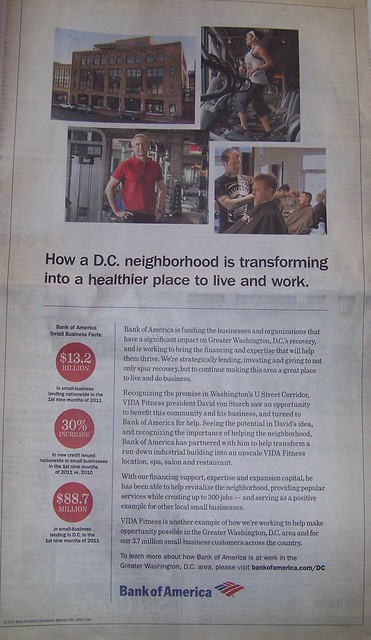
Bank of America ad in the Washington Post lauding its small business financing

This ad is ironic because the firm featured, Vida Fitness, was not the original developer of the building, which was Results Gym.

Results Gym is now a small chain of fitness facilities in the city, but it started at the facility on the 1600 block of U Street NW. Their financier was David Von Storch, and he owns the building. Von Storch liked the Results business so much he went on to start his own company, Vida Fitness (and he owns other ventures, such as Capitol City Brewery). When the time came to renew the lease, the landlord----refused, and he opened a new fitness facility in its place.

So what Bank of America lauds in the ad--the revitalization efforts on upper U Street NW, sparked in part by a fitness facility--was actually done by Results Gym.

Labels: , , ,

Wednesday, September 14, 2011

When locally/regionally owned companies make a difference over national firms

The issue of a local economy is now more of a micro-business discussion, such as various local first/buy local campaigns or the locavore movement in food production.

The new book by Marc Levinson, THE GREAT A&P AND THE STRUGGLE FOR SMALL BUSINESS IN AMERICA, discusses the creation of one of the nation's first retail chains operational across the country, the A&P Supermarket. New York Times review; NPR story.

It has long since been the case that most business sectors in the U.S. have been reorganized from a local and regional operational scale to a national scale, accompanied by massive consolidation of smaller separate businesses into large companies.

This is true especially for banking.

Two of the biggest problems in the economy now are (1) the difficulty that banks are showing customers who need to refinance their mortgages in order to avert foreclosure; and (2) loans for small and medium sized businesses, because despite the billions in dollars of financial support received from the Federal Government, the nation's biggest banks aren't loaning money.

The Wall Street Journal has a fascinating story about Webster Bank, "For Lender, Foreclosure Is a Dirty Word." From the article:

Webster's small size makes it more nimble than bigger competitors. But its track record shows how focusing on customer service can pay off for banks and borrowers. Webster services $8 billion in mortgages and home-equity loans, a tiny fraction of Bank of America Corp.'s $2 trillion portfolio. Webster also owns 75% of the loans that it services, helping the bank call the shots. Just 1.84% of the mortgages serviced by Webster were at least 30 days past due but not in foreclosure as of June 30. The U.S. average is 8.15%, according to Lender Processing Services.

When it restructures a loan, Webster usually waives late fees, penalties and unpaid interest instead of adding them to the loan balance—and putting homeowners deeper in the hole. Borrowers don't have to make months of trial payments before the modification is made permanent.

A dozen employees in Webster's collection unit staff the front lines, prodding borrowers with hardships to apply for help and then send in required documents. Seven loan-modification specialists sit nearby. Employee bonuses are tied partly to the number of modifications. About 80% of the agreements hammered out with borrowers are approved by Webster's management without any changes. ...

Webster has completed 1,184 modifications, boosting reserves by $20 million to cover possible losses. As of March 31, 9.6% of borrowers whose loans were reworked in 2010 were at least 60 days past due on their payments nine months later. The re-default rate was 24.7% for modifications completed by the largest U.S. banks and thrifts in 2010, says the Office of the Comptroller of the Currency.


What a difference compared to the big national banks, like Bank of America.

In "Mr. banker, can you spare a dime?, Joe Nocera of the New York Times describes how a couple small businesses tried to get loans for their successful businesses, in order to expand. One couple was rejected by 14 banks before being funded by a local institution.

... On another note, while it has been discussed in the Washington City Paper and this blog in the past, the lease to manage the retail in DC's Union Station is held by a nationally active firm based in New York. They paid $160 million for an 84 year lease ("Ground lease for Union Station changes hands" from the Washington Business Journal).

They have been systematically eliminating locally owned retail and restaurant businesses in favor of national chains.

But they keep saying that they need to not pay local property taxes on their earnings, that it's a hardship because maintaining the building is expensive. First they asked for property tax abatement (see the blog entry "76 year tax abatement proposed for Union Station"). Now they are repudiating that the building should pay taxes, because the building, underlying, is owned by the federal government ("Union Station: Don't Tax Me, Bro from the Washington City Paper Housing Complex blog).

Why did the company pay $160 million for such an asset, if it were truly encumbered?

This is why I say the issues of "building a local economy" are more intricate than the typical "economic development" element that is present in Master and Comprehensive Land Use Plans. They need to be more fine tuned and nuanced and focused on the total net returns to the local economy from various actions.

WRT Union Station, I would argue that the retail space management operations don't necessarily justify any tax abatement whatsoever, because their management overall is reducing the dollars circulating in the local economy, because the economic multiplier of chains is significantly less than that of locally owned stores, even probably if there is somewhat higher dollar volume for the chain stores.

Labels: , , , , ,

Saturday, September 01, 2007

YIMBYs from Brooklyn to DC -- Thinking about Community Participation in Shaping Development

--------
Reprinted from April 2005
--------

Otis White writes "The Urban Notebook" column for Governing Magazine and produces an e-newsletter as part of his Civic Strategies consulting practice. He wrote this today:

Beyond Negative and Provincial
YIMBY Power

People who study power in cities will tell you that it's shifting away from the business community and toward neighborhood associations. Problem is, these grassroots organizations aren't up to the task in most places. They're far too negative and provincial to wield real power. But there are exceptions. Take what happened recently in the Park Slope area of New York's borough of Brooklyn. Or, better yet, let Aaron Naparstek tell you.

Naparstek is a writer who's active in a group called Park Slope Neighbors. Park Slope is a "classic brownstone New York City neighborhood," Naparstek said recently, whose Fifth Avenue has become a "vibrant, mixed-use, pedestrian-oriented neighborhood Main Street of restaurants, hardware stores, groceries and various other neighborhood services."

Recently, a bank company announced it was placing a branch on Fifth Avenue in a spot that once had a gas station. The neighborhood needs a bank, Naparstek said, but not the building that the bank had in mind: a "standard, cookie-cutter, suburban-style, drive-through" branch. It was the drive-through, of course, that hit the neighborhood's hot button. "It was so wrong," Naparstek said. "It felt like the very type of design that killed so many Main Streets around the country." What to do? Oppose the branch on the grounds that it would cause more traffic congestion, endanger pedestrians and set back the neighborhood's progress.

But here's where Park Slope Neighbors took a slightly different tack. In its campaign, it didn't vilify the bank company. In fact, the opposite: The group made it clear that, if the design could be changed, the branch would be welcomed with open arms - and Park Street Neighbors would lead the parade. Naparstek calls this "YIMBY activism" (for "yes in my back yard").

It's activism, he said, that's "positive, rational and unemotional." Better yet, it worked. The bank changed the design, and neighborhood activists showered the company with credit for its responsiveness. It even arranged a press conference at which it presented the bank with what Naparstek described as "a big, cheesy deposit slip" representing the group's intent to open an account there. "We promised that if they changed their design, we'd open our first account there," he said. "The press loved it and a lot of good vibes were generated for the bank."
Park Slope Neighbors website.
commercebank
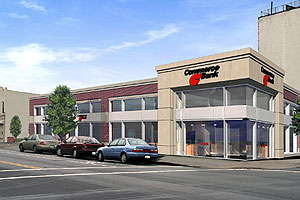
Rendering of the "victory" in Park Slope.

On the pro-urb email list, Larry Felton Johnson (there is a link to his blog in the sidebar), wrote this:

This whole incident had a really nice outcome. It also demonstrated the value of the urban oriented web logs (blogs) in rapidly spreading interesting news. As events unfolded the blog network was getting frequent updates, including interaction with Aaron Naparstek and others in the neighborhood. One of my own posts consisted of corrections by a Park Slope resident who had been involved early, but at that point wasjust following at the local level. Otis White follows the "urblogs" closely, and reviews them. I suspect this article is a result of his keeping his finger on that pulse.
_____

Actually, I sent notice of this Park Slope happening to the pro-urb list first, because I had
read about it in the New York Press when I was in NYC in December. See this for an update on the story in a March issue of New York Press.

Anyway, this dovetails with something that I have been mulling over since last Saturday, when I popped into part of the planning meeting for the baseball stadium-South Capitol area, the process that is being co-led by the Anacostia Waterfront Corporation, DC's Office of Planning, and the DC Department of Transportation. (I mentioned this meeting in a blog entry last Friday.)

The Post reported on the meeting in the Sunday paper, with this headline "Residents Near Stadium Offer Tips, Voice Fears: D.C. Demonstrators Seek Direct Input." I got there late, so I missed the demonstration. By the way, all the materials generated by the workshop will be put up on the Public Space Forum website for the project by the beginning of next week.

After the meeting, I talked with some people for as long as 90 minutes about neighborhood planning, citizen involvement in the process, how under-funded agencies such as the NCRC look to various projects to develop income streams and how this can lead to significant uncorrectable compromises, planning, review of development projects, etc. The pro-urb posting has "forced" me to put together these thoughts.

In DC, we have what are called "Advisory Neighborhood Commissions" which are elected neighborhood councils that do a variety of things, including making recommendations with regard to planning, zoning, and licensing matters, when review is required ("matter of right" developments are not reviewed, only those matters that involve zoning changes, large tract review, variances, exceptions, or where review is specified).

But the "city" doesn't provide much in the way of training resources to these entities and they can be excellent, good, average, bad, or really bad (fisticuffs, embezzlement, etc.). Because of problems over the years, the amount of money allocated to these entities (for community organization grants, etc.) has been drastically reduced, and the city government doesn't provide office space or other infrastructure support, although various agencies occasionally accomodate these entities, but in a non-systematic way. They also don't usually interact with each other, share best practices amongst the various ANCs, and build organizational and community capacity on a neighborhood and city-wide basis. (I wrote about this in a March entry about "Neighborhood Planning".)

Well, lately I have been thinking that we (my ANC, which includes a swath of downtown) pretty much approve of everything that comes before us. Maybe we tweak it, and get something in return, but usually, the developers get what they want.

There are some exceptions, such as historic designations, which can change projects significantly, or out and out fights against particular projects which can either result in a stalemate and/or victory (BP gas station, which now that the market has changed, the property is too valuable and it will become a mixed use non-gas station development, after five years of community organizing) or a big loss (Station Place is an ugly, anti-urban design federally leased building that was greased through the system by the company's choice of architect and that architect's connections within the system).

stationplace
Station Place on 2nd Street NE, Washington, DC.

The complex is designed by Kevin Roche, a Pritzker Architecture Prize winner. Roche's design of an urban brutalist building in New Haven Connecticut led Vincent Scully to become committed to historic preservation. Certainly Roche's friendship with J. Carter Brown didn't hurt this project when it came before the Commission of Fine Arts. (Design, setback, connections to the neighborhood, how the building fronts on H Street, the possibility of retail at 2nd and F as part of the building were all issues raised by the community that we by and large, lost. The building, in my opinion, looks worse in person.)

Maybe this is because in the city we are "desperate" for investment, and I guess various neighborhoods around the city differ--particularly the neighborhoods in Ward 3, along Wisconsin Avenue, which have been organizing against an intensification of land usage along the Avenue, particularly around the Metro stations.
unionstationpostcard2
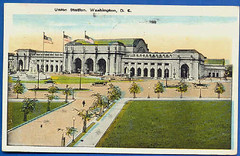
Station Place backs up to the Daniel Burnham-designed Union Station, which was planned and built as a result of the Senate Park Commission (McMillan) plan of 1901, and was one of the first examples of the "City Beautiful" movement in the United States.

In comparison, my neighborhood is more "urban" but less dense than Dupont Circle and similar neighborhoods, and is within the L'Enfant Plan area, so the idea of density and connectedness isn't completely foreign, even if most of the residents still have a suburban sensibility as far as development is concerned.

The issue really then is over "good" or "quality" development vs. "bad" or "ugly" development as well as developing a base of knowledge or awareness about the broader issues, when there isn't a training infrastructure to provide it. (This idea could be expanded by discussing Molotch's work on environmental and preservation organizing to maintain "use values of place" vs. "exchange values of place," and where it is successful and where it isn't, and whether or not such movements are able to develop in the first place. See Building Rules and Urban Fortunes: A Political Economy of Place.)

(Note: if the Park Slope Commerce Bank branch as rendered is a victory, then I think that Brooklyn and Park Slope needs some remedial design education. I would still be raising a lot of issues of that pretty average design.)

Anyway, individuals with knowledge or interest and a willingness to participate on ANC "Planning and Zoning" committees (the titles vary by ANC) make a big difference in the quality and impact of the ANC's participation on such matters.

In our Ward, we have 4 ANCs, two including mine deal with the H Street neighborhood that I always write about (although they include territory up to East Capitol Street), one focuses on "Capitol Hill" and the other on SW DC, the area that was urban renewaled in the 1950s...

Well the ANC in the Southwest quadrant of DC is the one that has to deal in particular with it becoming a zone of "intensification of use" because, directly east and south of downtown (jumping the National Mall) and north and south of Union Station is the only place where the city can grow in an intense, commercial, downtown-like fashion.
swfreeway03
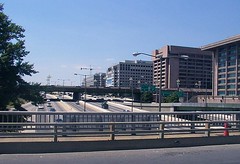
Urban brutalism in Southwest DC, along the Southeast-Southwest Freeway. Photo from BeyondDC.

But that ANC has no committees that allow for the tapping of the expertise of community residents. And various "hotheads" as Commissioners take anti-development positions that face it, won't fly in a city that is committed to the development agenda. But as a result, the ANC and more importantly, the residents that ANC Commissioners purport to represent, are cut out from having meaningful substantive involvement in the process, getting improvements, benefits, etc.

I suppose, fundamentally, this is difference of magnitude in comparison to one small development site. The NCPC South Capitol plan rendering shows the elimination of a huge swath of SW neighborhood (building stock from the early 1900s) in favor of big albeit mixed use buildings.

Balancing the needs of a "residential" Washington as opposed to the needs of the "Federal City" of Washington is at times, a great dilemma, with no easy resolution.

Labels: , , ,

Unlearning continues at a furious pace

1. Stuart Sirota has coined the term "inward suburbanization" to describe the process of suburbanizing urban places. This relates to the transect idea from New Urbanism, that you put the right kind of building form in the appropriate place.
Illustration from The House Book by Keith DuQuette

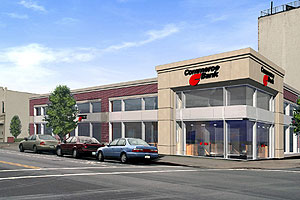
2. The current issue of Dupont Current (not available on line) has a story about Commerce Bank building a suburban styled branch in Tenleytown.
commercebank
See "Commerce Bank breaks ground on Washington branches" and "Banking on branches," from the Washington Business Journal and "Area Gets An All-Day Bank Fight" from the Post about Commerce Bank's expansion strategy. The founder of the company still owns Burger King franchises and it shaped his approach to the banking business.

But the fast food sensibility also shaped their focus on design. And while a Commerce Bank official likens their approach to Starbucks, the latter company is fine with historic buildings, whereas Commerce Bank doesn't seem to be similarly minded.

3. This is frustrating because this problem keeps happening around the city--it happened in Georgetown, except that Georgetown has an extra level of and stronger design review process than regular DC historic districts.

4. And I wrote about this problem in Brooklyn, with Commerce Bank, a couple years ago. See "YIMBYs from Brooklyn to DC -- Thinking about Community Participation in Shaping Development." (Actually, I am gonna reprint this entry next.)

Why don't we learn that design review is important everywhere? And that urban forms are the appropriate building forms for a city like Washington, DC.

5. Also see "A Retailer's Lament: Influx of Bank Branches," a 2005 blog entry.

6. This is a book I want to read...
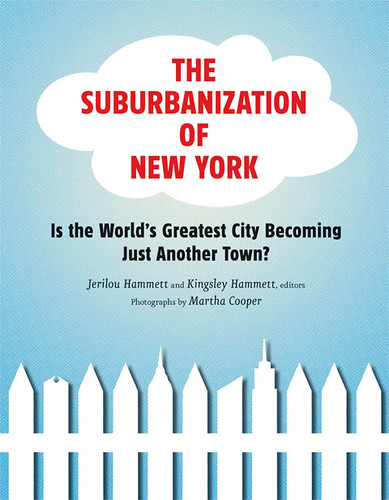
The Suburbanization of New York: Is the World's Greatest City Becoming Just Another Town?; Edited by Jerilou Hammett and Kingsley Hammett; Princeton Architectural Press; $24.95.

Labels: , , ,

Thursday, April 28, 2005

YIMBYs from Brooklyn to DC -- Thinking about Community Participation in Shaping Development

Otis White writes "The Urban Notebook" column for Governing Magazine and produces an e-newsletter as part of his Civic Strategies consulting practice. He wrote this today:

Beyond Negative and Provincial
YIMBY Power

People who study power in cities will tell you that it's shifting away from the business community and toward neighborhood associations. Problem is, these grassroots organizations aren't up to the task in most places. They're far too negative and provincial to wield real power. But there are exceptions. Take what happened recently in the Park Slope area of New York's borough of Brooklyn. Or, better yet, let Aaron Naparstek tell you.

Naparstek is a writer who's active in a group called Park Slope Neighbors. Park Slope is a "classic brownstone New York City neighborhood," Naparstek said recently, whose Fifth Avenue has become a "vibrant, mixed-use, pedestrian-oriented neighborhood Main Street of restaurants, hardware stores, groceries and various other neighborhood services."

Recently, a bank company announced it was placing a branch on Fifth Avenue in a spot that once had a gas station. The neighborhood needs a bank, Naparstek said, but not the building that the bank had in mind: a "standard, cookie-cutter, suburban-style, drive-through" branch. It was the drive-through, of course, that hit the neighborhood's hot button. "It was so wrong," Naparstek said. "It felt like the very type of design that killed so many Main Streets around the country." What to do? Oppose the branch on the grounds that it would cause more traffic congestion, endanger pedestrians and set back the neighborhood's progress.

But here's where Park Slope Neighbors took a slightly different tack. In its campaign, it didn't vilify the bank company. In fact, the opposite: The group made it clear that, if the design could be changed, the branch would be welcomed with open arms - and Park Street Neighbors would lead the parade. Naparstek calls this "YIMBY activism" (for "yes in my back yard").

It's activism, he said, that's "positive, rational and unemotional." Better yet, it worked. The bank changed the design, and neighborhood activists showered the company with credit for its responsiveness. It even arranged a press conference at which it presented the bank with what Naparstek described as "a big, cheesy deposit slip" representing the group's intent to open an account there. "We promised that if they changed their design, we'd open our first account there," he said. "The press loved it and a lot of good vibes were generated for the bank."
Park Slope Neighbors website.
commercebank
Rendering of the "victory" in Park Slope.

On the pro-urb email list, Larry Felton Johnson (there is a link to his blog in the sidebar), wrote this:

This whole incident had a really nice outcome. It also demonstrated the value of the urban oriented web logs (blogs) in rapidly spreading interesting news. As events unfolded the blog network was getting frequent updates, including interaction with Aaron Naparstek and others in the neighborhood. One of my own posts consisted of corrections by a Park Slope resident who had been involved early, but at that point wasjust following at the local level. Otis White follows the "urblogs" closely, and reviews them. I suspect this article is a result of his keeping his finger on that pulse.
_____

Actually, I sent notice of this Park Slope happening to the pro-urb list first, because I had
read about it in the New York Press when I was in NYC in December. See this for an update on the story in a March issue of New York Press.

Anyway, this dovetails with something that I have been mulling over since last Saturday, when I popped into part of the planning meeting for the baseball stadium-South Capitol area, the process that is being co-led by the Anacostia Waterfront Corporation, DC's Office of Planning, and the DC Department of Transportation. (I mentioned this meeting in a blog entry last Friday.)

The Post reported on the meeting in the Sunday paper, with this headline "Residents Near Stadium Offer Tips, Voice Fears: D.C. Demonstrators Seek Direct Input." I got there late, so I missed the demonstration. By the way, all the materials generated by the workshop will be put up on the Public Space Forum website for the project by the beginning of next week.

After the meeting, I talked with some people for as long as 90 minutes about neighborhood planning, citizen involvement in the process, how under-funded agencies such as the NCRC look to various projects to develop income streams and how this can lead to significant uncorrectable compromises, planning, review of development projects, etc. The pro-urb posting has "forced" me to put together these thoughts.

In DC, we have what are called "Advisory Neighborhood Commissions" which are elected neighborhood councils that do a variety of things, including making recommendations with regard to planning, zoning, and licensing matters, when review is required ("matter of right" developments are not reviewed, only those matters that involve zoning changes, large tract review, variances, exceptions, or where review is specified).

But the "city" doesn't provide much in the way of training resources to these entities and they can be excellent, good, average, bad, or really bad (fisticuffs, embezzlement, etc.). Because of problems over the years, the amount of money allocated to these entities (for community organization grants, etc.) has been drastically reduced, and the city government doesn't provide office space or other infrastructure support, although various agencies occasionally accomodate these entities, but in a non-systematic way. They also don't usually interact with each other, share best practices amongst the various ANCs, and build organizational and community capacity on a neighborhood and city-wide basis. (I wrote about this in a March entry about "Neighborhood Planning".)

Well, lately I have been thinking that we (my ANC, which includes a swath of downtown) pretty much approve of everything that comes before us. Maybe we tweak it, and get something in return, but usually, the developers get what they want.

There are some exceptions, such as historic designations, which can change projects significantly, or out and out fights against particular projects which can either result in a stalemate and/or victory (BP gas station, which now that the market has changed, the property is too valuable and it will become a mixed use non-gas station development, after five years of community organizing) or a big loss (Station Place is an ugly, anti-urban design federally leased building that was greased through the system by the company's choice of architect and that architect's connections within the system).
stationplace
Station Place on 2nd Street NE, Washington, DC.

The complex is designed by Kevin Roche, a Pritzker Architecture Prize winner. Roche's design of an urban brutalist building in New Haven Connecticut led Vincent Scully to become committed to historic preservation. Certainly Roche's friendship with J. Carter Brown didn't hurt this project when it came before the Commission of Fine Arts. (Design, setback, connections to the neighborhood, how the building fronts on H Street, the possibility of retail at 2nd and F as part of the building were all issues raised by the community that we by and large, lost. The building, in my opinion, looks worse in person.)

Maybe this is because in the city we are "desperate" for investment, and I guess various neighborhoods around the city differ--particularly the neighborhoods in Ward 3, along Wisconsin Avenue, which have been organizing against an intensification of land usage along the Avenue, particularly around the Metro stations.
unionstationpostcard2
Station Place backs up to the Daniel Burnham-designed Union Station, which was planned and built as a result of the Senate Park Commission (McMillan) plan of 1901, and was one of the first examples of the "City Beautiful" movement in the United States.

In comparison, my neighborhood is more "urban" but less dense than Dupont Circle and similar neighborhoods, and is within the L'Enfant Plan area, so the idea of density and connectedness isn't completely foreign, even if most of the residents still have a suburban sensibility as far as development is concerned.

The issue really then is over "good" or "quality" development vs. "bad" or "ugly" development as well as developing a base of knowledge or awareness about the broader issues, when there isn't a training infrastructure to provide it. (This idea could be expanded by discussing Molotch's work on environmental and preservation organizing to maintain "use values of place" vs. "exchange values of place," and where it is successful and where it isn't, and whether or not such movements are able to develop in the first place. See Building Rules and Urban Fortunes: A Political Economy of Place.)

(Note: if the Park Slope Commerce Bank branch as rendered is a victory, then I think that Brooklyn and Park Slope needs some remedial design education. I would still be raising a lot of issues of that pretty average design.)

Anyway, individuals with knowledge or interest and a willingness to participate on ANC "Planning and Zoning" committees (the titles vary by ANC) make a big difference in the quality and impact of the ANC's participation on such matters.

In our Ward, we have 4 ANCs, two including mine deal with the H Street neighborhood that I always write about (although they include territory up to East Capitol Street), one focuses on "Capitol Hill" and the other on SW DC, the area that was urban renewaled in the 1950s...

Well the ANC in the Southwest quadrant of DC is the one that has to deal in particular with it becoming a zone of "intensification of use" because, directly east and south of downtown (jumping the National Mall) and north and south of Union Station is the only place where the city can grow in an intense, commercial, downtown-like fashion.
swfreeway03
Urban brutalism in Southwest DC, along the Southeast-Southwest Freeway. Photo from BeyondDC.

But that ANC has no committees that allow for the tapping of the expertise of community residents. And various "hotheads" as Commissioners take anti-development positions that face it, won't fly in a city that is committed to the development agenda. But as a result, the ANC and more importantly, the residents that ANC Commissioners purport to represent, are cut out from having meaningful substantive involvement in the process, getting improvements, benefits, etc.

I suppose, fundamentally, this is difference of magnitude in comparison to one small development site. The NCPC South Capitol plan rendering shows the elimination of a huge swath of SW neighborhood (building stock from the early 1900s) in favor of big albeit mixed use buildings.

Balancing the needs of a "residential" Washington as opposed to the needs of the "Federal City" of Washington is at times, a great dilemma, with no easy resolution.

Labels: , , ,