Rebuilding Place in the Urban Space

"A community’s physical form, rather than its land uses, is its most intrinsic and enduring characteristic." [Katz, EPA] This blog focuses on place and placemaking and all that makes it work--historic preservation, urban design, transportation, asset-based community development, arts & cultural development, commercial district revitalization, tourism & destination development, and quality of life advocacy--along with doses of civic engagement and good governance watchdogging.

Monday, August 24, 2020

Corporate real estate is a cutthroat business

I remember back during the Great Financial Crisis, when there was lots of writing and talk about the moral obligation to pay your mortgage ("Faced with an underwater mortgage: the moral choice to pay," Christian Science Monitor), about the contradiction of big firms like Related Companies "walking away" from loans, by "giving the keys to the property back to the loan holder" ("Commercial Property Owners Choose to Default," Wall Street Journal).

From the WSJ article:
Companies such as Macerich Co., Vornado Realty Trust and Simon Property Group Inc. have recently stopped making mortgage payments to put pressure on lenders to restructure debts. In many cases they have walked away, sending keys to properties whose values had fallen far below the mortgage amounts, a process known as "jingle mail." These companies all have piles of cash to make the payments. They are simply opting to default because they believe it makes good business sense.
From the CSM article:
Call it what you will – a “strategic default” or simply cutting one’s losses in a business decision – this trend to walk away is creating an erosion of trustworthiness, and not just for the financial industry. It is a creeping moral crisis that needs a solution soon.

Yes, under certain circumstances and in those states where lenders have limited rights to go after a walk-away’s assets, a default can make sense – in an amoral calculation of personal finances. A buyer took a risk by assuming a rise in home prices and failed, similar to a failed business or a speculator in commodities.

Yet if more Americans get used to being deadbeats in a heartbeat, it will lead to higher interest rates and create other hurdles for those want to buy a residence and honor their contract. It would also create more uncertainty for still-wobbly banks and put a drag on the economic recovery, helping keep unemployment high.
While a program to modify home mortgages was developed, most of the banks didn't handle it very well, many people didn't get modifications, and millions of houses went into foreclosure. 

And speaking of taking advantage of new investment opportunities, a number of capital investment firms bought single family houses in bulk from banks, and now rent them out, changing the nature of residential housing market more generally.

A lot of the anger that has affected politics since 2008 was the idea that regular people weren't helped very much during this time, that most of the government "help" went to corporations, and the officers of these corporations faced no consequences.

There's an article in Bloomberg about what's going on in the commercial property market now, with big firms walking away from some mortgages and properties, while still raising funds for new endeavors.   In these cases, "it's just business," proving that residential mortgage owners are treated much differently from big capital.

From "Real estate investors skip paying loans while raising billions":
Some of the largest real estate investors are walking away from debt on bad property deals, even as they raise billions of dollars for new opportunities borne of the pandemic.

The willingness of Brookfield Property Partners LP, Starwood Capital Group, Colony Capital Inc. and Blackstone Group Inc. to skip payments on commercial mortgage-backed securities backed by hotels and malls illustrates how the economic fallout from the coronavirus has devalued some real estate while also creating new targets for these cash-loaded investors.

"Just because a prior investment didn't work out doesn't necessarily mean that should tarnish the reputation for future endeavors," said Alan Todd, head of U.S. CMBS research for Bank of America Securities. "It's not like something was done in bad faith."

While cutting losers to buy winners is an age-old investment proposition, the Covid-19 pandemic may create even more openings than the past crises that became bonanzas for real estate investors. ...

Missing payments on CMBS debt is relatively painless, because it's typically non-recourse, meaning borrowers can hand over the keys to a property and lenders won't be able to come after other assets. Property owners are more likely to walk away when their equity has been wiped out by lower values. ...

Now these firms are raising money for their next round of bets, even as they skip debt payments on old obligations.

At least 11 Brookfield malls with more than $2 billion in CMBS debt are delinquent or seeking payment relief because of COVID-19. The company has already repurchased some of its former debt at reduced prices.

"The lenders are willing to sell us their loans or the mortgages back at a discount," Brookfield Property Chief Executive Officer Brian Kingston said during an Aug. 6 earnings call. "And so in that case we've been able to essentially reacquire the asset at an attractive basis."

Brookfield Asset Management Inc., the parent of the property firm, raised $23 billion from investors in the most recent quarter, including $12 billion in new commitments for a distressed fund.
The article discusses similar moves by other real estate companies including Colony Capital, Starwood Investment Trust, and Blackstone.

Conclusion.  I'm not saying that people shouldn't worry about paying mortgages and treat it as an important obligation.  I'm just pointing out the double standard.  I suppose someone will point out the difference between recourse and non-recourse loans.  In recourse loans, the lender has call on other assets owned by the mortgagee.

But given the impact of the coronavirus on the retail, hospitality, and entertainment industries, there's going to be a property bloodbath, and many communities will be harmed by it, just as they were in the real estate fallout from the Savings and Loan Crisis in the 1980s and 1990s and other times of overbuilding followed by crashes.

Labels: , , ,

Saturday, December 21, 2019

USA Today series on the problems with reverse mortgages

Reverse mortgages are a loan product available to seniors when their house is paid off.  The mortgagee receives a monthly payment, which comes from tapping the equity value of the home.

But when the mortgagee dies, to get the house back, the survivors have to pay a fee equal to 95% of the value of the house.  Most families aren't able to pull this off.

One of the major discoveries in all the foreclosures that transpired in the aftermath of the 2007-2008 Great Financial Crisis was that there were major documentation, ownership and process issues when it came to handling mortgages.

Many people lost their homes because of process failures within the mortgage companies.

The USA Today investigation series shows that the reverse mortgage loan sector has the same kind of problems discovered in the main mortgage loan sector, and many families with the means to keep the home end up being screwed.

I just came across this, but the series ran in June.

-- "Seniors were sold a risk-free retirement with reverse mortgage"
-- "Should you get a reverse mortgage? The reasons you should or shouldn't"
-- "Reverse mortgages left many seniors in foreclosure. Here's what can be done to stop it"

Actor Tom Selleck shills reverse mortgages in tv commercials.

It's a very good discussion of the problem, irrespective of the specific focus on seniors.

Predatory practices.  The article also explores predatory practices, where mortgages are both heaviliy marketed and sold to households that may not have been in the best position to take on such a financial product.

Such practices contributed to the GFC ("Victimizing the Borrowers: Predatory Lending's Role in the Subprime Mortgage Crisis," Wharton School of Business) but were not the only cause.

Foreclosures in bulk devastate neighborhoods.  While the stories are about a mortgage product for seniors, because the mortgages can go into foreclosure, the primary article has an extensive section about foreclosures and how a preponderance of foreclosures in close proximity can have extraordinary negative impact on neighborhoods.

Labels: , ,

Tuesday, January 27, 2015

Washington Post series on "Dashed Dreams: The Plight of the Black Middle Class"

The Post ran a series of articles ("The American Dream shatters in Prince George's County") concluding today on the impact of the decline of the housing market on the Black middle class, focusing on an 1,800 house subdivision, Fairwood, in Prince George's County, that was built in the early part of the last decade.  With the housing crash, 1/3 of the houses tumbled into foreclosure and housing values declined precipitously, with problems abetted by various personal circumstances.

I was prepared to think, "wow, what a great series" especially because the first story led with a great graphic illustrating  the vast differences between the average financial worth of white and black households.
Graphic on difference in wealth between white and black households
Graphic from the Washington Post.

But the examples featured in each of the articles are about people who made incredibly bad financial decisions.  Therefore, it is difficult to draw useful conclusions from the series, and they don't raise any of the issues I  would have mentioned:
  • Lousy financial terms make you more vulnerable financially (the articles sort of make this point, but indirectly) 
  • refinancing mortgages to take out cash because of higher values can go awry if housing values decline
  • buying way more house than you need is expensive and can be impossible to pay if your personal economic circumstances change
  • houses in what Christopher Leinberger calls "walkable urban places" tend to maintain their value more when macroeconomic circumstances change and the Fairlawn subdivision featured in the series is a conventional automobile-centric subdivision
  • when you have too much house, you can take in roomers to help generate money to pay the mortgage, but it can be hard to attract roomers to auto-dependent places
Building grand but automobile-dependent subdivisions in Prince George's County was the primary economic development strategy of former County Executive Wayne Curry and this continued under his successor.

But this ended up not being a resilient strategy and the county today is paying for it in terms of the crash in housing values and the high rate of foreclosures.

While you don't have the same level of price escalation in DC that you did at the height of the market before the 2008 crash, most DC neighborhoods (except East of the River) have recovered much of their pre-crash value (even if some households are still underwater mortgage-wise because of cashing out gains during the housing bubble).

These neighborhoods are mostly walkable, but not always, with increasingly vibrant neighborhood centers.

Prince George's County has some communities somewhat similar to DC in urban form although typically with significant less density, mostly along the Route 1 corridor in the western county, along the border of DC and Montgomery County.

Those neighborhoods too crashed in terms of housing values, and still are way off their peak pre-crash values, but they have recovered more compared to the conventional automobile-dependent suburbs further east.
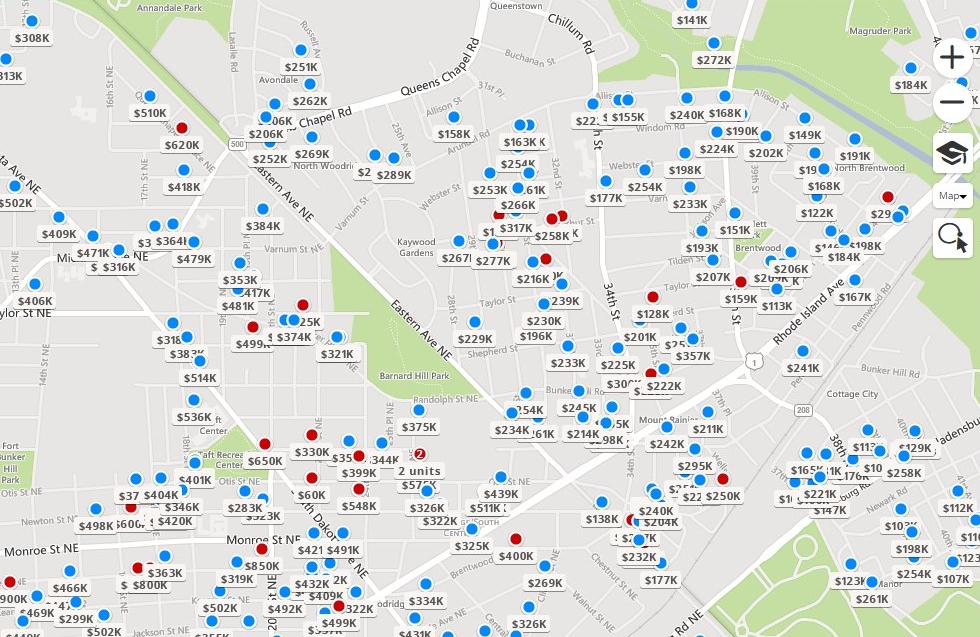
Houses for sale in Eastern DC and western Prince George's County Maryland
This image shows houses for sale in eastern DC's Woodridge neighborhood, and across the city-county line, houses in Mount Rainer and Hyattsville.  The prices are higher in DC, even for smaller houses and lots.  Source:  Zillow.

We won't ever really know if Prince George's County had taken a different course towards development, and extended "urbanism" rather than conventional suburbanism, whether or not the county would today be in a different place economically.

Interesting, the biggest lesson may be that density builds value and resilience in many situations, rather than reducing it, which is the common but incorrect belief.

Yes, PG County has other issues.  Traditional decline of "inner ring suburbs," is an issue.  So is poverty in some areas.  Like DC, PG County shoulders a disproportionate number of the region's poorest.

-- Foreclosure data webpage, Prince George's County

But maybe the biggest issue is the way that they develop land isn't the best method for building and maintaining property values over long periods of time.

=======
Interestingly, in many of the examples featured in the Post, if the households hadn't refinanced in the lead up to the crash, also on adjustable mortgages to take money out, they wouldn't be in financial predicament.

For example, one household, instead of selling a house and taking out a $200,000+ profit, which they could have used to pay towards the even newer $600,000 they bought, kept both houses.  With the crash, both declined in value, the renter in the original house stopped paying rent, and their job circumstances changed, depressing their household income.

Labels: , , , ,