Rebuilding Place in the Urban Space

"A community’s physical form, rather than its land uses, is its most intrinsic and enduring characteristic." [Katz, EPA] This blog focuses on place and placemaking and all that makes it work--historic preservation, urban design, transportation, asset-based community development, arts & cultural development, commercial district revitalization, tourism & destination development, and quality of life advocacy--along with doses of civic engagement and good governance watchdogging.

Thursday, May 28, 2020

Restrooms, drinking fountains, sinks, doorknobs, street crossing buttons (etc.) in the time of pandemic

Image from the Twitter feed of the advocacy group, DC Department of Transformation.

(Although this is like initiatives from Portland City Repair and the UK Road Witch project, the first Parking Day in San Francisco, which I been writing about for 10+ years.)

One of the responses to stay at home orders and the pandemic has been shifting road right of way use away from cars towards pedestrians and cyclists, both formally through actions by local governments and informally by activists ("https://wtop.com/dc/2020/05/activists-block-off-dc-streets-to-create-socially-distant-outdoor-space/," WTOP radio; "

The Washington Post ran an article, "Coronavirus may never go away, even with a vaccine," making the point that covid19 will be with us "for a long time" even forever and whether or not there is a vaccine or herd immunity, elements of public space will have to change. From the article:
Eventually, many experts believe this coronavirus could become relatively benign, causing milder infections as our immune systems develop a memory of responses to it through previous infection or vaccination. But that process could take years, said Andrew Noymer, a University of California at Irvine epidemiologist.
Doorknobs and pedestrian crosswalks. From the article:
Communities should be thinking about installing doors that don’t require grasping a handle, and re-engineering traffic signals so pedestrians don’t have to push crosswalk buttons, said Eleanor J. Murray, an epidemiologist at Boston University.
More elements will require redesign.  Like putting flags at crosswalks that people can wave when they cross the street.  Maybe people will have to own and bring their own flags.  Although the flag intervention is too accommodating of car-centricity.

Restrooms and sinks. We will need to wash our hands a lot more frequently, throughout the day, regardless of where we are. Do we create a "network" of sinks in public spaces? How do we keep them clean? Can they be activated by proximity sensors so you don't have to turn the faucets on and off?

Many communities don't have "public restrooms" ("Restrooms as an element of the public realm," 2018). If that changes, how do we keep them clean?  Do laws and incentives change so that privately provided restrooms such as at restaurants and hotels have to be open to non-customers?

Drinking fountains. I've argued for an expanded network of public fountains ("Why not get office buildings to install water fountains in facades as a community amenity?," 2019).  London's been doing this.  Some supermarkets even have outdoor drinking fountains for dogs.

That doesn't seem practical now. And for all the about how bottled water misuses water and creates plastic waste, especially when local water sources are often superior to bottled water, we'll need to bring our own water.

But instead of buying it, people should be encouraged to have their own containers.  Many cities, including DC and Metropolitan Washington with the "Tap It" program, have created a network of businesses that have agreed to fill up people's water bottles.

What else?  What other urban elements will require redesign?  Obviously, transit is one.  What else?

Labels: , , , , , , ,

Tuesday, November 19, 2019

Today is World Toilet Day

Who knew?
“Toilets should be considered urban infrastructure — they should be taken for granted, like paved sidewalks,” says sociologist Harvey Molotch, an emeritus professor at New York University and editor of Toilet: Public Restrooms and the Politics of Sharing. And when human waste winds up on city streets, he argues, it’s the fault of a society that has failed to give humans anywhere else to put it. (Boston Globe

-- World Toilet Day, United Nations
-- World Toilet Organization
-- American Restroom Association

-- "Though ubiquitous, toilets aren’t available to everyone, and that should change," Boston Globe
-- "World Toilet Day this week is not a joke, but deadly serious," Economist
-- "World Toilet Day draws attention to the global sanitation crisis," Die Welt
-- "Tales of the toilet: a historical A–Z," BBC History Magazine


Past entries:

-- "Restrooms as an element of the public realm," 2018
-- "Pay toilets," 2018

Family restrooms.  Something I've become more conscious of, helping to provide care to someone with dementia, is the need to have "family toilets" where people can go together. Of course, the problem with large public restrooms in the public space is the opportunity for large toilet spaces to be used for nuisance activities.

-- Family/Unisex Restrooms, American Restroom Association

Not enough capacity in women's restrooms.  And I think I've written in the past about the need for public facilities to have more accommodations for women, who need stalls. Typically, public facilities don't provide enough accommodations for women when it comes to restrooms.

-- "The Long Lines for Women’s Bathrooms Could Be Eliminated. Why Haven’t They Been?," The Atlantic

Gender neutral access.  Politically, access to restrooms can be a powder keg too.

-- Trans Rights and Bathroom Access Laws: A History Explained, Teaching Tolerance

Labels: , , , ,

Saturday, November 24, 2018

Pay toilets

A recent issue of Store Brands magazine, on private-label food options for supermarkets, had a story on restrooms as an element of the supermarket store brand ("The bathroom: A significant store brand").

I wrote a brief piece this summer about the thing that surprised me the most about restrooms in public places, stores, museums, and train stations, was how compared to those places in the US, they were nice.  Really nice.

-- "Restrooms as an element of the public realm"

Here, we think going to the bathroom is dirty, something to be hidden and embarrassed about, and so public restrooms are value engineered.  And for the most part, a terrible aesthetic experience.

CityLab opines ("Pay Toilets Are Illegal in Much of the U.S. They Shouldn't Be") that whether or not restrooms are free doesn't matter if restrooms aren't made available. The quest to make pay toilets illegal was successful, but it ended up creating different problems. And anti-human responses, for example, San Francisco paints streetlight poles with an additive that "spits back" urine onto a person urinating on the pole ("San Francisco uses 'pee-proof' paint," CNN).

Public restrooms in public spaces, like in Camden Town or Covent Garden, and at train and bus stations in London, did have a small charge. I don't think there was a charge at Selfridges Department Store, I can't remember. Probably there was at the V&A Museum. They had a room for baby strollers, and it cost to use that too.

If the alternative is none at all, I say, have a small charge.

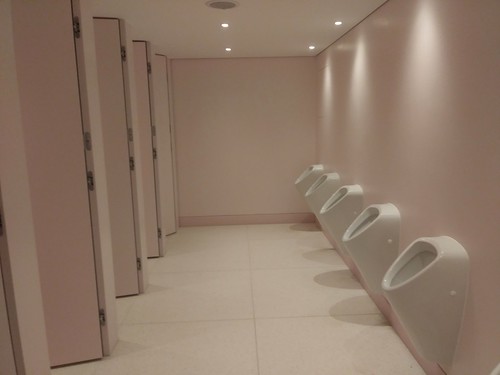
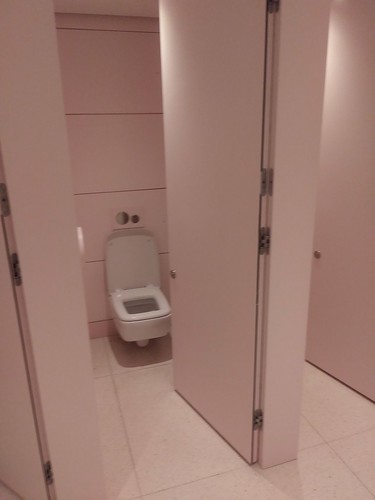
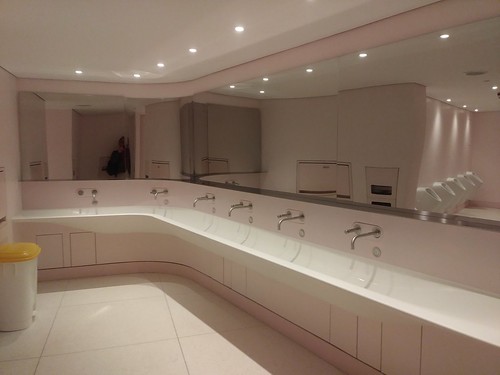
But imagine if stores took Store Brand's advice and made the restroom experience a key element of the brand experience, like the pink bathrooms at V&A Museum.
Men's Restroom/Toilet, Victoria & Albert Museum, London

Some places that have nice enough restrooms in DC are Eastern Market, the National Building Museum, and the National Gallery of Art.

When I first came to DC, 30+ years ago, and used the facility in the Mayflower Hotel, I was surprised there was an attendant. (I don't know if that's still the case.) The city's hotels tend to have decent restrooms.

Although judging by "how hard" the restrooms are used at Union Station in DC, I believe that the cost of running public restrooms isn't cheap.

Labels: , , , , , ,

Thursday, June 07, 2018

Restrooms as an element of the public realm

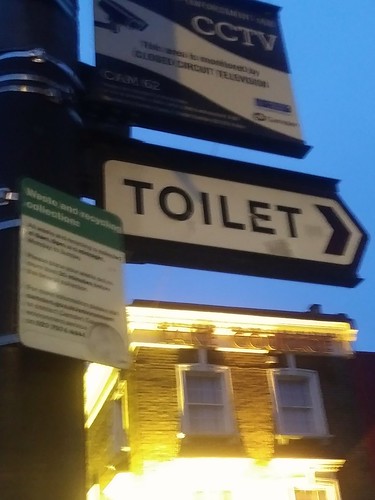
Toilet wayfinding sign, Camden Borough of LondonToilet wayfinding sign, Camden Borough of London

Back from the UK. Didn't really have access to a computer. Wouldn't have had time to write anyway. Didn't see half of what I was hoping to see, because "merely" walking around is so valuable.

But the very first thing that stuck out for me was the high quality of the restrooms, which they very directly call "Toilets," and the provision of them in public places.

Sure, restrooms in train stations and in certain public districts like Covent Garden can only be used if you pay a fee of 30 pence in the train stations and 50 pence in Covent Garden. And those restrooms aren't necessarily state of the art.

But they are way better than the gnarly facilities in say, Union Station in DC.

The restrooms at museums, stores like Selfridges, Heathrow Airport, etc.--Selfridges especially--were exquisite.  Restrooms at National Airport are decent enough, way better than at Union Station.  Granted the restrooms at Union Station are also used by the homeless, which probably puts much more stress on the equipment.

Yes, in Washington, DC, restrooms at hotels etc. are decent. The restrooms at National Gallery are decent. I really like the restrooms at National Building Museum, which are "old-fashioned." But they are the exception.

Restroom at V&A Museum, London
Men's Restroom/Toilet, Victoria & Albert Museum, London

Men's Restroom/Toilet, Victoria & Albert Museum, London

Men's Restroom/Toilet, Victoria & Albert Museum, London

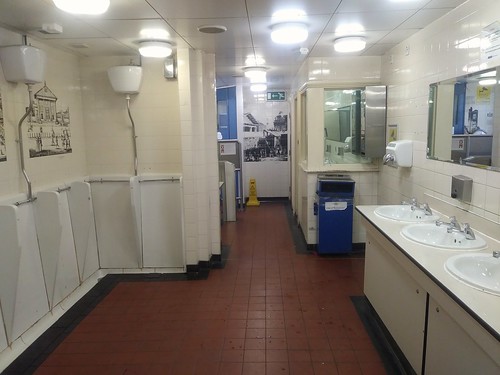
Public toilet at Covent Garden, London.  Note the tiled art showing historic views of St. Paul's Church.
Men's Restroom/Toilet, Covent Garden, London

Now it's easy for me to overgeneralize, but "globalizing" is my nature, but I would say that the difference is a recognition that the quality of where you go to the bathroom matters, and that when you're in public it matters just as much as in private, and that the idea of the provision of a public realm of quality extends to restrooms.

In the US, what has happened is that because of the hindrance of having to pay for a restroom, there may be laws about not charging.  What's happened as a result is that most local governments no longer provide restrooms in public spaces ("Why does D.C. have so few public restrooms?," Washington Post).

(When I was a child, say at the Hudson's Department Store in Downtown Detroit, to access a restroom stall there was a coin-based entry device, and it cost 5¢  That was for the stall, it was probably free to use the urinal.)

Restrooms are accessible in businesses, but like the recent Starbucks incident in Philadelphia ("Starbucks tells employees: Let anyone use the restroom," Associated Press), you're supposed to be a customer--buying something--in order to have access.  And many firms don't invest enough money in maintenance to keep the facilities high quality.  Plus some people are pigs ("It takes two (parties) to keep a restaurant bathroom in order," Washington Post).

Of course there are plenty of exceptions.  Restrooms at Hank's Cocktail Bar in Petworth or The Coupe in Columbia Heights are nicely done.  And the fancier places these days understand the value of investing in the restroom as part of a total focus on the experience of the place (and brand).  And I've been thinking lately about how cool restaurants could specifically design restrooms as art installations--immersive experiences.

But it is also an element of destination management, and most places don't have well enough development "visitor management" protocols in place to even consider this issue in a considered manner.

High tourism cities especially should be focused on managing as many aspects of the visitor experience as possible.  But commercial district management and revitalization organizations should be equally concerned as it relates to this element too.

-- "Town-City branding or 'We are all destination managers now," February, 2005

About four years later, in plans I wrote for Cambridge Maryland and Brunswick Georgia I extended this idea along the lines of brand management of a city/county, writing in those plans:

Just as the study team believe
s that “we are all destination managers now,” elected and appointed officials in particular and in association with other community stakeholders serve as a community’s “brand managers”—whether or not they choose to think of their roles in this manner.

That means that decision-making on land use and zoning, business issues, infrastructure development (roads, sewers, water, utilities, transit), technology (broadband Internet, etc.) and quality of place factors (arts, culture, historic preservation and heritage, education, public schools and libraries, etc.) must be consistent and focused on making the right decisions, the decisions that collectively achieve and support the realization of the community’s desired vision and positioning.
That means "public facilities" too, like toilets/restrooms.

==========
This post was sponsored by the donors--anonymous and named, to the GoFundMe account associated with my recent trip to Liverpool and London, which was triggered by my receiving a free registration to the International Place Branding Event one-day conference in Liverpool. Their support is gratefully acknowledged in making this and many other posts possible.

(Donations are still appreciated.)

Labels: , , , , , ,

Wednesday, March 05, 2008

It's not the Growth Machine, but Harvey Molotch makes The New Yorker Magazine...

on restrooms. See "Powder Room."
Where Stuff Comes From by Harvey Molotch

Labels: , ,

Friday, August 31, 2007

What is the best retail store restroom in DC?

Writes Heather Strang of the Retail Design Diva blog and the trade magazine Display and Design Ideas:

...we would love to get your nomination for best retail bathroom in D.C. Leave your comment at Best Bathrooms in Retail

--------
What say you? What are the best retail (not restaurant, not hotel) store-provided restrooms in the City of Washington? Home Depot? Macy's? Some hip chic boutique that I don't know about? The restrooms down the corridor at Georgetown Park Mall?

(There was a bakery-cafe called Wheatberry in Cleveland Park that had an extra very nice sink in the hallway approaching the restrooms... And I was weirded out for a time when the Front Page Restaurant had a restroom attendant. I mean, this was the Front Page, not 1223...)
Entryway to Jungle Jims restrooms
Jungle Jims International Market in Ohio was the winner of the annual best restroom contest sponsored by Cintas. Entryway. Photos from Cintas.

inside Jungle Jims restroom
Interior.

Restrooms matter for commercial districts because when people can refresh themselves, they stay longer.

Labels: ,

Saturday, May 05, 2007

Good stuff at Pruned

pieces on generating electricity through piezo pads at transit turnstiles in Japan (The Piezo Array ), and on a luxury ladies restroom in London (Urinating in London). It links to a longer Bloomberg piece on the state of access to restrooms in public places.

Check out Pruned.

Labels: , ,