Rebuilding Place in the Urban Space

"A community’s physical form, rather than its land uses, is its most intrinsic and enduring characteristic." [Katz, EPA] This blog focuses on place and placemaking and all that makes it work--historic preservation, urban design, transportation, asset-based community development, arts & cultural development, commercial district revitalization, tourism & destination development, and quality of life advocacy--along with doses of civic engagement and good governance watchdogging.

Wednesday, October 18, 2017

Why can't the "Bilbao Effect" be reproduced? | Bilbao as an example of Transformational Projects Action Planning

The Guggenheim Bilbao. ©FMGB, Guggenheim Museum Bilbao, 2017.

I wrote about Bilbao and the so-called "Guggenheim Effect," in the series of articles I did for an EU National Institutes of Culture project in Baltimore:

-- "THE BILBAO EFFECT’S SECRET INGREDIENTS: PLANNING, RELATIONSHIPS, FUNDING, IMPLEMENTATION," Europe in Baltimore

I was pretty pleased with the article, especially because afterwards I heard from people in Bilbao who said that I had captured very well the essence of their approach, process, and program.

It was but one of many examples that shaped my thinking about the need for what I am now calling "Transformational Projects Action Plans" and the Transformational Projects Action Planning process, as an essential element of Comprehensive Land Use Plans/Community Master Plans.

I wrote about the concept more recently here:

-- "(Big Hairy) Projects Action Plan(s) as an element of Comprehensive/Master Plans"

but even four months ago, I hadn't scintillated the TPAP phrase and acronym, although admittedly it still doesn't flow off the tongue.

Besides the Amazon HQ2 discussion, it also comes up because it is the 20th anniversary of the opening of the Guggenheim Museum in Bilbao, and as discussed in this excellent article, "The Guggenheim Bilbao, 20 Years Later: How a Museum Transformed a City—and Why the ‘Bilbao Effect’ Has Been Impossible to Replicate," from artnet, though many other communities seized on the example, in particular the employment of a "starchitect" and "starchitecture" to create sculptural usually cultural buildings that were supposed to attract hundreds of thousands if not millions of visitors, none have been truly successful.

Frank Gehry didn't single-handedly revitalize Bilbao. The Guggenheim Museum was but one element of a wide-ranging program.

I summarized the process in Bilbao as being constructed of six integrated components.   I drew the conclusion that successful revitalization programs, especially in those cities that were working to overturn serious disadvantages, were comprised of these elements:

  1. A commitment to the development and production of a broad, comprehensive, visionary, and detailed revitalization plan/s (Bilbao, Hamburg, Liverpool);
  2. the creation of innovative and successful implementation organizations, with representatives from the public sector and private firms, to carry out the program. Typically, the organizations have some distance from the local government so that the plan and program aren't subject to the vicissitudes of changing political administrations, parties and representatives (Bilbao, Hamburg, Liverpool, Helsinki);
  3. strong accountability mechanisms that ensure that the critical distance provided by semi-independent implementation organizations isn't taken advantage of in terms of deleterious actions (for example Dublin's Temple Bar Cultural Trust was amazingly successful but over time became somewhat disconnected from local government and spent money somewhat injudiciously, even though they generated their own revenues--this came to a head during the economic downturn and the organization was widely criticized; in response the City Council decided to fold the TBCT and incorporate it into the city government structure, which may have negative ramifications for continued program effectiveness as its revenues get siphoned off and political priorities of elected officials shift elsewhere);
  4. funding to realize the plan, usually a combination of local, regional, state, and national sources, and in Europe, "structural adjustment" and other programmatic funding from the European Regional Development Fund and related programs is also available (Hamburg, as a city-state, has extra-normal access to funds beyond what may normally be available to the average city);
  5. integrated branding and marketing programs to support the realization of the plan (Hamburg, Vienna, Liverpool, Bilbao, Dublin);
  6. flexibility and a willingness to take advantage of serendipitous events and opportunities and integrate new projects into the overall planning and implementation framework (examples include Bilbao's "acquisition" of a branch of the Guggenheim Museum and the creation of a light rail system to complement its new subway system, Liverpool City Council's agreement with a developer to create the Liverpool One mixed use retail, office, and residential development in parallel to the regeneration plan and the hosting of the Capital of Culture program in 2008, and how multifaceted arts centers were developed in otherwise vacated properties rented out cheaply by their owners in Dublin, Helsinki, and Marseille).
I realize now is that what I then called "visionary plans" are really "transformational projects action plans."

And essential to these plans is flexibility, and the ability to seize on unplanned for opportunities (such as a second Amazon headquarters).

Bilbao didn't plan for such a museum, although it did create a framework for the creation of new civic and cultural assets, and wanted to engage leading architects to design architecturally startlingly new buildings.

When the opportunity to land the Guggenheim Museum came up, Bilbao was able to seize the opportunity because they already had the necessary process framework in place to be successful at doing so.

Similarly, once the Museum opened, they realized they needed better surface transit connections, although they had already constructed a subway as a transportation demand management mechanism due to the physical constraints on transportation imposed by mountains and the River Nervion--the reality was that the distance between subway stations was too great to provide the necessary connections to the Museum and better intra-district transit ("Return to the Rails: The Motivations for Building a Modern Tramway in Bilbao Spain," Matti Siemiatycki).

The first link of a tram system for Bilbao opened within a few years, while in DC it took 13 years to open a streetcar line of a similar distance.

Other failures to see benefits comparable to that of Bilbao: libraries.  Starchitecture has been attributed to the success of new central libraries by Rem Koolhaas in Seattle and Moshe Safdie in Vancouver, but I would argue more fundamental than the design is the program for the library as a multi-faceted community, civic, and cultural asset and the execution of the design on those elements has been the primary reason for sustainable success of these facilities. 

Similarly, the David Adjaye-designed Idea Store libraries in the Tower Hamlets borough of London are successful because of their program and central locations--the design is secondary.  And the David Adjaye designed community libraries in DC are not particularly noteworthy in the way that the Idea Stores are, because what mattered most, like for Bilbao, was the program overall, not the specific architectural or cultural "object."

High Line analogues.  New York City wasn't the first city to repurpose an elevated rail line for a walking trail, Paris was, with the Promenade Plantée/Coulée Verte ("Paris' Elevated Park Predates NYC's High Line by Nearly 20 Years (and It's Prettier, Too)," TreeHugger). 
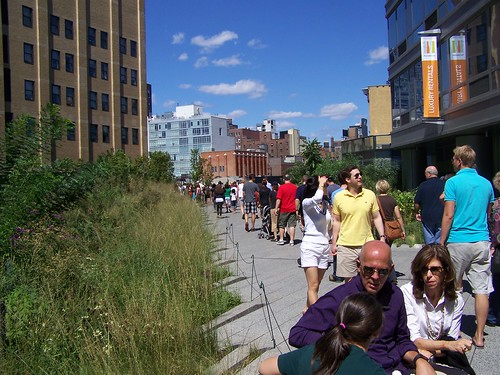
New York City High Line ParkBut the High Line in New York City is particularly well-placed, in an area that had all the hallmarks of success, but needed a branding and positioning device, as well as a civic facility to rally around (comparable to how Bryant Park was revitalized and contributed to improvements across Central Manhattan, see "Splendor in the Grass," New York Times, 2005).

-- "New York's High Line: Why the floating promenade is so popular," Washington Post
-- "New York's High Line Park a marvel of vision, co-operation" Toronto Star
-- "The High Line effect: Why cities around the world (including Toronto) are building parks in the sky," Toronto Globe & Mail

Other communities including DC (11th Street Bridge Park) and Chicago (606) are doing similar projects, although an attempt to create a similar Garden Bridge in London has fallen apart.

There is no reason for other projects to not be successful, but it needs to be understood why the Promenade Plantée, the High Line and the 606 Trail are successful--they are already entwined and integrated within communities that are either already successful or capable of being so, which is why a Scarborough High Line in suburban Toronto may not succeed ("SRT could become 'high line' park," Toronto Star).

The proposed Rail Deck Park in Toronto is a different animal, but exorbitant is a word that under-describes the financial requirements ("Much enthusiasm for Rail Deck Park plan that is short on details," Toronto Star).

"The arts," public art, murals, etc.   Public art too isn't necessarily an independent transformational force, although as part of a program it can bring communities together and draw visitors.  The difference is between a single project versus a program.  The way buildings are turned into murals in the Wynwood district of Miami is an example of the latter (Wynwood Walls - Urban Graffiti Art Miami). 

See "Arts, culture districts, and revitalization," especially the discussion of the writings of John Montgomery and this article, "How the Arts Drove Pittsburgh's Revitalization," from The Atlantic on the Pittsburgh Cultural Trust.

Conclusion.  (1) It's all about the program; (2) a set of transformational projects; (3) the capacity and capability for implementation; (4) financing; and (5) a willingness to experiment and be flexible.

Labels: , , , , , , ,

Thursday, December 05, 2013

Stadiums and economic effects

I know this is beating a dead horse, but I came across some interesting articles over the past few days that make it worth bringing up.

First are a couple articles in the New York Times, "Giants and Jets, Super Bowl Hosts, Have Already Been Richly Rewarded," about the new MetLife Stadium in New Jersey and "For Vikings, New Stadium Meets Lingering Doubts" about the program to build a new football stadium in Minneapolis.  Both articles outline how much the localities are giving up.  The new MetLife Stadium in particular has greater revenue going to the teams than the split from the previous Meadowlands Stadium.

Second, what is new, as disclosed by the article about MetLife Stadium is more accurate reporting about the economic impact of events like the Super Bowl.  According to the article, the actual economic impact is about one-quarter that claimed by the NFL.  From the article:
The 2014 Super Bowl Host Committee, which was created by the Jets and the Giants, estimates that events in the week leading to the Super Bowl will generate about $550 million in economic activity in New York and New Jersey. 

But many sports economists are dubious, arguing that big sporting events tend not to produce anywhere near the kind of money organizers predict. 

“It’s pretty crazy to think that it has that kind of impact,” said Robert A. Baade, a sports economist at Lake Forest College and a co-author of the scholarly paper “Super Bowl or Super(Hyper)Bole; Assessing the Economic Impact of America's Premier Sporting Event.” 

The study, which looked at 30 Super Bowls, concluded that the N.F.L. routinely overestimated the benefits of the event, while underestimating the cost of putting it on. On average, the economic impact is “one-quarter or less of the magnitude of the most recent N.F.L. estimates,” the study said.
Third, I came across a journal article, "Stadium Architecture and Urban Development from the Perspective of Urban Economics," (International Journal of Urban and Regional Research, 34:3, pages 629–646, September 2010) by German professors, analyzing the impact of architectural distinctiveness as a element of stadium-building, and as a possible factor that may generate extra-normal economic returns.  From the article:
A range of econometric studies suggest that neither major sports events nor related new stadium construction typically have any appreciable effect on income or employment at municipal scale.  ...

Sports administrators and politicians frequently claim that stadia and the sports events associated with them have beneficial effects on the economy. Surveys compiled before the construction or installation regularly demonstrate this. A case in point is the 2006 Soccer World Cup in Germany, for which various banks, organizations and universities tendered their expertise. Positive effects such as a long-term increase in the number of visitors, the establishment of new industries and so on are claimed for the period following the event, but in most cases the claims do not have the back-up of appropriate data. 
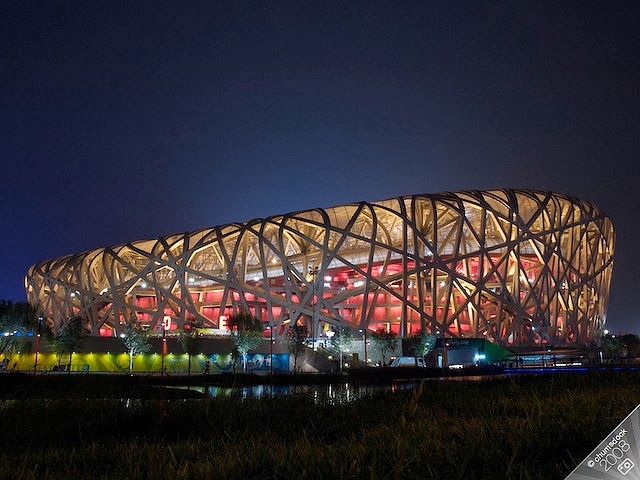
Beijing National Stadium (The "Bird's Nest") at night.  Wikipedia photo.

For distinctiveness to matter economically, the stadium would have to spur additional economic activity

I think it's an interesting point, but I would argue that architectural distinctiveness isn't necessarily going to contribute in extra-normally positive ways, outside of normal events. 

First, people mostly don't travel places to see stadiums.  Second, mostly people visit stadiums as part of their attending regularly scheduled team matches.  Third, most stadiums don't experience a great number of additional events that generate extra-ordinary economic returns, especially overnight tourist stays, etc.

This is pretty much the experience with stadiums and other facilities created for the Olympics as well as the World Cup--not during the event

Therefore, as iconic architecture as an element of what many refer to as "architectural tourism," even distinctive stadiums are not likely to be a long term contributor to scalar changes in local economic activity.

Stadiums do draw economic activity from other parts of a metropolitan area, so specific areas can benefit

That being said, stadiums and arenas can be successful in drawing economic activity from other parts of the region thereby benefiting specific sub-districts and jurisdictions at the expense of others, even though overall economic output measured at the metropolitan scale remains unchanged.

But crappy facilities probably aren't much of a benefit, as they don't spur additional demand to locate proximate to the facility.  Although a study of the FedEx field in Suburban Maryland did find a positive association on housing values ("How Does a New Sports Stadium Affect Housing Values? The Case of FedEx Field," Charles C. Tu.  Land Economics 81:3 (Aug., 2005), pp. 379-395" ).

Do architecturally distinctive stadiums last longer, thereby generating public benefit from lower subsidies overall?

And, where there might be a difference from "architecturally distinctive stadiums" is in how long they last.  Whereas the Giants Stadium was built in 1976 and lasted about 35 years, before it was replaced by MetLife Stadium, maybe distinctive stadiums will last significantly longer.  Although there may be a difference between sports, at least in the US, over the longevity of stadiums and arenas.

Baseball stadiums tend to last for quite awhile (well, not for stadiums built in the 1970s), while football stadiums and basketball and hockey arenas tend to be replaced more quickly.  However, this could be a function of when the buildings were likely to be constructed, with more recent buildings not being constructed for the long term, as opposed to baseball stadiums constructed earlier in the 20th century.

Presumably, a stadium that stays up longer costs less than more frequent rebuilding and replacement of stadiums, and this would be of great value to the public.

Labels: , , , , ,

Monday, November 24, 2008

About "iconic" architecture and connecting (a/k/a placemaking)

If you build something and it is closed off from the area around it, or it's an object of art-building as scultpture, but not context sensitive, it's more about creating enclaves (think something like a gated communicated disconnected and afraid of the world beyond its walls) and not about revitalization.

For example see "The breakdown of Boomtown" from the Baltimore Sun about the failure of a commercial district abutting Fort Meade--the district has declined as the military base has increased its level of security making it less convenient to go in and out, "Ensure UB building is part of city's life" a letter to the editor also from the Sun, about a new building at the University of Baltimore ("A bright new face for UB law school").

"When Buildings Try Too Hard" by Witold Rybczynski in the Wall Street Journal, also covers this broad issue. The article, subtitled "architects and developers are focused on erecting icons. Why most fall short" looks at how "iconic"buildings don't, for the most part, connect, and as a result they don't accomplish very much in the long term. The last two paragraphs of the story summarize the argument pretty well:

Another example of a building that responds to its setting is Toronto's new opera house, the Four Seasons Centre for the Performing Arts, designed by Diamond & Schmitt Architects. The traditional horseshoe-shaped auditorium is situated within an unprepossessing blue-black brick box whose chief feature is a glazed lobby facing one of the city's main streets, University Avenue; dramatic, but hardly iconic. "It's easy to do an iconic building," says Jack Diamond, "because it's only solving one issue." The Four Seasons Centre addresses several issues: On the exterior, the building responds to a busy downtown site with transparency and openness; on the interior, it creates a multi-use lobby that includes an informal performance space and a remarkable all-glass stair; and in the 2,000-seat hall, it provides intimacy, excellent sight lines and exemplary acoustics. At $150 million, the cost of the Four Seasons Centre is relatively modest as opera houses go, but more important is how the money was spent -- on the hall and the interiors rather than on exterior architectural effects. There is something very Canadian about this hard-headed reticence.

Buildings such as the Taft dormitory, the Williams College arts complex and the Toronto opera house seek to fit in rather than stand out, and to enhance rather than overwhelm their surroundings. While hardly shy, they don't stand there shouting, "Look at me!" Being in it for the long haul, they approach fashion gingerly, leaning to the conservative and well-tried rather than the experimental. They are handsome, beautiful even, but they don't strive to knock your socks off. Anti-icons, you might call them. Or just good architecture.

Labels: , ,