Rebuilding Place in the Urban Space

"A community’s physical form, rather than its land uses, is its most intrinsic and enduring characteristic." [Katz, EPA] This blog focuses on place and placemaking and all that makes it work--historic preservation, urban design, transportation, asset-based community development, arts & cultural development, commercial district revitalization, tourism & destination development, and quality of life advocacy--along with doses of civic engagement and good governance watchdogging.

Wednesday, March 20, 2019

Learning the right and wrong lessons from best practice: Hong Kong is Transit Oriented Development on steroids

Transit oriented development is a term from the last couple decades for linking denser development with high frequency transit, most usually rail (although sometimes it includes bus rapid transit). 

Ironically, it's the resuscitation of an approach that originated more than a century ago, about linking transit to development, and having higher density development immediately around stations and terminals. Mega-cities like New York or Paris or London or Tokyo couldn't operate if they were dependent on automobile transportation.  High capacity transit moves thousands of people efficiently and quickly.

The concepts are captured in a long out of print publication by DC's Office of Planning, which updates these principles for today:

-- Trans-Formation: Recreating Transit-Oriented Neighborhood Centers in DC: Design Handbook
-- Center for Transit Oriented Development
-- Ten Principles for Successful Development Around Transit, Urban Land Institute

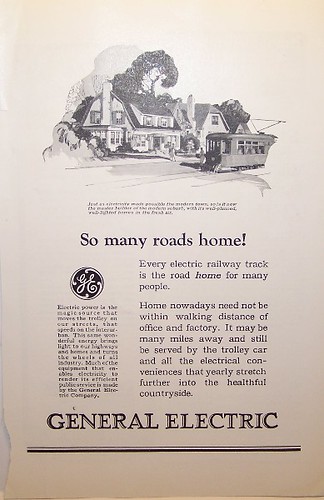
GE Streetcar ad, September 1925NotionsCapital points us to the Guardian article, "How public transport actually turns a profit in Hong Kong," about how the Mass Transit Railway (MTR) in Hong Kong is super profitable because they capture land value from transit adjacency in development and generate ongoing revenue from this development."

Half the revenue in the system is from property development, ownership, and management.

Historically, transit lines were created by land developers to make new residential development popular and successful.

In Washington, DC, for example, not only was a streetcar line built on Connecticut Avenue to Chevy Chase, Maryland, the streetcar franchise operators were required to build the street too. 

The streetcar line on H Street NE where I used to live was built because developers weren't able to sell lots without it.

Railroads had massive residential recruitment promotional programs.

The Van Swerigen Brothers who built Shaker Heights and Cleveland Heights outside of Cleveland actually bought a railroad to get the right of way they needed to provide high speed transit service to their new developments ("Train Dreams," Belt Magazine).

The London Underground had great promotions in association with new lines, especially the "Metroland"of Suburban London.

In the US, transit became publicly owned because it was no longer profitable.

In large part this was because relatively deconcentrated and small scale development was tough for transit to serve efficiently and economically.

Especially when combined in a massive increase in auto ownership + regulatory oversight which was focused on keeping fares low.

In Asian cities, many transit systems are privately owned today because they are profitable. 

Or they are run by public agencies, like MTR, but are managed to be revenue positive.

What's different about Hong Kong, many communities in Japan especially Tokyo ("Why Tokyo's Privately Owned Rail Systems Work So Well," CityLab), Seoul, and Singapore among others, is that these communities are massively dense in both building mass and housing. And most housing is multiunit.

Hong Kong.

So not only does MTR make a lot of money from development, lots of people live or work in Hong Kong and near transit stations, and so the ridership levels are huge as well--at levels far beyond what happens in most North American cities except for Mexico City and New York City.

Surprisingly, mass transit ridership in HK is about what it is in NYC, but they also have higher usage of buses, a still extant double deck tram system, and a great deal of walking, facilitated by a public system of walkway connections ("City of stairs: the interconnecting walkways of Hong Kong," Guardian) and public escalators.

Counter examples.  The development at DC's Fort Totten Metrorail station in mostly a maximum of four stories, and maybe has 1,500 residents.  Although there are taller buildings at other sites, such as Petworth which has one building about 8 stories high, and multiple taller buildings around the Columbia Heights and NoMA Metrorail stations.  But DC's height limit puts a severe limit on the ability to build around transit.

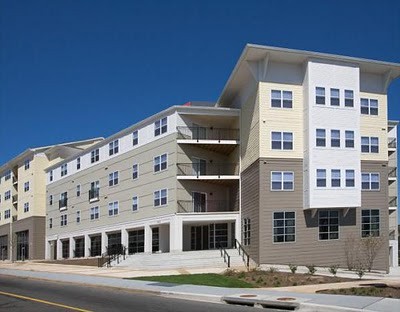
Fort Totten - Clark AvantineFort Totten.  (Although development a block or two away is more dense, about double in size.)

When I was writing the piece yesterday on Atlanta, I was shocked at the low ridership--only two stations of 38 in the MARTA system has more than 9,000 daily riders.

By contrast the Union Square development discussed in the Guardian article is 33 acres with 12 million s.f. of development and buildings as tall as 118 stories.

The built area includes 5,866 residential units, 2,230 hotel rooms, and 2,490 serviced apartments, alongside a shopping mall, Elements, of almost 1 million s.f.

Civic Square in West Kowloon. The shopping mall, apartments and two five-star hotels were all developed or are now owned and managed by the MTR. Photograph: Photogenic/Alamy.


Labels: , , , , , ,

Tuesday, March 06, 2012

Gasoline prices, roads, who pays for what, electric cars, etc.: why the argument is all f*ed up


"Gallon of Gas," by The Kinks, 1979. A lot of people in the blogworld are too young to be familiar with this song, which was written a few years after the "Gasoline Crisis" of 1973.

One of the lines of business my firm works on is bicycle sharing and one of the questions on most requests for proposals is the use of environmentally-friendlier vehicles for operations (in other words, the vans and trucks that do rebalancing and repair).

The Capital Bikeshare system uses Mercedes Sprinter vans which are probably diesel, but not electric. So I contacted a firm with US and British operations, because they make a van like the Sprinter, but fully electric, although the van is available in the UK but not the US, to see if they would be willing to launch it in a U.S. city where we hope to win a bicycle sharing contract.

They said that there is no way that it would be profitable for them to produce and/or sell that particular vehicle in the U.S. market.

I had to think about it for a minute, but the reality is that in the UK, because the price of gasoline is about $8.17/gallon (equivalent), it is cost effective to pay more for an electric delivery vehicle, because the cost of electricity over time is less than the cost of gasoline, even with the higher cost of the vehicle.
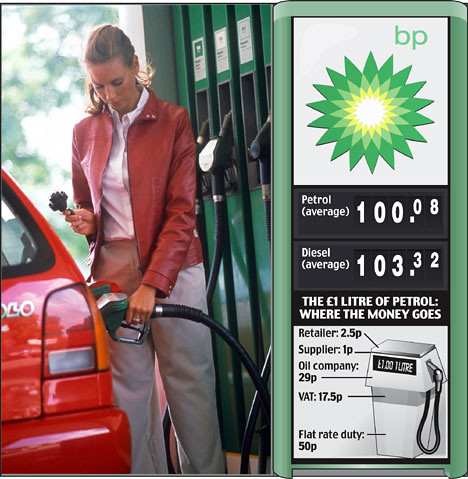
Cost of petrol (gasoline) in the UK
Daily Mail graphic. Note that 100 pence = One British Pound. Petrol there is priced in liters. There are about 3.78 liters per gallon. The British pound is worth just under $1.60.

European countries impose higher taxes, significantly higher, on gasoline, to make up for the various environmental and other costs. The U.S. doesn't. Hell, many states and the federal government haven't raised gasoline taxes in almost 20 years, so it should be no surprise that the "Federal Highway Trust Fund," funded by gasoline taxes, is practically bankrupt.

So it puts into perspective reports, such as in this column, "Driving to fantasy land: Electric cars and the liberal war with science," by Charles Lane of the Washington Post, about the "failure" of the Chevrolet Volt, as indicated by slow sales and a temporary shutdown of its manufacturing plant.

As long as electric cars "compete" against relatively cheap, subsidized gasoline, they aren't going to sell, except to ethically minded consumers, because the economics don't make sense.

But it's better to minimize the need to drive overall, then you don't need gasoline or electricty.

Speaking of economics that don't make sense, the people who run the Washington Post editorial page must know by now that automobile users don't pay for the full cost of roads, that the entire road network is subsidized to the tune of 50% or so from "general funds" as opposed to funds generated by registration fees, gasoline taxes, and tolls.

So I can't figure out why they ran this letter today, "Bus and rail riders should pay their share." From the letter:

Motorists pay nearly the full cost of automobile transportation. They purchase the car, buy the gasoline, pay for insurance and maintenance, provide the driver, sometimes pay for parking, and pay for the roads via the gas tax. Rail commuters, on the other hand, receive a fat subsidy. Twenty-one percent of Metrorail’s operating expenses are paid by subsidy. Bus commuters receive a 73 percent operations subsidy and ride on roads paid for via gas taxes on both cars and buses.

Rather than distorting the economics by having motorists subsidize rail investment, might it not be better to require rail and bus commuters to pay the full costs for their transportation? As gas taxes and fares rise to reflect the true costs of each mode of transportation, riders will adjust their commuting accordingly. This might result in the most efficient choices.


... unless they ran it only to generate responses from people like me.

As long as these kinds of fallacious arguments continue to be seemingly sanctioned by the meda, instead of being recounted, we're never going to move forward to a sensible, "adult" discussion, about what to do about our transportation system and how to fund it.

Roads are subsidized. Parking is subsidized. Health and the environment are negatively impacted. A goodly amount of the U.S. military budget is spent as a result of maintaining access to oil supplies around the world. Etc.

When Mr. Scher of Potomac, Maryland starts paying the full freight for driving, I'm happy to pay a bicycle registration tax, and more money for transit.

FWIW, David Engwicht, in Reclaiming our cities and towns: better living through less traffic, argues that automobile users should pay very high taxes, to cover the cost of transit systems, because their shifting to automobile use makes it much harder for transit systems to be economically viable.

Labels: , , , , , ,

Sunday, January 15, 2012

TriMet (Portland): CHALLENGES & CHOICES A Budget Discussion Guide

TriMet (Portland) Balancing the Budget exercise
Screen captures from the TriMet Challenges and Choices website.

Related to yesterday's entry on WMATA's proposed fare increases for transit in the DC region, and specifically the recommendations for subway fares, I came across an online budget exercise that TriMet of Portland has posted, to get public input into the budget process.

The Portland transit system relies in part on a transit payroll withholding tax, and with the recession, those revenues have dropped, impacting their budget.
TriMet budget game

I mention this exercise because it has four parts:

- Why is there a budget shortfall?
- What are the options?
- What are other agencies doing?
- Tell us what you think? (about the options presented, and other suggestions as submitted by the public)

and because it raises the issue of revenues other than fares.

The Portland TriMet exercise is still very much "transit operator" focused rather than "regional transportation planning" focused, but it's an illustration of the kind of exercises that I think ought to occur as part of a new regional discussion about the role of transit in the region's civic, social, and economic life, and its impact on the built environment and quality of life.

It would be better to make decisions on how to fund regional transit in that context, rather than on an annual crisis basis focused on the next year's budget.

This also gets to a point that Governor Jerry Brown made in the context of California's budget shortfall (this year over $9 billion, last year over $26 billion):

“Here's the dilemma: People don't want cuts in education and health care and policing, but they don't want to pay taxes, either.

“So the challenge for today's politics is to clarify the choices.”


From "Offering a clear choice on taxes" in the Santa Rose Press-Democrat.
TriMet (Portland) Balancing the Budget exercise

Labels: , , , , , ,

Tuesday, July 05, 2011

AP overview story on the state of transit

The Associated Press has a nice overview piece, "High gas prices, rough economy raise demand and challenges for aging public transit systems," about the state of transit in the U.S. The article is one of a series called "Broken Budgets," about the impact of the recession on state and local governments. From the article:

By one survey, more than 80 percent of U.S. transit systems had cut service, raised fares or both since the economic downturn started.

A 2009 FTA study that examined the “state of good repair” of the nation’s seven largest rail transit agencies — New York, Boston, Philadelphia, Washington, D.C., Chicago, San Francisco and the New Jersey Transit System — found anything but good repair.

The report found that 35 percent of all rail assets of those agencies were in subpar condition. Another 35 percent were deemed adequate and only 30 percent were in good or excellent condition. Upgrades would cost the seven largest systems $50 billion, the agency estimated. Add in the rest of the country’s public transit systems, and the maintenance backlog mushrooms to $78 billion.

Millar’s group surveyed its 1,500 agencies and found that at least 40 percent were delaying capital improvements. “The problem is to try to keep fares to a reasonable level, to try to keep services at a reasonable level, they have had to let some maintenance practices slip,” he said. “Of course they are concerned about safety, so they try hard not to defer anything of a major safety need.” ...

Federal support for mass transit comes largely in the form of the gasoline tax, with 2.86 cents per gallon of the federal tax earmarked for transit. But revenue has been declining as fewer Americans drive and many who do have switched to more fuel-efficient vehicles.

Federal funding also has strings attached. Transit systems in larger cities can apply it only toward capital improvements, while systems in areas with populations of 200,000 or less can use federal money to pay operating expenses.

The American Public Transportation Association has a campaign running now, "Public Transit Takes Us There," promoting support of public transit in terms of its positive impact in terms of energy use, on the environment, quality of life, and economic development.

Labels: , , , ,

Wednesday, April 20, 2011

First thoughts of transit, but what about biking

In "As Gas Costs Climb, Ridership On Metrorail Is Rising," from the Miami Herald, Evelina Galangtells us that she lives 4 miles from where she works and it takes as long as one hour to get home by car. From the article:

As she sits in traffic, she can see the Metrorail trains whizzing by, but although she has taken public transportation in every major city where she has lived -- Manila, Chicago, New York, Washington D.C. -- Galang had never considered it an option in South Florida until now.

"There's a lack of trust," she says. "I've been living here for 11/2 years and I drive everywhere. In these other cities, you know it's [the train] coming, but here the perception is that you may be left stranded if a meeting or an event goes on too long."

But with gas prices on the rise and predicted to reach $5 a gallon this summer more people like Galang, who is spending about $45 every time she fills up her Honda, are reconsidering their transportation options. Metro-Dade Transit officials say the number of people boarding Metrorail trains increased by 7 percent from January 2010 to January 2011.

But biking ought to be considered a realistic option as well--she could make the trip, presuming that the right access and infrastructure is in place--in 25 minutes


Frankly, a big reason that I bike is that it gives me far more control over my time than reliance on driving or transit can provide--at least in the kinds of places I tend to make regular trips.

Labels: , ,

Sunday, May 23, 2010

Charity on wheels: bus fares and transit system revenue

The Post today editorializes about continued underpricing of bus fares for the WMATA system, and how this hurts the system overall. See "Charity on wheels‎."

I am glad to see the editorial, which "conforms" to my editorial judgment. It's a point I made about a year ago, in testimony at the public hearing in January 2009, reprinted in the entry "Testimony on proposed bus service cuts in the Washington region" as well as in testimony submitted this year. (And last year, Dr. Gridlock quoted my testimony in a column in the Post on the transit fares question, around the point that in constant dollar terms through 2009, the basic subway and bus fares haven't increased in over 20 years.)

When the transit operator underprices fares, they generate less revenue, and over time, this comes back in diminished quality and breadth of service. This is the place where the WMATA transit system is today.

On the other hand, it is not reasonable to avoid discussion of transit and equity issues. To the credit of DC representatives on the WMATA Board of Directors, they are concerned about equity issues and they make it the priority when it comes to making decisions on fare pricing.
WMATA farecard

Toronto takes the consideration of equity to a higher level than we do in the DC region. For example, in 2008, the City of Toronto and the Toronto Transit Commission introduced a new concept, called “Transit City,” to shape expansion planning. As recounted in the article, "Toronto Plan rolls out new era in Transit," from the Toronto Star:
"Transit City is based on the principle that no one should be disadvantaged by not owning a car. (It) takes the high-quality transit service available in the core and begins to extend that to the four corners of Toronto," said TTC chair Adam Giambrone.
This organizing principle changes the discussion when it comes to both system expansion and service cuts. If the principle is that no one should be disadvantaged by not owning a car, it means that service cuts and reductions in the places and geography that is served should for the most part be off the table.

Where my testimony from last year is deficient and is avoided in the Post editorial as well, is in making the necessary links between:

1. providing transit fare assistance to people in need;
2. disconnecting that responsibility from the transit operator (in this case WMATA);
3. connecting that responsibility to the local governments; and
4. creating a system to provide that assistance.

What that means practically is that instead of DC elected officials on the WMATA board voting against fare increases and for service cuts, they should vote to increase fares and maintain service. At the same time, as elected officials in DC, they need to show leadership and develop a system of "transit credits," comparable to how the earned income tax credit works at the federal level, to incentivize working while recognizing the somewhat regressive nature of social security taxes at lower levels of income.

(I have been advocating the idea of a transit withholding tax as a way to fund transit system improvements in DC. It could generate upwards of $200 million annually and is based conceptually on a similar tax that is assessed in the Portland and Eugene areas of Oregon. This could generate some of the necessary revenue to pay for transit credits, as well as system improvement and expansion initiatives. And unlike social security, the assessment would only be on employers, not employees.)

This gets back to a point that I keep making, that regional level of service and level of quality metrics need to be set by a regional planning authority, independent of the transit operator.

In testimony I submitted this year ("Testimony regarding Washington Metropolitan Area Transit Authority Options to address FY2010 Budget Gap: Public Hearing #547"), I wrote:

A transit system that doesn't go where you want when you want, relatively quickly, is not a low cost system, even if the fares are "low," because to get where you want to go you have to spend a lot of time to accomplish your trip.

How can that be equitable? In short, crippling the bus and rail service by maintaining low fares keeps the system constantly focused on reducing costs, and results in a constantly reduced service profile.

Transit planning should be a separate endeavor from transit operations. By default, WMATA is both the region's transit planner and the region's transit operator.

But decisions about the level of service, level of quality, and the breadth of the transit network shouldn't be made by the transit operator, but by the region. In response to such metrics and preferences, WMATA in turn should demonstrate how to meet these preferences, what level of revenue is required, and offer options, including a discussion on fares, and appropriate farebox revenue levels, necessary to achieve the provision of the specified level of service, quality, and network robustness.
------

What is necessary is that the region rebuild its consensus about what transit is supposed to do and what it is supposed to accomplish.

My recommendation for how to deal with this is included in this year's testimony:

... The St. Louis region is currently going through a region-wide public planning process concerning the role of transit in the region. For many years, Chicago has been dealing with similar issues. And the San Francisco Transit Effectiveness Project (a multi-agency city government initiative) addresses comparable concerns.

All of these processes have involved significant citizen participation and input, as well as deep and wide discussions throughout their respective regions, including the widest possible participation and involvement of stakeholders at all levels.

In order to restore trust in the WMATA system generally, and to come up with a common understanding about the role of transit in the region, pricing, and metrics for level of service, level of quality, and the breadth of the transit network, the Citizens Planning Coalition recommends (as it has been recommending for at least 4 years in various writings) that WMATA embark on a similar public planning and participation process.

It is extremely important that this be a participatory process rather than a dog and pony show seemingly seeking citizen input, without allowing for the possibility of real substance.

(Also see the article, "Crowdsourcing helps the Chicago Chamber of Commerce Find More Bus Riders," from Government Technology Magazine, on an initiative seeking proposals for improvements in the quality and breadth of the transit system in the Chicago region. As well as discussions in the Toronto Star on the "transit camp" and other independent citizen initiatives focused on improving local transit.)
-----
We need a real, substantive, fundamental transit planning process that is metropolitan in scope, that goes beyond the perspective of the transit service operators (WMATA and the other transit services provided by the local jurisdictions), one that grapples with the tough questions that for the most part we seem to be avoiding notwithstanding the efforts of bloggers like myself--my entries tend to focus more on the systems and structures of governance, management, and planning as it relates to the region and to the transit operator specifically--and the many many entries of substance in Greater Greater Washington especially entries by Michael Perkins, David Alpert, and Matt Johnson.

Labels: , , ,

Thursday, January 21, 2010

The cost of a MARC train and other issues

MARC railroad sign, Riverdale
Every so often, MARC (Maryland Rail Commuter) executives set up tables at places like Penn Station in Baltimore and Union Station in DC and open it up for dialogue with customers. I had been meaning to write to them about a bunch of issues, and yesterday (nice since I caught the right and fast bus and had an extra 20 minutes to kill) they were set up at Penn Station, so I talked to them about:

- no recycling bins at Penn Station (really this is Amtrak's problem)

- no recycling bins at Union Station in the train area (Amtrak's problem + the management of Union Station)

- the disgusting pro-smoking area immediately adjacent to the entry at Penn Station so that often you have to walk through a gauntlet of heavy smoking to get into the station (Amtrak's problem because they own and manage Penn Station)

- that Amtrak ought to be more responsive to MARC and MARC riders on these points (MARC and riders as Amtrak customers) since they lost the contract to provide service to VRE ("Va. commuter rail operation rejects challenge" from the Post). On the other hand, since Amtrak owns the Northeast Corridor dedicated trackage, MARC has no alternatives but to buy from Amtrak.

(- note that there is dedicated bicycle parking in the parking garage at Penn Station, but there isn't in the parking garage--not managed or owned by Amtrak--at Union Station. Although yes, there is the Bikestation.)

- since MARC cancelled their 10pm hour departure from Baltimore to DC, if I have to work late I am screwed (I need to sign up forGuaranteed Ride Home from Commuter Connections so that they have to pay for me to come back to DC after MARC's last train, mostly I just pay a premium to ride on Amtrak, but I could probably take a Zipcar overnight from Towson U or take the light rail to BWI and take the WMATA B30 bus to Greenbelt, or I could crash at a friends place in Baltimore...), I asked if they could work it out with Amtrak that MARC monthly and weekly ticket holders could ride between Baltimore and DC on at least one of the trains that stops in Baltimore between 9:30 and 11pm.

On the last point, I was told that it costs MARC just as much to pay for privileges to have riders on Amtrak trains as it does to run a train.

The rough metric is that it costs one train $1 million annually to run between Baltimore/Perryville and DC and back (one round trip). The cost works out to be $2,000 for each leg or $4,000/round trip, for 250 days of service.

... and that the late train from Baltimore was cancelled only because of budget problems and that if the budget ever improves, they intend to restore train service at this hour.

This makes sense as the MARC Growth and Investment Plan is about expansion, not contraction.

Some other parts of the conversation:

- He said that the charges from Amtrak are high, but then it's costly to maintain the Northeast Corridor, buy electricity, etc.

- That maybe it would be cheaper if the various states would go in together and buy the Northeast Corridor from Amtrak.

- I said we can't even get Maryland and Virginia to create one combined railroad service (which I call RACER, for Railroad Authority of the Chesapeake Region, see "Regional transportation planning and fixed rail service" and the original piece, "A regional railroad passenger transportation vision for DC, MD, VA, WV and parts of PA") so how soon could we expect that?
Railroad system Washington-Baltimore region
BeyondDC's sketching of opportunities for a regional railroad system.

- He thought that a combined service on the part of Maryland and Virginia (with a modicum of DC participation) is not out the question in our lifetimes. We didn't discuss the RACER ideas, which derive from ideas first laid out by Dan Malouff, which include connections to Pennsylvania and Delaware (although the latter is covered in the MARC Growth and Investment Plan), although I did mention the paper I wrote about this and I should probably send it to him. (Not that most of the ideas haven't already occurred to them.)
The commuter parking lot at the Halethorpe MARC station
The commuter parking lot at the Halethorpe MARC station fills up fast in the morning. Commuters park on nearby streets, leading to clashes with residents. (Sun photo by Amy Davis / June 19, 2008).

- Finally, we talked about circulator type bus shuttle services to complement train service, to bring riders to stations without their having to drive, and without having to provide big parking lots.

Anne Arundel County is developing a circulator bus service to serve the Odenton train station as well as various facilities in that area, including Fort Meade and the NSA. These facilities get a lot of ridership from the DC region, which MARC likes because their service structure is "unbalanced" as 65% of their ridership is people going to DC from various points in Maryland.

MARC favors that idea, but probably doesn't have the money to help subsidize it. I mentioned the possibility of doing this at other stations. He said it really depends on what's around the station, if commercial facilities and/or government agencies were to locate at more stations (note the polycentric and sprawl aspects of this idea, even though it intensifies service possibilities and transit-centric mobility simultaneously)... that Halethorpe in Baltimore County isn't really a candidate for a circulator, because most of its riders get to the station using I-695 (the Baltimore Beltway) from various points in the region, that they don't live near the station, it's just convenient to use. So a circulator wouldn't get used and wouldn't reduce the need to provide parking there.

Labels: , ,

Sunday, January 10, 2010

Variable pricing for WMATA

Presentation: Mississauga City Forum: “A Way Forward” “Be Connected With Transit”
Slide from a presentation, Mississauga City Forum: “A Way Forward” “Be Connected With Transit”, 2006.

Sam Staley, the lead transportation researcher at the Reason Foundation, has taken up the idea of the need to increase local transit fares as an opportunity to push the idea of variable fare pricing. See the op-ed, "All Opinions Are Local : A $40 million crisis Metro can't afford to waste," from today's Post.

Conservatives and libertarians favor variable pricing options in transportation, especially for roads. Even so, the op-ed is not unreasonable.

I do however, think that getting WMATA to focus on variable fare pricing for transit is a waste of time.

The real issue is not diverting some people on the margins to more expensive or less expensive fares depending on their needs--after all, for the most part there is plenty of capacity (if the system had the money and the rolling stock necessary to be able to run 8 car trains whenever demand warranted it)--the real issue is generating enough money to run the system, and proper pricing.

The reality is that heavy rail WMATA service -- "the subway" -- is a premium service, which except during rush hour specifically, is not priced as a premium service.

At non-rush hours, a subway ride is the same cost as a bus ride, even though the quality of the service and the speed of the trip on heavy rail is far superior.

Rather than set up the technology for variable pricing, why not just price better, and reduce the subsidies for choice riders?

(Also, rush hour bus trips could involve a rush hour surcharge as well, as is the case in other transit systems, such as Philadelphia.)

I would think that proper fare pricing is worth figuring out, while the cost of implementing the technology necessary for proper "tolling" and charging of time-variable fares isn't worth the trouble.

Proper fare pricing, not grandstanding, is what I would like to see as the outcome from the budget crisis. That's the opportunity that I hope doesn't get blown.

I'm not hopeful though.
-------
Sam Staley, even though I have had fruitful and respectful dealings with him in the past, has on occasion, written bad stuff, such as this op-ed in the Post (based on a book) from 2007, "5 Myths About Suburbia and Our Car-Happy Culture."

I don't think he cares so much about what we might call "proper or right- [no pun intended] funding" WMATA as much as the opportunity to further push within transportation planning the variable pricing agenda.
Mobility first book cover
On the other hand, he does have a book out from 2008 that I didn't know about, that probably is somewhat reasonable on the issues. See the website for the book, Mobility First: A New Vision for Transportation in a Globally Competitive Twenty-first Century and this Powerpoint presentation.

Ironically, I make this same point--"Mobility first"--all the time, although I prefer to use the word "optimality." Too often, transportation planners pussyfooting around the reality that automobility dominates the transportation/mobility agenda make the point that by improving the environment for walking, bicycling, and transit that "we improve choice."

It's not about choice.

We want people to choose optimality because it's the best possible use of resources, 5 cent taxes on shopping bags notwithstanding.
Slide from a Mobility First book presentation, Sam Staley
Slide from a Mobility First book presentation, Sam Staley.

Labels: , , , ,

Wednesday, December 23, 2009

WMATA ridership declines are in line with national statistics

Nationally, transit ridership has declined by 3.82%, according to the American Public Transportation Association, in the article, "APTA: Ridership drop reflects harsh economy," from Metro Magazine. From the article:

Trips on all of the major modes of public transportation — bus, light rail, heavy rail and commuter rail — were down; paratransit (demand response) and trolleybus were the only two modes that saw increases in ridership. “This downturn in public transportation ridership is a reflection of our economic times,” said APTA President William Millar. “Nearly 60 percent of riders take public transportation to commute to and from work, so it is to be expected that public transit ridership would be lower when unemployment is high.” ...

Heavy rail (subways) declined by three percent. Los Angeles Metro heavy rail continued its trend of increased ridership with an increase of six percent for the first nine months. Ridership on the Washington Metropolitan Transportation Authority (WMATA) increased by 0.6 percent for the same time period. ...

Bus ridership declined by five percent in the first nine months of 2009. In the largest bus ridership report, bus trips increased in San Francisco by 1.1 percent. Bus travel in the smallest population area (below 100,000) decreased by only one percent — the smallest percent decrease of all population groups.

WMATA reports that ridership is down below projections, and is one of the reasons that an unexpected budget deficit is leading to proposals for service cuts. See "Metro ridership still falling below budget projections" from the Examiner and "Pain ahead for Metro : The transit authority is looking at a combination of cuts and extra money to close a $175 million budget gap" from the Post.

From the Examiner article:

The problem is that fewer riders have been taking both Metrorail and Metrobus compared with last year. Part of the explanation may be the disruptions the deadly June 22 train crash caused throughout the system. Metro also ran fewer rail cars on the Red Line, where the crash occurred.

But agency officials have pointed to the region's high unemployment rates. Last year also brought in record ridership levels as commuters sought public transit when gas prices rose above $4 a gallon. It makes sense that some riders would return to their cars as fuel prices leveled off. However, Metro assumed ridership would continue to grow when it crafted the budget that began July 1.

In addition to the lower ridership numbers, the report also says riders are taking shorter train trips. Because fares range from $1.35 to $4.50, depending on distance and time of day, an increase in short trips is undercutting how much Metro expected to bring in through fares.

The ridership declines have been tempered, though. In July, rail ridership dropped 3.82 percent over the same time last year. In October, the report says, the average weekday ridership had dropped just 1.42 percent compared with the same month in 2008.

Matt Johnson, in the post "A new late-night map to soften the blow of Metrorail cuts" in Greater Greater Washington, offers an interesting suggestion on rightsizing service across the lines, to reduce the "need" to go to 30 minute headways late at night. By reducing service on lines that overlap, Matt's proposal means that 15 minute headways are achievable.

Labels: , ,

Tuesday, September 29, 2009

Transit heights and lows

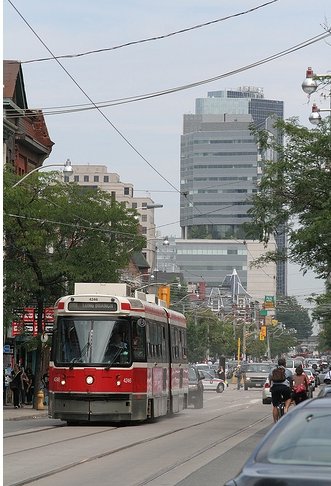
Toronto Streetcar, looking east on Queen Street West
Toronto Streetcar on Queen Street West. Flickr image by Rick Heath, used by permission.

Toronto's Mayor, David Miller, has decided not to run for a third term. Nigel sends us a link to the Spacing blog, where Steve Munro writes, in "The Mayor of Transit City," about how Mayor Miller is telling the truth when he states that one of his biggest accomplishments as Mayor and before that as City Councilor, was in expanding transit.

From the article:

... Indeed, improving public transit to make Toronto a “World Class City” was part of Miller’s first, unsuccessful, bid for a Council seat in 1991. The next election, in 1994, brought Miller to the old Metro Council.

I came to know then-Councilor David Miller in his role as a Commissioner on the TTC board after the city’s amalgamation in 1998. He had a good sense of issues and advanced his positions clearly and strongly, but without grandstanding.

After the mid-1990s funding and service cutbacks, the TTC needed strong advocacy to turn it around. Ridership dropped from a 1988 high of over 463-million to a low of 372-million in 1996, creeping back over 400-million by 2000. The TTC’s only plans for service expansion were a few new subway lines, but when these would be funded and built was anyone’s guess.

Operating subsidies fell over the years, and farebox cost recovery grew from about 70% in 1988 to almost 85% by 2000. Partly this was achieved through fare increases, and partly through service cuts. This placed a greater load on riders to fund the system while quality and quantity of service declined, particularly on the surface network.

The minutes for the April 10, 2002 Commission meeting contain a small item that would fundamentally change transit planning and advocacy:

CC-2 Commissioner Miller submitted his communication dated April 5, 2002 to Chair Ashton with respect to the development of a ridership growth strategy.

COMMISSIONER MILLER MOVED THAT STAFF BE REQUESTED TO BEGIN DEVELOPMENT, IN CONSULTATION WITH COMMISSIONERS, OF A REPORT ON A RIDERSHIP GROWTH STRATEGY.

THE COMMISSION APPROVED COMMISSIONER MILLER’S MOTION.

Later, the Toronto Transit Commission developed the Transit City Plan based on principles of both equity--that no one should be disadvantaged because they don't own a car--and mobility effectiveness. From the article:

Recently, the TTC published the Transit City Bus Plan (TCBP). This continues the focus on surface operations and transit’s attractiveness by proposing a core network of routes where service would always be at least every 10 minutes. This complements the subway policy headway of 5 minutes at all hours. Like its predecessor RGS, the TCBP makes incremental changes to the system to keep the cost of each change modest and to allow selective implementation of each stage. Most importantly, the TCBP looks at transit service from a network viewpoint, not as a single project of little benefit to most riders.

-- Toronto Ridership Growth Strategy.

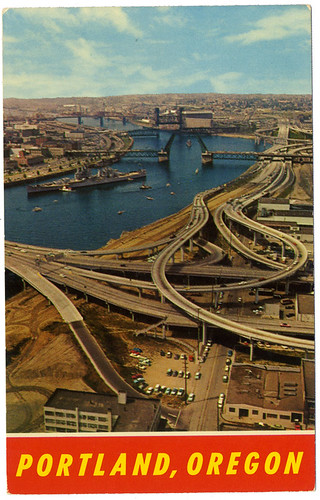
2. This article from the Portland Mercury, "The Dead Freeway Society: The Strange History of Portland's Unbuilt Roads," discusses how great Portland, Oregon is because they ended up not building planned freeways AND THEY TORE DOWN EXISTING FREEWAYS.
Portland's waterfront used to be scarred with freeways
Portland's waterfront used to be scarred with freeways.

Ironically, DC is no less great because most plans to build freeways within the city were also dropped, and instead, a subway _system_ was built. Interestingly, initial planning for freeways was paired with "rapid transit" planning, with plans to put rail lines in the middle of freeways.

(One of the most "accessible" articles about this topic is "END OF THE ROADS; In the Interstate Era, Congress ruled Washington like a fiefdom. Then a fight over some freeways inspired a biracial, neighborhood-level movement to fight the federal power" from the Washington Post, by Bob Levey and Jane Freundel Levey, Nov 26, 2000 from the Sunday Magazine. The article is not accessible for free online.)

Now, where Portland differs from DC is in the quality of and the vision possessed by local political and economic elites, and in their continued commitment to transit expansion and investment and the adoption of "new" technologies such as modern streetcars and an aerial tram.
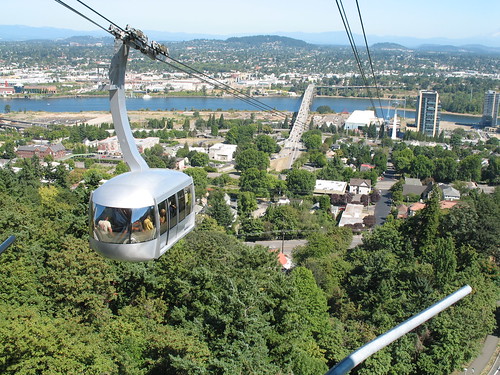
Portland aerial tram
Portland's aerial tram connects the Oregon Health Sciences University over steep terrain and the system is operated by OHSU. (An interesting public-nonprofit partnership driven by the University's recognition that certain land was developable only with better and transformative transit. The topography and river meant tram. Note the example in terms of redevelopment of large campus areas within DC and whether or not the developers are required to pay into transportation improvement such as streetcars--thus far, no.) Photo by Michael Farrell.

What's interesting is that Portland gets tremendous credit, justifiably for its vision, and the hard work it has performed in rebuilding an environment that promotes walking, bicycling, and transit.

DC proper hasn't done nearly as much focused work "lately". It has benefited from the creation of a true subway system, and in the city there are 40 subway stations, with 29 at the core of the city, laid over the top of walking-bicycling-transit friendly spatial pattern of small blocks, a grid-based street network, and "angled" arterial avenues that speed trips across the expanse of the grid.

The L'Enfant plan, developed at the outset of the "Walking City" era, combined with a strong employment center at the core of the city (the Federal Government and the entities that serve it--contractors, trade associations, lobbyists, and lawyers), plus transit means that the city is now one of the more successful center cities in the nation, despite many many persistent problems.
L'Enfant Plan, Washington, DC
The L'Enfant Plan for the City of Washington dates from 1791.

And while Portland gets all the credit it deserves, the fact of the matter is that mode split -- the number of trips to work by transit, walking, and bicycling -- is far better in DC than it is in Portland.

3. Sadly, most transit systems across the country are facing serious budget shortfalls for the next fiscal year. This is the case with the DC transit system (see "Board to Catoe: Cut service to balance budget" from Greater Greater Washington and my discussion in "Transportation stuff").

Seattle is looking to make massive cuts to eliminate a $213 million budget gap projected for the next two fiscal years. See "Triplett says his budget would stabilize Metro Transit" from the Seattle Post-Intelligencer.

Interestingly enough, the King County Metro system is looking to be somewhat more thoughtful and judicious, rather than reflexive and reactive like the mandate from the WMATA Board. From the Seattle P-I article:

A recent performance audit of Metro Transit found room to raise an additional $54 million in annual revenue by raising fares and reducing discounts for seniors, youth, and off-peak riders, which the audit said were "unusually generous." It also identified $41 million in potential savings through running more efficient bus routes.

Although Seattle does have a different reactive rule, a new mandate that service improvements can't overfavor Seattle, that 40% of service must go to east King County and 40% of service must go to south King County. But where do you think most people are likely to use transit? In Seattle or in the greater reaches of King County?

Note that the Sound Transit system of bus and now light rail also serves Seattle and King County but is managed and budgeted for separately from the King County Metro Transit system.

Labels: , , , ,

Tuesday, September 15, 2009

(Ir)rational planning #2: sexy (Circulator) vs. plodding (Metrobus) bus service

Georgetown Metropolitan reports in "Circulator to No Longer Ascend Wisconsin?," that the Circulator bus route up and down Wisconsin Avenue north of M Street is in danger of being cut.

Umm, that's fine.

The frequency of bus service on a specific route is directly related to the number of passengers using the route. Routes that exhibit high ridership should be provided frequent service, whereas routes with low ridership should be provided less frequent service.

-- from the journal article "Produtivity Frequency Index, Journal of the Transportation Research Board, 1997. (For another perspective, see the journal article "The Dynamics of Fare and Frequency Choice in Urban Transit," which calls for a better balancing of fares and frequency, making the point that more frequency can come at the expense of higher bus fares or subsidies, and this class lesson, (Bus) Costs and Service Planning Practice.)

That stretch of Wisconsin Avenue north of M Street has service from the 30s Metrobus line plus the Circulator. For most of the day, there is a minimum of 5-8 buses/hour on the 30s line there. Unless the Circulator is running 10,000 passengers/daily on the stretch, the duplication of the service is "unwise" and definitely wasteful.

A problem with bus service planning in DC over the last couple years is that in part it has shifted from focusing on ridership levels and service frequency to the design and type of bus.

The Circulator buses have a great design, and they are supposed to come every 10 minutes, meaning you don't have to rely on a schedule.

(Note that the new livery scheme for Metrobuses is really quite nice and competitive with the Circulator, even if Metrobus could do better still.)

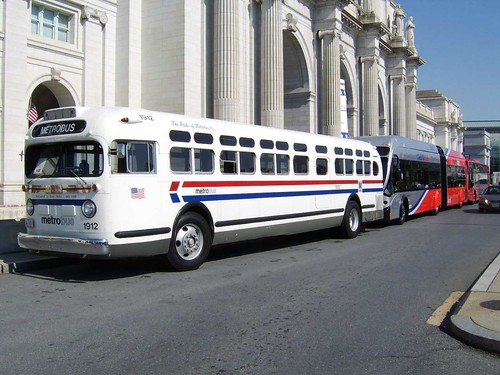
Old Metrobus livery vs. DC Circulator Bus (at Union Station)
Downtown Circulator at Union Station

New Metrobus design
A New Flyer Metrobus done in the Metro Local livery

Still, the extension of the DC Circulator bus, with 10 minute headways (6 buses per hour) to Capitol Hill and to Columbia Heights, is a mistake, despite the fact that other bloggers have written about it positively.

Unless a bus route has a minimum daily ridership of at least 10,000 people, service levels of six buses/hour aren't justifiable. The route that the Capitol Hill Circulator has replaced had fewer than 2,000 daily riders. I imagine that the ridership levels are comparable today. Make the buses prettier sure, but don't provide more service than is justifiable. This only increases costs with little in the way of practical return.

Even though the Columbia Heights Circulator bus has decent ridership (a few thousand people daily, but I am not sure of the exact number) in some respects this is merely poaching from other routes on 14th Street. Plus, this route has a long stretch--from U Street to McPherson Square--where it runs with no stops. Instead, the route should stay within the U Street-Columbia Heights-Adams Morgan-Woodley Park area. But again, the route this bus replaced (the Adams Morgan Link) was the least effective most expensive bus route in the WMATA system.
30 foot DC Circulator bus
The Circulator buses on the routes in Columbia Heights and Capitol Hill are 30 feet long, not 40 feet long, in recognition that ridership levels wouldn't justify the use of a 40 foot bus.

Rather than call it a day, DC is now paying for this separate, somewhat ill-conceived bus route, but with fancy new buses and more frequent service.

When resources are put into providing a high level of service on a route where ridership doesn't justify it, this comes at a cost to service and/or transit budgets in other areas with potentially greater need and/or demand.

Don't get me wrong, I do favor intra-neighborhood bus services (see the definition of tertiary bus service in this blog entry, "Thinking about the transit network,") but they have to be well conceived, with justifiable service profiles.

Otherwise, we end up making bad choices, bad decisions, and wasting money.

In the meantime, more and more people, because of the sexy livery of the Circulator, think it's a great success, advocating for expansion of "Circulator" bus service in more and more places in the city, without recognizing the truth that the expansion is occurring for nonpolitical reasons, when in reality, expansion is a sign more of manipulation than of success.
Downtown Circulator banner
Better marketing for transit is an absolute necessity, especially for bus service. But just because a bus service is marketed better than other bus services in the region, it doesn't necessarily mean in any and all cases that the better marketed bus service is actually better.

Labels: , , ,

Tuesday, August 18, 2009

Free transit/fareless square issues in Seattle and Portland

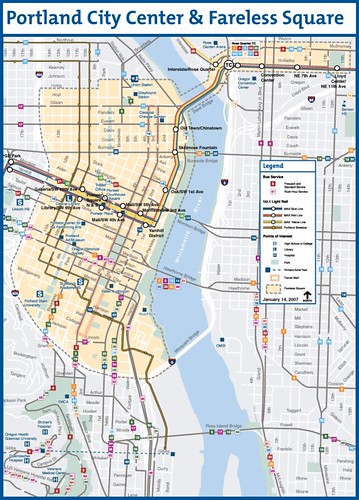
Portland is going to change their policy about free bus trips within their fareless square, stating that only about 1/3 of the trips originate and end within the designated area, and that many people get away without paying for trips outside the zone. See "Fareless Square: TriMet board cuts buses out of Fareless Square" and the editorial, "Keep Fareless Square open, friendly, simple -- and safe," from the Portland Oregonian.

This letter to the editor, "Livability concerns as Fareless ends for buses" raises questions of equity (similar to points I have made in the past), that transit policy preferencing rail benefits higher income people often at the expense of those of more limited means.

And this blog entry, "Fareless Square - TriMet's fixation" is pretty derisive of the policy change based on the constrained set of options that were considered. While confusing, they could have moved to the Seattle method of payment for trips originating in the fareless square area, you pay when you get off the bus, not when you get on. (The TriMet report can be found here.)
Portland City Center and Fareless Square

In Seattle, the City of Seattle pays King County Metro $400,000/year for the provision of free service in their fareless area, but the transit authority estimates that the real cost is at least 15 times higher, serving about 10 million people/year. See "Plan: Charge Seattle millions more for free downtown buses" and "Downtown merchants: Ride Free Area benefits all county commuters" from the Seattle Post-Intelligencer. and "King County lawmakers propose Metro bus increase" from the Seattle Times.

Of course, the City of Seattle doesn't want to pay more for this service, which at this juncture, could only be paid by cutting other city services.

But this does give some perspective on calculating the cost of providing free surface transit service in DC, which I estimated once would cost about $70 million/year.

Also see this past blog entry, "An idea for free public transit within DC" and "Free ride? Fat chance: Muni fares will stay" and "Other cities have found free-fare transit a bumpy road" from the San Francisco Chronicle and the series "No Fares! from The Tyee of Vancouver, BC.

Labels: , , ,

Thursday, June 25, 2009

Forgetting something key about dedicated funding streams for transit

They too are not inviolate. Tax receipts can go down. Typically, real estate transfer taxes and sales taxes are used to fund transit systems. The financial problems experienced by the Chicago Transit Authority "CTA president says specifics on cuts unknown" from the Chicago Tribune), the Massachusetts Bay Transportation Authority ("The tax that fails the T" from the Boston Globe), and the Metropolitan Transportation Authority in the New York City region ("Why the MTA Is Broken" from the Indypendent) are all due to falling tax receipts.

(And note that unlike DC, which is funding Circulator routes some of which don't justify the expense, other transit systems are dropping service frequency on routes where it isn't justified, and adding service where it is in demand.)

Still, today's column in the Post by the new Metro columnist Robert McCartney, "Long-Unheeded Metro Pleas Must Be Heard ," about management and funding issues relating to the transit system is better than I expected after his first outing on Sunday, when he wrote that one of the biggest problems in the region is that DC and Maryland aren't building more freeway lanes:

Of course, traffic congestion is the top example of this problem. Political gridlock leads to the highway variety. Consider this: Starting in three years, parts of the Beltway and I-395 in Virginia will be widened with the opening of newfangled toll lanes where you pay more when traffic is heaviest. Maryland and the District, however, aren't yet planning to add similar lanes on their sides of the American Legion and 14th Street bridges. Sound like a recipe for more bottlenecks?

Despite Monday's tragedy, the solution to congestion is reducing the number of automobile trips, not increasing or encouraging more automobile trips. Transit is the way to go.

Labels: , ,

Saturday, April 18, 2009

Testimony on proposed bus service cuts in the Washington region

100_5948.JPG
People in the hearing room last night. There was a strong contingent of workers, one bus driver was particularly eloquent, and many people from the Justice First campaign. Their campaign is no service cuts, no layoffs, no fare increases. You know the joke that if you're not a socialist before 20 you're a boor by 30? Well, their testimonies made me feel like a "neoliberal."

Testimony regarding

Washington Metropolitan Area Transit Authority
Proposed Service Adjustments and the
General Manager’s Proposed FY2010 Budget
Docket B09-3

Public Hearing #543
Metro Headquarters Building
Washington, DC
Submitted in addition to verbal testimony
April 17, 2009

Thank you, Chairman Graham and General Manager Catoe, for the opportunity to testify tonight. I am Richard Layman of the Citizens Planning Coalition, a DC-based advocacy group concerned primarily with stabilizing, maintaining, and extending the qualities that make living in the District of Columbia so worthwhile.

CPC is convinced that one of the city’s primary economic and competitive advantages rests upon the wide array of transit options serving residents, employers, retail and entertainment businesses, and visitors.

Furthermore, the richness of transit services available within the regional and specifically the City of Washington allows for optimal mobility without having to own an automobile, and more than 30% of the city’s households do not own cars—they are dependent, by choice or by need, on a robust Metropolitan Transit Network* and efficient services provided through an interconnected transit network.
------
* The Metropolitan Transit Network has been defined conceptually by the Citizens Planning Coalition, extending concepts expressed in the Transit Network Element of the Arlington County Master Transportation Plan (and Draft). This definitional framework has been attached to this testimony as an appendix.
------

Recently, the City of Toronto and the Toronto Transit Commission introduced a new concept, called “Transit City,” to shape expansion planning. According to the Toronto Star** :

"Transit City is based on the principle that no one should be disadvantaged by not owning a car. (It) takes the high-quality transit service available in the core and begins to extend that to the four corners of Toronto," said TTC chair Adam Giambrone.
-----
** “Toronto Plan rolls out new era in Transit,” Toronto Star, 11/24/2008.
-----

Social equity objectives are met by providing a pervasive transit network, and by extending transit service, not by reducing or eliminating transit service.

Using a commonly available inflation calculator, 75 cents in 1987 is worth $1.35 today. In 1987, fares on Metrobus were 75 cents in the City and 85 cents in the suburbs. Today, bus fares are $1.25 with a SmartCard and $1.35 if paid in cash.

Despite increases in energy costs, particularly the cost of diesel oil, personnel and other costs, in constant dollars, for the last 21 years, WMATA bus fares have not increased, they have barely stayed even with inflation—and bus fares have not stayed even with inflation if the rider uses a SmartCard.

While no one likes to consider fare increases, bus service in the Washington region is about to suffer its most severe cutback in many years.

As a result of forecasted budget deficits and the need to reach a balanced budget, the WMATA board voted to hold public hearings. Because board members from DC blocked consideration of a 5-cent across-the-board fare increase as an alternative to service cuts, only service cuts are being considered.

While we respect DC’s board members and their principled opposition to fare increases, which is driven by concerns for social equity and compassion for those with limited incomes, the reality is that the alternative, service cuts, can mean catastrophic deleterious impacts for the specific segments of the public that have to deal with the impact of real service cuts and route eliminations.

The amount of money to be saved by service cuts is about $13.5 million. Most other major cities across the United States charge significantly more for base fares for bus or subway service, compared to WMATA. If WMATA were able to raise bus fares by between 10 and 15 cents, no service would have to be cut.

We ask whether it is fair and equitable to demand that specific segments of the transit-using public experience significant hardship as a result of these changes, to the benefit of the broader ridership public which will experience limited if any changes to the service on bus routes they regularly use?

Our answer is “no,” we believe that it is better for the entire ridership public to sacrifice slightly by paying marginally higher bus fares (fares that would still generally be lower than those charged in most major U.S. cities), rather than expect that particular segments of the ridership public bear the brunt of specific, significant service cuts and route eliminations.

Because the transit services in the region follow WMATA’s lead in terms of setting the price of base fares, the decision to not consider fare increases has cascading and increasing impact on other non-Metrobus public transit service provided within the region.

Because of similar financial problems, Montgomery County's Ride On, Fairfax County's Fairfax Connector and Alexandria's DASH are planning cut backs in transit service also, in addition to the bus service cuts planned by WMATA.

This likely would not be the case, if a slight fare increase were on the table for WMATA, because suburban transit services would have “political cover,” to adopt a fare increase in tandem, thereby limiting the need for service cuts.

WMATA subway and bus operations are experiencing continued record ridership, not to mention WMATA’s triumphs during Inauguration Week, and WMATA is the nation’s second busiest transit system, despite the fact that the region is only the nation’s eighth most populated metropolitan region. And while the regional economy is suffering, on a national basis the Washington region, especially the inner core, is relatively healthy.

Let's face it, despite all the complaints of those here at the hearing tonight, we have a great transit system--sure it can always improve--and compared to the budget crises faced by other transit systems across the country--in New York City, Chicago, San Francisco, Boston, Seattle, Philadelphia, Pittsburgh and elsewhere--transit riders in the Washington region are relatively well off.

But what matters most is not what is happening elsewhere with transit system budgets and service, what matters to us in the Washington region most is what is happening here, with our transit services!

First, we must ask this question:

Is it worth keeping fares the same at the cost of service cuts that disproportionately impact certain segments of the bus riding public, and will the proposed service cuts make it difficult for many people to use transit?
Second, while fare increases are never desired, sound public policy means that they should be considered, when the alternative is significant cuts in service, even if those cuts in service will mostly impact suburban riders, rather than Washington residents.

Third, we ask that with this matter specifically, and going forward more generally, that the DC Government and DC’s appointees to the WMATA Board think more broadly about transit and how the sum of “jurisdictionally-specific” thinking must produce a Metropolitan transit system greater than the sum of its parts.

In this case, DC’s unwillingness to consider bus fare increases as part of the FY2010 Budget —negatively impacts the entire region and its Metropolitan Transit Network. We do not believe that it is fair for the entire region to be negatively impacted by overly parochial decision-making on the part of the DC members of the WMATA Compact.

The unintended consequences of significant service cuts and route eliminations in Maryland and Virginia as a result of posturing on the possibility of fare increases is but one example of how DC needs to step up and provide “world-class” “regionally-sound” leadership on transit issues.

Fourth, to maintain the position of the District of Columbia as “a transit city” and the Washington Metropolitan area as “a transit region,” we must maintain a robust Metropolitan-regional transit network. Despite financial exigency, bus service cuts should be an option of absolutely last resort, after all other options, including fare increases, have been considered and exhausted.

Therefore, the Citizens Planning Coalition asks the WMATA Board to reconsider service cuts in bus service, and put the possibility of a fare increase back on the table for consideration.

For this to happen, the DC City Council and Mayor Fenty must instruct DC’s voting representatives on the WMATA Board to change their stated position on the possibility of fare increases.

Thank you for your consideration of this recommendation.

----------------------------------------------------------------------------------Washington Metropolitan Transit Network
Working Document – Version 2.0, April 17th, 2009
Citizens Planning Coalition

A framework for an all encompassing DC-MD-VA transit network

This framework is predicated on a large base of transit users, a high-capacity transit network to move people around, connections to destinations that people want to visit, and activity centers that are visited regularly (especially the workplace). Buses running on routes with few riders aren’t cost effective. As articulated, the Washington Metropolitan Transit Network functions within a broader, multi-state, Regional Transit Network.

At both the Regional and Metropolitan levels, the overarching networks are defined by their provision of foundational “trunk line” service. Differences between the Primary, Secondary and Tertiary subnetwork categories are defined by speed, capacity and reach of the service, and how it connects to nodes within the overarching Metropolitan Transit Network.

Meta (or Multi-state) Regional Transit Network: MARC and VRE service ideally combined into one multi-state compact and system, with service as far south as Norfolk and as far north as Wilmington, DE and Harrisburg, PA, west to Charlottesville, VA (or beyond), and connections to West Virginia, with intermodal stations connecting to heavy and light rail transit systems; supplemented by Amtrak. Water-based transportation services could augment fixed rail service. At certain nodes connections are made with the Metropolitan Transit Network.

Washington DC Metropolitan Transit Network: WMATA subway system; ferry system if added; cross-jurisdictional bus rapid transit; commuter services oriented to moving people between home and major job centers within the region, across jurisdictional boundaries (i.e., OmniRide from Prince William County, which provides commuter-oriented service to Metro stations and job centers, with an end point in DC [and back] or the MTA Commuter buses).

Suburban Primary Transit Network: public transit systems operated by Counties and Cities in the Washington region providing bus, streetcar, and light rail service within the suburbs, providing connections to major activity destinations, stations (nodes) within the regional transit network, and potentially providing cross-jurisdictional service.

Suburban Secondary Transit Network: intra-jurisdictional municipal transit service; private shuttle services.

DC Primary Transit Network: The DC transit network considers the WMATA subway stations within DC as a subsystem of the full WMATA subway network. The primary network is comprised of the 29 subway stations in the inner core of DC (see map below); the proposed streetcar system; high frequency Metrobus and MetroExtra--express or limited stop—service (i.e., 30s, 70s, S, 90s, X, 50s lines); Downtown Circulator bus service; cross-jurisdictional WMATA bus service.

DC Secondary Transit Network: the other 11 subway stations in the city; other WMATA bus service within the city (i.e., 60s, G8); secondary DC Circulator routes (Adams Morgan-Columbia Heights-McPherson Square, Union Station-Capitol Hill-Navy Yard); Georgetown Connector shuttle service; water taxi service if added (based on the likely impact of utilization, which is projected to be minimal).

DC Tertiary Transit Network: intra-neighborhood bus services; private shuttle services (i.e., Washington Hospital Center to/from Brookland Metro, university shuttle services, etc.). This proposed tier of service would be comprised of an intra-neighborhood transit service that could be free (depending on monies provided separately by DC), and oriented to getting people to and from within a neighborhood, to main transit lines and stations without having to drive, and including delivery of goods and services from local commercial districts. The Tempe Orbit bus system in Tempe, Arizona is one model for this type of mobility option.
Subway stations at the core of the city of Washington
The subway stations defining the boundaries of the DC Primary Transit Network are Foggy Bottom on the west, Stadium-Armory on the east, Van Ness on the northwest, and Brookland on the northeast. (Fort Totten, pictured on this map, is not included in the definition of the Primary Transit Network, based on urban design and population density.)

Labels: , , , , ,

Monday, April 06, 2009

How DC decisionmaking impacts bus service cuts in the suburbs

Buses at Union Station
WMATA Metrobuses at Union Station for National Train Day, 2008.

I am the first to say that while I am very much concerned about regionalism, I am a chauvinist who favors the center city. That being said, DC is connected to the suburbs in so many ways that it is incumbent on all the various actors to work together. When we don't, we don't serve ourselves very well.

Yesterday's Post has a good Dr. Gridlock article on the coming bus service cuts, "Budget Cutters Target Bus Service." To be fair, the Examiner has also been providing good coverage of this issue ("Area bus riders face service cuts"), including coverage of service cuts at the county level in Alexandria ("Alexandria looks to cut bus service") and Montgomery County ("Montgomery County eyes raising bus, parking fees"). The Transit First coalition organized by the stalwart Action Committee for Transit in Montgomery County has been actively working to limit service cutbacks (see these press releases, "Apr 2, Transit First! Coalition on Metro and RideOn cuts" and "Mar 16, Transit First! on available funding to prevent RideOn cuts"). Of course, the Gazette newspapers have been covering the MoCo cutbacks as well.
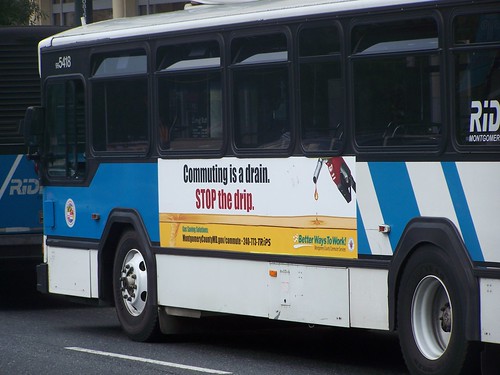
Commuting is a drain.  Stop the drip.  Promotional sign, Montgomery County Ride On bus
Montgomery County bus with a pro-transit advertising sign on the side.

From the Post article:

Bus service in the Washington region is about to suffer its most severe cutback in many years. The Metro board voted to hold public hearings on reducing Metrobus service to close part of the agency's $29 million budget gap. District members blocked consideration of a 5-cent across-the-board fare increase as an alternative to service cuts. Metrobus, Montgomery County's Ride On, Fairfax County's Fairfax Connector and Alexandria's DASH are among the local services planning to scale back by mid-2009 because their government sponsors are losing money. (That's tax money, not fare box money.)

In the DC region, for cost and other reasons, each jurisdiction offers separate bus service in addition to the bus services provided by WMATA as Metrobus. And each of these jurisdictions seems to have a tacit understanding that they will not charge more than the WMATA base bus fare, which is $1.25 with a SmartCard and $1.35 without a SmartCard.
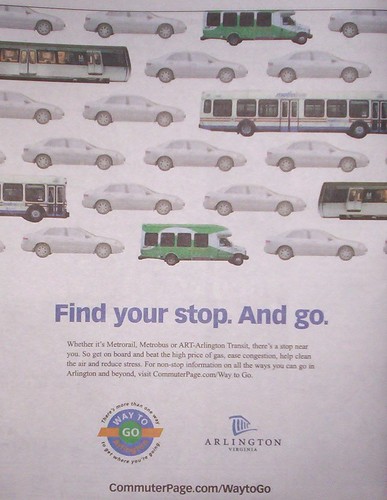
Arlington Transit Promotion ad
Arlington transit promotion ad from the Alexandria-Arlington Extra section of the Washington Post.

The amount of money to be saved by service cuts is about $13.5 million. Most other major cities charge $1.75 to $2.25 for a bus fare. If WMATA were to raise the fare by between 10 and 15 cents, no service would have to be cut.

This would "empower" the surrounding jurisdictions to also raise their base fares, and likely would allow these bus services to operate without big service cuts.
Fairfax Connector bus in new paint scheme
Fairfax Connector bus in new paint scheme in Crystal City.

This is how the DC representatives on the WMATA board's unilateral decision to oppose fare increases impacts the suburbs.

Nobody likes fare increases. But people would rather have a fare increase rather than no bus service at all.
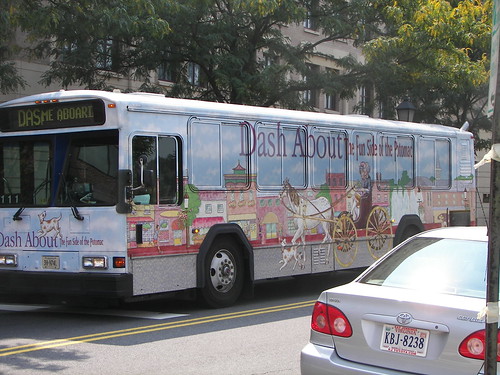
Alexandria Dash About bus, painted to promote tourism
This Alexandria Dash bus is painted in a manner that promotes tourism, highlighting historic sites in the city.

In February, I wrote a blog entry on this topic, "DC needs to exhibit regional quality leadership on transit issues: and right now, maybe it isn't," but I hadn't considered the cascading defaults on service from the suburban bus operations that would result from the WMATA decision.

DC needs to demonstrate greater regional leadership on transit issues.
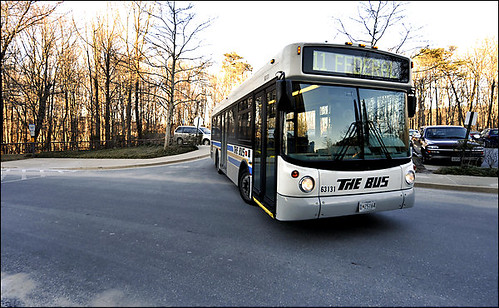
Route 11, The Bus, Prince George's County Maryland
A Prince George's County bus, marketed as "The Bus," in Greenbelt. Photo Credit: By Mark Gail -- The Washington Post.

This is but one example of what not to do, and how seeming to help people by not raising bus fares has extremely negative impact on large numbers of people regardless.

Here is the schedule for WMATA hearings on bus service cuts, from the WMATA press release, "Metro sets six public hearings on proposed budget" (the press release lists the procedure for being added to the witness list):

All hearings will begin at 6:30 p.m. The hearing dates and locations are as follows:

• Monday, April 13, at First United Methodist Church, Fellowship Hall, 6201 Belcrest Road, in Hyattsville, Md. (hearing number 538)

• Monday, April 13, at Marshall Road Elementary School Cafeteria, 730 Marshall Road SW, in Vienna, Va. (hearing number 539)

• Tuesday, April 14, at First Baptist Church of Wheaton, 10914 Georgia Ave. in Wheaton, Md. (hearing number 540)

• Wednesday, April 15, at Arlington County Government, 2100 Clarendon Boulevard, County Board Room, 3rd Floor, in Arlington, Va. (hearing number 541)

• Wednesday, April 15, at St. Francis Xavier Church, Bailey Room, 2800 Pennsylvania Ave., SE, in Washington, D.C. (hearing number 542)

• Friday, April 17, at Metro Headquarters, 600 Fifth St., NW, in Washington, D.C. (hearing number 543)

I have never testified at a WMATA hearing. I guess this round will be my first.
GEORGE bus, City of Falls Church, Virginia
Photo of a City of Falls Church George bus by Adam Moreira via Wikipedia.

Labels: , , , ,