Rebuilding Place in the Urban Space

A community’s physical form, rather than its land uses, is its most intrinsic and enduring characteristic. This blog focuses on place and placemaking and all that makes it work--historic preservation, urban design, transportation, asset-based community development, arts & cultural development, commercial district revitalization, tourism & destination development, and quality of life advocacy--along with doses of civic engagement and good governance watchdogging.

Friday, June 30, 2006

Reconsideration of the value of sports

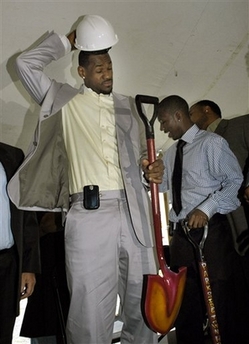
LeBron JamesLeBron James puts on a hard hat during a ground-breaking ceremony for Parkside Townhomes, a 20-million dollar project that James' company, LRMR Development, LLC., is co-developing, in Cleveland, Wednesday, June 21, 2006. At right is Richard Paul, one of James' partners in LRMR Development. (AP Photo/Jamie-Andrea Yanak)

I don't think much about sports-related revitalization. The fact that everything I wrote today is about transit and mobility reminded me of something that Mati Senerchia sent me, about LeBron James.

See "LeBron James Invests In Cleveland Housing Development: James' Development Company To Help Redevelop Glenville Neighborhood," now we don't know if they are urban design appropriate buildings--I haven't been able to find renderings--but still, that says something about this very young man and his character. From the article:

James, 21, along with three friends and business partners who formed LRMR Development LLC, are among the investors in the 18-unit project that will feature two- and three-bedroom, 2,000-square-foot townhouses expected to sell for $265,000 and $325,000 each.

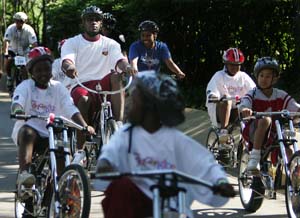
And speaking of another LeBron James pro-urban good deed, see "Sun, stars out in Akron to join bikeathon: Thousands gather on beautiful day to join LeBron James, NBA standouts," where "300 lucky Akron grade schoolers chosen to ride the three-mile course with James and other NBA stars. The kids were selected to receive free bicycles and helmets based on their character" as part of an annual fundraiser for the James Family Foundation and its support of the Akron Area YMCA and the Akron Urban League.

LeBron James King for Kids BikeathonLeBron James (rear) rides his bike down South Main Street in Akron on Saturday, June 24, 2006, in the second annual LeBron James King for Kids Bikeathon. The fundraiser brings thousands of riders and a host of NBA stars and celebrities to downtown Akron. The bikeathon was eight miles long and the family-friendly route was three miles. (Ken Love/Akron Beacon Journal)

That's quite a week for LeBron James.

Index Keywords: ;

Georgia Avenue Rapid Bus meeting

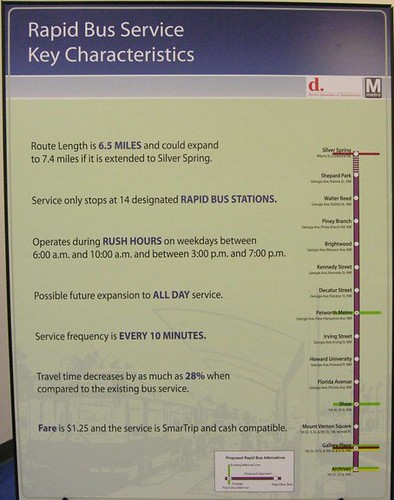
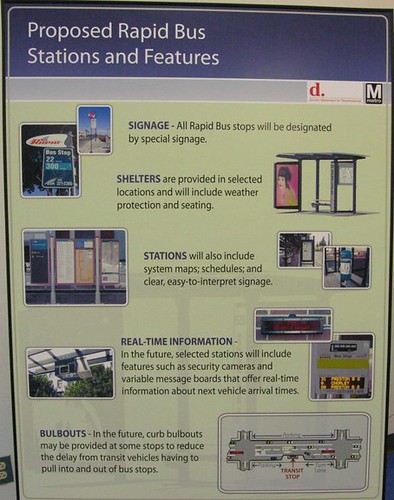
Georgia Avenue Rapid Bus proposalImages courtesy of Tom Metcalf, Chair, Transportation Committee, Sierra Club Metro DC.

So I went to this meeting after all last night and it was interesting. The usual grousing by neighbors, the excitement and glee of transit advocates. I think the proposal is interesting. It's designed to improve service for parts of the corridor that don't have access to higher speed subway service. It's an intermediate step to streetcars, but a whole lot easier to start off with. Their proposals seem fine to me. They intend to introduce this service this year.

My only concern is some desires to "satisfice" and terminate the service at Eastern Avenue, the border between DC and Montgomery County, because those damn Marylanders aren't involved in creating or funding this service.

Still, it makes sense to me that since the streetcar service would go to Silver Spring, and because the people currently riding the 70/71 bus from Silver Spring to DC are coming to the city for a reason, that these people, for whatever reason, are DC's customers-citizens-residents-visitors, even if they alight in Maryland, that it makes the most sense to provide them access to this service also, rather than tell them to "f* off" -- that's not the sentiment of DDOT, but was the basic sentiment of a 71-year old lifelong resident who pulled the "I've lived here my whole life" card, although he used the s*** word not the f*** word in expressing his point.

The way I look at this is that transit customers aren't too concerned about jurisdictional boundaries. To the average rider, they merely want to get from where they are to where they are going relatively painlessly. They don't want to have to mess with too many jurisdictional roadblocks. (I know that the various jurisdictions other than DC do offer their own bus services in addition to WMATA provided bus service, in order to provide more bus service at less cost--often without unionized bus drivers, etc.) Should transit riders from that segment from Silver Spring Metro station to the Eastern Avenue line be left behind to the 70/71 buses?

One complaint made by riders is that people fill up the bus at Silver Spring Metro, so that it is less comfortable and fewer seats are available for riders once they get into DC.

I have some concerns about that sentiment, believing that most DC residents aren't good empiricists, and that I would like to see survey data and origin-destination study data before I would be willing to concede that point.

Possibly one way to collect some more dough would be to charge slightly more for alighting at Silver Spring (maybe 50 cents?). The buses to Dulles and BWI Airport have premium fares of $3.

Photo 4 of 6, Rapid Bus.jpg

Index Keywords:

Speaking of (Baltimore) Streetcars

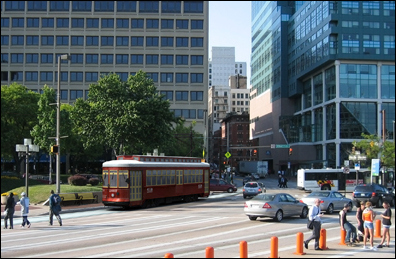
Charles Street Development Team.jpgBaltimore, Charles Street. Simulation: Charles Street Corridor Trolley Initative.

The Charles Street Corridor Trolley Initative has a website, with a nice photo gallery of various streetcar systems in North America, and some (but not all) of their documents--not the economic impact study--online. I like the simulation images, and one difference compared to DC, they seem to be more willing to entertain the idea of "heritage replica" vehicles.

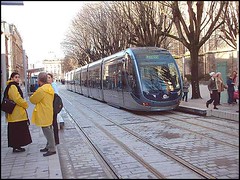
Also, in conversation with some of the Baltimore folk, they pointed me to Alstom's INNORAIL ground level power system, which would allow for in-ground powering instead of overhead wires.
BTO05.jpg"Look ma no wires!" Citadis, the Bordeaux tram. Photo from Transit Coalition.

Charles Street Development Team.jpgBaltimore, Charles Street. Simulation: Charles Street Corridor Trolley Initative.

I like that Baltimore seems to be more open to the idea of interoperable modern and historic (replica or actual) streetcars. As I have written before, there are cultural heritage reasons to promote this that make sense. See: "Adding cultural heritage dimensions and expanded service capabilities within commercial districts to DC Streetcar planning ."

Index Keywords:

Relativistic thinking about mobility

The New York Times  Business  Image .jpgChristophe Ruckstuhl/Keystone, via Associated Press. Despite its hip image in big European cities, the Smart division of Daimler has lost an estimated $3.6 billion since it opened in 1998.

"Conservatives" like to criticize society post-1960s as degenerating into a valueless sphere of relativistic thinking. It happens that this is a pretty facile approach to the nuances involved in cognitive development. I have mentioned before William Perry's work and his 9 stages of cognitive development. Relativistic thinking as a "permanent" form of thinking without commitment is by no means the highest stage.

This comes up with regard to thinking about different forms of mobility, comparing forms, and determining which are "superior." Sometimes I do fall into this trap that I need to extricate myself from too. People would send me stuff about scooters, Segways, etc. and I would always respond, "a bike is better." Sure, a bike is better than a scooter or a Segway for most settings, but that isn't the point.

In a city, for a lot of things, a bike is better than a car. And, now that you can take a bike on buses, and on the subway except for certain times of the day, you get further enhanced mobility that is relatively time-efficient.

For example, I went to that bus rapid transit meeting last night, but I didn't want to ride up the hill of Georgia Avenue. So I rode to 7th and Florida Avenue NW and took the bus up. On the way back, aided by the downhill slope, I rode all the way home (made good time too).

Anyway, there is some discussion about the Smart Car, and the response from some is "a bike is better." But the Smart Car isn't about bicyclists. It's about people who already have cars. In auto marketing what they call "conquest" sales is when a particular brand gets someone who drives another brand to switch (a Lexus sale to a Mercedes driver is a "conquest", etc.).

We need to think about "conquest sales" in terms of promoting (more) sustainable transportation options. And moving people along a sort of continuum to better mobility choices. The kinds of "conquests" we need to work towards are getting a car driver to switch to transit, or a multiple car household to get rid of a car, or for a F-350 pickup driver to switch to a Smart Car, etc.

walking
bicycling
Segways?
scooters/Vespas
transit
- bus
- rapid bus
- light rail/streetcar
- subway
driving
- car (usually big)
- cars (usually many in a household)
- shared cars
- Motorcycles
railroad

(this is another element of thinking about transportation planning through the lens of a transit or mobility shed)

Other dimensions include frequency of use, purpose of the trip (for example, delivery services need to come back--if Home Depot can make deliveries in Manhattan, maybe Best Buy and Target and Bed Bath & Beyond could have a shared delivery service from the DC USA shopping center in Columbia Heights), habitation type and location (apartment buildings could develop car sharing Smart car programs as a profit center), sustainable and efficiency, etc.

Yeah, a bicycle is better in a lot of instances than a Smart Car. But for someone committed to driving, a Smart Car is way better than most any other car choice they make--for most trips under 25 miles (and most people in the city make relatively short driving trips). And you can almost fit 2 Smart Cars in the same space that one car takes up on the street now.
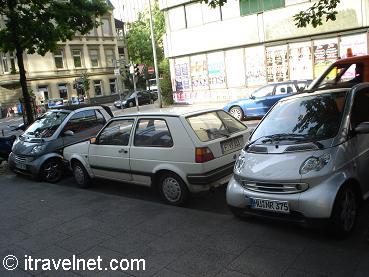
Smart cars in FrankfurtSmart Cars in Frankfurt. Photo from ITravelnet.
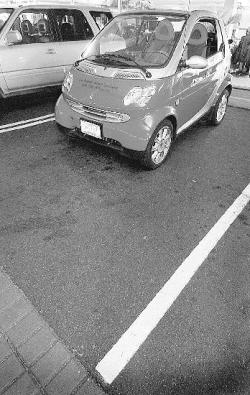
Smart use of a parking space (Smart Car in Canada)Smart use of a parking space (Smart Car in Canada). From Canada.com.
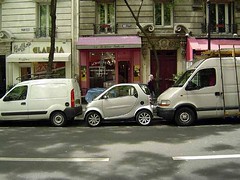
Smart Car - Spike's FotoPage - Fotopages.com.jpgSmart car in Paris. Photo by Spike.

That's good for cities, and why I expect I will write to United Auto Group and make the point that they need special dealerships in center cities (the Mini dealerships are in the suburbs).

In short, I think that a bicycle is always better than a Segway, and I can't even think of a possible conquest sale-choice favoring Segways (no car driver would give one up; is a Segway ever preferable to a bike or walking or transit?, probably not), but a Vespa would be much better than a car. On the other hand, a Segway can be great for people with mobility issues.

Everything isn't relative, but we need to be sure we are making the right comparisons when we are debating these issues.
_______
Question for you: in this New York Times article, "Daimler Hopes Americans Are Finally Ready for the Minicar," a trends analyst is quoted comparing the Smart Car to a Mercedes and using that as a marketing point, rather than focusing on its size and urban-appropriateness. From the article:

Smart will not be the only extreme-subcompact darting in and out of traffic on American city streets. Honda has had success with its new Fit, as has Toyota with the Yaris. DaimlerChrysler notes, however, that the Fortwo is the only car in the world less than 3 meters (roughly 10 feet) long.

That makes it small enough for two to squeeze into a single parking space. Or for drivers to park it perpendicular to the curb without protruding beyond other parked cars — a practice that is forbidden in some cities.

Some experts said DaimlerChrysler should promote Smart's European styling and affiliation with the Mercedes Car Group. "They ought to play it like a Baby Benz," said Joel A. Barker, an author and expert on business trends. "The Smart car just has a style to it that these other cars don't have. They don't have the cachet."

Do you think he is right and I am wrong? Should the Smart Car be marketed primarily as a "city car" or not?

Labels: , ,

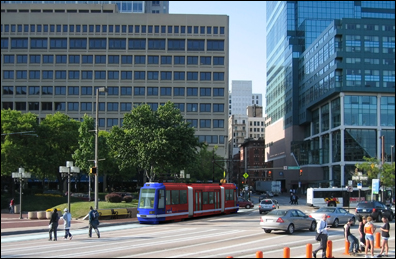
Look at this, I guess this streetcar is coming to DC


Picture-10-27 007
Originally uploaded by portlandtransport.
A Trio under construction for Washington D.C. From Portland Transport's Flickr account.

Index Keywords:

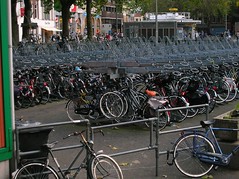
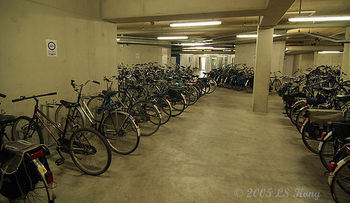
Two-tier Bike Parking


Two-tier Bike Parking
Originally uploaded by portlandtransport.
The top rack pulls down on a hinge for loading and unloading. Users prefer to use the bottom first. Netherlands. Photo from Portland Transport.

Public Opinion Research Presentation (from Portland)

I happened across the Portland Transport Flickr account, which has a bunch of images related to Portland's streetcar and transportation planning.

Index Keywords:

Thursday, June 29, 2006

A basic lesson in (housing) economics

Frozen Tropics writes:

[Yester]day's Post has this article, "Housing Cost Increases Migrate to Poorer Areas" about how, while housing prices in more established neighborhoods like Cleveland Park or Capitol Hill proper seem to be leveling out, prices in areas with greater poverty (like Ivy City) continue to climb steadily.

In high cost areas, adjacent areas of rough equivalence (location, housing stock, amenities) but lower prices experience increases in demand and therefore price, spurred by the demand of people who can't afford to buy in the higher cost, "nicer" but still close areas, so they accept a secondary choice-location. This is what spurs "neighborhood investment" and what some people call "gentrification." (See this previous blog entry on the topic, "More about Contested Space--"Gentrification".)

However, it is likely that the new entrants in the lower cost area, while having less household income compared to residents in the preferred areas, have more income than present residents in the secondary area, which can contribute to recognition and resentment of "differences." (See gentrification effect #2 in the previously cited blog entry.)

Case #1 Example: the H Street NE neighborhood.

People were first attracted to H Street because the housing stock is roughly identical to that on Capitol Hill, although the houses typically are a bit smaller. Generally, the area isn't as maintained as nicely, and the shopping amenities particularly restaurants are meager, but the area is just as close to Downtown, National Airport, and the Capitol. And if you want a decent meal, just go a few blocks south...

Talk to old-timers. Some say, yeah, when I first moved here, no one moved east of 6th Street, then it was 8th Street, then it was Lincoln Park (11th Street), now that Hill East will be home to a Harris-Teeter, interest is moving all the way over to the Anacostia, etc.

As prices increased in the H Street area, accelerated in part by the groundbreaking and later opening of the New York Avenue Metro station, demand moved northeast into lower Trinidad. It continues northward into upper Trinidad, Ivy City, and eventually eastward past Miner School on the 600 block of 15th Street NE, although that area is still tough...

Remember the same kind of progression with regard to Dupont East, Logan Circle, Shaw, U Street? Now it's Columbia Heights, Petworth, and northward up Georgia Avenue. Etc.

I was on U Street last night at about 8 p.m. and 50% of the people on the street were white. Makes you appreciate people's concern about deep changes in the city.

Although as I have said time and time again, that's the way it's been for more than 120 years. Neighborhoods change. And they keep changing.

See "Renaissance continues along capital's `Black Broadway': Washington D.C.'s U Street corridor -- known as Black Broadway for its history of drawing black artists and cultural institutions -- is undergoing a face lift that is already restoring some of its former glory" from the Miami Herald and today's obituary, "Mayor of U Street' John 'Butch' Snipes, 71" from the Post.
PH2006062802062.jpgJohn "Butch" Snipes. Family photo.

U Street Britta on Flickr - Photo Sharing!.jpgFlickr photo, Britta on U Street, from housing

Index Keywords:

Pedestrianism


Old pedestrian street sign
Originally uploaded by rllayman.
Today's District Extra section has an article and sidebar about pedestrians and street fatalities. I'm surprised that the statistics show that more people walk to work in Baltimore than in DC. From "Taking Steps to a Pedestrian-Friendly D.C.":

On average, 550 walkers are hit on District streets each year. And although progress has been made in reducing fatalities, which reached 25 in 1993, officials are aiming for zero.

It's an important goal in a place that ranks second among U.S. cities in the proportion of commutes done on foot. The 2000 Census found that walkers account for 11.8 percent of journeys to work in Washington. Baltimore is higher, at 13 percent. New York, a prime pedestrian city, has only 10.4 percent walkers.

When commutes that involve walking to public transit or bicycling are added in, almost 47 percent of trips to work in the District are fully or partly by foot or bike, city officials said.

Speeding is a major concern, because a vehicle's speed "is the most critical factor" in determining whether a hit pedestrian will live or die, said George Branyan, pedestrian program coordinator for the D.C. Department of Transportation.


Of course, while the speed limit on most streets is 25 mph, most of the streets are engineered for speeds in excess of 50 mph, we have a problem.

We need alternative ways to get people to think about streets differently, about the impact of cars on people and spaces.

Road Witch (UK)From the Road Witch project in the UK.

The article also has a sidebar on the city's Pedestrian coordinator.

Index Keywords:

(Why aren't people) Learning from Jane Jacobs revisited

PH2006022101798.jpgPreston Keres, Washington Post. Unveiling of a model for National Harbor in Prince George's County Maryland.

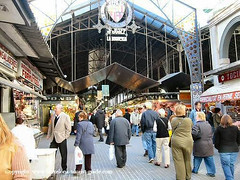
Last July, I wrote this entry, "(Why Aren't People) Learning From Jane Jacobs" in response to something that Michele Dyson wrote in the Post about National Harbor and making it more like Las Ramblas in Barcelona.
Yahoo! Mail - <a href=Here is the Mercat de la Boqueria a large and colourful market on the Ramblas. If you were to visit this market, particularly during the summer months, you'll be dazzled by the brilliance of colour from the fruits and vegetables in its stalls. Photos from Barcelona Tourist Guide.
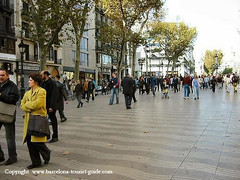
Yahoo! Mail - <a href=Las Ramblas.
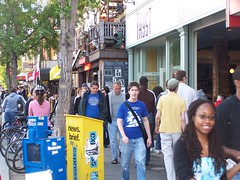
Sidewalk, Adams-Morgan (by Tryst)Sidewalk in Adams-Morgan.

Well, everything in that piece is relevant to the ongoing discussion about revitalization vs. redevelopment and authenticity vs. a focus on the attraction of retail chains. Silver Spring Singular linked to a story in the Gazette about this verysame issue in Silver Spring, which we discussed earlier in the week. See "Owners of niche shops downtown getting priced out: Being a part of the redevelopment in Silver Spring has its cost, many now say."
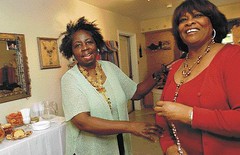
characters061406a.jpgNaomi Brookner⁄The Gazette. Elena Aiken (left), owner of Elena Design Studio on Fenwick Lane in downtown Silver Spring, helps customer Doris McGhee of Washington, D.C., decide on a necklace June 10, during an open house at her shop. ‘‘I like revitalization but I’m not benefiting from it,” said Aiken, who fears her rent will soon increase.

ALL I CAN SAY IS read Jane Jacobs, read the writings about the "economic restructuring" point of the Main Street approach. The problem is that the improvement in the real estate market for property owners is somewhat disconnected from improvements in the market for retail and service store proprietors. Rents go up in advance of business increases. And property tax increases lead to rent increases even though business could in fact be declining.

Rents have to be a function of market reality, of what businesses generate in revenue. Unfortunately, as our commercial districts become a part of the national and even international real estate market, local businesses get priced out.

As regular readers know, I have testified about the issues of property tax valuation methods in traditional commercial districts. Those new to the issue might want to check back to this analysis, which I figured out through some pretty careful analysis of what's happening in various commercial districts around the city. See:

-- Testimony -- Historic Neighborhood Retail Business Property Tax Relief Act.

Index Keywords:

Tonight -- Bus "rapid" transit planning for Georgia Avenue NW

______
Update: I don't think I can go to tonight's session, but I have one important comment. They are considering stopping and starting this service at Eastern Avenue rather than to/from the Silver Spring Metro Station. Presumably this is because DC will pay the extra costs for this service, not Montgomery County. On the other hand, more connectedness is better than less connectedness, and it would be a mistake to stunt the development and growth and opportunity of this enhanced bus service.

As Richard Gere says in "An Officer and a Gentleman": "Don't you do it. Don't!"

Do it right or don't do it at all.
______

Steve Pinkus sent this on to me, although I didn't get it in time to mention the meeting that was held Tuesday night:

Community Workshops to Be Held on Plans for 'Rapid Bus' Service Along Georgia Avenue and Seventh Street, NW

The
District Department of Transportation (DDOT) and the Washington Metropolitan Area Transit Authority (WMATA) will hold two workshops [this] week to engage residents on the establishment of a “Rapid Bus” service along Georgia Avenue and Seventh Street in Northwest. The workshops will give residents an opportunity to learn about the proposed Rapid Bus service and provide input.

As planned, the service would run between the Silver Spring Metrorail station or Eastern Avenue, NW, and the National Archives via Georgia Avenue and Seventh Street, NW. The existing Georgia Avenue/Seventh Street 70/71 Metrobus route transports 22,000 passengers daily between Silver Spring and Buzzards Point. Recent studies show passengers along this route would benefit from a service in addition to the regular route bus service. The service would feature distinctive, low-floor vehicles and provide faster service with fewer stops.

Thursday, June 29, 2006 in the Multipurpose Meeting Room, at the Emery Recreation Center, 5701 Georgia Avenue, NW.

The workshop begins at 6:30 pm and runs to 8 pm.

For more information, residents may contact Catondra Noye, DDOT Project Manager, at (202) 673-1737

Index Keywords:

Shaw Main Streets Lower 9th Street Open House -- Tonight

001Long View Gallery, 9th Street NW.

I am always impressed with the energy and ideas expressed by Alex Padro, director, and the Shaw Main Streets program. (I talk about co-authoring a book for the Main Street program, The Ultimate Guide to Retail Business Promotion. Clearly he needs to be one of the co-authors.)

Anyway....

On Thursday, June 29, 2006, 6:00-9:00 PM, pick up your Shaw Main Streets Night passport at either TG Cigars, 1118 9th Street, NW, or the Ninth Street Gallery, 1306 9th Street, NW, and join the fun as businesses on the 1100 through 1300 blocks of 9th Street open their doors for this first ever SMS Night Open House. Be sure to get your passport stamped at each of the participating businesses in order to be eligible for a drawing for a prize from each business.

Participating businesses will include (final listing on the event passport):

Ninth Street Gallery, 1306 9th Street, NW
Long View Gallery, 1302 9th Street, NW
Wagtime Pet Spa and Boutique, 1232 9th Street, NW
The Flats at Blagden Alley, 1212 9th Street, NW
Squares Fashions, 1208 9th Street, NW
Modern Liquors, 1200 9th Street, NW
Breakwell's Coffee + Tea, 900 M Street, NW
TG Cigars, 1118 9th Street, NW

Several of these businesses have opened in the past two months, so take this opportunity to visit them and win some exciting prizes. No purchase necessary to win. Contest rules will appear on the back of the passport.

Shaw Main Streets Night events highlight new businesses on Shaw’s 7th and 9th Street commercial corridors. For more information, contact
Shaw Main Streets at 202-265-SHAW or by email.

Index Keywords:

Does a restaurant selling alcohol create a pernicious environment for children?

Real Drunks Don't Drink Zima
Modern Drunkard Magazine.
______
Update: also see this article from the Washington Post, "Request for Liquor License Uncorks Dispute," by Lyndsay Layton. WRT the School Board holding an emergency meeting to weigh in on this issue, no wonder the school system is in trouble. They aren't focusing on what really matters. A restaurant's peak hours of operation are from 7-10 pm. Uhh, schools aren't open then, are they? (Note that Alex Padro's comment in the story, that restaurants make 60% of their revenues from alcohol isn't correct, maybe 60% of net profit--alcohol is marked up 5 times, and food not usually more than 3-4 times. So a drink that costs $1 to make yields $4 in profit. It adds up. From the article:

Evans said that his bill would remove the automatic prohibition against a license but that the alcohol beverage control board would still be required to hold hearings and consider opposition.

What's the problem with that?
_______

Bill 16-696, which proposes to allow CR and CT sales (restaurant/tavern) of alcohol within 400 feet of schools, continues to raise hackles amongst some. Apparently, the School Board is trying to call an emergency meeting to pass a resolution on the issue, and it's still being discussed on the columbia_heights e-list. (I wrote about this last week.)

In response to William Jordan's rhetorical question, "It that because we no longer feel the need to offer special protection to these classes of persons and insititutions?," I would answer:

It is because the proscription chosen, for restaurants, has no impact +/- in terms of offering "special protection" wrt the sight of alcohol or inebriated people.
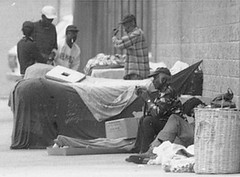
Skid Row in Los Angeles
Skid Row in Los Angeles. Photo from the Weingart Center.

Restaurants are the issue here. Not package sales. Package sales tend to over-contribute to conditions in the public spaces that are deleterious to children. Yet the exception clause for Class A and B licensees--if a preexisting establishment exists, then the provision can't be enforced against others--means that in many instances this law is moot.

But it affects restaurants (CR, CT) even so, which are a different category, and again, have little if any impact on children. Technically, night clubs (places such as in Adams-Morgan) though raucous, also have little impact on children because their activities happen late at night/early in the morning.
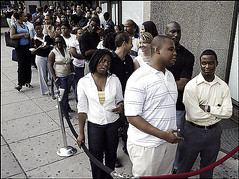
Club 1223 for Happy Hour
Queue the revelers: Steven Hargrove, front left, and Carl Biggs plot their Wednesdays to arrive early in line for the popular happy hour at MCCXXIII. (By Preston Keres -- The Washington Post). From "Drinking Up The Club Atmosphere."

For churches (not technically at issue), this is a non-starter. Most churches function only for about 3-5 hours/week, on Sunday mornings. Class A establishments are closed on Sundays. Class B sales start at noon. Restaurants serve alcohol in the morning, but it is quite limited.

The failure to make useful distinctions between Class A and B licenses vs. Class C licenses is one of the many failures in local political discourse. This catches us particularly in our mixed-use neighborhood commercial districts, which often include schools and religious institutions in the mix of uses.

Better to think about how to limit the impact of alcohol on children and work backwards in terms of thinking about and creating policies. In so doing, I can't imagine that restrictions on C licenses would have any impact whatsoever, or make the list of the top 10 or top 20 policies to work on bringing about.
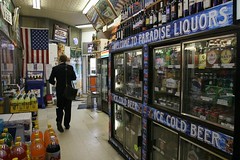
Paradise Liquors
Paradise Liquors. Washington Post photo by Nikki Kahn.

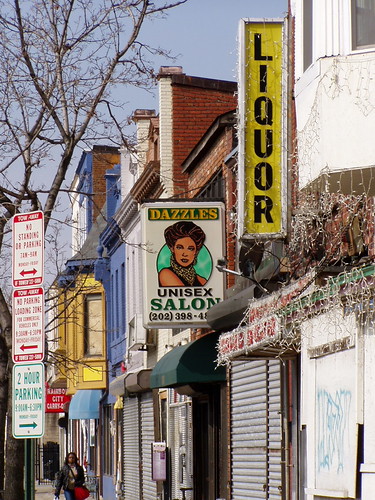
Liquor store on H Street NE
H Street NE. Flickr photo by Inked78.

Labels: ,

Wednesday, June 28, 2006

Walking Tour--Downtown DC Libraries and Research Facilities: Their German Immigrant and Neighborhood Histories

From Norma Broadwater (via the H-DC e-list):

Walking Tour: Thursday, June 29, 5 - 7:30 pm
Meeting point: Historical Society of Washington, D.C., 801 K St. NW
entrance (north side), Mount Vernon Square

The Historical Society of Washington, D.C.'s Kiplinger Research Library, which is located in the old Carnegie Library building, and the Washingtoniana Division of the Martin Luther King, Jr. Memorial Library, are indispensable facilities for local research.

Washington, D.C. guide and historian Alice Stewart will show photographs and documents from both libraries to illustrate how they can shed light on the history of specific buildings and former residents in the neighborhood. She will also update visitors as to the status and future uses of both library buildings.
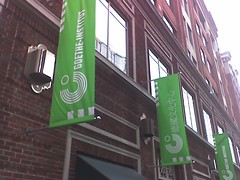
Goethe Institut, WashingtonGoethe Institut, Washington. Photo by Payton Chung.

The tour will begin at the former Carnegie Library, continue through the neighborhood north and west of the Library, stop by the Goethe-Institut (812 Seventh Street), where visitors will learn about its programs, research facilities and services, and end at the Martin Luther King, Jr. Library. A reference librarian in the Washingtoniana Division will give a special presentation for the group.

Limited to 20 participants
RSVP to 202-289-1200, ext. 510
For further information:
www.goethe.de/washington, or 202-289-1200

Charge: $5.00
Free for members of Friends of the
Goethe-Institut, the Historical Society of Washington, D.C., and Friends of Washingtoniana.

Index Keywords:

Losing my religion (continued)

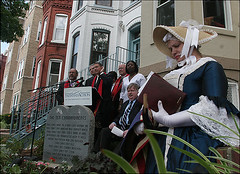
PH2006062601265.jpgMerrie Warren Turner, dressed as Betsy Ross, and other members of the evangelical Christian group Faith and Action unveiled a monument depicting the Ten Commandments in front of the group's offices in a Capitol Hill rowhouse this month. The property is across the street from the U.S. Supreme Court. (By Jahi Chikwendiu -- The Washington Post)
Officials in both DC and Baltimore have made bad decisions on planning and zoning regulations with regard to properties owned by religious organizations.

In Baltimore, Mayor O'Malley punted on letting the Archdiocese of Baltimore go forward with the demolition of an apartment building, according to a piece (part of a slew of letters to the editor) by Tyler Gearhart, director of Preservation Maryland:

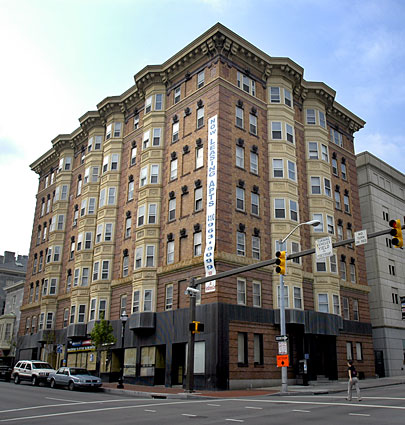
Mayor Martin O'Malley recently approved a demolition permit for the historic Rochambeau apartment building located at Charles and Franklin streets downtown. Depending on your perspective, the mayor has either bowed to or hidden behind the archdiocese's threat to sue the city in the name of religious freedom if the permit was denied.

For the Baltimore Sun editorial on this issue, please click the link and here for the original article, "Rochambeau has to go, mayor says: Catholic Church wins fight to raze building."

Today's Post has a piece "City Drops Objections To Religious Sculpture" subtitled "Display Doesn't Need Permit, Agency Says," about the controversy on 2nd Street NE where an evangelical group installed a sculpture of the Ten Commandments in the front yard "to influence" Supreme Court Justices as they ride into work. Obviously, whizzing by in a car, you can't read squat on a tablet from 30 feet away, so this is merely grandstanding.

From the article:

More than three weeks after District officials warned an evangelical Christian group about displaying a sculpture of the Ten Commandments on property across the street from the U.S. Supreme Court, they said yesterday that the 850-pound granite monument doesn't need a permit after all. ...

Yesterday, Lars Etzkorn, associate director of the office of public space management administration at the Transportation Department, sent a letter to the group rescinding the earlier warning. The letter stated that, "In view of the First Amendment interests reflected in the installation of the Ten Commandments sculpture . . . and upon further consideration of applicable law," the city now believes that no permits are required.

The First Amendment forbids Congress to make any law prohibiting the free exercise of religion or abridging freedom of speech.

Both cases are a misuse of religious principles to planning and zoning decisions, not much different than "blue laws" (no longer extant in DC) that prohibit the sale of alcohol within a certain distance of a church.

Granted that I am not a lawyer, but the way I read the law is that local laws that somehow treat churches differently (and punitively in some way) and therefore impact the practice of religion, are what are covered.

Zoning and land use provisions that are the same for every property owner would not be included, although many many churches bring up this federal law in an attempt to get around zoning laws. Or financial hardship. A church in Virginia said they couldn't repair their steeple to historic preservation standards and that the federal law allowed them to vacate the preservation provisions. My sense is that again, hardship is not a defense when the laws treat every property owner equally.

However, there is a case in Georgia currently, where a municipality has a law that only allows churches to be located on sites where churches already existed (because of loss of properties from tax rolls), that is likely to be considered a clear violation of the act. (It's a pending case.) And in Montgomery County whether or not churches (megachurches) should be allowed to locate in the Montgomery County Agricultural Preserve is a contentious issue. (I say no. Pouring cars onto rural roads is not the intent of the law that created the Preserve to begin with.)

Another problem with this is the City's elected officials kow-towing to churches over the hardships that Sunday parking during services often causes area residents. I think that this use can be accommodated, but not if churches don't have to create and manage "transportation demand management" programs and not if they can avoid being brought to the table as a result of elected officials pandering.

baltimoresun.com - The Rochambeau.jpgThe Rochambeau, once a hotel and now a vacant apartment building, has stood for a century at Charles and Franklin streets. Preservationists argued for saving the Renaissance Revival building. (Sun photo by Chiaki Kawajiri). Sep 30, 2004. Recent studies find that the amount of housing stock deemed affordable in Baltimore and the Baltimore region is shrinking drastically.

Index Keywords: ;

Central library planning redux

In a blog entry last month, I wrote about the Portland streetcar, mentioning a Seattle Times travel article about Portland. Somehow I missed a part in the article "A streetcar to inspire, in Portland," that discusses the difference between the two cities and their central libraries.
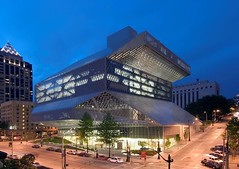
Seattle Central LibrarySeattle Central Library, photo from the American Institute of Architects.

WRT modern vs. classical design in libraries, Seattle has built a Rem Koolhaas-designed place. Portland has a library from the early part of last century, recently renovated (and ironically, the new director of the DC Public Library system worked in Portland during the time of that renovation. From the article:

Hop the streetcar a few more blocks to downtown and get off by Portland's Central Library at 11th and Taylor (the entrance is on 10th). The restored 1913 edifice with grand staircases and chandeliers is another Portland yin to Seattle's yang.

Where would you rather spend an afternoon, at the ultra-modern library in downtown Seattle or the historical library in Portland, my wife asked our daughter. "Oh, Portland!" our daughter exclaimed. "It's a beautiful library! The one in Seattle makes you feel like a pod person!"
Multnomah County Central LibraryMultnomah County Central Library, Portland, Oregon. Photo by Miles Hochstein, Portland Ground.

Portland Central LibraryMARK HARRISON / THE SEATTLE TIMES. The streetcar has a stop near Portland's Central Library, in a grand 1913 building.

With regard to the process in DC, the proposal is very much "satisficed", calling for a facility half the size of the current library and about half the size of new central libraries being built elsewhere (such as Seattle).

And the proposal calls for $100 million in private donations, when (1) DC doesn't have a good track record for attracting such (our major industry isn't private, but the federal government, so we don't have lots of indigenous rich people hanging around with open checkbooks, and (2) Seattle raised "only" $14 million (not $100 million) in private contributions as part of its project.

I have written about this pretty extensively. It's also very controversial in some quarters because the proposal calls for (1) mixed use; and (2) the deaccessioning and lease to private interests of the current library, a Mies van der Rohe building.

WRT the latter, I happen not to be a fan of modern architecture, but the proposal, overall, has so many many problems. It gives "caring" about "public spaces and the public realm" and "mixed use" a bad name.

This is a blog entry from January about some of the issues: DC Library Planning Part ? and this from November: Citizen Summit and Libraries.

Katie Salay of PPS calls our attention to this piece at ArchNewsNow, "Reference This: Two views on trends in public and academic libraries." The interview with Mark Schatz, AIA, Field Paoli, focuses on "recent changes in public libraries, especially smaller community libraries." From the piece:

Mark Schatz: One trend we are seeing more of is the multi-use building. The library, senior center, teen center, gym, all together.
KC: Is this something communities are demanding? Or is it mostly an issue of keeping construction and operations costs down?

Schatz: I think it's a matter of synergy more than budget. For years architects worked with this concept, which seemed rooted in the 1950s, that you had a city plan that gave each use its own discrete area. And you would drive from home to business to retail to school to library. That's not the tradition of cities prior to that period. Residences and offices were over the shops; uses and people commingled. You could get most of what you needed within a short distance. Architects and urban designers are finding ways to change various codes and ordinances to encourage mixed use, and one area we are seeing that effort is with community facilities. It's part of a significant, larger trend.


He also discusses linking retail in with planning, how you need to look at different user segments (he calls them "layers") and how their needs differ and how to design and respond to these different needs, as well as public participation issues.

The interview with Ed Dean, AIA, LEED, Chong Partners, focuses on trends and design of "large urban libraries," and college libraries too, developments within which are relevant to urban centers. (They don't discuss the impact of book superstores on libraries, although this piece from the Seattle Times, "Meet your new Central Library: It's both a testament to and test of civic chutzpah," mentioned in this blog entry "Today's Library hearing testimony" covers that issue. From the ArchNewsNow piece:

Ed Dean: Libraries are becoming a kind of public forum. They are one of the last places where people can intersect, get public service, and shop for information. They're becoming less about checking out a book and more about finding services and interacting. There are homework centers, computer training centers. I reviewed the plans for a new library in San Bernardino, California ?it hasn't been built yet, but a prominent feature in the design is a community garden that occupies the entire roof. The biggest change I've seen is the addition of computers for children. A lot of larger libraries now have arrangements with the school district to provide a high-tech classroom. The districts don't tend to have the resources.

The article is full of good images as well and you need to read it.

For various reasons, I think we need to stick with the current Central Library, fix it, expand it, add other functions (such as City Museum, archival, and visitor functions, and look at working to bring other special libraries into the mix such as the independent Foundation Center Library currently located on K Street NW).

Something I wrote about that is here:

-- Central Library Planning efforts and the City Museum, how about some learning from Augusta, Maine ... and Baltimore? and
-- MLK Library: Eyesore or Modern Masterpiece?

Index Keywords:

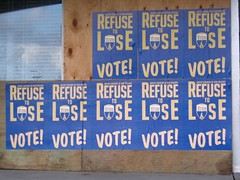
Mid City: Refuse to Lose

This is from the flickr photo account associated with The Third Battle of New Orleans blog on rebuilding New Orleans.

There is no question that blogs, photo communities like Flickr, other web communities and software applications (and for good and bad--email*) take connecting and learning to levels unimaginable 13 years ago.

I say 13 years ago because it was in August 1994 when the New York Times first wrote about the "World Wide Web," specifically the Mosaic graphical browser, which was a recognition of the fast spread of this software innovation.

* Email is also a curse. I now get over 200 emails daily and I cannot keep up, or even get through a single day's messages.

Plus, I get queries for help and my opinion from all over. And I do respond. And that takes time. You see my blog entries (long, with citations), well, my emails are no different.

Farmers Market Policy presentation last night


Yellow Pepper
Originally uploaded by AndrewMorrell.
Tuesday night was the now annual (this was the third one) presentation about farmers market policy, held in the Longworth House Office Building, sponsored by the chairman of the House Agriculture Committee, Robert Goodlatte of Virginia (he's from Roanoke, and the Roanoke Farmers Market is in his district).

Large farms have the product and systems to participate in the national and international sales and distribution system. "Direct" marketing of produce is a way for farmers to capture more of the value from the market chain. Plus, it is one of the better ways for truly small farms (under 15 acres) to sell product and make a workable, viable, profitable business.

Presentations by Steve Davies of Project for Public Spaces (one of the lead organizers of the session), Charles Kuperus, Secretary of Agriculture for the State of New Jersey, and Errol Bragg, Associate Deputy Administrator for the Agricultural Marketing Service of USDA were excellent.

One funny thing though about the person speaking from the federal government. He discussed the various initiatives of the office, including a Farmers Market Policy mini-conference, and how they hope that this becomes a more regular event. This mini-conference occured at last fall's PPS Farmers Market conference, and it was my idea. I raised it at a steering committee meeting, making the point that they needed to leverage the opportunity to engage federal policy types, since the conference was to be held in Washington.

It was weird to see how my idea is being translated into federal "policy"...

Afterwards there was a nice reception, with food provided by farmers who participate in farmers and public markets.

Public markets are the permanent buildings, such as Eastern Market, while farmers markets are the "temporary" events, such as the Brookland Farmers Market on 12th Street from 10-2 on Sundays, or at the Metro on Tuesday nights, or the Historic Anacostia Farmers Market sponsored by the Capital Area Food Bank, held at "Peace Park" on 14th Street between U and V Streets SE, every Wednesday, June through mid-November, from 3 – 7 pm (or until dark in the fall).

Anacostia Farmers Market

Index Keywords:

Rock Creek Park


Rock Creek Park
Originally uploaded by birdcage.
I am taking the liberty of reprinting this entry from the Columbia Heights yahoogroup. The writer took advantage of Rock Creek Park being closed to cars because of flooding.

(very slightly edited) From Peep:

Now is your chance...run, walk, bike on Rock Creek Parkway!

I ran this morning even in the rain because the chance to run the length of Rock Creek down to the Kennedy Center is something I could not pass up. I heard birds chirping, the sound of a very full Rock Creek flowing, and even the wind blowing. No cars, no cars, no cars!!!

The politicians and our WONDERFUL elected officials are so afraid of this. Why? Because all of the cars had to take the Beltway, drive through downtown, or take some other way to get to work and did we have any major disasters with traffic? No! I drove through downtown this morning (7:30AM) on Connecticut Avenue to 21st Street down to Constitution and it only took me 15 minutes.

Now this proves that we can safely close the entire length of Rock Creek Parkway on the weekends with no problem!! Why not??

The traffic is even lighter on the weekends without all the Feds going to work. I know you people who oppose this will say boo hoo! This is a critical route for people, emergency vehicles, blah, blah, blah. Well, become a politician then if you want to complain that much (sorry venting now before I read the hater's posts).

I think we should reclaim Rock Creek Parkway back for the people who run, walk, and bike - people who help the environment. Why reward people who drive cars that produce ozone and damage the environment. What a dumba$$ way of thinking.

Index Keywords: ;

Speaking of windows


Originally uploaded by Your New Best Friend.
From Danielle Thyse, Preservation Maryland:

Colleagues Workshop: Historic Window Rehabilitation

In partnership with Allegany College of Maryland, the City of Cumberland, the Maryland Historical Trust and the Historic Preservation Institute, Preservation Maryland is pleased to offer the first of several workshops on Historic Window Repair. Join historic restoration specialist David Gibney for a full day workshop and learn how to save a bit of history for your old home, while making it more energy efficient and saving thousands of dollars on repairs.

When: July 20th, 9am – 4pm
Where: 9 Virginia Avenue, Cumberland, MD
Cost: $25 – Members of Preservation Maryland Colleagues
$55 – Non-members
______
Although Cumberland is a bit of a trip...

Index Keywords:

Baltimore: tourism (slogan) revisited

Banner ad, Baltimore Summer Tourism Promotion, 2006
As you may recall, I was somewhat derisive of Baltimore's new tourism promotion slogan, "Baltimore, Get it on it," even though I think the associated logo is okay. See this previous blog entry, although now I feel guilty about the headline [More (pathetic?) city branding efforts... (Baltimore).]

However, I must make it clear that Baltimore, regardless of the slogan, does great tourism marketing. Right now, they seem to be the primary banner headline advertiser on Yahoogroups.

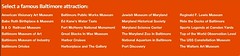
Click through to Baltimore Summer and you'll be impressed with the webpage that greets you. It's well laid out, lists major attractions, offers up to $150 in coupons, calls your attention to an e-newsletter you can sign up for and enter a contest for a free weekend.
Baltimore Summer Tourism Promotion, 2006
It's topnotch, truly.

By comparison, our own Washington tourism promotion webpage is unompetitive.

And this listing of assets is a great way to organize our own thinking about how to present our "local" tourism resources vis-a-vis the "national-federal" tourism resources.
Baltimore Summer Tourism Promotion, 2006

Index Keywords:

Tuesday, June 27, 2006

Our friends in New Orleans need our help

Trash your city, trash yourself

1. The The Vieux Carré Property Owners, Residents and Associates, Inc. association in the French Quarter is looking for a community organizer with a preservation sensibililty or a preservationist grounded in community organizing. The problem is that organizers tend to think preservation is just for the rich, and the average preservationist doesn't understand organizing, what I call "built environmental justice." From the posting:

The job requires being a strong and effective:

Strategist; Motivator; Teacher; Facilitator; Organization builder; Committee builder/trainer; Financial Development coordinator; Organizational coordinator; “Behind the scenes”-style leader; Politically savvy thinker and practitioner; Big-picture thinker and doer; Patient and people-skilled leader.

Description:

This position is not that of an “advocate”. In some ways, being an“organizer” is harder than being an advocate. In a world in which it’soften “easier to just do it yourself”, organizing represents achieving victories by effectively helping other people succeed, by teaching them how to strategize, organize, inspire and motivate. This leads to not just winning issues, but a process of finding new leaders and building the organization.

The person in this position will help VCPORA develop its structure and operate according to its structure. This person does not and cannot do the work of the committee chairs; rather, this person helps the committee chairs reach their own potential in terms of leadership and results.

Success will be seen by the numbers of people involved, goals accomplished and campaigns won. Different types of involvement include issue work, support work, strong financial development and strategic recruitment.

Contact Ellen LaFleur.

2. There is a blog on rebuilding called "The Third Battle of New Orleans," and they have a "Walgreen's problem" in the South Carrollton area. Because I took the wrong bus a few weeks ago when I was there, I actually know this particular place, because I walked around exploring it. I didn't take too many photos, and I haven't uploaded the ones I did take. It's at the end of the St. Charles Streetcar line (not currently operational) and a short jog to Jefferson Parish.

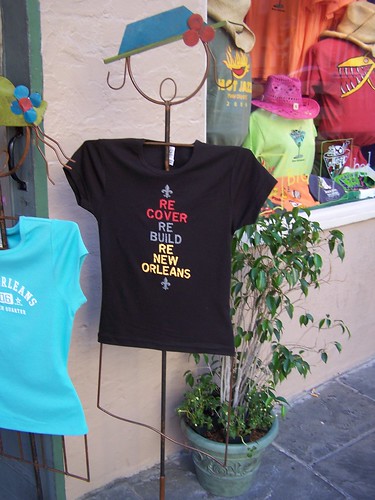
Tee shirt

Index Keywords:

The Zoning Commission makes the front page (of the sports section)

Not being a maven of the ins and outs of the Zoning regulations, I didn't realize that the Zoning Regulations require that the parking for the stadium be constructed underground.

I say no exception or variance should be granted.

It is a shock to read a quote from a Commission member concerned about the "quality" of the result, rather than a strict adherence to the regulations (which are about everything but design and the post-construction impact on people and places).

From "Garages proposal roundly criticized," in the Washington Times:

Members of the D.C. Zoning Commission last night roundly criticized a proposal to build two parking garages with condominiums and other development at the north side of the Washington Nationals new ballpark, and said it was clear that plans for the project had been rushed.

"I'm a little concerned," commission member Greg Jeffries said after watching an hour-long presentation from city officials and stadium architect Hellmuth, Obata and Kassabaum. "How much time was put into this plan? It has to be five days or seven days. It just does not seem like it's fully developed." ...

Commission members were not impressed, particularly with renderings of the garages that appeared to show that cars would be visible from inside the stadium. "Having exposed garages is not what we want to see," said commission member Michael Turnbull, Architect of the Capitol. "We have this fear that we're going to build this temporary thing for 50 years that's not going to look good."

Index Keywords:

Silver Spring: Revitalization vs. Redevelopment

The Express blog cites another blog's comment about Silver Spring, "The price of urban renewal," and how a friend of the blogger commented that it reminded him of Disneyworld.

I have made this point for years, long before I began blogging, on national e-lists, and in email to Annys Shin, one of the business reporters for the Post in the Montgomery County bureau.

Silver Spring exemplifies the difference between "revitalization" which is a rebuilding strategy based on assets: buildings (usually historic); businesses; people; organizations; versus "redevelopment" which looks at the only asset being present as land, land that needs to be cleared and redeveloped into something new.

The revitalization strategy is best exemplified by the "Main Street" Approach or the "Community Economic Development" approach outlined by Mihalio "Mike" Temali. It's the difference between saving Eastern Market and a Giant Supermarket, or between revitalization the Florida Market and clearing it and starting "fresh."

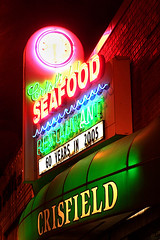
Now it's not true that this is fully the case in Silver Spring. There are extant assets. The Silver Theater is one, and I rue the fact that they were able to make such an arrangement with AFI, whereas the Tivoli Theater in DC would have been perfect for such a venture. Regardless of what you think about Doug Duncan, he does appreciate the economic development power of arts and culture (also see the Strathmore Center). Mayorga Coffee is another. And Crisfields!

Crisfields Georgia Ave. Silver Spring 4 Jan 06 003 on Flickr - Photo Sharing!.jFlickr photo of Crisfield's by Smata2.

On the other hand, it's the kind of place where an arts organization (!!!!!!!!!!!!!!!!!!!!!!!) demolished one of the few remaining Little Tavern buildings, and it has City Place, a pretty gross "urban mall" within the city, and it is attracting mostly chains.

Google Image Result for http--www.nationaltrust.org-magazine-_images-news-silveFrom "Historic Maryland Eatery at Center of Preservation Debate." To quote Neil Young, "once you're gone, you ain't ever comin' back." Photo: Silver Spring Historical Society.

It's getting more Bethesda-like by the day, and while Bethesda Row is interesting, although skewing towards chains, and a good example of new urbanism (see this blog entry: Why are people so damn good at asking the wrong questions?) the fact of the matter is that the rest of Downtown Bethesda is placeless and faceless. Silver Spring is hurtling towards the same future. (Which is why if I were a Maryland resident I would have voted for Martin O'Malley in the primary...)

On the other hand, given that most people grow up in faceless placeless places, maybe that's the best way for Silver Spring to compete within the automobile-centric Montgomery County market.

The cool stuff, the independent businesses are finding it hard to survive. So much so that a student urban design studio from UMD provided Montgomery County with a slew of suggestions about Minimizing Small Business Displacement.

Index Keywords:

Monday, June 26, 2006

Finally, a decent idea for "Dupont Under"

Washcycle has a good idea for the old trolley tunnel under Dupont Circle, a bikestation. I hope he includes showers. (It's so rare to see good urban ideas in area blogs that this is such a breath of fresh air. Although, Washcycle has way more ideas than most.)
TheWashCycle Got Any Other Bright Ideas.jpgUnderground bike station in the Netherlands. Photo via Washcycle.

Index Keywords:

Smart Car In Baltimore


Smart Car In Baltimore
Originally uploaded by spike55151.
Paul Johnson called my attention to this. See this press feed for more.

Now if they would get "Smart" and create specific car dealerships in center cities...

Pittsburghers can wear their city pride

According to the Pittsburgh Business Journal:

A slogan that was last seen on the streets of Pittsburgh in 1994 is being resurrected by the Allegheny Conference on Community Development. Buttons with the phrase "Ask me. I'm a Pittsburgher!" will begin appearing on the chests and lapels of the city's residents in July as part of the efforts to make the city more friendly and accessible for the 2006 All-Star Game. Civic leaders introduced the phrase the last time the All-Star Game was in town, in 1994.

Pam Golden, a spokeswoman for the conference, said she resurrected the buttons as a way to let out-of-towners know which Pittsburghers are willing to be stopped and asked for things such as directions or dining recommendations. Golden has begun handing out the buttons to visitors to the conference's headquarters in the Regional Enterprise Tower on Sixth Street. They also will be given to elected officials, cab companies, hotels and other businesses involved in the hospitality industry.

It'd be a lot better if the people who received the buttons were trained... see as an example, the Detroit Orientation Institute.

I see so many people give wrong directions, etc.

Trained people, now that's a different story.

Here's something I found from the University of Texas. I like the idea.
Ask me for Help (University of Texas)

Index Keywords:

Baseball, Hot Dogs, Apple Pie and Transportation Demand Management

cm_giants_2Photo by Mike Kepika of the San Francisco Chronicle. People leaving the streetcars to see a Giants game at PacBell Park.

Yesterday's Close to Home section in the Post also has a pro-automobile letter from a suburban denizen, "Don't Drive Away Nats Fans," about the big picture really being "insufficient parking spaces" in the vicinity of the baseball park, not the concern of us urbanists to have great experiences streetside, which means parking underground.

(Today's Post also has a piece about creating a "district" around and beyond the ballpark, which the Anacostia Waterfront Corporation is working on busily with various members of the local Growth Machine. See "Anacostia Group Looks Beyond the Ballpark," by Dana Hedgpeth.)

Ken Reid writes:

The stadium will not have enough parking spots, and with Metro's capacity constraints, I'm afraid that the lack of parking could dampen attendance and hurt the team and the city. According to a June 8 Metro story, the 1,225 parking spaces "likely will go to holders of high-priced tickets and patrons of luxury suites." This accommodates at most 5,000 fans, assuming you can fit four or five in a car. The rest of us who are in the "cheap seats" will have to take Metro.

Suburbanites seem to form the major market for the Nationals; just scan the license plates at RFK Stadium. Without adequate parking and with ever-increasing prices for food and tickets, the Nationals will be driving away their base of support.

Driving to the stadium is cheaper and faster than taking Metro. There are at least 10,000 parking spaces at RFK, and Eastern High School sells spaces, too. If I took Metro from my home in Leesburg to RFK, I would have to drive to the East or West Falls Church Metro station, park and then wait for a train. Parking at Metro is free on weekends, but not during the week.
Lot 8 at RFK StadiumLot 8, RFK. Flickr photo by Big Cat.

For a family of four, taking Metro from East Falls Church to RFK Stadium costs $18.80 round-trip at off-peak hours, and $23.80 during peak hours. It costs just $12 to park at RFK. The saving in gas is not that great (we own fuel-efficient cars).

The cost to take Metro from East Falls Church to the Navy Yard for a family of four is $14.80 off-peak, $18.80 peak. But with the new stadium, most Nats fans, and especially season ticket-holders, will have to take Metro, thus adding more time to the trip and making this an expensive and arduous proposition.

I'm not going to berate Mr. Reid, because he raises an important issue, "Transportation Demand Management" should be a fundamental part of big projects like this.

I don't think it happens with as broad brush as it needs to be.

Maybe the Lerners, DDOT, and WMATA need to get together and do some out-of-the-box thinking about creating special family Metropasses for baseball, working with out-country transportation systems (like Loudon Transit or OmniRide in Prince William, etc.), to create special transit options that discourage driving.

Why should our limited land base in the city be burdened with providing parking for denizens of Leesburg?, people who free ride in part on our WMATA system anyway because they don't participate in the WMATA compact, even though thousands of Prince William County residents use the system each day.

But rather than berate them, maybe we need to get creative and figure out how to make this work for them, at less than $19-$24 round-trip for four people? This could be extended to professional basketball and hockey as well.

Perhaps it could even be worked out with Ticketmaster and similar organizations to sell/bundle special transit passes along with events tickets for concerts, theater, etc.

It's worth "the subsidy" to get them off the roads and onto the extant transit system. A model that should be looked to is how transit systems provide special transit passes and options to college students.

It's also another way to encourage people who might not be regular transit riders to sample public transportation. As Mr. Reid says:

Nats and D.C. officials are living in a dream world if they think everyone can and will use Metro. It is a good system, but one that is used for just 3 percent of all trips taken in the Washington area, according to the Metropolitan Washington Council of Governments.

I look at this as another opportunity to challenge this way of thinking and build the awareness, usage, and support of public transportation.

(And about Mr. Reid's comments about parking lots promoting tailgating, which boosts pride in the team and camaraderie, well, I think DC residents are paying enough for the stadium as it is. More parking comes at too great a cost considering all the money that's going into this, as well as the displacement of businesses and cultural organizations, and how much money DC residents have put into the public transportation system on a per capita basis, compared to the suburban residents of the region. If the Lerners want parking-lot camaraderie, is it really asking too much for them to pay for it themselves--just this once?)

WMATA farecard

Index Keywords: ; ; ;

Mid-block crosswalks, L'Enfant and Jane Jacobs and the eastern quadrants

Midblock Crosswalk, SeattleMidblock Crosswalk, Seattle. Flickr Photo by Paradise Found.

A piece in today's Seattle Post-Intelligencer, the transportation column "Getting There: Midblock crosswalks give driver pause," is about mid-block crosswalks and some problems, that drivers are not always conscious of the need to stop.

But it reminds me about midblock crosswalks as a way to break down superblocks to a more manageable walking experience.

The only DC mid-block crosswalk that readily comes to mind is on the 1300 block of F Street NW. (On a related but unrelated matter, there is a good letter to the editor yesterday about pedestrianism and DC in the Post, "A Deadly Crossing," by Stephanie Faul.)

In the L'enfant Plan in the eastern quadrants, the 600 and 1200 blocks are double-sized, and the 1300 block is triple-sized compared to the average block. (This is an issue in the western quadrants too, but I am not as familiar with the issue there, plus the major retail corridors there, except for U Street, tend to be north-south, whereas in the eastern quadrants (except for 8th Street SE and 12th Street NE in Brookland) they are east-west.
Ourisman Chevrolet, 600 block of H Street NE, 1948.Ourisman Chevrolet, north side, 600 block of H Street NE, 1948. Horyczdak Photo, Library of Congress.

H Street NE, Washington DCPhoto of H Street NE by Preston Keres, Washington Post.

Jane Jacobs writes in Death and Life of Great American Cities about the necessity of small blocks to provide multiple paths in the city and to maximize the pedestrian nature of the city. Perhaps Portland, Oregon takes this the furthest, because their blocks are 200x200 meaning that in the distance of three average-sized blocks in DC, they fit in four blocks, and four more higher-rent corner spots at the same time.

On H Street NE, these blocks are tough for retail. The same goes for Pennsylvania Avenue SE, at least for the 600 block, which like the 600 block of H Street NE, is also "troubled" by some super-buildings which suck up some of the life off the street.

The student urban design studio from Catholic University in 2004 had some ideas about this for the 600 block of H Street NE for sure (I can't remember if they discussed this issue for the 1300 block as well).
DC Dept. of Employment Services, H Street NE, DC609 H Street. Photo from A9.

In the context of the H Street streetscape project, adding mid-block crosswalks should be considered for the 600 and 1300 blocks at a minimum. And because there is a proposal to convert the two hulking office buildings on the south side of the 600 block of H Street into a mixed-use site as opposed to the virtually all office that it is today (one check cashing place and one hot dog vendor comprises the retail), now is the time to bring this up. (See "Developer to turn H Street site into mixed-use project," by Sean Madigan from the Washington Business Journal.)
Atlas Performing Arts CenterFlickr photo by Elise Bernard.

It can also be done in the 1300 block, perhaps in the vicinity of the Atlas Performing Arts Center. If there was a better way to bring people across the street, perhaps the storefronts on the north side of H Street would start getting leased up (although this is impacted by property owners often unrealistic expectation for how much the spaces are worth, their condition, and the pending opening of the theater spaces in the Atlas, which until they open, reduce significantly the number of patrons coming to the block for evening events).

It's also a natural for the 600 block of Pennsylvania Avenue SE.

Index Keywords: ;

Re: Preservation keeps D.C.’s historic assets

That enlightened developer that I mentioned (I do know one more enlightened developer, actually), here's his reaction to what I wrote:

Like every other property condition (i.e., site contamination, title, etc.), historic is just one more thing that a developer should do its due diligence on and should not assume something is not historic just because it has not been landmarked.

Wow. Brief and to the point. (I can learn a lesson from this.)

Index Keywords:

What's more important here? The "green" of money, or the "green" of the environment? (ethanol)

Wanted: Intelligent PoliticsDemonstrators march in downtown Vienna, Wednesday, June 21, 2006, to protest a visit by U.S. President George W. Bush for a summit with European Union leaders. President Bush met with EU leaders for talks ranging from the Iran nuclear standoff to ways of reducing the West's foreign energy dependence. (AP Photo/Zoland Zak)

Speaking of clear thinking about energy and driving, there is a need for some directness about ethanol as a replacement for gasoline.

It's not cost-efficient. It's not energy-efficient. It will take a lot of land, possibly forcing the importation of food. It's a big tax and federal credits give away to very large businesses such as ArcherDanielsMidland.

I don't know if this is related to "Rebuilding Place in the Urban Space," but it is related to logic in government and federal policy and the impact on the environment.

The Financial Times ran a number of articles last week on this issue, including a very long summary piece, "Elusive cornucopia: why it will be hard to reap the benefit of biofuel." This piece is not online, so I will quote the most important parts. From the article:

Wall Street is drunk on ethanol, pouring cash into constructing refineries and searching for any company that can claim a link to "green" fuels. Political leaders have been quick to offer their imprimatur. "Ethanol benefits a lot of folks," US President George W. Bush told an audience this year at Johnson Controls, a car parts supplier. "Most importantly it benefits people who are driving cars."

But strip away the hoopla and it becomes clear that the benefits of this investment, both for the environment and for energy security, are being wildly overstated -- because money is being poured into technologies likely to be outdated within a decade. Moreover, a big switch to biofuel with today's technology would only serve to replace US and European dependence either on foreign biofuels or foreign food....

Biofuels--ethanol and biodiesel--made from plants and animals have been given tax breaks, farmers growing them receive subsidies and exemptions from European production limits, while cars that run on them qualify for free parking in some cities....

So how sound is the rationale for all this activity? ... [W]hat is rarely highlighted is just how small the savings are in the US and Europe from using the current technology--and how much land is needed. It is difficult and expensive to convert food crops such as corn, wheat, sunflower, sugar beet or rapeseed...into fuel and requires intensive energy.

As a result, according to a study by Alexander Farrell of UC Berkeley and published in Science Magazine, today's ethanol production processes cut overall greenhouse gas emissions by only about 13% compared with petrol. In Brussels the [European] Commission has found that the standard production methods for sugar-beet ethanol in Europe reduced global warming emissions by a "modest" one-third compared with petrol. ...
Ethanol Production Plant (VeraSun Aurora, located near Aurora, S.D)VeraSun Aurora, located near Aurora, S.D., is one of the largest dry-grind ethanol production facilities in the United States, producing approximately 120 million gallons per year, Friday June 16, 2006. VeraSun's successful IPO this week showed that investors are bullish on ethanol, but some analysts say the burgeoning industry faces long-term risks of oversupply and volatile commodity markets. (AP Photo/Eric Landwehr)

Biofuels can save significantly on petrol, however, because the energy used to produce them comes mainly from coal and natural gas-fired power plants--important in the US, where the focus is on reducing oil use and the science behind global warming is still questioned. But the same plant sources that are used to make ethanol could more easily replace fuel oil, a heavy oil derivative, it they were burnt for heat. That would have the same energy security benefits at a much lower cost.

The advantages for drivers are also open to doubt. Because ethanol contains less energy than petrol, a "flex fuel" car able to run on E85 needs four gallons of ethanol to travel the same distance on three gallons of petrol. The cost of E85 thus needs to be significantly lower than it is to make sense on financial grounds alone...

Skeptics say the powerful farm lobby has hijacked the debate, helped by US automakers keen to deflect demands for greater fuel efficiency....

Richard Parry-Jones, chief technical officer at Ford, admits there is a danger that poorly structured tax breaks will lock in first-generation technology and deter investment in better production methods but says: "Let's not let the perfect be the enemy of the good." Evidence is increasing that poorly thought-out legislation and tax breaks are not only encouraging the current technology but its least effective versions. ...
E85 fuel pumpAn E85 fuel pump is shown in a file photo from March 3, 2006, at the Ohio Department of Agriculture in Columbus, Ohio. VeraSun's successful IPO this week showed that investors are bullish on ethanol, but some analysts say the burgeoning industry faces long-term risks of oversupply and volatile commodity markets. (AP Photo/Kiichiro Sato, File)

To power one in 10 of America's cars with home-grown corn-based ethanol...would require almost one-third of US farmland, although other estimates vary significantly. ...

Because second-generation methods use waste plant material, they also hold out the potential to replace far more oil than is possible with current methods...

The article concludes:

In principle, biofuels should provide a clean, green alternative to oil that could help break Opec's control of the world's fuel supply. Tropical regions should be able to grow fuel for a large part of the world's cars, with less sultry areas such as Europe and the US joining in when the technology is fully developed. Yet, as with so much else involving farmers and world trade, this appears the least likely outcome.
______
The New York Times article "Mountains of Corn and a Sea of Farm Subsidies," discusses the politics of U.S. ethanol production.

Other FT articles from the week include "BP and Dupont near biofuel production breakthrough" (Wednesday) which stated that "the new product, biobutanol produces more energy than ethanol and does not require engines to be modified." ... "Whereas ethanol produces only about three-quarters of the energy of convention petrol when burned, biobutanol, which is also produced from sugar, could produce as much as 95%."

And Brazil has developed "H-Bio," a hybrid diesel-vegetable oil fuel that "puts Brazil at the forefront of the development of green, alternative fuels" according to "Brazil breakthrough plants idea of growing fuel oils in the fields" in the Friday FT.

H-bio fuel.  President Lula da Silva, BrazilIn this photo released by Agencia Brasil, Brazilian President Luiz Inacio Lula da Silva holds the new H-Bio fuel at a Petrobras refinery in Curitiba, 415 miles (670 kms) southwest of Rio de Janeiro, Brazil, on Tuesday, June 20, 2006. Brazil has developed a new diesel fuel mixed with vegetable oils that will sharply reduce its need for imported diesel, the state-run oil company Petroleo Brasileiro SA, or Petrobras, said Tuesday. Lula da Silva said the new fuel represented a 'revolution of tremendous magnitude for the 21st century,' when Petrobras presented the fuel in Curitiba, 415 miles (670 kms) southwest of Rio. (AP Photo/AGENCIA BRASIL, Domingos Tadeu)

When the oil and automobile manufacturing industries control your "energy research" program, perhaps it is to be expected that the U.S. isn't necessarily leading the forefront of research into new products and technologies.

The article "Wind changes in favour of biofuels" from the Tuesday FT covers the boom in investor interest in the ethanol production industry. A chart of manufacturer capacity points out that Archer Daniels Midland controls 37% of the industry (Cargill has 4%). For more information about the agriculture commodities industry, the book Merchants of Grain is a good place to start.

Index Keywords: ;

You can't blame historic preservation when you make your own bad decision (windows)

Elizabeth Elliott of the Foggy Bottom Association sent these comments from Patrick Sheary to the HistoricWashington yahoogroup. I am taking the liberty of reprinting them.
__________
Regarding the Post's 6-24-06 article, "Home Energy Crunch" subtitled "Condo Costs Hang On Preservationists And Gas Contracts," too bad Mr. Thomason and his condo board didn't do better research on their window project. The new windows that were placed in the Boston House condo building will only last about 15 years when they will need to be replaced again.

A cheaper and equally efficient option would have been to repair the original windows with new weather stripping and storm windows. This operation would have given the same amount of desired energy efficiency that he claims to get now. The sad ending to this story is that the now-tight frames and sashes will wear in time, and they will become just as loose as the older windows were. (Loose or rattling windows and panes falling out don't indicate defective windows but signal instead a lack of maintenance.) The panes of the new windows will eventually fall out, and, if any of them break, the entire unit--not simply just a pane of glass as was done before--will have to be replaced.

Double-glazing is not a new concept--it dates back to the 19th century in the form of storm windows. Speaking of storm windows, many manufacturers make very good and practical ones and they would have cost a fraction of what was paid for replacements AND you would have still gotten a reduction in fuel costs.

I know because we restored (not replaced) the windows in my historic, cooperative building, the Northumberland, which is nearly 100 years old. Not only do the restored windows look beautiful and work well, but also, because of the new weather stripping, our 96-year-old windows are efficient. Replacement of our windows would have doubled our costs. Additionally, in our case, the original windows were so well made from old growth wood, that taking them out and throwing them into the dump would have been a tragedy because you simply cannot get this quality product anymore.

Northumberland Apartments, Washington, DCNorthumberland Apartments, Washington, DC

In a related matter, it's interesting to me how everyone talks about being "green," which is a good concept, and proceeds to replace windows that are then just thrown in the dump when they could have been restored. Restoration would certainly been much more environmentally friendly. Unfortunately, it seems that people don't equate the option of window and door restoration as being "green," especially when the friendly window person is pushing for replacement (remember he is making a commission on what he sells to you).

I sincerely hope that the new Boston house windows aren't vinyl. Vinyl windows can be very toxic and lead leaches out of vinyl as it degrades in the sun. That leaves the choice of much less energy efficient metal frames.

It is not fair to berate the Historic Preservation Office on this issue. It's apparent many times that the Post hasn't done its homework on prservation, given the essays like this one that I've read unfairly criticizing preservationists. Mr. Thomason is very lucky I don't head the preservation office because window replacement for older buildings would cease and restoration would be the only option. And, finally, to Mr. Thomason, good job on the solar panels and new furnace, and my condolences regarding the windows.
____________
For Windows resources, check out:

-- Windows and Doors for Historic Buildings* (DC Historic Preservation Office)
-- Your Windows (Community Design Center of Pittsburgh)
-- Preservation Brief 9: The Repair of Historic Wooden Windows (National Park Service)
-- Preservation Brief 13: The Repair and Thermal Upgrading of Historic Steel Windows (NPS)
-- Preserving and restoring old windows (Old House Web)

and from time to time, Historic Mount Pleasant sponsors workshops on window repair, and the Capitol Hill Restoration Society has a good publication, not available online, on windows. Although most of these publications and seminars refer to single family houses...

One issue this article raises is the need for more focused information and/or workshops for association members, residents, and managers of historic multiunit residential buildings.

Index Keywords: ;

Preservation keeps D.C.’s historic assets

This piece ran in The Current Newspapers (Georgetown, Foggy Bottom, Dupont Circle, Northwest) on Wednesday. It was based on emails I wrote on the HistoricWashington yahoogroup, in part in response to the original email by Peter Sefton, which discussed why preservationists nominated the apartment building at 1440 Rhode Island Avenue NW. The Current Newspapers then editorialized about the need for predictability in the development process, which my piece focused on. (Developers and the elected officials who jump when developers say jump often talk about this issue of "predictability.")

The final version submitted incorporated comments from Bell Clement and Mary Rowse. (Thank you!) Articles from The Current Newspapers are not available online.

I added five words, in brackets [ ] below, because the one person who let me know that he saw the article is actually one of those truly "enlightened" DC developers.

Also, in the first paragraph, I list DC's "four" competitive advantages, while not listing the fifth and perhaps most important, the strong core of employment in the Central Business District centered upon (and the presence of) the federal government.

RL

The Current Wednesday, June 21, 2006
Preservation keeps D.C.’s historic assets
VIEWPOINT
Richard Layman

The city of Washington is defined by architecture, history and urban design. Along with a great public transit system, these factors define the city’s “competitive advantage” vis-à-vis the suburbs and other regions. Every time these advantages are allowed to degrade, the city
is diminished.

Winston Churchill has been quoted as saying, “We shape buildings; thereafter they shape us.” Yet too often, land-use regulations in the District of Columbia fail to reflect the critical importance of how the built environment shapes the quality of life in our city.

Use of the word “predictable,” as in The Current’s May 10 editorial “Landmark notice” on designation of the Braxton Hotel, to refer to development matters is problematic. The conflict is rooted in drastically differing definitions of the word “historic” in the context of land-use regulation in the city.

The way the development process works, the broader interest group of people and organizations concerned about land use and city livability are often the last to be notified or consulted. Too often, preservationists have no choice but to be reactive.

To a[ll but the most enlightened] developer[s], the word “historic” has a legalistic definition that refers to a building designated on the D.C. Inventory of Historic Sites (or regulated as part of laws such as the Shipstead-Luce Act), and requiring a different kind of review compared to matters solely under the purview of the Office of Planning, Zoning Commission or the Building and Land Regulation Administration of the Department of Consumer and Regulatory Affairs. It is not a definition that encompasses broader cultural and community values.

To a preservationist, the word “historic” refers to cultural resources, designated or eligible for designation as a landmark, site or district in the National Register of Historic Places or the D.C. Inventory of Historic Sites. This includes individually designated resources, as well as those considered to be contributing structures as part of a larger historic district.

When considering projects that involve cultural resources, developers and their minions (architects, lawyers, financiers) often fail to consider whether impacted buildings are eligible for designation. (Sometimes developers do seek out designation when it is to their favor to utilize the 20 percent Federal Historic Preservation Tax Credit.)

In short, a developer rarely considers the question of eligibility, while a preservationist always considers the question of eligibility.

To a developer, predictability means that if the site isn’t designated when they start with a project, the site should continue to remain undesignated. To a preservationist, predictability means that if a building is eligible for designation, designation must be considered,
especially if the threat of demolition is imminent.

While this is complicated by the fact that the city has never conducted a comprehensive inventory of eligible buildings and districts, the real issue is the failure of most developers to consider that just because buildings aren’t designated “historic,” it doesn’t mean that they aren’t eligible for and worthy of designation.

The hours of volunteer time that people pour into writing and filing historic designation applications is a contribution, a sacrifice made at the expense of other things. But we believe that maintaining the livability of the city is worth such sacrifices.

Preservationists are the guardians of the city’s livability and beauty.

Just the other day I was interviewed for an identity study that is being conducted for a particular area of the city. I made the point that because the historic buildings have been pretty much eliminated from that area over the past two decades, it no longer possesses much
of an identity other than being a large “office ghetto.” Residents don’t visit that part of the city much, because it really has little to offer to us.

George Washington, Thomas Jefferson and Pierre L’Enfant set a high bar, intending through design to create a lasting, beautiful city. We are the stewards of that legacy.

Before you write your next editorial about historic preservation, think about the homogeneous, “placeless” places in our region — downtown Bethesda, the sprawl of Tysons Corner, or the typical new subdivisions in the Maryland and Virginia suburbs. A swinging wrecking ball or a large bulldozer makes it a simple matter to make over the city of Washington into the kind of placelessness and facelessness that you seemingly desire.

Fortunately, the city’s historic preservation laws present barriers that make this difficult — but not impossible.

Index Keywords:

Sunday, June 25, 2006

Marie Johns wants your vote


Marie Johns wants your vote
Originally uploaded by chrisafer.
If you click through and look at the on-photo comments, I like the one referring (in my mind) to Candidate Bolden. I've actually warmed up to Marie Johns. I was dismissive originally because she comes from "industry," but she does have ideas. And I like people who think.

Faith for Mayor


Faith for Mayor
Originally uploaded by chrisafer.
Speaking of the election...

La herramienta para enviar se dinero, numero dos


061806_15331.jpg
Originally uploaded by jsmjr.
Para el fotógrafo Flickr jsmjr. También ver "La herramienta para enviar se dinero "

E(l)ectile Dysfunction

Cannonball, Mayor Williams at Turkey Thicket Recreation CenterMayor Williams performs his final trademark cannonball "dive" to kick off the summer season at Turkey Thicket Recreation Center. Photograph by the Mayor's Official Photographer, Lateef Mangum. Source, DC Government website.

Speaking of "Challenge Bibendum" in the City of Washington, Colbert King wrote a scathing column in yesterday's Post, "The Dysfunction Williams Didn't Tackle," about the legacy of Mayor Williams.

While I do think that Mayor Williams made a fair number of bad choices of agency heads, and he stood by too many people for too long, (e.g., "The Chief is Here to Stay," in the Post article "Williams Keeping Fire Chief 'In Place'"), I think that most of us, perhaps even Mr. King, don't realize how entrenched is dysfunction within DC Government, how entrenched the attitude of "business as usual" and as the government as "gravy train" really is.

One of my big concerns is that there has been tremendous backsliding over the past couple years within DC Government towards the "whatever, it's not my job, quality doesn't matter, the best thing about DC government is getting contracts," kind of attitude.

This is my biggest fear with the upcoming election in the Mayor's race, and the City Council Chairman's race. It's also a big issue in the race for the Democratic At-Large Councilmember race.

That was a big part of my concern in what I call the "Uncivil War" (see this blog entry from last July, "Tom Sherwood, Duncan Spencer, Anwar Amal, and thinking about what I call the "Uncivil War") and I think the election of Marion Barry, Kwame Brown, and to some extent Vincent Gray in 2004, is part of that backsliding, the battle over what government is supposed to be about, and to some extent is a counter-attack against good government, even though they would deny this vociferously, and I wouldn't necessarily argue with their stated explanations. But it is the substance that concerns us here.

Vince Gray's campaign for Council Chair (and note I am not much of a fan of Kathy Patterson) and Scott Bolden's (a former President of the DC Chamber of Commerce, a leading position in the Growth Machine, pro-business agenda) attempt to beat one of the only avowed progressives on the City Council, and the kind of people lining up to support Linda Cropp (even though I have a great deal of respect for her and could still vote for her), demonstrate that the problem is a lot more than merely Mayor Williams not trying harder.
Money Faucet #2Image by Chicago Multimedia.

Government as a jobs program started out long before Marion Barry. It has been a constant tension with regard to government ever since government began, when Kings had courts (and jesters) and sycophants.

In the "modern era," it was more affordable when growth seemed perpetual and that more money would always be forthcoming.

It's not like that anymore.

If the DC government feels like it has to give "advertising space" on the city's streets in order to get $250,000 for environmental programs, in a city with a $5 billion local budget (plus another $3 billion in spending from the federal government), then clearly the money faucet is starting to close.

Books such as Black Social Capital and The Future Once Happened Here discuss these issues in the context of today's financial, political, and demographic environments. It makes for chilling reading.

Index Keywords:

Leading by Doing

Jachlin Leatherman and Wayne Nesbit graduating from Ballou High School, Washington DCJachlin Leatherman and Wayne Nesbit graduating from Ballou High School, Washington DC. Washington Post photo by Marvin Joseph.

Excerpt from the article "For the Love Of Ballou," subtitled "2 Scholar-Athletes Made a Private Pact: To Nurture Hope at a Troubled School," one of the articles published in the Post series "Being a Black Man."

On their first day of high school, Wayne and Jachin met in the cafeteria before classes began and talked about how excited they were by what was ahead. The freedom of high school life. The party atmosphere of Ballou.

Soon, though, they were noticing how many students would show up for school but never go to class. And the closer they paid attention to the classes where students did show up, such as biology, the more they realized how difficult improving Ballou would be.

"People would come to class and didn't do their work. People around us were getting C's and D's -- and they didn't really care," Jachin said. "We realized how much work it would take to get others around us wanting to do good. We realized it was going to be a tough job."

In that first year, they didn't have much effect at all, other than establishing themselves as students with high expectations in a place where low expectations were often viewed as good enough.

In 10th grade, though, when Jachin and Wayne made the football team, things began to change, if ever so slightly. Most of the players were barely making the 2.0 grade-point average necessary to stay on the team, and when the coaches realized they now had two straight-A students in their midst, they used Jachin and Wayne to full advantagee.


The coaches established mandatory study sessions at 7:30 in the morning and in the hour between the end of classes and practice, putting Wayne and Jachin in charge. Math, English, social studies -- whatever a player asked about, Wayne or Jachin would help. As the football season continued, they felt they were making progress. Perhaps they couldn't affect a broad spectrum of students, but they could affect their teammates. .

This relates to my point, my being against an "education rights" charter amendment to the Home Rule Charter of the District of Columbia. As I said in this blog entry, "School daze continued":

1. It should be understood as a matter of course that all District government agencies should provide excellent services.
2. It opens the District Government up (i.e., our taxpayer-generated revenue stream) to terrible legal liabilities.
3. The advocates for this charter amendment are not offering other amendments simultaneously to make the DC Public Schools manageable and accountable.
4. The advocates are not acknowledging "inputs" issues on the children-parent side of the equation.

A lot more must be done along the lines of what these students did, on the student inputs side of the equation, as well as on the school-provided inputs side, to make a difference. Continuing to apply more of the same thinking won't make any difference. Also see these blog entries, among others:

-- Positive deviance and DC Public Schools
-- Thinking about schools
-- School daze
-- If money fixed everything wouldn't we have a great society ...
-- Involving the community in school improvement.
________
Update: The Post editorialized along these same lines on Sunday, in this piece: "How Not to Fix D.C. Schools."

Index Keywords:

Is there hope for a "Challenge Bibendum" equivalent for the DC government?

EcoZone: Selling the environmentEcoMedia: Selling the Environment?

Probably not, judging by two articles in the Tuesday Washington Times, which communicate how difficult intelligent policy making appears to be in the City of Washington, a focus on glitz instead of substance, or a failure to lead in the face of pretty serious issues.

It frustrates me some that the DC Government announced to great fanfare an advertising program allowing street signs with "pro-environment" messages combined with advertising to be posted on major thoroughfares in the city, by creating an "EcoZone." For more, see the article "Ecological signs of the times."

The cost to the advertisers will be $5,000/sign; half of the money will be directed to pro-environment activities by EcoMedia, the company that somehow managed to snag this contract. Figure out the amount and the impact for yourself.

One of the signs pictured in the article is sponsored by Alcoa (which makes aluminum cans) and it states "Alcoa and the District of Columbia ask you not to litter." (The sign on the website, with a different caption from the article, highlights a different company, DaimlerChrysler.)
002
Rather than put up a sign like this, how about focused programs as I have discussed before, to build environmental stewardship and understanding into the schools, i.e., students being responsible for cleaning schools (as in Japan) and school-community cleanups in the fall and spring around each public school in the city?
721-727 H Street NE, Washington, DCPhoto of the sidewalk in front of 721-727 H Street NE by Elise Bernard.

And speaking of alumninum cans and recycling, how about a container deposit law, like the one that was fought off, partly with race-based appeals, by the beverage industry in 1988?

Or restrictions on the sales of single containers of beer, which seem to be "disposed of" disproprotionately in the public spaces? Etc.
____
This reminds me a bit of how the Children's Museum was supportive of BP's plans to build a 50,000 s.f. gas station across the street because it was a pro-environment project--because they were to use solar panels to provide electricity to the lights on the pump islands!!!??? (Plus, I'm sure there was a promise of a donation...)
____
The second Times article, "Parking permit fee increase cut by council," continues these theme of misplaced, underthought effort. The article states:

D.C. Council members yesterday said a proposal that would have increased fees for residential parking permits has been killed, citing press scrutiny. "I'd say 99.9 percent of it is because of the coverage," said council member Jim Graham, Ward 1 Democrat. "I'm stopping short of saying 100 [percent]. It takes that type of press coverage to really call attention to something. It certainly did for me." ...

The proposal -- which was offered by D.C. Mayor Anthony A. Williams, a Democrat who is not seeking re-election -- would have increased residential parking permit fees from a flat $15 to $25 for a first, $50 for a second and $100 a third permit. It also would have limited households to no more than three parking permits.

The Washington Times, which normally promotes a pay-as-you-go no subsidy agenda--unless it is sprawl promoting--seems to be unconcerned about the cheap provision of city-owned land, a public asset, for parking.

Furthermore, given the scarcity of parking, discouraging multiple car households is sound public policy. Making people pay for the costs they impose on others, by increasing the price for parking permits is the way to go.

In rowhouse neighborhoods, the average house is 15-18 feet wide, which means that the street in front of the house can accommodate at best 1.25 cars. The more cars per household the more stress on the system. The more that parking is subsidized, the fewer cues (other than the difficulty of finding a parking space) to change behavior.

I find actions like these to be very frustrating. Makes me reconsider my campaign donation planning...
Challenge Bibendum, Michelin

Index Keywords: ;

"Rallying together towards sustainable mobility"

Michelin posterIn 1898 the Michelin Tire Corporation introduced Bibendum (Bibo), its company icon. At that time the firm was a leader in the production of pneumatic bicycle tires. By 1900 Michelin achieved dominance in the French market for automobile tires, and on the eve of World War I Michelin supplied approximately a third of the world's tires. While bicycles were becoming mass-market goods, automobiles remained elite commodities. Michelin thus had a vested interest in encouraging automobile travel as a way to sell tires, and in educating new consumers as to its uses and capabilities. Bibendum, helped to do both. Appearing in posters and the press as a well to do Frenchman who embodied contemporary assumptions about class and racial privileges and appropriate activities (such as automobile travel and tourism), Bibendum also dispersed advice on technical matters pertaining to autos and tires.

is the slogan for Challenge Bibendum, sponsored by Michelin. This three-day conference focuses on "what if" and was written about by Washington Post automobile columnist Warren Brown, in the piece, "Energy Policy Without the Fear Factor." From the article:

Bibendum, named after Michelin's century-old, rubberized, rotund mascot, is not intended to give concrete answers to the many troublesome questions about the kinds of vehicles we drive and their overall effect on natural resource depletion and society. Bibendum's mission is to confront fear, to ask: "What if?''

For example, what if we developed policies that required normal commuters--those not hauling construction equipment or commercial property--to use smaller vehicles in downtown traffic during weekday business hours? What if we assessed parking fees based on vehicle size, charging higher fees for bigger vehicles and lower rates for smaller cars and trucks? Would that make more sense than the current rush to reward the buyers of expensive gasoline-electric hybrid models with tax breaks--even though many of those hybrids get the equivalent mileage, or sometimes less than that of small economy cars?

Why do we need so many vehicles with seven seats? Look around you. How many minivans, SUVs, station wagons and large sedans are carrying more people than the driver?

Smart Car Display, manufacturing facility, FranceWhy Mini or the Smart Car doesn't create center city small car dealerships is beyond me. (Photo from DaimlerChrysler.) Although the Smart Car is a really small car, and the Mini is much larger comparatively.

What if someone developed a one-passenger car, or if a car company was brave enough to give more than a passing glance to Italian architect Romolo Nati's idea for the B.U.S. (Block Utility Service) car--a three-wheeled, three-seat bubble of a thing designed for inner-city transportation?

Answers to those questions have attendant problematical queries related to safety, property rights, consumer choice and lifestyle. But, again, the idea behind Challenge Bibendum is not to force solutions down consumers' throats.
_______

Interestingly enough, I have suggested some of these kinds of ideas in various blog postings. Too bad I wasn't invited to go to Shanghai...

Index Keywords:

Friday, June 23, 2006

Jamin Raskin Maryland State Senate Campaign Field Office, in DC (plus ruminations about the Maryland Governor's Race)

I am always intrigued by "anomolies" with regard to elections in the region, because of our tight borders. This Maryland State Senate campaign field office for the Takoma Park area is located in DC...

Plus, speaking of Maryland politics, the Duncan announcement yesterday was a shocker. I heard it on the radio and I was surprised. (Forgot to blog about it though.).

It makes the fall election much more competitive, because now the Democratic candidates won't spend the rest of the summer beating each other up to get ahead, therefore allowing the Republican candidate more of a free ride.

Well, remember what the Hulk said... "it's clobbering time" although I expect this to be a close election, and there is no question that the job of the Mayor in Baltimore is not yet finished, which will be a campaigning point on the part of Gov. Ehrlich vs. his Democratic opponent.

Florida Market Tour, Saturday June 24, 9 a.m.

The Capital City Market, more commonly known as the Florida Market, is the primary wholesale food distribution center in the city. A number of the businesses sell to retail customers. The cinder block "DC Farmers Market" building on Neal Street is comparable to Eastern Market, except it is privately owned, and a lot less pretty. The market area is under great development pressure because of its location and the attractiveness of the New York Avenue subway stop. The Office of Planning Cluster 23 Study proposes that the market be revitalized through a food-centered plan. An alternative proposal suggests demolishing everything and starting over. We're interested in showing people the assets that the market has to offer.

On Saturday, Elise Bernard of the Frozen Tropics blog, and I will lead a free tour of the market. It will start at 9:00 a.m. at 4th and Morse Streets, NE. We will then go eat at Young's Deli (inexpensive Korean and other foods). People could join us at 9:40 at Young's (300 block of Morse St., NE) for the rest of the tour if they are not up for kimchee. We will then visit eleven other places that sell retail, including the multi-vendor cinder block "Farmers Market" and the outdoor flea market, before finishing at Litteri's, which in my opinion, has the best Italian sub sandwich in the city (sorry Vace, sorry Mangialiardo's). We should finish up around noon.

We will repeat the tour on Saturday, July 29, at 9 a.m., beginning at the same meeting place.

D.C. Farmer's MarketThe market area is a lot more interesting than this photo might indicate. Flickr photo by EZRAW.

Index Keywords:

Public to Glimpse 'Uncle Tom's Cabin' -- Montgomery County Heritage Days

ME/HENSONJames Henson, the great-great-great-nephew of Josiah Henson, at the cabin where his ancestor lived while enslaved on a Montgomery County plantation. (By Hamil R. Harris -- The Washington Post)

"Public to Glimpse 'Uncle Tom's Cabin' " from the Montgomery Extra section of the Washington Post:

The historic "Uncle Tom's Cabin" on Old Georgetown Road in Bethesda, recently purchased by Montgomery County, will be open to the public for the first time, for limited hours the weekend of June 24-25. The special opening during Montgomery County's Heritage Days event will provide an opportunity to walk through the 13-by-17-foot 18th century cabin that is the former home of slave Josiah Henson, whose autobiography was the model for Harriet Beecher Stowe's novel "Uncle Tom's Cabin."

The Montgomery County Planning Board purchased the $1 million property -- the cabin, the adjacent three-bedroom house and an acre of land -- in January from the estate of Hildegarde Mallet-Prevost, who died in September at 100.

Guides will lead people in groups of 10 through the cabin and rooms on the first floor of the house during Heritage Days, said Peggy Erickson, executive director of the Heritage Tourism Alliance of Montgomery County. Tours will be offered from noon to 4 p.m. on June 24 and June 25.

Three dozen other historic sites, including many that are rarely open to the public, are on the self-guided route of this year's Heritage Days, an annual celebration of the county's history. The rarely seen sites include St. Paul's Community Church in Poolesville, Warren Church and Historic Site in Martinsburg, Davis House in Hyattstown, Gaithersburg Latitude Observatory in Gaithersburg, and the Latvian Museum in Rockville.

Also on the tour is Montgomery's oldest church, St. John the Evangelist Catholic Church, built as a chapel for the Carroll family in 1774, and Montgomery's only winery, Sugarloaf Mountain Vineyard, which was established on a restored 85-acre farm in Dickerson.

Index Keywords:

Stuff

I am behind in my reading.

1. On May 28th, the New York Times ran a good article, "Passengers May Now Pirouette to Gate 3," about choreography and placemaking, about how David Rockwell applies such concepts to building design, including the new JetBlue Terminal at Kennedy Airport. While the story is no longer online for free, the multimedia presentation, including more images than were included with the printed story is still online here: Audio Slide Show: Dance and Space.

Union Square, Placemaking elementsUnion Square, Placemaking elements.

2. Washcycle is arguably the best area blog about bicycling issues. The leading entry right now is about "The High Cost of Driving." Good information.
bin_laden
3. Interestingly enough, and related to the Washcycle entry, while working out conceptually my idea of "transit-shed planning" as mentioned in an earlier blog entry (think of not equally sized but concentric circles representing five, ten, and fifteen minute walking distances, biking distances, drive and drop off, drive and park, and bus, not to mention car sharing), I was
001I'm thinking like this in terms of transit-shed planning.

looking again at some consumer research about transit on the Montgomery County Ride On site, this report "Commuting Behavior Research: Bethesda and Friendship Heights-February 2000."

It proves that the best way to increase transit usage it to eliminate free employer-provided parking.

4. And Will Fleishell and Steve Pinkus of the DC Alley Dwellers Alliance call our attention to this nice paper on parking, "Should Planners Under-Provide Car Parking?"

Index Keywords: ; ; ; ;

Build DC Lecture tonight

Via Iris Miller, Adjunct Professor of Landscape Architecture, CUA:

(This is an announcement from the Congress for the New Urbanism's developing DC Chapter. However, it isn't listed on the organization's website.)

The Mid-Atlantic Chapter of the Institute of Classical Architecture & Classical America and the National Civic Art Society invite you to participate in the Build DC Charrette #1 Pre-Charrette Lecture, "The Spirit of Place."

Alexandria Lyceum
201 S. Washington Street
Alexandria, Virginia

at 6:30 pm on June 23rd 2006, featuring:

Calder Loth, Virginia State Historian
Calder will speak about the Spirit of Place in the DC Region.

and

John Bailey, Executive Director of the Washington Smart Growth Alliance
John will present Reality Check

We will convene after the lectures for dinner within walking distance of the Lyceum to discuss the lectures and their impact on our design approaches. Dinner will be Dutch Treat, (location TBD).

Please RSVP for the post-lecture meeting as well as for the lectures themselves as we need to know the number of attendees.
______
I'm going to try to make it, as Iris asked me to come. Plus, I'd like to meet Dr. Loth, who was kind enough to share with me (and us) photos of his award-winning alley beautification-gardening efforts in the Fan District of Richmond.
Alley, 204 N. Granby -- Fan District, Richmond, Virginia204 N. Granby Street (rear), Fan District, Richmond, Virginia.

Index Keywords:

Thursday, June 22, 2006

Cleaning the storefront window display, Takoma Park


?


?
Originally uploaded by rllayman.

Takoma Park Bikes


Takoma Park Bikes
Originally uploaded by rllayman.

Storefront windows that also appeal to guys...

Takoma Park

Purple Line supporter


Purple Line supporter
Originally uploaded by rllayman.
Last night I went to one of the open houses for the "Purple Line" light rail or bus rapid transit proposal from Bethesda to New Carrollton. The major stuff is online at Bi-County Transitway , but it was still interesting.

The people from
Prince George's County Advocates for Community Based Transit were there, and I had a good conversation with them. My photo model here is their webmaster and membership coordinator, Tom Reitzel.

Their key members include Jimmy Allen, co-chair, and former president of the WMATA workers union. PGACT meets the second Monday of each month at the Hyattsville City Hall (accessible from DC via the 83-86 buses that leave Rhode Island Metro Station).

Purple Line Map  DC Metro Sprawl.gifA couple things come to mind.

1. Advocates on the Virginia side ought to be thinking about this system and linking up "circle line" planning on their side of the river.

2. Similarly, remember my point about light rail to and within Annapolis? This system, which terminates in New Carrollton, could continue out to Annapolis.

3. Same with people in Southern Prince George's County. I know that it is a priority issue for the Sierra Club Metro DC campaign to have Metrorail (or some form of rail-based transit) on the Wilson bridge. Would it make sense to do it as part of the light rail system that MTA is looking at, rather than the heavy rail system and cars of the WMATA subway? Or, do you propose some kind of WMATA spur?

Rendering of WMATA subway service on the Wilson BridgeSierra Club rendering of WMATA subway service on the Wilson Bridge.

I didn't have significant comments at the presentation. Obviously, I prefer light rail. And they were sloppy (inaccurate) with some of their photo captions. The only thing that I commented about significantly was that their planning efforts do not incorporate bicycle articulation planning at the same level that currently exists with WMATA (bike racks at stations, use on trains, etc.). Since this system will run in the WMATA service area (and I imagine it would be run by WMATA, although that decision is a long way from being made), it should plan for comparable bicycle policies at the outset.

My other comment, which I didn't write but discussed with someone, is something that I have been working out conceptually, "transit-shed" transportation planning.

You know the "circles" that are drawn on transit maps, showing the walk- or pedestrian-shed?

Well, I think of these circles as "transit planning" districts. They need to be bigger geographically to incorporate bus planning (they could be drawn to incorporate walking, bicycling, bus, and driving zones) and transportation demand management needs to be planned at that level.

Montgomery County was pathbreaking in re-orienting much of the Ride-On system to providing walkable transit stops within neighborhoods, that would pick up residents and get them to the subway stations relatively efficiently.

This kind of bus planning and re-routing needs to occur in association with the development of this light rail (preferred over bus rapid transit) system.

Index Keywords:

Get the Big Picture, UPS Yard, Landover


La herramienta para enviar se dinero

A couple weeks ago, I wrote about the presentation by a Fannie Mae Foundation person at the National Main Streets Conference. I mentioned that his presentation infuriated me, because much of the anti-preservation anti-authenticity actions by Community Development Corporations (such as the H Street CDC in Washington) has been funded by the verysame foundation (or similar entities like LISC).

He made a point that commercial district revitalization programs should be concerned with financial acumen and practices on the part of lower income residents who might be served by our commercial districts. And that if they banked more intelligently, they would have more disposable income that they could spend in our commercial districts, instead of paying it away in check cashing fees.

Last week, I saw this ad on the H8 bus (which serves Mt. Pleasant). Even if your Spanish is basic, like mine, the sign is completely understandable.

Home Depot has created an ATM card system allowing for money transfers and multiple cards on an account, usable in multiple countries. Given how many Hispanics work as construction laborers in this country, it's really quite smart.

Regardless of what the FMF guy said, there is too much for Main Street programs to do to take up "social and other" issues other than those specifically related to commercial district revitalization.

In fact, getting involved in social and/or justice issues is one of the "pitfalls" identified by the tough love approach to commercial district revitalization written by Ed Crow in his book Myths and Pitfalls: On the way to a new vibrancy in older retail districts.

But this is one area where it's worth reaching out and working with Home Depot, if the demographics of your commercial district warrants it.

It's also the kind of thing that Fannie Mae Foundation could have done, because this needs to work on a national and international scale, something that tends to be out of the normal way of doing things for neighborhood commercial district revitalization programs.

Index Keywords:

Another one of those


Another one of those
Originally uploaded by rllayman.

When more of the same isn't working, you have to do things differently (education)

My first response, when I read the first paragraph of this story was holy s***! From "Preparation is Elementary," from the Tampa Bay Tribune:

Student Sarah Sinteff knew exactly how she wanted the papers to look. The 4-year-old was pretending to write invitations to a movie party she planned to throw. The exercise was part of the rotating activity centers she participates in every day at her prekindergarten class at Clark Elementary.

She showed her friend Brendan Bowman exactly how to fold the papers so they would fit into the envelopes. "You fold like this and this and, wow, I did it," Sarah said. "I folded the paper. I'm a genius."

Brendan wasn't having the same luck, quickly became frustrated and threw his paper. "Why can't I be a genius?" he asked.

But Sarah stroked her friend's arm and offered to help. Brendan's pout turned into a smile. This type of social interaction is why educators urge parents to enroll their children in a prekindergarten class. Experts say students become comfortable with a school environment and sharing with other children, as well as early exposure to academic lessons.

Clark is the only public school in New Tampa to offer the state's voluntary prekindergarten program. The state initiative allows any child at least age 4 to attend the prekindergarten classes. There are 69 children in the Clark program.

Private schools and companies also offer the free classes, but Elizabeth Calleri said there is a definite advantage to the public school program...

Calleri said prekindergarten differs from the traditional school day. "This is more about getting students accustomed to the school environment and the teachers and other students," she said. "Teachers incorporate letter and number recognition into fun activities.".

Index Keywords:

Wednesday, June 21, 2006

Athenian Oath

We will never bring disgrace on this our City by an act of dishonesty or cowardice. We will fight for the ideals and Sacred Things of the City both alone and with many. We will revere and obey the City's laws, and will do our best to incite a like reverence and respect in those above us who are prone to annul them or set them at naught. We will strive increasingly to quicken the public's sense of civic duty. Thus in all these ways we will transmit this City, not only not less, but greater and more beautiful than it was transmitted to us.
______________
The Athenian Oath was recited by the citizens of Athens, Greece over 2,000 years ago. It is frequently referenced by civic leaders in modern times as a timeless code of civic responsibility.

Index Keywords:

A great example of what makes a place great

Dupont Circle spontaneous music, June 20th
Last night, I was in the Dupont Circle area for a meeting, and afterwards I went to scavenge a copy of the Dupont Current, because something I wrote is supposed to run as a "viewpoint"--maybe in today's paper? So I happened upon a band playing away, by the Starbucks. Because I have a problem figuring out how to take good night shots with my camera, my shots just weren't that great.
Jazz playing at Dupont CircleJazz playing at Dupont Circle, photo via DCist.

It was pretty amazing, and I was thinking that they were better than the band I saw at Bourbon and Canal Streets a couple weeks ago, and that band wasn't bad either... Occasionally a black church jazz band plays in the area, but I never saw such a crowd as I did last night. Fortunately, I wasn't the only urbanist in the vicinity.

From Steve Pinkus:

Walking through Dupont Circle last night around 10 PM, I stumbled upon this great example of spontaneous place making ….. a large New Orleans-style band with a large and participating audience. It's spontaneous gatherings like this that make me, and many others, love cities and urban life. Only when you have mixed use, human scale, lots of pedestrians, and calmed traffic can you have true urban street life. Tysons Corner it isn't!

This makes me think that perhaps there are other uses for our streets and public spaces than just moving traffic and am frankly surprised the police or neighbors didn't have this shut down.


Spontaneous music in Dupont Circle, June 20thThe photos don't fully capture how many people were in the audience, more than 100 people easy, on the road apron, on the sidewalks on both sides of Connecticut Avenue...

It was truly a magical moment ... especially the interaction between the band players and the audience to the point where the two blurred into a true mix of race, ethnicity, and class. That's what properly designed urban spaces are supposed to do .... comfortably mix people of all social backgrounds. I was reminded of Schrag's take on the Great Society Subway.

It's very difficult to have this sort of spontaneous interaction in car-dominated environments and I think the isolation of the car leads to segregation and a sense of automony from the public realm. I think this explains why larger, denser cities and densifying inner suburbs tend to vote Democratic while low density, car dominated areas tend to lean Republican..


(While I try not to comment too much about Democrats vs. Republicans, preferring to focus on the tension between "the exchange value of place" and "the use value of place," in part this comes down to a difference in preference between connectedness and individualism-selfishness-narcissism, although we have plenty of that in urban areas...)

Check out this article, "Pride of Place: Fred Kent and the Project for Public Spaces," about PPS and Fred Kent, where Fred talks about "layering" of events and happenings as a fundamental aspect of making great places. From the article:

Kent, Madden and their colleagues have spent the years since they formed the Project for Public Spaces in 1975 elaborating on this basic notion. They have plenty of suggestions for creating the sort of clutter on a street that people like, for the way buildings ought to behave--don't create blank walls, don't confront pedestrians with theheating and air conditioning infrastructure, don't lard a block with curb cuts--and for layering attractions that gather people in. "If you have a children's reading room inside and a playground outside," says Kent, "then you put a coffee shop, a Laundromat and a bus stop right there, you will create the busiest spot in your community."

For me, Dupont Circle is about the best park space that we have in DC. Now all we need to do is take back the inner circle road and make it over into more park for the Circle.
Dupont Circle Street Recital and FundraiserDupont Circle Street Recital and Fundraiser, photo by Keith Stanley.

Dupont CircleDupont Circle photo by Daquella Manera.

Index Keywords:

A lesson in "intensification of land use"* from Dreyfus Corporation

strat·a·gem n. (Definition from answers.com)
1. A military maneuver designed to deceive or surprise an enemy.
2. A clever, often underhanded scheme for achieving an objective.
stationplaceStation Place, 2nd Street NE, rendering from the developer.

A group of us citizen advocates from around the city (Foggy Bottom, Friendship Heights, H Street) trade notes about the corruption of the PUD process. I have stated in public forums that the process makes me feel "dirty" as a citizen involved in the process, where you see the obfuscation, misrepresentation, and such odd decisionmaking on the part of grassroots elected officials (ANC Commissioners) and many neighborhood organizations that you have to wonder about "green love" or other special considerations being spread around.

(Often a good indicator of a problem project from the standpoint of citizens is when Holland & Knight is retained by the developer... Note that many years ago, the City Paper had excellent cover stories on Whayne Quin, representative of Dreyfus in the matter discussed below, and David Wilmot, land use lawyers who had worked at the firm known as Wilkes, Artis.)

Dreyfus Corporation, the company that is developing Station Place, as well as the development on the back side of the block of 11th, 12th, and I Streets NW (the Asbury Park Church is on the K Street side of this block), has acquired a fair amount of land across the street from Station Place, and intends to develop the part of the block it owns as a tall residential building.
Window replacement, Station PlaceStation Place, F Street side.

Station Place was a whole other debacle. Much of what citizens asked for was rejected by the Zoning Commission and the Commission of Fine Arts. You see, that job was greased. Dreyfus picked an architect (Kevin Roche), good friends with the then chair of the Commission of Fine Arts--in fact the chair gave the keynote address at the ceremony awarding Roche the "Pritzker Prize of [modern] architecture." How critical do you think the chair of the CFA was going to be about a building designed by his good friend? That's the way it works in development and land use.

(Much of the community discussions about this issue were on the old anc6a e-list which was summarily destroyed one day by the then moderator who created the list, Wanda Stevens-Harris, then an ANC commissioner with strong ties to developer interests.)

The block at issue here, the 700 blocks of 2nd and 3rd, and the 200 blocks of I and H, ever since it was first developed, likely in the 1870s-1880s, has always been comprised of two story buildings, virtually all rowhouses (although the 700 block of 2nd Street NE has been zoned commercially for many years, and the rowhouses on that block have been used as offices, until Dreyfus started buying them up). Decades ago, there was a gas station on the 200 block of H Street, at the corner of 3rd Street NE, which is documented by a photo in the Wymer Collection at the Historical Society of Washington.
Carriage house, 721 2nd St. NE, rearThis two story carriage house at the rear of 721 2nd Street NE is one of the buildings targeted for demolition as part of the Dreyfus project.

The Stanton Park Neighborhood Association has produced a detailed analysis of the obfuscations in the materials submitted by Dreyfus, claiming that Dreyfus is hiding that they are asking (demanding?) zoning bonuses of more than 100,000 s.f. of development (multiply that by $500 or $600/s.f. and you get a sense of how much these changes are worth...).

The SPNA analysis is reprinted in full on the Frozen Tropics blog.
_______
Frozen Tropics also says that there is a presentation tonight about this project, but the address doesn't appear to be correct:

Dreyfus will present its Capitol Place PUD proposed development tonight (Wednesday, June 21) at 6:00PM at 775 H Street, NE.

I expect that this will be corrected sometime today. I can't find mention of the meeting on the SPNA or ANC6C websites.
__________
This project is a good example of how incompatible massing comes about through zoning inconsistencies. Maybe there was a way, other than doing a full rezoning of the east side of the 700 block of 2nd Street's rowhouses from residential to commercial zoning.

In this case, the underlying character of the R4 residential character should have been preserved. Perhaps there is a way to allow abutting buildings to be used commercially, in some instances, without providing the opportunity for massive increases in scale that commercial development allows when compared to residential zoning.

The next block that faces this kind of scale change is Square 750 -- 200 block of K and I, the 900 block of 2nd and 3rd, and the alley-converted-to-street, Parker Street, which is all two story rowhouses, plus two two-story commercial buildings and one one-story commercial building) but is zoned not R4, but C2A.

* Intensification of land use (one of the ways to make more money from land) is one of the aims of "The Growth Machine" as described in the text Urban Fortunes: A Political Economy of Place, by John Logan and Harvey Molotch

Index Keywords:

Tuesday, June 20, 2006

DC Board of Education meeting on School Consolidation


education
Originally uploaded by swardraws.
From Audrey Williams, Public Affairs Officer, DC Board of Education

There will be a Special Committee of the Whole Meeting of the D.C. Board of Education on Wednesday June 21, 2006 at 4:00 pm in the 5th Floor Board Room of 825 North Capitol Street, NE.

The regular Stated Board Meeting will begin at 6:30 pm on June 21st.

The purpose of the Special Committee of the Whole Meeting is to consider the Superintendent’s recommendation on school consolidation and rightsizing.

Index Keywords:

Spam bowling


Spam bowling
Originally uploaded by bosconet.
Paul Johnson of the Bosconet blog is now a member of the Flickr community.

Courtesy of Paul's Flickr photos, here's an idea for your next festival. This is from Hampden Village's (in Baltimore) HonFest, which I've not managed to attend as of yet.

DC Council Hearing on Legislation to Help Restaurants Obtain Liquor Licenses, 6/23

From Alex Padro, Executive Director of Shaw Main Streets:

There is finally legislative movement that would allow Vegetate to get its liquor license. This legislation, Bill 16-0696, would amend the current law that restricts any establishment that is within 400 feet of a school from getting a liquor license. Specifically, it would allow the ABC Board to consider liquor license applications for restaurants and taverns that are within 400 feet of schools, whether or not a license of the same type is already in the area.

This is city-wide legislation, not legislation just for Vegetate or just for the Shaw neighborhood--though clearly we will benefit if it passes. Next Friday, June 23rd at 10am in the Wilson Building, 1350 Pennsylvania Avenue, NW, Councilmember Jim Graham, chair of the Consumer and Regulatory Affairs committee, is holding a public hearing to discuss and hear testimony regarding this Bill.

We are asking that all of you who are interested in this issue attend the hearing. The more people who simply show their faces in support of this Bill, the better.

We are also asking everyone to wear a white shirt or blouse, so that the council members know that you are there to support restaurants. We will have white ribbons for those who aren't wearing white. If you are so inclined, you may testify as well. If you plan to testify, you should call John Adams at 202-724-8198 before 5 p.m. on Wednesday, June 21st. You will then have three minutes to speak at the hearing on the 23rd.

Finally, if you can't make the hearing, you can submit written testimony to all the council members on the Consumer and Regulatory Affairs committee.
_____
I am unable to attend, but this is what I submitted (based a bit on the sample letter that you can get from Alex). The members of the committee are CM Jim Graham (chair), Sharon Ambrose, Kwame Brown, David Catania, and Adrian Fenty.

Dear Councilmember Graham and fellow members of the Committee on Consumer and Regulatory Affairs:

I am writing to ask you to support Bill 16-696, introduced by Councilmember Jack Evans. While I am a strong advocate of protecting children from underage drinking, I also support mixed use, thriving neighborhood commercial districts.

One of the unintended consequences of mixing uses, in particular public functions such as schools, as well as churches and other nonprofit organizations in our commercial districts, is that current laws provide these institutions with extra-normal power to prevent restaurants and taverns, which primarily operate in hours when schools and churches are not open, from selling liquor.

Because these institutions operate at different times of day (the whole point of "mixed primary uses" that was made by Jane Jacobs in Death and Life of Great American Cities when first published in 1961), the fear that underage drinking will be fostered by restaurants in commercial districts abutting schools and/or churches is misplaced.

Our city's commercial districts have experienced decades of disinvestment. Restaurants are key levers in commercial district revitalization because such establishments provide "third places" for neighbors to gather, and the opportunity for residents and other market segments to re-sample and to begin to "re-populate" the commercial district.

Furthermore, people need places to refresh, including restrooms, if we want them to linger in our commercial districts. Patrons cannot do so if there is no place to eat or drink or go to the restroom.

And, like it or not, the profit margins from alcoholic beverages are often necessary to provide the revenue streams to make restaurants successful.

The Law as it stands now does a disservice to the entire city. The law as written allows more Class A and B establishments to be opened when extant licensees exist. These are the types of establishments that tend to contribute to disorder in the public spaces, which occurs often and usually during the day. Such establishments contribute mightily to the negative perceptions that we face in our neighborhoods and for our city.

Meanwhile, these businesses have few if any restrictions, yet sit-down, fine and casual dining restaurants find it extremely difficult to get licenses or open. Such investments should be supported, not discouraged.

Please make it possible for new restaurant and tavern establishments to succeed in and contribute to revitalizing neighborhoods and commercial districts.

Unless the issues covered by this Bill are addressed, there will continue to be obstacles to the kind of neighborhood commercial district development that all of us--residents, business owners, and visitors--want and need. And our commercial districts will continue to suffer the kind of disinvestment that the city has experienced for more than 40 years.

Thank you.

Index Keywords:

Speaking of parking and mixed-use in highly used places

Baltimore's Inner Harbor from Rash FieldBaltimore's Inner Harbor from Rash Field. Photo by Roger Millman from Kit Ehrman.

There is a park on the Inner Harbor called Rash Field that is used for a variety of things including volleyball. The demand for parking in the Inner Harbor area is high and the city wants to build a parking structure there. However, they recognize the value of the park, and therefore insist that the parking structure be built underground, and that the park be restored above. From "Garage planned for Rash Field," in the Baltimore Sun:

Inner Harbor's Rash Field, once home to an ice skating rink and now a playground for barefoot beach volleyball players and soaring trapeze students, might soon be transformed again - with a parking garage beneath it.The preliminary plan, which might endanger the two attractions, is to be presented to Mayor Martin O'Malley and community and business leaders this month. It would involve elevating the field enough to build a one- or two-level parking structure underneath, holding 400 to 500 cars...

Rash Field would be restored atop the garage when construction is complete. City officials said that views of the harbor would not be obstructed. "People would just drive by this and see a park and a skyline," said Andrew Frank, executive vice president of the Baltimore Development Corp., the city's economic development agency. But neither Frank nor an O'Malley spokesman would say whether the trapeze school or the volleyball beach would return.

It's important to make the right decisions on such matters, because we live for decades with the results.

Rash Field in the Inner Harbor, BaltimoreJason McDonald (right) of Canton spikes the ball during a beach volleyball game at Rash Field in the Inner Harbor. A winter ice rink was maintained by the city on the field for a decade but was removed in 2003. (Sun photo by Kenneth K. Lam) Jun 13, 2006.

Index Keywords: ;

Training growth

001This map of Boston-area transit lines and associated development is available as a much larger pdf in the associated article.

is the headline of a set of articles in the Sunday Boston Globe real estate section about how "policies are successfully steering new housing and commercial development near transit stations."

Index Keywords: ;

potomac mills virginia


potomac mills virginia
Originally uploaded by zarelle.
Herb Miller built Potomac Mills among other "Mills" type developments.

Index Keywords:

D.C. mayor offers proposal to end stadium parking controversy

(or it helps to be connected) from the Washington Business Journal story by Sean Madigan:

Mayor Tony Williams has asked the D.C. Council for permission to sell city land at the new baseball stadium site to a developer who would build more than 900 parking spaces -- both above ground and below ground, a possible solution to a controversy that has dogged the project in recent weeks. The proposal, sent by Williams to the council late Friday afternoon, also includes housing and retail.

The resolution does not say exactly how much land would be involved in the deal or what Western would pay. But the agreement would require Western to build at least 925 parking spaces and possibly housing and retail, which would have to be delivered by March 1, 2008.


For more about Herb Miller (and Western Development), see "A superb lesson in DC "growth machine" politics from Loose Lips ..., from that entry:

"Miller Time," an "exposé" of Herb Miller, president of Western Development Corporation, explains what the DC Growth Machine is all about--keeping local politics and politicos subservient to the land use and development agenda of business elites.

If you want an explanation of DC's governing coalition, agenda, resources, and mode of cooperation, it's all there in "Miller Time." From the article:

The big deal of late for Miller is baseball. He firmly believes the stadium deal will kick-start development in the ballpark area of Southeast and yield huge benefits for the city. His company is also one of four firms overseeing the building of an entertainment and retail complex on the stadium site. These four companies will split the proceeds on a multi-billion-dollar venture.

And who knows what council actions may be needed to move the development along? Miller isn’t taking any chances. He seems bent on pulverizing the council’s already diminutive liberal wing, which consists of sometimes-feuding councilmembers Adrian Fenty, Phil Mendelson, and Jim Graham. Mendelson is up for re-election this year, and Miller wants the NIMBY sensibility off the dais.

Last week, D.C. Council at-large candidate A. Scott Bolden, who’s battling Mendelson for his seat, was the guest of honor at a Miller-compound fundraiser. Bolden has all the professional bona fides he needs to woo the pro-business crowd. A partner in the Reed Smith law firm, the Penn Quarter resident was once president of the D.C. Chamber of Commerce.

Bolden hopped an easy ride on the money train. All he had to do was convince Miller that he supports the baseball-stadium deal.

It's ugly, but that's the way it is. And if you don't understand the DC Growth Machine, prepare to be schooled in the coming election. The Growth Machine wants every seat on Council, every one...

There are these older entries, which allude to Miller's original proposals to build big box retail stores next to the stadium:

-- DC's Growth Machine is hard at it, well-funded, and odious ...
-- Baseball, Hot Dogs, Apple Pie, and Mixed Primary Uses

Index Keywords: ; ;

Monday, June 19, 2006

A made for City Paper story if there ever was one...

Urban Etiquette Guide, New York MagazineRules of the road: (1) No raking women with your eyes; glance quickly and respectfully. (2) Offer to share a taxi rather than fight over it. (3) Babies in strollers get right-of-way—until they abuse it. (4) Still no ogling girls—c’mon! (5) And skateboarding, are you kidding me? (6) Not everybody loves your dog as much as you do. (7) No bicycling on the sidewalk unless under the age of 6. (8) Pedestrians can die of secondhand smoke, too. (Photo: Photomontage by Peter Rad)

New York Magazine has a cover story on urban etiquette, "The Urban Etiquette Guide," like "Sex in the City," I don't "get" a lot of it... but there are some great images. From the article:

And these days, there are unprecedented opportunities for new offense: You’ve got interfaith-interracial partners, gay married couples with kids from a best friend–cum–surrogate, friends in ridiculously disparate income brackets, threesomes, twosomes with an “understanding.” Who walks the bride down the aisle—especially when there are two brides? (Anyone she damn well pleases, most likely.) And what does the polite guest bring to an “I’m Divorced!” party? (First, find out who got possession of the good crystal.) How do you react when someone introduces a colleague to you as “my lover”? (Step one: Do not spit out drink.)

And that’s just the beginning—in a new era, age-old questions become vexing all over again. As a city of early adopters, New York has embraced countless communication-facilitating services and gadgets, which have simultaneously brought us closer together and pushed us further apart. On the one hand, technology is the great equalizer; on the other, it’s created brand-new sticky situations. We expand our social networks via Friendster and MySpace but often end up with an unmanageable list of mere acquaintances or even strangers. We can feel like we know someone intimately whom we’ve never met while never speaking to the person who’s worked down the hallway

The New Rules For Getting Along
Love & Sex
David Cross on How Not to Alienate a Celebrity
The Office
Cell Phones & iPods
City Living
Subway & Cabs
Family
Dining
Friends
Amy Poehler's 8 Rules for Being a Civilized New Yorker

Urban Etiquette Guide, New York MagazineRules of the underground: (1) Knees may be no more than six inches apart. (2) If you can't control your offspring, watch as a stranger does it for you. (3) What did we say about checking out the girls? (4) The Post is only 25 cents—buy your own. (5) Holding the subway door makes everyone on the train love you. (6) As does loud music. (7) Lie down on subway only if dead. (Photo: Photomontage by Peter Rad)

All the more reason to love NYC.

Index Keywords:

Better transit as a "gentrifying" force

Interestingly, on the same day that the Post runs a story about neighborhood change in Seattle and Portland--"Parts of U.S. Northwest, a Changing Face," the Seattle Post-Intelligencer runs a story about the impact of light rail on an area of the city, in the article "Rainier Valley fears losing 'home' to rail: City looks for ways to curb downside of new development." From the article:

It's hard for Heidi Dang to believe the day will ever come when the street in front of her Sunlite Hair Salon is no longer a morass of orange barriers, construction debris and plywood sheets covering holes. But with three years left on her lease -- about the time when the Sound Transit light rail line, now under construction outside her shop door, is scheduled to start operating -- she plans to stick it out.

Now, city officials and Rainier Valley residents want to head off another threat from the transit project: the potential displacement of ethnic businesses and longtime residents by rising rents tied to a light rail development boom.

Remember back to the early 1990s, when U Street was all torn up to build the Green line, using "cut and cover" rather than underground tunneling--driving on railroad ties, the difficulties that businesses had in staying open and serving customers? (See "Metrorail Mid-City Line Opening," for more information about this.)

We forget sometimes the link between better transit connections in the U Street area, and the often controversial changes that are occuring today, in part because after they were finished tearing up the streets and even after the Green line opened in 1999, it still took about five years, and other even more significant changes and trends, to begin attracting new residents, especially non-African-American residents, to the U Street corridor. (These changes were a marginal increase in demand for urban living, and an improvement in city services and amenities, in large part due to the election of Mayor Williams in 1998, and the post-Barry era.)

Working throughh these wrenching changes are what led to the dissolution of the 14th and U Main Street program, as well as to the continuing anger over what some see as a focus on calling attention to and building upon the neighborhood's historical culture and identity as a revitalization strategy, without ensuring that the people who are in fact a part of this culture are able to stay.

This was the subject of a very spirited dinner discussion in New Orleans with Kathy Smith, Alex Padro, Priscilla Francis and myself (Alex and Priscilla are with Shaw Main Streets).
Alex Padro, Kathy Smith, me, and Priscilla Francis
Sometimes it may appear that I am less conscious of this dilemma, because I tend to focus on what I perceive to be a lag in appreciation for urban living on the part of many African-Americans, which continues to fuel outmigration on the part of middle- and upper-income African-Americans, while whites and others are moving back to the center city.

But the fact is, we haven't done a good job in the city of developing programs to ameliorate these problems. Seattle has a very strong Department of Neighborhoods and a "bottom-up" neighborhood development tradition, albeit with some problems.

From the article:

Community leaders concerned about gentrification are hoping to launch a broad conversation about ensuring that wealthy newcomers aren't the only ones to benefit from the profound changes under way in Rainier Valley. Toward that end, the city is considering creating a community renewal agency with the power to assemble or condemn land, in order to ensure development projects will include low-income housing, entrepreneurial businesses or other provisions to aid the neighborhood.

"It's very clear to me that we have a window of opportunity that's fairly short to get ahead of these issues," said Glenn Harris, the city's neighborhood coordinator for Rainier Valley, which has long lured immigrants and young families with its affordable housing....

City officials are exploring several other ideas to stimulate development around light rail stations while minimizing displacement of residents and businesses:

-- Change zoning to allow more density but require developers to provide affordable housing or other community benefits.
-- Buy apartment buildings whose landlords seem likely to drastically raise rents or convert to condos.
-- Work with a community land trust to develop an inventory of homes that remain permanently affordable.


In DC, I don't think we've done a very good job about staying ahead of this problem, or in utilizing city-owned property to help address these concerns. (For example, you could develop a 100% affordable housing project on top of the Fire Station on the 1600 block of U Street NW).

And, I wrote about another Seattle article about this issue last August:

The Pacific Northwest Magazine of the Seattle Times has an interesting article about the construction of a streetcar line in a neighborhood similar to Anacostia. "MLK Way: More than a highway or a piece of the next grand plan, it's home." Change is painful and the pain is undeniable.
The Seattle Times.jpgSeattle Times graphic.

Index Keywords:

The times they are(n't) a changing, at least not yet...

Seattle Post-Intelligencer Comics.gifClose to Home comic.

001Sunday 6/11/2006 Bizarro. The Post doesn't run Bizarro on Sundays, but the Seattle Post-Intelligencer does.

Index Keywords: ;

Election runoffs

A couple weeks ago, the Current newspapers editorialized in favor of Election runoffs in DC. Now I don't always agree with Current editorials (at least as far as historic preservation is concerned) but I thought this was interesting.

From the June 8th Voice of the Hill, p. 10:

Running off (with our elections?)

Back in 1994, Marion Barry's victory in the Democratic mayoral primary led to calls for the District to establish runoff elections. Though Mr. Barry won by a significant margin, the other two major candidates--John Ray and incumbent Sharon Pratt--together got more votes than Mr. Barry.

Thus, Mr. Barry won the Democratic primary without having to prove himself acceptable to the majority of voters. Regrettably, support for runoffs was seen as an anti-Barry measure, and the idea never got off the ground.

This year's elections provide new reason to implement runoffs or the alternative now in place in San Francisco--ranked-choice voting or instant runoffs, in which votes mark their first and second choices.

In the Ward 6 D.C. Council race, four Democrats have picked up petitions. Races in Ward 3 and 5 are more crowded, with eight and 14 Democrats running, respectively.

Though it is too late to change the rules for this year's elections, we believe that the District needs to adopt some type of runoff or ranked-voting system in order to assure public confidence in the winners.

There's a lot to be said for this, especially the SF method, which would allow those to us to get "two chances to vote," once for our "heart" and the other for our at times more pragmatic side. (This is another way to deal with the desire to vote for "an electable candidate" vs. "the candidate you want" -- i.e., Kerry vs. Dean, or Cropp vs. Fenty.)

Index Keywords:

Get back honky cat

(Check out the lyrics of the Elton John song Honky Cat...)

African-American outmigration, Prince William County, VirginiaNikki Kahn (The Washington Post). Amani Moore chases after brother RJ in a field behind their house. "We have our own little backyard here," Toni Moore said. The neighborhood, once mainly white, became an affluent black community almost overnight. From the article "In a Pocket of Prince William: Black Residents Find Comfort and Company in New Neighborhoods."

Today's Post has a story about "white gentrification" in the Pacific Northwest, "In Parts of U.S. Northwest, a Changing Face," subtitled "Economics Drive White Gentrification of Core Black Neighborhoods of Seattle and Portland."

It's not a lot different from the Post stories that led to my writing a "four-part series" on "Commerce in the 'hood." It's worth going back and re-reading these pieces, in particular Karen Alston's quoted comments in the first piece.

-- Commerz in the 'hood... (aka "Commerce as the engine of urbanism")
-- Commerz in the 'hood, part two
-- Commerz in the 'hood, part three
-- Commerce dans de quartier de la ville, partie quatre (Commerz in the 'hood series) 在商业街道

As well as this blog entry from the following week, "It appears as if I am becoming a sociologist...," about the outmigration of African-American families to Washington's exurbs

whitecitiesCharles Ford, a longtime resident of Portland, Ore., talks with new neighbor Tara Heiggelke. Gentrification is altering neighborhood demographics. Photo Credit: Blaine Harden -- The Washington Post.

Index Keywords:

School daze continued

McKinley Tech DedicationDedication day at the reopening of McKinley Tech High School in 2004.

Education activists are lobbying for a referendum on an amendment to the Home Rule charter of the District of Columbia, guaranteeing the right to a quality education for children. I don't like this for at least four reasons:

1. It should be understood as a matter of course that all District government agencies should provide excellent services.
2. It opens the District Government up (i.e., our taxpayer-generated revenue stream) to terrible legal liabilities.
3. The advocates for this charter amendment are not offering other amendments simultaneously to make the DC Public Schools manageable and accountable.
4. The advocates are not acknowledging "inputs" issues on the children-parent side of the equation.

Imposing requirements without changing the ability to execute or manage merely opens up the system for liability without allowing for substantive change.

A couple years ago, when Jonetta Rose Barras was still doing the Barras Report e-letter, we had a side e-conversation about her belief that the Mayor of DC should be able to take over the schools, comparable to what has happened in Chicago, where there is a clear line of accountability, and many many many many fundamental changes in the way things are run.

Fundamental change of municipal institutions seems to be anathema in DC.

That's why I find interesting the article in yesterday's Post, "Cropp Shifts On Control Of Schools," which starts out stating:

D.C. Council Chairman Linda W. Cropp said that if elected mayor, she would seek to take control of the city's failing public schools on a case-by-case basis, a shift from her position on the council, where she sought to maintain the school system's autonomy. In a policy paper released by her campaign last week, Cropp (D) laid out a plan to ask the council and Congress for authority to allow the executive branch to take over public schools whose test scores are below federal standards five years in a row.

I'm not sure this is the direction I'd go, but it's a start.

From "Understanding Achievement (And Other) Changes under Chicago School Reform," G. Alfred Hess, Jr., Educational Evaluation and Policy Analysis, Vol. 21, No. 1 (Spring, 1999) , pp. 67-83:

This article focuses on changes in student achievement in Chicago schools since the passage of the 1988 Chicago School Reform Act, and notes corresponding changes in funding, staffing, and leadership. At the center is a 5-year longitudinal study of 14 Chicago schools (10 elementary and 4 high schools) that were chosen through a stratified, random selection process. The schools were studied intensively, with particular concern for tracking the effects of changes in the governance structure of the schools resulting from the 1988 reforms. Changes in the principalship in these schools had a significant impact on achievement scores. The results of this study are linked to achievement changes that have occurred since the adoption of the 1995 amendments to the reform act that put primary responsibility for the administration of the school district in the hands of the city's mayor.

And from Educational Policy, Vol. 13, No. 4, 494-517 (1999), "Expectations, Opportunity, Capacity, and Will: The Four Essential Components of Chicago School Reform," G. Alfred Hess, Jr. From the abstract (emphasis added):

This article examines the school-based management reforms instituted in Chicago since 1988 and needed changes added to those reforms in 1995. After describing student achievement patterns between 1990 and 1998, the article examines three essential components of the reform effort: higher teacher expectations for students, the opportunity for schools to do things differently including additional resources, and addressing the capacity of teachers to dramatically improve the level of instruction. But school-based management alone was not enough to make improvement happen in all schools. A fourth component was needed. Accountability provisions, strengthened in 1995, addressed the lack of will among school staffs to undertake change and among students to be highly engaged in learning.

I am starting to believe that there needs to be a fundamental seizure and re-orienting, just like in Chicago. I disagreed with Jonetta before only because I didn't think that Mayor Williams had the perserverance to stay the course.

But accountability is a two-sided coin, something that I don't think DC educational advocates are willing to acknowledge. This is why I am really intrigued by the "positive deviance" model and its applicability to the school system here. See:

-- Positive deviance and DC Public Schools
-- Thinking about schools
-- School daze
-- If money fixed everything wouldn't we have a great society ...
-- Involving the community in school improvement, among others.

Still and all, even Chicago has a long way to go, see "Special Report: What's better and what's not," and "10 years of mayoral control: How far have we come? ," from the school improvement advocacy website, Catalyst Chicago School Reform.

And, oh yeah, why can't we learn from other places (also the "urban regime" political scientists have a big project looking at urban school system improvement, see "Urban educational challenges: Is reform the answer?")

Index Keywords:

Supermarket market share and experience marketing

Giant Supermarket Truck with Slogan
About 27 years ago, in response to the rise of discount closeout chains like TJ Maxx, Kmart Corporation created a new concept called "Designer Depot." But they didn't really compete very well, because it was Kmart applying their way of thinking to a different business category. Imagine a Kmart with clothes on pipe racks, everything crammed in, not much room to walk through the aisles. The chain was eventually shuttered. (Note: I have an affinity for Kmart Corporation because it was the successor of the S.S. Kresge Company, the 5 and 10 cent store founded in Detroit, Michigan.)

Similarly, the newspapers are full of articles about the regional trade magazine, Food World, and its annual study of the market, which finds that Giant has lost four points of market share in the past four years. The article from the Washington Times, "Competition gnaws at Giant Food lead," is typical of the coverage. From the article:

Giant Food Inc., the Washington area's largest grocery chain, saw its market share fall 2 percent for the second year in a row this year as new and existing grocery chains continue to wiggle into a larger slice of the market. ...

"Competition has significantly increased within our market," said Giant spokesman Barry F. Scher. Giant, which now controls 38.02 percent of the Washington-area market, down from 45 percent in 2001, plans to respond to the new competition with about a dozen new stores over the next 18 months as well as a 20-store remodeling project.

The first remodeled Giant store will open in Bowie under a new prototype later this summer. The store's design, modeled after a new Millville, Del., store, will include an expanded produce, deli and meat section, as well as a Boston Market kiosk, coffee shop, video rental kiosks and environmentally friendly features such as skylights, Mr. Scher said. The new store design stresses the most prominent features of Wegmans, Harris Teeter and Safeway's new lifestyle concept stores.

In my experience with the Giant supermarket at Tivoli Square my assessment was that the company can't get out of its suburban-centric, car-centric paradigm. See these blog entries for more:

-- That's not my Giant (or "People that "care", but about different things ")
-- (Urban) Grocery Shopping
-- Urbanity, History and the Giant Supermarket at Tivoli Square
-- News for Downtowns searching for grocery stores

It's not just the product offer that differs between stores like Giant and Safeway vs. Whole Foods, Trader Joes, and Wegmans, more importantly it is the experience.

Giant or Safeway can sell more organic food, but it is the experience, the way the products are merchandised, the development of a lifestyle that is more important, just like Kmart proved to be unsuccessful at importing the Kmart way to discount clothing, which still is a profitable business for TJ Maxx 27 years later...

The "new" Safeway Lifestyle concept isn't all that special. And in urban areas, Safeway fails to focus on the value of connection and the ability to open onto the street. Although according to the table in the Washington Times article, Safeway's market share has been increasing (this is one of the markets where they are holding their own--Safeway acquisitions and subsequent management failures in Texas and Illinois destroyed billions of dollars in value...).

Index Keywords:

Saturday, June 17, 2006

You know the Smiths song "I want to wish you an unhappy birthday"?

SF Gate Multimedia (image).jpg
The San Francisco Chronicle reminds us, in the piece "The United Interstates," that the U.S. Interstate Highway system is 50 years old. From the article:

The act, which envisioned a 41,000-mile network of smooth, wide, fast and intersection-free superhighways from San Francisco to New York City, promised to reimburse states for 90 percent of the cost of building the new thoroughfares. It set off a highway building boom that produced nearly 47,000 miles of interstate highways as of 2004....

"The interstate highway system was the most important public works project in United States history," said Kenneth P. Jackson, a Columbia University history professor. "It has made life and travel easier for tens of millions of Americans. You can drive from New York to Memphis without hitting a red light."
In addition to making it easier and quicker for average Americans to drive, interstates also made it faster and cheaper for businesses to move goods around the nation and led to a huge boom in the trucking industry. Today, 2 million trucks travel the interstates and move more than 10 billion tons of goods, compared with 120,000 trucks hauling half a billion tons when Eisenhower signed the bill.


The interstate boom brought with it an economic boom, particularly for the highway construction, oil and automotive industries. But it also benefited the tourism industry and helped drive the growth of fast-food outlets, national motel chains and business districts built around off-ramps -- even in the middle of nowhere. ...

The network also brought suburban sprawl. Suburbs had existed, even flourished, before the advent of the interstate. But the new, wide-open interstates made it not only possible, but also enjoyable, to live a significant distance from work. "It seemed so easy," said Amanda Brown-Stevens, field director for the anti-sprawl Greenbelt Alliance in the Bay Area. "We could live here, and we could work there. People didn't think of what the impacts would be."

The nascent ease of travel brought new, more-distant suburbs, which lured residents and businesses from central cities, leading to the decline of many downtowns and creating communities that required driving to get to the supermarket, the park or the shopping mall.

"The positives (of the interstate system) are balanced by the negatives," Jackson said. "The decline of the sidewalk, the decline of walking, the decline of the front porch -- you can't put all of these on (interstate) highways and the automobile, but it was encouraged by all those ribbons of concrete."


Today, with the ribbons of concrete often clogged with commuters, the travel is no longer easy. That hasn't stopped the development of far-flung suburbs or the willingness of people to live in them while working far away.

But the biggest impact of the interstate system, historians and some critics say, it that it has created a nation in which a car is necessary and public transportation is often dismissed as an undesirable alternative to driving, and an economy that is dependent on oil. And even with rising gas prices, the mentality that drove the interstate boom is hard for many people to shake, say critics of sprawling development.
i69miexit3.jpgI-69 in Michigan. You can imagine as a teen, I found this moniker pretty interesting, although I never made the tee-shirts for sale that I thought about creating. There is a proposal to extend this road from Michigan and Indiana southwest to Mexico (through Texas) and east through Michigan to connect to Canada.

69future.jpgPhoto from ValleyNews.

Index Keywords: ;

High density living in Vancouver, British Columbia

Welcome to the Vancouver Courier - On Line - News (2).jpgEight is enough but not too many, say Tanya Varnals and Rob Huntley, who share a three-bedroom townhouse with their six children. Photo-Dan Toulgoet, Vancouver Courier.

Vancouver, British Columbia is known for its high-density housing development downtown, as has been discussed by many including John King of the San Francisco Chronicle, in this piece, "GRACEFUL GROWTH IN VANCOUVER - Clearly defined, strictly enforced goals key to city's expansion." From the article:

This Canadian waterfront has done what San Francisco only talks about: create neighborhoods where most people live in the air. Its financial district is framed by nearly 100 towers added in the past decade, many of them slender spikes of concrete and glass. With the towers come shaded sidewalks and large grassy parks, along with money for day care centers and subsidized housing...

"When you're selling a lifestyle as much as square footage, you have to show there are attractive streets, nice parks, a place to walk the dog," says Gordon Price, who stepped down from Vancouver's City Council in December after 16 years.

SF Gate Multimedia (image).jpgCanoeists paddle about on False Creek as Concord Pacific Place's buildings rise gradually from the waterfront. Photo by Nick Didlick, special to the Chronicle

The Vancouver Courier community newspaper recently ran a story, "In the City," about families with children living in the downtown, often in high-rise buildings. It's definitely worth reading, and does show that there are different ways of living other than in more suburban like settings. It makes sense too, given the Roberta Gratz quote from the other day ("" which is about the benefits of critical mass. The Varnals-Huntley family has 6 children, and they live in a 1,300 s.f. townhouse. (The average DC rowhouse has far fewer than 8 inhabitants, and tends to run around 1,200 s.f., without a basement, and has more s.f., if possessing either or both a basement or a dormer, as is typical of Wardman type "S" or porch-front houses).

From the article:

For 39-year-old Spino, an elementary teacher recently hired on the Vancouver School Board's teacher-on-call list, downtown is the ideal place to raise children. "I don't see the need for having rooms in houses that you don't use. I don't see why you have two spare bedrooms for visitors that you just use to store boxes. I don't think that's efficient. I don't think that's a responsible way to live," he says. "You don't need that space. You don't need skis in the garage or a snowmobile somewhere and stuff in the attic-all that consumerism collecting. I don't think we're occupying a lot of space here. This high-density living is good for the city. It's good for the environment. It's good for the children-it's a fantastic way to live." ...

They own one car. Otherwise, the Spinos walk or ride bikes kept in a bike locker. They don't have to go far for entertainment. Granville Island, English Bay, Stanley Park, the aquarium, shops, and restaurants are nearby.

It helps that the government planning process ensures that there are community amenities including parks (downtown is already close to the water), schools, and other services.

Check out the article.
Welcome to the Vancouver Courier - On Line.jpgPhoto-Dan Toulgoet, Vancouver Courier.

Index Keywords:

Bus Chick, Seattle Post-Intelligencer

The Seattle Post-Intelligencer has a number of blogs written by non-journalists. (I don't know if they get an honorarium.) One of them is about transit, called Bus Chick is pretty interesting and worth reading. This photo is from that blog.

Index Keywords:

Purple Line meetings this week

Purple Line Map  DC Metro Sprawl.gifPurple Line concept as laid out by transit advocates, and first proposed by Mark Jenkins in an article in the City Paper in the late 1980s. Sierra Club image.

Next week, there are two public meetings about the Bi-county Transitway, or "purple line," between Montgomery and Prince George's Counties.

The Examiner has had a number of pieces about this, including an editorial that comes out in favor of Bus Rapid Transit, rather than rail, "A different kind of Purple Line." From the piece:

Now that the long-awaited Intercounty Connector is finally going to be built, there’s no time to waste moving to action on other much-needed transportation improvements for the Washington region. That means some sort of Purple Line, but not the versions currently proposed by the two candidates who are hoping to succeed Montgomery County Executive Doug Duncan.

Last month, the Montgomery County Council voted to spend $5 million to update the Bethesda Metro stop in anticipation of the project. But this was somewhat premature, as there’s still no consensus on what form a Purple Line linking Bethesda, Silver Spring and New Carrollton should take. The option that should be at the top of the list is a bus rapid transit system connecting these existing Metro stations. While the cost of a 14-mile rail extension is estimated at $2 billion, BRT could move just as many people the same distance at a tenth of the price and be in place to do it much sooner.

BRT is much cheaper to create than light or heavy rail, there is no question. But there is a big difference, overall, in ridership. Light and heavy rail cost much more to build (I imagine heavy rail, like the WMATA subway, is out of the question in any case due to ridershp projections and resultant cost-benefit analysis) but each trainset carries far more riders than BRT.

Still, it might be worth doing BRT to begin with, in order to prove/make the case that this transit corridor is worth developing.

On Monday, the Examiner published this article, "Bi-County Transitway: The hot topic in Maryland," and a series of meetings about it. Two were last week, but two are coming up this week:

Bethesda, 4-8 p.m. June 19
Bethesda Chevy Chase High School, 4301 East-West Highway, Bethesda

College Park/Riverdale Park/New Carrollton, 4-8 p.m. June 21
College Park City Hall, Municipal Center Council Chambers, 4500 Knox Road, College Park

From the article:

The transitway would provide a 14-mile high-capacity public transportation link — either bus-rapid transit or light-rail service — between the Bethesda and New Carrollton Metro stations. The project as currently planned would not follow the Capital Crescent Trail, which has been at the center of the debate for decades.

Although state transportation officials still say they expect to begin construction in 2010, the future of the project depends heavily on federal support. State transportation officials are optimistic that 50 percent of the project, expected to cost between $360 million and $1.6 billion depending on alignment and modes, can be funded with federal dollars. But with the groundbreaking of the InterCounty Connector last month, some worry that the Bi-County Transitway could be delayed because hundreds of millions of dollars are already being pumped into that east-west connector.

The Examiner ran a number of letters to the editor about the Purple Line throughout the week:

Letters: June 16, 2006 - 06/16/2006
The governor’s priorities should be Purple Line, not ICC
Letters: June 15, 2006 - 06/15/2006
Bus system would just add to traffic problems
Letters: June 14, 2006 - 06/14/2006
Light rail version of Purple Line is preferred over heavy rail, ICC

Index Keywords:

Blogs as a tool to focus energies on revitalization

YearlyKos pic on front page of NYTimes on Flickr - Photo Sharing!.jpgRick Scibelli Jr. for The New York Times. Potential presidential candidates, campaign representatives and Washington reporters were in abundance Friday at the YearlyKos 2006 Convention, a three-day gathering of bloggers in Las Vegas.

Yesterday's Examiner had an interesting article by Chris Bowers, "YearlyKos and the rise of progressive netroots," on "YearlyKos," a convention of progressive bloggers and followers of a progressive agenda, built on the foundation of the DailyKos blog. From the article:

A new political power is rising in America, and last weekend it had its coming out party. The progressive “netroots,” the 10 million progressive Americans who engage in politics online, held their first major conference, YearlyKos, in Las Vegas from June 8 to 11. Named after the nation’s leading political blog, Dailykos, the conference drew more than 1,000 attendees. Despite limited outside funding and being organized by an all-volunteer staff, the conference was universally praised as well-run. Panels started on time, the wireless network performed well, food was plentiful, and it was easy to see and hear all speakers.

Then again, that the netroots were able to put together a major conference on a shoestring budget and with an all-volunteer staff should not be surprising. Since 2002, the primary media arm of the progressive netroots, the progressive blogosphere, has grown from an audience of about 10,000 to more than 3 million readers a day, despite operating on a budget smaller than that of the daily newspaper you are reading right now.
The New York Times  National  Image .jpgRick Scibelli Jr. for The New York Times. The crowd attracted to the convention demonstrated that blogging has become a way for candidates to organize and communicate with voters

Drawing upon the do-it-yourself values of what Richard Florida has called “the creative class,” the populist outpouring that is the progressive netroots thrives upon the inventiveness, tirelessness and passionate desire for change found among its participants.

(Also see these articles from the New York Times, "Gathering Highlights Power of the Blog," and "A Mixed Bag of First Impressions by Democrats at Blog Rendezvous.")

The same goes for politics and agitation for change at the local level.

Today's Post real estate section has a feature on Trinidad, "Gardened and Glowing in Trinidad," with the subtitle "Residents Turn Their Front-Porch NE Neighborhood Around," focusing on the efforts of a variety of people, including Elise Bernard, a homeowner in the neighborhood (who migrated from a couple blocks south--north of H Street NE), and erstwhile blogmistress of Frozen Tropics (which gets more readership than this blog, and certainly more comments).*

*[although I know why this is so, e.g., this excerpt from an email I received today... "For reasonable reasons I havn't been able to read thru all your site but have seen enough to know you're so right about alot of DC stuff (and I know, of course, with absolute certainty- because I too am always right)"]
Gardened and Glowing in Trinidad.jpgFreddie Stewart, Tony Golden, Elise Bernard, Yamilee Dambreville and Mabel Blocker show a tree box. Ivy City is a next-door neighborhood. (By Marianne Kyriakos For The Washington Post).

In any case, it speaks to something important, that too often neighborhood organizations or traditional leadership have been, for some time, part of the problem, and that neighbors can come together outside of the traditional neighborhood organizational structure, partly with the assistance of the Internet (note that the Trinidad-Ivy City Garden Club also has its own blog), and work together for change, partly through physical effort, partly through community organizing, partly through perserverance.

I say, many times, with frustration, that part of the problem in our neighborhoods is disinvestment sure, but part of the problem is people and organizations unwilling to move forward, and unwilling to change the way they do things, because those ways of doing things are being proved to be ineffective. Of course, another issue is giving up "power," and that is proving for many to be very difficult.

When it comes to complaints about "gentrification," mostly people are really talking about change and having to accommodate new people, people who may or may not differ in terms of race and/or ethnicity, but do differ in terms of income, educational attainment, lifestyle choices, etc.

Index Keywords:

New perspectives - Linderhof Castle

Check out these photos (Frankfurt?) from Resilient Monkey.

Orange Bike - 7th Avenue, Brooklyn

Photo by Brooklyn Hilary.

I like the alternative take on bicycling...

Index Keywords:

Analysis of DC Mayoral Candidate websites

Washington DC Election 2006
From Digital Sisters/Sistas:

Digital Sisters/Sistas has been asked to do a critical analysis of the mayoral candidates websites. The article has been published in two parts in the Washington Afro American. You can see the article online, we would recommend purchasing the paper for support.

Part I -"
The Digital Mayoral Campaign 2006"
Part II- "
D.C. mayoral candidates: What their websites really say about them"

If you have any questions about the analysis feel free to
contact the author.
_______________
Her grades are pretty harsh. No one gets higher than a "D."

Index Keywords:

Friday, June 16, 2006

Do good fences make good neighbors?

Photo courtesy of Louis Meuler (via the urbanists e-llist).

Civility Patrol

Google Image Result for http--www.bridgeandtunnelclub.com-bigmap-queens-kewgardKew Gardens Station, Photo from Bridge and Tunnel Club.

From "If Train Riders Don't Mind Their Manners, a Commuter Group Will," in the New York Times:

THE 7:47 a.m. Long Island Rail Road train from Ronkonkoma to Jamaica pulled into the Deer Park station, and Sandra Krebelj-Douglas eyed her fellow passengers carefully. As one of eight official "note takers" for the The Long Island Rail Road Commuters Council, a volunteer group that acts as the voice of the railroad's passengers, she was preparing to monitor riders' behavior in a two-month program to establish the nature and extent of antisocial behavior. Results from the note takers, who ride different lines from different stations, will be used in a report sent to railroad management later in the year.

"Most people aren't deliberately rude," said Ms. Krebelj-Douglas, who lives in Dix Hills. "They just forget they're in a public space."

Some examples they're looking for:
- putting your feet on the seat.
- having your I-pod so loud the person next to you can name that song.
- leaving your newspaper in pieces on the seat when you leave the train.
- leaving a half-filled coffee cup - or any coffee cup - under the seat - just waiting to be tipped over.

Index Keywords:

New developments in museum marketing... in London

british_museum.jpgPhoto of the British Museum from www.blank.org

From the New York Times, "At the British Museum, It's Dinner and a Masterpiece":

The old stereotype that British people, if they see a line forming, will immediately stand in it, has been getting some fresh reinforcement at The British Museum here where a blockbuster exhibition has been created around some relatively small works. The hubbub should be no surprise given that the artworks in question, however diminutive in scale, are by Michelangelo (1475-1564), an artist whose last solo engagement at this museum was some 30 years ago.

Since "Michelangelo Drawings: Closer to the Master" opened in March, such has been the public enthusiasm that The British Museum has announced that it will keep the galleries open until 10 every night in the show's final week, June 18 through 25. Taking things another step — or rather two hours — further, on Saturday nights this month the exhibition remains open until midnight, taking the august institution into the city's lively nightlife realm for the first time.

On these evenings, along with the stunning selection of 90 drawings by Michelangelo — ranging from Annunciations, Crucifixions and lamentations to more than a few muscle-bound male figure studies — the museum is also serving Italian antipasti, desserts and wines at special stands in the Great Court. For the next two weeks, dinner and a masterpiece will be a viable option to the more typical cinematic Saturday night date.


For about 5 or 6 years, I've been saying that DC should devote some of its tourism tax monies to extending the hours of the Smithsonian Museums, to maybe 9 pm, as part of the cultural and tourism promotion agenda of the city.

Index Keywords:

Speaking of Mayors truly setting a high bar for quality and achievement

"As the city and its consultant, Chicagoland Bicycle Federation, began researching the plan three years ago, the mayor encouraged them to seek inspiration across the globe."

The 2005 line-up for Mayor Daley’s Bicycling AmbassadorsThe 2005 line-up for Mayor Daley’s Bicycling Ambassadors hit the streets last month,beginning their six-month odyssey of enlightening Chicagoans about bike transportation, safety and road-sharing. Photo from Bike Traffic.

The Sunday Chicago Tribune reports on Chicago's ambitious bicycling promotion master plan in the article "CHICAGO'S MASTER PLAN: DON'T DRIVE. JUST BIKE. City peddling new proposal for 500-mile network of paths to be finished by 2015." From the article:

...the city's Department of Transportation is bent on getting people to bike to work, to school, to stores and to mass transit stops, cobbling together a 500-mile network of designated routes.

Understanding that bicyclists' greatest enemies--aside from sloth--are car doors, right-lane passers and other street perils, planners looked around the world for new safety ideas. From Geneva, Switzerland, they got the idea of raised bike lanes, a layer of pavement above street level and below the curb that would help dissuade motorists from veering into cycling territory. By 2010, the city hopes to experiment with raised lanes in a few locations. In Copenhagen, Cambridge and other places, planners saw bicycle lanes colored a startling shade of teal green, thermoplastic markings they hope to duplicate at some Chicago intersections to try to warn right-turning cars to watch for bikes....

The plan does not say where the new miles of bike lanes and improvements would be located. But, with a strong track record of delivering for cyclists, the city is thinking big: a bike route within a half-mile of every resident; a 50-mile circuit of bike trails, with some off-road paths to be announced later this year; 185 miles of new bikeways altogether.

By 2015, planners hope, 5 percent of all trips shorter than 5 miles long will be made by bike. "It's truly putting Chicago on the forefront of improving cycling across the country," said Andy Clarke, executive director of the Washington D.C.-based League of American Bicyclists, adding that unlike most cities where bike plans are shelved, they frequently are implemented in Chicago, with the backing of Mayor Richard Daley, an avid biker.

Riding toward the Field Museum, Chicago, The Chicagoland Bicycling Federation and the City of Chicago sponsor a "Bike the (Lakeshore) Drive" ride attracting as many as 20,000 riders in fundraising for bicycling promotion. Group riding towards the Field Museum, photo by ASI Photo.

Of course, just because you bicycle, it doesn't mean, necessarily, that it influences your policy choices.

 President George W. Bush (R) and Prime Minister Anders Fogh Rasmussen of Denmark navigate a path at Camp David, MarylandPresident George W. Bush (R) and Prime Minister Anders Fogh Rasmussen of Denmark navigate a path at Camp David, Maryland. White House photo, from the article "Diplomacy on Two Wheels" in the Washington Post. "He's very fast," Anders Fogh Rasmussen observed afterward. "I consider myself a skilled mountain biker, but it was challenging."

Index Keywords: ;

A close to a sound bite as you'll ever get from me (MLK Library)

I tend to talk in paragraphs and pages, not the quotable quotes that journalists are looking for...

From "Mayor Braves the Mies Mystique," subtitled "Aging Building's Architectural Fame Obscures City's Needs, Council Told," from the Washington Post:

Several community advocates testified that the main library, built by renowned German architect Ludwig Mies van der Rohe, should be renovated and maintained as a historic landmark. Others asked that city officials weigh the costs of construction against renovation before making a decision.

"I'm torn," Richard Layman of the Citizens Planning Coalition said after he testified. "The current library stinks. But it is bigger than the proposed new central library. I don't want a new library that's smaller, but the jury's out whether that building can be fixed."

Index Keywords:

Two more (transit) examples of why who gets elected matters (Maryland)

Bus Performance, Baltimore regionBaltimore Sun graphic.

1. From the Baltimore Sun article, "Political clash results in 2 Red Line panels":

The Maryland Transit Administration will have two distinct advisory committees on the proposed east-west Red Line through Baltimore after legislators voted early yesterday to override the governor's veto of their plan to appoint an oversight panel. The governor has created his own panel by executive order.

The legislature overrode the veto of the bill - which creates a 15-member advisory panel largely chosen by General Assembly leaders and legislators from the affected districts - on mostly party-line votes in the Senate and House of Delegates. It was one of two transportation-related vetoes overridden during this week's special session.

The Red Line bill passed both houses by overwhelming margins during the regular 90-day legislative session. Last month, Ehrlich vetoed the measure and created his own advisory committee on the proposed Canton-to-Woodlawn transit line - all gubernatorial appointees - by executive order.

Transportation Secretary Robert L. Flanagan said yesterday that Ehrlich would not abandon his plan to create his own panel. "We've already got a group of citizen activists and community representatives who have agreed to serve," Flanagan said. "The happiest outcome will be that the two panels will work together and see eye to eye on what the issues are."

But the legislators who chair the House and Senate committees that recommended the overrides disagreed. "It sounds dysfunctional," said Del. Maggie L. McIntosh, chairwoman of the House Environmental Committee.

2. Also from the Sun, "MTA buses fail on-time tests":

Despite a recent overhaul of routes and schedules, Maryland Transit Administration buses show up on schedule less than half the time, according to a survey to be released today by a community watchdog organization. The survey by the Citizens Planning and Housing Association found that only 41 percent of buses on nine routes in the Baltimore area arrived within the window used by the MTA to define a bus that is on schedule. A bus is not considered on time if it is more than 5 minutes late or more than one minute early.

About 29 percent of buses arrived late, while another 29 percent came early - potentially leaving on-time passengers waiting for the next scheduled bus, the planning group said. The survey's lead author, CPHA regional policy director Dan Pontious, called the results "very disappointing."

Click here, "Bus route changes," for more Sun coverage of the Greater Baltimore Transit Initiative.

3. Extra credit would be the Inter County Connector toll road, which will capture most of the federal monies awarded to Maryland for transportation for the next decade ("Interesting difference of opinion between the Baltimore Sun and the Washington Post on the Inter County Connector"), instead of more transit, and the Ehrlich Administration's hardball tactics in an attempt to get approval to change bus routing without public hearings ("We do what we should have done, you do this for us (MTA transit)").

Maryland Transportation Secretary Robert L. FlanaganTransportation Secretary Robert L. Flanagan (left) talks to Ronald Epps of Reservoir Hill on the No. 13 bus during a three-hour tour that let passengers tell him what they thought of the overhaul. (Sun photo by Amy Davis) Feb 2, 2006

Index Keywords:

Smart car in Maryland

UMD Professor John Robinson stands inside his Smart carJohn Robinson stands inside his Smart car, which he bought in New Hampshire for $30,000. The vehicles aren't widely available in the United States. (Sun photo by Kenneth K. Lam) May 23, 2006

The Baltimore Sun reports, in Street smart, about UMD college professor John Robinson, quest to bring a Smart car to Maryland. From the article:

He seems to enjoy the attention generated by his car - which at just over 8 feet long is 4 feet shorter than a Mini Cooper - so much so he no longer bemoans that it took seven years to secure one to use in this country.

This despite the fact that Robinson is a top expert on time usage, having devoted his career to studying, hour by hour, how Americans spend their days and nights. But the Smart car has helped shift his attention from time to space, namely the amount of unused space people drive around in.

"The whole point of doing this is to confront some of the environmental issues that come up in ordinary automobiles," Robinson, 71, says. "About 90 percent of trips are taken alone. Why are we carrying around all these back seats in our cars?"

As I have mentioned in blog entries in the past, even a VW Beetle is 13 1/2 feet long. So that the space in front of the average rowhouse can only accommodate 1.25 cars.

The Economic Development element in the DC Comprehensive Plan revision (draft) did incorporate my idea to encourage the sale of truly small cars in urban dealerships. I don't understand why DaimlerChrysler is so obtuse about this. The Smart Car is the perfect urban mobility car. They should be pushing this vehicle up and down the center cities of the East and West Coast at the very least.

Smart Car vs. the Sunflowers, Flickr photo by SickboyCheck out Flickr photos of Smart Cars, including this one by Sickboy.

The Ford F-350 is wider than the typical Capitol Hill rowhouseThe Ford F-350 is wider than the typical Capitol Hill rowhouse, A Street SE, Washington, DC.


Index Keywords:

Maryland WMATA Board Member canned

Both the Post, in "Metro Board Member Fired for Comment on Gays," and the Sun, in "Ehrlich appointee fired over remark: Transit official equates gay lifestyle with deviancy," report that Robert Smith, a Montgomery County resident somewhat unfriendly to transit, has been removed from the Washington Metropolitan Area Transit Authority board. Of course, it's unlikely that a pro-transit person will be appointed in his place.

Robert J. Smith, Montgomery County, MarylandRobert J. Smith, one of two Maryland members of the Washington Metropolitan Area Transit Authority, talks to reporters after a fellow board member called for him to disavow his remarks on gays or resign during yesterday's regular meeting. (Sun photo by Barbara Haddock Taylor) Jun 15, 2006

Index Keywords:

Thursday, June 15, 2006

The Washington Post editorial page caves in to the Growth Machine twice in the last two weeks

Newspaper boxes in SW, by Elvert BarnesIt might take a snowy day in June for the Washington Post to buck the Growth Machine. Photo by Elvert Barnes.

Newspapers are part of the Growth Machine, that's just the way it is.

The Washington Post's then publisher, Philip Graham, was one of the founders of the Federal City Council (read this article, "THE DISTRICT'S POWER BEHIND THE SCENES Washington Post-connected business group wields influence over city's legislative agenda," for what the FCC is about), and his son, Donald Graham, the current publisher of the paper, is a member of the Council today.

There is a joke about the Wall Street Journal that it's two papers in one, an incredibly conservative editorial page, and an interesting and wide-ranging business newspaper comprised of the other pages of the paper.

Maybe the Post evinces a similar kind of bifurcation.

On various subjects, the Post editorial page sidles up to the Growth Machine time and time again, even if more balanced coverage on the same issues makes up the gist of the day-in day-out reporting. One example recently was the editorial that came down favorably on the Inter County Connector in Montgomery and Prince George's County, which I commented on in this blog entry, "Interesting difference of opinion between the Baltimore Sun and the Washington Post on the Inter County Connector."

Another example was in January, when the Post editorialized, in "The Cost of a Fight," against reimbursing the people in Clarksburg, Maryland for the $500,000 they spent to prove that the developer and the Montgomery County Planning Office weren't following agreements and planning and zoning requirements. To me, this means that the Post believes that the only people allowed to challenge developers are those that can afford to do so out of their own pocket. So much for democracy and ensuring that government and businesses follow the law.

Anyway, there are two more recent examples from the last 10 days:

1. Today the Post editorialized in favor of above-ground parking garages at the Washington Nationals baseball stadium, in the editorial "Lots of Disagreement," even though that is counter-productive to creating a great place. The Post used the same Stan Kasten quote I used yesterday, where he arrogantly points out that only he has experience building a stadium, not the DC politicos. Yet if you look at yesterday's photos of Turner Field, he constructed a building, but didn't create a place. If he cared about cities, I can't imagine he'd be so proud of the freeways and parking lots that surround his creation.

Turner Field, AtlantaTurner Field, Atlanta, built by Stan Kasten. Note the car-centric barren areas around the stadium.

2. Last week, the Post called for Mayor Williams to step in and help negotiate between neighbors and George Washington University over disagreements about the validity of efforts to change the GWU Campus Plan, in the editorial "Town vs. Gown in D.C." with the subtitle "GWU's planned $250 million commercial and office development sparks Foggy Bottom opposition."

These disagreements have led the neighbors to sue the City and the University. Doesn't the Post understand that the reason the neighbors are suing is because the City Government has already made its position clear?

From "Sport News in the Local Media - Green Bay Packers' Return to Glory," by Doobo Shim, National University of Singapore, The Sport Journal, 8:4, Fall 2005.

For the past several decades, local news media institutions have concerned themselves with suburbanization, and the weakening of citizens’ attachment to the city—phenomena that could possibly lead to a loss of readership and audiences (Kaniss, 1991; Friedland and McLeod, 1998). In order to overcome this, local media have made efforts to promote civic pride and local identity among citizens. In alliance with other community groups, local media campaign for increased membership in literary circles, sports clubs and Lions Clubs, and for greater voter turnout during elections, which are considered indices of the abundance of social capital in a locality. In order to create symbolic capitals in the community, the local media often sponsor the construction of major public works. In a sense, local media is part of what Harvey Molotch calls the “growth machine,” which refers to the “apparatus of interlocking progrowth associations and governmental units” (Logan and Molotch 1987, p. 32). The foremost aim of the growth machine is to facilitate a value-free development of the community so that there are more jobs for citizens, improved urban services, etc. Since their major financial sources are in the local arena, the aggregate growth of a community directly affects the existence of the local media, and the media’s acquisition of greater readership and sale of more advertisements.

Index Keywords: ;

Today's Library hearing testimony

There were hours of testimony today, I missed much of it. Still some good points were raised, as well as some obfuscations.

First, I have to say that I don't like modernist buildings much, and I don't think the MLK Library is all that functional. On the other hand, it seems INSANE to advocate for a smaller central library facility, albeit one that is newly constructed. That point alone is making me think we need to stick with the MLK Library, as much as I hate it.

Second, the numbers bandied about are questionable. According to this article about the Seattle Public Library, "Meet your new Central Library: It's both a testament to and test of civic chutzpah," the SPL was built at a cost of $273/square foot and the San Francisco PL was built at a cost of $480/square foot.

While the Mayoral estimates are that $100 million in private donations will need to be raised to build a new library, Seattle raised $14 million in donations (note that Portland raised private funds in its recent library renovation, to ensure the installation of high quality furnishings and other accoutrements).

The new SPL is 362,987 square feet. The SFPL is 376,000 square feet. Yet the plans for a new DC Central Library are for about 225,000 square feet.

The problems with the current proposal are:

1. The plan for a new library isn't comprehensive. (See the testimony below about the need for broader and comprehensive cultural development and management planning.)
2. To incorporate other functions, a new Central Library would have to be as big as the current facility at a minimum, or more likely bigger. Yet the current library is about 400,000 square feet (albeit poorly utilized), and the plans are for a facility at least 1/3 smaller!
3. Some people spoke in a misleading way about the cost of renovation vs. building new. Typically, rehabilitation is less expensive than new construction, especially if considering like quality construction. This is not what people said.
4. Some people had some good suggestions, but the proposed space in a new building likely can't accommodate much in the way of innovative uses. Teens from the Cesar Chavez School advocated for a teen center, while a representative from the Washington Philharmonic Society advocated for high quality performing arts spaces to complement other cultural functions and collections of the Main Library. The SPL devotes 116,000 square feet to books and printed materials.

One interesting quote from the SPL article:

Designers calculated that the downtown Barnes & Noble bookstore had 40 times the people traffic, per square foot, as the old library. Why? What was the public sector doing wrong that the private sector is doing right? They want to compete.

More resources:

Paper Chase: Nicholson Baker makes a case for saving old books and newspapers, a review of the book Double Fold. From the NYT review:

When Baker first began what looked like a second career as a ''library activist'' -- a 1994 New Yorker piece about the iniquity of dumping card catalogs, a 1996 speech in the San Francisco Public Library's auditorium, after that institution had sent books to a landfill because there wasn't room to store them -- I thought it was a noble, quixotic and essentially bum idea, like Rimbaud taking up gunrunning.

Today's Post has a piece by Ben Forgey advocating for keeping the current building, "Through Glass Darkly: D.C.'s Poor Vision for Library." And Mayor Williams had an op-ed in the Post a couple days ago about why we should move on..."Why D.C. Needs a New Library."

Here's my testimony (slightly edited):

Thank you Councilmember Patterson and members of the Committee for the opportunity to speak to you today about the "Library Transformation Act of 2006."

The bill calls for (1) leasing the current MLK Library building; (2) using the revenues from the lease to build a new library; (3) issuing $90 million of bonds; (4) $50 million to go towards the Central Library; and (5) $40 million to fund improvements to neighborhood libraries.

At this time, the bill raises a great many more questions than it answers and therefore it is premature to move this bill forward.

1. The Mayor's desire to put the DC Public Library system on a renewed path is laudable. We do need to build a community of learning.

2. The Library Task Force did a lot of work, but the conclusions are for the most part ordinary, and the report did not consider broad issues concerning the creation of a community committed to learning and knowledge. (For example, school library planning in conjunction with broader library planning, and access to school library and learning facilities at night and in the summers.)
3. Many "best practices" library and mixed-use library facilities were not discussed in the Task Force reports, including the Signature Theater-Library combination in Arlington County, Virginia, the Children's Theater and Library in Charlotte, North Carolina (Imagion); the combined San Jose Public Library-San Jose State University Library in California; the combined library and museum at Union Station in Kansas City, Missouri; the library-affordable housing mixed use development in Portland, Oregon; as well as the trends in the construction of new College "Unions-Learning Centers" and Libraries (which should mean the consideration of much later hours for the Central Library, perhaps even a facility with certain sections open 24 hours).

Part of the reason that many citizens fear mixed-use public facilities is that "as a community" the conversation and understanding of the urban design and placemaking advantages of such spaces has been inadequate (see the work of Jane Jacobs and others, especially the Project for Public Spaces) and so most citizens fear that mixed-use proposals are subterfuges designed to promote the privatization of public spaces and public assets. This is true of the Library Planning Process and in particular the "Listening Sessions" conducted under their auspices.

4. Also left undiscussed are the changing expectations that libraries must respond to as a result of changes in bookselling, in particular the quality of surroundings and selection in book superstores such as Barnes & Noble and Borders. This came up in the Listening Sessions numerous times.

5. The City lacks a comprehensive Cultural Resources Development and Management Plan, and this bill proves it. The Arts and Culture Element in the Comprehensive Plan should be looked to for guidance on this issue and yet, it possesses no such language. (This element of the draft plan needs to be completely rewritten.)

6. If the City wants to make a case for statehood, it could start by managing its cultural resources in a comprehensive manner, comparable to how states do so. For example, the Louisiana State Department of Culture, Recreation, and Tourism manages:
-- state parks, historic sites, and the state arboretum
-- state museums (5 in New Orleans, 1 in Baton Rouge, and 3 others)
-- state library and archives
-- historic preservation management including archeology
-- other cultural programs
-- tourism development.

7. Similarly, the State of Pennsylvania Historical and Museum Commission operates the State Museum, the State Archives, 25 other museums around the State, and the State Historic Preservation Office.

8. Yet, while the Executive Branch is pursuing the course outlined in the Library Transformation Act, it is for the most part ignoring other pressing Cultural Resources Development functions that should be incorporated into the planning processes for the Library system.

9. The City Museum failed to succeed financially, yet there is great demand for the kind of work it attempted to do*. Citizens expressed a strong desire for the library system to be involved in this kind of work at the Citizen Summit. Additionally, the DCPL Washingtoniana Collection and Georgetown Room are examples of the kinds of resources that complement the idea of a City Museum. It is reasonable to provide city funds for such efforts. (I have written extensively about this, including "Who Loves DC? -- More about DC tourism.")

10. Similarly, Washington, DC lacks a visitors center to orient visitors to the city both in terms of the Federal or National Experience that everyone thinks of when they think of Washington, as well as the local culture and historical tradition, as well as to serve as the primary staging point for tours.

Annapolis Visitors Center, list of toursList of the day's tours posted at the Annapolis Visitors Center, which is the primary staging point for tours of the city.

11. District Government archival requirements should be planned in concert with the Library Planning initiative. For example,
a. DC Archives should have easily accessible facilities available to researchers.
b. The Recorder of Deeds does not manage its collection of historic documents in a security and conservation controlled environment.
c. Many other DC Government agencies possess important documents that are inadequately stored and managed, such as the Department of Transportation, which stores important documents in unused freeway tunnels.

12. The Mayor has not presented a convincing case that the Martin Luther King Jr. Central Library is not capable of being renovated. And note, I say this as someone who is no fan of "modernism" architecture, and with the belief that as designed, the current library is nothing more than an office building outfitted with some books, and that it is impossible to make a great place out of such a "machine-like" place.

13. The Mayor has not presented a convincing case that a new Central Library, smaller than the current facility, would be an improvement.

14. It is unclear that the additional non-public funds to construct a new Central Library can be obtained.

Last week, the DC Library Renaissance Project had a teach-in on renovating and expanding the current MLK Library. I'm torn. The current library stinks. But it is bigger than the proposed new central library.

Moving to a smaller facility makes no sense--is no one familiar with the debacle of the new San Francisco Central Library, which did not provide for adequate space for storage--although it has grand public spaces including an atrium--which forced the library to "discard"--throw away--more than 100,000 books. We are by no means at a point where digital information has supplanted the need for (and space required to store) printed materials.

I don't agree with a number of the points made by the DC Library Renaissance Project. Mixed use isn't a bad thing, and it can help stabilize and revitalize neighborhoods. Plus, given the relative compactness of the city, it might make sense to have fewer neighborhood libraries but with greater depth and quality (although I think overall we do need more and better neighborhood libraries) given the easy accessibility of the Central Library from much of the city east of the Anacostia River.

(One way to consider this would be to have the Central Library, fewer but better neighborhood libraries, and to redevelop school libraries as joint School System-Library System ventures open to the public during non-school hours.)

I also think they are wrong in stating that improving neighborhood libraries is a more serious priority than improving the central library. These are equally important objectives.

The central library should be as good as a college library, with different kinds of depth and strengths of course. The DC Central Library doesn't compare to the average college library, with the exception of the Washingtoniana Collection. Overall, the collection is weak. I can't help but compare the DC Central Library to some of the central libraries I've visited such as New York City, Brooklyn, Cleveland, Houston, Portland, etc. (not to mention the cities with newly constructed libraries) and I shake my head.

Too often, architects, especially modernists such as the late Mies van der Rohe, design buildings as objects, personal expressions, rather than thinking through the issues and designing buildings to be great places for people. That's the difference between architecture and placemaking.

It's why I wonder if it is possible for the Central Library to be remade into a decent library.

In any case, I hope that this testimony communicates why it is premature for your Committee to move this bill forward.

The discussion up to now about these Cultural Management and Development issues has been inadequate. It is essential to deal with these issues. But we cannot afford to make mistakes.

It is up to the Mayor and his Cultural Affairs staff, as well as the Library System and the Task Force, to answer the many questions that have been asked throughout this process, but have been left unanswered.

Thank you.

Index Keywords:

A quote for today (and every day, when it comes to thinking about land use and urban design questions in the City of Washington)

001Robert Brandes Gratz is the author of two of the better books about urban revitalization, The Living City and Cities: Back from the Edge. She's also on the board of Project for Public Spaces.

This is a quote of hers, swiped from the Civic Tourism blog (thanks Dan!):

“Urbanism must be understood as more than urbane amenities scattered between and within self-contained projects, more than cultural institutions, public parks, sports stadiums, attractive street furnishings, clean streets, and public art. Those are critical urbane embellishments, not the urban essence. The basics run deeper and are more complex than such surface attractions. Diverse economic functions evolve naturally in proximity to each other, giving strength to a whole that would not survive if distance separated the parts. Infrastructure costs are contained, lessening the unacceptable strains on public budgets of the smallest town and largest city. Cultural and leisure time amenities draw local and distant audiences sufficient to support them and add immeasurably to the locale’s importance and quality of life. The public realm is fostered in a manner consistent with the democratic principles to which so much lip service is paid.”

Excerpt from Cities: Back from the Edge about the difference between "urban husbandry" and "project planning."

Index Keywords:

Hearing today on legislation to build a new central library in DC

The hearing starts at 10 a.m., in the District Building, before the Committee on Education, Libraries, and Recreation.

The bill calls for (1) leasing the current MLK Library building; (2) sing the revenues from the lease to build a new library; (3) issuing $90 million of bonds; (4) $50 million to go towards the Central Library; and (5) $40 million to fund improvements to neighborhood libraries.

Last week, the DC Library Renaissance Project had a teach-in on renovating and expanding the current MLK Library. A number of people wrote about the teach-in in last Sunday's issue of themail.

I'm torn. The current library stinks. But it is bigger than the proposed new central library. Moving to a smaller facility makes no sense. We are by no means at a point where digital information has supplanted the need for (and space required to store) printed materials.

I don't agree with a number of the points made by the DC Library Renaissance Project. Mixed use isn't a bad thing, and it can help stabilize and revitalize neighborhoods.

Plus, given the relative compactness of the city, it might make sense to have few neighborhood libraries (although I think we do need more libraries, not fewer libraries) given the easy accessibility of the Central Library to goodly portions of the city.

I also think they are wrong in stating that improving neighborhood libraries is a more serious priority than improving the central library.

The central library should be as good as a college library, with different kinds of depth and strengths of course. The DC Central Library doesn't compare. And the collection is weak. I can't help but compare the DC Central Library to some of the central libraries I've visited such as New York City, Brooklyn, Cleveland, Houston, Portland, etc. (not to mention the cities with newly constructed libraries) and I shake my head.

Rendering, DC Library Renaissance ProjectThis is the rendering of a restored and slightly expanded MLK Jr. Central Library (by one floor, I say if you're going to expand, do the full two floors in the original design, eventually the space will be needed and it will only cost more later).

See the feasibility study for rehabilitating the MLK Jr. library by Kent Cooper/American Institute of Architects. Read the study in PDF form.

Remember my bias though, too often architects design buildings as objects, personal expressions, rather than think through the issues and design buildings to be great places for people.

That's the difference between architecture and placemaking.

It's why I wonder if it is possible for the Central Library to be remade into a decent library.

Index Keywords:

New developments in DC video slots initiative

Slots in Las Vegas Mike Dearborn.

The current issue of the DC good government e-newsletter, themail, starts off with an update on a submitted referendum for video slots in DC. It's not pretty.

From Gary Imhoff:

We haven't written much about the Video Lottery Terminal Gambling Initiative of 2006 in themail, although everything about it is online. In fact, we've written about it only once, when Dorothy noted in the April 5 issue that the first version had been withdrawn, so here's an update. The initiative is designed to force the city to issue a license to run a slots casino to the gambling interests that are sponsoring it.

These are the same gambling interests that were behind the slots initiative in 2004 but, since they have hired a different local agent to be the proponent of their efforts this time, the DC Board of Elections and Ethics treats the two efforts as though they are not connected in any way.

Since early April, the initiative was rewritten to answer the initial concerns expressed by Charlotte Brookins-Hudson, the General Council of the city counsel, and resubmitted to the Board of Elections. The BOEE ruled that it was a proper subject for an initiative, and Dorothy and two Anacostia citizen-activists, Thelma Jones, the president of the Fairlawn Citizens Association, and Anthony Muhammad, the chairman of ANC 8A, appealed that ruling to the Superior Court on three grounds: that the initiative appropriates funds, since it requires the Lottery Board to license and regulate gambling casinos, which forces it to expand significantly; that it concerns administrative matters that cannot be the subject of legislation, since it forces the Lottery Board to issue a license to the initiative's sponsors; and that it attempts to overturn a federal law.

We didn't know it in 2004, and nobody mentioned it then, but the Johnson Act, the federal law that outlaws gambling devices nationwide, has a specific provision that forbids them in the District of Columbia. While states can opt out of the Johnson Act and legalize gambling, the provision that covers DC has no such opt-out option. ...
There are three more long paragraphs that you should read in themail.

Thank you Dorothy Brizill, Thelma Jones, and Anthony Muhammad!

Slot machines at a casino.Slot machines at a casino. A report from the American Gaming Association revealed that US residents spent more than four billion dollars last year on Internet gambling, despite a de facto prohibition on such wagering in the United States.(AFP/Getty Images/File/Francisco Leong)

Index Keywords:

Wednesday, June 14, 2006

The presence of women as indicators of revitalization success

Yoga House, PetworthKatrina Toews, left, and Autumn Saxton-Toews, attend an evening yoga class at Yoga House studio. Yoga House, on Georgia Avenue in the Petworth neighborhood, is one of the newest yoga studios sweeping through Washington. However, it is not located in a wealthy neighborhood. Washington Post photo by Lois Raimondo.

Maybe 15 years ago, I read an article in the Post that quoted an African-American stating that you can tell when white people are moving in because Mexican (Tex-Mex, El Salvadoran, etc.) restaurants start opening. He said something like "See, white people eat Mexican food. Blacks eat Chinese."

The other day, the Post ran this article, "Breathing New Rhythm Into Tired Streets," with the subtitle "Yoga Studios Signal D.C. Gentrification." While I object to the headline writer's use of the word "tired" (another word I need to add to the lexicon for the ongoing development of the paper "the language of revitalization"), it's still an interesting article.

Here's something I wrote in response to the article's being sent to me by Steve Pinkus:

Steve, I can't imagine that you remember the H Street Main Street presentation I did in July 2002 (even though you were there). I had a slide on women and commercial district revitalization, making the point that since women conduct upwards of 80% of all retail transactions, they must feel comfortable in our urban commercial districts, or revitalization won't happen.

I still think that restaurants are more important catalytic-seeds for neighborhood commercial district revitalization than a yoga studio. Just because you put up a yoga studio (or a Curves maybe), which appeals to women, doesn't mean the area is in fact safe to walk on the streets...

Restaurants seed activity, ideally positive activity, throughout the evening hours.

For another take on this kind of question, check out this piece by John King, Great architecture, clean streets, culture -- it must be Minneapolis, although I did write about it in the blog... John King on Cities (looking at Minneapolis) and this blog entry too:
The presence of women as an indicator of healthy public spaces.

In any event, since women conduct most retail transactions, it is essential that we pay attention to this, what I call the "soft side" of commercial district competition, in relation to the Reilly Law of Retail Gravitation:

(1) the quality and condition of the buildings;
(2) the cleanliness of the street and sidewalks;
(3) the condition of the street furniture, treeboxes and other aspects of the physical environment;
(4) the signage and windows of the businesses;
(5) the quality and organization of the store interiors;

all influence whether or not people will choose to shop in your commercial district, or if they will merely continue to shop elsewhere because you provide no compelling reason for them to change their minds, attitudes, habits, and comfortability.

Index Keywords:

Thought for the day

I came across the Energize website, which focuses on volunteerism and leadership, while searching for a parable about the difference between focusing on symptoms rather than causes of problems. This was another story on the site:

Submitted by Lynn Carroll, Volunteer Program Coordinator, The Nature Conservancy, PA:

A French riddle for children illustrates the idea of "exponential growth." I like to use this riddle to combat the myth that "there's plenty of time to act--I'll volunteer next year." Suppose you own a pond on which a water lily is growing. The lily plant doubles in size each day. If the plant were allowed to grow unchecked, it would completely cover the pond in 30 days, choking off all other forms of life in the water. For a long time the lily plant seems small, so you decide not to worry about it until it covers half the pond. On what day will that be? On the twenty-ninth day. You have just one day to act to save your pond.

Google Image Result for http--64.226.176.144-pgimgs-lily-lily-pond-4--x118--2.jLily Pond 4.2, image by M. Zlotkin.

Index Keywords:

Full speed ahead on the DC Comprehensive Plan revision process

steamroller-744731.jpg
At the Mayor's hearing last night on the DC Comprehensive Plan revision process, there was no indication that there is much interest in adding revision time to the process before submitting the document (as-is) to City Council. The belief was expressed that there are many points in the process where public comments and revisions will be gathered and inputed into the Comprehensive Plan.

The Post covered the daytime hearing, but clearly not the nightime hearing, in this article: "Residents, Interest Groups Comment on Building Blueprint."

A big date is June 23rd. A week from Friday. Get your comments in by then.

Most people who spoke had very specific concerns primarily related to their neighborhoods. Some people spoke about the big picture, but I'd say their vision and viewpoint was somewhat blurry.

E.g., a person prominent in local transportation circles spoke about how great it is that the Comp Plan Transportation Element calls for "transit facilities" (things like bike lockers and showers) for Planned Unit Developments.

Frankly, that was one of the provisions in the Transportation Element that I thought deserved a failing grade: such facilities should be required in all developments, not just developments seeking PUD zoning treatment.

The same goes for Transportation Demand Management. While mentioned throughout the section, the Transportation element did not demand TDM as a matter of course, regardless of whether a building is extant or to be newly constructed. And not just for office buildings, but for multiunit housing as well, etc.

Also see these resources:

-- Arlington County Transportation Demand Management (TDM) Program for Site Plan Development;
-- Victoria Transport Institute - Online TDM Encyclopedia

For example, there is a housing development proposed that is within 1/8 of a mile of the Brookland subway station, and the developer is calling for spaces for 400 cars! This needs to be addressed through comprehensive TDM. The developer is not seeking a PUD zoning classification. So it wouldn't be subject to "suggested" provisions in the Comprehensive Plan revision. That makes no sense.

It's like the previous blog entry on the baseball stadium, these decisions are too important to let them be screwed up. I just don't understand why there doesn't appear to be a clear and convincing desire to "do it right the first time" rather than to satisfice.

Or as I joke about writing, using the term that originally was used to describe CD-ROM drives--WORM drives--which stood for "write once, read many."

The revitalization resources available to us are not so plentiful that we can continually afford to under-achieve. Or, over-promise and under-deliver.

Index Keywords:

Our "friends" the Lerners: More about constructing buildings vs. creating places

WrigleyRight_Pregame_LR[1].jpgChicago's Wrigley Field and houses across the street in "Wrigleyville." Photo by Sandy Sorlien.

Speaking about the necessity of urban design as the ultimate guiding element for the Comprehensive Plan revision, I've been meaning to write about the latest whining from the Lerner baseball group, as reflected in this article from the Sunday Washington Post, "Battle Brews for Control of Stadium Project." The subtitle summarizes the article pretty succinctly, "Parking Fight Highlights Strain as Team Fears City Will Bungle Job."

Granted, I can understand their concern. DC as a government appears to have some project management "issues." Nonetheless, the debacle over above-ground and underground parking speaks to fundamentally different objectives held by the Washington National Baseball Club vs. planning and economic development officials from the City of Washington.

Even though I worry about execution, the City is equally concerned about sparking development, creating a neighborhood, a place, whereas fundamentally the baseball team is concerned about making money and opening the stadium. Their only concern is commerce, specifically their profits, not the financial success of any other entity other than their own.

I don't agree that it's absolutely necessary for the parking lots, of whatever sort, to be open when the stadium opens. It's better to build the best, than to satisfice and build something crappy. Crappy is with us for at least 20 years.

But great places stay with us for decades, if not centuries. And they mean more to us than commerce.

From the article:

"The only people who had ever built or operated a stadium, or built a building, were us," Kasten said of a recent meeting with city leaders. "And we are trying as hard as we can to help them avoid mistakes. . . . We need to have this project done on time. We need to have it done on budget. It needs not to be a massive construction zone when it opens."

Stan Kasten shouldn't be so proud of his experience in building a baseball stadium. Because it sure looks like he created a big old construction project disconnected from the City of Atlanta.

It adds little to neighborhood economic development or urban vitality outside of the stadium wall, unless you consider surface parking lots to be vital urban spaces.

Look at Turner Field, which Stan Kasten built:
Turner-Field-thumbnail.jpgSatellite image from TerraServer.

Turner Field, AtlantaImage from Skyline Pictures.

From the standpoint of enhancing and extending city livability and quality public spaces, clearly Turner Field is a failure. It shouldn't be the example guiding stadium construction and placemaking for the Washington Nationals baseball stadium in DC.

But from a site planning standpoint, this isn't much different from the difference between Tysons Corner Shopping Center, built by the Lerners, and Georgetown.
Tysons Corner, VirginiaTysons Corner Shopping Center is in the background of this photo. Source unknown.

M Street Georgetown
This is hardly the best photo of Georgetown, but there are people on the sidewalks, and activity on the street, not just a bunch of sterile parking lots and inwardly focused buildings.
WrigleyLeft_LR[1].jpgWrigleyville photo by Sandy Sorlien.

Urban design-placemaking should be the primary consideration when developing projects such as the Washington Nationals Baseball Stadium.

Also see these previous blog entries:

-- Baseball, Hot Dogs, Apple Pie, and Mixed Primary Uses
-- Siting, site planning, and connection: More thoughts about baseball
-- Baseball, hot dogs, apple pie, and profits... and
-- Tale of Two (or more) Cities.

The latter piece quotes from work by architecture professor and stadium architect Philip Bess:

EIGHT IMPERATIVES FOR TRADITIONAL NEIGHBORHOOD BASEBALL PARKS

■ Think always of ballpark design in the context of urban design;
■ Think always in terms of neighborhood rather than zone or district;
■ Let site more than program drive the ballpark design---not exclusively, but more…;
■ Treat the ballpark as a civic building;
■ Make cars adapt to the culture and physical form of the neighborhood instead of the neighborhood adapting to the cars;
■ Maximize the use of pre-existing on- and off-street parking, and distribute rather than concentrate any new required parking;
■ Create development opportunities for a variety of activities in the vicinity of the ballpark, including housing and shopping;
■ Locate non-ballpark specific program functions in buildings located adjacent to rather than within the ballpark itself.

In closing he tells us that "it is possible to make new ballparks that are neighborhood friendly and generate equivalent revenues as current industry standard stadia, for about 2/3 the cost...."

Index Keywords: ;

Tuesday, June 13, 2006

Intensification of land use

People are afraid of density, sometimes justifiably so.

Harvey Molotch explains the Growth Machine agenda in his seminal paper, City as a Growth Machine: Toward a Political Economy of Place. The abstract summarizes the paper:

A city and, more generally, any locality, is conceived as the areal expression of the interests of some land-based elite. Such an elite is seen to profit through the increasing intensification of the land use of the area in which its members hold a common interest. An elite competes with other land-based elites in an effort to have growth-inducing resources invested within its own area as opposed to that of another. Governmental authority, at the local and nonlocal levels, is utilized to assist in achieving this growth at the expense of competing localities. Conditions of community life are largely a consequence of the social, economic, and political forces embodied in this growth machine. The relevance of growth to the interests of various social groups is examined in this context, particularly with reference to the issue of unemployment. Recent social trends in opposition to growth are described and their potential consequences evaluated.

But all "intensification of land use" isn't a bad thing. Too much development in the city is inappropriate for the urban context and wastes precious land.

The Comp Plan revision draft makes the point that of the city's "69 square miles," 8 square miles are water! Plus 39 square miles are utilized by the federal government. That leaves 22 square miles for everything else.

So projects like these, as written up in the Washington Business Journal by Sean Madigan, seemingly make sense:

-- Developer to turn H Street site into mixed-use project;
-- 14th St. center to give way to $100M redevelopment.

The first piece makes the point that the center of H Street isn't seeing a resurgence. There the resurgence will require a wholesale change in the business mix and the quality of the retail offer. However there are key exceptions:

1. The H Street Connection strip shopping center, no different in concept and effect from the Nehemiah Center on 14th Street NW which is now being redeveloped, is a revitalization opportunity to the nth degree.

2. So is the west side of the 1100 block south side, with some empty lots and an indequately utilized corner shop--one story, squat, and not built to the lot line.

3. The Autozone lot on the south side of the 1200 block again is a great opportunity, and the site qualifies for New Market Tax Credits besides.

This demonstrates the necessity of Catalytic projects (see this planning brief, one pager, on Implementation), something that wasn't covered in the H Street Strategic Development Plan in 2003, although you could argue that the Streetcar system, as outlined in the plan and in the H Street Transportation Study is such a catalytic project.

(The National Capital Revitalization Corporation has also created a proposal for such catalytic projects for H Street but this should have been included in the original plan.)

If this doesn't emphasize the primacy of Urban Design in planning and developing the city, I don't know what does.

Index Keywords:

Comprehensive Plan Revision Process is too accelerated and a deficient product will result

All along, people have been complaining that the process for revising and creating a finished product for the Comprehensive Plan for the City of Washington has been circumscribed and accelerated. That the amount of work that had to be produced in this time frame is greater that can be done and be done well.

Today and tonight there are the final "Mayor's hearings" on the plan:

Mayor's Public Hearing
Tuesday, June 13 -- The Whole City
441 4th Street, NW
Old Council Chambers
-- 1:00-3:00PM
-- 5:00-8:00PM
Call 202/442-8812 to sign up to testify.

Then, unbelievably, the Comp Plan draft is to be submitted to the City Council for action within the next three weeks.

The Comp Plan document is hundreds of pages long.

There are 8 "area elements" and 17(!) sections of the document related to "citywide elements."

It was released last month.

There is no question that the people involved in the project are dedicated and have produced a great deal of work in a relatively limited and constrained timeframe.

But clearly, it is a first draft.

If it were a graduate school thesis or dissertation, I don't think it would qualify as final work. Although average and under-average students might consider it to be finished. It needs a great deal of revision. At best, in its current condition, it would get a C or a C- grade.

Is that the kind of grade you'd be satisfied with? The kind of paper you'd want to turn in with your name on it? The kind of document that you'd want to guide planning and development for the nation's capital, a "world class" city?

The draft as published seems to have avoided a number of questions. And in a number of areas, it is clear that best practices were not considered in developing sections or land use guidance (or that there wasn't time to con