Rebuilding Place in the Urban Space

"A community’s physical form, rather than its land uses, is its most intrinsic and enduring characteristic." [Katz, EPA] This blog focuses on place and placemaking and all that makes it work--historic preservation, urban design, transportation, asset-based community development, arts & cultural development, commercial district revitalization, tourism & destination development, and quality of life advocacy--along with doses of civic engagement and good governance watchdogging.

Wednesday, January 11, 2023

Pittsburgh developer backs down on opposition to ticket fee for concerts, to be used for area improvements

In my writings on stadiums and arenas ("Framework of characteristics that support successful community development in association with the development of professional sports facilities"), I was intrigued by how a community organization in the Hill District of Pittsburgh had proposed a surtax on parking at NHL hockey games, to support community improvements, as a way of mitigating the negative effects resulting from an arena in their community.

It was never approved, but I put that in the framework, as something that should be pursued everywhere.

The Hill District was "abandoned" by the Pittsburgh Penguins for a site in Downtown, but they still own and are redeveloping the property.  One of the elements will be a concert venue, and Hill District groups proposed a ticket fee for community improvements, which the developer opposed, as I wrote about in October:

-- "Parking fees/admissions fees for arenas, stadiums, concert facilities to fund neighborhood improvements: Fee proposal for Live Nation Pittsburgh opposed by developer"

Now, they've agreed to it, according to the Pittsburgh Post-Gazette, "Penguins propose $2 ticket surcharge for music venue events at former Civic Arena site."  From the article:

In addition to the letter touting the ticket surcharge and other investments related to the arena redevelopment, the package included a 101-page response to concerns that had been raised by an executive management committee that makes sure that Penguins live up to the promises and commitments they made to the community as part of the $1 billion arena redevelopment. ...

Before Tuesday, the Hill Community Development Corporation had been pushing for the $2 ticket fee as well as a $2 surcharge on each vehicle parked in the garage as a way to help fund infrastructure improvements and development activities in the neighborhood.

Buccini Pollin and the Penguins have flatly refused to impose a parking surcharge, stating it could put the garage at a “competitive disadvantage” particularly given that many such facilities are still struggling to attract customers in the age of COVID-19.

But in its letter Tuesday to the commission and others, including Mayor Ed Gainey, the team and its developer said they “are prepared to deliver an exciting new recurring revenue stream” in the form of the $2 ticket surcharge.

The letter stated that the money would be deposited into the same Hill District reinvestment fund that was the conduit for nearly $7.2 million in anticipated tax revenues advanced by First National Bank as part of the construction of a new 26-story office tower to be anchored by FNB. The money is to be used to help build up other parts of the Hill.

This is an important precedent that can be referenced by other communities.

2.  Related are admissions taxes on tickets more generally.  Groups always fight them, including nonprofit groups receiving subsidies.  They say it will discourage attendance.  I think they are a reasonable fee for the privilege of receiving public monies for the development of such facilities.

And sometimes they are the only way communities get anything back financially from arenas and stadiums.  For example, the admissions tax on the Washington Commanders NFL games is the only revenue that Prince George's County generates from the FedEx Stadium presence.

3.  General discussion about the progress of the redevelopment in dealing with community development concerns.  Interestingly, the article discusses the back and forth between the community and the development group on their provision of various community benefits, which the community says has been laggard.

The documents submitted to the Planning Commission included a 101 page response.  I haven't tracked it down yet.  It probably makes interesting reading.

4.  Privately managed public spaces.  Concern was also expressed by the community in terms of management of the public spaces on the site, which the developer plans to put into a third party nonprofit conservancy. It would be interesting for the community to suggest that the conservancy be run by the community development corporation, not the developer.

See:

-- "The layering effect: how the building blocks of an integrated public realm set the stage for community building and Silver Spring, Maryland as an example," 2012

Other models are community improvement districts and public improvement districts such as the Green Benefits District in San Francisco and other types of special assessment districts for community improvement.

Labels: , , , , , , ,

Tuesday, October 18, 2022

Parking fees/admissions fees for arenas, stadiums, concert facilities to fund neighborhood improvements: Fee proposal for Live Nation Pittsburgh opposed by developer

Updated 1/11/23 here, because the developer has acquiesced to the imposition of a ticket fee to support community improvements in the Hill District of Pittsburgh

=========

Marimba Milliones is president and CEO of the Hill Community Development Corporation. (Photo by Maranie Rae Staab/PublicSource)

The African-American neighborhood of the Hill District ("The Story Of The Pittsburgh Neighborhood That Inspired "Fences"," NTHP, "The Hill District, a community holding on through displacement and development," Public Source) in Pittsburgh was ripped apart by urban renewal.  

One of the projects was an arena for the Pittsburgh Penguins, called the Civic Arena, which opened in 1967 and was torn down in 2010.  

Wikipedia photo.

At one time, it was proposed a new sports arena would be built there, but instead other development plans are moving forward.

But at the time of the second arena proposal, in 2015, the Hill District Consensus Group made a startling proposal, that there should be a parking fee/tax on each car parked for events, as a form of mitigation, with the monies to be used for improvement projects elsewhere in the community ("A dollar a car for the Hill," Hill District Consensus Group).

It wasn't approved, but it's a concept that I refer to in "Framework of characteristics that support successful community development in association with the development of professional sports facilities" as one of many mitigation steps that should be adopted in developing broader community improvement programs associated with such facilities. 

The Hill District Community Development Corporation is proposing something similar in association with a concert facility proposal run by Live Nation ("Hill District group pitching a plan for parking and ticket surcharges at former Civic Arena site ," Pittsburgh Post-Gazette) but the developer is opposed ("Developer rips proposal for $2 parking surcharge at former Civic Arena site," PPG).  From the second article:

Mr. Buccini’s comments came in response to a proposal by the Hill Community Development Corporation to impose a $2 surcharge on each car parked in the garage and another $2 surcharge on each ticket sold at the music venue.

The Hill CDC wants to see the revenue generated by the fees redirected to other parts of the neighborhood to fund infrastructure improvements and development activities.

Craig Dunham, senior vice president of development for the Pittsburgh Penguins, who hold the development rights to the 28-acre lower Hill site, said a parking surcharge at one time was considered as a way of generating revenues for other parts of the Hill.

But he added that idea eventually was replaced by a plan to divert tax revenue generated by development on the lower Hill property to other parts of the neighborhood.

The parking surcharge could create a “competitive disadvantage” for the garage, Mr. Dunham said.

The same thing comes up all the time with such facilities.  Owners-developers oppose ticket or parking taxes saying it will reduce patronage.  Well, that's a great way to build a source of funds for mitigation, unless the owner-developer wants to pay separately, which they rarely do.

Interestingly, if Prince George's County Maryland didn't charge an admissions tax on tickets for the Washington Commanders football team they would get zero revenue from games.

As it is, concert goers pay exorbitant fees on tickets ("Why Ticket Service Fees Are so Annoyingly High — and How to Avoid Them," Money Magazine).  The likelihood of the fee being a significant hindrance is minimal, especially as it should be built into the cost of the ticket.  The big issue is the cost of tickets generally ("Collier’s Weekly: Concert Ticket Inflation Is Out of Control," Pittsburgh Magazine).

Community benefits agreement.  From the first PPG article:

The Hill CDC also is pushing for a benefits agreement known as the Community Collaboration and Implementation Plan, or CCIP, to be incorporated into the formal preliminary land development plan for the venue.

The $4 in proposed surcharges would be in addition to a proposal by the Penguins and developer Buccini Pollin Group to divert an estimated $8.2 million in parking tax revenues to other parts of the Hill to support housing stabilization efforts.

Ms. Milliones did not have an estimate on how much the surcharges would generate. But she said such funding is needed because it can cost as much as $40 million to develop just two blocks in the Hill.

She noted that the one-block New Granada Theater redevelopment on Centre Avenue will cost about $60 million. What’s more, there are about 600 acres of vacant land in an 1,100-acre neighborhood, Ms. Milliones explained.

“We have major infrastructure issues,” she said, adding that the recent award of a $11.3 million grant to refurbish the Centre business district and several nearby streets “will not fix everything.” ...

Ms. Milliones noted that the CCIP calls on the Penguins to make “commercially reasonable efforts” to identify potential revenue streams that could lead to additional reinvestment in other parts of the Hill, including a $1 per car surcharge on structured parking.

The Middle and Upper Hill already are expected to benefit from more than $7 million advanced by First National Bank in anticipation of tax revenue to be generated by development at the arena site. FNB will anchor the 26-story office tower currently being built there.

That money is to be used for projects in other parts of the Hill. But Ms. Milliones noted that the funding is not a “generous contribution” from the Penguins but a transfer of tax revenue that otherwise would have gone to the city, county, and school district.

 A Community Collaboration and Implementation Plan has been developed for the Lower Hill District.

 -- document

A similar plan was developed in association with the new Atlanta Falcons football stadium.  It's not miraculous, but it does a bunch of interesting things ("Building a Stadium, Rebuilding a Neighborhood," New York Times).

Labels: , , , , , , ,

Monday, September 09, 2013

Should more restrictive and exclusive residential parking restrictions trigger higher prices for permits?


Of course, the average resident thinks they give plenty of money to their local government already, but the pricing of parking provides one of the key signals (along with limited supply and burgeoning demand) that encourages people to make more sustainable mobility choices.

My biggest problem with DC's "performance parking" and various other " pilot programs," is that for the most part, almost every action of the program has provided greater exclusivity and privilege for residents without residents having to pay more for the increased privileges.  And they deny use of the parking resource to other users with equal compelling reasons for using the resource.

From the standpoint of economics, this sends the wrong pricing signal.  In economics, when demand is high, you charge more, especially when there is a limited supply of the resource.  (In general, DC's parking permit programs seem to be focused on doing anything and everything but charging more, which tends to be the policy that best allocates resources in high demand.)

The September 4th issue of the Dupont Current has an article on the front page, "City lets residents seek stricter parking limits," which states:

"... residents can now request extra parking restrictions on their blocks. ...  'Enhanced Residential Parking Permit' limitations set aside one side of a street exclusively for cars with a permit for that parking zone, instead of offering non-residents a two-hour window."

Problems with residential parking are multiple:

- residents typically believe that they are entitled to parking on the street (a "right" vs. a "privilege")
- especially in front of their domicle
- and that their privileges should come first, before other potential users of the space, regardless of whether or not other users include residents from other parts of the city, or if other use of the space could support more sustainable mobility choices.

Parking in Seattle neighborhoods can be pretty intense, because of the mix of apartment buildings and single family housing.  Left:  Capitol Hill, Seattle.

Currently, the price for a DC residential parking permit is $35/year.  With a couple of exceptions, few cities in North America charge much for permits.  Seattle and Vancouver have 3 different prices, topping out between $65 and $75/year--Vancouver is the highest, with the highest rates charged in the densest neighborhoods, which have the greatest demand for street parking.   Seattle also charges a higher fee for additional permits. Vancouver also charges for visitor pass parking ($5.25 for commercial users, like contractors; $10.50 per week for household guests).

San Francisco charges $109 per year.  Toronto charges three different rates, with the highest rate, almost $50/mo., charged to households which possess off-street parking.

• DC doesn't charge differential rates that are higher in denser neighborhoods.
• DC doesn't charge more for permits to those houses which have on-site off-street parking (which encourages such households in high-demand neighborhoods to get a street parking permit and rent their off-street parking)
• DC doesn't charge more for each additional permit issued to a single household
• DC doesn't charge more for larger vehicles

I would argue that in neighborhoods where "Performance Parking" is in place and on streets where "Enhanced Residential Parking" has been instituted--in both cases, residents receive exclusive access to one side of the street, and at least with Performance Parking, a visitor pass (which can be significantly misused as well)--that the price for an annual permit should be significantly increased, commensurate with the enhanced value of the privilege.

I don't know what would be the right price, but it should be significantly more than the current rate. To start, I'd peg the price at $100 to $125/year.

A visitor pass should probably not be issued straight up, and without a fee, and could be done through an online process.

Labels: , ,

Friday, November 11, 2011

Do it yourself no parking zones (taking "self-help" to new levels)

It's not hard to buy "official" looking street signs. You can buy them via the web.

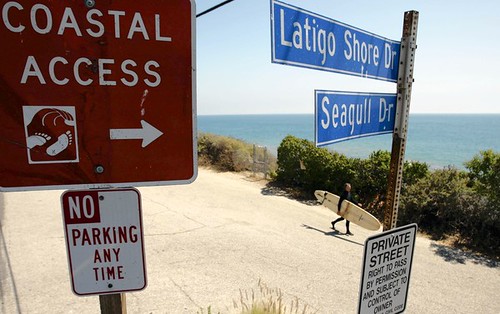
The Los Angeles Times reports, in "Do-it-yourself parking bans in Malibu: The California Coastal Commission fights a losing battle against homeowners who post illegal 'No Parking' signs. Some look so official that even authorities are misled," about how beach property owners install "official looking" no parking signs on access roads to limit access to the beaches. Another issue is that California state law mandates public ownership and access to ocean beaches.
unreal parking signs, Malibu, CaliforniaA surfer is framed by street signs, a sign pointing to coastal access, and a pair of signs restricting public right of way and parking. According to the California Coastal Commission, many parking signs posted along the Malibu coastline are unauthorized and erected by property owners seeking to restrict public use of local beaches. Luis Sinco / Los Angeles Times

Labels: , , , ,

Saturday, November 28, 2009

"Parking, parking, parking" and "Driving, driving, driving"

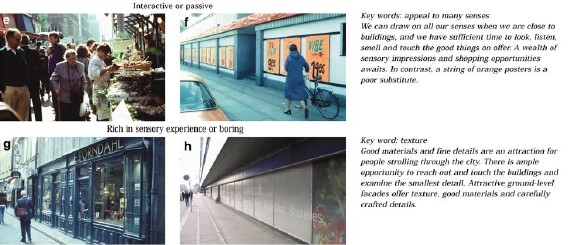
Urban scenes at eye level, Part Two
Urban scenes at eye level, Part Two, Jan Gehl, Close Encounters with Buildings

For those of us who grew up watching the Brady Bunch on television, we remember the competition on the show between the middle and older sisters, Jan and Marcia, and Jan's lament that everything was about Marcia -- "Marcia, Marcia, Marcia."

I have a similar kind of response when listening to what I would consider whining by automobilists about the demands for what I consider to be overaccommodation.

"Parking, parking, parking" (a/k/a "privilege, privilege, privilege")

The proposed new Silver Spring library is across the street from a huge parking structure. Now there is a debate between the pro-urban design (against) and the pro-automobilist (for) over whether or not there should be a "skywalk" connecting the garage directly to the library.

Since active urban spaces have active ground floors, we urban design types think that just as how people go to the ground floor of the garage to exit to the stores, restaurants, cinemas, and other destinations in the area around the parking garage, that library patrons should do the same.

But Robert Oshel disagrees in his letter to the editor, "Silver Spring library design lacks parking," in the Gazette, demanding dedicated parking specifically for the library, or baring that, a skywalk.

Ironically, one of the examples Jane Jacobs uses in Death and Life of the Great American City to illustrate the concept of "mixed primary use" is having arts and culture uses located in central business districts and how the parking demands for these uses can be accommodated by the garages that during the day support the office buildings, that building dedicated parking facilities is a waste of money and space compared to using the same facilities for more hours of the day for a multiplicity of uses. (She was writing about Pittsburgh's downtown versus the development of a cultural center in the Oakland neighborhood.)

Skywalks are not great for cities. A graduate student did her thesis on skyways, finding them to be antithetical to great urbanism. See "University of Utah student compiles report on skybridges" from the Salt Lake City Deseret-News. From the article:

Hill, a graduate student at the University of Utah, is completing a master's degree in urban planning and is preparing to begin a Ph.D program. For nearly a year she researched skybridges in urban settings and compiled her findings in a 43-page report titled "Preserving Life of the Street."

"I felt like someone needed to speak up and say, 'This isn't the right concept for our Main Street,"' she said. "Someone needed to gather a body of information to say, 'This is a bad move. Let's come up with another option."'

Hill cites several sources supporting her conclusion that skybridges hinder street-level pedestrian activity and promote segregation and separation. "Planning and design professionals are all standing up and saying that skybridges don't work in this setting," she said.

Anyway, to be fair and equal, Mr. Oshel and others who make the same arguments need to advocate for all library users, including transit users, and should demand that transit users trips to the library be absorbed by the library too.

Labels: , , , ,

Thursday, October 08, 2009

DC/USA 2004...

This is from email to the Columbia Heights email list. Although I don't think that the $2 million for local business development ever came through. And maybe the parking garage isn't an asset that the DC residents want to own. And maybe we'll lose money.

That being said, I do think spending public money to assist the creation of DC/USA was a good idea, and I have to admit that I didn't think so at the time. (I guess I do learn stuff.) You do need regionally attractive shopping options within DC, even if "region" in this case means other parts of the city, but not the region outside of the city.

Where I think we fall down within the city is figuring out how to leverage these additions to our overall retail offerings and commercial districts in ways that also strengthen and extend the qualities of independent businesses and unique retail.

I.e., how can the energy and demand for retail at DC/USA be pulled along the 14th Street corridor and spillover to adjacent commercial areas. For example, despite the success of DC/USA and the Giant Supermarket, two restaurants, Rumberos and Nori, located on the 3200 block of 14th Street in Tivoli Square, abutting the Giant, have failed.

That is an indicator that something about this process isn't working...

PRESS RELEASE
Contact: Steven Hernández
July 13, 2004

COUNCILMEMBER GRAHAM MOVES EMERGENCY BILL TO PROMPT TARGET AND MAJOR RETAIL DEVELOPMENT TO COLUMBIA HEIGHTS

(WASHINGTON, DC) In order to ensure that Target comes to Columbia Heights, Councilmember Jim Graham (Ward 1) moved, and the Council passed, emergency legislation to provide $42 million in tax increment financing to build a needed garage and thus transform a vacant lot into a major retail development.

The tax increment financing ("TIF") is for the Target/DC USA retail and entertainment development at 14th and Irving Streets, NW. $2 million of the TIF funds will go directly towards
supporting existing small businesses impacted by the development. With this legislation, construction is estimated to begin in 6-8 months, with scheduled completion in 2007. "For too long, District residents have been forced to go out of town for their retail needs," said Councilmember Graham, "The Council's action helps ensure a new major retail center, not only for Ward One, but for the entire region."

Target/DC USA will provide approximately 460,000 square feet of high-quality retail development with 1000 spaces of below-grade parking, create approximately 500 construction jobs and 1000 new permanent jobs for District residents, all at no cost and no risk to the District. In fact, with the tax revenues that will be generated by the project as soon as it opens, DC USA will practically pay for itself. Furthermore, upon repayment of the debt service on the TIF Note, this project will also generate over $240 million in new tax revenue to the District over the first 20 years.

Moreover, unlike any other TIF approved by the District to-date, DC taxpayers will come out of this deal with an asset: we will own the 1000 space garage built on the premises to support the retail development. The Target/DC USA project will be the centerpiece of Columbia Heights initiatives which include:

* The Tivoli Square project, featuring a 53,000 square foot full-service Giant Food supermarket, a 250-seat theater managed by GALA Hispanic Theatre, 24,000 square feet of additional retail, 28,000 square feet of commercial space, 220 parking-garage spaces, and 40 for-sale town homes, (20 percent of which will be affordable). The project is expected to generate approximately 200 permanent jobs, where possible, first priority for new jobs going to Columbia Heights' residents;

* The Donatelli & Klein development of Kenyon Square and Victory Heights (Parcel 15), comprised of mixed-use development to include 153 condominium units offered at various affordability levels, 21,000 square-feet of retail space, a 75 unit affordable senior housing building, and underground parking;

* The Donatelli & Klein development of Columbia Heights Station (Parcel 26), comprised of mixed-use development to include 235 residential units offered at various affordability levels, 22,000 square-feet of retail space, and underground parking;

* La Casa, a new state of the art homeless facility on the 1400 block of Irving, NW, replacing dilapidated trailers currently on that site;

* The Dance Institute of Washington (DIW) project, a two-story non-traditional 7,000 square foot retail project that will bring badly needed child-care services to the community (ground floor) and provide the community with a valuable recreational resource, a two-story professional 6,250 square foot dance studio (2nd floor);

* The Metro/WMATA project at 14th and Kenyon, NW, with 18,000 square feet of retail and 120 new residences offered at various affordability levels.

Labels: , , , ,

Friday, August 28, 2009

How not to do "transportation demand management"

I had forgotten about the Washington Redskins latest revenue generation technique, charging a fee for parking on every ticket (see "You'll pay a parking fee at FedExField - even when you don't come in a car" from the Washington City Paper) until I listened to last week's Kojo Nnamdi Show on WAMU-Radio show partially about transportation, which featured WRC-TV reporter Tom Sherwood and Arlington County Board member Chris Zimmerman, among others.

Sherwood talked with Kojo about how DC Government is still talking with the Redskins about relocating back to the city. One of the things that he said is that the Redskins stadium generates $20 million annually for Prince George's County. Other reporting, such as this article from the Post, "Md. Weighs Stadium for D.C. United: Study Will Gauge Pr. George's Benefits," from last year, says differently.

PG County nets $10 million in Redskins-related economic benefit, but 80% comes from the additional tax on concessions and tickets. Even $10 million annually might not be an adequate return on investment in terms of what was expended by the State of Maryland and the County to land this facility.

Without the tax on tickets, PG County would make only $2 million/year from the stadium.

But I digress....
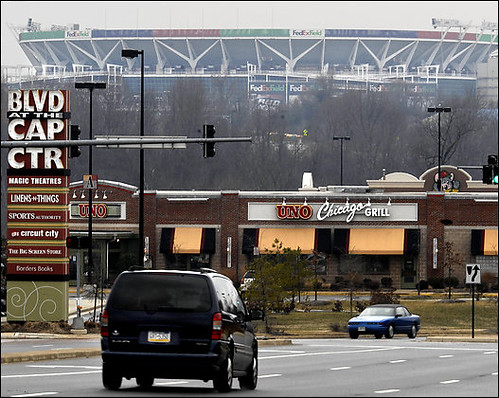
FedEx Field and retail
Redskins stadium in the distance. Katherine Frey, Washington Post.

While I believe that stadiums and arenas should be required to do transportation demand management planning, the parking charge by the Redskins is a travesty (yes I know people tailgate). People should be encouraged to carpool or use transit, and the parking charge doesn't do that, since people pay regardless of how they get there.

From the City Paper article:

Area rock and soccer fans these days are feeling Snyder’s parking genius, right in their pocketbooks. Paul McCartney and Real Madrid v. D.C. United played at Snyder’s FexExField this month, and U2 is coming next month. For every ticket sold to these events, Snyder has tacked on a parking charge, from $5 to $10, in addition to all the other fees (Ticketmaster and the like). This is in addition to the advertised admission charge.

So, if you drove with five people to the McCartney show, you will have paid $60 for a parking spot in a Godforsaken portion of Prince George’s County. And if you took those same five people on the Metro with you, you will have paid $60 to not park in a Godforsaken portion of Prince George’s County.

In "The Stadium of the Future" (also see "HOK Imagines the Ballpark of the Future") Fast Company magazine reports that with proper planning, a significant number of fans will come to the event via public transit. From the article:

NO PARKING ZONE

Noticeably absent: parking. Last year, 53% of visitors to Washington's Nationals Park came via the Metro, a trend that's expected to grow. Ideally, residents park off-site and ride light rail (or maglev trains, in this rendering), allowing better -- and more revenue-generating -- use of space than parking lots.

Transportation demand management requirements, not just a parking charge benefiting the stadium owner, should be mandatory for stadiums/arenas and the events held within.

If Nationals or Wizards or Capitals tickets were each assessed a $10 fee for transportation demand management, there would be justifiable rebellion... But Verizon Center (and RFK) and Nationals Stadium abut transit, even if the power of transit connections vary (Verizon Center is served by all five subway lines without necessarily having to transfer--if you are willing to walk from Metro Center...).

Labels: , , , ,

Friday, July 31, 2009

More about parking as an entitlement in Montgomery County

I read the Takoma-Silver Spring Gazette every week, since this is my greater neighborhood (I do a limited amount of volunteer work for the Main Street Takoma program, which covers the commercial district in both MD and DC) and I can't help but shake my head over the ongoing discussion, letters, etc., over "free parking" for the library at the Rockville Town Center.

What never seems to percolate through into these discussions is a recognition that subsidized parking only benefits drivers, that people who use transit are expected to pay their own way.

I understand the desire to reduce impediments to library use, but favoring one class of library users--in this case automobile drivers--over another is patently unfair. Either start paying for people to ride transit to and from the library, or drop the subsidy. (This is an issue because Montgomery County ends up having to pay for it out of its increasingly strapped budget.)

See:

-- Free libraries have an expanding role by Art Brodsky, a member of the Montgomery County Library Board;
-- County Council votes to reimburse Rockville for library parking
--Reconsider free parking at the county seat's library by George L. Leventhal, an at-large member of the Montgomery County Council and chairs the council's Health and Human Services Committee, which oversees libraries.

Note that DC does provide free parking at certain libraries for library users. I do think it is an unfair subsidy although I am not going to challenge it. (I am still mulling over suggesting that the 30 minute parking for customers that is placed on the west side of Eastern Market ought to be metered, and I am not sure I am prepared for the fallout.)

Labels: , , , ,

Wednesday, July 08, 2009

The issue of weekend closing of 7th Street SE adjacent to the Eastern Market

7th Street SE at Eastern Market
There was a meeting last night about this, convened by Councilmember Tommy Wells of Ward 6. (Currently the street is closed on weekends as a result of an Executive Order by Mayor Fenty, and he shows no desire to revoke the order. However, various camps in the community question either the decision or the lack of community input into the decision.)

It was a civil meeting, not widely attended (more than 50 people, maybe not 100 people). The sentiment was overwhelmingly in favor, but some merchants were opposed and some residents.

1. The merchant opposition has to do with the perception that people need to be able to come up to the market with a car to pick up items they've purchased, because they are too heavy to carry. (And the discussion in part focused on creating short term pick up zones.)

One of the things that bothers me about this discussion, although I understand and appreciate the sentiment, is that it only recognizes the value of automobile owners as customers. 40% of DC households, such as mine, don't have cars. Creating a pick up zone is for the convenience of automobile owners. That's fine, it's an important segment of the market. But where is the planning for the segment of the market that doesn't own a car.

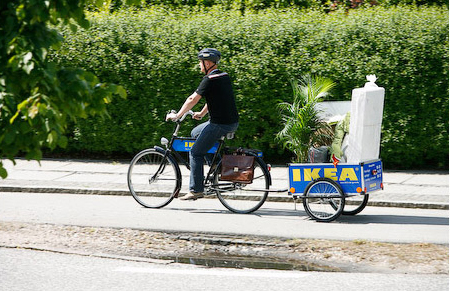
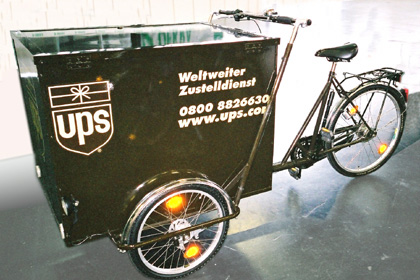
For a couple years I have advocated for a shared delivery service, renta-bicycles, etc., and this seems to fall on deaf ears. At least I don't think I have ever heard it acknowledged or considered...
Ikea bike and trailer, Velorbis
At Ikea stores in Denmark, you can borrow a bicycle and trailer to take your purchases home. Velorbis photo.

UPS delivery bike, Amsterdam
UPS delivery bike by Workcycles, Amsterdam.

2. Another thing that most of the pro-car camp fails to acknowledge is that for the past few years, there hadn't been metered parking on Saturdays, so most of the spaces on the block of 7th Street SE from C Street to North Carolina had been used by people parking all day. The spaces for the most part didn't turn over.

3. A lot of the discussion took for granted the centrality of automobile ownership, the desire to park in front of your house, the increased demand for parking in the area, as Eastern Market becomes more of a destination.

4. Many people stated that they feel much more comfortable with the street closed on weekends, especially if they have children or dogs, because before it was more dangerous, with cars rushing through, and all of the parked vehicles, especially adjacent to the Farmers Line Shed, blocking visibility.

5. But other people worried that making Eastern Market more of a festival could make it harder for the food sales, both outside by regional farmers, and inside by the merchant-vendors, to succeed.

6. Some businesses ("brick and mortar") on the east side of the street have been fighting the street closure, saying that it negatively impacts their business.

Now I don't think I have ever met a business proprietor who doesn't believe that parking is the biggest issue for them, impacting their business. But often this is an excuse or a misreading of concerns expressed by customers. A lot of times, businesses aren't doing enough to promote their business, to make their merchandising exciting.

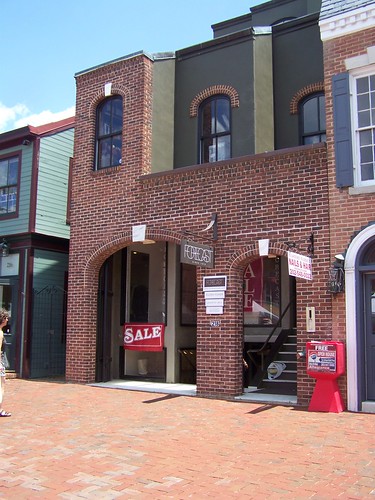
A perfect example is the lack of merchandising by Market Row businesses, a failure to capitalize on the vitality of the street, and to connect their business to the sidewalk and street, to lure customers in. For example, The Forecast is a clothing and gift store. They have some very nice items (we have bought gifts there, and Suzanne has bought clothes from them), but you would never know it, looking at the outside of their building.
Forecast clothing and gifts, 7th Street SE, Eastern Market
Forecast, 7th Street SE.

Part of the problem with the Forecast building is that it was designed to ward off the street, rather than connect to it. The store windows are hidden behind a projection of the facade. This is typical of buildings built in Capitol Hill in the 1980s. (And categorically, the buildings are failures for the retail stores within.) It's also a problem with the Georgetown Park mall in Georgetown, which for the stores on the interior of the mall, pedestrians have to leave the excitement of M Street and Wisconsin Avenue in Georgetown for the artificial light and deadness of the bowels of that shopping center.

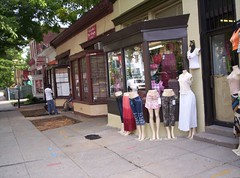
This store on 11th Street NW in Columbia Heights, Franklin's, a street not known as a retail destination, does a far better job in trying to reach out to customers who might be walking by, to leverage the little pedestrian activity there is, to draw customers inside.
Franklin's Women's Clothing, 3300 block 11th St. NW

7. In a side conversation with Councilmember Wells, I discovered that he has become far more informed about the nitty and the gritty of transportation/mobility issues and politics. It's a very good sign. At the end, unlocking our bikes, the three bicyclists (including Councilmember Wells), traded tips on riding at night and the best place to get lights -- Councilmember Wells is a fan of adaptively reusing items sold at Fragers Hardware, located on Pennsylvania Avenue SE, as they tend to be less expensive than the gear sold at bike stores...

Labels: , , ,

Thursday, July 02, 2009

I don't think a congestion fee is the right direction for DC or congestion fees are sexy, but there are better policies, at least right now

-------------
Revised with significant additional content at the end.
-------------

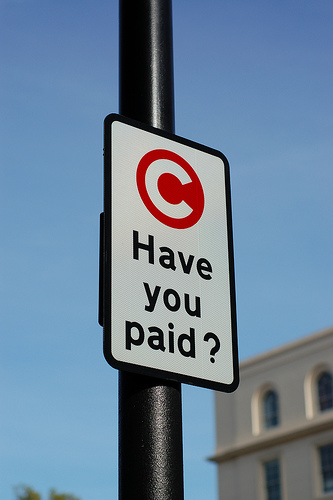
London Congestion Charge sign
Flickr photo of a congestion charge sign by KZ08.

Arlington's CommuterPage blog has an entry proposing a congestion fee for DC, "Save Two Birds With One Starbucks - Fixing Washington's Traffic." And this has been discussed for a couple years. And some people think it's a good idea.

I am not on the bandwagon.

To be honest, I don't think traffic is that bad in downtown DC, although some streets, such as New York Ave., I Street (especially since PA Ave. is closed), K Street and others have comparatively heavy traffic and are in fact, very much congested.

But even at the same time, many other downtown streets are not congested, and even during rush hour I can ride through intersections on my bike, through stop lights, because there isn't oncoming traffic.

And the reality (granted most regional congestion studies focus on freeways) is that most of the highest congestion areas in the region are not in DC proper, and it's unlikely that assessing a congestion fee in DC would have any impact on those problems.

Furthermore, we can't trust the suburban jurisdictions--which includes Arlington, which happily picks off organizations from DC for relocation to their fair burg as it is--to not use the existence of a congestion fee in DC to urge presently DC-located organizations and businesses to relocate to the suburbs in large part for their car driving employees to avoid a congestion fee.

More important to DC's transit financing agenda than imposing a congestion charge would be to:

(1) impose a transit withholding tax, comparable to how it's done in Portland and Lane County Oregon (or soon for the MTA in Greater NYC) -- in a paper I wrote a couple years ago, I estimated this could generate $200 million/year. And it would be applicable to everyone who works in the city, whether or not they drive. Since 70% of jobs in DC are held by non-DC residents, it could be considered a commuting tax, on the other hand it would be fully justified and the use targeted.

(2) impose an annual personal property tax on automobiles registered in the city. I came to this position in a roundabout way. The annual fee for a residential parking permit is $15. The value of using a parking space on the street is worth upwards of $2,000 year, but people still whine about proposals to increase the fee.

But there are really two aspects to raising the rate, one has to do with the value of the parking space, but the other has to do with recovering more of the costs of paying for roads as typically, automobile taxes and fees cover no more than 55% of the cost of roads.

And increasing parking permit fees solely doesn't address the need to recover more of the costs of paying for roads for people who have off-street parking spaces, and therefore don't require residential parking permits.

I haven't costed this out. But the annual registration fee in the city is pretty low, from $72 to $155/year, depending on the weight of the automobile.

(3) but still, it is necessary to raise residential parking permit fees, in order to send the proper message for how much these spaces are worth, and to discourage people from buying larger vehicles or multiple vehicles and expecting to be able to store the vehicles on the street.

This is what I wrote in last year's The revised revised People's Transportation Plan/2008 Transit-Transportation wish list:

[C]hange the residential parking permit system in DC to one that emphasizes the privilege, rather than the right, to park. 40% of the people in DC do not own cars. Why should the 60% that do be privileged with practically free parking spaces?

a. Residential parking permits should cost a lot more generally. As you probably know, Prof. Shoup estimates that the value of the public space on the street is about $1800 annually.

b. There should be a limit on how many residential parking permits can be issued per household. Only one car can fit in front of a typical rowhouse. Multiple cars per household should be discouraged.

c. The rate for residential parking permits should go up considerably for each additional permit per household address.

d. Parking permit rates should be weighted according to how large a car is, and its carbon footprint (maybe). One of the big problems I'd say anecdotally is that people in the city may only be buying one car, but it is much much larger than it used to be (an SUV). This further reduces available parking inventory for residents.
A SmartCar on East Capitol Street, Capitol Hill, DC

Note that the various plans for "improvements" of parking policies in residential districts are really further prioritization of resident demands for parking preferences, i.e., such as that being considered in Ward 1. The proposals provide additional protections for resident parking (which further privileges car owners at the expense of people who don't own cars) without adequately charging for it.

See "Night-time Public Hearing/Ward 1/Protecting Residential Parking" from the Councilmember Graham website and the proposed legislation.

It shows the absolute necessity of having a Master Transportation Plan comparable to that possessed by Arlington County and having an element on Parking and Curbside Management like they do.

It's not that the Comprehensive Plan doesn't address this issue. Here's what it says in the Transportation Element:

T-3.2 Curbside Management and Parking 415

Long- or short-term parking is part of almost every car trip, and parking—especially when free—is a key factor in the mode choice for a trip. The availability and price of parking can influence people’s choices about how to travel to work, shop, and conduct personal business. The District’s challenge, like that of many other major cities, is to manage limited curbside space to accommodate ever increasing parking demand. 415.1

There are approximately 400,000 parking spaces in the District of Columbia. The majority of these parking spaces (260,000) are on-street parallel-parking type spaces. About 6 percent of these on-street spaces (16,000) have parking meters. Another 140,000 parking spaces are located off-street in parking lots and garages. The majority of the off-street spaces are located in Downtown parking garages. 415.2.

And then this action

Action T-3.2.C: Curbside Management Techniques
Revise curbside management and on-street parking policies to adjust parking pricing to reflect:

a. the demand for and value of curb space;
b. adjust the boundaries for residential parking zones;
c. establish parking policies that respond to the different parking needs of different types of areas;
d. expand the times and days for meter parking enforcement in commercial areas;
e. promote management of parking facilities that serve multiple uses (e.g., commuters, shoppers, recreation, entertainment, churches, special events, etc.);
f. improve the flexibility and management of parking through midblock meters, provided that such meters are reasonably spaced and located to accommodate disabled and special needs populations;
g. preserve, manage, and increase alley space or similar off-street loading space; and
h. increase enforcement of parking limits, double-parking and other curbside violations, including graduated fines for repeat offenses and towing for violations on key designated arterials. 415.7

Action T-3.2.D: Unbundle Parking Cost
Find ways to “unbundle” the cost of parking from residential units, allowing those purchasing or renting property to opt out of buying or renting parking spaces. “Unbundling” should be required for District-owned or subsidized development, and the amount of parking in such development should not exceed that required by Zoning. Further measures to reduce housing costs associated with off-street parking requirements, including waived or reduced parking requirements in the vicinity of Metrorail stations and along major transit corridors, should be pursued during the revision of the Zoning Regulations. These efforts should be coupled with programs to better manage residential street parking in neighborhoods of high parking demand, including adjustments to the costs of residential parking permits. 415.8

This sentence bears repeating:

These efforts should be coupled with programs to better manage residential street parking in neighborhoods of high parking demand, including adjustments to the costs of residential parking permits.

Parking for residents is the "third rail" of local politics and the City Council does everything it can to avoid addressing this.

David Alpert of Greater Greater Washington rightly called me to task in the earlier version of this entry because I equated performance parking policies (better, market pricing of street parking, mostly in commercial areas) with residential parking policy initiatives.

One of the reasons though that some of the performance parking policies bug me has to do with restrictions on parking on side streets (remember that I do commercial district-retail revitalization consulting) and that the residents are getting almost a complete free ride on the cost of these spaces.

Labels: , , , , ,

Monday, June 01, 2009

Stupid is as stupid does

both from the perspective of gaps in DC historic preservation and demolition laws, and the writing in the local press about this, as evidenced in the City Paper blog post, "Anything Worth Saving Here?: H St. Rowhouses Edition."

I have various comments in the response, but then, why do I bother?

This is an extract from an email I wrote a couple days ago after the hearing:

The average untrained preservationist, and I suppose that includes me at times, doesn't always distinguish between the level of significance necessary for the creation of a district vs. a landmarking of a single or group of buildings. The issue of integrity--all four original buildings being intact and in this case, one glaring omission--made it a difficult case. Tim Dennee's staff report on the landmarking issue was well argued, with a surprising hint of sympathy on the complexity of the matter.

Those pursuing the application knew it was a long shot, but knew that it had to be pursued in order to try to deal with the property owners in a substantive way. I know that HPO and probably the Board doesn't like the landmark application process being used in this way, but the lack of other remedies in DC law forces this type of action.

Most of my writings about the need for more robust processes and systems in DC planning, zoning, and building regulation come from dealing with these kinds of issues and getting crushed by the gaps between platitudes and the dearth of substantive ways to deal with problems that come up. E.g., I asked Muriel Bowser why the hell she is pursuing placarding for raze permits without adding any additional remedies to the law? She said notice is important. I said why?, when you can't do anything in response...

The only possible remedy that exists in DC law currently to stop a demolition is the landmarking of the building/or the inclusion of a building within a historic district as a contributing resource.

What frustrates me about other people who testify about these kinds of issues, is that they aren't making the connections between the Comprehensive Land Use Plan and processes all the time, and that they don't know how to articulate the problems in a useful way. They end up being scolds and because they can't see why the problem exists, they come off as testy.

The real problem is that the Comp. Plan is mostly platitudes--in the context of law it is a bunch of shoulds and "mays" not "shalls"--and that there isn't a desire to put into place focus and protections on things that matter because that would interfere with the real estate development process in substantive ways.

I am still angry about the technical amendments bill from a few years ago because--as the blog entry from the other day indicated--I testified for years about dealing with putting into place demolition protections whether or not buildings are designated. In the technical amendments legislation, a provision on this was included. But it didn't stay in the bill. I suppose it was probably put it in knowing it would have to be given up, but that by giving it up the rest of the bill would sail through. So the building industry assn. is still happy about getting Chairman Cropp to take that section out of the bill. I'm still pissed.

But we needed to organize more and better, and as I keep writing and agitating, I don't think we (preservationists) have been very good at articulating the links between preservation and the quality of life and attractiveness of the city that people want to consume as residents and visitors, and how this is the foundation of the city's competitive advantage.

As far as the Board being frustrated, I am frustrated too, because the classic tome on preservation revolving funds was published in 1976, but in all that time, the preservation community in DC hasn't managed to create such a fund. Had one been in place, that's how we could deal with this particular matter, if only to stabilize the building to prevent the leakage between that building and the Atlas, which is driving the Atlas crazy--they have been pushing the matter via the Condemnation Board, because of the damage to their own property.

Labels: , , , , ,

Monday, May 25, 2009

Even a church can do transportation demand management planning

From "Beach Town Churches Brace for Unpredictable Summer Attendance," in today's Washington Post:

While catering to often larger congregations during the summer, pastors must also ensure they are not neglecting their core members. Each summer, Holy Savior Roman Catholic Church, located just blocks from the boardwalk, adds a Saturday evening service at a Methodist church in Berlin so that residents do not have to battle beach traffic.

"It's a 10-minute trip, but sometimes it takes me an hour and a half. It's much easier for me to go over there than for all of those people to come here," said Father John Klevence, who has worked at Holy Savior 12 years. "Ocean City is a small town, ultimately, and there is a good spirit of cooperation here. There has to be."

Labels: ,

Friday, May 22, 2009

Another example of getting the story wrong

While I agree that DC is maybe a little too gung ho about ticketing, the reality is that the city has about 260,000 on-street parking spaces throughout the city (see the DDOT report Mayor’s Parking Task Force (2003)) and fewer than 10% of the spaces are metered. In short, there is a limited supply of spaces.

So like Bill Myers who wrote about the lamentations of police officers getting tickets while being paid overtime for testifying at the Courts in the Examiner, Tim Craig focuses on the plight of people breaking the law and having to pay for it, in "Street Sweepers May Ticket You " from the Post.

As of the 2007 Census, there are 248,338 households in the city. While 38% of the households don't have cars at all, that still means that there are at least 154,000 cars out there waiting and wanting to be parked. Even if all of the automobile drivers aren't looking to park on the street, that's a lot of cars out there.

There are about 570,000 jobs in the city, of which 400,000 are occupied by people who don't live in the city. Many of them drive in.

In short, there aren't enough parking spaces to accommodate 248,338 households, 400,000 non-resident workers, millions of visitors, all the delivery traffic, etc.

So you provide "incentives" to use forms other than driving to come to the city. Tickets are disincentives, and they are good incentives for people to make better decisions, just as parking fees are. For example, the Fairfax edition of the Post Extra section has this article, "For More Riders, 'the Bus Is Beautiful': Commuters Leaving Cars at Home To Save the Cost of Parking at the Metro." The concept is the same...

From the article:

Bad luck put Haydee Moore, 60, on Fairfax Connector Bus No. 621 from her home in Penderbrook to the Vienna Metro station last week, after her car had broken down.

But bad luck turned to good when she discovered how comfortable the 45-minute ride was, how much easier it was than staking out the always-full Park-and-Ride lot at the station, and how much cheaper it was than paying the $5 daily parking fee.

"The bus is beautiful," Moore said as she prepared to board a train to Metro Center, where she works as a makeup artist and cosmetics marketer in a department store. Moore's car is fixed, but she has no plans to return to her old commute, she said.

Optimal mobility is not automobility. And if Haydee Moore can learn this, so can others.
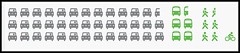
Cars-buses-walking-bicycling
Image extracted from the Vancouver BC Transportation Plan.

Labels: , , ,

Tuesday, May 19, 2009

Bill Myers misses the real story about parking around Judiciary Square

which is that police officers think they should be able to park their private vehicles for free.

Instead, we get this, "Cops decry parking tickets during court visits" in the Examiner and officers clamoring for a parking lot (it costs upwards of $30,000 per space to build a parking structure, or do officers want some buildings torn down so they can have a surface parking lot?)

My response to the article:

1. Where do DC police officers...
2. Many of whom live in the suburbs,
3. and drive their automobiles to the Courts
4. expecting free parking
5. even though the Courts are located downtown in a densely developed area where there is only a limited amount of parking available on-street to begin with,
6. (although there is some paid parking available nearby in underground parking structures)
7. despite the fact that the Courts are located two blocks away from either the Judiciary Square (red) and Archives (yellow/green) subway stations
8. and when they don't get free parking, or tickets because they are parked illegally
9. they whine
10. and expect the city to build them free parking lots or parking structures.

-------------
1. Me, I would never expect to be able to drive to downtown and park for free--let alone find parking. Instead, I would take public transit.

2. Note that whenever our household gets phone calls asking for donations to the Fraternal Order of Police I inform the caller that we disagree with many of the positions expressed by Kristopher Baumann, the leader of the FOP (the police officers union), as expressed in the local media and therefore aren't willing to make donations.

3. This is another illustration of how every DC government agency should be required to do transportation demand management planning, focused on reducing the number of automobile trips made by people coming to work.
Overview of Judiciary Square area, Downtown DC
Overview of Judiciary Square area, Downtown DC. Indiana Avenue is on the top of the photo. Probably, this is a Historic American Building Survey photo from the early 1970s. The parking lot shown in the bottom middle of the photo is now an office building for the local field office for the FBI.

Labels: , ,

Monday, May 18, 2009

Eastern Market post-fire renovation and road improvements: Adding a mid-block crosswalk at the entrance on 7th Street SE

Eastern Market is reopening on June 26th. In the meantime, building construction workers, logistics coordinators, and road construction workers are working feverishly to ensure that the building will in fact open as scheduled.

One of the things that I didn't realize was being done as part of the resurfacing of 7th Street SE in front of the Market is the addition of a mid-block crosswalk. DDOT isn't always in favor of this kind of pedestrian oriented street improvement, so it's good to see.

The merchants, both of the interior of Eastern Market, and the businesses on 7th Street seem to be vociferously against closing 7th Street SE on the weekends.

It's a continuous continuing battle. They see this as negatively impacting their business, due to the loss of parking spaces. It's discussed in the Hill Rag article, "Permanent Closing of 7th Street Challenged: Commuters Fill Promised Parking at Hine."

However, heretofore, there has never been any parking enforcement on Saturdays on 7th Street SE, so the likelihood is that workers were driving in and taking up these spaces all day, meaning there was limited if any turnover of the parking spaces which would normally support retail business.

And, those of us in favor of closing the street on the weekends to support the Market area, inside and outside of the market, have a continuing battle to maintain this as a test.

One of the things I didn't like about the Hill Rag article is that because it focused on the letter from the "Market Row" merchants, it didn't cover the issue more broadly, and interview people who might be in favor of the weekend street closure.

This is going to continue to be a major issue for the next year.

Thus far, Councilmember Wells has taken a lot of heat for being favorable to the "test," which was started more as a way to accommodate displaced vendors, and less as a tactic to create a more interesting and accommodating walking-friendly urban environment.

(Disclosure: I am on the Eastern Market Community Advisory Committee, which functions somewhat--not fully--as a board of directors.)

Labels: , , , ,

Monday, April 13, 2009

Appropriately developing neighborhood-appropriate street parking policies

(Based on a set of email exchanges, edited)

From Tom:

Right now I can't move my little mini car beacuse the nightclubbers will start to show up at 6:30 pm [and park in the 14th Street NW/U Street neighborhood] with their big SUVs and no spaces will open until 3 am. This is a really small irresponsible segment of the nightclub community as there's a subway station two blocks away and they know they'll be drunk driving when they leave. 3 am hell breaks loose around here.Arlington even has now gone to 24/7 Residential Parking Permit requitements.

Unfortunately with Jack we'll probably have to wait for Graham's parking reforms to get any relief. Graham and Wells got their wards' parking changes by law a year ago. Of course it's about money as the side of the street where non-RPP can park for 2 hours charges market rate with the new smart meters.Jack told me he won't make a move until the ANC recommends it so I'm getting the ANC to act. Here's a link that describes how the Expanded RPP works in Ward 6.

From me:

I'm basically familiar with it. I saw Don Shoup, author of The High Cost of Free Parking, speak in 2005 for a DC "great streets" conference. And I've skimmed his book. I think it's fine. And I will add your points to my 2009 transpo wish list section on parking.

I favor what is called "performance parking," but at the same time, I think that residents need to pay far more for the privilege of having a car and being provided with street parking space for practically no cost. It's a privilege supported by the almost 40% of households (like mine) in the city which don't have cars. And then when the car owners grouse about Zipcar getting dedicated spaces....! (although I have to be thankful for that debate, 'cause it led me to have some important insights on the issue).

Anyway, DC doesn't have a transportation plan, and within that nonexistent transportation plan, there should be an element on parking and curbside management.

And that element, if properly written, would provide all the support for the regulatory structure neighborhoods need to deal with parking issues, without a neighborhood having to petition the local caudillo (elected Councilmember) to deal with it.

In short, I DO NOT UNDERSTAND WHY DEVELOPING NEIGHBORHOOD-SPECIFIC PARKING POLICIES REQUIRES THAT EVERY NEIGHBORHOOD GET A SPECIAL LAW PASSED BY CITY COUNCIL.

I hate this "creation" of a piss poor transportation plan in bits and pieces through a series of convoluted legislative actions.

Speaking of Arlington County, their transportation plan is very elegant. The provisions within each element "cascade" from the goals and priorities laid out in the introduction to the Plan and are for the most part mutually supporting. I can see how 24/7 RPP would logically follow, because the entire plan is based on discouraging suboptimal mobility and single occupancy vehicle trips particularly, and each element is designed to support the realization of that goal/priority. Hence 24/7 Residential parking priority. But within that priority, the Element does not prioritize parking at curbside for automobiles at the expense of transit, pedestrians, bicycling, or urban design.

Without the equivalent kind of transportation plan in DC, it makes it much harder to do the right thing. And without a plan, elected and appointed officials lack the cover they need to lead on hard issues. And without a plan, elected officials get to grandstand, and appointed officials cower.

E.g., with a Comprehensive Land Use plan that would prioritize management of transportation demand as well as preserving houses, churchly land acquisition to support tearing down houses would be prevented. Instead there would be transportation demand management plans for each church. Within this context, you would allow double parking, properly managed, because an imposition of double parking for a couple hours/weekly is much better public policy than it is to tear down domiciles (housing people, generating property and income and sales taxes) in favor of the creation of parking lots used for a handful of hours weekly. At the same time, the church would have to work to limit the overall number of trips, by encouraging car pooling, and other measures. Etc.

I think in mixed use districts, residents should have the option of declaring their block 2 hour restricted til midnight. This shouldn't have to require involvement the councilmember in order for action to be taken.

This is from my 2008 transportation wish list:

18. Take on the parking mafia. Do a parking study of the entire city, comparable to what Seattle did, and change requirements accordingly, including a paradigm of shared parking systems in commercial districts. As a result, Seattle eliminated parking requirements in certain areas, including around transit stations, stating:

Lower parking requirements based on local demand and to support alternative transportation. In Urban Centers and high capacity transit station areas, allow the market rather than the code to determine appropriate parking supply.

DC really bobbled an opportunity during the Comprehensive Land Use Plan revision process to address parking and curbside management, which by and large it failed to do.

19. Speaking of parking and curbside management, change the residential parking permit system in DC to one that emphasizes the privilege, rather than the right, to park. 40% of the people in DC do not own cars. Why should the 60% that do be privileged with practically free parking spaces?

a. Residential parking permits should cost a lot more generally. As you probably know, Prof. Shoup estimates that the value of the public space on the street is about $1800 annually.

b. There should be a limit on how many residential parking permits can be issued per household. Only one car can fit in front of a typical rowhouse. Multiple cars per household should be discouraged.

c. The rate for residential parking permits should go up considerably for each additional permit per household address.

d. Parking permit rates should be weighted according to how large a car is, and its carbon footprint (maybe). One of the big problems I'd say anecdotally is that people in the city may only be buying one car, but it is much much larger than it used to be (an SUV). This further reduces available parking inventory for residents.

Tom responded (and the thread discussed other things too):

The value of parking around here is much more than $1800/yr. Spaces rent for $200-$250/mo and sell for $50,000.

Labels: , , ,

Monday, March 16, 2009

When you create parking districts, they only focus on parking

Bethesda Parking Garage
Center of the block parking garage at Bethesda Row, Bethesda, Maryland. Usually parking at night and on weekends is free. People park, and then walk around the 3+ blocks of the commercial district. There is a Barnes & Noble, movie theater, and many many many restaurants.

When you create "Transportation Management Districts," then the organization rightly focuses on all transportation modes. I was really struck by this, reading about the creation of a Parking Management District in Manayunk, Philadelphia, in the book Paths and pitfalls - on the way to a new vibrancy in older retail districts by Ed Crow. Manayunk is served by buslines and regional rail, but the PMD there focused completely on parking lots.

Greater Greater Washington, in "Fund Ride-On, not subsidized parking, says Transit First," shows an example of similarly limited thinking in nearby Montgomery County. Granted that in Bethesda and Silver Spring, MoCo has transportation districts, however because of the way that the parking district is created and how parking ticket revenue supports the parking garages, not all transportation modes, policies tend to promote automobility rather than more balanced transportation choices.

In "Parking district plan is half of the solution" in the Gazette, last year I wrote about overly constrained thinking.

Labels: , ,

Friday, March 13, 2009

Very good article on parking issues

from Intransition Magazine, "Putting Parking into Reverse: Professor’s Theories Influence Cities to Reconsider Pervasive Free Parking" about the work of Professor Donald Shoup of UCLA.

Labels: , ,

Wednesday, February 18, 2009

Parking in historic districts

(This is a reprint of something I wrote on the Preservation Forum e-list, although it has been edited).

Regarding this query, there are two other and I think more important ways to consider this issue.

1. is in terms of the history of urban design in relation to historic neighborhoods and how neighborhoods and housing production practices changed in order to accommodate the car in response to its invention; and
2. is focused on making sure that transportation and neighborhood planning goals are congruent and that parking and curbside management policies are properly and adequately reconciled with neighborhood preservation policies.

1. Urban design.

When considering historic preservation in DC and the city's competitive advantages, at first I bound together in one concept two very different aspects: historic architecture and the urban design/urban form of these neighborhoods (small blocks, zero lot lines, sidewalks, no curb cuts on the face blocks of streets except for alleys, houses served from rear alleys, carriage houses/outbuildings, etc.). After awhile, I realized that I had to separate out the characteristics of the building architecture from the urban form aspects, in order to properly interpret the characteristics and value of the place apart from the buildings.

Urban form during the period of the walking city (1800-1890) and the streetcar or transit city (1890-1920) was very different from the automobile-centric zoning codes that typify regulations across the country.

(From a transportation sense, these concepts were laid out in a classic paper by Peter Muller. "Transportation and Urban Form: Stages in the Spatial Evolution of the American Metropolis," appears in the 2nd and 3rd editions of the textbook Geography of Urban Transportaton. A kind of summary is here.)

You can see this progression in how DC neighborhoods and houses were designed in periods before or after the introduction of the automobile. For many years, I lived in Greater Capitol Hill, and most of the buildings were constructed (1860s-1920) before the existence and/or widespread use of cars. Alley buildings were originally constructed to stable horses, and eventually were converted into garages.

Now I live in the upper northwest quadrant of the city, in a neighborhood that was constructed for the most part in the 1920s and 1930s and rather than incorporating the car as an afterthought, into buildings originally constructed for horses, building plans accommodated vehicles from the beginning. However, housing cars was made subsidiary to housing people.

Cars were accommodated either by separate garages on the lot, accessed for the most part through rear alleys or for corner lots, through garages accessed from the street, in garages integrated into the house but in a less prominent fashion, i.e., basement side entry garages located on the house perpindicular from the front facade, with steep slopes and curb cuts, or entire blocks of rowhouses with rear entry basement garages.
100_5531.JPG
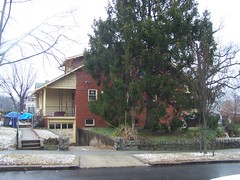
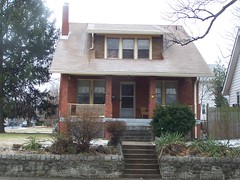
Brick bungalow at the end of my block. The house faces 2nd Street, but the garage is entered from Quackenbos Street. When we were house shopping, we looked at a rowhouse on 311 Gallatin Street NW--still on the market, with a reduction in price--where I also learned about rear entry garages in rowhouse blocks. The original doors and garage are still extant in that house. I would have gone over and photographed it for this entry, but with the snow and my attitude of the moment, I am not up to it.
100_5532.JPG
The front of the bungalow.

(Although it appears as if some detached houses may have had rear entry garages within the basement of the house. In the case of my next door neighbor, where original carriage house garage doors are still intact on the back of the house--but no garage is located in the interior--the distance from the back of the house to the end of the rear lot line is 80-90 feet.)
100_5529.JPG
The garage doors on the back of my next door neighbor's house.

What is interesting is how the prominence of the garage or "house" for the car has become far more pronounced as private automobility, rather than transit, became the predominate U.S. practice.

In the 1970s, growing up in a suburban subdivision in the Detroit area, almost all of the houses had garages that were prominently positioned as a key feature of the front facade. (In my current neighborhood, similarly some houses, perhaps dating from the 1940s, have very small front yard entry garages, for one car, accessed via a curb cut from the street.)

Today, with snout houses, garages are an even more prominent feature of typical American housing.

So, from a "how to use the history of urban design and architecture to support exceptions from current zoning regulations" standpoint, it is important to ensure that our local historic preservation laws include protection of historic urban design as well. This provides the historical justification for limiting the accommodation and centrality of the automobile in planning regulations, because the automobile was not present or significant in these neighborhoods during their original period of architectural significance.

Even though the urban design of neighborhoods is not the complete reasoning for why historic districts in DC have an exception from the parking regulations in the zoning code (which was passed in 1958, many many decades after the construction of what are now historically designated neighborhoods), balancing regulations in favor of exceptions to traditional car-centric regulations comes out of this broad line of reasoning. As does the fact that typically, the neighborhoods designated as historic were constructed of houses without garages integrated into the house, especially in the front of the house, and therefore it is virtually impossible to get approvals for curb cuts in historic neighobrhoods in DC.

(It happens that in DC, the L'Enfant Plan, the urban design for the original "Old City,"is a historic landmark on the NRHP, however I don't think this is why DC historic districts enjoy an exception from standard parking regulations.)

2. Reconciling parking and curbside management and neighborhood planning policies.

Few cities have detailed and thorough transportation plans on the scale of the plan for Arlington (County), Virginia--an urban county outside of DC that functions for the most part as a city. As a planner, and as a reader of a wide variety of commercial district, tourism, transportation and other plans, I find that this plan is one of the best in the country in terms of how it sets out primary goals and the resulting objectives, and how each element of the plan is internally consistent, that the polices and regulations laid out within each element derive directly from and are consistent with the goals in the initial outline chapter of the plan.

Arlington has made mode shift away from private automobile trips generally, and from single occupancy vehicle trips specifically, a key goal and priority of the plan. What this means in the element on parking and curbside management is that accommodating privately owned vehicles on the city's streets (recognize that like DC proper, Arlington enjoys high quality subway and bus-based transit) is not prioritized in the plan.

Similarly, a historic preservation plan focused on preserving neighborhood livability, historic architecture, urban design, and history, authenticity and identity should be focused on identifying and maintaining those qualities that positively impact livability. And planning and zoning regulations should be written to be congruent with the goals and objectives identified from neighborhood, historic preservation, and comprehensive land use planning.


In short, with regard to this particular query, while you can focus on finding other communities that provide exceptions from parking regulations for historic districts, by putting these exceptions within the proper historical and planning context, you provide a much stronger legal justification for focusing planning considerations in ways that preserve walkability rather than automobility, as well as the various other components that contribute to the quality of place-place values of historically designated neighborhoods.

Labels: , , , , ,

Monday, September 22, 2008

Parking and its discontents

The Associated Press reports, in "Cities rethink wisdom of 50s-era parking standards," on proposals before the Zoning Commission to reduce "mandatory" parking requirements associated with new construction. Generally, the requirements are based on suburban-oriented needs. The basics of DC's zoning regulations were laid down in 1958.

DC has a much higher percentage of residents using transit for its density, as a graph produced by "Guy" for Greater Greater Washington shows. (See "The outlier.")
Transit usage in Washington

It's hard, it seems, for some people, including Councilmember Brown (as discussed on Sunday), to grapple with the fact that the competitive advantage of DC is based upon transit, not automobility.

From the AP article:

Opponents say making parking more scarce will only make the city less hospitable. Commuters like Randy Michael of Catharpin, Va., complain they are already forced to circle for hours in some neighborhoods. "Today I had an 11:30 meeting and I had to plan an extra hour just to park" said Michael, 49. It ended up taking him 40 minutes to find a metered spot.

Then don't drive. Park somewhere outside of the city and take the subway. How hard is it to figure that out?

Note that traffic on DC streets, for the most part, except for the main arteries in and out of the city, is really not that bad at most hours of the day. (My anecdotal judge of this is my ability to bicycle through main street intersections against red lights during rush hour periods.)

From the article:

Parking requirements — known to planners as "parking minimums" — have been around since the 1950s. The theory is that if buildings don't provide their own parking, too many drivers will try to park on neighborhood streets. In practice, critics say, the requirements create an excess supply of parking, making it artificially cheap. That, the argument goes, encourages unnecessary driving and makes congestion worse. The standards also encourage people to build unsightly surface lots and garages instead of inviting storefronts and residential facades, they say. Walkers must dodge cars pulling in and out of driveways, and curb cuts eat up space that could otherwise be used for trees....

The D.C. proposal would eliminate minimum parking requirements with some exceptions. Caps on parking would also be established.

In old D.C. neighborhoods like Capitol Hill and Georgetown, where parking is scarce, opponents of the change fear that if new homes don't provide off-street spots, competition for on-street parking will worsen. Ken Jarboe, a neighborhood leader from Capitol Hill, said the way to reduce traffic is to continue improving the transit system and to create incentives for people not to drive. "Simply saying, 'Let's make it more painful to park — it doesn't get you where you want to be," Jarboe said.


The Ford F-350 is wider than the typical Capitol Hill rowhouse
Photo taken at 4th and A Streets SE, Capitol Hill.

Sure it does. The best incentive to not drive is to make parking difficult.

And in the meantime, ANC Commissioners could suggest much higher fees for residential parking permits. And much higher fees for each additional residential parking permit awarded to a household. And much higher fees for larger vehicles. Until then, ANC Commissioners are part of the problem.

I will say it is very difficult to park in places like Capitol Hill. A house is an average of 15 feet wide, and a car, when you figure the amount of space in front and back, is about that wide too. So you can see how having more than one car per household mucks things up.

Labels: , , , ,