Waste in not using products for the normal "useful" life: sidewalks and trash cans
One of the things that bugs the s*** out of me is the replacement of sidewalks that have 5 to 15 more years of useful life (along with the installation of sidewalk across the planting strip, presumably to serve cars and people walking between the planting strip and sidewalk but it is impossible to get a parking spot immediately at that point, so instead it makes a bit more of the landscape impervious).
Note that the idea of maximizing the use of a product during its useful life is the whole point of "collaborative consumption."
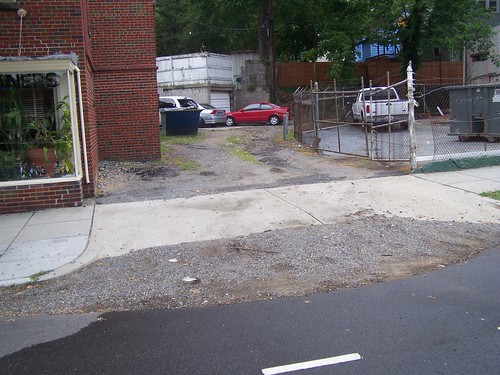 Last fall I pointed out to my Councilmember, now a candidate for Mayor, that this alley (left) on the 6200 block of 3rd Street NW is a prime candidate for the city's "Green Alley" program. I never got a response. Meanwhile, the runoff problem continues unabated.
It's a waste of public money to replace this kind of infrastructure early. Especially when there are more pressing needs such as to put sidewalks in places where they don't exist and should, or to fix sidewalks, alleys, curbs, and roads that are in much worse condition.
There are two reasons this happens. (1) DC allocates funds for this activity by ward, not need. So you have to spend the money...
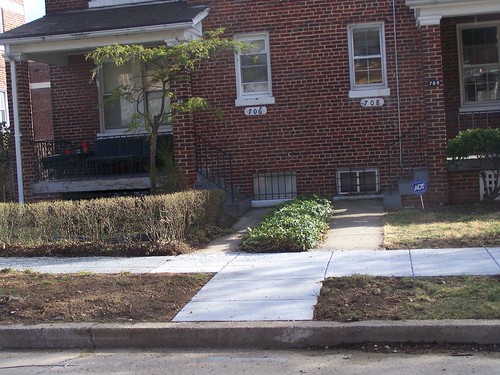 (2) DC DOT hasn't upgraded its information systems (instead of using GIS it uses an Excel spreadsheet) to include in the master "street side" database places without sidewalks. It only includes places with sidewalks. So the sidewalk "replacement" program is only focused on replacement. It doesn't focus on or prioritize the installation of so called "missing" sidewalks.
Because it is happening year after year in my neighborhood, it's at the top of mind. Although I did just notice that on the 5900 block of Blair Road, the city did install sidewalk at the corner, replacing a narrow path asphalt strip. That's a good thing.
But some of the residential streets coming up to Blair don't have sidewalks on either or both sides of the street and that problem isn't getting corrected.
 Extending the city's wasteful replacement practices to trash and recycling cans
The Examiner reports, in "Talking trash: D.C. begins search for the new Supercan" that the city wants to spend $10 million to replace the trash and recycling cans, because the ones that are out there are old models, some are broken, and can't be fixed.
Again, I ask, (1) why not just replace the broken cans? (2) although potentially, you can augment the recycling cans, and give people larger ones if their usage justifies it. Currently, the city's recycling cans are all one size. I know it's not big enough for our household.
(Getting people to actually recycle is another issue. Many people don't, or they don't recycle maximally.)
Just now, I went out and did a "survey" of the houses on my alley. There are 25 houses on my block with alley access and 7 without alley access. Of the 25 lots on the alley, it appeared as if there were only 2 trash cans with missing lids. And 2 buildings without any cans at all (one has been vacant, in the process of being "renovated" for going on to 5 years, and maybe the cans are in the basement, the other is a church and not eligible for city trash pickup).
Some houses had missing recycling cans (although it is more likely the can was located elsewhere on their premises). There were four extra trash cans at three different households, one of these cans was also missing a lid.
 On our block at least, new trash cans would replace more than 21 fully working cans, consigning them to a landfill, ideally recycling, or Fairfax County's waste-to-energy plant.
Only replace the cans that need replacing.
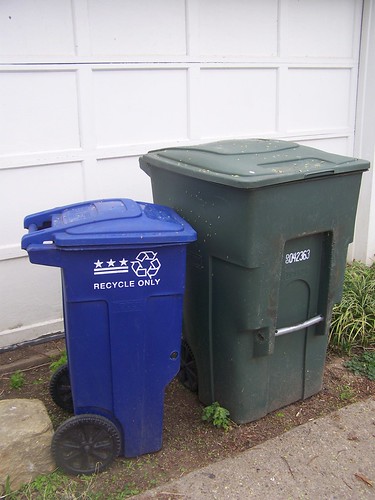
Above: my trash and recycling cans are fine, although I'd like a recycling can as big as the trash can. Right: my neighbor across the alley (and my next door neighbor) both have trash cans without lids. When I first moved in, my neighbor across the alley used our trash can because they didn't have one. I did a service request for them, so they could have their own can.
A partial sidewalk on the north side of the unit block of Quackenbos Street NW

No sidewalk on the south side of the unit block of Quackenbos Street NW

Replacing sidewalk and road (the road needed repair, big time) on the 700 block of Quackenbos Street NW

Labels: government contracting, product replacement practices, public finance and spending, sanitation and solid waste, sidewalks, transportation infrastructure, urban design/placemaking
posted by Richard Layman @ 11:16 AM&Permanent Link
Follow this blog
4 comments







