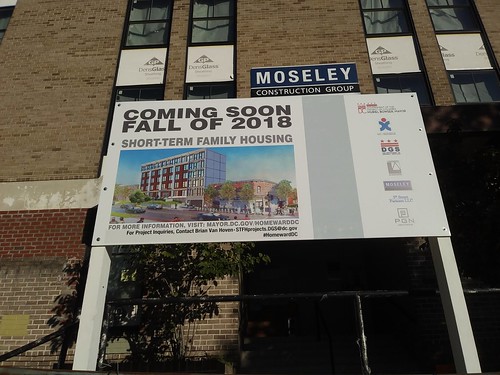
Recently, the
Washington Post has run stories on the city's clearing out of homeless encampments and the impact of the closure of a well-located "self-storage" facility on people living marginally, and using the facility to store their belongings and as a sort of place to live.
-- "
'It made America possible for me': The final hours in a lost refuge for the homeless," also see this 2015 story identifying the pending closure of this facility, "
For D.C.'s desperate, a refuge from homelessness is about to disappear"
-- "
Homeless tent city in the heart of gentrifying Washington gets moved out" (note that the
Post has run many similar articles since 2015)
These are tough issues.
Homelessness as a choice? Partly, people live in tents because they don't want to live in shelters for various reasons, some legitimate, some likely spurious. For single adults, the cost of housing is an issue, as can be mental and health issues, including substance abuse.
Public space management. But the fact of the matter is that people don't have an inalienable right to camp in the public space, and this isn't necessarily an issue of gentrification, but it is an issue of an increasingly desirable housing market shifting towards the provision of housing only to the most expensive segments of the market.
I don't necessarily have a problem providing space for encampments, although given the spatial organization of the city, likely such space would not be as well located as at 2nd and K Streets NE. But such space needs to be managed. And such facilities have been semi-disastrous in Seattle ("
Shooting At Homeless Camp In Seattle Kills 2, Wounds 3," NPR) which gives me pause, although DC hasn't had similar problems.
Is homelessness generated in part by the lack of affordable housing for single adults? I was talking about this with a journalist and I burst out that the problem is that we don't have SRO -- single room occupancy -- housing,.
SRO housing (also a variant, "rooming houses" or "boarding houses") for singles and the working class was a typical feature of communities especially pre-1950s, SRO buildings were made up of single rooms with limited kitchen facilities in the room (sink, hotplate), and shared bathrooms. Usually the buildings didn't have much in the way of common facilities or larger, shared kitchen facilities.
By contrast, boarding/rooming houses provided meals for an additional charge.
The decline of SRO housing availability. In the booming economy of postwar America, this kind of housing was crowded out in favor of apartment buildings, usually in the suburbs, although some remained in the center cities, especially as the real estate markets there declined. After WWII, some cities, including New York City, made creating new SRO facilities illegal.
-- "
The $80-a-Week, 60-Square-Foot Housing Solution That’s Also Totally Illegal: It’s Time to Bring Back the SRO,"
NextCity
-- "
Bring Back Flophouses, Rooming Houses, and Microapartments: Dumb urban policies wiped out the best kinds of housing for the poor, young, and single. But they’re finally making a comeback in smart cities," Slate Magazine
But more recently, as center city real estate markets improved, this kind of housing was crowded out.
Microapartments as single adult housing for the comparatively well off. Although interestingly, these days, but as a "product" targeting upscale demographics, the type has been revived, marketed as "microapartments."
New York City especially has encouraged the creation of upscale microapartments, creating a national design contest ("
Efficiencies wanted, emphasis on efficient,"
New York Times; "
Tiny Apartment, Big Winner: The Design That Won NYC's Micro Contest,"
Wired Magazine) while not paying much attention to the demand for SRO housing on the part of lower income segments.
Today, microapartments are being built in New York City, Seattle, Washington, and other locales.
-- "
Manhattan-style micro units have arrived in DC,"
Post
-- "
Life in a 375-square-foot apartment,"
Post
While microapartments are cheaper than larger units or houses, they are comparatively expensive. Traditionally, Single Room Occupancy housing was cheap, and paid for by the week. From the second article:
Their $2,250-a-month “junior one-bedroom,” overlooking the bustling bar and restaurant scene along 14th Street NW, is “massive” at 500 square feet, says manager Jason Tremblay, grinning. That’s because the smallest of the Harper’s 144 units are practically shoe boxes at 350 square feet.
DC does have SRO housing, but clearly not enough. I was prepared to write an article about how DC doesn't have any of this kind of housing, but the reality is that it has some.
In fact, the organization So Others Might Eat
has 500 units of SRO housing, which they call "Single Adult Housing," spread out in buildings across the city, and a few other organizations provide similar housing too, such as
a 10-unit building run by the Coalition for the Homeless and the 60-unit
Willis P. Greene Manor Supportive Housing Program run by the Marshall Heights Community Development Organization in Ward 7.
I think we probably need a couple thousand more units of this type of housing to satisfy "the market" and simultaneously address homelessness for a significant segment of the market.
Orange County, California: the problem is both supply and cost. Then I read a great story in the
Orange County Register, "
Who are the homeless living in the shadow of the Big A? Here are 11 stories," recounting the stories of 11 people living on the banks of the Santa Ana River in the shadow of Anaheim's baseball stadium, so I started looking up SRO housing in Orange County where they have even less than is available in DC, but at much higher prices.
Clearly, not only do they need a lot more SRO housing in Orange County, but it needs to be well located, and cheaper. From the article:
We spent a week talking to people who live along the Santa Ana River trail. Like any neighborhood, the people are diverse, but most share a common goal: They’d rather be paying rent than living in a tent.
Location is an issue because the transit system in Orange County is much less robust than DC (or Los Angeles County) and the cost of a car is a deal breaker for many people living on the economic edge of society.
Failure to plan for a robust housing market for all segments creates big problems. Likely the lack of affordable single adult housing is is a much bigger issue than we think about, and it's an illustration of my point that without a "market segment analysis" of the etiology of homelessness, it's hard to address the issue properly ("
A brief follow up on homelessness policy," 2016).
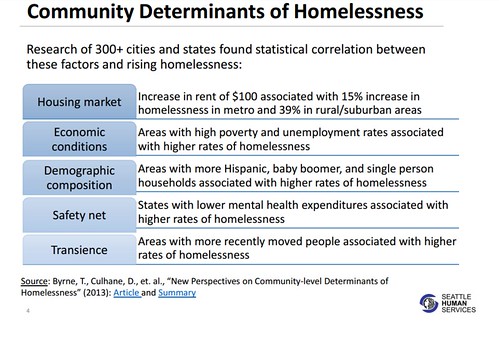
Community Determinants of Homelessness, slide from a Seattle Human Services presentation
Not to mention the need for comprehensive housing policies rather than piecemeal approaches ("
Look ma, no comprehensive housing policy: so affordable housing suffers," 2012).
Problems include the cost of serving homeless adults "on the street." Plus it's very expensive as the cost of "servicing" homeless adults is much greater than if they were housed ("
Million Dollar Murray,"
New Yorker Magazine).
See "
Seattle may extend alcohol-sale limits to much larger area" from the
Seattle Times, the series "
Health Care 911" and "
A Costly Cycle of Care" from the
San Diego Union Tribune.
These stories discuss what emergency services personnel call "frequent flyers," the people who are the most frequent consumers of emergency medical services. These clients go in and out of the system, and consume a disproportionate share of the resources. In San Diego, 1,136 frequent users, less than 1% of the city's population, generate 17% of the emergency calls, which cost about $20 million annually. According to the 2004
Seattle Times article:
An estimated 2,000 chronic street alcoholics live in King County, nearly all in the three downtown Seattle zip codes. The 20 worst offenders among them cost an estimated $2 million a year for police, medical, ambulance and transportation, according to the King County Department of Community and Human Services.
Housing segregation abets the problem. The tendency to keep housing types segregated, rather than mixing housing types within neighborhoods, limits the ability to satisfy the needs of various segments, especially low income housing. This is complicated further by the fact that traditional residents tend to oppose the addition of different housing types to their otherwise type segregated neighborhoods.
E.g., my neighborhood has a handful of apartment buildings, one nearby building might have 50 units, otherwise apartment buildings have 4-6 units and there aren't very many, plus many of the buildings that are particularly well located and nice have been converted to condominiums.
Otherwise, all of the houses in my neighborhood are single family, a mix of both detached and attached (rowhouses, triplexes, and duplexes), which doesn't leave much room for serving other segments of the housing market, especially lower income segments.
Recommendations concerning Single Room Occupancy Housing for lower income segments of the housing market
-- build more "single adult housing"
-- provide subsidies recognizing that it's cost-effective because it is cheaper to provide services to people who are housed rather than through emergency services provided "on the street"
-- make sure it is well-located, proximate to high quality transit access
-- and includes "supportive programs" as necessary to assist the residents
Labels: affordable housing, housing market, provision of public services, public/social housing, real estate market, social and human services, social programs