Rebuilding Place in the Urban Space

"A community’s physical form, rather than its land uses, is its most intrinsic and enduring characteristic." [Katz, EPA] This blog focuses on place and placemaking and all that makes it work--historic preservation, urban design, transportation, asset-based community development, arts & cultural development, commercial district revitalization, tourism & destination development, and quality of life advocacy--along with doses of civic engagement and good governance watchdogging.

Wednesday, July 18, 2012

Told you so: taxi edition
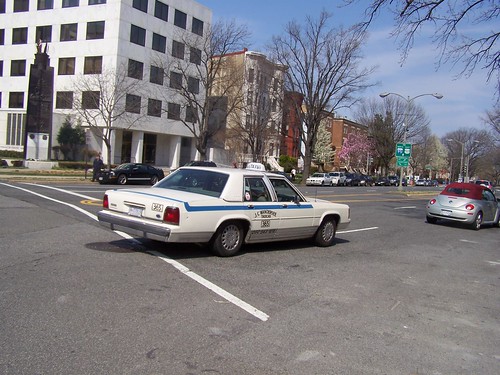
DC taxicab, Constitution Ave. at 2nd Street NE, NE cornerActually, I am past the "told you so" stage.  The way I say it now is that there should be studies and plans.  So today's Post has a big story, "D.C.'s cabbies fear being pushed out of taxi business," on the taxi industry in DC, and how many cabbies believe that changes promulgated in new legislation (done without the benefit of significant planning or studies) in how the industry is organized will force more cabbies out of business.

The article states:

Taxi drivers’ activism and dollars helped oust Adrian M. Fenty as mayor and get Vincent C. Gray elected in 2010. But many drivers now say Gray is much worse than Fenty. Not only did many fares decrease when meters were installed, but the city scrapped shared rides and eliminated night and fuel surcharges — blows to drivers’ income.

Note that the editing for this paragraph is bad. Whether or not "Gray is worse than Fenty," the changes that are described happened under Mayor Fenty, not Mayor Gray.

I averred that income would drop when changes in taxi industry regulation were considered under the Fenty Administration.  I said a few things:

1.  The biggest concern that people had--other than bad service--was a level of uncertainty about fares, because the zone maps were unclear, etc.
2.  But you could do meters for zones too, not just by the minute.
3.  And that by switching to traditional meters AND giving up the ability for a run to include multiple passengers going to multiple destinations, revenues would go down as would the "efficiency" of the industry and its relative sustainability.

It's come to pass. (post in DC Watch)

Too bad legislators and the executive branch don't have much belief that planning is a good thing, and that drastic changes in regulated industries ought to be considered through planning studies first.

The Transportation Element in the Comprehensive Plan doesn't even mention taxis.  Taxis should be addressed in the forthcoming Transportation Master Planning Process that the DC Department of Transportation is about to embark upon.

Labels: , ,

Monday, October 24, 2011

Taxi medallion prices in New York City hit $1 million

A proposal to create a taxi medallion system in DC has met with resistance in this blog and elsewhere because of the way a medallion system creates barriers to entry and monetizes a government-received licensed for the well-connected. This story from the New York Times, "2 Taxi Medallions Sell for $1 Million Each," demonstrates that a medallion system is more about creating large businesses than it is about focusing on service improvements, especially because the original grantor of the license, the municipal government, gets no royalty from the later re-sale of this asset, all the subsequent value is reaped by the licensee.

From the article:

There are 13,237 medallions in the city; new ones, when issued, are sold at auction. But the medallion pool is rarely expanded, creating a scarcity that helps keep values high. (Many owners have objected to a city proposal that would allow livery cabs to pick up street hails outside busy parts of Manhattan, saying such a plan would lower the value of their medallions.)

Large fleets, which can control hundreds of medallions, often find it easy to secure financing to meet the high prices. Medallion sales can make for big business: the biggest lender, Medallion Financial, is a publicly traded company (ticker symbol: TAXI) and shares its skyscraper on Madison Avenue with the Rockefeller Family Fund.

Corporate medallions, like the two sold on Wednesday, do not need to be driven by their owners and can be leased out 24 hours a day. Individual medallions, which make up about 40 percent of the fleet and must be occasionally driven by the owner, are worth slightly less: the latest sale was for about $700,000.


This piece from the Reuters blog, "Why taxi medallions cost $1 million," explains that the price escalation is driven by the rate of return in the context of interest rates.

From the article:

We’re basically talking about a real income stream, here, of about $75,000 per year. (Let’s assume, for the sake of argument, that the income from a taxi medallion rises at the same rate as inflation.) That’s a real yield of 7.5% on a $1 million investment — which isn’t half bad at today’s interest rates.

Put it this way: how much would a bond paying a real yield of $75,000 a year cost? At the most recent auction, the 29-year TIPS cleared at an interest rate of 0.999%. At a 1% real yield, an income stream of $75,000 a year would cost you $7.5 million.

Now you don’t actually get $75,000 a year if you own a medallion. You have to pay for maintenance, insurance, and workers comp; you also have to pay someone to manage your drivers. But even if you bring the income down to $50,000 a year, that’s still a pleasant 5% yield on your money, and what’s more it’s a yield which behaves much more like a real yield than a nominal yield. Paying $1 million for such a thing doesn’t seem silly to me, especially when there’s a lot of room for capital gains as well.

Labels: , , ,

Friday, December 07, 2007

Be careful this holiday season

(Reprinted from 2/2007 because of a thread on a local e-list on subway transportation.)

The New York region's MTA has released a video about railroad crossings and safety. It's pretty graphic, indirectly showing the death of someone who "didn't look both ways."

There is more about this video and the campaign in this article, "New York MTA Hopes Graphic Video Boosts Safety and Cut Deaths" from the New York Daily News.

Labels: , , ,

Wednesday, October 31, 2007

Because one argument is too many...

I've come around on the idea of meters in taxicabs because even one argument with a cab driver on how much to charge is too many arguments. And there probably isn't one cabrider in the city who hasn't had at least one bad experience with a taxi driver. (And I will say, many good experiences, but still...)

Labels: , ,




