Rebuilding Place in the Urban Space

"A community’s physical form, rather than its land uses, is its most intrinsic and enduring characteristic." [Katz, EPA] This blog focuses on place and placemaking and all that makes it work--historic preservation, urban design, transportation, asset-based community development, arts & cultural development, commercial district revitalization, tourism & destination development, and quality of life advocacy--along with doses of civic engagement and good governance watchdogging.

Sunday, August 04, 2013

(US) National Farmers Market Week: August 4th - 10th (slightly updated)

Sunday starts National Farmers Market Week, which provides another excuse for you to go to a farmers market.

Notions Capital calls our attention to this article from Slate, "Fight the Farmers Market Backlash."  The headline is somewhat misleading.  The article mostly discusses public markets--buildings that house markets, like Eastern Market in DC or Tokyo's --and how market functions (think NYC's Meatpacking District, which is now a hip place to live) get displaced over time as real estate values rise.

But it also discusses the positive elements around markets, in terms of strengthening quality of life (and not so much about how selling direct allows farmers to make more money).

And I came across this report from the Kellogg Foundation, Perceptions of the U.S. Food System: What and How Americans Think about their Food. (I haven't read it yet.)


I have a past blog entry on reasons why communities create farmers markets here, "The reason(s) why a farmers market is created shapes the type and mix of vendors allowed to sell."

I wish that DC did more focused food security and food market planning and coordination than it does. 

Toronto's Food Policy Council is a good model for what can be done in this arena, although many other communities have set up similar food policy councils, following the example of Toronto.

The Neighborhood Notes blog in Portland has a good entry on creating successful farmers markets, "Ingredients of a successful farmers market," which references this market study of farmers markets, Portland Farmers Markets/Direct-Market Economic Analysis: Characteristics of Successful Farmers Markets.

One thing going on with farmers markets and real estate these days is "activation," the process by which property owners "program" their property to get visitor-customers.

For example, DC's Union Market started a Sunday Farmers Market a couple weeks ago (although I was surprised that even though it is a FreshFARM market which tends to be organic and therefore extremely expensive, some of the vendors--most sold added value items, not produce--had reasonable pricing) and the Washington Business Journal reports a similar case, "Temporary farmer's market eyed for prime U Street real estate.

One of the problems of such efforts is that this can lead to a over-availability of markets.  For the amount of sales, DC actually has more markets than are probably supportable.  Contrast this to Baltimore, which has fewer markets, but each one is much bigger, with greater variety, and less expensive food, compared to DC markets.
---------
National Farmers Market Week Kickoff this Weekend in D.C.

The Farmers Market Coalition (FMC), Columbia Heights Community Marketplace, Wholesome Wave and D.C. Greens will host a press conference on August 3rd at 10:00 am (at the farmers market, on 14th and Park Streets NW) where the USDA will announce the 2013 farmers market numbers. Every year, the USDA Agricultural Marketing Service issues updates to the USDA National Farmers Market Directory, tracking the number of farmers markets in the United States. The directory also documents how many markets are offering electronic benefit transfer access for Supplemental Nutrition Assistance Program (SNAP) customers, and how many accept WIC and Senior Farmers Market Nutrition Program (FMNP) coupons.


-- National Farmers Market Coalition blog entries tagged National Farmers Market Week


Below is a great infographic on Farmers Markets from the American Farmland Trust, which was created as part of their "I Love My Farmers Market" campaign.

I Love My Farmers Market Infographic

Labels: ,

Sunday, August 05, 2012

National Farmers Market Week: August 5-11

From the Farmers Market Coalition:

United States Secretary of Agriculture Tom Vilsack proclaimed August 5th through 11th, 2012 as National Farmers Market Week.  Since 2000, when the United States Department of Agriculture (USDA) first proclaimed National Farmers Market Week, the number of farmers markets has grown an estimated 170%, from 2,863 in 2000 to over 7,800 in 2012.  As these numbers increase, farmers markets are bolstering local economies, improving community health, and bringing diverse groups of people together through a shared social space. 


Across the country, farmers markets will be celebrating National Farmers Market Week through special events, contests, cooking demonstrations, tastings, and much more. During each day of National Farmers Market Week, the Farmers Market Coalition will celebrate a theme and highlight the accomplishments of stand-out markets in towns across America.

* Sunday, August 5th: Farmers markets and community education
Innovative partnerships that allow markets to serve as hubs of information
* Monday, August 6th:  Farmers markets and public health
Promoting good nutrition and healthful habits
* Tuesday, August 7th : Farmers markets as economic engines
Business incubation, job development, and local spending
* Wednesday, August 8th: Farmers at the center of the system
Governance and policies that put farmers first
* Thursday, August 9th: Farmers markets and food equity
Improving access to healthful foods in underserved neighborhoods  
* Friday, August 10th: Farmers markets and civic engagement
Growing social capital and engaging volunteers
* Saturday, August 11th: Farmers markets and rural renewal
Supporting agricultural diversity and farm viability, while inspiring a new generation of producers

--------------------
One of the biggest "problems" in DC is the proliferation of farmers markets across the city, which provides breadth, but makes it very difficult for farmers to make money. People forget that farmers come to sell their goods not because they want to activate the place and space, but to generate income.

I have a past blog entry on reasons why communities create farmers markets here, "The reason(s) why a farmers market is created shapes the type and mix of vendors allowed to sell."

312 pp, Paperback
Nov 15 2009
$24.95 CAD
And I wish that DC did more focused food security and food market planning and coordination than it does. Toronto's Food Policy Council is a good model for what can be done in this arena, although many other communities have set up similar food policy councils, following the example of Toronto.

Recently, I came across a nice blog entry on creating successful farmers markets from the Neighborhood Notes blog in Portland, "Ingredients of a successful farmers market," which references this market study of farmers markets, Portland Farmers Markets/Direct-Market Economic Analysis: Characteristics of Successful Farmers Markets.


(And Union Station needs a food market hall, like the one at Grand Central Station in New York City.)


The Post had an article earlier in the week, "Ward 8 farmers market helps local food assistance users one voucher at a time," about encouraging farmers market participation by WIC program participants.  From the article:

The Prince George’s County Women, Infants and Children (WIC) food assistance program was at the Ward 8 farmers market on Mississippi Avenue SE distributing $20 bonus vouchers to Leach and other clients, a once-a-year event.

On top of that, the farmers market was handing out bonus bucks for every dollar the clients spent, up to $25. By the end of Leach’s shopping trip, she had spent nearly $50 and had decided to return as frequently as possible to buy healthier food for herself and her baby. ...

Since earlier this year, Maryland food assistance users in programs such as WIC and the Supplemental Nutrition Assistance Program (SNAP) have been allowed to use their vouchers at any farmers markets in Maryland and the District. Clients in the District enjoy similar benefits. Virginia does not have a program.


I thought that was interesting because 7 years ago at the International Public Markets conference in DC, one of the local farmers on a panel complained that they are active in markets in DC, Virginia, and Maryland and each state has different rules and procedures for farmer acceptance of food benefits and that they had to spend an inordinate amount of time following three different rules.  Harmonization is clearly in order.

It is unfortunate that DC and neighboring states don't work more closely together on agriculture matters.  Although this WIC/SNAP initiative that joins together DC and Maryland programs is a great first step.

I believe that the Departments of Agriculture in Virginia, West Virginia, to some extent Pennsylvania, and Maryland should support farmers markets and direct food sales in DC because DC is a primary market for those states.  Although the Southern Maryland Agriculture Development Commission does provide some financial support to their farmers to promote their presence at markets, including DC markets.  And now there is this WIC program.

I mentioned last week that on Tuesday evenings, Eastern Market has a late afternoon farmers market that you should check out.

Markets in Columbia, Missouri ("Farmers market funds new bus route," Columbia Daily Tribune) and in Ward 8 in DC ("Ward 8 Farmer's Market launches new free shuttle service," Washington Post;) among others have special shuttle services to bring people to the market. I tend to think this type of service tends to be under-utilized and is a waste of money.

It's best to locate farmers markets in active places well served by transit, so you don't have to make special trips to get there.  Project for Public Spaces calls this "layering" while Jane Jacobs called it "mixed primary uses."

DC's WMATA system isn't too focused on placemaking and supporting farmers markets at transit stations.

Philadelphia's SEPTA system has a completely different outlook on the matter, see the past blog entry, "Transit and placemaking."

Labels:

Sunday, August 11, 2019

Last week was National Farmers Market Week

-- National Farmers Market Week, August 4th-10th, 2019

I wasn't able to write much last week, because I was preparing for a presentation on an RFP, although it was related to this topic.

I've written posts in the past if you really want to look them up and draw on my experience.

But one little blurb in the Express during the week is worth writing about.  According to the American College of Sports Medicine's 2019 American Fitness Index, DC is ranked #1 in the US in farmers markets per residents.

DC has 57 farmers markets which means that there are 8.2 markets per 100,000 residents.

But I would argue what that means is that DC has too many farmers markets relative to its size, meaning that most farmers markets end up being underpowered.

For example within a two mile radius on Saturday you can go to farmers markets at 14th and U Streets, in Mt. Pleasant, Columbia Heights, Petworth, and 14th Street and Colorado Avenue.  It's convenient for the residents, but not so great for the farmers, who have to represent themselves in multiple markets.  Were people to travel to one market, say in Columbia Heights, likely it could be an awesome market, stronger than any of the five individual markets.

What my experience is with other places is that they have many fewer markets.  Yes that means that people have to go out of their neighborhood sometimes to get to a farmers market.  But at the same time, the likelihood is that the farmers market offerings are much better.

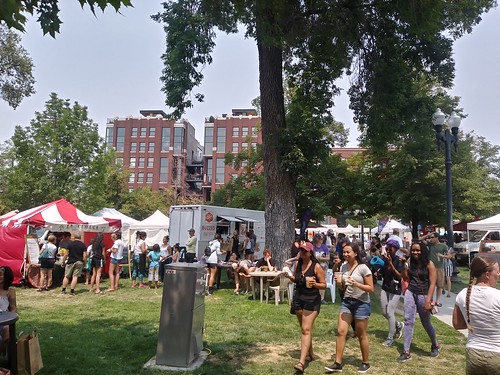
Downtown Salt Lake Saturday Farmers Market
Downtown Salt Lake Saturday Farmers Market.  One of the vendor-sellers is the Salt Lake County Jail, which has a gardening program.

Portland Farmer's Market on PSU Campus
Portland, Oregon

There is no farmers market in DC as good as the Portland Farmers Market or the Downtown Salt Lake City Farmers Market, both on Saturday.  They are huge markets, with an incredible range of offerings, both in fresh and prepared foods, and in supporting innovative offerings, etc.  The Waverly/32nd Street Market in Baltimore also on Saturday is at least as good as the Dupont Circle Farmers Market on Sundays, and might be a little better.

People at the Waverly Market, Baltimore
Waverly Market, Baltimore.

The Baltimore Farmers Market might not be quite as good as those, but supports a range of pricing including lower priced goods, especially for larger quantities, while the pricing at farmers markets in DC tends to be uniformly high, because "out-of-state" farmers and vendors believe, rightly, that they can charge a lot more when selling to mostly higher income DC residents.

That's why vendors travel many hours to sell in DC, because they can get much higher prices than if they were selling locally.
There is a new farmers market in Petworth on Friday </p><p>evenings
Petworth Market.

Labels: , ,

Thursday, August 05, 2021

This week is National Farmers Market Week

The first full week in August is National Farmers Market Week, when in normal times--enough sun, water, and not too much heat--all types of crops should begin being ready for market.

So this year, it's August 1st - August 7th.

1.  During the pandemic year, many farmers markets still operated, but with capacity constraints and other social distancing requirements, to reduce contact between patrons.

2.  The pandemic showed how farmers markets often are more about "community building" than buying or selling food, even though for vendors, selling enough food to make a living is their primary concern.

Years ago, I wrote a piece, "The reason(s) why a farmers market is created shapes the type and mix of vendors allowed to sell," outlining the various reasons that communities have farmers markets, which should shape how they are organized and what they sell.  

Some markets only allow food to be sold that is grown by the vendor.  Others allow some consolidation, or farmers working together selling goods from multiple farms, thereby allowing them to reach more people while using less labor. In communities lacking supermarkets, I argue that markets ought to be allowed to sell foods not necessarily grown locally, because of the lack of sales options.

Steen's microgreens, Salt Lake.

3.  Comparing DC to cities like Salt Lake City and Baltimore, I've always thought the problem in DC has been too many markets.  Every neighborhood wants their own market, and many school PTAs sponsor truck farm sales on school grounds too.

DC had almost 60 farmers markets, some operating multiple days each week, before the pandemic.

What it means for the most part is that there are some anchor markets that are pretty good (Dupont Circle, Columbia Heights, Takoma Park) but most are underpowered.

By contrast, Salt Lake and Baltimore have a handful of markets, and for the most part each is a great event with a wide array of vendors.  The vendors sell a lot more too, making it worth their while ("For the first time since the pandemic began, Downtown Farmers Market reopens to its normal array of vendors — and crowds," Salt Lake Tribune).

For example, the Downtown Salt Lake Saturday Market, in my opinion, is one of the best in the nation, while the Baltimore Sunday Market and Saturday Market in Waverly are still probably better than the best farmers market in DC (but not as great as Salt Lake's).

4.  Then there are basic issues like "wayfinding," restrooms, marketing, etc.  

Again the Downtown Salt Lake Farmers Market is a stellar performer. As are the markets in DC run by FreshFARM/Community which merged a couple years ago.

5.  To sell more food, people need to know how to cook.  

Extension programs often have a presence at farmers markets, but aiming to integrate nutrition and cooking education at farmers markets ought to be a greater priority than it is at many markets.

In the Salt Lake area, the Harmon's sSupermarket chain has cooking schools at many of their stores, as does the much smaller Caputo's Deli.  Across the country, supermarkets, especially specialty stores but not just them, are incorporating cooking schools into their programs.  Many nonprofits do it too.  So do Sur La Table and Williams-Sonoma.

But not many public markets.  But some, such as the River Market in Little Rock and the Reading Terminal Public Market, have demonstration kitchens and cooking classes. 

Labels: , ,

Friday, August 05, 2016

National Farmers Market Week, August 7th - August 13th

-- US Department of Agriculture press release

1. List of the best farmers markets.  While the list is suspect in my opinion -- for example there's no way that Salt Lake City's Downtown Market is 23rd compared to some of the markets ranked more highly, the Daily Meal lists what it avers are the top 101 farmers markets in the US.  It does mix public markets, which are building-based, and farmers markets, which typically are outside and only one or two days per week.

2.  Individual farms getting trumped by aggregators.  Non-farm specific more corporate "CSAs" are taking business away from individually farmer run CSAs.  "When Community-Supported Agriculture Is Not What It Seems," New York Times.

The idea behind CSAs--community supported agriculture--was that by committing to a particular farmer for a season, and contributing capital towards planting, risks could be better managed. Food hubs are aggregators, bringing together products from many farmers, at a bigger scale, and less "movement" oriented. Aggregators, "sophisticated food hubs" disagree with the characterization of the article ("Editorial: Local Agriculture Needs The New York Times to Dig Deeper," Modern Farmer).

Relay Foods in the DC region is an aggregator.  It just merged with another firm (Merger between online grocers sparks employee layoffs," CBS-TV, Charlottesville, Virginia).  Relay sets up at various distribution points in the Metro area, including Eastern Market in DC.

Photo of the Dupont Circle Farmers Market from the Borderstan blog.

3.  More markets selling less fresh food.  Farmers markets are selling more prepared foods, and less food that needs to be cooked, at least at the Dupont Circle farmers market in Washington, DC ("For some growers, farmers markets just aren't what they used to be," Washington Post).

A similar article ran in the Montana newspaper, the Missoulian, "The farmers market scene: Social scene negatively impacting vendors’ bottom lines across country." It discusses how the original farmers market in Missoula was more ascetic, only selling producer grown goods, and no prepared foods, and how another market, the "Meat Market," with smoothies and such came about to get in on the action. Now they co-exist--no info on sales though.

And interestingly there was a spirited response to the Missoulian article, in the local independent weekly "A farmers market killing hipster strikes back," defending markets as being more about the experience and less about buying copious quantities of food to prepare throughout the week.

4. Markets as experiences. Besides the issue of whether or not people know how to cook and the explosion of farmers markets in this city and across the country, which naturally is going to depress the sales at a particular market now facing increased competition, a big part of the issue likely has to do with the setting of the market.

For example, regardless of the intent of the operators, a market on a Sunday morning in Dupont Circle is going to be more of an event or experience, a point on the journey to a restaurant for brunch out, and not a place to buy fruits and vegetables and items like meat or eggs that need to be taken back home to be refrigerated.
The Farmers Market Coalition publishes a graphic (left) about the purposes of a farmers market.

I've written about this, suggesting a typology for why a farmers market is created, "The reason(s) why a farmers market is created shapes the type and mix of vendors allowed to sell."

When a market is an activation device for commercial district revitalization or community building, revenue generation for farmers selling goods at the market can be less of a priority, especially for attendees. The same is an issue with the explosion of markets, more markets reduces sales for individual vendors, even if the total revenue for all markets is greater.

But people will still clamor to open a market "for their neighborhood" as an activation device, not thinking so much about how much money farmers might make and the impact on other nearby pre-existing markets.

There is also a greater recognition on the part of real estate developers that farmers markets are great enliveners ("Blending Farmers' Harvests with Retail, Multifamily Developments," Urban Land Magazine).

But sometimes selling unprepared food doesn't meet the needs of the district.  For example, the Waterfront Partnership in Baltimore, which covers the Inner Harbor district, has launched an early evening and an early morning "pop up market" to sell food and beverages that can be immediately consumed.  It's a great idea for activity the space and building awareness of the organization and a sense of community amongst workers in the district, but it isn't intended to sell fresh food ("Inner Harbor pop up market expands with breakfast hours," Baltimore Business Journal).

Personally, I am a fan of fewer but better markets. The Downtown Salt Lake Farmers Market is a perfect example.

The main market in Salt Lake City has between 100 and 150 vendors, including a separate section for prepared foods.  It's also across the street from a great Italian upscale grocer, Caputo's.  Salt Lake is fortunate that Pioneer Park is huge, well located, and a great setting for a market.

SLC only has a couple of markets each week. As a result, the main Saturday market is premiere, easily "ten times better" than the best markets in DC (Dupont Circle, Silver Spring, Alexandria, Eastern Market), because all the best producers are in one place. It's a spectacle and experience, but also a great place to buy food, and the range of products on offer is incredible.

The same is true in Greater Baltimore. While there are more markets there than in Salt Lake, a slimmer array of markets means the ones that are there can be great, e.g., Sunday Market, Waverly Market on Saturday, markets in Towson, rather than having a plethora of underpowered but local markets.

(Although I was told of a great Latino-focused market on Saturdays on the grounds of the Howard University Law School in DC's Van Ness neighborhood.)

5.  Increased competition from supermarkets.  The Charleston Post & Courier suggests that part of the problem for farmers market is the expanded range of produce, including organic items, at local supermarkets ("There's such a thing as too much fun at farmers markets"), including the rise of "farmers market" like stores such as Sprout's and Lucky's (which recently received a major investment from the Kroger supermarket company),

Focusing attention on locally grown produce at a supermarket in Utah.  Photo from Progressive Grocer.

Not to mention increased focus by many supermarket chains on selling locally grown fresh produce.

In the DC region, both Giant Supermarkets and Harris-Teeter highlight their purchase of locally grown goods.  Of course, Whole Foods has been doing this for awhile.  Also see "Local farmers markets show Utah pride," Progressive Grocer Magazine.

Similarly, an article on the "grocerant trend" where supermarkets are more focused on selling prepared foods, to take home or for on-site consumption, mentioned that at Mariano's, a growing chain of 35 stores in Greater Chicago, they have 20 event managers ("Marketing Engages Customers With Your Retail Foodservice Concepts: Mariano’s Puck," NRA Grocerant e-letter).

It's tough for farmers markets to compete against companies which have a lot more money to spend on marketing.

6.  Farmers markets in Greater Tampa aren't what they seem.  Earlier in the year, Laura Reiley, the food editor of the Tampa Bay Times, investigated farmers markets in the Tampa Bay area ("From farm to fable"), finding much of the food sold was purchased from brokers, likely of goods rejected by Publix, which is based in Lakeland, Florida, and is the largest and dominant supermarket chain in the state.

7.  More money to spend at farmers markets by federal food program recipients.  Lots of markets get support from the US Department of Agriculture to provide extra monies to food and WIC benefits recipients, so that they can buy more produce at farmers markets.  Partly this is to encourage the consumption of more fresh foods, but also to compensate for what can be higher prices compared to supermarkets.

I didn't know that there is a similar program for seniors ("Yonkers offers seniors farmers market vouchers," Westchester Journal-News, Senior Farmers’ Market Nutrition Program, USDA).

8.  Food waste and seconds. There is an increased focus on addressing food waste in a variety of ways.  Apparently more food is wasted than is consumed (Wasted: How America is losing up to 40% of its food from farm to fork to landfill, Natural Resources Defense Council).

Some grocery stores are starting to sell "less pretty" produce at a discount, as a way to offer items at a variety of price points.

A couple vendors do that at the Takoma Farmer's Market on Sundays, and I try to purchase those items (e.g., dinged apples are great for pie, tomatoes for soup or sauce, etc.) as a way to save money (e.g., $1/pound for tomatoes instead of $4/pound).

CUESA, the farmers market organization in San Francisco, has developed an ad campaign promoting the purchase of "weird" produce, which tastes fine but looks funny ("This Sexy Ad Campaign Wants to Get You to the Farmers Market," Modern Farmer).  Note that attractiveness criteria were developed by the USDA in the Depression, as a way to cut supply and boost prices.

I also use overripe fruit in smoothies and baking (in fact I started baking at the outset to make banana bread to use up overripe bananas).

While farmers at many markets provide goods after the market closes to food pantries and such, it seems like during fruit growing season, they could produce smoothies on site at markets as a way to monetize unsellable produce and to promote better practices more generally.

9.  Youth farmers market in Meridian, Idaho.  Obviously, in agriculture regions, people grow food and there are programs like 4H and Future Farmers of America, working work with youth.  The farmers market in Meridian, Idaho is run by teens, selling produce and other items that they grow or make themselves ("You can grow it at Youth Farmers Market," KTVB-TV).  I thought that was pretty cool.

-- Meridian Youth Farmers Market

10.  Accommodating sales by home growers with an extranormal bounty.  I noticed a farmers market in Salt Lake's Westside neighborhood that will let home gardeners sell their extras at the entry price of $5 for a table.

11.  Pop-up breakfast events at Santa Cruz farmers markets.  Tickets are $37, but the meals look to be awesome.  What a great event.  From the website:
We at the Santa Cruz Community Farmers’ Markets miss no opportunity to celebrate around good food. For the 2016 season, we are hosting 4 pop-up breakfast events at the Westside and Scotts Valley Markets. Guests gather to sit down at long tables with friends and enjoy a fresh, multi-course meal.

At each event admired local chefs serve up sensational mixes of simple cuisine made with seasonal ingredients from the very farms that sell at the markets. Local youth leaders from food justice organization FoodWhat serve the fair and farmers speak about their work. Events are unique, each one offering its own pleasing qualities: a wood-fired stove, seasonal blooms, fine charcuterie. With each event we learn more about how to make this moment magical, connecting farmers, chefs, our local landscape and you.
12.  Consider adding dietitians and nutrition programs to public markets and farmers markets.  More and more supermarket companies--started by Hyvee in the Midwest and Martin's in the Mid-Atlantic--have RDs on-site to work with individual customers providing dietary and nutrition advice, provide supermarket tours, etc. ("Supermarket Dietitians: What They Can Do for You and Your Clients," Today's Dietitian. From the article:
Ten Things a Supermarket Dietitian Can Do for You and Your Patients

1. Teach people how to cook.
2. Educate about reading labels.
3. Increase fruit and vegetable consumption.
4. Manage food allergies.
5. Media wellness coverage.
6. Teach kids about nutrition.
7. Dispense credible nutrition information.
8. Promote wellness programs.
9. Make connections in the food system.
10. Improve the RD image
Also see "Dietitian on aisle four: Grocery stores are calling in health experts," Chicago Tribune and "The Next Big Marketing Weapon For Supermarkets --The Dietitian, Advertising Age.

The KITCHEN at Boston Public Market.

Many newer market buildings have demonstration kitchens ("'Demonstration kitchen' planned for new Saginaw farmers market," Saginaw News), but I don't think they have developed programming with local supplemental food programs, the State Department of Agriculture, and county agriculture extension programs.

Plus, now I believe that market buildings should incorporate "incubator" and office space where "fellow traveler" organizations and related government agencies could be housed on-site.

13.  Markets and market buildings as a way to foster retail and business development.  As always, it's good to mention that farmers and flea markets can be a way to seed retail business development, the same with food trucks.  People can start off selling in an environment that requires less capital and generate the funds necessary for a "bricks and mortar" location ("Entrepreneurs Go From Farm to Retail," B'more Media).

I argue that the market building as a format should be used on a more widespread basis to seed business development in underserved communities.  NextCity reports on some PPS findings ("How Public Markets Support Small Businesses Owned by Women, Minorities and Immigrants").

The Portland Mercado is one example and is sponsored by the Portland Development Commission, the city's economic development agency ("Portland Mercado opens, providing space and support for Latino business owners," Portland Oregonian).  But these projects are hard.  An Oregon Public Broadcasting story comments on how the building was 9 years in the making ("After 9 Years, Portland Mercado Opens Its Doors").

Thai Town Marketplace is a similar project in Los Angeles, but I don't it has launched yet, even though I saw a presentation about them last year.

14.  Don't forget that August is the big month for county and state agriculture fairs, which are always fun.

Labels: , , ,

Friday, August 04, 2017

National Farmers Market Week, August 6-12 and the food sector

-- Farmers Market Coalition resource page for National Farmers Market Week

According to the USDA press release:
On Friday, Aug. 11, USDA’s flagship Farmers Market in Washington is hosting several special events on the National Mall at 12th Street and Jefferson from 9 a.m.–2 p.m. and adding a special Night Market from 4 p.m.–8 p.m. Special guests include the Farmers Market Coalition, the official chef of the Washington Capitals Robert Wood, and the U.S. Army Band.
Infographic from the Farmers Market Coalition.

Farmers markets.  I have a past blog entry on reasons why communities create farmers markets here, "The reason(s) why a farmers market is created shapes the type and mix of vendors allowed to sell."

The Neighborhood Notes blog in Portland has a good entry on creating successful farmers markets, "Ingredients of a successful farmers market," which references this market study of farmers markets, Portland Farmers Markets/Direct-Market Economic Analysis: Characteristics of Successful Farmers Markets.

Farmers markets as a retail activation device.  One of the disconnects in a city like DC is that farmers markets are used as a way to "get people to come to our commercial district" as an activation (and placemaking) device, with less interest on the overall functioning of "the food system."

In practice it means that DC has "way too many farmers markets" in terms of them all being able to be successful and thrive, especially on the most popular day--Saturday.   For example, on Saturdays within a couple square miles there are four markets at 14th and U Streets NW, 14th and Park Road (Columbia Heights), Petworth at Georgia Avenue and Upshur Street, and at 14th Street and Colorado Avenue.

Contrast this to Baltimore, which has fewer markets, but each one is much bigger, with greater variety, and less expensive food, compared to DC markets.  But you do have to travel farther to get to those markets.  On the other hand, each market tends to be "much better" than the typical DC farmers market.

Similarly, Salt Lake City only has a couple farmers markets (granted the city is half the population of DC), but the Downtown Farmers Market on Saturday has to be one of the best in the United States, in the top 10--and that means, compared to markets in Southern California, Portland, and New York City.  No farmers market in DC functions at that level. 

"Concentration"--just having a couple markets rather than many dozens makes that possible.

I sit on the board of DC's public market, Eastern Market, and I am constantly amazed at all the new competition that the market continually faces, from new supermarkets to new farmers markets--one just opened up in the Capitol Riverfront district on Sundays, and one is likely to open at The Wharf development in Southwest next year.  And EventsDC, which controls the RFK stadium campus, proposes to create a "food hall," there, less than one mile from Eastern Market.

I noticed that FreshFarm Markets moved its Thursday Penn Quarter Market from a closed block of 8th Street NW to the large sidewalk plaza on F Street in front of the Smithsonian Reynolds Center arts museums, becoming much more central and visible.

Food security.  In the past I wrote that "I wish that DC did more focused food security and food market planning and coordination than it does," although now there is a Food Policy Council in DC.  Interestingly to me, I don't think they've ever reached out to DC's public market, Eastern Market.

Toronto's Food Policy Council is a good model for what can be done in this arena, although many other communities have set up similar food policy councils, following the example of Toronto.

Community Foodworks is a DC nonprofit that is active in this area, running a number of farmers markets, a farm, and outreach activities.  They publish "food access" brochures for many of the city's wards, but they don't seem to be available online.

One of the "problems" in food security planning is that oddly enough, some times it doesn't include supermarkets in the planning.

When Aldi, a "hard discount" store, first opened in DC, I found illuminating one of the quotes in an article from the Washington Post, "Grocery store openings boost underserved communities in D.C. region."
"I’ve been praying that they’d bring a store like Aldi’s or Wal-Mart to this neighborhood because that’s where we spend our money,” Davis said. “The stores where consumers spend most of their money is outside of D.C. This is going to improve everything in the neighborhood.”

City officials said having a branch of Aldi, which is known for low prices, will help meet several needs. 
It made me realize that in planning for a community's retail mix, we don't necessarily aim to cover all price points in a retail category, and that facilitating access to lower cost food--including supermarkets not just farmers markets (although in DC, farmers markets tend to offer high priced food, not low priced food, e.g., a couple weeks ago at the Takoma Farmers Market, granted an organic-focused market, one vendor marked pints of raspberries for $10 each)--ought to be a part of retail planning.

Satisfying multiple market segments with one farmers market.  One problem with organic-food oriented farmers markets is that as a rule the items are expensive, and I personally can't stomach "paying that much for food," when I know I can buy nonorganic items for 1/4 the price--although I happily buy specialty organic items that are unique.

You don't see this at most farmers markets, but a few of the vendors at the Takoma Farmers Market on Sundays sell "seconds" produce at a deep discount.  A couple vendors are the deepest, selling their defective tomatoes, cucumbers, stone fruit, and apples for up to 75% off, while the other vendors might discount items by 33% to 50%.

I buy that defective produce knowing that for some recipes "perfect" ingredients are not required, especially tomatoes for making gazpacho and in recipes where the tomatoes are cut up finely, apples and peaches for pies and other sweets, etc.

In the supermarket world, this type of sales and pricing is called "salvage" ("Salvage Grocery Stores: The Next Big Thing In Food Isn't Even New," Modern Farmer).

Separately, there is a trend of more chain supermarkets selling "ugly produce" at a discount to standard produce, both to reduce food waste and to round out their pricing and segment strategies ("'Ugly' fresh produce gets hipper for grocers, but there's one problem -- supply," CNBC).  Technically, "baby carrots" are produced by grinding down "ugly" carrots, as a way to make sellable produce out of what otherwise would be wasted.

More farmers markets, especially the highest-priced ones, should do this.

Markets as opportunities for nexus on environmental issues.  This year, contracting with Compost Cab, DC has set up food scraps/compost drop off programs at a market in each ward, for example in Ward 1, it's the Columbia Heights market on Saturdays, and in Ward 6, it's at Eastern Market.

(Granted it's something I suggested that DC do for many years, but I shouldn't be too critical that it takes 4-8 years for programs to be initiated, should I?)

Maybe the next step could be pizza box composting at farmers markets.  Most people just toss them into recycle bins, but because they are soiled they aren't recyclable ("wish recycled") and if not diverted, make recyclable paper and cardboard less usable.


Nevertheless, millions of pizza boxes are put in recycle bins
North Carolina State University has created a program to capture pizza boxes in a separate process ("Pizza Box Composting Gets College Try: Campus arms race to go green nets creative efforts to deal with the greasy containers," Wall Street Journal) which is easier for them to do compared to individual households because they can focus on dormitory buildings.  From the article:
College students love pizza. They also love recycling.  But their pizza boxes are virtually unrecyclable, thanks to the cheesy, greasy residue left behind on the cardboard bottoms.  What’s a poor school to do?
At North Carolina State University, the answer is the Pizza Box Composting Project—dumpsters placed at eight locations around campus that since early last year have helped turn approximately 16,000 grease-stained boxes into fertilizer.
(Because I hate tearing up pizza boxes for composting, I prefer that we make pizza from scratch.  The problem is that when the urge for pizza arises, we don't usually have fresh pizza dough ready for cooking.  Yes, I used to just toss pizza boxes into recycling, knowing that the firm that processes DC's recycling has a chipper in their facility for pizza boxes, separate from the recycling stream.)

Trends in the food sector

Food Halls are exploding.  Speaking of "retail activation," food halls, which are a variant of public markets but usually focused on prepared foods, with maybe a bit of selling of fresh food, are exploding as the retail sector declines generally and real estate developers and property managers need to absorb space.

-- "How artisan food halls are transforming malls," JLL Real Views
-- The Successful Integration of Food & Beverage Within Retail Real Estate, International Council of Shopping Centers

Home delivery/meal kits.  Affecting farmers markets is the growing demand for home delivery of food, as well as "meal kits," where preparable meals are purchased--usually delivered, but more and more supermarkets are offering them as well.

I realized that meal kits need to be considered not in terms of being more expensive than buying "fresh food," but in terms of being cheaper than restaurant meals.  So the issue isn't that the average meal is double the cost of fresh food, but $5-$8 cheaper than a restaurant meal, and more gourmet than the average home cooked meal.  Plus now Blue Apron is positioning itself as "farm-to-table."

Hard discounting/Lidl and Aldi.  Lidl is a competitor to Aldi, another "hard discounter," in Germany where both are based, and around the world.  Hard discounters offer mostly private branded goods and generally lower costs on produce--20% to 40% cheaper than traditional markets and generally cheaper than Walmart (although they are aiming to be price competitive at locations where they compete).

Aldi has been active in the US market for a couple decades and is currently expanding ("German grocery chain Aldi expands stores," Fortune Magazine), while Lidl has just entered the market and aims to grow fast. Lidl aims to differentiate by being a bit more "upscale" ("German grocer promises high quality, low prices; US supermarkets take notice," CNBC).

By comparison, the Aldi shopping experience can be grim, but people accept it in return for significant savings.  (I buy produce and certain basic goods at Aldi, but over the years have found that most of their private label "more processed" items don't measure up.)

In the UK, Lidl and Aldi have significantly reshaped the supermarket industry there, putting great pressure on those firms. 

While it is reported that Walmart is responding to Lidl I think that the real issue is over time, Lidl especially will put pressure on traditional supermarkets, which have gone through rounds of shrinkage in the face of waves of competition first from Walmart and then from the larger more successful chains, especially Kroger, which operates nationally, but from superior regionally focused chains too, like HEB in Texas, Giant-Eagle in Pennsylvania, Publix in the South, and Meijer, first in Michigan and now expanding.

Amazon-Whole Foods and supermarkets as a real estate product.  This is more about Amazon purchasing a system that can support its Amazon Fresh grocery service than it is fixing Whole Foods and lowering their cost basis, although their cost basis is likely to be improved as a result of being exposed to Amazon's pricing discipline.  Amazon likely doesn't care about expanding Whole Foods.  They don't need to be "nationwide," just present in those areas that have a preponderance of Amazon Prime members, so they can use the stores to support home delivery of food (along with other Amazon products).

It will put more pressure on supermarkets though, which except for weaker companies (e.g., Marsh Supermarkets in Indiana just went out of business, a wholesaler with stores--Strack & Van Til, just went out of business in Illinois, etc.) tends to be one of the strongest segments of today's declining retail property sector.

While these articles are older, they support the point, although there will be a sorting between stronger and weaker strip centers.

-- "Strip Malls turn heads," Realtor Magazine
-- "Most likely to succeed: Strip centers anchored by grocery stores," Real Estate Journal

This article is new, about a shopping center in Bowie, Maryland:

-- "At Hilltop Plaza, Fortified Property Group And Rappaport Find A Neighborhood Stronghold," Bisnow

For example in Southeastern Virginia, Wegmans and Publix have entered the market and this is leading to consolidation and closures of supermarkets by existing companies.

This sorting will impact strip centers as those with the more competitive supermarkets will do better than those with weaker players.

Labels: , , , , , ,

Tuesday, August 04, 2009

National Farmers Market week, August 2nd - August 9th

markets_are_up_postcard_pack.jpg
Promotional postcards from the Farmers Market Coalition.

Started Sunday, ends Saturday.

Take this opportunity to visit and buy food at a local farmers market.

-- National listing of farmers markets (Local Harvest)
-- Washington DC listing of farmers markets (Washington Post)

This past Sunday's New York Times Magazine has a long story, "Out of the Kitchen, Onto the Couch," by Michael Pollan about how food preparation has changed, that people don't cook, they buy processed and prepared foods. A big part of the article is about how people watch shows on the Food Network, but they don't actually cook meals themselves. (The article doesn't discuss how people over the past 15 years would build elaborate kitchens which they didn't use.)

This certainly is true. At the same time, the current recession may be changing people's behaviors, and this leads to a rise in cooking as opposed to purchasing prepared foods and restaurant meals. While restaurant sales are down ("Restaurant Sales Nationwide Expected to Decline in 2009" from New Orleans City Business), generally supermarket sales are up (although particular chains may be in distress) although not at Whole Foods Supermarket ("With Shoppers Pinching Pennies, Some Big Retailers Get the Message" from the New York Times) which has relatively expensive pricing.

We see this in the related trend of the locavore movement and gardening.

But in order for people to cook foods, they need to know how to cook, and the widespread knowledge of how to cook has been declining over the past few decades. Some supermarket chains like Florida-based Publix are adding teaching operations to their stores. Kitchenware retailers like the national chain Sur La Table and the Georgia-based Cook's Warehouse include demonstration kitchens and teaching facilities.

Some public markets, such as River Market in Little Rock, have extensive demonstration kitchens and teaching programs. Some places have programs specifically for children.
Teaching Kitchen, River Market, Little Rock, Arkansas
Teaching Kitchen, River Market, Little Rock, Arkansas. Photo from the Market.

A great source of information on local food scenes around the country are the various "Edible" magazines. It's a network of magazines across the country franchised through a company called Edible Communities. Some of the magazines are free and distributed through their advertisers, such as the Edible Chesapeake publication in the DC-MD-VA region. Others are sold by subscription and on the newstand. When you travel, you should look for this publication as it will give you ideas on places to eat at or visit.

And listening to NPR recently, there is a weekly radio show distributed by American Public Media on food and gardening issues called The Splendid Table.

This week, make it a point to visit (and buy food at) a farmers market and/or a public market (generally, farmers markets are outdoors and public markets are indoors), and cook something at home.

Think about visiting a market you haven't been to (which is why I am thinking of going to the Alexandria and Courthouse Markets next Saturday).

Tonight is a farmers market in Brookland, by the Michigan Avenue overpass. One advantage of it is that the Licking Creek Bend Farm owner, Mike Tabor, is committed to selling food at low cost...
Mike Tabor and Ellen Siegel of Licking Creek Bend Farm in Pennsylvania (and Takoma Park, MD)
Mike Tabor and Ellen Siegel of Licking Creek Bend Farm in Pennsylvania (and Takoma Park, MD).

These issues of the online magazine Making Places from the Project for Public Spaces are exclusively about public and farmers markets:

- September 2007
- October 2005

Labels: ,

Saturday, July 25, 2009

Potatoes for sale at the Baltimore Farmers Market

I don't get why for the most part, food prices are so high at farmers markets in the DC-MD area (I don't have a lot of experience attending markets in Northern Virginia, so this comment doesn't extend to those markets, yet).

The Baltimore Farmers Market on Sundays and the Waverly Farmers Market (32nd Street Market) on Saturdays in Baltimore are my favorite markets in the region.

Last weekend was Artscape, so we went to Baltimore and attended the Sunday Farmers Market as part of our trip.

This farmer-vendor was selling two boxes of potatoes, admittedly not organic, for $3. The day before we were in Silver Spring and for the first time we walked through the Saturday Farmers Market there. One box of red potatoes was $6.

The Farmers Market Coalition has a new campaign, "Markets are Up" to promote farmers markets, in recognition of National Farmers Market Week, August 2nd to August 8th.

Sunday, August 02, 2026

National Farmers Market Week, August 2nd - 8th

Food is more than just picking up the item and buying it:  Farm and farming issues.  I've been keeping track of some of the broader issues concerning farms and farming, as something we should be thinking about all the time, but especially when it comes to National Farmers Market Week.

========

Farmers markets as events.  Most people think of farmers markets as events--I call them activation devices--to go out and do something.  

WRT activation, many years ago I wrote a piece outlining the different reasons to sponsor a market, and how that should shape policy wrt what can be sold, and the distance away by which a farm can be considered local.  

-- "The reason(s) why a farmers market is created shapes the type and mix of vendors allowed to sell" (2011)

One reason is to support farm income and the regional economy.

In DC, you get lots of vendors from West Virginia and Pennsylvania because they get better prices in the big city.

For example, there is research about the social value of markets as community hubs--that's great for the attendees, but what about the value to the farmers? ("Do Farmers Markets Build Community? New Research Says Yes," PPS)

Seattle Neighborhood Farmers Market, University District Farmers Market, Seattle, Washington. Credit: Redstone Photography

Farmers markets are supposed to be places to buy food first and foremost, food that is locally produced ("Local, organic, and bipartisan: How Vermont is challenging Big Food,," Christian Science Monitor).  

Secondarily we think about how farmers markets are supposed to be ways to cut out the middleman in a quest to get better and local (regionally sourced) food, ideally at a cost lower than from the supermarket.  

This is an old photo.  This year stone fruits are in short supply in Utah because of a late freeze in early June.

Well, maybe just maybe cheaper than Whole Foods--last week at the Downtown Farmers Market in Salt Lake City, which is a great one, in large part because there aren't dozens of markets in the area, but a handful, making it worthwhile for a large number of vendors to show up, vendors were selling corn for $8 per dozen.  

Granted it's not the 70s when you could get that many ears from a truck farmer for $1.  Still that's a shocker.

While a lot of the items sold at markets are value added products--e.g., hot sauce made from locally grown peppers, and the sauce costs more than selling raw peppers--the fact is food comes from farms.  And cost-wise, inputs, labor, taxes, it might not be enough ("Massachusetts loves its small farms. Will that be enough to save them?," Christian Science Monitor). 

BLT at Middle Child.

Farm to Table/Featuring local foods in special ways promotes the regional food system.  Farm to table is a longstanding movement where restaurants make items based on what they can source from local farms and farmers markets.  Some restaurants even have their own farms.

Middle Child in Philadelphia features for one month heirloom tomatoes grown at Philadelphia's Urban Roots Farm in BLTs--also with locally grown arugula and bread from the artisan Merzbacher’s Bakery ("Middle Child’s BLT season has arrived. This is how they prepare for the frenzy," Philadelphia Inquirer).  They also offer tomato agua fresca, tomato water ice, frozen tomato pops, and tomato martinis.  

An increasing number of bakeries are using regionally-grown harvested and milled grains, rather than standardized industrial seed varieties ("Regionalizing Michigan’s Small Grains: Highlights from the 2026 Food-grade Grains Field Day," Michigan State University).

VINE Foods, a new agricultural innovator to the market, starts its inaugural harvest of vine-ripened tomatoes on June 25, 2026 at 4451 Knight Arnold Road in Memphis.  Photo: Stu Boyd II-The Commercial Appeal

Relatedly, VINE Foods in Memphis is a small urban farm aiming to grow items that are best grown and consumed locally, like tomatoes ("VINE Foods plants roots in Memphis with innovative urban farm," Memphis Commercial Appeal).  

This is sort of what Urban Roots Farm is doing, and could be done in more places.  They also focus on the recovery and reuse of vacant lots, which is important in cities that have lost population ("Memphis-founded VINE Foods turns abandoned lots into organic produce farms," ActionNews5).

Years ago, I came across the Tomato Independence Project initiative in Treasure Valley/Boise, which now seems inactive ("Building a Better Tomato" Edible Idaho) and if you've tasted a great heirloom tomato off the vine, you know how important it is to spread the understanding of food that is not so industrialized that the flavor is gone, which is a problem with most tomatoes sold at the supermarket.  

More farming and promotion initiatives like this need to be developed throughout the country, to promote the consumption of what is otherwise highly perishable but super tasty locally grown foods.  The Dwarf Tomato Project is a national version, still at a small scale, of the TIP.

Wasatch Community Gardens in Salt Lake holds an annual "Tomato Sandwich Party." (Photo at right.)

Now, VINE Foods needs to find a restaurant partner like Middle Child.

Food needs sun and water (and other inputs) to grow | Climate change.  Crops need sun and water and other inputs to grow.  And labor to tend to the crops and then to pick them.  Bad weather can be catastrophic ("Spring’s bizarre weather caused up to $200 million in lost crops in Pa. N.J. farmers also suffered." Philadelphia Inquirer, "A late spring frost wiped out much of Utah’s tree fruit crop. Here’s what growers are selling instead," Salt Lake Tribune).  Weather is becoming much more extreme due to climate change, and the geographic areas where food can be grown are shifting in response to higher temperatures.

Weeks after December’s historic floods, water remains on Yeng Lee Cha’s farm in Snohomish. Cha says her farm experienced up to 9 feet of flooding, and the water didn’t recede for nearly two months in certain areas. The rushing water damaged farm... (Erika Schultz / The Seattle Times)

Flooding too ("WA’s Hmong farmers face floods at generational crossroads," Seattle Times).  Not just flooding, but land sinking as water is drained from underground aquifers ("Study finds California farmland is sinking shockingly fast," SFGATE).

1.  Food borne illness is a symptom of regulatory failure and the perils of large scale mass agriculture.  The media is full of reporting on cyclosporiasis associated with lettuce.  "Cyc­lospora isn’t new. Why it’s dif­fer­ent now," USA Today:

Every sum­mer, it seems, we get the same headline: a cluster of cyc­lospori­asis cases traced to fresh pro­duce, a recall, a brief wave of concern and then silence until next year. The news cov­er­age almost always frames this as a food safety story – con­tam­in­ated basil, bad lettuce, a sup­plier that slipped through the cracks.

I want to offer a dif­fer­ent dia­gnosis, because I’ve watched this exact pat­tern before, in a very dif­fer­ent dis­ease. This is a slow, envir­on­ment­ally depend­ent para­site with no capa­city to out­run a func­tion­ing sur­veil­lance sys­tem. It has no abil­ity to evolve its way past inspec­tion. It only needs one thing to spread fur­ther than it used to: for us to stop look­ing as care­fully as we once did. That’s the part of this story nobody is telling.

Import inspec­tion capa­city, pro­duce sampling at the bor­der, the state pub­lic health labor­at­or­ies run­ning whole-gen­ome sequen­cing to match an isol­ate from a sick patient to a spe­cific lot num­ber, the epi­demi­olo­gists con­vert­ing scattered case reports into a recog­nized cluster – this is the immune sys­tem pro­tect­ing our food sup­ply. And like any immune sys­tem, when you starve it of resources, you don’t get a health­ier host. You get a slower, blinder response to a threat that was always there.

Decades ago Jim Hightower wrote a book, Hard Tomatoes, Hard Times, criticizing Agricultural Colleges and their research programs designed to promote big agriculture by creating nee tools and crop seeds modified for easier picking and distribution over great distances rather than for nutrition and flavor.

Who knew that one of the outcomes of Big Agriculture/Big Farming could be Big Diarrhea.

Trading farm futures on your phone.

2.  Tariffs, foreign policy fights, etc.  Many farmers have lost access to markets because of tariffs or responses to US foreign policy ("Already under financial pressure, farmers squeezed further by tariffs and Iran war," PBS).  

Plus the Iran War has impacted the production of fertilizer inputs and the transport of fertilizer using the Strait of Hormuz ("The Iran War threatened a food crisis. The next Gulf conflict could do the same," Reuters).

... another reason why many farmers are active in buying and selling futures.  Or going bankrupt ("Minnesota bankruptcies rise as a ‘perfect storm’ of challenges roils farm country," MinnPost).

3.  Farming is hard work and its hard to convince younger people to take it up ( "Why The Kids Won't Farm," New York Times).

4.  Food science and technology.  Growing food involves scientific research ("Her Lab Worked to Future-Proof Fruits and Vegetables," New York Times), some of which the US under the Trump Administration doesn't want to fund anymore.  Some favor large scale production--industrial food--others don't ("Stop Worrying, and Learn to Love Industrial Food,," and "What Our Industrial Food System Can't Do," NYT).

5.  Food as intellectual property/Big corporations and massive supply chains.  As seeds beome patented, problems are created for farmers, including if they aren't licensed ("A California farmer is giving away tons of nectarines that he’s not allowed to sell" AP).  

Driscoll's has shifted from being a large farming operation to a massive "systems integrator" operating across the globe to make strawberries available every month of the year ("Why Are Berries Everywhere, in Every Season? Driscoll’s," NYT).

A fire burns piles of grapevines and stakes after they were ripped out at Sarmento Vineyard. Photo: Nic Coury for The New York Times

6.  Big farmers are less flexible with major changes in conditions.  For example, because people are buying fewer canned peaches, Del Monte is closing canneries and peach orchards need new markets (s ("California farmers must destroy 420,000 peach trees after Del Monte closes its canneries and cancels more than $550 million in long-term contracts," Fortune Magazine).  

As people drink less alcohol, including wine, more vineyards are shutting down ("Sales Are So Low, California Wineries Are Burning Their Vineyards," NYT).

7.  Right to repair.  Like with the concept of food as intellectual property, farm equipment has become much more technologically complex, full of electronics and sensors and connections to data systems and services that make recommendations on how to plow particularly plots, how much seed and fertilizer, etc.  

As equipment becomes more complex companies like John Deere had licensing agreements that prevented farmers from fixing the equipment themselves.  They had to wait for registered technicians, which can put equipment out of service for days. 

For years farmers have been fighting for the "right to repair."  They made some gains at the state level ("Colorado gave farmers the right to repair their own equipment, but Great Plains, Oklahoma farmers continue waiting," KOSU/Oklahoma Public Radio) but enacting federal legislation was impossible.  

Nevertheless, John Deere, the leading manufacturer, finally capitulated ("John Deere owners will get the right to repair their own equipment under a new FTC settlement," AP).

Farmers Andrew Cadwallader and his father David Cadwallader (front) at Waldac Farms in Salem, N.J., on Jan. 29. Tom Gralish / Staff Photographer

8.  Smaller farms need multiple revenue streams to survive.  In the past, there has been opposition to farms adding event spaces and agritourism accommodations, new types of facilities,  

There was a dairy selling ice cream issue years ago in Baltimore County, selling out to housing developers, now solar and wind farms, which some farms aim to add to increase and stabilize revenues.  

Boston Globe photo.

Salem, Pennsylvania wouldn't allow a dairy farm to add solar panel electricity generation to add revenue ("Will this Salem County town love its last dairy farm to death?," Philadelphia Inquirer).  So they got rid of their cows.  From the article: 

The future of a family farm in rural Salem County was at stake, and after multiple meetings and hours of presentations, questions, pleas, and complaints, a local planning board was set to vote.

Before the vote, one longtime resident of Mannington Township came to the podium with a warning. In preparation for this crowded, mid-March meeting, Alice Waddington, 98, said she’d made a list of dairy farms she remembered from her decades in the little town.

At one time, she said, there were close to a dozen. “There’s only one farm left milking cows,” Waddington told the board, “and that’s the Cadwalladers.”

In Vermont, farmers are fighting similar kinds of restrictions ("A rural rebellion in Vermont is on the verge of unlikely success," Boston Globe).

9.  Some farmers are making more money off social media than farming ("The Family Farmers Making More From Clicks Than Crops," Wall Street Journal).  This is led by younger generations of the family.

Labels: , , , , , ,