Rebuilding Place in the Urban Space

"A community’s physical form, rather than its land uses, is its most intrinsic and enduring characteristic." [Katz, EPA] This blog focuses on place and placemaking and all that makes it work--historic preservation, urban design, transportation, asset-based community development, arts & cultural development, commercial district revitalization, tourism & destination development, and quality of life advocacy--along with doses of civic engagement and good governance watchdogging.

Saturday, April 10, 2021

Orange County Register coronavirus tracker graphic is a great model

Showing the value of local media in communicating locally important information, the newspaper is focused on only the one county, but it's a big county in population, more than 3 million residents.

It's also a decent example, in the vein of the work on graphical illustration of information by Edward Tufte, showing the power of multimedia to communicate.


Labels: , , , , ,

Friday, April 03, 2020

Is Navy Captain Brett Crozier the US version of China's Dr. Li Wenliang?

Captain Brett Crozier helmed the USS Theodore Roosevelt, an aircraft carrier with about 4,000 personnel.  Currently docked in Guam, the ship is being ravaged by the coronavirus.  He sent a letter to his command, stating forcefully that personnel needed to be off-boarded and quarantined.  The letter was leaked to the press.  Probably that spurred the Navy to act, but at the same time Crozier was relieved of command ("Navy relieves captain who raised alarm about coronavirus," NBC News) because:
... he sent the letter over "non-secure unclassified email" to a "broad array of people" rather than up the chain of command.

"I have no doubt in my mind that Captain Crozier did what he thought was in the best interest of the safety and well-being of his crew," Modly said. "Unfortunately, it did the opposite. It unnecessarily raised the alarm of the families of our sailors and Marines with no plans to address those concerns."

Modly insisted the that decision was his alone. He praised Crozier but said he had concluded that the captain "allowed the complexity of the challenge of the COVID breakout on the ship to overwhelm his ability to act professionally."
It seems similar to the case of Dr. Li Wenliang in Wuhan, who alerted colleagues to the existence of what is now called Covid-19.  He was questioned by the police and ordered to retract his statements.

He later died from the virus. 

Afterwards the state asserted he was a martyr, while on social media, Chinese people said he was a hero yes, but a victim of the state ("Chinese doctor who tried to raise alarm on coronavirus in Wuhan dies on ‘front line’ of medical fight," Washington Post; "Li Wenliang’s death is a new crisis for China’s rulers," Economist).

An article in The Nation avers "How Trump Is Going to Get Away With a Pandemic."

Given the Administration's propensity to lie and all the problems required to manage the president ("Trump has handled the coronavirus the way he handles everything: Like a toddler," Washington Post), this seems pretty likely.

Labels: , , ,

Tuesday, September 10, 2013

More on libraries and Fairfax county's mis-steps

1.  It's interesting after last week's posts on libraries ("A follow up point about "local" library planning and 'access to knowledge'" and "The Central Library planning process in DC") it turns out that even in the metropolitan area, DC isn't the only public library agency to fail in terms of overarching planning and in engaging citizens in the process.

According to today's Washington Post, "Fairfax County library revamps system, discards books, reduces librarians," that county's library system is making the same kinds of mistakes that many other libraries have made in terms of reducing hours, professional staff, and the size of collections in the face of budget reductions, but also justified in response to the impact of "digitization" on the presentation of knowledge.

The library proposes to cut back on professional personnel and has thrown away 250,000 books in what appears to be a poorly conducted de-accessioning process.  I did like one idea from the plan though, reducing resources spent moving books from one branch to another, instead "leaving" books in the collections of the branches they are returned to, and not subsequently returning the book to its "home branch."

The article discusses that Fairfax had three public meetings on the proposed changes, but the meetings were poorly attended.

2.  More recently, Seattle faced similar issues.  They put the choice before voters, who agreed to a  tax increase to fund more staffing and more librarians at branch libraries.

The "Libraries for All" bond in the late 1990s funded both the construction of the Main Library designed by Rem Koolhaas, as well as a branch renovation program and construction of new branches.  Some of the libraries co-locate city functions.  One is in a public housing complex.  See "Seattle Public Library celebrates "Libraries For All" inneighborhoods across the city" from the Seattle Times.

SPL argued that the Proposition 1 proposal was necessary to ensure that the library budget matched the footprint of the expanded system, and would be able to provide the levels of services that patrons expected from the system.

This was controversial, because many stakeholders, including the Seattle Times editorial page, believed that bonding authority should only support capital projects.  But the levy won.  (And this issue touches on taxation and while the paper argued that libraries should be funded out of the city budget, the paper wasn't arguing for ensuring that the tax stream was the right size to fund the functions that people want.)

3.  Libraries are put in a bind because ultimately the Library Director reports to the Executive, and funding decisions are out of the hands of the Director.  In Seattle, the Mayor was supportive of the SPL proposal.  Locally, most agencies lack that kind of support from the Executive, and their hands are tied.  Hence Fairfax County's cutbacks, even as the county population continues to grow.

4.  Related to this issue, I missed this piece from Financial Times, "A new chapter for libraries," in part a response to the opening of the new library in Birmingham, England.  From the article:


It was the Enlightenment that inaugurated a rational new age based on knowledge, in which access to that knowledge was no longer seen as dangerous but as desirable. The Victorians, with a characteristic blend of paternalism and civic pride, instituted libraries as engines of self-improvement testifying to the dynamism of their new industrial cities. Books lost their chains and the library remains one of the few spaces in which we can feel we are citizens rather than consumers, a place to which access is free, in which we ourselves become free.

Today the solid, reassuring presence of the civic library is threatened, and not just by government cuts; the internet, we are told, is obviating the need for books. ...

The contemporary library is, of course, something very different to the stolid classical pile of a century ago. Designed to be open and light, modern libraries take their language more from the commercial corporate office than the civic landmark. They are also – whatever bibliophiles like me might think – about more than just books. As media come and go, from scrolls to VHS cassettes and CD-ROMs, the library adapts. ...

Ultimately, however, the emphasis is firmly on education – and Gambles believes that this represents a return to a traditional role. “When the public library service started in the 1850s, it was about how to give opportunities to those who didn’t have opportunities to learn through the formal system,” he says. “Over time we lost that and the library became about transaction, about finding and borrowing products. That transactional function is withering as there are now so many more media than just the book.”

4. Probably more libraries need to do more expansive planning, as suggested in the above-cited blog entry, "A follow up point about "local" library planning and 'access to knowledge'."

Planning processes, when done right, set the stage for empowered commitment and civic participation and support.

It's the rare library millage vote that is turned down (e.g., "Across Ohio, all 14 library levies, 1 bond request successful" from the Toledo Blade). Although it does happen.

But you have to ask. Otherwise you get nothing.

And afterwards, you have to communicate-communicate-communicate with the electorate-patrons so that they know their "yes" vote is important and makes a difference.

Strategic Planning
  • The Seattle Public Library Strategic Plan 2011-2015 
Budget
  • 2012 SPL Budget

Labels: , , , , ,

Tuesday, September 03, 2013

A follow up point about "local" library planning and "access to knowledge"

Boise, Idaho takes libraries seriously, judging by their use of the exclamation point in signage.  Image:  Boise Weekly.

In other blog entries, I have argued that the planning scope of "local" planning efforts needs to be expanded to ensure that citizens needs and interests are fully represented, with regard to how other government agencies (federal and/or state), public and private institutions (such as universities, which may be either public or private), and for profit organizations fit into the scope of a particular element of master planning.

For example, parks and recreation plans should cover the gamut of options, including state and federal parks, as well as for profit ventures, recognizing that the "local plan" needs to consider how citizens needs are met in total and how to have proactive plans in place when situations change (e.g., when states closed parks for budget reasons, localities were unprepared because they never expected a state to stop funding its park, which while state run, for all intents and purposes, is a local park).

How many people outside of higher education in the city know that most of the city's higher ed libraries are open to them? That association libraries are often open to them?

DC is a special case with regard to what we might call "access to knowledge," because the DC Public Library system and the Central Library especially, are fundamental, but not the only assets available to us, and how might this shape master planning?

In fact, because there are so many specialized and advanced libraries open to me, I don't use DCPL very much at all.
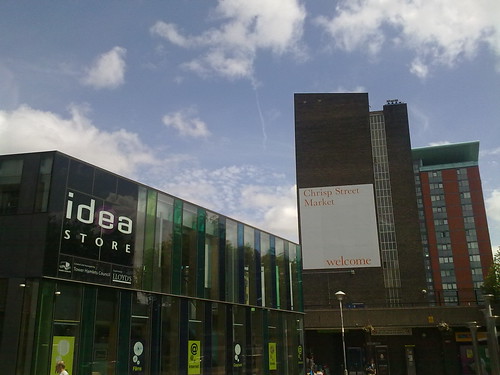
Idea Store at Chrisp Street MarketI think it's time to make the conceptual leap and develop "local" library plans that address a more  complete picture of citizen "access to knowledge."

Right: Idea Store at Chrisp Street Market.  Flickr image by Gordon Joly.  Note the signage.

I have also written about this in terms of how the Tower Hamlets borough of London has rebranded and repositioned libraries as "Idea Stores."  See "Social Marketing the Arlington (and Tower Hamlets and Baltimore) Way."

Local archives and special collections.  For example, you have archives and historical and cultural functions in addition to the straight up library.  In DCPL, you have a special Peabody Room collection for Georgetown at its public library, along with the Washingtoniana Collection at the Main Library.  Plus the Historical Society of Washington, some new library-museum created by GWU for the public, featuring the Albert Small Collection of materials on Washington.

But the NYPL system has collections on African-American Culture and the Arts.  Many library systems have special health and wellness collections, and government, such as the Dallas Public Library's Urban Information Library. 

DC has its own archives.  (Not too accessible with other issues.)  And the Register of Deeds is a repository of great information of historical import, as is the Surveyor's Office (which is part of DCRA).

Because of DC's odd status as a district controlled ultimately by the federal government, various federal agencies have records and archives that are relevant to DC.  For example, the National Park Service (parks, Union Station) and the Army Corp of Engineers (which controls certain parts of the city's water infrastructure) have such records.

And separately from their libraries for students and faculties, universities often have historic archives and records related to the history of the neighborhoods in which they are located.

University libraries.  In DC, most of the university libraries, with the exception of law libraries (open generally only to lawyers) and the George Washington University Gelman Library, are open to the public without charge.

But that could change.

I use the CUA libraries, especially the Architecture and Engineering Library, quite a bit, and on rare occasions GWU (now that you have to be a friend of the library to get in, and the price has gone up so much, I don't.  I get to the GU library a few times each year.  AU very infrequently. I went to HU's library in December--pretty but didn't have a lot of what I wanted.

Probably the local collections in the Gelman Library will get greater prominence in this new museum that GWU is building.  And fortunately, the Moorland-Spingarn Collection at Howard, which has languished for many years, is getting new attention.

Note also that in San Jose, California, the main library is jointly operated by the local library system and San Jose State University, and residents have access to the university library collection for check out.

And college student unions and libraries, in particular Goucher College's Athenaeum, offer new models as well.

But these are issues worth covering in a "local" master plan for libraries and access to knowledge.

The Library of Congress.  Arguably the Library of Congress is the world's biggest library.  (The British Library begs to differ.)  And it is open to researchers, and has many different reading rooms providing access to special collections.

But over the years they have cut back on their hours.  And now there are plans to close many of the specialized reading rooms.  (I envy people who work for Congress, because they can check out books.)

The National Archives.  This repository has already cut back on evening and weekend hours.  See the 2006 blog entry, "Archives redux."

Association libraries.  I used to use the library in the higher education associations building on Dupont Circle, when I worked in that area, but I don't so much anymore.  The Foundation Center library is open to the public.  Some associations may provide access to their libraries to the public with an appointment, but there is no master guide to what resources might be available.

This library sector should be covered in a local library master plan.

I have suggested that as part of Central Library planning, DC could even offer co-located space to certain association libraries that serve the public, like the Foundation Center, providing space for free in return for expanded hours.

Federal agency libraries.  The National Library of Medicine is in Bethesda; the National Agriculture Library is in Beltsville (I used it once).  But many federal agencies located in DC have libraries which may be open to the public.  Again, to my knowledge there is no master list.

I used to use the Dept. of Ed. library when it was comparatively easy to access when it was located by Union Station.  Once it moved to SW DC it became very cumbersome to use because it is buried in the building, you have to go through security, a librarian has to come out and get you, etc.  I stopped going.  At its former location, it had a direct entrance.

Note that at the state level, in state capitals, state agency libraries and archives collections should be considered in a similar context as it would relate to local library/knowledge access planning.

National Museum libraries.  The National Gallery of Art has a library, as does the Smithsonian American Art Museum, and the National Library of American History.  Likely so do other institutions.   Many of these libraries are open to researchers.

K-12 school libraries.  Another issue that is important.  Increasingly, school libraries in the city are being de-emphasized, even as some of the private schools enhance their libraries.  Maybe the planning for this function shouldn't be limited to the school system.  Residents in Capitol Hill have used library improvement as a fulcrum to engage residents and revitalize local schools.  See "Has D.C.'s Black Middle Class Given Up on Neighborhood Schools" from the City Paper.

Other public library systems.  In the DC region, with a couple of exceptions, residents can get reciprocity to other area library systems, with the ability to check out books.  It's not well-publicized.  I've even read that you can check a book out of a "foreign" library, and return it to your own library.  This needs to be covered in a "local" library plan also.

Conclusion.  To be "comprehensive" local master planning efforts often ought to be bigger in scope and scale than what we might term "agency functional plans," which for the most part is what "master plans" are, unless they have innovative scopes.

More and more I have come to believe that local plans need to address these kinds of issues as it relates to each element of a comprehensive plan, because otherwise, no one represents the interests of local citizens in relation to other organizations and bodies that also function and offer services within the community.

DC's libraries plan is but one more example of where this concept can be applied.

Also see "Bike-based library outreach."

Labels: , , , , ,

Sunday, February 10, 2013

National Park Service high resolution map of owned properties in DC

The advocacy group, Government Attic, focuses on getting and providing access to government documents. They turned up a high resolution map of the National Park Service lands in DC.

MAP A: A high resolution map of the Park System of the Nations Capital and Environs under Jurisdiction of National Capital Region - National Park Service, United States Department of Interior, (NPS 869/80,251-I), November 2008 - PDF 19.8MB

Labels: , ,

Thursday, August 04, 2011

(Update) City of Chicago posts a variety of usable information on the city website


This is the same concern I have with regard to DC--the DC Gov website is substandard, and after a redesign many reports and documents produced in the last 10 years are no longer available, people have to use FOIAs to get responses from the city, and heralded improvements like dashboards don't provide much in the way of actionable information.

The Chicago Sun-Times reports, in "City contracts dating to 1993 to be posted on Internet," that:

Information on more than 90,000 city contracts dating back to 1993 will be available and easy to download on the Internet, thanks to Mayor Rahm Emanuel’s latest move to shine the light on City Hall.

In nearly three months in office, Emanuel has posted an unprecedented amount of information on the Internet in the name of government “transparency.”

The mayor’s office has literally released 170 “datasets” — everything from the names and salaries of city employees to information on lobbyists, crime, abandoned buildings and the list of contractors barred from doing business with the city.

Until now, contract information was available on the Internet, but it was not easy to find, search or download. You had to make a specific search on the Department of Procurement Services website or file a Freedom of Information request. Contracts were distributed by the city through e-mail or PDF.

The new system is in an “open, searchable, machine readable format” designed to dramatically reduce the time it takes to access information on city spending. Chicago would literally blaze a national trail when it comes to contract transparency, officials said.

Labels: , , , ,

Thursday, December 16, 2010

More thoughts on what gets measured gets done

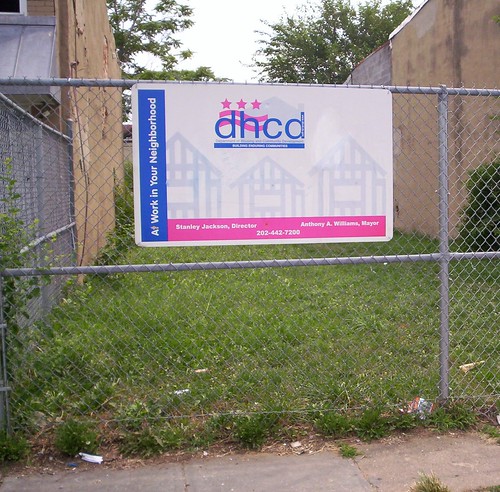
DHCD sign, Florida Avenue NW
This DC Government owned property on Florida Avenue NW has been vacant for decades.

Someone wrote to me and pointed out that DC Government does have a reasonably extensive performance measurement webpage, Track DC. I hate to admit I wasn't familiar with this offering (there is too much to keep track of). It's definitely a start.

For example, in the entry on the relative uselessness of the DDOT Dashboard, I mentioned that 5 of the 6 buttons on the dashboard do not provide the means to drill down more deeply to more detailed information, and that the 6th button provided inadequate and incomplete info.

So I just looked at the Parks Department tab on Track DC. I think the site is somewhat clunky, but it does provide some interesting information, and the ability to go down one level to a summary of each subcategory of the data (e.g., on performance indicators). But it doesn't go deeper than that. E.g., what about a master table of all the maintenance requests, and then the ability to look at the data say and determine all the individual requests of a certain duration, and make some of your own assessments, etc.

It's great you can download GIS data files on their assets, but for those of us without a GIS program, why not just have the map links?

The website doesn't mention current planning activities or the reality that the #$%^&* Parks and Recreation Department doesn't have a master plan (well one was done in 2005 and never released to the public). Maybe this should be an overall indicator on these pages, about the status of agency master plans, links to them, along with detailed data about capital improvement planning.

How they rate themselves on spending their budget is somewhat interesting.

My criticism of performance indicators during the Williams administration was that there were pretty "gross" and easy to achieve because they weren't all that significant in terms of what they measured.

Granted I don't know what I'd want to measure, the things that most citizens think are important.

I mentioned in the blog entry a database on road conditions.

Here's some indicators I think are important generally, and these kinds of indicators should be focused on overall, rather than providing "too much" information by organizing metrics the way they are organized right now, at the agency level, on the Track DC website.

Some performance indicators that probably matter to residents:

-- litter rates by block (we don't collect this information)
-- accident data for peds, bicyclists, and cars
-- pavement quality conditions by block
-- participation rates in recycling
-- crime statistics by police district and block, what's going up, what isn't
-- incarceration statistics
-- number of neighborhoods with plans (none, we don't do neighborhood plans)
-- use rates for parks and rec centers
-- statistics for transportation mode split (walking, biking, transit, car) by neighborhood (we'd need a good research program...)
-- number of automobiles in DC, by size and weight class
-- breakdown of parking spaces by neighborhood, commercial district, structure
-- vacant buildings, by neighborhood/commercial district, how long they've been vacant
-- nuisance property and environmental crimes (i.e., dumping)
-- number of ideas offered by citizens, and the take up rate, database listing of ideas
-- graffiti -- reports and eradication
-- sidewalk conditions and planting strip maintenance (e.g., I've shown photos in my blogs of things that don't get corrected for years)
-- school data (enrollments, success, etc.) + for private and charter schools too
-- graduation data for DCPS students
-- data on success rates of DCPS students in college
-- number of special education students in private school/costs
-- absenteeism rates in school
-- suspension/expulsion statistics, by individual school/grade level
-- snow removal -- not just from streets, but from pedestrian areas, bus stops and transit stations, public buildings, etc.
-- time to open a business (this is really hard, but would be interesting to measure)
-- business retention and failure rates
-- grass cutting records for various public sites/installations (such as schools and various public reservations)
-- status data on all publicly owned properties
-- status data on community development corporations and companies like David Wilmot's cash cow of group homes for the developmentally disabled
-- youth crime statistics and status
-- water main breaks and repair status

My issue with the DC Government call center (311/online) is I never see any reports on what people call about. Do they sift out stuff and identify (and address) structural problems?

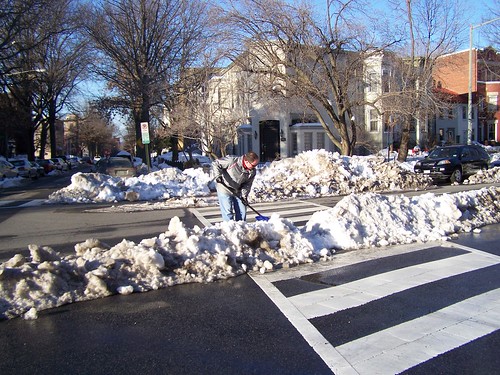
A committed resident clearing the crosswalk median on his block
A committed resident clearing the partially blocked crosswalk median on his block of Maryland Avenue NE.

Labels: , , ,

Tuesday, December 14, 2010

Since we're talking about more public information on transit...


One thing that neither the Office of Planning nor the Department of Transportation do is a lot of what we might call "informed" public outreach. Sure there are tons of public meetings, so many that I am overwhelmed. And as the entry from yesterday discusses, often public meetings aren't really good venues to get informed.

DC's public libraries could be used as venues for displays on land use and transportation planning issues. For example, with the streetcars, there ought to be displays in libraries serving the areas where the streetcars are supposed to go. The same goes with "urban" design and placemaking, and the difference between urban and suburban land use paradigms.

I guess I never got around to blogging about a display about plans for light rail in Montreal. Some of Montreal's public libraries are augmented with added "cultural center" facilities. This was the case with the library in Frontenac, which also had a display on the proposed light rail line for Montreal.

Of course, when we were there, an old man came up to us and asked us if we believed in streetcars. He said cars were better...

------
Images are from boards about the proposed light rail in Montreal as displayed at the Frontenac Library and Cultural Center, Montreal.

Labels: , , , , ,

While we are on the topic of public information: web redesigns should increase access to information not reduce it

The redesign of the DC Government website sucks.

At least, it sucks if you want to find plans and studies and reports, or easy links to agencies from the homepage.

Before, such would be listed in a very retrievable link, mostly on the front page of the agency website.

Now you have to dig and dig.

If you can find it, the link is graphicized and it can take forever to find the report you want.

If you can't find it, you have to resort to looking up an archived version of the agency website at Archive.org.

How does this help the public?

How is this forward moving?

Why should this change be heralded if in fact it reduces access to important public information rather than improving access?

For planning, you can use the "in your neighborhood" tab to eventually find reports, although the old version of the website was much easier. I haven't figured out how to find Thrive or Trans-Formation yet, except through archive.org:
For transportation, I have no idea how to find the reports (except through archive.org), although a couple weeks ago DDOT said that they would restore a link to these reports.

This is !@#$%^&*()_ frustrating.

Labels: , , ,

Wednesday, December 08, 2010

DC is #51! (on tax subsidy disclosure)

Good Jobs First released a study comparing the 50 states plus the District of Columbia on online disclosure of information concerning companies receiving state and local tax breaks, cash grants and other subsidies for job creation. From the press release:

• Thirty-seven states provide online recipient disclosure for at least one key subsidy program.
• Based on our scoring system, the states with the best averages across their programs are: Illinois (82), Wisconsin (71), North Carolina (69) and Ohio (66).
• Thirteen states and the District of Columbia currently have no disclosure at all, although one of those states, Massachusetts, is slated to come online as enacted legislation takes effect. All our scoring is based on what was available online as of November 26, 2010.
• Since 2005, half a dozen states have enacted legislation mandating subsidy recipient reporting in one or more program, the most recent being Massachusetts. Several other states have moved toward transparency through administrative action alone.
• Four states provide recipient reporting for all the key programs we examined: Missouri, North Carolina, Ohio, and Wisconsin.
• Of the 245 programs we examined, 104 of them (42 percent) have online recipient reporting.


Maryland tied for 18th ("Maryland ranks poorly for tracking tax breaks" from the Baltimore Business Journal and Virginia tied for 25th.

DC and 13 other states have no requirements for disclosure.

-- full report
-- press release
-- DC appendices

Too often the city gets credit for online initiatives like website redesign and various Web 2.0 applications, while substantive failures to provide information (like this) more generally, or respond to FOIAs, isn't discussed all that much.

Labels: , , ,

Sunday, June 20, 2010

What we need is action, not the ability to sue...

http://www.cosmosmagazine.com/files/imagecache/feature/files/Gladiator_1.jpg
Gladiators. (Internet photo.)

In "D.C. government gets an earful for lack of openness," the Examiner reports on a DC Council hearing considering expanding requirements for openness for DC Government. From the article:

Many speakers complained that routine requests for information were often ignored or improperly denied by city departments. Those kind of complaints are nothing new and aren't unique to the District.

But the District's problems, Cheh and other speakers said, have only gotten worse under the administration of Mayor Adrian Fenty, who rose to power on a platform of accountability.

The average number of Freedom of Information Act requests wholly denied by the city has quadrupled under Fenty, while the average number of requests has stayed constant to previous administrations, according to figures from Cheh's office.

The article concludes with this:

Cheh's proposed bill would create an Open Government Office, which would advise agencies on public records laws and have the power to sue an agency that failed to comply with the law. She said the office would work as a "gladiator" for the public.

So you create a government office that has the power to sue another government agency?

Wow. Some solution.

Gladiators weren't content to sit in a courtroom arguing desultorially about what to do. Gladiators do things!

Instead, give the "Open Government Office" the authority to go in to the agency and fill the request, and seize funds from the uncompliant agency to pay for their cost of doing so.

Adding another lawsuit to the courts is hardly a step forward in protecting citizen rights and access to government. It does guarantee full employment for government lawyers though.
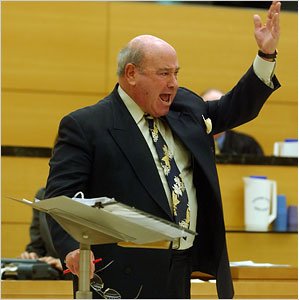
Attorney Michael S. Washor, making his opening remarks at a trial
Attorney Michael S. Washor, making spirited opening remarks at the beginning of a trial. New York Times photo.

Labels: , , , , ,