Rebuilding Place in the Urban Space

"A community’s physical form, rather than its land uses, is its most intrinsic and enduring characteristic." [Katz, EPA] This blog focuses on place and placemaking and all that makes it work--historic preservation, urban design, transportation, asset-based community development, arts & cultural development, commercial district revitalization, tourism & destination development, and quality of life advocacy--along with doses of civic engagement and good governance watchdogging.

Friday, August 01, 2025

Christopher Taylor Edwards, Rest in Peace | A grassroots leader in design thinking

Later he grew a huge beard but this is how I remember him.


Open-casket visitation Sunday, August 3, 3pm (service begins 4pm) at Colvin House, 5940 N. Sheridan Rd., Chicago, IL 60660. Reception 5-7pm. Parking is limited. Guests are encouraged to take public transportation or rideshare.
(I like the nod to public transportation.)

He moved around a lot and since I am not a big Facebook user we lost touch, but my partner kept following him, from his getting another design degree in NYC and being the first design fellow in a Knight Foundation program at Parsons, to Chicago.  Before that he lived in Oakland and DC among other places. 

In the early 2000s when blogs were the supreme social media (having long since been superseded by other media like Twitter/X, Instagram, TikTok, etc.), there was a small blogging community in DC devoted to the city and its urban issues and that's how I met him.

-- Christopher's old blog

As part of my activism then I used to lead walking tours of "Florida" Market (now renamed Union Market, which was the original name, also see "Revitalization of the wholesale food Union Market in DC to a consumer focus," [2025]) to increase awareness and to ford off the attempt at urban renewal-ing a cool food business district, mostly oriented to wholesale customers, but a number of businesses also sold to the consumer.

I was also interested in the visitor/tourist/guest experience, these days the profession is often oriented to computers using the shorthand of UX--user experience.  But the principles last.

In the tours besides going to businesses that sold to retail customers, we talked about missing amenities,  like directories, trash cans, etc., which were used as reasons for urban renewal.  My response was, yes it's dirty, why doesn't the city have trash cans?  Yes, it's hard to find things, why isn't there a directory?  Etc.

I knew Christopher as a "graphic" designer, but he was also into museum exhibiting and urban design, and he offered to help develop a "proof of concept" in wayfinding signage for the market.  

The city already had a wayfinding system, but I discerned gaps, and the concept of a district area directory map was one.  I also thought the "Discover DC" headers were more oriented to tourists, rather than both residents and tourists, so we developed a "Discover DC" concept as well.

The city sign.  Maybe it's merely a quibble, but I liked the idea of "exploring" being open to all, not the implication of "discover" being you had to be an outsider to find something, ignoring the fact that these are existing places known to many.

I had been aware of the concept of "design thinking" before this project, but he and I talked about it and related issues to design.  These blog anniversary pieces draw a lot on design thinking, business process redesign, design method, and systems thinking. This was in 2008.

(I started blogging in 2005, and these anniversary pieces draw a lot on design thinking, business process redesign, design method, and systems thinking.

--  "20th anniversary of the blog| Urban revitalization systems thinking's greatest hits: Part one -- (in)FAQ and my influences," 
-- "20th anniversary of the blog| Urban revitalization systems thinking's greatest hits: Part two -- not transportation
-- "20th anniversary of the blog| Urban revitalization systems thinking's greatest hits: Part three -- transportation"

In my writings, I prefer the application of design thinking to the typical urban planning process of constrained scopes, because that allows for an iterative process that can explore and incorporate new ideas, rather than be limited to the client's defined and usually constrained scope.

-- "Florida Market proof of concept wayfinding signage and the need for a wayfinding conference," 2009
-- Explore Florida Market (history)
-- Florida Market Map and Directory


In the project I had a idea leap using design thinking on the Florida Market Map, and how to represent necessary items like transit.  

I came up with the idea of using the local transit system's iconography rather than weak lines and or the weird looking industry-standard rail transit icon.  We extended this to mapping bus routes using the WMATA graphic design as well, although it's not as pathbreaking.

FWIW, I still haven't come across a similar use of integrating local transit map graphic design into other map products. 

 There is tons of writing and display of great transit map design, but not about incorporating some of that design into different kinds of maps.

WMATA Metrorail map.

Extract from an old WMATA bus system map 
(WMATA has since changed all of its bus-related routes, naming conventions, and map designs.)

The design method, graphic design, and design thinking offer a lot to making better government services like parks, libraries, schools, forms, etc.

-- "City branding versus identity | Branding versus Urban Strategy," 2019
-- "All the talk of e-government, digital government, and open source government is really about employing the design method," 2012
-- "PL #7: Using the Purple Line to rebrand Montgomery and Prince George's Counties as Design Forward," 2017
-- "World Usability Day, Thursday November 9th and urban planning," 2017
-- "Branding's (NOT) all you need for transit," 2018
-- "Illustration of government and design thinking: Boston City Hall to Go truck," 2013<
"Best practice bicycle planning for suburban settings using the "action planning" method," 2013,

Thank you Christopher.

============

Over the past week, I came across some design thinking publications, downloadable, from the UK Design Council.

-- The Design Economy: Environmental and Social Value of Design 
-- Design Economy: People, Places and Economic Value, 
-- Design for Neighbourhoods: A design agenda for the new government
-- Future of Motorway Service Areas (interesting speculation about electric cars)
-- Public Design Beyond Central Government Key Insights and Recommendations

-- "Five components of social design: A unified framework to support research and practice," Design Journal

Labels: , , , ,

Friday, April 25, 2025

Impact of proposed transit cuts at SEPTA/Philadelphia presented in graphically compelling ways

With WFH and the ending of special grant programs from the Biden Administration ("Public transit agencies eye service cuts as pandemic aid runs out," Marketplace/NPR), coupled with the Trump Administration's pro-car bias, virtually every transit agency is facing financial exigency in future  budget cycles ("Metra, CTA and Pace warn of possible 40% service cuts starting in 2027," NBC Chicago, "What to know about possible PRT cuts and how to make your voice heard," Pittsburgh Post-Gazette) , often with pleas like in Philadelphia ("No more excuses — Harrisburg Republicans must find a way to fully fund SEPTA," Philadelphia Inquirer) and the SF Bay, for state bailouts.

Process for considering transit service cuts in Pittsburgh

WFH has totally messed up transit agency budgets, shifting the most use from morning and evening commute to primary business districts, to use spread out during the day, across the system, further increasing costs alongside revenue decreases.  DC for example has lost about 250,000 train riders from pre-covid highs.

The Reddit Philadelphia has included entries on what budget cuts would to do to SEPTA's, the regional transit agency for Philadelphia, service network, and I thought they've had some good graphics to illustrate the changes.

-- SEPTA budget cut fact sheet

  Proposed cuts to the current rail system ("SEPTA prepares for major service cuts," Trains Magazine).

Current ail transit system

The Delaware Valley Regional Planning Commission ("Regional planners calculated the impact on traffic if SEPTA cuts happen. It’s really bad," Inquirer) did a study of the impact the proposed cuts will have on motor vehicle traffic congestion.


From the article:
SEPTA is facing a $213 million annual structural deficit due in part to pandemic-related ridership reductions and inflationary pressure on labor and materials costs. (Fare evasion doesn’t help matters, costing from $30 million to $68 million yearly, according to SEPTA projections.)

The transit agency released a $1.65 million operating budget on April 10 that included a doomsday scenario of service cuts, along with an average fare increase of 21.5% across the board. In all, up to 55 bus routes would be eliminated, five Regional Rail lines shut down, and 66 stations closed. Other routes and lines would see reduced frequency of buses and trains.
At least one of the SEPTA trolley routes serve the suburbs.  This is in Media, Pennsylvania. 
Those cuts would occur in two phases, this fall and on Jan. 1, without new state subsidies, the transit agency says. If the full menu were enacted, all rail services would stop at 9 p.m. across the SEPTA network early next year.
From the standpoint of "those who don't know history are doomed to repeat it, some Pennsylvania Republicans are recommending privatization ("Idea to privatize SEPTA floats around the State House amid funding crisis," Fox29).  The proposal focuses on bus services, not the entire system.

There's a reason that with few exceptions, privately run transit systems were acquired by local and state governments to maintain service.  They were unprofitable from a fare standpoint, especially in that many of the "spillover benefits" of transit aren't captured by the transit operator.

Note that plenty of public transit agencies outsource operations of some or all of their transit services to the private sector.  Sometimes it works, sometimes it doesn't.  Since the operator isn't responsible for investments in transit infrastructure, that's often skipped over.  Privatization is no panacea.

Impact on property values.  Another report ("SEPTA cuts could lead to drop in property values around Regional Rail lines," WHYY/NPR, Economic Impact Analysis: SEPTA Service Cut Proposal Due to Lack of Funding) points out that property values will drop in areas that get less service at a cost of .  This is another example of a "spillover benefit," improved property values, just one of multiple positive economic development impacts not being captured by a transit agency.


Impact on special event population.  SEPTA promotes transit service to sports events like Eagle football games and concerts ("Taylor Swift's Eras Tour helps boost Philadelphia's economy," ABC6).  Philadelphia will host ceremonies commemorating the 250th anniversary of the signing of the Declaration of Independence, and World Cup soccer.  

Severe cuts to transit will significantly impact the ability of visitors to move around the city ("Philly mostly ready for 2026 … except for that little SEPTA problem," WHYY/NPR).

Streetcar service to ATT Park in San Francisco. SF Chronicle photo.

Impact of graphic design in government communications.  Note that the presentation of these issues with great graphics is an illustration of the power of good graphic design and the use of the design method by government agencies.

-- "All the talk of e-government, digital government, and open source government is really about employing the design method," (2012)
-- "PL #7: Using the Purple Line to rebrand Montgomery and Prince George's Counties as Design Forward," (2017)
-- "Design as city branding: transit edition," (2012)
-- "City (and university) branding: brand deposits; brand withdrawals; brand destruction," (2012)
-- "Georgetown: A subtle but important difference between branding and identity-positioning," (2010)
-- "Identity ≠ branding or Authenticity is the basis of identity," (2007)
-- "The taxi livery debacle as a lead in to a broader discussion of the importance of "design" to DC's "brand promise," (2012)
-- "Illustration of government and design thinking: Boston's City Hall to Go truck," (2013)
-- "(DC) Neighborhoods and commercial districts as brands," (2012)

Labels: , , , , , , ,

Saturday, April 10, 2021

Orange County Register coronavirus tracker graphic is a great model

Showing the value of local media in communicating locally important information, the newspaper is focused on only the one county, but it's a big county in population, more than 3 million residents.

It's also a decent example, in the vein of the work on graphical illustration of information by Edward Tufte, showing the power of multimedia to communicate.


Labels: , , , , ,

Sunday, February 16, 2020

World Design Capital 2020: Lille, France


The World Design Organization sponsors the World Design Capital, which runs on a two year cycle in even years, so that this year's World Design Capital is Lille, France. Valencia, Spain is the designee for 2022.

-- Lille Capital of Design website, English
-- Lille Tourism webpage
-- Lille Metropole webpage on the program

Labels: , , ,

Thursday, August 30, 2018

Improvements in 311 response: still has a ways to go

Years ago I "complained" in a blog entry that the way the city reported on citizen service "requests" through the 311 system was inadequate, because the report merely said the item was "closed" with no information on disposition.

With two requests over the last couple months I see one big improvement, but problems still exist.

Not only has the notice been reformatted to be more like a letter, they have added a new field "Case Closure Comment."

In May I reported an abandoned likely stolen vehicle on the next block.  The car was moved, but the service request "case comment" was gobbledygook.  Likely what it is saying is that someone else reported this as well, and they already or were in the process of responding.

They should say that. Still, compared to having no comment line reporting on what happened, this is a step forward.


Just yesterday, I reported a dead animal in the street.  The response "comment" was more direct, that the "item," in this case a possum, was picked up.  That's direct and easy to understand.  (Sadly, it's so direct because likely I'm the only person who reported it, and it wasn't even in front of my house.)

Interestingly at first the city employee couldn't find the possum and called us, since I included my phone number on the request.  I went out there, showed him where it had been--you could still see the mark on the street and tufts of animal hair--and then he noticed that it was moved off the street, likely by another animal who fed off it.

=====
Last year, I was somewhat dismissive about the city's touting its use of a grant to fund a center on innovation in public services on "form redesign."

-- "Five new forms: is that all you've got?"

But it is important.

But I am not so content to take pride in helping to foment such change, when it isn't second order change (Change: Principles of Problem Formation and Problem Formation).

Labels: , , , , ,

Wednesday, October 04, 2017

Information design -- graphic presentation of information by government: sewer pipe flow quality in Bellevue, Nebraska

A couple days ago I came across an article in the Omaha World-Herald about the process in the City of Bellevue to determine the state of good repair of their sewers ("Sonar-like analysis of Bellevue's aging sewers suggests repairs will cost millions").

It turns out most of them are blocked.  The city presents the information in a graphic.

I was struck by this, not because it is particularly unusual--most "highway departments" collect and present information about pavement condition in this matter (although DC hasn't updated its public presentation of this type of data for three years;)--but because of the animus in various sectors in many communities about rising water service bills.

-- Presentation of Pavement Condition Index data for Greater Honolulu

In most places--outside of those areas experiencing drought--water bills are rising significantly not because of the cost of water--in fact per capita water consumption is declining ("Why is water usage declining across the United States?," GreenBiz, although significant water consumption occurs through industrial usage, such as agriculture), but because of the cost of infrastructure:

(1) replacing decaying water pipe systems as most had been constructed before the 1920s and it is in need of repair ("Drip Drop: America's Crumbling Water Infrastructure," Harvard Political Review)

(2) replacing lead-based water pipe systems, as lead consumption is a public health hazard ("US water systems repeatedly exceed federal standard for lead," Associated Press; "Avoiding A Future Crisis, Madison Removed Lead Water Pipes 15 Years Ago," NPR)

(3) creating separated sewer and stormwater collection systems as many communities built integrated systems, which often leads to discharges of polluted water into rivers during major storms, and this violates Clean Water regulations--some communities like Seattle, Philadelphia, and DC are also employing "green infrastructure" as a way to slim down the requirements for underground storage tanks and piping

-- Combined Sewer Outflows, National Pollutant Discharge Elimination System (NPDES), Environmental Protection Agency

(4) creating protected water storage systems in the face of tightened EPA regulations concerning the storage of post-treated drinking water ("After 60 years, new reservoir being built for Baltimore," Baltimore Sun)

(5) building and maintaining water treatment systems generally.

From the OWH article:
Extrapolating from the early numbers, Councilman Pat Shannon said the city is potentially looking at an $80 million problem.

Bellevue’s sewer problems have proved costly for homeowners as well. Last year in the Olde Towne area, a dozen homes were invaded by brown sludge after a water line was hit when workers were trying to fix a collapsed sewer line. There’s a lawsuit pending in Sarpy County Court to determine fault.

Bellevue residents are already helping to pay for another major sewer project. Bellevue’s sewage is treated at Omaha’s wastewater treatment plant, as is much of Sarpy County’s waste. Omaha is the midst of a federally mandated sewer system overhaul, which is expected to cost more than $2 billion. To pay for the work, Omaha is charging its residents and other cities more for treating sewage at its facilities.

Bellevue raised its sewer service charges last year. Residents will see their bills jump about 30 percent between 2016 and 2018. The service charges also are the main source of revenue that Bellevue has to maintain the 360 miles of sewer pipe and 21 sewage pump stations that it owns and operates.
There is a city gadfly and perennial political candidate who tries to stir up residents on the water issue, and since I run some of the e-lists to which he sends his missives, I've replied to some of his writings making these kinds of points.

In many places, conservatives have been successful in defeating Democratic Party candidates over "rain taxes."  Such taxes aren't ridiculous or stupid, but are imposed to collect money to pay for the necessary infrastructure.

-- "When It Rains, It Pours Tax Dollars In Maryland," Forbes
-- "Bogus Conservative Media Talking Point: Martin O'Malley "Taxed The Rain," Media Matters
-- "Ellicott City flood vindicates the 'rain tax'," Baltimore Sun

Could explaining these matters through an information design approach make a difference to people's understanding of the various issues involved in maintaining clean water in our rivers and streams?

Certainly, Bellevue, Nebraska's graphical rendition of blocked pipes throughout their sewer system makes it much easier for people to grasp that there are problems that will only get worse without correction.

Another kind of example is the “What the Flush” campaign by the Maine Water Environment Association. It was a television ad public service campaign which aimed to educate consumers on what is biodegradable and what isn't. But research found that public education campaigns only have short term effects.  Therefore, more structural approaches are needed.

=====
Bonus sewer policy feature:

DC is aiming to ban "flushable wipes," because they aren't flushable and impose serious operational problems and costs on local water and sewer systems ("Bathroom wipes, moist towelettes blamed for sewer backups," Milwaukee Journal-Sentinel; "Huge Blobs of Fat and Trash Are Filling the World's Sewers," National Geographic).  Kimberly-Clark is suing the city over the ban, but while I am not a lawyer, there arguments don't seem particularly sound legally ("Fight over labeling of 'flushable' wipes headed to federal court," Washington Post).

I don't understand why such wipes aren't "banned" altogether, which is a role for our national government, which of course, these days is totally dysfunctional.

The article "How the wastewater industry can take on flushable wipes," Environmental Science and Engineering Magazine, recommends that the wastewater treatment industry redesign treatment facilities to better capture, divert, and grind so-called flushable wipes to prevent damage to the facilities and pipes.

And yes, improperly disposed of oils and fats are another problem ("10-tonne fatberg removed from west London sewer," Guardian) which combined with "flushable wipes" lead to blocked sewer lines.

Labels: , , , , , , ,

Tuesday, October 03, 2017

5 new forms: is that all you got?

(From the Department of OMG, LOL division)

In June I wrote a piece "For a lot of "urban problems" the issue isn't knowledge about what to do, but willingness to engage that knowledge" somewhat skeptical about DC Government's innovation initiative called "The Lab," funded in part by a large grant from the Arnold Foundation.

The point I made is that there is plenty of opportunity in the design method, process innovation, etc. without having to do "big data."  That plenty of opportunity in dealing with "little data" is missed, and that local government tends to not be very interested in hiring and keeping around people who have an inclination toward innovation.

Today, DC Government heralded one of the big innovations of The Lab innovation initiative is the redesign of five forms.

While I think that design-led innovation, of forms, information products, and other elements is extremely important, the press release ("Mayor Bowser and The Lab @ DC Release Updated DC Government Forms: Five High-Profile Forms Updated Based on Input from Form-a-Palooza") proves my point. From the press release:
“At Form-a-Palooza, we took government forms that were notoriously and unnecessarily difficult to use and worked with residents and experts to make them more accessible. Today, we are proud to reveal the results of such a tremendous community effort,” said Mayor Bowser. “We want residents to use the programs and services available to them and we will continue using The Lab to find innovative ways to make DC Government work better for District residents.” ...

The forms included:

· Department of Motor Vehicles’ Driver License and Identification Card Application, used to obtain or renew a driver’s license or identification;
· Department of Consumer and Regulatory Affairs’ Basic Business License, used to certify a business as authorized to operate legally in the District;
· Department of Human Services’ TANF Job Search Log, used to allow Temporary Assistance for Needy Families customers to document their job searching activities;
· Department of Disability Services’ Service Request Form, used to access intellectual disability support services; and
· Department of Energy and Environment’s Lead Disclosure Form, used by landlords to acknowledge potential presence of lead-based paint to their tenants.

-- before and after of the changed forms

-- "Guns, Butter and Ballots," a column in Communications Arts which references the proposal by graphic designer Greg Storey to redesign the President's Daily Intelligence Brief in the face of the realization it inadequately called attention to threats posed by Al Qaeda, and a general discussion about the importance of information design in government
-- Information Design Wikipedia page
-- and the work of Richard Saul Wurman and Edward Tufte among others
=====
One of my lines about DC is that it like the point Daniel Patrick Moynihan made in his argument about "defining deviance down," DC defines mediocrity up, as excellence, that by definition because DC is the national capital anything it does must be "world class."

Um, it isn't.

====
Yes, I am sure there are some sour grapes because a city agency offered me a job and then reneged.  But still.

Labels: , , , , , , ,

Monday, July 10, 2017

Bicycling information systems for bikeways

I've written about ideas to create community information networks--digital (see item #10, here, "PL #5: Creating a Silver Spring "Sustainable Mobility District" | Part 3: Program items 10-18 ) and analog--at the city and sub-city scale.

And I've suggested that bicycle route signage use branding and identity systems (see also the Better Bikeways signage project by Joseph Prichard and "Greater Knoxville Greenway signage project"), including map signage and signs with URLs/contact information for bikeway planning.

Dealing currently with the creation of cycletrack infrastructure in the Greater Takoma area because I sit on the neighborhood "Public Works and Infrastructure" Committee, I have been thinking about incorporating (1) community information boards; (2) murals; and (3) underpass lighting as part of the planning and construction process. 

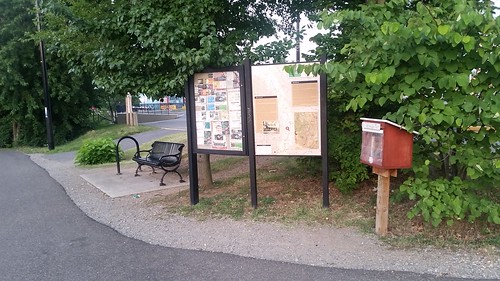
There is a community information board (and a Little Free Library) at the Rhode Island Metrorail Station "trailhead" on the Metropolitan Branch Trail, and a neighborhood association occasionally posts yard sign meeting notices at the R Street "trailhead," but these are exceptions.
Map sign, bulletin board and Little Free Library at the Rhode Island Avenue pedestrian bridge trailhead, Metropolitan Branch Trail
I think this is the only bulletin board placed on a DC bike trail.

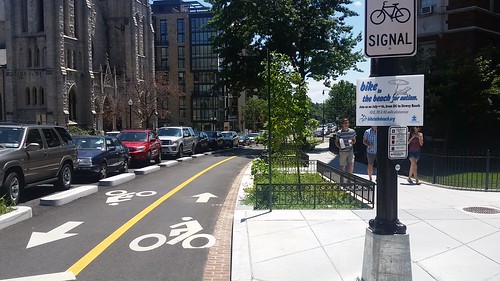
This weekend I noticed that the "Bike to the Beach" fundraising event posted signs promoting the event on various trails and cycletracks throughout the city.  I thought that was pretty smart, a well-targeted way to reach potential participants.

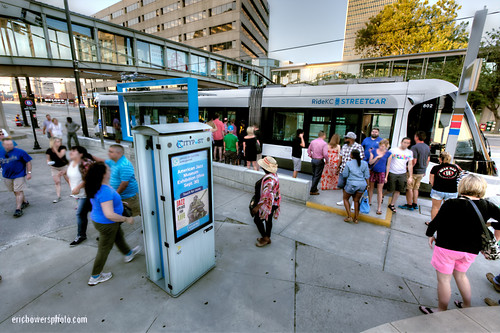
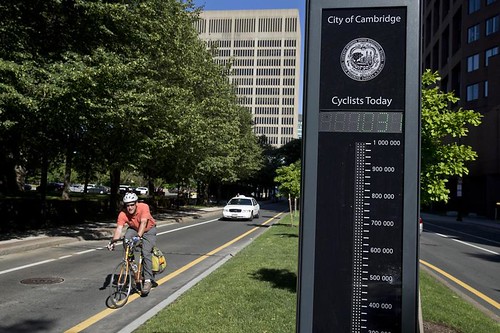
It reinforced the idea of the need for more systematic delivery of cycling-related information along bikeways, besides counters, and maybe digital information systems can be integrated into bike counter kiosks as one method.

A feed could be created as part of local and metropolitan bicycle planning, besides government agencies, it could include info from bicycle organizations and publications like the regional Spokes Magazine for the bicycling community, even ads (to help fund it).

15th Street Cycletrack between V and W Streets
15th Street Cycletrack between V and W Streets NW

Kansas City Streetcar Stop with Smart City Post Kiosks
Kansas City Streetcar Stop with Smart City Post Kiosks.  Flickr photo by Eric Bowers.

Bicycle counter, Cambridge, Massachusetts
Bicycle counter, Broadway Street, Cambridge, Massachusetts.  Photo by Michael Lee, Boston Globe.  Why not make this a kiosk incorporating biking related notices and information?

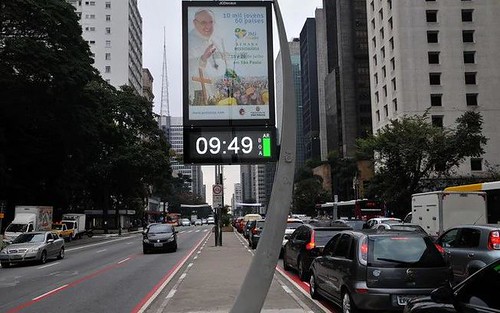
I noticed from images that on a cycletrack in Sao Paulo they have digital advertising kiosks.
Digital ad signage on Avenida Paulist ciclovia/cycletrack, Sao Paulo
Digital ad signage on Avenida Paulist ciclovia/cycletrack, Sao Paulo.

Labels: , , , ,

Friday, April 07, 2017

Posting information on board members and the Metro Riders Advisory Council in Metrorail stations

At the Silver Spring Transit Center there is an information center called Trips.  Operated by Montgomery County's Department of Transportation, it provides information on transit and sells various types of transit passes.

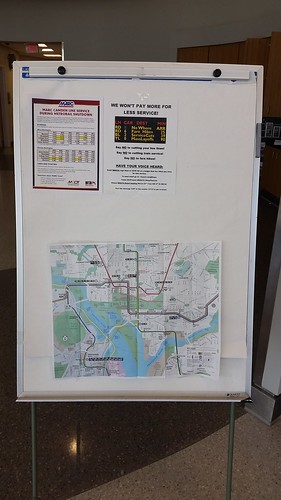
I checked it out the other day and I was surprised to see that a newly posted information board
Information board with flyers at the Silver Spring Transit Center

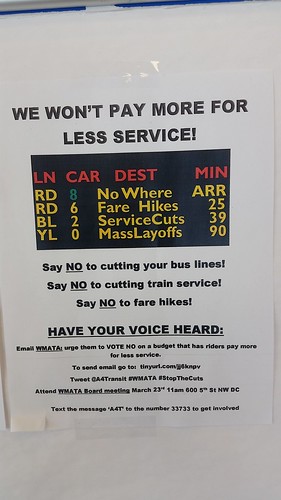
included an advocacy flyer concerning the FY2018 budget for WMATA, which calls for fare increases and service decreases.
Flyer calling attention to Metrorail fare increases and service cuts posted at the Trips information center at the Silver Spring Transit Center

I wasn't surprised that the flyer was still up, although the date for action had passed.

I think in the past I've suggested that contact information for WMATA Board members be posted in Metrorail stations.  A couple years ago, then BART Board Member Zakhary Mallett suggested this for their stations, although I don't think the proposal was adopted ("BART director wants to display board's photos in cars, stations," San Francisco Chronicle).

But seeing the flyer made me realize that at the very least, contact information for the WMATA Riders' Advisory Council should be posted, as well as an information board broadcasting their actions. WMATA does post information boards in stations when actions/hearings are scheduled concerning fares and service changes.

Sometimes you will see information from chapters of the National Association of Railroad Passengers posted in train stations.  You don't see this at Union Station, but you do at Penn Station in Baltimore (at least back when I used to ride MARC to Baltimore a few days each week for work).

The various "commuter stores" -- Arlington, Fairfax, Montgomery have versions -- should probably post this kind of information too.

Note from a design perspective, the information board is a "staff intervention" designed to call out information on frequently asked questions (e.g., the map of the Downtown Metrorail Stations is posted) and communications of urgency, such as MARC railroad service changes designed to aid people impacted by Metrorail repair shutdowns.

Labels: , ,

Saturday, August 20, 2016

Wyoming displays traffic death totals on highway safety signs

I'm intrigued by the idea of sensor networks and other counters and displays of relevant information in the public space, be it bike counters like in Arlington County (and many cities in Europe) or potentially the display of information on water and air quality ("Park bench air monitoring station at Smithsonian National Zoo and city sensor networks").

Another way to do this is in online dashboards, although I sometimes question failures in the quality of the information provided ("Does the focus on big data mean we miss the opportunity for better use of "little data": Part 1--Road Condition Data as an example of failures in presenting data (Information Design)").

Yet another example is information presented within office buildings on various environmental metrics ("A Measured Approach to Going Green: IBM “Green Sigma (TM)”: Consulting Offering to Help Clients Reduce Energy and Water Usage," IBM).

According to the Wyoming Tribune-Eagle ("Wyoming electronic signs highlight highway deaths"), the Wyoming Department of Transportation is using the freeway sign active information displays to present information on traffic fatalities.

Photo: Wyoming DOT.

From the article:
You might have already seen this staggering statistic on electronic message boards across the state: 25 fatal crashes have happened on Wyoming highways since July 15.

As of Thursday, there had been 73 fatalities so far this year.

“The message in all of this is that a third of our fatalities this year have occurred in the last 30 days,” said Gregg Fredrick, the Wyoming Department of Transportation’s chief engineer.

“It’s a sobering message, and it’s not a message that we want to see out there. We don’t want to see any fatalities on our highways.
It turns out that many other states do this too.  Nevada does it, Ohio, Tennessee, Wisconsin, Colorado, Texas, Illinois, and likely others.  Texas, being so big and populated, has over 2,000 traffic-related fatalities each year ("TxDOT Signs To Regularly Display Traffic Death Numbers").

While only a small proportion of the population makes behavior changes based on information and logic ("The healthy choice:n ow behavioral factors create influential health campaigns," Deloitte), it's still powerful.

Note that a few weeks ago I was traveling from Virginia across the 14th Street Bridge and there was a similar message about the WMATA SafeTrack program advising people to consider other transportation options, but I wasn't in a position to be able to get a photo.

Labels: , , , , , ,