Rebuilding Place in the Urban Space

"A community’s physical form, rather than its land uses, is its most intrinsic and enduring characteristic." [Katz, EPA] This blog focuses on place and placemaking and all that makes it work--historic preservation, urban design, transportation, asset-based community development, arts & cultural development, commercial district revitalization, tourism & destination development, and quality of life advocacy--along with doses of civic engagement and good governance watchdogging.

Thursday, August 10, 2023

Lies, damn lies, and misleading data: bus service (DC Circulator)

When I went to college there was a book "famous" in economics called Lies, Damn Lies, and Statistics, about the manipulation of data.

In reporting on transit ridership, I am bothered when they don't report ridership by bus line or day of the week, but "by the year."  

There was a reddit entry about this on the Alexandria bus system, touting 5 million riders last year, a system high, without discussion of daily data.  It turns out they have about 10,000 riders during a typical weekday, on 12 bus lines. Probably most of the ridership is on the King Street line, which connects the King Street Metrorail station to Old Town.

This comes up with the DC Circulator.  For years they haven't been reporting data by bus line--there are six.  Obviously it's because most of the lines have minimal ridership.   This is from a blog entry, "Semi-reprint: Methodology for determining transit expansion" from 2014:

DC Circulator ridership per day
High and low service months (2013 data)

RouteRidership PeakMonthRidership LowMonth
Georgetown-Union Station6,600June5,500February
Woodley Park-McPherson5,060February4,000November
Union Station-Navy Yard1,700July900November
Rosslyn-Dupont Circle2,750July2,550October
Potomac Ave.-Skyland1,650September1,150November


I had no idea that the ridership of these various bus lines was so pathetic. I knew they were bad mostly, but I had no idea how low the ridership is--other than the fact that I look at every Circulator bus that I pass and judge the amount of ridership on that particular bus, and most cases, except Downtown-Georgetown and sometimes on 14th Street, the number of riders appears to be minimal.

2. Circulator expansion is a form of what I call political bus service, provided to assuage business or neighborhood groups, but not really justifiable on a cost basis, because it gets minimal ridership.

Circulator bus at a stop on 14th Street NW.  

The reason this matters is that besides "branding" the most significant element of Circulator service is frequency, ideally every 10 minutes.  

But to justify that level of service cost-wise, you need high ridership, [ideally] 9,000 to 12,000.

DC's highest used buslines provided by Metrobus provide service as frequent as every 6-8 minutes during peak times, and have from 15,000 to 20,000 daily riders.

Even though DDOT makes information about the services available, they are not subject to the same budgetary pressures as the transit services offered by Metro, because the Metro budget process is much more public because their fare and route system is subject to federal regulations about how changes can be implemented, while locally-provided services don't have the same requirements.

So they evade real scrutiny.

3. This is why for many years I have advocated for the creation of an objective set of service metrics and standards for locally-provided transit service, so that decisions about what to offer or to not offer can be made in an objective, non-political, cost effective manner.

===========

I threw up my hands about the Circulator years ago, calling it "political bus service"--created to assuage particular neighborhood groups, not because it's needed ("Throwing up my hands and the "Anacostia" "Circulator"," 2010).

The fact is that public services ought to be offered where they are used, although breadth--offering services where they wouldn't otherwise be available--is an important criterion too.  The thing is, most Circulator bus lines duplicate in some ways Metrobus service.

Anyway, Greater Greater Washington has an article on the Circulator ("The DC Circulator's electrification dilemma"), saying that the city shouldn't cut back services in order to pay for electric buses, that reducing bus service is a different way of contributing to greenhouse gas emissions.  It turns out, introducing electric buses and cutting three lines might actually be the way to get rid of the minimally used services.

The Circulator bus service has six lines.  With 5.7 million riders in a year pre covid, that's an average of 2,735 riders per line per day.  That's pathetic for a city that pre-covid, had multiple Metrobus lines with ridership between 12,000 and 28,000 each day during the week.

But now total ridership is almost 1/3 of that level, so it's fewer than 1,000 daily riders per line.

Note: all transit systems are screwed ridership-wise these days, given the impact of work from home on ridership.  Most systems have less than 50% of pre-covid ridership, although there are a couple of exceptions.

So I understand the dilemmas of transit planning in that environment.  On the other hand, it's all the more reason to discontinue services that are not only minimally used, but duplicated by other services.

====

Here in Salt Lake City, a local sustainable mobility group advocated for a dedicated bus lane on a street with only four lanes, for a bus line with fewer than 2,400 riders per day.  That's crazy.

I am reminded about a section in one of the books I read about the Vietnam War, that the US kept reporting battle victories duly written about in the New York Times, but a journalist mapped each battle, and noticed that each one was that much closer to Saigon, indicating that actually the US/ARVN were losing territory.  

Labels: , , , , , ,

Saturday, January 15, 2022

Op-Ed in Washington Post about preserving affordable housing in the Purple Line corridor (Department of Duh)

There is an op ed, "Maryland must do more to preserve housing around the Purple Line," in the Washington Post by David Bowers of the Enterprise Community Partners--one of the nation's leading affordable housing constructors and advocates--about the need to preserve affordable housing in the swath of Montgomery and Prince George's Counties that will be served by the Purple Line light rail because new transit will lead to housing price appreciation.  

From the article:

When construction on the Purple Line began in 2017, the Purple Line Corridor Coalition, a multi-sector group, estimated that 17,000 affordable homes in the line’s vicinity were at risk of being lost to market forces. Rent increases will lead to displacement; 47 percent of all renters in the area around the Purple Line are already rent-burdened, meaning they pay more than 30 percent of their monthly income in rent. They can’t afford to pay more.

The concerns about housing appreciation due to better transit access from new projects aren't new.  

It's been an issue in the Langley Park community for more than 10 years ("In Langley Park, Purple Line brings promise, and fears, of change," 2011; "Along the Purple Line, worries that new transit will bring higher rents," 2021, Washington Post) and was raised in the Columbia Pike community of Arlington when they were considering streetcar service there ("Columbia Pike housing, transit questioned," 2012, Washington Post).

And those concerns are logical based on the experience in the region with Metrorail and how it has led to significant price appreciation, especially in core neighborhoods in Washington, DC and Arlington County, Virginia, even if it took a couple decades and longer to become visible.

One example is how the addition of the NoMA Red Line infill station in 2004 led to a significant increased in demand for housing north of H Street NE.  Since then housing prices have increased by 6x to 10x.

Express newspaper, 2012.

For what it's worth, I first suggested that Montgomery and Prince George's Counties go in on a community development corporation to address this in a brief blog entry in 2009.  

Relatedly in 2012, "Time + improvements in transit infrastructure = increased housing values."

Then in response to two conferences organized by the Purple Line Coalition in 2014, I wrote two pieces about this ("Purple line planning in suburban Maryland as an opportunity to integrate place and people focused initiatives into delivery of new transit systems" and "Quick follow up to the Purple Line piece about creating a Transportation Renewal District and selling bonds to fund equitable development").  

At the time, I talked about this with a member of the Montgomery County Planning Board, and he said it wasn't an issue of concern with the chair, because the chair couldn't see such a response being adopted, so why bother?

In 2017, I updated the post a wee bit and included it in the Purple Line series of articles about how to respond to and leverage the Purple Line as an addition to the Washington metropolitan transit network.

-- "PL #6: Creating a transportation development authority in Montgomery and Prince George's County to effectuate placemaking, retail development, and housing programs in association with the Purple Line"

Now that the Purple Line is going to be delivered 4+ years late, Maryland gets a little more time, but not much.  The places that are likely to be good locations for market rate housing are already being developed ("Suburban Maryland Purple Line light rail as an already successful economic development driver," 2020).

Amenities at the Chevy Chase Lake development will include a swimming pool, outdoor grills, co-working spaces, a wine room, a game room, a library, a bar and a fitness center. (Imerza)

For example, in Chevy Chase, new development is underway to leverage its location to the coming Purple Line ("New apartments leasing in Chevy Chase Lake in Montgomery County," Washington Post).  From the article:

Three residential developments are slated to be part of the Chevy Chase Lake development in Montgomery County, Md., designed to be a walkable mixed-use community with a town center and access to the Capital Crescent Trail. The development is adjacent to Connecticut Avenue and the planned Purple Line transit system, which will provide an east-west connection between Montgomery and Prince George’s counties.

My idea was that among its activities, the Bi-County CDC would help to fund, buy, operate and hold affordable housing in the corridor, including buying existing properties and adding more housing to them. 

Note also I was intrigued how Seattle was considering this issue wrt the Martin Luther King Corridor and the forthcoming addition of light rail there ("MLK Way: More than a highway or a piece of the next grand plan, it's home," Seattle Times).  I blogged about it in 2005.

And I was impressed by a proactive community development housing production initiative in Greater Phoenix in association with the light rail program there ("Light rail housing fund spurs 15 projects in metro Phoenix" and "Why you don't see more vacant lots along light-rail route," Arizona Republic).

How much time is necessary to respond to an obvious situation?

======

I find the affordable housing "argument" frustrating, because the problem is obvious--not enough housing--and the solution is obvious--build more.

But it costs money and requires government action is counter to the neo liberal argument that the market will solve every problem and government is ineffectual.

After reading an article about a project in Long Beach, California, I looked up Mercy Housing, a multi-state CDC focused on AH production, and this is on their website:

Nationwide, there are only 31 affordable units for every 100 extremely low income renters. In no state can a full-time minimum wage worker afford a one-bedroom or a two-bedroom rental unit at Fair Market Rent. 2.5 million children are homeless each year in the U.S. These sobering numbers are only a few of the many illustrating our country’s dire need for affordable housing.

These statistics couldn't be more clear.  There is great demand for affordable housing.  But if you want more affordable housing, you have to build it and it won't be produced by the for profit real estate development community, at least not without subsidy.

FWIW, the chapter on housing in Jumping the Abyss: Marriner S. Eccles and the New Deal, 1933–1940 is must reading.  The way that the housing market was restructured in the 1930s has set the stage of the US housing market ever since.  

Even then it was understood that housing for the lowest income segments would have to be subsidized.  But the "bias" or preference of policy makers was in favor of private housing production and not providing subsidies.  

Even though various legislation authorized affordable housing production, it was a very small part of New Deal housing measures.  And after a time, active government involvement in affordable housing was forbidden, and severe restrictions on what could be produced and for how much were also imposed, making production of high quality affordable housing increasingly difficult.

Today's piece by Philadelphia Inquirer urban design columnist Inga Saffron, "The Philadelphia Inquirer: The city desperately needs more public housing. There’s a perfect site in West Philadelphia," is equally illuminating.

She points out that since the Clinton Administration, public housing policy has focused on reducing the number of low income housing units, adding market rate housing to AH developments, lessening a focus on providing housing for the lowest income segments, and limiting new production.  From the article:

The real crisis in Philadelphia is poverty. Even as the city’s economy has rebounded over the last two decades, launching a building boom that has shined up blighted neighborhoods, its poverty rate has grown steadily worse. Almost a quarter of city residents struggle to pay for food and housing — 65,000 more than in 2000. No matter how many houses Philadelphia’s private developers build, those low-income residents will never be able to afford the rent. ...

Why doesn’t PHA just build more apartments? The short answer is that the federal government has drastically reduced funding to the nation’s housing authorities over the last three decades and imposed strict limits on new construction through the Faircloth Amendment. Things got so bad here that PHA closed its waiting list to new applications (except for seniors and the disabled) in 2013. The situation isn’t unique to Philadelphia: Today, there are 200,000 fewer public housing units available nationally than during the Clinton era.

So yes, as poverty and housing prices have increased, not just in Philadelphia, but nationally we have:

  1. reduced the number of low income housing units; 
  2. restricted construction of new low income housing units; and 
  3. reduced the amount of money available to public housing authorities.

And we wonder why there is an AH supply problem?, while conveniently blaming "greedy developers."

Labels: , , , , , , ,

Friday, February 14, 2020

Local Washington Post op-ed: Gentrification pushes people from homes and away from transit

From the article that I guess will be published this Sunday:
A recent study by the University of Minnesota found that in the District, low-income residents are being pushed out of gentrifying neighborhoods at the highest rate in the country. The neighborhoods that have experienced the largest outflow of low-income residents, according to the study — places such as Logan Circle, Petworth and Columbia Heights — have an average walk score of 82.5 and an average transit score of 74.5. ...

The Purple Line, scheduled to open its first five-mile stretch in late 2022, is expected to provide daily service to nearly 75,000 people, some of whom now live in transit deserts. But three years is a long time to wait. Transit improvements can make low-income residents worse off by driving up house prices and making them vulnerable to displacement, says David Bowers, vice president and Mid-Atlantic market leader for housing finance organization Enterprise Community Partners. So, maintaining the supply of affordable housing concurrently is key. The Purple Line Corridor Coalition has released a Housing Action Plan that proposes to preserve 17,000 affordable housing units along the planned route.
Umm, duh. But a Housing Action Plan without implementation mechanisms won't do much.

It happens that in 2009, and then in 2014 after a Purple Line conference at the University of Maryland I suggested that a bi-county community development corporation be created to buy, hold, fund, and develop properties with an aim at maintaining affordability based on the likelihood of price appreciation based on the real examples of DC and Arlington County in the face of changes unleashed by Metrorail even though it took a almost three decades after the first leg of the Metrorail system opened in 1976 to begin seeing displacement occur in a significant way.

This piece from my 2017 series of articles on leveraging the investment in the Purple Line with complementary improvements to the transit network primarily updated my 2014 writings:

-- "Part 6 |  Creating a transportation development authority in Montgomery and Prince George's County to effectuate placemaking, retail development, and housing programs in association with the Purple Line"

1.  Create a companion "Revitalization District" that wraps around the newly created transportation infrastructure, and create a "Tax Increment Financing" program to raise a very large fund, which could increase significantly the velocity of revitalization, and to purposefully fund the kinds of equitable development activities espoused by the Purple Line Corridor Coalition.

2. Rather than creating a variety of micro-TIF districts for various projects, this proposal is for a large single fund, but with a detailed program facilitating projects at various scales and locations, but using the large tax district as a way to realize projects across all parts of the catchment area, including areas where current demographics and economic conditions wouldn't normally support financing for such projects.

3. Originally I did not foresee using TRD monies to fund the construction of transit infrastructure per se, but to fund new property development by both for profit and nonprofit entities, property acquisition to maintain long term affordability, civic infrastructure, and community improvement programs of various types.

Now I would include transit network improvements as eligible for funding, and would even consider using a portion of the revenue stream to fund the actual construction of the Purple Line specifically.

4. The lessons from DC and Portland's use of an Urban Renewal District to fund most of the local match for the Yellow Line light rail is that it takes 30-40 years to see fully the investment, so the TRD needs to be set up to last a long time--typically an urban renewal district's funding is for a 20 year period and then ceases, although Portland has a process for extending the period.

5. Recognizing that new development results in new costs for existing systems like emergency services and schools, "all" of the forecasted increase in property taxes should not go to the TRD, some of the stream should be reserved and fund such services.

6.  Action plans would need to be created, along with the right accountability mechanisms and marketing systems, along with some flexibility to respond to changes in market conditions, circumstances, and opportunities as they development. 

Transit network improvements that are equity focused.  The op-ed makes a good suggesting about improvements to the transit network's breadth and depth as a result of displacement and lower income households being forced to move to outlying areas where transit connections are sub-standard.
By contrast, the neighborhoods receiving the largest inflow of low-income residents — suburbs including New Carrollton, Aspen Hill and Annandale — have an average walk score of 42.5 and an average transit score of 28.8.

This means the District’s most vulnerable residents, who had not historically relied on a car because they lived in dense urban zones, are being pushed into areas where having a car is necessary. Many can’t afford one.

One shorter-term option is to extend bus lines and increase frequency of buses serving the areas experiencing population inflows. Efforts such as the Bus Transformation Project are vying to improve the region’s bus system. Another option is to continue expanding micromobility options, including services such as Jump bikes and Skip scooters, which aren’t tied to docking stations that may be absent in transit deserts.
I have made a similar kind of point for a long time, that the transit network's breadth and depth should be planned separately from the budget for transit.  Although my focus wasn't on equity, just creating a great transit system that works for everyone.

It happens that an op-ed piece earlier this week in the Guardian about alleged plans to improve bus transit offerings in the UK sort of mentions this, calling for the UK to look at the way Switzerland manages its transit ("If Boris Johnson really wants to improve the UK's buses, he should look to Switzerland").

But it's not rocket science. And in the UK the problems are even easier to figure out. Except for London, they completely privatized the bus system and eliminated a network planning organization or requirement.  Private corporations provide service where it is most profitable (unless the local government provides subsidies to operate a route.)

But the Switzerland model is really German.  In any case, the "Switzerland model" is the kind of network management proposal I've been recommending for years:

-- "The answer is: Create a single multi-state/regional multi-modal transit planning, management, and operations authority association," 2017
-- "Will buses ever be cool? Boston versus the Raleigh-Durham's GoTransit Model," 2017
-- "Making bus service sexy and more equitable," 2012

And it's based on the German VV, Verkehrsverbund ("transport association") model.  (Seeing it in operation in Hamburg was really eye-opening.  Even though I was also in Essen, because the Ruhr is so spread out you can't see the same level of coordination as there is in Hamburg.)

-- VDV, the trade association for German transport associations
-- "Verkehrsverbund: The evolution and spread of fully integrated regional public transport in Germany, Austria, and Switzerland," International Journal of Sustainable Transportation (2018)
-- Transport Alliances - – Promoting Cooperation and. Integration to offer a more attractive and efficient Public Transport, VDV.  NOTE: if you click on this link it will just download the file

Transit improvements to the network in association with the Purple Line.  WRT the Purple Line, my complementary transit network improvement recommendations ("Setting the stage for the Purple Line light rail line to be an overwhelming success: Part 2 |   the program (macro changes)") are more focused on changes around the Purple Line.

They aren't specifically equity focused, but result in equity improvements.

Items 10, 11, 12, 13, 15 and 19 address improvements to bus service. One hindrance is that the State of Maryland generally forbids investment in better bus service that crosses the DC-Maryland land. Many bus lines are broken into two at the DC line.

10. Bus service in certain corridors between DC and Maryland should be extended and/or frequency increased to better link these areas to the new light rail service.

11. Montgomery County bus system improvements with the launch of the Purple Line and bi-directional service on the MARC Brunswick Line should include launch of planned Bus Rapid Transit services.

12. Rearticulate, rebrand, and reposition-extend the Prince George's County TheBus bus transit service. Change the name of the service and the graphic design of the bus livery.

13. Consider a redesign and rebranding of the the metropolitan area's bus systems into an integrated framework, comparable to that of GoTransit in the Raleigh-Durham area.

15. Set the opening of the Purple Line as the deadline for the implementation of a full-fledged integrated Night Owl bus network for the DC metropolitan area.

19. WMATA should upgrade its Metrorail station bus shelters.

Based on previous writings, I also called for a merger of MARC and VRE, starting with the MARC Penn and VRE Fredericksburg lines. Items 3, 4, 5, 6, 7, and 14 address train integration and improvements.

3. Integrate MARC fares into the SmarTrip/ CharmCard fare media system.

4. Introduce bi-directional passenger rail service between DC and Frederick on the MARC Brunswick Line.

5. Consider charging DC-Montgomery County trips on a bi-directional Brunswick Line using the Metrorail/Purple Line tolling/fare schedule. That would treat mileage from railroad trips in the context of a complete (linked) trip on railroad+subway+light rail as a single fare.

6. The White Flint Sector Plan calls for an infill MARC station. Plans to build that station should be accelerated as part of this proposal.

7. Build an infill train station in DC on the Penn Line, serving the New York Avenue corridor.

14. Set the opening of the Purple Line as the deadline for the integration of the MARC Penn Line and VRE Fredericksburg Line into one combined railroad passenger service.

Conclusion. These lists are Purple Line specific, and all of the changes aren't necessarily equity focused, although there would be plenty of equity benefits. For example, separately in a similar piece about Northern Virginia ("Using the Silver Line as the priming event, what would a transit network improvement program look like for NoVA?") item 27 discusses long distance commuter bus services. But there are other recommendations concerning bus transit as well.

And again, not including improvements that take longer than 5 years into the initial series limits huge equity initiatives like extending the Purple Line to Virginia from Bethesda and from New Carrollton to Alexandria.

There are many other improvements that can be made to network breadth and depth were there such a planning and operations system focused on bringing it about.

For example, this piece outlines a truly statewide passenger rail program for Maryland ("A "Transformational Projects Action Plan" for a statewide passenger railroad program in Maryland").

The same goes for housing affordability vis a vis transit. But without plans, planning, implementation mechanisms, and financing it will never happen.

Labels: , , , , , ,

Tuesday, April 02, 2019

When the transportation planning paradigm is centered on automobility, transit systems have to constant fight for survival: Phoenix (etc.)

After the special election in Gwinnett County, Georgia to join the Atlanta-based MARTA system failed, I wrote about how having special elections apart from the normal election cycle often dooms transit referenda, especially in places that are so centered around automobility, because the most motivated people are those who are against.

But I didn't know when I wrote, that the Republican leaders in Gwinnett County didn't want the election in the normal cycle because transit is typically favored by "Democrats" and they didn't want to boost the turnout of Democrats in the Georgia election, where even though a bunch of Republicans lost seats in Congress, the Governorship still went Republican.

But as importantly are what we might call re-votes concerning transit systems, even if they are already in place.  See::

-- "Transit notes #2: Anti-transit opposition a form of defending automobility as a way of life," 2016
-- "One reason to focus new fixed rail transit on those places where it can be wildly successful: it doesn't give ammunition to critics," 2014

Kansas City and Cincinnati had multiple votes concerning the continuation of its streetcar system.

Just as the Charlotte light rail system was about to open in 2007, there was a ballot issue for shutting it down.  It failed, but still took time and energy to address ("Charlotte light rail and transit").

In the 2016 election cycle, a referendum on the ballot against the continuation of the Norfolk light rail system to Virginia Beach, the largest city in the Hampton Roads metropolitan area won, and even though it was not binding, the city and state stopped planning efforts.

It didn't help that municipal unions came out against LR in Virginia Beach, seeing the city's budget as zero sum, they believe that LR would compete for funds vis a vis future wage raises.

-- "Virginia Beach municipal workers unions taking positions against transit: see budget as either/or choice," 2012

PHOENIX--128 at Camelback/Central Station OBAnd now the Phoenix light rail system faces an anti-expansion ballot referendum ("DOWNTOWN PHOENIX INFO SESSION ABOUT AUGUST LIGHT RAIL BALLOT MEASURE, Downtown Phoenix BID) even though the city's light rail system is reasonably successful for a "metropolitan city ("Transportation and Urban Form," Professor Peter Muller).

The ballot is in-Phoenix only, but would affect expansion outside of the city limits too, because loss of funds from the city would affect the entire system.

Light Rail First FridayThe Phoenix system has half the ridership of Dallas' system with one-quarter of the trackage, 40% more ridership than Charlotte. and slightly less ridership than Houston.

It has been extended twice already, to Mesa east of Tempe, and within Phoenix, with commensurate increases in ridership.  On that basis, with past and future planned expansions, it's doing better than Houston ("Metro scaling back future transit plans to one light rail line to Hobby airport," Houston Chronicle).

Likely the Phoenix-based Friends of Transit organization will fight hard against the referendum.

And I remember in a city-wide election a few years ago, anti-transit candidates were soundly defeated "Quote of the day: rail transit is antiquated, like delivering a bucket of ice to Congressional offices."

Still the constant battle just to stay the same is wearing and often makes elected officials reticent about taking a stand on and/or supporting contentious issues.

=====
Although Arizona is somewhat of a separate case.  Granted they have a streetcar system in Tucson, which was successfully initiated as a result of citizen advocacy.  But the state has a strong conservative political environment, one that militates against projects that might be called "collective."

The Goldwater Institute, a group founded by now deceased Senator Barry Goldwater, a key figure in the development of today's hard right turn of the Republican party, is quick to fight tax increment financing proposals and other types of initiatives typically used in urban revitalization programming.

Labels: , , ,

Wednesday, June 13, 2018

Update: Action Committee for Transit "Sustainable Mobility" election candidate scorecard

===========
Update and reposting of this entry, originally published on Thursday June 7th, with a new date

Originally I wrote that ACT wasn't doing "transit scorecards" for candidates. Over the past few election cycles, they did create internally distributed scorecards, but they weren't publicly distributed or passed out in electioneering such as at Metro stations.

For the 2018 election cycle, ACT has an active program during the primary season where they are passing out literature and talking with people at Metrorail and MARC rail stations. (They need volunteers to help.)

However, in the past, ACT has published transit scorecards. For example, in 1998, a pro-Purple Line candidate who was featured in literature that they publicly distributed won--by 100 votes! Likely the transit scorecard information made a difference.

And within a couple hours of the new Council being seated, one of their first actions was to create and send an official letter to the Maryland State Government calling for continued support and focus on creating the Purple Line.

The Maryland primary election is Tuesday June 26th, although early voting starts today.

In the DC area, the blog Greater Greater Washington has made endorsements for the various seats, which include local government races such as for the Montgomery and Prince George's County Councils and for County Executive, and for the State House of Delegates, State Senate, and Governor (among others).

-- "Our endorsements for state legislature in Montgomery County," GGW
-- "Our endorsements for Prince George’s County Council districts," GGW
-- "Our endorsement for Montgomery County Executive: George Leventhal," GGW
-- "Our endorsements for Maryland state legislature in Prince George’s County," GGW
-- "Our endorsements for Montgomery County Council At-Large: Hans Riemer, Danielle Meitiv, and Will Jawando; plus, two other great options," GGW
-- "Our endorsements for Montgomery County Council districts: Reggie Oldak, Ben Shnider, Nancy Navarro, Tom Hucker," GGW
-- "Our endorsement for Prince George’s County Executive: Angela Alsobrooks," GGW
============

A few years ago ("Tolls, parking taxes, elections, oh my!," February, 2014, items 1-3) I called on advocacy groups like Action Committee for Transit to be more proscriptive and not just hold "candidate forums" but to lay out an agenda of priorities and rate candidates on it.

While the agenda could be more wide-ranging, they have done just that, here:

Where the Candidates Stand

They have rated local (local Council and State of Maryland house and senate candidates) on five issues:
  • Support for the Purple Line
  • Bi-directional all-day service on the MARC commuter rail Brunswick Line
  • Opposition to the M-83 Highway
  • Support for Walking
  • Support for Housing near Transit
  • Support for more funding for WMATA, the metropolitan heavy rail and bus service operator.
A lot of candidates aren't up to snuff.  I was especially surprised that a number of County Council candidates, including incumbents, were weak on all-day bi-directional MARC service.
    =======

    They did miss some stuff:
    • HOT lane preferencing by Governor Hogan
    • support for the new Bicycle Master Plan in Montgomery County which looks to be quite good, clearly a national best practice (with only one big omission)
    • more specific bicycle and pedestrian improvements in the conurbations like Silver Spring**
    • my ideas for leveraging the Purple Line to drive complementary improvements across the transit network**
    • my ideas for creating a sustainable mobility district in Silver Spring as a national model**
    But I think that comes from the fact that they are still primarily a "transit promoting" advocacy group and haven't fully expanded their vision around sustainable mobility more broadly.

    ** Purple Line complementary improvements plan
    -- Setting the stage for the Purple Line light rail line to be an overwhelming success: Part 1 | simultaneously introduce improvements to other elements of the transit network
    -- Part 2 |   the program (macro changes)
    -- Part 3 |   influences
    -- Part 4 |   Making over New Carrollton as a transit-centric urban center and Prince George's County's "New Downtown"
    -- PL #5: Creating a Silver Spring "Sustainable Mobility District"
    - Part 1: Setting the stage
    - Part 2: Program items 1- 9
    - Part 3: Program items 10-18
    - Part 4: Conclusion
    - Map for the Silver Spring Sustainable Mobility District
    - (Big Hairy) Projects Action Plan(s) as an element of Comprehensive/Master Plans
    - "Creating the Silver Spring/Montgomery County Arena and Recreation Center"
    -- Part 6 |  Creating a transportation development authority in Montgomery and Prince George's County to effectuate placemaking, retail development, and housing programs in association with the Purple Line (to come)
    -- Part 7 | Using the Purple Line to rebrand Montgomery and Prince George's Counties as Design Forward


      Labels: , ,

      Friday, April 07, 2017

      Posting information on board members and the Metro Riders Advisory Council in Metrorail stations

      At the Silver Spring Transit Center there is an information center called Trips.  Operated by Montgomery County's Department of Transportation, it provides information on transit and sells various types of transit passes.

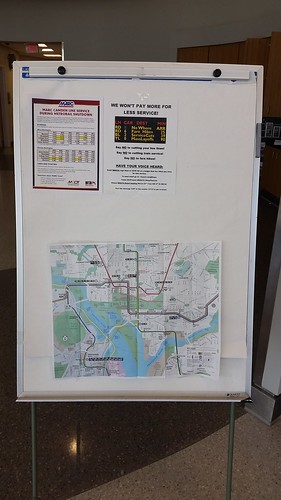
      I checked it out the other day and I was surprised to see that a newly posted information board
      Information board with flyers at the Silver Spring Transit Center

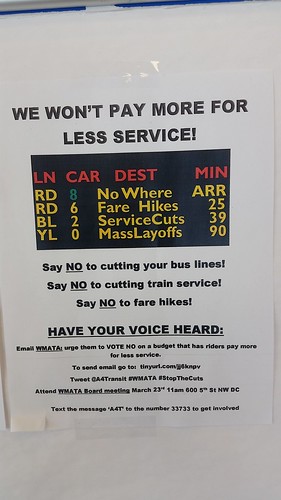
      included an advocacy flyer concerning the FY2018 budget for WMATA, which calls for fare increases and service decreases.
      Flyer calling attention to Metrorail fare increases and service cuts posted at the Trips information center at the Silver Spring Transit Center

      I wasn't surprised that the flyer was still up, although the date for action had passed.

      I think in the past I've suggested that contact information for WMATA Board members be posted in Metrorail stations.  A couple years ago, then BART Board Member Zakhary Mallett suggested this for their stations, although I don't think the proposal was adopted ("BART director wants to display board's photos in cars, stations," San Francisco Chronicle).

      But seeing the flyer made me realize that at the very least, contact information for the WMATA Riders' Advisory Council should be posted, as well as an information board broadcasting their actions. WMATA does post information boards in stations when actions/hearings are scheduled concerning fares and service changes.

      Sometimes you will see information from chapters of the National Association of Railroad Passengers posted in train stations.  You don't see this at Union Station, but you do at Penn Station in Baltimore (at least back when I used to ride MARC to Baltimore a few days each week for work).

      The various "commuter stores" -- Arlington, Fairfax, Montgomery have versions -- should probably post this kind of information too.

      Note from a design perspective, the information board is a "staff intervention" designed to call out information on frequently asked questions (e.g., the map of the Downtown Metrorail Stations is posted) and communications of urgency, such as MARC railroad service changes designed to aid people impacted by Metrorail repair shutdowns.

      Labels: , ,

      Monday, March 02, 2015

      Tonight: Somewhat of an anti-transit forum in Silver Spring

      Action Committee for Transit, the Montgomery County, Maryland-based sustainable transportation advocacy group, calls our attention to the Maryland Public Policy Institute's (MPPI) "policy forum" tonight, featuring the anti-transit propagandist Randal O'Toole. They do call the program a non-partisan debate and it will be moderated by the Washington Post's Dr. Gridlock columnist, Robert Thomson. The pro-position will be offered by Rich Parson, Vice Chair, Suburban Maryland Transportation Alliance.

      ACT will hold a press conference at 6:00 PM, in front of Silver Spring's American Film Institute, where the event will be taking place.

      Afterwards, ACT will be holding a free talk on the value of the Purple Line light rail project, featuring purple pancakes, at nearby Tastee Diner of Silver Spring.'

      Metropolitan DC has a high rate of transit use, higher than most other US cities.  While an average of fewer than 5% of daily trips are made by transit across the United States, Metropolitan Washington, DC is an outlier, as it has one of the highest rates of transit use in the United States--not as high as New York City, but very high. 

      For example, in DC, about 40% of trips to work are made by transit.  The rates are lower in the suburbs, but still very high compared to most other metropolitan areas.  About 700,000 people ride the subway during the week, and more than 500,000 people ride buses. 

      Independent of the Metrobus system, Montgomery County Maryland's RideOn bus system is one of the highest use suburban bus systems in North America. 

      O'Toole's piece slamming the Purple Line.  It happens that Randal O'Toole wrote an op-ed for the Washington Business Journal, stating that the Purple Line will be a failure.

      Interestingly, none of O'Toole's examples of lower use systems are from DC, but from New Jersey and Baltimore--Baltimore lacks a transit network and has a dispersed set of employment centers, making transit use there comparatively low vis-a-vis DC.  They aren't relevant.

      High transit use in the Purple Line corridor already.  Already about 60,000 bus riders use transit in the corridor to be served by the Purple Line.  The line would link four legs of the Metrorail system--the east and west legs of the Red Line, serving Montgomery County, the north leg of the Green Line and the east leg of the Orange Line, both of which serve Prince George's County--and would be integrated with it, further increasing the likelihood of use.

      It is likely that from Day One, the Purple Line will have the largest ridership of any US light rail line, and at 16 miles long, will be significantly shorter than the 90-mile Dallas light rail system of four lines, which gets about 100,000 daily riders. 
      Purple Line light rail map, property takings
      Washington Post graphic of the proposed Purple Line route.

      Do transit opponents fear successful transit?  Perhaps anti-transit advocates are afraid of the Purple Line?, because it's likely very high rate of success will spur more such projects, not fewer.

      Labels: , , , , ,