Rebuilding Place in the Urban Space

"A community’s physical form, rather than its land uses, is its most intrinsic and enduring characteristic." [Katz, EPA] This blog focuses on place and placemaking and all that makes it work--historic preservation, urban design, transportation, asset-based community development, arts & cultural development, commercial district revitalization, tourism & destination development, and quality of life advocacy--along with doses of civic engagement and good governance watchdogging.

Tuesday, July 26, 2016

Institutional financial support for employees to buy houses in weak real estate markets

A tried and true formula for building demand in weak real estate markets is for institutions, universities mostly because they alone among nonprofits tend to be well off, to provide financial assistance to employees to buy houses in targeted communities.

University of Pennsylvania did this as part of their University City initiative.

Johns Hopkins University just announced a similar program in Baltimore ("Johns Hopkins ups the ante on 'live near your work' with $36K deal," Baltimore Business Journal), which has a bimodal real estate market.  Basically, neighborhoods along the Charles Street corridor, north and south, are doing well, and neighborhoods outside of this corridor aren't doing nearly as well.

For a decade or longer, JHU has been working on the "East Baltimore Development Initiative," an area adjacent to the JHU Hospital--an area significantly east of the main campus--where they have been developing a biotechnology and life sciences campus and initiative, mixing academic endeavor with space for start up and established businesses.

On September 10th, the University is offering a "one day sale" with $36,000 of financial support, to buy a house in the EDBI zone.

I'd argue this isn't the same as what Penn did.  EBDI bought a few residential blocks and demolished all the buildings, and is now building new houses, which cost $260,000 or more.

Where Baltimore needs help is stoking the demand and stabilizing neighborhoods comprised of extant housing, places like Reservoir Hill, Hollins Market/Pigtown, etc.

Then again, what JHU is concerned about primarily is the success of areas immediately abutting its campuses and facilities.  EBDI qualifies, Hollins Market doesn't.

Same thing with the University of Pennsylvania, which provided less support ($7,500) and also targeted the assistance, albeit to a much larger area around the main campus.  I believe that this program has changed as the residential housing market around the campus has improved.  Now, employees can receive financial assistance towards closing costs, and lower cost loans for renovation.

The University of Chicago has a similar program.  Brown University in Providence, Rhode Island has a mortgage assistance program as well as a program where houses owned by the university but no longer a high priority for university functions are sold to faculty and staff.

Baltimore also has a resident attraction program called Live Near Your Work, which is a joint venture between the City and employers based in the city.  The program aims to recruit more employees to live in the city and "live near their work" to reduce the transportation impact from long commutes.  The City and the employer each contribute $2,500 towards the purchase of a home.  University of Maryland Baltimore participates in the program.  UMB's eligibility area, near the campus, is definitely a weak real estate market, including neighborhoods like Union Square and Sandtown-Winchester.

-- University Employer-Assisted Housing: University-Community Partnerships, Lincoln Land Institute

Labels: , , ,

Tuesday, January 07, 2014

It's impolitic to say but no property taxes for older senior citizens is a bad idea

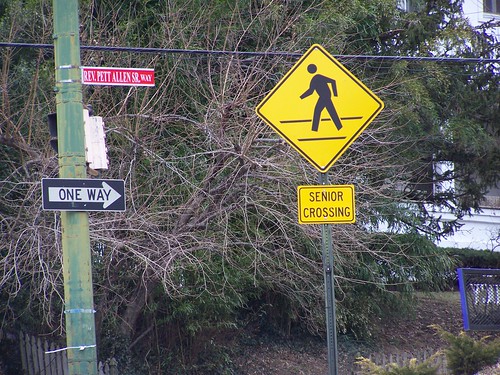
Senior crossing pedestrian signThis sign is actually in Baltimore City.

A big reason that many DC neighborhoods declined in the 1980s and 1990s was because of limited housing turnover.  As households age, they buy less stuff, they go out to eat less, and therefore local commercial districts get less business and they decline in turn.   So it's important to balance aging in place supports with neighborhood improvement goals (see "Yes, the suburbs are still screwed: aging edition").

DC's Senior Citizen Homestead Property Exemption already cuts property taxes in half.  Most older households with minimal income have already paid off their houses, and the cost of property taxes are minimal, especially factoring in the Senior Citizen Homestead exemption, which cuts their property taxes in half already.

Semi-abandoned houses owned by seniors.  Certainly you see that in many neighborhoods where houses may not be lived in but still owned by the family, because the cost of property taxes and insurance and upkeep is so low.  When I lived in the H Street neighborhood back in the pre-2005 days, you could see this a lot.

But it happens all across the city.  In my neighborhood (Manor Park-Takoma) you can see on most blocks minimally maintained properties with phone books delivered a few months ago still on the porch and overgrown vegetation (one house that had been vacant for years was recently flipped and we were shocked to see after they cut back the shrubs that there is a front porch on the house).

There are 3 houses on my face block (22 houses total) where this is the case (two other houses are similarly situated but in the process of turning over)--that's almost 15% of the housing stock on our block.

One has been in the process of renovation for 5.5 years so far--it was willed to the daughter by the deceased property owner and is still taxed at the estate/senior rate and has been long paid off so they don't same economic circumstances of a typical flipper motivated to get in and get out to increase the velocity of economic return.

According to the Washington Post article "Two D.C. bills promote property tax cuts":
One bill, introduced by Anita D. Bonds (D-At Large), would exempt low- and moderate-income homeowners 75 or older who have lived in the city for at least 15 consecutive years from all property taxes.  ...
Bonds said her bill, which would apply to longtime residents earning no more than $60,000 a year, would allow more senior citizens to stay in their homes. “Helping those who need the help,” she said. “That’s what we should do.”
While there are good intentions behind the bill, this specific legislation is a bad idea.  It won't actually assist people in staying in houses as much as it will encourage neighborhood stagnation.

If there is a problem with some people in that demographic maintaining their ability to stay in houses because of property tax costs, more specific policies should be proposed, needs-tested, rather than blanket provisions exempting most everyone from paying taxes.

Labels: , , , , ,