Rebuilding Place in the Urban Space

"A community’s physical form, rather than its land uses, is its most intrinsic and enduring characteristic." [Katz, EPA] This blog focuses on place and placemaking and all that makes it work--historic preservation, urban design, transportation, asset-based community development, arts & cultural development, commercial district revitalization, tourism & destination development, and quality of life advocacy--along with doses of civic engagement and good governance watchdogging.

Friday, February 10, 2017

Will a BQX light rail along the waterfront in Brooklyn and Queens have extra-normal economic impact?

Proposed routing for the Brooklyn Queens Connector light rail line in NYC.

Notions Capital (not a fan of the DC streetcar) calls our attention to the Village Voice cover story ("Light Rail’s Dark Side: How Will NYC Pay for the BQX?") casting doubt on the economic impact assumptions of the proposed BQX light rail line along the Brooklyn and Queens waterfronts.

While it is true that development on the Queens waterfront lags other areas, there is no question that development along the Brooklyn waterfront has been on fire for a long long time.

The argument, according to the Voice, is that the economic impact is significant enough to allow for the city to pay for the system--as a local transit project, it would not be paid for by the MTA, which runs the subway and bus system in the city--conceding that the proposed line isn't addressing "transit desert" issues--or improving transit service and access in areas under-served by transit. From the article:
BQX's location far from the city's transit deserts has been one criticism of the plan, which has otherwise drawn cheers from advocates eager for any new mass transit construction. While some gentrification-wary residents suspect a stealth ploy by developers like David Walentas's Two Trees Management — which not only first concocted the idea, but continues to play a central role in planning discussions — the city has a simpler explanation: BQX may not be the transit system New York City most needs, but it's the one we can get. By building in a hot neighborhood along the waterfront, officials insist, they can use the magic of "value capture" to grab increased property tax receipts to pay for the project's estimated $2.5 billion construction cost, getting the city a new light rail line entirely for free.
Given all that I've written ("Update on the DC Streetcar program on the verge of launching Sunday service") about the DC streetcar being wildly successful in auguring development intensity and velocity at a level comparable to that of Metrorail station catchment areas, even though most of the H Street corridor is significantly outside of the Metrorail transit shed, I am not convinced that the proposed light rail line is the right choice for New York City.

(Note that when I first read about the idea in the NYT years ago, I was skeptical, because light rail has an inherent capacity limitation that doesn't make sense for such a densely populated city as New York. "Streetcars are not a good inter-borough transit choice for New York City").

1. Unlike H Street NE, the Brooklyn waterfront already is undergoing extensive redevelopment and has been for some time.  Therefore, it is arguable that a light rail line will add that much in the way of incremental development.

Does it make sense to encumber the property tax revenue stream from this area to build a light rail line, when other parts of the city are in much greater need of better and higher capacity transit service?

For example, the proposal for the Triboro RX, which probably should be train, not subway, service, to be able to interact with extant freight rail service.

-- "How About A Subway Linking Brooklyn, Queens & The Bronx WITHOUT Manhattan?," Gothamist
-- "This Commuter Rail Line Could Revolutionize Outer-Borough Transit," Curbed

From the Curbed article:
The above-ground line would intersect and connect with 17 existing subway lines and four commuter rail lines, and will also include 24 of its own new stops. RPA estimates that about 100,000 people would take the Triboro daily, which trumps the daily ridership of the Staten Island Ferry by about 30,000 people.

As with all things, the concern is: but how much will this cost? RPA nails the initial estimate at $1 billion to $2 billion (which is, er, pretty lenient) including the cost of installing signals, new track, rail cars and stations, and possibly power substations.

The plan is still in its conceptual phase, but an RPA representative said that the project's development could be partially funded through Move NY, the city's on-the-table plan to add tolls to the Brooklyn and Williamsburg bridges as well as create a surcharge for entering Manhattan by car below 60th Street.
2. Although one advantage of the addition would be another transit line directly connecting Brooklyn and Queens without having to travel via Manhattan  in between.

Today, the G Line is the only subway line that travels directly between these two boroughs.

Rendering of an in-street BQX train.

3. Is light rail even the right choice? In transit-intensive cities, light rail tends to be used in areas with significantly less ridership potential, which tend to be outside of the core, such as on the outskirts of Paris, where orbital light rail lines connect subway and railroad passenger lines, not unlike how the pending Purple Line project in Suburban Maryland will connect four legs of the Metrorail system as well as all three MARC railroad passenger lines.

On the other hand, the Docklands Light Railway in London serves about 340,000 riders daily. But over time it has grown from 8 miles of track, 15 stations and 3 branches to 7 lines, 45 stations, and 24 miles of trackage (with further plans for extension), becoming a more extensive system rather than merely a line.

When the DLR was launched, the Docklands was in the beginning of its revitalization program.

Built originally on an abandoned railway line, the system has dedicated trackage, not shared with roadways.  It's also computer controlled, cutting labor costs, and affording frequent service.  To increase capacity, the system has gone to three-car trains, which has necessitated platform extensions and other changes.

-- "Docklands Light Railway: A success story that spans a generation," Global Rail News.

4. The TransitCenter, in "What the Paris Trams Can Teach U.S. Cities," suggests that the Paris tram system offers many lessons not typically considered in the US, especially the utility of trams in transit cities as a way to provide additional connections to existing lines, the value of dedicated right of way, and fare integration practices that don't require an additional payment to use this mode.

Another key point in the article is that transportation planners there have used the implementation of tram service as a way to create new roadway and traffic patterns that emphasize sustainable mobility over privileging the automobile. This for the most part, doesn't occur in the US, putting serious capacity limitations on LR as a mode.

Labels: , , , , , ,

Tuesday, April 22, 2014

Streetcars are not a good inter-borough transit choice for New York City

I can hardly claim to be an expert on New York City or its transit system, but we do get to Queens, Manhattan, and Brooklyn from time to time, because we are privileged to have occasional access to a friend's apartment in Astoria.  Queens is still not considered hip like Brooklyn or preferred like Manhattan, but on the N Subway, Astoria is only 6 stops to Manhattan, and Astoria is cool in itself.

It turns out years ago I wrote a piece ("Retail and authenticity: continued") on the Steinway Street commercial district based on a New York Times article  and the place we can stay is just a couple blocks from it.  The same with my use of a green grocer photo from Queens that I plucked off Flickr, it's from 30th Avenue in the same neighborhood and just a few blocks away.

Similarly, I have ridden modern and historic streetcars in places like San Francisco, New Orleans, and Portland, and I can say unequivocally that they are not suited to great numbers of people.

So while I appreciate the need for a waterfront transit service as suggested by New York Times architecture critic Michael Kimmelman in yesterday's article, "Brooklyn to Queens, but Not by Subway," I worry that he made the wrong recommendation, for streetcar not light rail. 

Peak ridership on the Portland streetcar now is about 12,000 daily riders, on two routes spanning 7.2 miles.  The G subway line between Queens and Brooklyn carries about 115,000 daily riders.  


A surface transit line about 11 miles long serving Brooklyn and Queens would have the capability of drawing tens of thousands of daily riders, at least 50,000 and likely more. 


Right: T3 tram in Paris.  Image from Linternaut.

Plus, to move that many riders reasonably efficiently, dedicated transitways would probably be required--to the extent possible--and again, Kimmelman specified streetcars moving in mixed traffic.

On the other hand, some of the light rail projects implemented in European cities, including Paris but also Bilbao, are better examples.

A good comparison would be T3 tramline in Paris, which draws more than 100,000 daily riders on its 14 mile long line.  Streetcars don't have the capability of comfortably serving that many riders.

And it turns out that light rail was what was  suggested ten or so years ago, by Alex Garvin, who came up with the idea originally.

So it is unfortunate that instead the NYT architecture critic highlights a great idea bringing better and more transit to underserved parts of Brooklyn and Queens and giving it the endorsement of the nation's leading newspaper--but he suggests the wrong solutions (1) streetcar instead of light rail and (2) mixed traffic instead of dedicated transitways. 

Images below of trams in Bilbao from "Bilbao Straßenbahn und U-Bahn."


Bilbao.  Bilbao demonstrates that unlike in the US, it is possible to implement light rail programs relatively quickly.

After the Guggenheim Museum opened in 1998, the city's economic development team realized that Metro subway service wasn't situated well enough to serve the museum and to move people between other areas along the waterfront.

They realized that trams (light rail) could be a good way to move people between subway stations and to various destinations along the river and in adjacent districts.


Subway service was included in the original economic development and transportation revitalization planning for the city. but light rail was not.

They revised their thinking and decided that light rail would complement and extend plan objectives.

They committed to go ahead very fast, and four years later, in 2002, the first part of the tram line was opened between two Metro stations and providing service to the Guggenheim Museum.

The original line continues to be  extended, and additional tram lines are now being constructed elsewhere in the metropolitan area.

Labels: , , , , ,

Tuesday, September 24, 2013

Insights from HafenCity and IBA_Hamburg for Baltimore's Howard Street corridor

This article is another in the series of pieces I am doing for the "Europe in Baltimore" project by the European Union National Institutes of Culture.

-- "Lessons from HafenCity and IBA_Hamburg applied to Baltimore’s Howard Street corridor

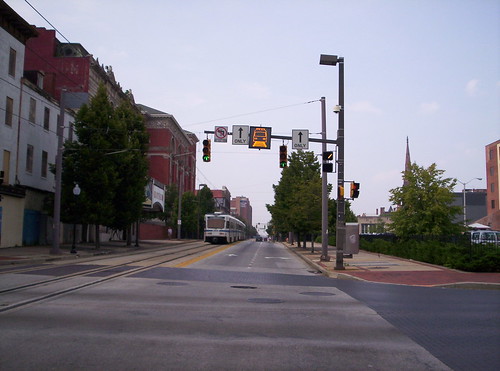
Light rail approaching, Howard StreetHoward Street is the main light rail corridor in Baltimore. Despite or because of the presence of the first generation light rail system--which is heavy and bulky and is complemented by an equally heavy-grained street treatment--the corridor isn't successful, with myriads of empty buildings and surface parking lots.

However, on the southern part of the district, the developing Bromo Tower Arts and Entertainment District is bringing renewed energy to the the area, which provides new opportunities for revitalization, especially as the area east of the corridor, especially Charles Street, has seen significant improvement over the past few years, including leasing of many ground floor spaces that had been previously vacant, and the conversion of some buildings to residential along with some new construction of residential multiunit buildings.

Note that when I worked for Baltimore County, I made some unheeded recommendations with regard to transit expansion planning there, starting with connecting the subway and the light rail at the Hutzler Building, see "From the files: transit planning in Baltimore County."

When Baltimore builds the Red Line light rail system, it would be nice if at the same time they could upgrade the vehicles on the current line.  As the representatives from Hamburg commented, "it isn't light rail, it's heavy rail."  But that isn't in the budget so far.

I know it's way too expensive, but I also wonder if it would be worth doing a cut and cover tunnel for the light rail on Howard Street.  A lot of the light rail that Sound Transit is building in Seattle is being put into tunnels, although they are boring the tunnels, not doing cut and cover.

Labels: , , , , , ,

Friday, January 23, 2009

Here come the streetcars!

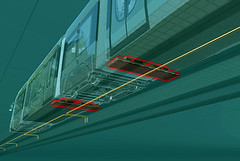
Bombardier PRIMOVE underground power system
Pickup coils, Bombardier PRIMOVE underground power system

Transport Politic reports (via a press release) that Bombardier, the Canadian rail vehicle (built in part on the assets of the former Budd Company) and airplane manufacturer, has introduced reliable underground "third rail" powering for outside use for streetcar and light rail systems. (The Alstom system used in Bordeaux hasn't proved to be reliable or easily used in snowy climates.) See "Bombardier Presents New Catenary-Free Streetcar."

123.11_McClelland_DC_Map.jpg
The L'Enfant City

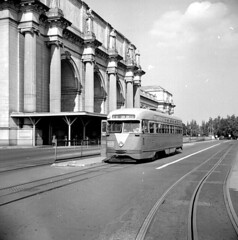
In the old days, underground powering of streetcars was not uncommon. However, "modern" safety standards would not allow the installation and use of similar systems today. DC has a law banning overhead wires in the original "City of Washington" which we commonly call the "L'Enfant City" as well as Georgetown. This has been one of the many holdups over moving forward with streetcar planning in DC.
Streetcar at Union Station, Washington, DC
Streetcar at Union Station, Washington, DC. Photographer unknown.

From the Bombardier website, PRIMOVE Catenary-Free Operation:

The PRIMOVE system’s outstanding feature is its safe and contactless power transfer. Its electric supply components are invisible, hidden under the vehicle and beneath the track. This is a key benefit in historic or environmentally protected areas of cities. With its contactless power transfer, our unique PRIMOVE technology:

• Eliminates overhead wires and increases a city’s attractiveness
• Safely transfers inductive power
• Eliminates wear on parts and components
• Operates in all weather and ground conditions


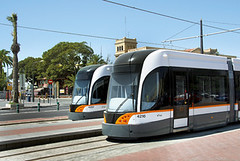
The only thing with this, unless Bombardier is willing to license the technology to other manufacturers, such as those producing the Inekon Trio vehicles used in cities like Portland, Seattle, and eventually DC, DC will need to switch to the Flexity tram vehicle produced by Bombardier, in order to get a streetcar system up and running in the L'Enfant City (the historic core) which has to operate under the strictures of the law banning overhead wires on the city streets. (And it means that DC should hold off installing rail track on H Street NE, because likely the installation of a PRIMOVE-capable railbed requires more than steel rails and ties.)
Bombardier Flexity streetcar (tram), Valencia
Bombardier Flexity streetcar (tram), Valencia, Spain

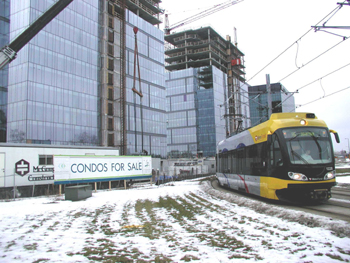
The Flexity light rail vehicle is used in Minneapolis.
Hiawatha Light rail Line, Minneapolis
Metropolitan Council photo of the Hiawatha Light rail Line, Minneapolis

Labels: , , ,