Rebuilding Place in the Urban Space

"A community’s physical form, rather than its land uses, is its most intrinsic and enduring characteristic." [Katz, EPA] This blog focuses on place and placemaking and all that makes it work--historic preservation, urban design, transportation, asset-based community development, arts & cultural development, commercial district revitalization, tourism & destination development, and quality of life advocacy--along with doses of civic engagement and good governance watchdogging.

Friday, April 21, 2017

Revitalization, re/urbanization and cohort-generational attitudes

There was a very interesting presentation yesterday at the Woodrow Wilson Center for International Studies, primarily by academic researchers in Montreal, looking at Montreal's history of immigrant immigration and considering what lessons might be applicable to DC as a city (not DC as the center of the current anti-immigrant national government).

Whites refocusing city investment on public spaces "for them."  Professor Derek Hyra, Director of American University's Metropolitan Studies Center, was the respondent, and in response to a suggestion by a GWU professor in the audience, Prof. Hyra recounted the story of dog parks in the Shaw neighborhood as an example of how new residents are reshaping the city's investment priorities at the expense of what we might call legacy residents, mentioning that at the time the park where the dog park went was in need of renovation.

The reality is that in the past 15 years or so, DC has spent hundreds of millions of dollars on park and recreation (and library) improvements, with a disproportionate amount of that money being spent on facilities serving African-American and/or disadvantaged areas in the city, e.g., new recreation centers in Barry Farm, Trinidad, Deanwood, new libraries like in Anacostia, Deanwood, and Shaw, etc.

Is it age/generational or racialization? One of the people in the audience, Justin Rood, organizer of the DC Funk Parade, argued that in DC it's very easy to see every issue in terms of race, black or white, and what he called a "racialization" of issues, when he thought that the major issue was more about change generally, and that older people, black or white, are less favorable to changes as a matter of course.

Re/urbanization vs. out of date ideas about urban practice. I countered that while it was a good point, it isn't so much about age as it is about generationally-based sets of attitudes towards what (re)urbanization is and ought to be and what it should look like. (Some of this is discussed in Richard Florida's new book, The New Urban Crisis.)

For years I have discussed this in terms of the general "suburbanized paradigm of transportation and land use policy" that has imprinted most of us in the US, whether or not we are aware of or acknowledge it, where land uses are separated, and the primary means of getting around between various disconnected activities is the car.

Even the people who moved to the city from say the early 1960s through the 1990s before urban living became not only trendy but accepted, while more pro-urban than most, still are imprinted by land use ideas, behaviors, and attitudes that aren't fully pro-urban.

I have written about the split in attitudes within DC in terms of the Core or Inner City vs. the Outer or more suburban City ("DC as a suburban agenda dominated city"), and how yes, people in the Outer City are older, more connected, generally have more time to be involved, and without realizing promote more suburban-appropriate policies.

But the issue is about re/urbanization more than it is about "age," it's just that what reurbanization means is more easily addressed as a race or generational question.

This is especially problematic for two reasons.

First, like everywhere else and in national politics, people argue that there is only one way to act, to live, etc., and they aim to require that every piece of land or transportation policy be made to support their particular set of choices, which they deem a form of "natural law."

Instead we need to recognize the value in differentiation, e.g. as one example, that the rural areas can have different gun policies than cities and it doesn't mean that restricting uses means that the government aims to make us all slaves,

It definitely means that cities and metropolitan areas need to be addressed in ways that support the reality that these are economic engines for regions and states.  Instead, many state legislatures, dominated by rural interests, use their levers of power to punish center cities at every opportunity.

One current example is how the Minnesota Legislature is working on a bill to eliminate state funding for transit in Greater Minneapolis ("Transportation bills pass, starting the real Minnesota talks," Grand Rapids Herald-Review).

Another is how the State Legislature in Kentucky is diminishing power of the combined City-County Government in Louisville-Jefferson County ("Bill strikes at Louisville merger, tax base," and "A 'war on Louisville' bill poised to become law," Louisville Courier-Journal).

Second, people refuse to wake up to the fact that to be successful now, in this decade and throughout the 21st century, places--not just cities--need to refocus on the benefits from and generation of agglomeration economies that support clustering, and organizing, reorganizing, and appropriately intensifying land use and transportation infrastructure in response.

The problem is that people are making decisions today which will shape this and other cities for generations, in ways that seriously impinge social and economic resilience.

Decisions made today more generally and with regard to specific properties have a useful life of 30-60 years at a minimum, longer depending on the land tenure arrangements.

Getting it right the first time is an imperative, especially in a period of increased economic competition, increased demands for services from the government, increased costs for services and infrastructure, and a national government that is increasingly hermetic, anti-government, anti-tax, and is federalist to the extent it can use national law-making powers to restrict local ability to act independently.

Labels: , , , , , ,

Thursday, December 22, 2016

Special event security planning and street fairs

You can tell from this photo of the carnage at the Berlin Christmas Market that there were not vehicle crash barriers set up along the side of the street/ backing up to the market. Reuters photo.

Recent reports of terrorist acts using motor vehicles to plow into crowds killing and injuring many at public events in Berlin, Beijing, and in the summer in Nice, France ("Truck attacks in Berlin and Nice reflect change in Islamic State tactics," Guardian) always reminds me of running farmers markets in Brookland, and the day an older man plowed through the sawhorses blocking the street because he saw no reason to prevent him from proceeding to CVS.

Fortunately, the market was over for the day, and who knows, maybe if there had been people in the street he would have stopped.

That wasn't what happened in 2003 in Santa Monica ("Ten Years After Tragic Crash, States No Closer To Solving Elderly Driving Problems," Autoblog) where 10 people died in a similar situation--an aged person driving through the crowded market.

There have been similar casualty events at street fairs since then ("Car Plows Into D.C. Street Festival, Injuring 35," Fox News).

In response, most communities have upped their traffic control requirements to include hardier barriers. But many times, events are allowed to slough off the requirements because of the cost.

In DC, street closures are supposed to be executed using water filled Jersey barriers.

They are expensive to rent (but relatively cheap to buy depending on how many you need) and at least the last time I had to close a street, DDOT would fill up the barriers for free, using their water truck--a filled barrier has almost 2,000 gallons of water.

But I have noticed that various street closures don't always use such an apparatus.

And neither does Eastern Market's weekend street closures--although for years I've recommended the installation of retractable bollards in the street at 7th Street and North Carolina Avenue, and at C Street (eventually I would like to see them installed at Pennsylvania Avenue SE too).

Retractable bollards installed in a street.

It appears that neither Jersey Barriers or bollards were part of the security plan for either the Christmas Market in Berlin or the farmers market in suburban Beijing.

It would have been hard to put them all along the route in Nice, but at various places, barriers could have been installed and this might have thwarted the attack there.

Street fairs and similar events must pay more attention to emergency preparedness on this dimension.

Labels: , , , ,

Thursday, March 12, 2015

WMATA and the two types of public relations programs


One type is focused on putting lipstick on a pig.

The other is a strategic approach to righting an organization's mis-steps.

My sense is that WMATA's move to hire some public relations firms are more focused on putting out a better story, rather than a strategic rethink.  See "Metro brings in high-powered help to rebuild its image" from the Post.

It happens that in late 2009 I wrote extensively on this issue, making the point that in the aftermath of the Fort Totten crash, where many people died, it is necessary to reconstruct the metropolitan consensus about the role of public transit and by extension WMATA in the community, how to pay for it, etc.

-- St. Louis regional transit planning process as a model for what needs to be done in the DC Metropolitan region"

The Metro Momentum planning initiative from the past couple years, focused on expansion, while important, wasn't aimed at accomplishing what I think is needed.

Recent events:

-- The fire at the L'Enfant Station in January, marked by poor emergency response and one death of a passenger plus many injured

-- the contentious search for a new CEO of the agency, one that is touching off a schism between jurisdictions ("Major rift in Metro's board disrupted search for new chief," Post)

-- the uniformly negative reaction to WMATA's proposal to increase fares (e.g., "Metro's tone deafness has no bounds," Post) in the face of serious service degradation

-- to which WMATA responded by backing off ("Metro Fares Won't Increase This Year, But Service Cuts Still Possible," Washington City Paper)

make that recommendation all the more relevant today.


This document was published before the first segment of the Metrorail system opened in 1976, and was distributed as an advertising insert in the Washington Star.

But I made the point last year as well, in "WMATA 40th anniversary in 2016 as an opportunity for assessment."
.
Then, I outlined four points that should be the main thrust of such a process:

1. Rebuilding the regional consensus for transit.
2. Developing a better understanding of the role of transit in economic development.
3. Developing a better understanding of the role of transit in placemaking and community development.
4. How to do better going forward.

But I think the financial element of how to fund the system needs to be a separate element, as should be how to plan and operate transit in the region.

A report produced for Toronto's Metro agency is a good starting point ("Metrolinx Toronto: 25 potential tools to fund transit-transportation infrastructure"). Note that DC's MoveDC transportation planning process does raise some of these issues, but in the DC context, and still not to the extent necessary, judging by the MAJOR DC SCREWUP OVER STREETCARS.

Plus, I've also argued that WMATA shouldn't be the primary transit planner ("(Sort of a repeat) Without the right transportation planning framework, metropolitan areas are screwed, and that includes the DC area.""), that the MPO should be.

So such a process should have at least six elements:

1. Rebuilding the regional consensus for transit.

2. Developing a better understanding of the role of transit in economic development.

3. Developing a better understanding of the role of transit in placemaking and community development.

4. How to plan and operate transit of all types in the metropolitan area, regardless of the mode (subway, railroad, bus, light rail, street, commuter bus, aerial tram, etc.).

5. How to fund transit of all types at the suburban, center city, metropolitan, and regional scales.

6. How to do better going forward.

Note that currently, Chicago and Toronto are undergoing similar discussions about the necessity of changing the way they are providing, funding, and planning transit.

Labels: , , , ,

Tuesday, September 24, 2013

Insights from HafenCity and IBA_Hamburg for Baltimore's Howard Street corridor

This article is another in the series of pieces I am doing for the "Europe in Baltimore" project by the European Union National Institutes of Culture.

-- "Lessons from HafenCity and IBA_Hamburg applied to Baltimore’s Howard Street corridor

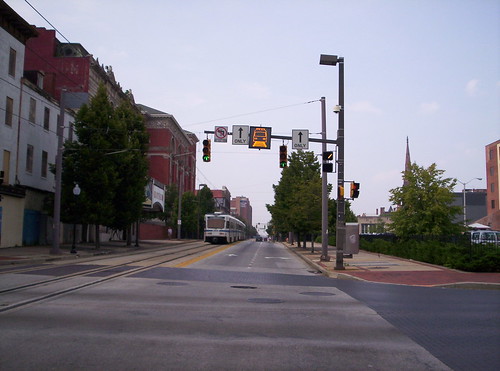
Light rail approaching, Howard StreetHoward Street is the main light rail corridor in Baltimore. Despite or because of the presence of the first generation light rail system--which is heavy and bulky and is complemented by an equally heavy-grained street treatment--the corridor isn't successful, with myriads of empty buildings and surface parking lots.

However, on the southern part of the district, the developing Bromo Tower Arts and Entertainment District is bringing renewed energy to the the area, which provides new opportunities for revitalization, especially as the area east of the corridor, especially Charles Street, has seen significant improvement over the past few years, including leasing of many ground floor spaces that had been previously vacant, and the conversion of some buildings to residential along with some new construction of residential multiunit buildings.

Note that when I worked for Baltimore County, I made some unheeded recommendations with regard to transit expansion planning there, starting with connecting the subway and the light rail at the Hutzler Building, see "From the files: transit planning in Baltimore County."

When Baltimore builds the Red Line light rail system, it would be nice if at the same time they could upgrade the vehicles on the current line.  As the representatives from Hamburg commented, "it isn't light rail, it's heavy rail."  But that isn't in the budget so far.

I know it's way too expensive, but I also wonder if it would be worth doing a cut and cover tunnel for the light rail on Howard Street.  A lot of the light rail that Sound Transit is building in Seattle is being put into tunnels, although they are boring the tunnels, not doing cut and cover.

Labels: , , , , , ,

Thursday, June 20, 2013

A follow up example with regard to Metropolitan Revolutions: the National Science Foundation moving to Alexandria

As a follow up to the previous entry, it's worth discussing the federal government's role in fostering research and discovery in the context of seeding innovation districts in the National Capital Area.

The fact that the Defense Advanced Projects Research Agency, a USDA experimental station, NIH, FDA, NIST, the Naval Research Laboratory, and other federal research agencies are located "here" is one of the reasons that there is a big research and technology community here, aided by the fact that DOD and the federal government in general are large customers for information technology and telecommunications, hence the large presence of such companies in this region also.

The book focuses on academic, medical center, and private industry research.  But there are scads of federal government laboratories and research centers, dating back to the 1800s, when military-related research and then the creation of the Extension Service of the US Department of Agriculture and federal financial support of agriculture colleges were elements in research-based investment in the nation's future.  Comparable to how USDA funds research at Ag Schools and Experiment Stations and communicates it out through the Extension Service, the US DOT funds research at universities and research centers around the country also, and communicates it out as well (I get publications from some of these centers, based in Minnesota, New Jersey, and California, and try to keep up with the output of the Volpe and Mineta Centers).

Most of the research installations of the federal government are campuses and research laboratories set apart and alone, and mostly they don't function as anchors of "innovation districts."  This is an issue that should be addressed going forward generally, because by re-orienting these facilities to the world, likely we will get greater return on investment.

(Partly this happens because Congressmembers see such installations as "economic development" for otherwise forlorn places, although there are some instances where the remote location was chosen for security reasons, such as for various federal labs like Oak Ridge, Sandia, etc.)

I've been putting off writing about how it has been announced that the National Science Foundation is moving from a very connected location in an innovation district it anchors on Wilson Boulevard in Arlington County (where other science organizations and contractors have located, including DARPA, a research campus for Virginia Tech, the Center for Defense Innovation, and the Arlington campus of George Mason University) to a disconnected location somewhat office-park-y, in Alexandria ("National Science Foundation moving headquarters from Arlington to Alexandria," Washington Post).

This was predicted because of how Congress is so f*ed up that the General Services Administration isn't seeking the approval of what are called "prospectus leases."  GSA has a set rent schedule of something under $45/s.f.  To lease space at higher costs--and higher costs are typical of closer in locations in Arlington and DC specifically--Congress has to approve the lease.  That's not happening in the current political environment.  (Wilson Boulevard as a discovery-innovation district  and the benefit of urban locations as innovation districts is discussed in this blog entry, "The state of Arlington County Virginia's commercial real estate market: 2012 and the future.")

So Arlington wasn't in the position of being able to retain NSF.  Because NSF is being offered what I would consider to be a marginal location, although it is directly across the street from the Eisenhower Avenue Metro, which is probably the only advantage present in the new location other than cheap space--well, it's not too far from the Wilson Bridge/I-95/I-395, although the current location is close to I-66.  (Note that the Ruby Tuesday's located there right now has really marginal food.)

On the other hand, most of the agglomeration economies of being located in an "innovation district" are lost, reducing the spillover benefits from the research and knowledge networks that are presently based in Arlington.

Arlington, Alexandria, and DC face further competition for federal agencies from Fairfax and Loudoun Counties, which through the January 2014 opening of the Silver Line subway extension, will be able to offer to the GSA low rent space with subway transit access. ("Short term vs. long term thinking: transit, the Washington Examiner, Fairfax/Loudoun Counties vs. DC")

So a focus on the short run cost of space and Congressional logjams mean that agglomeration economies from research clusters anchored by federal agencies are likely to be dissipated for the next 10 years.

Another example of how the Federal Government is too focused on the here and now and not investing in the future.

----
And also counter-examples of how not to organize research organizations spatially.

Labels: , , , ,