The "
Washington Area Bicyclist Association blog has a piece ("
HOW MANY U-TURNS ACROSS PENNSYLVANIA AVE BIKE LANES DID WE COUNT IN ONE HOUR?") on the "U Turn" problem and the bike lanes in the middle of Pennsylvania Avenue and the conflict between motor vehicles and bicyclists.
The blog entry is nicely done, with video, and finds as many as 13 illegal U turns per hour on particular blocks.
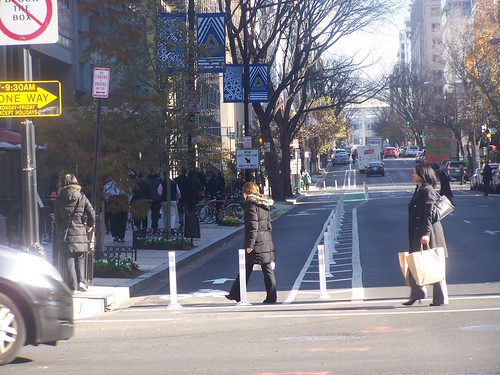
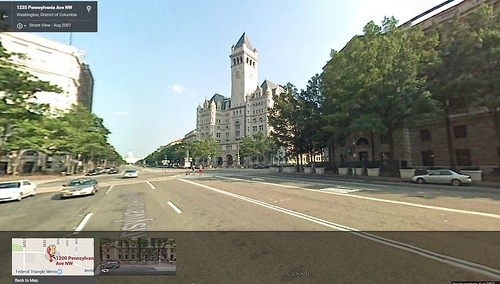 1200 block of Pennsylvania Avenue NW, Google Street View, August 2007. Note that the street is wide and there is a large marked median in the middle of the street.
But the reality is that this is the result of a fundamental design problem and is to some extent, unfixable, because of how the lanes were placed in the street, the width of the street, driver expectations about where bike lanes are placed, and the inability to place (semi-)permanent bollards in the street for urban design reasons.
Sure you could do enforcement, but the need for enforcement is in turn an indicator of poor design. The reasons that I say that it is unfixable are (1) too many drivers on Pennsylvania Avenue are itinerant, so "education programs" won't have any effect and (2) most people, even knowing that the U turn is illegal, will think "just this once" justifies driving illegally, and will ignore the rule, not expecting that there could and would be any consequences to their action.
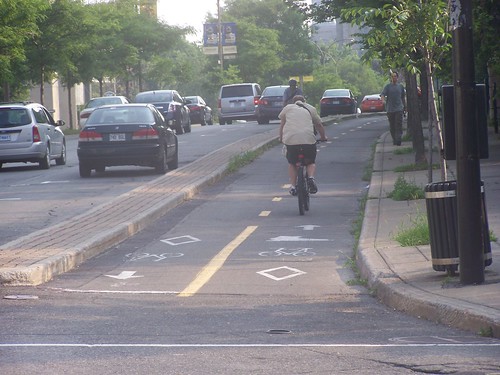 Cycle track (piste cyclable) in Montreal. Montreal, like many European cities, installs bi-directional separated cycle tracks, figuring that if they don't make them bi-directional, people will ride in both directions anyway.
The 15th Street cycle track is bi-directional, but is placed on just one side of the street.
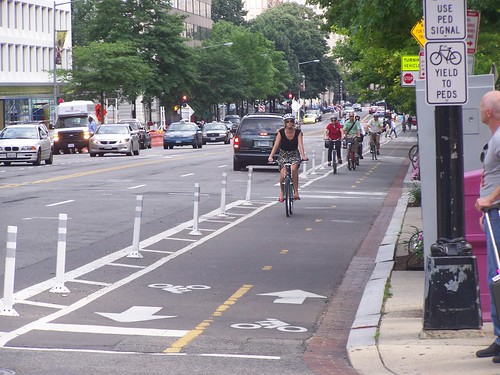
The point I make about planning is that it is supposed to "design conflict out" rather than to create it.
But Pennsylvania Avenue is a very very wide street, with comparatively low traffic volumes, but had a "median" in the street, empty unused space--except for occasional parking by emergency vehicles, that was seemingly easy to convert to bike lanes.
The DC transportation department did the conversion in response to a challenge issued by Congressman Earl Blumenaur at a public presentation by David Byrne, author of the
Bicycle Diaries--at least that's what I seem to remember, it might have just been a NACTO event. Congressman Blumenaur said, "it would be so easy, do it."
If the suggestion had been by someone less prominent in sustainable transportation circles, the idea would have been more rigorously evaluated, which, if had it been done, would probably have determined that it would have been better to put one bike lane in each direction, in the right lane on each side of the street. Or baring that, a separated bi-directional cycletrack on either or both sides of the street.
The bike lanes on Pennsylvania Avenue NW are in the middle of the street, which is outside of expected or recommended design and engineering practice.
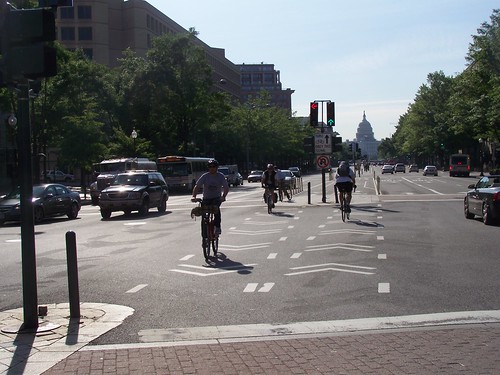
Sure, bike lanes on the side of the street would have posed some conflicts and problems too, but comparable to any issues that come up with cycletracks, such as the one on L Street NW.
Instead, not being able to install bollards for urban design reasons, motor vehicles will continue to make U turns, and because they don't expect cyclists in the middle of the road, this will continue to create problems.
L Street NW, between 11th Street and 24th Street, is one way in the eastbound direction. A uni- or single direction cycletrack has been installed on the left side of the street. (Maybe it should have been installed on the right, but I believe the idea was that there would be fewer conflicts between motor vehicles and cyclists in this particular configuration.)
Alternative treatment, bike lanes on the sidewalk. One of the commenters on the blog who usually is "Anonymous," recommends doing what is done in Germany and other countries in Northern Europe, where bike lanes are placed "on the sidewalk" between the walking zone for pedestrians and the road/curb.
In this photo, near the Hamburg train station in Germany, you can see the bike lane on the rightmost side of the photo. Were this treatment done on Pennsylvania Avenue NW, I would have recommended a "road diet" for the Avenue, and taking out one lane in each direction, and the sidewalk could have been extended with an on-sidewalk bike path installed, comparable to this treatment.
Note that even though "I knew" that the red pavers denoted the bike zone, I frequently walked in this zone, errantly. (There weren't all that many cyclists in the part of Hamburg that I was habituating.)

Another alternative, equally expensive, and not likely to be approved by design review authorities (the National Capital Planning Commission and the Commission on Fine Arts) would be
retractable bollards. They would be heavy and would prevent cars from making U turns, but the city could argue that they would not be permanent structures marring the viewshed.
Labels: "streets as places", bicycle and pedestrian planning, civil engineering, street design, sustainable transportation, traffic engineering, traffic safety and enforcement, urban design/placemaking

 Fortunately, the market was over for the day, and who knows, maybe if there had been people in the street he would have stopped.







