Rebuilding Place in the Urban Space

"A community’s physical form, rather than its land uses, is its most intrinsic and enduring characteristic." [Katz, EPA] This blog focuses on place and placemaking and all that makes it work--historic preservation, urban design, transportation, asset-based community development, arts & cultural development, commercial district revitalization, tourism & destination development, and quality of life advocacy--along with doses of civic engagement and good governance watchdogging.

Friday, December 27, 2024

Quimbyism: sign me up!

A book I need to read.  Yes to the City: Millennials and the Fight for Affordable Housing

We've heard of NIMBY -- not in my backyard -- and YIMBY -- yes in my backyard -- abbreviations for different factions in communities opposed to or supportive of development.

A few years ago, Michael Mehaffy a prominent new urbanist, came up with the term, QUIMBY ("Never mind NIMBY and YIMBY–it’s time for ‘QUIMBY’ urbanism We need a major rethink of gentrification and affordability challenges if we’re going to get anywhere," Public Square), for "quality in my backyard" in part because YIMBYs don't seem to be too clued into quality, just building.

This comes up a lot with criticism of historic preservation as a limiter of development, or a stalking horse to stop development.  OTOH, there are a lot more areas of cities not zoned for preservation than for preservation.  

So most cities have plenty of build out capacity in commercial districts, transit catchment areas, reproduction of institutional lands, etc.

It happens that the neighborhoods that many people want to live in are typical of those that are designated historic, such as rowhouse neighborhoods in New York City, Baltimore, DC and Richmond.  YIMBYs basically argue for tearing down historic housing in favor of building more, to meet current demand, not recognizing that the new housing will be even more expensive because it is built at today's pricing for land, labor, materials, and financing.

To me, this is a perfect example of YIMBY housing on Sherman Avenue NW in DC, adjacent to housing that is eligible for historic designation but isn't designated, hence there are no design standards or processes to ensure compatible development.

Anyway, I commented on a recent post on the Pro-Urb list that QUIMBYISM could help us solve a problem of lack of congruence with multiple movements all addressing an element of what makes urbanism and urban living so attractive, by providing the glue that could join them in an agglomerated movement:

  • Historic Preservation
  • New Urbanism
  • Urban design and placemaking (including Project for Public Spaces concepts)
  • Walkability-15 Minute City concepts
  • Sustainable mobility
  • City Beautiful.  
This too, in NE DC near H Street NE and Hechinger Mall, in a rowhouse neighborhood that is eligible for historic preservation designation.  

These kinds of examples are why I argue that the entire city should be treated as a historic district ("Treating an entire city as a heritage area/conservation district, rather than a neighborhood by neighborhood approach," 2020).

On the other hand, this is an example of good, quality oriented infill development in a historic district and yes it costs more.  

It's a row of four or five new builds constructed on the 500 block of East Capitol NE (a tony housing district in DC).  

Ironically, they were built on a parking lot that was created by the Capitol Hill Baptist Church in the 1970s, by tearing down a beloved neighborhood restaurant, Mary's Blue Room  ("Losing my religion," 2008).

This action sparked the creation of a local historic preservation ordinance, providing protection against non-federal property owners, when the National Register Historic Districts designation process created by the 1968 National Historic Preservation Act only provides protections against federal undertakings.

But as Stephen Semes writes in Future of the Past: A Conservation Ethic for Architecture, Urbanism, and Historic Preservation, "the architecture of the ensemble" and maintaining neighborhood design coherence should be our priority.
"Maintaining a broad stylistic consistency in traditional settings is not a matter of 'nostalgia,'" he says. "It's a matter of common sense, of reinforcing the sense of place that made a building or neighborhood special to begin with. But many academically trained preservationists want to impose their inevitably subjective notions of what the architecture 'of our time' is."

Modern rowhouses in Capitol Hill, Seattle

Historic era rowhouses in Pittsburgh (I don't know if they are designated)

Typical new construction apartment design.  This is in Lakeland, Florida.


Labels: , , , , , , , ,

Sunday, July 06, 2014

Richard Mellon Scaife dies: funded conservative groups ... and historic preservation in Pittsburgh

Richard Mellon Scaife, scion of the Mellon Family, and publisher of the Pittsburgh Tribune-Review, died on Friday ("Tribune-Review publisher Richard Scaife dies," Pittsburgh Post-Gazette).

While he is best known for his funding of "hard right" conservative groups which have changed the nation's political discourse for the worse, I have always been amazed by the fact that Mr. Scaife was equally committed to urban revitalization and culture in Pittsburgh, providing funds to such worthy causes as the Carnegie Museum of Art and the Pittsburgh History and Landmarks Foundation, including funding for major rehabilitation projects such as Station Square, a 52-acre complex that had been a railroad station, headquarters and repair and maintenance facilities for the Pittsburgh & Lake Erie Railroad.

Scaife's financial support enabled the PHLF to act as a developer and take on wrenching, difficult projects, and helped the organization build the capacity and program to become one of the strongest historic preservation action organizations in the US (e.g., "City, PHLF announce partnership, development," Pittsburgh Business Times).

Many years ago pro-sprawl groups put forward a proposal to create an anti-"New Urbanism" group hoping to get funding from Scaife, and I pointed out to people with the Congress for New Urbanism that he was approachable from the standpoint of urban revitalization and that it was likely that he could be convinced to not fund such a group.

I don't know if the CNU pursued this, but the pro-sprawl group ended up not being created.

And it is an example, albeit rare, that it is possible to create common ground with people on urbanism and center city revitalization issues where it might not normally seem possible, because of ostensible differences in political ideology.

-- Richard Scaife tribute, Pittsburgh Tribune-Review

Labels: , ,

Tuesday, May 22, 2012

Recapping new urbanism

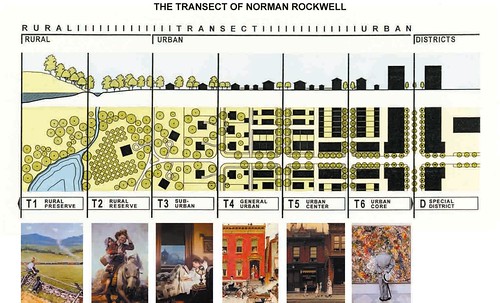
The Transect of Norman Rockwell
The New Urban Transect, using images by Norman Rockwell to illustrate the various zones.

A couple weeks ago, the annual conference ("congress") for the Congress of New Urbanism was held in West Palm Beach, Florida. 

In advance of the meeting, the newsletter Better! Cities and Towns ran a three-part series by Peter Katz on the beginnings of the movement and the development of a relationship with HUD that led to the HOPEVI program which spearheaded redevelopment of public housing projects.  See "CNU at 20: A recollection," "The origins of the Congress for the New Urbanism," and "HopeVI and the inner city."

Interestingly enough, according to Katz' articles, some of the schisms in the movement today over what we might call new suburbanism and the development of greenfield tracts far from urban centers, but with new urban principles based on the Charter of the New Urbanism vs. focusing redevelopment at the core of a metropolitan region, with a focus on "infill" apparently were present at the beginning and still aren't resolved.

Erin Chantry, an urban designer at the firm Tindale-Oliver & Associates and blogger (At the Helm for the Public Realm) attended the congress and wrote eight dispatches related to conference sessions and her reactions

Her dispatches are a good introduction to the basic principles underlying smarter growth and well worth a read.

Labels: , , , , , , ,

Wednesday, October 01, 2008

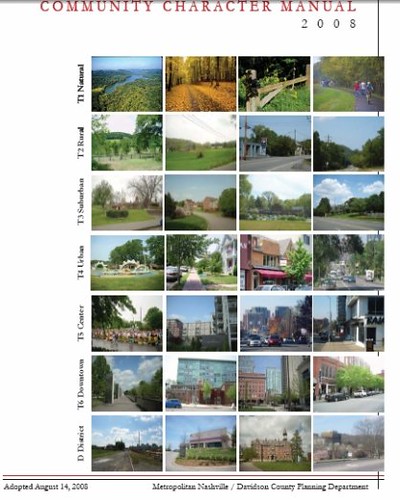
Nashville Community Character Manual

Nashville just adopted a Community Character Manual as the basis forplanning. It is a transect based place type system. It looks like an important addition to a community planning system, although I think that within neighborhoods we need more nuanced definitions of appropriate heights etc., based on a kind of intra-neighborhood transect--in short, it's ok to build higher by transit, that such doesn't fundamentally change a neighborhood in its entirety although it does change things.
Nashville Community Character Manual, Cover

Labels: , , , ,

Wednesday, April 09, 2008

Walkable sprawl

as a description for new urbanism. Check out the entry, Thoughts on Transit and New Urbanism, from The Overhead Wire.

-- Yes, new urbanism is mostly about greenfield development.

-- Yes, increasingly the developments are farther and farther from the core of the region.

-- Yes, the farther people live from the core, the more likely they are to hate the city and not be too focused on urbanity.

-- Yes there are new urbanist infill projects.

-- Yes, new urbanism is one of the "instigators" for a reappreciation of the principles of urban design, the principles that make city living worthwhile, and have been helpful in countering "inward suburbanization" of the city.

-- In particular New Urbanism has spearheaded the recognition of the value of mixed use rather than homogeneous zoned districts, articulated by Jane Jacobs in Death and Life of Great American Cities in 1961

-- Systems created by the New Urbanists including the Charter for the New Urbanism, the modernized concept of the transect (Kropotkin did one first, in the 1800s), and the Smart Code are impressive.

-- Plus, the rigor and focus on research is impressive.

-- Andres Duany and many other proponents of New Urbanism are also very impressive.

-- But Smart Codes are about "choice," providing inducements if developers do the right thing. And too many developers are happy with crap, so inducements don't always matter.

-- Yes, the holier than thou attitude of the typical new urbanist is really grating.

-- Yes, lots of people call their projects new urbanist because that's a good marketing term. But the projects don't really meet the ideals of the Charter.

-- And Cities in Full is probably a more important book, as good as Suburban Nation is.

-- And Fred Kent of Project for Public Spaces is right when he calls new urbanism new suburbanism,

-- because, sure, while there are plenty of new urban infill projects, infill as a process existed long before new urbanism and the reality is in terms of the number of dwelling units produced, etc., new urbanism mostly creates greenfield development

-- But, it's better to have better development than crap in the suburbs, and you can begin to repattern the crap as long as you have some quality nodes.
The Transect of Norman Rockwell

My term for it for many years has been "smarter sprawl." You can look it up in the pro-urb archives... and I militantly call myself an old urbanist, focused on revitalizing and repopulating center cities.

Labels: