Rebuilding Place in the Urban Space

"A community’s physical form, rather than its land uses, is its most intrinsic and enduring characteristic." [Katz, EPA] This blog focuses on place and placemaking and all that makes it work--historic preservation, urban design, transportation, asset-based community development, arts & cultural development, commercial district revitalization, tourism & destination development, and quality of life advocacy--along with doses of civic engagement and good governance watchdogging.

Wednesday, December 18, 2013

Government, planning, and design

Whenever I talk about the value and necessity of "master" planning, most people seem to recoil.

I chalk this up to the fact that their predominate experience with planning is that it is a top-down phenomenon with limited opportunity for citizen input, constrained definitions of the scope of work, and a disconnection between planning and action.  (Another criticism I have of how we set up planning engagements is "why don't people get better with each planning iteration they participate in?"--that "we don't" is an indicator that the processes are often flawed.)

My approach is different--design-based and constructed on the precepts of participation and small d democracy.  I call it Action Planning.

But I haven't gotten many opportunities to practice it when I've done planning engagements.  A visioning exercise in the West End (not a complete planning process) and the Western Baltimore County Pedestrian and Bicycle Access Plan are probably the two most prominent examples.
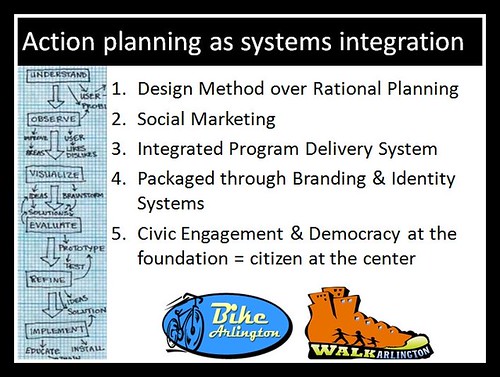
Slide, action planning as systems integration
2.  A piece in the Wall Street Journal, "Obama and the 'Amazon Experience'," discusses the prevalent practice and experience with top-down government and planning. Granted you can't expect WSJ analysis and opinion pieces to favor "big government" but the piece is valuable in its mention of development economist William Easterly, his analysis of the failure of a lot of big "Third World" development projects, and his distinction between "planning and searching."  He argues that planning by definition is top down.  Of course he's right that this is how planning is mostly done, but I myself am a "classic example" of the searching approach.

From the article:
• Searching, not planning: The development expert William Easterly makes a useful distinction between "planners" and "searchers": The former come to a task with preset ideas about what should work, and then they go about implementing the plan. Searchers, by contrast, spend their time figuring out through trial-and-error what does work. 
And that's why despite the millions and billions and trillions spent on "government" and "development" and "programs" based on plans, too often we don't get the kind of results we are looking for.  (cf.  the book Seeing Like a State and "Seeing Like a State: A Conversation with James C. Scott," Cato Institute).

3.  Similarly, an article in the Sunday Post a couple weeks ago, "The problem with public policy schools," makes the point that graduate school policy programs are a waste, that they are disconnected from politics.   I think the problem is reversed, the real problem is that politics is often disconnected from and uncommitted to analysis.  Certainly, it's controlled more by the people with the most to gain, and that means rent seeking.

I picked up an older policy analysis textbook, Policy Paradox: The Art of Political Decision Making (summary), and the basis of the argument is that the polity--we the people+government is not based on what the Europeans would call "marketization" or the market economy, but community, but our approach to politics, government, and society is mostly dominated by market economics philosophies.

So we have a difficult time discussing the issues from a common frame of reference, let alone making progress.

I think this is the problem more than the failures of implementation, because failures are mostly derived or generated from the lack of a common frame of reference.  Certainly this is the case with "Obamacare."

4.  More on the topic...  There was a piece in the Post by Thomas Ricks, "To improve the U.S. military, shrink it," discussing what should the US military be, how should it be organized to deal with whatever future conflicts that are presented.  He then said something very apt, that the military should be organized to be flexible.  From the article:
The issue, therefore, is how to have not the most powerful military today but rather the most relevant military at the point of necessity — a point that cannot be known. To have that, the United States needs a military that is not necessarily “ready for combat” at any given moment but instead is most able to adapt to the events of tomorrow.

The wrong way to prepare is to try to anticipate what the next war will be and then build a military — on land, sea and air — that fits that bill. Guesses about the future will almost certainly be wrong. In 2000, no one thought we would invade Afghanistan the following year. In 1953, Vietnam was a faraway country about which Americans knew little. In 1949, Korea was thought likely to be beyond our defense perimeter. And so on.

The best form of preparedness is to develop a military that is most able to adapt. It should be small and nimble. Its officers should be educated as well as trained because one trains for the known but educates for the unknown — that is, prepares officers to think critically as they go into chaotic, difficult and new situations.
Of course, that's not what government typically is about.  It's about standardization, which is the whole point of the argument by sociologist Max Weber in Economy and Society (cf. Robert Michels on oligarchy in organizations, in Political Parties).

5.  These pieces get to my point that planning needs to be more design-based, because traditional planning approaches can be pretty static, while design allows for prototyping, testing, small projects (like the ideas of Tactical Urbanism) and dynamism and change.

I see planning, especially master planning, as supposed to be focused on "searching" when the reality is that it isn't.

6.  McKinsey has just released an article, "Government by design: Four principles for a better public sector," coining a nice phrase "Government by Design" that I wish I would have come up with earlier.   Although a better phraseology would be "Government by the Design Method" and "Planning by the Design Method."

The article lists four principles of "government by design":
1. Better evidence for decision making
-- Collecting credible performance data
-- Benchmarking consistently against peers
-- Using data to design and improve interventions

2. Greater engagement and empowerment of citizens
-- Using innovative channels to make services more citizen-centric
-- Soliciting citizen input to improve public services
-- Tapping citizens to help deliver better services at a lower cost

3. Investments in expertise and skill building
-- Using adult-learning practices to build core capabilities
-- Developing specialized capabilities in critical sectors
-- Sharpening strategic and risk-management skills

4. Closer collaboration with the private and social sectors
-- Improving government’s procurement of products and services
-- Unleashing government’s power as a provider of public goods
-- Refining government’s role as an economic shaper and integrator
Interestingly, "empowering citizens" should be first, and it isn't.

Conclusion.  Clearly, we aren't at the point where there is a definitive piece laying out the concept of "Government by the Design Method" but we are getting there.

Labels: , , , , , , ,

Monday, January 28, 2013

Illustration of government and design thinking: Boston's City Hall to Go truck

Last May, I wrote a piece, "All the talk of e-government, digital government, and open source government is really about employing the design method," that made the point that what matters most in terms of government agencies adopting social media and mobile applications is that it isn't the delivery ("marketing channel") that matters as much as it is about responsiveness and willingness to be engaged from and by citizens on the citizen's terms.


While it is an illustration of adopting more innovative techniques and does not necessarily reflect a change in how government organizes itself, the City of Boston's "City Hall on the Go" outreach truck, modeled after food trucks, is an innovative information delivery method that at the very least is a step forward along the design method framework.  See "Boston City Hall To Go Truck Follows Food Truck Trend" from Government Technology and
"City Hall services go mobile" from the Boston Globe.

Note that more recently, I came across the book Designing for Social Change: Strategies for Community-Based Graphic Design.  The method as proposed is applicable not just to "graphic" design but the creation and maintenance of programs and inititives.

And there are also important books about specific campaigns and materials such as the book Designing for the Greater Good: The Best in Cause-Related Marketing and Nonprofit Design. This matters a lot because so much of the marketing by government agencies and nonprofit organization is not very good.  I am sure that there are way more books in this area than I know about.

And of course there is the field of social marketing, which is focused on engendering behavior changes.

In my approach to planning I work to incorporate the design method, social marketing, branding and identity systems, and program delivery into integrated systems, which I call Action Planning.  (No doubt I have been influenced by the social psychological-organizational behavior approach called "action research.")
Slide, action planning as systems integration

But there is also the point about creating the right kind of organizational and/or programmatic "choice architecture" as discussed in the book Nudge (review from the Economist Magazine), "Empirically Informed Regulation," University of Chicago Law Review, 2011).

Anyway, if you want the "back story" of how I think about social change, these books illustrate of the building blocks.

Labels: , , , , ,

Friday, May 04, 2012

All the talk of e-government, digital government, and open source government is really about employing the design method

Mobile Commuter Store vehicles, Arlington
Arlington County has a number of bricks and mortar "Commuter Stores" which sell transit media and provide information on various sustainable transportation modes.  They also have two mobile stores, which they deploy around the county, at festivals, etc.

I have written about what I call "action planning," which is based on my observation of some best practice "government" programs like Arlington County's transportation programs (transportation demand management, BikeArlington, WalkArlington, FitArlington, the CommuterStore, the Car Free Diet, and relatedly, FitArlington), the Live Baltimore resident attraction and recruitment program, and the re-positioning of libraries in the Tower Hamlets borough of London as "Idea Stores."  See the past blog entry "Social Marketing the Arlington (and Tower Hamlets and Baltimore" way."

I've since updated my thinking about action planning as discussed in that entry to make the link to civic engagement and participation more direct.
Slide, action planning as systems integration

The key element is using the design method, which is iterative and dynamic, rather than using the traditional "rational planning" method which is the foundation of urban planning and public administration, which tends to somewhat static and not very open to new ideas.

This is the biggest problem with traditional planning, that it is pretty focused on maintaining things the way they are already, unless they are not working well, which allows for some change.

Design method
Design methodology

Rational planning model
Rational Planning Model

John Friedmann captures this dynamic in his discussion of how government is organized in Planning in the Public Domain.  Most of government or "the system of political order" is focused on system maintenance.
Basic Concepts, Planning in the Public Domain

Anyway, there is plenty of good discussion about the design method and "design thinking," from books by the principals at the Ideo design consultancy, the d.school at Stanford, and writing in magazines like Fast Company and Wired.

Design thinking graphic by Nitjyot Saroan
And there has been plenty of breathless coverage about how social media and apps and the web and the cloud will change government.

That kind of coverage has always left me unsettled because to me apps are just processes.

What's more important and fundamental is the commitment to democracy, participation, civic engagement, capacity building, and self-help.

A great app for reporting problems makes it easier for citizens to report problems, but if the government agency responsible for dealing with the problem is no more responsive in the face of the app, it doesn't really matter how a citizen reports a problem.

There is no question that the quality of the design and operation of processes really matters.

Lacking a central repository for reported problems likely contributed to the death of a cyclist in Seattle, who not realizing a trail ended, because there was inadequate signage, rode down a stairwell, crashed, and died.  See "Long-time Vivace general manager seriously injured in bicycle crash" from the Seattle Bike Blog.

Reading this piece, "The open source problem solvers creating government 2.0: Meet the new breed of technologist who's hacking the government at every level to make it work better for you," from the Guardian about how "open source software" is changing government, I finally came to the fundamental conclusion that what "open government" is really about: process redesign.

Process redesign is nothing new.

In fact, it's the approach I take to planning and public administration as a matter of course, although I sometimes call it gap analysis and reverse engineering, based on figuring out mismatches between preferred outcomes--which should be generating as a matter of course "improvements to quality of life"--and recurring outcomes, which tend to not be improvements in quality of life.  Then I look backwards at the processes generating the current outcomes, and try to come up with new and more robust processes that will instead generate the preferred outcomes, all the while trying to figure out how to bring about changes within conservative organizational environments.

So "open source government" is aided by "apps" and engaging new people into the process, but fundamentally, it's process redesign, not much different than the initiatives pushed by the Reinventing Government people back in the late 1980s.

But there is a key difference.  There is an openness to change when there wasn't before, maybe because the "app"/computer/mobile device provides a touchpoint/entrypoint for reconsideration of how to do things.

Another difference is that more people are trying to get involved, they have the means to produce "solutions," and for some reason, more governments, probably because they are financially strapped, which leads to what I call "a desperate willingness to experiment because they have no other choice" are more open to accepting "outside the box" "solutions" than they would be if times were different.

Labels: , , , , , ,

Tuesday, April 26, 2011

Crazy: BART is scheduling multiple community meetings out in the field to get input on seating configuration

Interesting that BART, the subway system in the San Francisco Bay region, is scheduling meetings out in the community to get input about seat configurations, versus the more traditional process likely to be followed by WMATA in seeking the same information. See the Patch article "Pick a Seat: BART Lab Coming to a Town Near You."

From the article:

Between now and the beginning of summer, BART is bringing a mobile lab filled with seats of different heights, widths and materials to communities.

The goal is to get feedback from commuters on what kind of seats they would like to see in a new fleet of BART cars scheduled to start hitting the tracks in 2018.

"What I might like might be different from what the public might like," said BART Board President Bob Franklin. "So, we're going to get a range of opinions from a wide variety of people." ...

On Monday and Tuesday, senior citizens and disabled riders will test out the seats at the BART offices. After that, a sampling of the seats will be packed into a trailer and taken to at least nine communities over the next two months.


This is the kind of prototyping that is typical of the design method, which isn't usually used in planning, which tends to rely on the more static "rational planning" method.
Design methodology

Labels: , , , ,

Monday, November 09, 2009

(Not) Understanding Government

1. To reiterate from yesterday, the (primary) reason that Rollin Stanley is so disconcerting is that he is painfully direct.

2. today's Post has a piece about how WMATA, the DC transit organization, is "stonewalling" safety checks by the advisory safety organization that seemingly provides oversight. See "Metro barred safety checks on tracks."Of course, the Post misses the point about requiring oversight, saying this is a problem of the federal government. From the article:

The dispute encapsulates what many safety experts and federal officials have described as a fundamental flaw with Metro and other subway systems: a lack of effective and enforceable oversight that leaves transit systems in charge of policing their own safety. Unlike with other forms of transportation, the federal government cedes primary oversight of subways to a patchwork of state-level monitoring boards.

It isn't. DC, Maryland, and Virginia could jointly mandate oversight and create a regulatory structure to do it. It's merely a matter of having the Public Service/Utilities Commissions of the respective jurisdictions be given oversight and the money to set up and implement the system.

If the California Public Utilities Commission manages to have and execute a mandate to oversee the transit authorities within the State of California, nothing prevents something similar from happening in the DC-MD-VA region.

And in the pre-government owned transit system days (such as when a streetcar system existed in DC), the local public utilities commission did in fact have oversight over the streetcar system. Recently, I managed to pick up a print of the old Public Service Commission laws (printed in the 1940s or 1950s). Some time this week, I will thumb through it to see what it says about this.

3. But it is interesting to think about government, how it operates, and how it stonewalls, no differently usually than privately run organizations, with one exception. In my opinion, perhaps the biggest problem with government is that most elected officials (not all) are lawyers. And the agencies are top heavy with lawyers and everything needs legal review before it can go forward.

I understand this, but except for lawyers who work to help start up firms, most lawyers are inherently conservative and fail to think expansively. Lawyers are not about transformation, about challenging how things are done, for the most part they are about stare decisis, about doing things the same way as they have been done.

When resources are constrained, when systems aren't working, stare decisis doesn't offer a way forward.

4. This I think is true even of our friend President Obama. There isn't a whole lot that is creative in the proposals for national health insurance. There is no fundamental rethinking of how "health care" (not health insurance) is provided in a way that is transformational, deals with costs and other considerations. (For example, see "Budgeting for diabetes care requires a long view." from Governing Magazine.)

5. But even the difference between WMATA -- and again, my joke about "small" government in the DC region is that it is shaped in the image of the federal government, so think ossification -- and MBTA in the Boston area is that MBTA is open to "open source" propagation of information about transit schedules and WMATA is not, as has been amply discussed in Greater Greater Washington.
iPhone app has public transit down 'To-A-T' - The Boston Globe.jpg
iPhone transit application for Boston.

The Boston Globe has a nice piece, "iPhone app has public transit down ‘To-A-T’," about MBTA's new approach:

To-A-T is an application that uses an iPhone’s GPS feature to locate the closest MBTA subway or bus stop, and tell users when next train or bus will arrive. But state transportation officials also like it for another reason: To-A-T did not cost them any money. Wonderland Development, based in Cambridge, developed the app using publicly available scheduling data the T posted on its website last spring.

“The beauty of releasing the data is it frees us from having to develop the applications ourselves,’’ said Chris Dempsey, an assistant secretary in the Massachusetts Executive Office of Transportation. “That’s expensive and something that we’re not very good at.’’

Transportation officials are promoting a contest they hope will result in even more data-based apps for commuters. The best ideas will be dis cussed at an all-day conference on transportation and technology Saturday at the Massachusetts Institute of Technology. The winners receive Charlie Cards good for a year’s worth of free rides on the T.

The conference is aimed at bringing together app developers, T riders, and transportation officials to figure out what types of applications would be useful and which ones they could live without. In addition to more sophisticated apps tailored to the iPhone, transportation officials want developers to create more basic functions, like an application that would provide schedule information via standard text messaging.

This is similar to the "Transit Camps" that have been organized in places like Toronto ("Minding the gaps on The Better Way" from the Toronto Star, website) and San Francisco, and something I have written about in the past, harvesting the interest and energy of users. Also see the Wikipedia article, "Leveraging Worldwide Transit Knowledge."

While this is frequently associated with software development, there is no reason that "user generated content and involvement" has to be computing/technology specific.

6. And this gets back to the idea of using the design method, rather than the more traditional and more static "rational planning" method for organization design and transforming how government agencies work and how public services are provided.
Design methodology
Design method.

Also see these past blog entries:

-- (Ir)rational planning
-- Social Marketing the Arlington (and Tower Hamlets and Baltimore) way
-- Disruptive innovation (once again) and Bods/Cuerpos

Labels: , , , , ,

Sunday, November 08, 2009

How do innovators think?

Is a piece from the New York Times, featuring an interview by an editor of Harvard Business Review. From the article:

Q: You conducted a six-year study surveying 3,000 creative executives and conducting an additional 500 individual interviews. During this study you found five "discovery skills" that distinguish them. What are these skills?

Dyer: The first skill is what we call "associating." It allows creative people to make connections across seemingly unrelated questions, problems or ideas. The second skill is "questioning" — an ability to ask "what if," "why" and "why not" questions that challenge the status quo and open up the bigger picture. The third is the ability to closely observe details, particularly of people's behavior. Another skill is the ability to experiment. And finally, they are really good at networking with smart people who have little in common with them, but from whom they can learn.

Labels: ,

Tuesday, September 15, 2009

(Ir)rational planning

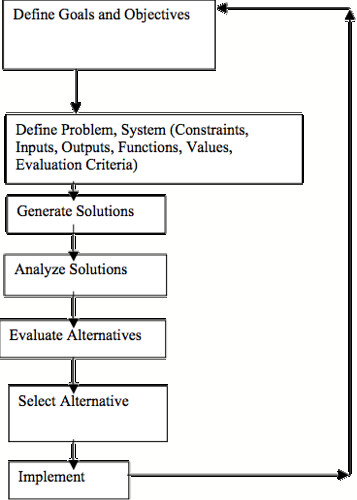
Organizational-based planning, be it land use planning for which planners go to school, or in other disciplines, is typically called "rational planning" and follows a particular method.

Rational Planning Model -- lacks a step for prototyping and feedback before final implementation
Rational Planning Model

The biggest problem with this method is that for the most part, the evaluative framework that planners use is relatively static, it's more backwards looking than forwards looking. We can all fall prey to this (e.g., in a study I did in a county on Maryland's Eastern Shore, while I mentioned the impact of global warming, I didn't really key in on the fact that depending on the projections, half that county could be underwater in 30 years).

Chris Argyris spent his academic career studying and working to make more effective, learning and action in organizations. This webpage discusses the basic points:

-- that people have an espoused theory of how they respond and act;
-- which usually differs from how they act in specific situations;
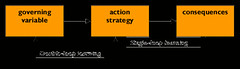
-- that single loop learning doesn't question the basic principles of an approach;
-- and double loop learning does.

From chris argyris: theories of action, double-loop learning and organizational learning:

Single-loop learning seems to be present when goals, values, frameworks and, to a significant extent, strategies are taken for granted. The emphasis is on ‘techniques and making techniques more efficient’ (Usher and Bryant: 1989: 87) Any reflection is directed toward making the strategy more effective. Double-loop learning, in contrast, ‘involves questioning the role of the framing and learning systems which underlie actual goals and strategies (op. cit.).
Single loop and double loop learning (Argyris)
This graphic from the website shows the difference between the two forms of learning. In short, in double loop learning there is a feedback and consideration loop (feedback loop is the term used in systems theory), and there is no feedback loop in single loop learning.

I think we are a single loop society, one where for the most part, our organizational systems, especially political and governance institutions, are resistant to learning and improving.

Through discussions with blog commenter and colleague Christopher, I have become much more clued into the design method combined with principles from social marketing, which is the planning method that Arlington County has been developing around its transportation-related planning activities. (See the blog entry "Social Marketing the Arlington (and Tower Hamlets and Baltimore) way.")

Design Method
Design methodology

The design method is more anthropological, and anthropology-based design methods are all the rage in industry. In fact, there is a developing design discipline called design anthropology.

Without the ability to go beyond constrained scopes of work, most planning efforts have the tendency to produce somewhat static results.

Some examples...

1. While not an urban issue, the problem of grizzly bear management in the Greater Yellowstone eco-region is one issue. The Post had a travel story about this on Sunday, "Into the Wild," and PBS's Nature show on Monday was about the same broad topic, The Good, the Bad, and the Grizzly.

The issue is about constraints and conflicts. These bears need a fair amount of land on which to roam. If the same lands are used for other purposes, such as running cattle on national forests, conflicts are created, and the bear generally loses out, when it comes up against people. The Dept. of Interior, under President Bush, declared that in the Yellowstone region, the grizzly bear is no longer an endangered species, meaning a management plan isn't necessary, that the bears aren't protected.

But how do you resolve the conflicts that will continue, whether or not the Dept. of Interior changed the regulations?

2. In the Sunday Post, there is a short op-ed piece, "The New Walter Reed: Less Than 'World Class'?," about the impact of the Base Realignment and Closure Commission (BRAC) process, which called for the merger of DC-based Walter Reed Hospital into the Bethesda Naval Center, and the failure to re-engineer processes, systems, and facilities as a result of the merger. From the article:

There is much to commend in the work that has been done so far. For example, the view of the facility from Wisconsin Avenue will be very pleasing, with the iconic 1930s tower flanked by a new outpatient building and a revamped, extended inpatient building -- and these will provide not only good but excellent care. But a master facility plan has never been done for the campus, which serves multiple functions and includes many older buildings that, over time, should be replaced in an orderly manner. During our review, we were told that such a plan was not within the scope of the BRAC budget.

Similarly, no analysis has been performed to determine needs based on future local demographic changes (the number of retired military personnel in the area is increasing), changing types of wounds (such as from improvised explosive devices) or advances in the delivery of medical care. Instead, the consolidation was planned using a static approach, whereby the functions performed at Walter Reed were simply shifted to the future facilities. Again, the rationale we were given for this was that the BRAC law did not allow for any other approach.

This is a perfect example of a planning failure resulting from static legislative and planning processes.

3. Today's Health section in the Post has an article, "Study Gives High Marks To Retailers' Clinics," about the success of for profit walk in clinics to provide low cost basic health care services.

I have been writing about this for 3+ years as an example of how communities can reengineer basic public health service provision, to move a lot of this kind of care out of hospital emergency rooms, to better manage chronic conditions at the community level, and to provide broader wellness services (which are needed, see "Obesity a Major Issue For Many Minorities" also from today's Post) within neighborhoods.

See the past blog entries "Disruptive innovation (once again)" and "Bods/Cuerpos."

This is an example of what isn't being discussed in the national "debate" about health care "reform."

Without refiguring how health services (not "health insurance") are conceived and how they are delivered, providing effective health and wellness care for all will continue to be out of reach.

Labels: , , , , , ,