Rebuilding Place in the Urban Space

"A community’s physical form, rather than its land uses, is its most intrinsic and enduring characteristic." [Katz, EPA] This blog focuses on place and placemaking and all that makes it work--historic preservation, urban design, transportation, asset-based community development, arts & cultural development, commercial district revitalization, tourism & destination development, and quality of life advocacy--along with doses of civic engagement and good governance watchdogging.

Thursday, June 06, 2013

I think it's great that CM Wells has introduced legislation for joint space use coordination between the schools and the parks/rec. department

See "Councilman pushes for more access to D.C. school fields" from the Washington Examiner.  From the article:

A District lawmaker, frustrated by periods of idleness at D.C. Public Schools properties throughout Washington, will on Tuesday introduce a plan to give the public access to those institutions' facilities for athletic use outside of school hours.

"Frequently, the fields of our public schools sit empty and unused," Ward 6 Councilman Tommy Wells, who announced a mayoral bid last month, will tell the D.C. Council on Tuesday. "A significant barrier to using these public facilities is that the District holds liability concerns for the city and government employees."

For what it's worth, for certain facilities, this is already the case, although the system for doing so needs to be regularized and improved.

For example, residents are able to use the Coolidge High School outdoor track (a great facility) for jogging before and after school hours.  (Sign pictured at left.)  Many school playground areas are open for public use during non-school hours.

But it is true that it's a pain to use inside resources.  And there was a letter to the editor of the Dallas Morning News saying it was fine to close school libraries, because kids could use the public library.  On the other hand, why not integrate school and public libraries to extend community resources?

But this kind of space co-location is something I have advocated for years, and would still prefer it be initiated through the master planning process, not "legislation."

Baltimore County has had an MOU between the school system and the recreation and parks department on this exactsame issue for 60 years!!!!!  It means that the parks department will subsidize more robust facilities for particular schools beyond what the school on its own would require, to serve broader community needs in one co-located facility.  From the webpage:

As a result of this concept, school-recreation centers feature many additional amenities, which could not otherwise be funded such as recreation offices, activity rooms, full-size gyms, additional athletic fields, tennis and multipurpose courts, storage areas, concession stands and comfort stations. Further, each neighborhood has an easily accessible community center and focal point for activities. The school-recreation center concept is formally adopted through a "Joint Use Agreement"...

And the schools stay open for the recreation and other community purposes (I held one of the  planning meetings for the Western Baltimore County Pedestrian and Bicycle Access Plan at Cockeysville Middle School) til later in the evening.  At least 9 pm.

Note that the article in the Post about the Dunbar girls track team being intrepid in training while they don't have a facility at their school ("Dunbar track & field teams don't let lack of a track slow them down") talks very proudly of having a two lane indoor track at their high school.  Two lanes?  Big deal, although I suppose it is for a particular school.

Why doesn't the city have an exposition facility other than the DC Armory with a full indoor track?  Arlington County, which is the size of , has at least one such facility.  I've been to the one at Thomas Jefferson Middle School/Community Center.

-- Joint Use Schools Initiative - Center for Cities & Schools
-- blog entry, 2006, "Public assets: public school buildings used for more than school"

KaBOOM! releasing report this weekend  KaBOOM!.jpgKaboom, the national organization which assists communities in improving and building playgrounds, has produced a report, Play Matters, which among other elements, addresses:

local initiatives that have increased the quantity of available play spaces and opportunities, improved the quality of kids playtime, and increased children’s safe access to them.


Blog entry reprint: Another example of a need for a DC parks and recreation master plan, 2011

... ideally that would have a memorandum of understanding with DC Public Schools and with charter schools about access to facilities when school is not in session. (And maybe even the local colleges), not to mention including guidance with regard to National Park Service facilities located in the city.

Anyway, yesterday's Post has a big piece about a "controversy" concerning the use of the pool at Wilson High School, "Pool wars: How long should swimming lanes be aat D.C.’s aquatic centerpiece?"

In a piece a few years ago, I suggested that parks and recreation planning needs to occur at at least three scales:

- city-wide
- subdistrict (maybe by quadrant or by the Planning Office's 10 designated areas, which are slightly smaller than Wards)
- neighborhood.

I don't think Wards are a good scale at which to plan for these kinds of facilities because residents need services but maybe a facility can serve multiple wards, even if Councilmembers don't think so (e.g., the Ward 4 Senior Center is less than 3 miles from the Ward 1 Senior Center).

Certainly, a city of 600,000 people needs more than one public facility with a 50m long pool. Maybe we don't need three, but maybe two? Etc.

E.g., we don't have one indoor track or exposition facility other than the DC Armory, which is unaffordable for most nonprofit events and organizers, etc.

From the article:

... A spat over the length of the lap lanes has roiled the waters.

On one end: swimmers who want shorter lanes to accommodate more people and different activities. On the other: a loose coalition led by competitive athletes who want to keep the status quo because Wilson is the city’s only indoor pool with the 50-meter lanes they consider ideal for training.

Both sides want to know: Whose pool is it, anyway?

It’s not the biggest issue in the city, by any stretch or butterfly stroke. But it does lead to another question: Should a public pool — and by extension the District government — serve the broadest range of residents or an underserved minority?

The Wilson Aquatic Center is considered by many to be the crown jewel of a massive overhaul of the District’s parks and recreation facilities launched during the tenure of former mayor Adrian M. Fenty (D)...


Clearly, not having a master plan for parks and recreation facilities has contributed to this problem. There ought to be facilities that satisfy both types of swimmers, it shouldn't be an either/or question.

Past blog entries:

-- Prototyping and municipal capital improvement programs
-- Government facilities planning can accomplish multiple objectives
-- No area municipality does it better: Arlington County extracting mixed primary use benefits from publicly supported facilities

Adult runners using the Coolidge High School outdoor track, before 8:45 am, Thursday June 6th.


Residents walking on the outdoor track at Coolidge High School, before 8:45 am, Thursday June 6th.

Labels: , , ,

Friday, January 25, 2013

Who says you can't raise children in multiunit buildings in the city?

From the Metropolitan Diary column in the New York Times:

I am friends with a family whose young children like to play in the small kitchen of their Manhattan apartment. The parents were able to accommodate them by relocating the contents of one lower kitchen cabinet and removing the shelf.

The mother reported to me that both girls had recently managed to squeeze inside the cabinet. From behind the partly closed door, the elder daughter announced that they were pretending to be cockroaches.

Labels: , , ,

Tuesday, November 13, 2012

Planning for unplanning: parks and recreation

Finding_The_Game by Gwendolyn Oxenham, book coverThe Post has an article, "Rec leagues vs. Pick-up games: two sides of the playing field," about the use of recreation facilities in the city, and how organized leagues with permits for the use of fields trump the use of fields for "unorganized" pick up athletic activity.  The example is soccer.

I understand how government agencies want to minimize their work and conceive of most activities as a regulatory or rationing-type function.  If you have facilities ("Assets") you manage them, and ration their use through permits and fees.

On the other hand, a parks and recreation agency could conceive of its mission as enabling the recreation and parks needs of interests of all demographics, systematically, and stepping in to assist various constituencies/demographics when they way that they are accustomed to using facilities doesn't fit with the standard paradigm.

In basketball, it is not uncommon for court time to be scheduled for "pick up" basketball.  And in swimming, "open swim" time.

In soccer, in DC, at Petworth, and likely other places, DCPR should schedule field use for "pick up" soccer as well, in view of mission goals of serving diverse segments of the population, including those who don't play in leagues.


And in some other jurisdictions, there is more accommodation for this.  In Arlington County although they charge, and in NYC, a group PSNYC / Pickup Soccer NYC has organized the unorganized, at least the English speakng ones...  And this piece from the New York Times, "Pelada: Pickup, the Essence of a Game," references a book, Finding the Game: Three Years, Twenty-five Countries, and the Search for Pickup Soccer on pickup soccer around the world.

Note that this is an issue across recreation and parks planning.  The most organized parks constituencies tend to be people affiliated with team sports and leagues.  Without taking extra steps to ensure that other constituencies are represented, it's very easy for recreation planning to end up focused primarily on team sports.

Labels: , ,

Sunday, August 07, 2011

Another example of a need for a DC parks and recreation master plan

... ideally that would have a memorandum of understanding with DC Public Schools and with charter schools about access to facilities when school is not in session. (And maybe even the local colleges), not to mention including guidance with regard to National Park Service facilities located in the city.

Anyway, yesterday's Post has a big piece about a "controversy" concerning the use of the pool at Wilson High School, "Pool wars: How long should swimming lanes be aat D.C.’s aquatic centerpiece?"

In a piece a few years ago, I suggested that parks and recreation planning needs to occur at at least three scales:

- city-wide
- subdistrict (maybe by quadrant or by the Planning Office's 10 designated areas, which are slightly smaller than Wards)
- neighborhood.

I don't think Wards are a good way to plan for these kinds of facilities because residents need services but maybe a facility can serve multiple wards, even if Councilmembers don't think so (e.g., the Ward 4 Senior Center is less than 3 miles from the Ward 1 Senior Center).

Certainly, a city of 600,000 people needs more than one public facility with a 50m long pool. Maybe we don't need three, but maybe two? Etc.

E.g., we don't have one indoor track or exposition facility other than the DC Armory, which is unaffordable for most nonprofit events and organizers, etc.

From the article:

... A spat over the length of the lap lanes has roiled the waters.

On one end: swimmers who want shorter lanes to accommodate more people and different activities. On the other: a loose coalition led by competitive athletes who want to keep the status quo because Wilson is the city’s only indoor pool with the 50-meter lanes they consider ideal for training.

Both sides want to know: Whose pool is it, anyway?

It’s not the biggest issue in the city, by any stretch or butterfly stroke. But it does lead to another question: Should a public pool — and by extension the District government — serve the broadest range of residents or an underserved minority?

The Wilson Aquatic Center is considered by many to be the crown jewel of a massive overhaul of the District’s parks and recreation facilities launched during the tenure of former mayor Adrian M. Fenty (D)...


Clearly, not having a master plan for parks and recreation facilities has contributed to this problem. There ought to be facilities that satisfy both types of swimmers, it shouldn't be an either/or question.

Past blog entries:

-- Prototyping and municipal capital improvement programs

-- Government facilities planning can accomplish multiple objectives

-- No area municipality does it better: Arlington County extracting mixed primary use benefits from publicly supported facilities

Labels: , , ,

Thursday, August 04, 2011

First Fridays for Teens: Richmond's response to teen violence problems

Montgomery County is looking to pass a curfew law on teens because of a recent particularly violent gang incident in Silver Spring, which took hours and many police to contain.

See "Montgomery curfew controversy: How much is this about location?" from the Post, although I also mentioned in a previous entry a particularly good editorial from the Baltimore Sun, What Baltimore can teach Rockville about fighting crime: City's experience with a teen curfew (and its limited effectiveness) can inform Montgomery County's effort to reduce violent juvenile crime."

And in DC, which has a curfew law, there have been ongoing problems at Gallery Place and/or on the subway system, which has resulted in various responses by police and merchants. See "Fights, teens among challenges as D.C.'s Gallery Place entertainment area matures," Gallery Place youths say crackdown on rowdy teens affecting all," and Mosquito noise device at Gallery Place aims to annoy potential troublemakers" from the Post.

Part of the problem with organizing programs and activities for teens is that by definition developmentally, many are looking for unstructured and things to do that have limited adult supervision.

A couple months ago at a First Friday event in Richmond there were some problems at a particular event that drew many teens, some said that the police picked a fight more or less. See "Changes to First Fridays Announced After Skirmish" from the Richmond Times-Dispatch.

My initial reaction to the responses at Gallery Place was that a teen ambassador/teen ranger program should be created (they have Teen Bike Ambassadors in Minneapolis to promote biking, and somewhere, I think in Ohio, I once read about a parks and recreation program for teens that was developed and delivered by teen "rangers"), although this becomes a definite management issue, and such programs won't be able to eliminate every and all problems.

The other day another initiative was announced, a First Friday event specifically for teens, see "First Fridays Event for Teens Introduced, at CenterStage" from the RTD.

From the article:

The City of Richmond has joined with sponsors for “RVA Presents the Lounge at CenterStage,” which will feature live performances by the youth, for the youth. The event is a First Fridays for Teens.

The event will give the teens, who have been flooding First Fridays Art Walk, their own place to showcase art and express themselves. July's event brought a record attendance, with thousands of young adults present.

“The Lounge is not intended to limit our youth’s ability to mingle with other art enthusiasts, but it encourages them to expand their experience downtown and offers an alternative positive means of doing this," said Chief Norwood. The event will “Provide an outlet for teens to express themselves,” Tesha W. Davis
Parks, Recreation and Community Facilities Health Marketing and Public Relations Manager, said.


I think that's a pretty good approach. We'll see how it works out.

Labels: , , , ,

Thursday, July 30, 2009

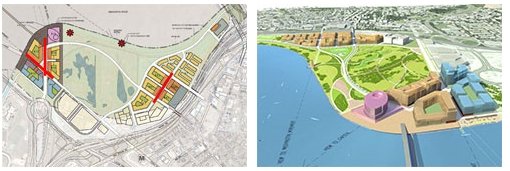
Thinking really really really big for Poplar Point's park

Isn't in the three scenarios put forward by DC planners, as discussed in this entry from Greater Greater Washington, "Poplar Point planners present possibilities." (Also see this previous GGW entry, "Poplar Point and the Case of the Too-Large Park.") GGW writes:

Should Poplar Point become two separate districts, one extending the Anacostia neighborhood and one connecting across the river? Or should it be one neighborhood, centered around the Metro station leaving parkland along the waterfront, or activating the waterfront with a large park to one side? Should DC redevelop the Anacostia Metro garage, or leave it? These are some of the questions DC economic development officials asked members of the community at last weekend's Poplar Point presentation.

I'd say for a connected place, rather than two separate districts on either side of a large green space, EXCEPT that I offer a different alternative. Two "separate" districts connected by an active public-civic-recreational-educational-amusement place. In this fashion, there is nothing separate about the land use plan, it's all connective and supportive of both east of the river interests and objectives while at the same connecting to west of the Anacostia River and anchoring the east with the kinds of civic assets that the community justifiably believes have been denied to it.
Alternative 1, Poplar Point redevelopment
Alternative 1, Poplar Point redevelopment.

Yesterday I listed a bunch of articles about recent activities of the Project for Public Spaces. PPS is a planning firm kind of, but one with a advocacy bent. It's a nonprofit, built on the legacy of William H. Whyte and Jane Jacobs, but much of their operating budget comes from fee-for-services from doing planning consulting.

One of the articles, "The Place Doctor" from Convene Magazine is a kind of summary of the PPS philosophy. There is a section of the article that is particularly relevant to Washington, DC, where we have a great deal of open space/parks (especially those run by the National Park Service) but the parks are passive spaces, rather than active. From the article:

Activity is fundamental to great places. Kent dislikes the trend toward converting urban parks into open spaces that provide few things for people to do. The park of the future, Kent said, will be more like Europe’s 19th century pleasure gardens, such as Tivoli Gardens in Copenhagen. One good contemporary example is downtown Houston’s newly opened Discovery Green, where visitors can play bocce or horseshoes, picnic, take Pilates classes, play in a fountain, attend free concerts, shop at a farmer’s market, kayak, canoe, sail, and more.

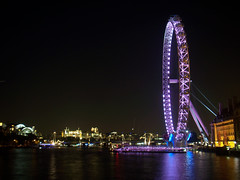
Places like Millennium Park in Chicago, Campus Martius Park in Detroit, and Discovery Green in Houston are active fun places. Hell, have a ferris wheel like the London Eye.
London Eye
London Eye photo from Flickr by Adriano Aurelio Araujo.

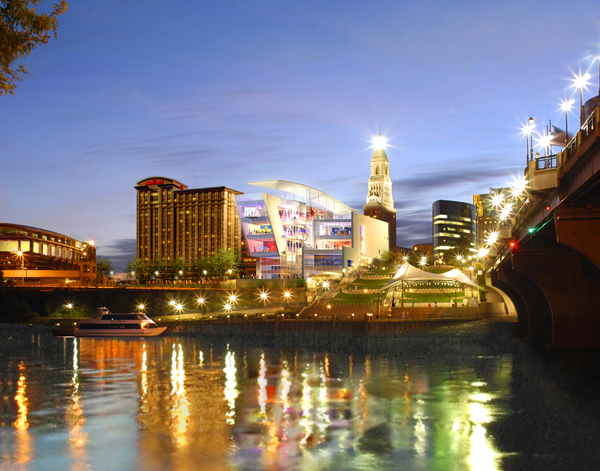
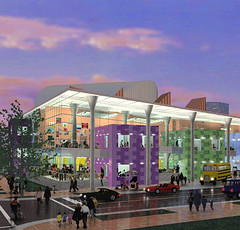
Imagine that kind of park at Poplar Point, connecting the mixed use areas, connected by transit, maybe having a soccer stadium (I am of two minds on this, but see "D.C. United back in talks with District officials" from the Washington Business Journal), other civic assets--what about a real "City Museum" or a Science Center like the new Connecticut Science Center in Hartford (see "Future shock made child's play" from the Boston Globe) or a great maritime-related discovery center and activities and a Children's Theater and Library like Charlotte's ImaginOn--instead of another passive recreation space that is under-utilized in a city with an overabundance of passive park spaces.
Rendering of the Connecticut Science Center, Hartford, located on the Connecticut River
Rendering of the Connecticut Science Center, Hartford, located on the Connecticut River. (It just opened and I haven't been able to find good photos yet of the exterior.)

Imaginon -- Children's Library/Theater, Charlotte, NC
Imaginon -- Children's Library/Theater, Charlotte, NC.

Including a kick-a** recreation center. One of the problems with recreation planning in DC is that it is plain vanilla--every rec center is pretty much the same. The "big" centers have a pool. The smaller ones don't. How about a mini-aquatic park, urban sized (like the H Street Country Club putt putt course rather than Disney World, the Post reports in "Time to Join the H Street Country Club" about an indoor mini golf course), an indoor track, and other facilities that will help make this recreation be a destination, one that serves the entire city. (And maybe a velodrome, etc.)

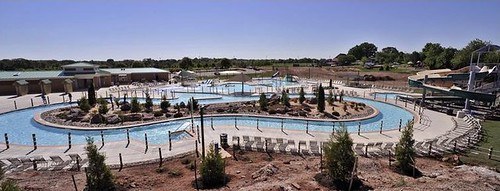
But why should the cool amenities only be available in the suburbs? See "Aquatic Center Opens in Leesburg" from the Washington Post Loudoun Extra section about the recent opening of a new aquatic park there.

Etc.
An overview of the new Aquatic Center at Leesburg's Ida Lee Park. The center features a six-hundred-foot "Lazy River."
An overview of the new Aquatic Center at Leesburg's Ida Lee Park. Washington Post photo by Tracy Woodward.

Elsewhere in the article on PPS, PPS president Fred Kent is quoted saying "Every City needs a square."

Well, the area of the city called Anacostia-Ward 8-East of the River needs that square too. And maybe Poplar Point is the place to do it.

Who needs National Harbor anyway (see "National Harbor's 'Mini-City' Takes Shape" from the Post). Or the Children's Museum when we could do a Connecticut Science Center or a Imagion (Charlotte, NC) see "National Children's Museum's Launch Zone" from the Post.

Labels: , , , , , , , ,

Friday, June 26, 2009

What's the matter with Kansas (Avenue)?

(With apologies to Thomas Frank...)

The Northwest Current should really be called the West Northwest Current because for the most part it isn't distributed east of Georgia Avenue, so I don't always read it, although I have recently learned that the pdfs are now available online.

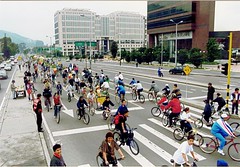
Recent issues have had a story and editorial about the Dept. of Parks and Recreation proposal to close a few blocks of Kansas Avenue NW on one Sunday, I think in August, in order to create a New York City like "Summer Streets" program, which is modeled after the Ciclovia program in Bogota, where streets are closed on Sundays, and people walk, bike, exercise, etc. in the streets, rather than leave streets as the more or less exclusive domain of automobiles and trucks.

Apparently ANC4 was negative because it would impact driving on the street, going to Church, etc. Since the Current Newspapers website seems to be down at the moment I can't find and provide the details, direct citations and quotes that I would normally include. But the editorial in the Current agreed that closing the street was a bad idea. It was for one Sunday, and probably proposed closing the street from Georgia Avenue eastwards to Sherman Circle and beyond.

Now, it happens that I am a bit leery of summer streets like programs in DC, not because I don't believe in feet first programming, but because for these programs to really work, you have to have a lot of participation, and population density. The fact is that this area isn't that dense and is somewhat spread out. It's not the ideal place to launch such a project, if you want to ensure a successful launch.

But I am still distressed by the negativity in general, about closing the street. I do see a slight problem resulting from impact on the routing of the 62 bus line, and that bus is the only bus providing north-south service between Georgia Avenue and Blair Road, in the area between the Takoma and Petworth stations.

But it happens that the concern about blocking traffic, except for a couple churches, which have alternative routes, is pretty much laughable.

It happens that now that I live in upper northwest, Kansas Avenue is one of the major bicycle "highways" I use to get to Downtown, via either Georgia Avenue or 13th Street, and beyond, because it makes for efficient moving about the city from where I live. I ride on this street at a variety of times of day including at night and on weekends.

Kansas Avenue has bike lanes for a goodly section and it barely has any traffic (even though a guy in a car once screamed at me from across the street, then turned around after me and threatened me a couple blocks down because he seemed to have a problem with bicyclists), few pedestrians, and it's served between Georgia Avenue and 5th Street NW by the 62/63 busline.

Here are a couple photos, one looking eastward towards Sherman Circle, the other westward towards Georgia Avenue, taken around 6pm last night (Thursday). This level of traffic is minimal and typical for this street.
100_7522.JPG

100_7524.JPG
Westward view.

The concerns people have expressed about major imposition are groundless.

Nonetheless, I think that aping the Summer Streets program is a bit grandiose. What the city needs to do is "walk before it starts to run." In my bike plan, "Ideas for making bicycling irresistible in DC," I suggest that each ward have an annual Ward bicycle ride, modeled after the BikeArlington event. We need to do ward bike rides at least once/year, and ward walks every month. From that point we can step it up to Summer Streets.

Here's what I wrote in that plan. Of course, it's focused on bicycling, but the concepts can easily be scaled up to include walking and health promotion programs.

Ward/Neighborhood bicycling enhancement

• Rate all neighborhoods in terms of their capacity to support bicycling including topography, distance to amenities and other destinations, location of schools and parks, etc. (Could use DCOP’s 37 planning areas for the organizing framework for this activity.)

• Create (relatively simple) subplans of the Bicycle Master Plan for neighborhoods-ANCs-Wards and develop programs to enhance bicycling within neighborhoods based on this assessment.
Create programs that are fine-tuned to local conditions, rather than one-size-fits-all programs that will fail if implemented in places with unfavorable conditions.

• Create focused programs to engage demographic segments under-represented in the ranks of bicyclists: children; families; disabled (London has specific programs); seniors, people who speak English as a Second Language (ESL), low-income, etc.

• Ensure that bicycling promotion programs provide information, focused outreach, and assistance to various ESL demographics.

• DDOT and DCOP have ward planners. (And DPR has Ward coordinators for Recreation Centers and programs.) Add a new position of Bicycle and Pedestrian Ward Planner to DDOT for each ward. (This could be funded all or in part by the TEA grant. Or part of the funding for these positions could be local – for the non-bicycling portion—and be considered local match, if required.

• Develop stronger civic engagement/volunteer programs. Non-government employee bicyclists can serve as “ambassadors,” mentors, and “buddies” to move people along the path from occasional rider to daily bicyclist.

• Community-neighborhood cycling enhancement grants (London). This is a small grants program (up to $10,000) supporting various projects. Could be run in coordination with ANCs. Some ANCs have Transportation and Public Space Committees (ANC6A, ANC6C), which would be logical partners.

• Annual neighborhood and/or ward rides, comparable to BikeArlington and Alexandria but on a smaller scale. This can be complemented with the development of a BikeDC annual ride, comparable to that offered by BikeArlington.

• Create neighborhood bicycle tours with online and printed maps. Partner with DestinationDC and CulturalTourismDC to do this.

Labels: , , , , , ,

Saturday, January 03, 2009

Transit makes no sense in the Washington region... and it's better to serve 16,500 people/week vs. 70,000 people/day

From Executive Director's Report by William C. Barr, Parking Magazine (the journal of the National Parking Association), Fall 1962, p. 9.

"In spite of the need to move urban traffic, many urban highway programs have been stalemated for one reason or another. In Washington, DC there has been an effective, organized citywide drive to curtail highway construction. The Washington program includes an Inner Loop Freeway which would serve the purpose of bypassing through automobile traffic and permit the citizens who live in the outlying areas to have greater accessiblity to the downtown area.

The opponents of this program have succeeded in persuading Congress to hold in abeyance the necessary appropriations until a study regarding the need for a subway and rapid rail transit system is completed.

Such a program for Washington, DC, is obviously not feasible from an economic point of view and would serve no useful purpose. Metropolitan Washington is a 'lateral' area. As a result, there is little, if any, heavy concentration of people in a given suburban area. If they were to use such a rapid transit system they would be requited to drive considerable distances to the pick-up stations... states that motorists would continue to shun public transit if they were paid to ride it."


(Underlining added. The second underline is merely to point out that putting transit stations in the middle of freeways doesn't work as a way to generate high ridership. The original plan for the subway system in the Washington region was for the transit lines to be placed in between freeways, comparable to how the orange line pops out on I-66. This was true for many of the stations proposed in upper NE and NW Washington as well.)

Ironically, this editorial was published about 7 months after the streetcar system was abandoned as a result of an order by Congress, in legislation passed in the 1950s.

I raise this because of my ongoing concern that "rails to trails" programs end up creating constituencies that favor trails over transit. From the overall maximum benefit standpoint, this often makes sense.

This comes up because of the letters, "A Purple Line in Harmony With the Hiker-Biker Trail" in today's Post in response to Marc Fisher's recent columns on the Purple Line ("A Little Give and Take Is Called for in Debate Over Purple Line Route" and "As Purple Line Creeps Closer, Hard Choices Loom") which make the point that both sides have decent points but that it makes the most sense to opt for the choice that produces the greatest amount of good.
Light Rail in Barcelona
Light Rail in Barcelona. Photo by John Norquist.

I think my bicycling advocacy credibility is pretty good, but I think it's wrong for trail advocates to deny the primacy of light rail (which was why the railroad right of way was purchased to begin with) in this instance.

Labels: , , ,

Thursday, December 06, 2007

Bogota's Ciclovia

There's a great video in Streetsblog on a Sunday Ciclovia.
Ciclovia, Bogota
Photo by Robert J. Matter.

Labels: , , ,