Rebuilding Place in the Urban Space

"A community’s physical form, rather than its land uses, is its most intrinsic and enduring characteristic." [Katz, EPA] This blog focuses on place and placemaking and all that makes it work--historic preservation, urban design, transportation, asset-based community development, arts & cultural development, commercial district revitalization, tourism & destination development, and quality of life advocacy--along with doses of civic engagement and good governance watchdogging.

Wednesday, June 01, 2011

Intelligent Cities conference -- National Building Museum -- Monday June 6th

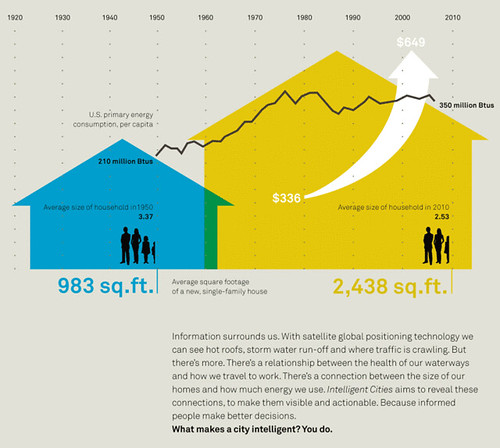
House size graphic, Intelligent Cities project, National Building Museum
House size graphic, Intelligent Cities project, National Building Museum, Susan Piedmont-Palladino, curator.

Next week, on Monday June 6th, is the National Building Museum conference on Intelligent Cities. Interactive presentations throughout the day will explore such topics as:
  • What Makes an Intelligent City?
  • The City as a Lab
  • Engaging the Broader Community
  • Regionally Thinking: Transportation, Affordability, and Equity
  • Imagining a Healthier City
  • Community and Social Interaction in the Wireless City
  • Designing a Collaborative Built Environment

Explore the complete forum agenda.
Learn more about the forum speakers.

Can't attend in person? Join the forum webcast online.

Labels: , , ,

Wednesday, October 27, 2010

Management and capacity building to realize and maintain better public places

-------
note the first sense is edited. I had written that PPS was founded by William H. Whyte, but I misremembered the actual chain of events. It is discussed in the article "Pride of Place,"
which was published in Governing Magazine in 2005. (Which is a great article worthy of reading and re-reading.)
-------

Project for Public Spaces is an organization founded by Fred Kent, who became interested in the quality of public spaces after working for William H. Whyte, the former editor of Fortune Magazine who became interested in urban revitalization and tapped Jane Jacobs to write a piece, "Downtowns are for People" that led to her writing the classic Death and Life of Great American Places.

PPS figured out in the early 1980s that management was key to the revitalization of public spaces, such as Bryant Park, that had been overrun by disorder. Management and programming--providing lots of reasons for people to come to and frequent public spaces--is key to the successful revitalization and ongoing success of public places.

They came up with the public-private partnership model, out of a recognition that many places needed more attention and capacity than a typical government agency was capable of providing. Although, they (like the Main Street program) got a lesson in this from the City of Corning, New York, which in the 1960s figured out that if they wanted their downtown commercial district to remain competitive with privately owned and managed shopping malls opening up in their region, that they would have to buckle down and hire a "downtown manager" as well, and they did so, creating the model for both the Main Street program and business improvement districts, which are other examples of public-private partnerships in local communities.

New York City is also the hotbed of public-private partnerships managing local parks, including Central Park and Prospect Park, and the 32nd Street and Times Square Business Improvement Districts manage parks in their geographic service areas as well (such as Madison Square Park, and other parks along Broadway).

This comes to mind when reading John King's column, "S.F. needs to create permanent public spaces," in the San Francisco Chronicle, about the parklet project there that is getting a lot of attention. King warns that to scale the project up--from 5 to 25 parks--a lot more civic and organizational capacity is necessary for the spaces to stay used and not turn into some other still derelict thing. (Sort of like demolishing a vacant building. One "problem" is corrected, seemingly as there is no longer a vacant building. But then, the problem becomes, what do you do with and how do you maintain vacant lots?)

PPS's placemaking resources are a good place to start for building local capacity, but right now there is no real system for integrating everyday people into this kind of programming in DC.

I think about this in terms of the "local parks" in my neighborhood. In the context of the local Main Street program (for Takoma) I suggested coming up with a common public space plan for a number of triangle parks, including the problematic park at 4th and Blair, which is a flashpoint for what some people call loitering as well as persistent public drinking, and larger parks, such as the combined Coolidge and Takoma recreation centers, four blocks of park on 3rd Street NW behind Coolidge High School, from Sheridan to Whittier.

Just today I was thinking about how aggravating it is that they don't have recycling at the park, and how during team playing seasons, thousands of bottles and cans are discard there, only to end up in the waste stream (I pick up recyclables and put them in recycling bins as I walk along the park), but how there isn't really a system to engage residents in dealing with the parks in their neighborhoods.

There is a great opportunity to change things, but it would require a complete sea change in how parks and recreation spaces are perceived in the city.

Instead of a merry go round of political appointees to serve as the director of the DC Parks and Recreation Department, it would be great if one of the nation's leading parks practitioners or planners would be tapped for the position in the soon-to-be elected Gray Administration.

In the short run, the PPS "How to Turn A Place Around" guidebook/workshop is a good model for creating awareness and building capacity amongst citizens.

I used to encourage DC government employees to go to the workshop, but they could never get approval. Instead, I think we should do the program here every year, as a training exercise for DC Government employees and citizens, while focused each year on a particular neighborhood and project.

Labels: , , , , ,

Monday, February 15, 2010

A best practice local example of "building public will" by Councilmember Tommy Wells

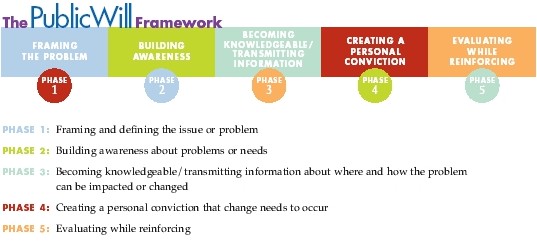
Framework for Building Public Will
Those of us who lived in the city in the late 1980s remember how the beverage industry "schooled" environmentalists by successfully vanquishing a referendum that the environmentalists got on the ballot in DC in 1988, calling for deposits on bottles and cans. By making the deposit idea a race issue--that whitey was out to make life hard for the Black Man and Woman--the referendum had no chance. Of course it didn't help that the beverage industry made lots of donations to black churches, which then sermonized against the law...

Last week, Colbert King of the Post wrote a column, "Our racially divided city" about the separation of the races in the city, according to recent polling data written about in the Post. One of the things he pointed out was that African-American support of the recently enacted 5 cent tax on shopping bags ("D.C. shoppers opt for roughing it over paying 5-cent bag tax" from the Post) is much less than that of whites.
http://www.tufts.edu/tuftsrecycles/images/news/plasticbags.png
Plastic bags. Tuft University photo.

In this week's column, "Tales of snow -- and race," most of the column was given over to Councilmember Tommy Wells, and his explanation of how he reached out to African-American constituencies in crafting the bill and getting support for its passage. From the article:

"I conducted formal presentations at four senior wellness centers about trash in the Anacostia and then fully described my bill, placing a 5 cent fee on disposable bags. The presentations were held at centers in Wards 4, 5, 7 and 8. I engaged the council members for the wards, including Marion Barry, who is a strong supporter of the bill. The vast majority of the participants were black. A group of seniors from one of the centers even came down and testified in support of the bill."

"Finally, environmental degradation is often accepted as the norm in lower income neighborhoods, but I never assumed that black citizens living along the Anacostia found the state of our river acceptable. In fact, many of the older black residents I talked with remember swimming in the river and fishing with their parents, and they still boat on it."

"I take my responsibility to represent all the citizens of a diverse Ward 6 very seriously, and I am disappointed in any racial divide in our city. But as it relates to the bag bill, I believe it was only by seriously engaging black leadership and concerned residents on both sides of the river I was able to pass it unanimously at the Council."

It's a tour de force example of what we might call "Building Public Will" (which is what the Metropolitan Group consulting firm calls it)--building support for and creating change by crafting your message/initiative in a manner which connects to and people's expressed and felt values.

From the Building Public Will framework:

1. Framing and defining the issue or problem;
2. Building awareness about problems or needs;
3. Becoming knowledgeable/transmitting information about where and how the problem can be impacted and changed;
4. Creating a personal conviction that change needs to occur;
5. Evaluating while reinforcing.

Labels: , , , , ,

Sunday, February 14, 2010

Blueprint America: Moving Detroit Forward (PBS documentary)

http://www.paisleypetunia.com/blog/wp-content/uploads/2009/09/vintage-detroit-postcard.jpg
I am not sure what I think about the documentary that ran on PBS Friday night (and repeated early this morning), "Blueprint America: Beyond the Motor City," using the decline of Detroit to discuss transit and its ability to repattern the land use and transportation planning paradigm in the U.S. The show discusses proposals for local light rail service in Detroit, the potential to develop a high speed rail system in the U.S., while looking at the Ave system in Spain , and manufacturing green technology and train and transit vehicles in the U.S. (and agriculture as a way to absorb vacant land in the City of Detroit).

First, Detroit is so lost--more than 40% of its land vacant, its major industry dying in the context of a global economy where the industry of the United States, especially for products manufacturing firms based in the U.S., is no longer dominant and is often a declining player, the region is the most dispersed of any metropolitan area in the country, so much of the population is extremely impoverished--that while they have to do something, transit isn't necessary the magic cure that people believe it to be. (Although maybe doing something with transit is better than doing nothing. And gives people the ability to hope.)

E.g., in the DC region, it has taken upwards of 30 years for transit to start to have the kind of positive economic effect in certain neighborhoods that everyone believes it has immediately.

Cities like Buffalo, St. Louis, and Baltimore demonstrate that in and of itself, adding transit line or two isn't enough, that you need to have a functioning local economy.

And Cleveland, which has had streetcars/light rail for decades--although much of the system was eliminated, with the exception of certain service lines, including providing service to the Airport as of 1968 (or Philadelphia), proves that it isn't transit in and of itself that keeps a region in play economically.

This is why I write about the necessity of preconditions/decisionmaking that allow transit investment and infrastructure to be fully leveraged. Some of the preconditions are:

• the creation of a transit system rather than a single line;
• having a strong central business district and/or other employment centers that remain relevant in an otherwise globalizing economy;
• having extant high quality housing stock such as Victorian rowhouses and recoverable neighborhoods;
• an urban design that promotes walkability and transit use (cities created during the period of the Walking and Transit City eras)
• population density and a growing metropolitan area;
• infill development opportunities;
• some functioning local commercial districts.

Not to mention the necessity of good planning and resident willingness to change land use and development patterns to leverage the public investment in transit infrastructure. Or you can do it the Arlington County, Virginia way, and repattern your land use development in high-density ways to take advantage of rail access. That's harder to do where there are extant long standing and historic neighborhoods.

These factors allow transit investments to grow into something more than transit, yielding benefits beyond mobility improvements.

Some stuff that the show didn't address adequately:

- the reason the Spaniards created the high speed rail system and invested in infrastructure was to allow the nation to rebuild and rebrand itself and its national identity after the many decades of authoritarian rule under Generalissimo Franco.

- that beliefs that somehow U.S. automobile manufacturers can retool, especially in Detroit, to build green infrastructure and rail vehicles are somewhat fantastical. The industry is much different and much less able to innovate and do different things compared to the period (up through WWII) when the original inventors and entrepreneurs who built the industry will still somewhat in charge.

A good example is the computer industry. Companies that built mainframe computers--Honeywell, Sperry, Burroughs, Control Data--and minicomputers--DEC, Data General, etc.--are not the leaders of the personal computing business today. With few exceptions, such as IBM, which has repositioned primarily as a services and software enterprise computing consulting organization, those companies are history.

While it is possible for traditional organizations to innovate, it is not easy, and it's that much harder when your business is failing, rather than succeeding.

It is possible, I will say, to use the abandoned manufacturing facilities for new businesses. But you need the inventors and the entrepreneurs and the venture capital to make it happen. And even in the best case, you need far fewer employees to construct the equipment compared to the early days of mass production, when the labor requirements were huge, and capital equipment was less of a factor than it is today (especially compared to automation).

Probably the most interesting of the people featured on the show was Robin Boyle, professor and chair of the Urban Studies Department at Wayne State University. He is from Glasgow, and discussed how Glasgow declined and then has revitalized since (he didn't use the UK term "regeneration" that is used in Europe to describe what we call "revitalization").

Professor Boyle made the point that took me a long time to figure out, that you have to focus on the neighborhoods and commercial districts that are functioning even in the midst of an otherwise declining area (it's a different application of the Positive Deviance thesis), leverage the assets and build from them, and connect the areas that are functioning.

Since I am such a strong proponent of the theses of Steven Belmont as laid out in Cities in Full, that metropolitan regions need to recentralize housing, commerce, and transit in order to revitalize, I have to wonder if Detroit has declined so much that it is beyond the ability to be saved. Even in the best case scenario, GM and Chrysler will never be what they were. (See "GM's Doomed Future" and "GM, Chrysler, Toyota: How They Doin'?" from Forbes Magazine.)

Maybe Ford Motor can remain strong as a player in the U.S. market while GM focuses on Asia and Europe, and Chrysler becomes a means for Fiat to distribute designs and vehicles on a global platform.

As a former Michigan resident and beneficiary of previous automobile industry success as invested in the University of Michigan, from which I graduated, this pains me greatly.

From Belmont's presentation:

Density alone not enough
The central theme of Belmont’s presentation was that it is inefficient and ineffective for cities to plan for density or transit in a vacuum. He said cities need to plan for density and transit together and they need more than just random density; they need strong central, dense cores to make transit most effective and to support the range of shops and services that make driving non-essential.

Belmont began making his point by demystifing certain beliefs about transit and commuting and how they worked in less dense, edge cities. Belmont declared that “transit is irrelevant in most of America’s metropolitan areas” largely because of the low density and poor layout of those cities. He said where transit is most effective is not in the less dense, polycentric cities, but in the denser, central cities such as Manhattan and Boston where there rests a “critical mass” of customers.

-----
Note that one of the transit advocates in the program denigrated "jitney" service, which is a form of what I call intra-neighborhood transit service that can be conceptualized and offered as part of a city and metropolitan area's tertiary transit network. But you can't have "mass" transit at the level of a neighborhood in all but the most dense of cities. Definitely you can't have "mass transit" service at the level of a neighborhood when most of the blocks are vacant of housing and/or of residents.

(I have gone back to look at some of the places where I have lived in the city, and at least one of the places is all gone. Nothing is left on the block at all.)

Labels: , , , , ,

Wednesday, December 16, 2009

DC* just drives me crazy (transportation oversight edition)

I could probably write 4 or 5 posts/day using this title, if only I had the time to write about everything that drives me crazy about governance and policy development and "planning" in DC.

And not getting around to being able to discuss the Mayoral race (Vince Gray = ethical issues too; Don Peebles = more connected to developers and a benefitee of extra-normal access to govt. decisionmaking (a/k/a "self-dealing") in his favor as anyone else; Leo Alexander = umm, interesting cognitive processes; etc.) we'll just have to discuss transportation, to wit, Councilmember Graham's proposal to create, according to "New bill would create DC transit board" in Greater Greater Washington, "a new board to oversee DC's Circulator and streetcar systems, routes and fares."

As is typical in the city, it appears that there is no point in considering developing a comprehensive framework for transportation oversight and system improvement, when some kind of piecemeal proposal will do.

Two of the jurisdictions in the U.S. with the very best transit-placemaking decisionmaking and practice are Arlington County, Virginia, and the City of Tempe, Arizona. Both have Transportation Commissions that consider transportation issues widely and deeply, comparable to how Planning Boards and Zoning Commissions consider land use and building regulation issues (and how they should but usually do not consider transportation aspects of land use).

From the ArCo Transportation Commission website:

The Transportation Commission is an advisory body to the County Board on transportation related items. This includes streets, transit, pedestrian, taxicabs and bicycle modes and their relation to site plans, local area and sector plans and the Master Transportation Plan. The Commission was formed in 1972 and is comprised of no fewer than 7 members nor more than 13 members. The members are typically appointed to four year terms and the chairman is designated by the County Board in June of every year. The Transportation Commissions generally meets monthly and the activities/agendas are coordinated by a county staff member.

From the City of Tempe website:

Transportation Commission
(City Code Chapter 2, Art. V, Div. 8)
The Transportation Commission advises and makes recommendations to the City Council and assists City departments and the City Manager regarding:

• a balanced transportation system within Tempe which incorporates all forms of transportation in a unified, interconnected manner and complements land use, making a positive environmental impact through reduction of energy consumption, air pollution and congestion, while promoting economic development and providing mobility for all persons, including elderly and disabled;

• appropriate performance standards and benchmarks for use in evaluating the City’s transportation system and program;

• transportation plans, projects and ordinances;

• elements of prioritized, unified operating and capital improvement program budgets for transportation;

• providing a forum for public hearings and other public involvement mechanisms to assure community-based transportation plans, projects and issues, and to meet all federal and other guidelines where applicable.

The Transportation Commission has fifteen (15) members. Members must be Tempe residents and may include at least two neighborhood association representatives, one member of the transportation profession, one chamber of commerce representative, and one transportation management association or large employer representative. The members of the Transportation Commission are appointed for a term of three years. The Commission usually meets monthly throughout the year on the second Tuesday of every month at 7:30 p.m., at City Hall.

(The City of Tempe webpage on Boards and Commissions also has a powerpoint on the responsibilities of members of boards and commissions. It's a good guide for ethical behavior.)

* Even though the song "She Drives Me Crazy" by the Fine Young Cannibals is about "relationships," many of the stanzas of the song are relevant to my relationship with DC governance, all I have to do is change one word, "she" to "DC":

I can't stop
The way I feel
Things you do
Don't seem real
Tell you what I got in mind
'Cause we're runnin' out of time
Won't you ever set me free
This waiting' 'round's Killeen' me

DC drives me crazy
Like no one else
DC drives me crazy
And I can't help myself
I can't get any rest
People say I'm obsessed
Everything [that's serious lasts]
But to me there's no surprise
What I have, [fatal last truth]
Things go wrong, they always do

Why not do something comprehensively and best practice, considering all aspects of transportation, rather than just a component or two? The Taxicab commission could be amalgamated into this body, reducing the opportunity for corruption, and the bicycle and pedestrian advisory committee could be a subcommittee.

Anyway/1, I do think that if a Planning Commission were to be created in DC that it should include the purview of a transportation commission as laid out by the City of Tempe. Or that a full blooded transportation commission should be created in DC to push a sustainable transportation agenda.

People might counter that CM Graham's bill is a good first effort, and provides the opportunity for incremental change, that the purview could be expanded later. That's true. In theory. But in practice, government improvement in operations is incremental only over multi-decade periods of time.

It's better to get it right the first time as the amount of organizational, social, and political capital necessary to create the initial entity usually is about all the capital that exists that can be tapped for the accomplishment of the change. There is nothing left for future improvement.

--------------
The idea of zero defects courtesy of the Mind Tools website

Zero defects is a way of thinking and doing that reinforces the notion that defects are not acceptable, and that everyone should "do things right the first time". The idea here is that with a philosophy of zero defects, you can increase profits both by eliminating the cost of failure and increasing revenues through increased customer satisfaction. ...

"Zero defects" is referred to as a philosophy, a mentality or a movement. It's not a program, nor does it have distinct steps to follow or rules to abide by. This is perhaps why zero defects can be so effective, because it means it's adaptable to any situation, business, profession or industry.


The question that often comes up when zero defects is discussed, is whether or not zero defects is ever attainable. Essentially, does adopting a zero defect environment only set users up for failure?

Zero defects is NOT about being perfect. Zero defects is about changing your perspective. It does this by demanding that you:

• Recognize the high cost of quality issues;

• Continuously think of the places where flaws may be introduced; and

• Work proactively to address the flaws in your systems and processes, which allow defects to occur.

Zero defects is a standard. It is a measure against which any system, process, action, or outcome can be analyzed. When zero defects is the goal, every aspect of the business is subject to scrutiny in terms of whether it measures up.
----------------------

Anyway/2, in the Bicycle and Pedestrian planning process I am managing in a county in Maryland, I have been putting out there the idea of creating a "sustainable transportation commission" rather than a "bicycle and pedestrian advisory committee" (one was recommended after the first phase of the county-wide plan a few years ago but never implemented; I am working on the second phase plan). Of course, the model ideally is what Arlington and Tempe are doing, but the County isn't there yet (although I am putting forward the idea of a more hard core transportation element in their master plan update and reframing the element around sustainable transportation and reframing transportation planning within the county as sustainable transportation).

The advocacy group Starkville in Motion in Mississippi is another source of inspiration, and maybe a good interim model for how cities and counties can position oversight and advocacy on walking, bicycling, and transit issues, but not as comprehensively and as thorough as Tempe and Arlington. But it is more than what a typical bike and ped advisory committee is likely to do.

There are many other groups that are good models for what a local bike & ped advisory committee can be, such as Livable Streets organizations in various communities, and of course, the great Transportation Alternatives in New York City.

Labels: , , , , ,

Wednesday, December 09, 2009

Advocacy for livability and walkability

While I don't remember his exact words, an area blogger mentioned to me last night that now I am part of the system (at least through the end of this project) since I am working for a county government. It's kind of interesting, because while I write in a reasonably strident fashion, I am not comfortable with being direct and argumentative, unless people are so hypocritical or out and out misrepresenting-lying, so if my b.s. meter hits about 70% I end up speaking out.

(e.g., the time I described the transportation planning project that is resulting in what is now being built as the new H Street NE Streetscape as "faux urban renewal shopping mall aesthetic, [that] H Street is a real neighborhood not neighborhood 9 at Potomac Mills Shopping Center" and I went on to explain why their response to perceived problems with loss of traditional building stock [every place there are new buildings, for the most part what was there was destroyed in the 1968 riots] was extremely "flawed.")

For 20 years I have been bicycling transportationally. For 10 years I have had many roles as an involved citizen, advocate, grant writer, consultant, and commercial district improvement program manager. Now I work for government...

So when you're sitting on a board and someone says something so outlandish (i.e., the day when a board member of H Street Main Street argued that we should create and operate a retail business so we would understand and have empathy for businesspeople), if you blurt out "that's absolutely insane" because you can't help it (even though the correct response is "what an interesting idea" and then ignore it) because it is insane, you can kind of get away with it. (Well, eventually they kicked me off the board because they weren't into directness about our situation, but I ended up learning from that too.)

But you can't say stuff like that working for government, when you have to build relationships with other agencies in the Executive Branch of your government, as well as other agencies in surrounding jurisdictions and the State, as well as with legislators representing at all levels of government within your area of service.

The trick though is to think radically (see the field of "communicative planning" which is derived from the work of John Friedmann and is focused on building a radical planning discourse) rather than bureaucratically, while working practically and pragmatically to achieve the best possible outcomes, from that radical-progressive framework.

So when someone from the DPW says something that to me is "absolutely insane" I don't say it. I think it. And I figure out how to deal with the problems that the attitude causes, and lay out a long term course of action to change that policy and practice.

Anyway, while Councilmember Tommy Wells of Ward 6 doesn't have the luxury of always being doctrinaire because he has to answer to all too often extremely parochial constituents (a/k/a "people who vote, donate money, and work on campaigns"), the fact of the matter is that he is the only DC City Councilmember with an active platform and agenda focused on placemaking--walkability and biking as well as transit--improving the Ward's neighborhoods and advocating for better city policies, laws, and practices more generally.
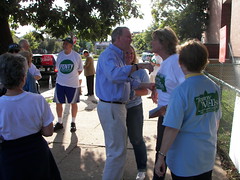
Tommy Wells talking to campaign workers at the Hine School polling site
Tommy Wells talking to campaign workers at the Hine School polling site, 2006.

Three years ago Councilmember Wells introduced annual awards for Livability, to call attention to the residents, civic groups, government employees, and others working to make Ward 6 (and to a lesser extent, the city) a better place to live, work, play and visit. The third set of awards, given out Monday night, shows the progress of the Councilmember's thinking and working on these issues. It's a great array of awards (I seem to recall the first event had three honorees).

From the Councilmember Tommy Wells Blog, "Tommy Hands Out 3rd Annual Livable, Walkable Awards":

Livable, Walkable Neighbor Award – Ms. Elizabeth Nelson

Elizabeth Nelson has spent the better part of two decades working to improve her neighborhood and community. In reviewing the nominations, one neighbor wrote that Elizabeth “personifies the livable, walkable ideal of public service”. Another wrote of her as an “ambassador for the North Lincoln Park neighborhood”. Noted Councilmember Wells, “Elizabeth has helped lead Trees for Capitol Hill – an effort that adds more tree canopies and shaded walks every year.” He added, “Countless times we’ve seen her hauling water jugs to area parks in the summer to make sure young trees survive and thrive. Everyone who knows Elizabeth knows of her passion for preserving and creating great public spaces.” An active volunteer with the Capitol Hill Restoration Society, ANC 6A, the North Lincoln Park Neighborhood Association and the Maury Elementary School PTA, she is both dedicated to our community and our neighborhoods - not just her trees or her street, or her park, or her block, but her entire community.

Livable, Walkable Community Organization Award – Moms on the Hill

Moms on the Hill has become a vital link for parents and families across the Ward. It’s moved well beyond finding the latest information on elementary school test scores and now boasts thousands of members that don’t shy away from sharing the diversity of opinions, priorities and advice from within our neighborhood. Besides becoming a font of information, Moms on the Hill has developed a reputation for true grassroots advocacy for many of the principles and values that create livable, walkable communities. Stated Wells, “From pushing for challenging and high performing neighborhood schools, to supporting strategies to slow traffic commuting on our streets, to embracing public parks and green space, MoTH creates a forum for thoughtful debate that doesn’t pull any punches.” In handing out the award, Wells noted that there is no one voice for Moms on the Hill, but accepting the award on the group’s behalf were many of the women that serve as moderators for the group.

Livable, Walkable Business Award – The Channel Inn

In Southwest DC, retail and restaurants can be scarce. Hundreds of millions of dollars of redevelopment are in the pipeline, creating new housing and office space, and renewed commercial retail options for neighbors. But for right now, neighbors have a hard time finding a cup of coffee, let alone a meal. Despite it all, Manny Fernandez and the Channel Inn have kept their doors open, creating community space where residents can gather, discuss, or simply socialize. “In a neighborhood that too often feels isolated, the Channel Inn is steps from the Circulator bus, two blocks from the Waterfront Metro station, accommodates walking, biking and wheelchairs, and opens its doors onto the river walk of the Washington Channel with boat docks and slips just a stone’s throw away -- it’s just about the most transit friendly restaurant in the city,” commented Wells. Manny Fernandez, the owner of The Channel Inn, accepted the award on behalf of his business and all the Channel Inn employees.

Livable, Walkable Public Service Award – Barry Margeson, Dept. of Real Estate Services

Earlier this year, the community reopened Eastern Market to much excitement – welcoming back the merchants and vendors into their homes. “Shortly after the fire, one man had the unenviable position of serving as the District’s go-to guy – and with every challenge we put before him, he answered the call,” stated Wells. Barry Margeson worked with all the stakeholders – merchants, vendors, neighbors, and elected officials, to find compromise and common ground, be it during streetscape construction, improving daily maintenance, or ensuring our local merchants and vendors have what they need to be successful. Added Wells, “Eastern Market is a special and revered place in the hearts of our community – it’s practically the definition of ‘livable, walkable.’ Barry Margeson has bent over backwards to preserve that for us and I’m proud to recognize that public service on behalf of all of us.”

Livable, Walkable Honorary Award – Miles Groves

“Miles Groves became a resident leader in Penn Quarter almost before there was a Penn Quarter neighborhood,” stated Wells. As the city created a new vision for our downtown, Miles played a pivotal role in turning an area that emptied out at 6 pm, into a vibrant community with retail, restaurants and nightlife, but also supported the new residential neighborhood that emerged. From fighting for better sidewalks, better lighting, stepped up police presence, neighborhood based retail, and most recently, supporting two-wheel alternatives as personal vehicles, he’s been a champion of the revitalization of our downtown. Miles also helped form and lead the Downtown Neighborhood Association, bringing a voice to City Hall for thousands of his neighbors, and became a mentor to dozens of leaders in the communities around him. Miles was unable to attend the event last night, but Councilmember Wells will present him with his award at an upcoming Downtown Neighborhood Association meeting.

Congratulations all, and thank you Councilmember Wells for continuing to focus attention and action on livability and placemaking.

Labels: , , , ,