Rebuilding Place in the Urban Space

"A community’s physical form, rather than its land uses, is its most intrinsic and enduring characteristic." [Katz, EPA] This blog focuses on place and placemaking and all that makes it work--historic preservation, urban design, transportation, asset-based community development, arts & cultural development, commercial district revitalization, tourism & destination development, and quality of life advocacy--along with doses of civic engagement and good governance watchdogging.

Monday, June 28, 2021

Small update: Transit agenda for Greater Baltimore

As discussed in the previous post, "Transit "wokeness" in DC and Baltimore," but reminded by the media coverage of an agreement to improve the B&P Tunnel ("Amtrak, Maryland DOT Debut B&P Tunnel Replacement Plan," Railway Age), which slipped my mind, I forgot to include additional suggestions for transit improvements in Greater Baltimore, from comments on a 2020 GGW post, ""Maryland looks at connecting MARC toward Philadelphia and within Baltimore."

This is the plan for the B&P Tunnel, which will improve the routing and increase the height.

Here is the expanded list.

1.  Extend the transit lines within the city and county and connect them better.  Plus extend light rail to Columbia in Howard County.  ("From the files: transit planning in Baltimore County," 2012) And extend the line northward to the major office district in Cockeysville.

-- Additional Point #1

Construct new Metro Heavy Rail Lines: (1) a new Metro line from Ellicott City to the existing Metro line, with stations along the route (using the old mainline to the B&O museum and having a station under UMMC, along with stations in Catonsville, UMBC etc), and new Metro lines from (2) JHU northeast along the Belair Road and (3) southeast to Canton and Dundalk. (rouge_foreigner)  Covered but not to this level of detail in #1 in the original list.

2.  Create a true regional rail system for Greater Baltimore (and DC), modeled after the German S-Bahn approach.  Integrate MARC into the transit systems in Baltimore City and Greater DC.  Expand the number of intra-city stations in Baltimore especially ("Baltimore City Mayoral candidates views on transportation (and other matters)") (but also DC).  ("One big idea: Getting MARC and Metrorail to integrate fares, stations, and marketing systems, using London Overground as an example," 2015 and others).  


Besides the S-Bahn, The RER (Paris), and London Overground are examples of a regional rail system.  RER is known for undergrounded lines.  (Greater New York has a lot of regional rail, but the system is balkanized across multiple systems and doesn't incorporate through routing.)

In the MARC Growth and Investment Plan from the early 2000s, they proposed three infill railroad stations in Baltimore (Bayview--Hopkins and Madison Square in East Baltimore and Upton in West Baltimore) as well as an upgrade of the West Baltimore station.   The suggestions below add many more infill stations not just in the city but in the counties too.

-- AP 2. Provide a minimum of hourly service in each direction on the Penn Line from 4 am to 2 am.  (marc),  Currently the service runs from 4:45 am to 9:45 pm south from Baltimore to Washington, and from 6:15 am to 10:45 pm from Washington to Baltimore.

-- AP 3.  Electrify the Camden and Brunswick Lines and straighten the routing where appropriate to shorten trip times.  (rouge_foreigner)

-- AP 4.  Extend the Camden Line underground to Penn Station (kk).

A London Overground Station.

-- AP 5.  Combine the St. Denis Station on the Camden Line  by moving it to the Halethorpe Station on the Penn Line to interconnect the lines.  (kk and rouge_foreigner)  (This is also relevant to this post, "Two train/regional transit ideas: Part 2 | Running tourist trains from Union Station.")

-- AP 6.  Add infill stations at Morell Park/Irvington and Lakeland (kk).   

-- AP 7.  Construct a new airport MARC line that allows for a station directly under BWI, probably involving a spur from the Penn Line connecting to the Camden Line on the north side. Airport spurs are about the only kind that are useful in regional rail. (rouge_foreigner)  

-- AP 8.  WRT the B&P Tunnel, rouge_foreigner recommends routing a new tunnel through downtown Baltimore under US 40,  and adding 5 stations: a new central station downtown, roughly at where Metro West is now, and new stations adjacent to the Jones Falls Valley, Johns Hopkins, Elwood Park and Bayview, and four tracking the tunnel (like the Penn Line). Four-tracking enables Amtrak and MARC express service and aims for 30 minute travel time to Baltimore on express.

-- AP 9. Shift the Camden Line alignment before the stadium complex and put it up Russell Street with a new Camden Station near the intersection of Russell Street and MLK Avenue and a northward alignment to Baltimore County and Pennsylvania with multiple new stations including under UM Medical Center, intersecting with the Penn Line in that central station under Metro West (and also the Metro and Light Rail via a tunnel to Lexington Market), then north to stops at a new Penn Station, JHU-Homewood, Loyola/Notre Dame, Towson University, Towson, [ed: + Cockeysville/Hunt Valley], and then on to York and Harrisburg in Pennsylvania. (rouge_foreigner)  (In a way, this re-creates the old Maryland Central Railroad, which  in the 1880s went as far as Lake Ontario in New York State.  Part of its routing is used for the Baltimore Light Rail line.)

-- AP  10Construct a new electrified mainline from Baltimore to Frederick largely along I-70, primarily to avoid having to shunt freight through DC, and run MARC service on it as well (thus also connecting intermediate stops, including the Social Security office complex, Security Square, and others—in Baltimore County, this scheme would largely supplant the since cancelled Red Line light rail proposal). (rouge_foreigner)

-- AP 11. Construct a MARC line from the new mainline by I-70 and 32 or 97 to Annapolis, connecting Columbia, the Penn and Camden lines, Ft Meade, and Annapolis, and potentially even on to the Eastern Shore and Ocean City to alleviate traffic on the Bay Bridge and Route 50.  (rouge_foreigner) 

3.  Merge the Maryland and Virginia Passenger Rail services, starting with the MARC Penn Line and the VRE Fredericksburg Line. ("A new backbone for the regional transit system: merging the MARC Penn and VRE Fredericksburg Lines")

4.  Create a true statewide passenger rail program, connecting western, eastern, and southern Maryland to DC and Baltimore.  ("A "Transformational Projects Action Plan" for a statewide passenger railroad program in Maryland.," 2019)

Note that 

-- AP 9 -- creating a new line northward to Baltimore County and Pennsylvania

-- AP 10 -- creating a new line from Baltimore to Frederick

-- AP 11 -- creating a new line from Baltimore to Annapolis with the potential for extension to the Eastern Shore 

are also relevant to the development of a statewide railroad passenger program as distinct from a regional railroad system for Baltimore modeled on the S-Bahn/London Overground concept.

5.  Upgrade the light rail vehicles in Baltimore, rebrand them, and make other surface transit improvements as necessary. ("Baltimore City Mayoral candidates views on transportation (and other matters" and "Part 7 | Using the Purple Line to rebrand Montgomery and Prince George's Counties as Design Forward")

Labels: , , , , , ,

Friday, June 25, 2021

Transit "wokeness" in DC and Baltimore

Minnesota Avenue NE, Washington Post photo.

DC.  I came across a local op-ed in the Washington Post ("Transit equity should be a priority in D.C.'s budget") about how transit equity means that DC should extend the streetcar east to Benning Road station.  

I find this pretty ironic.  

Not because they are wrong but because it was the "white" transit and economic development advocates like myself who made this point at the outset of streetcar planning c. 2003, and it was the neighborhoods East of the River that were oppositional.

-- "Transportation and economic development: H Street edition," 2011
-- "Sustainable transportation as social justice," 2010
-- "If you build it (streetcars) does economic development magically happen?, 2008

It shouldn't take 17 years to recognize the mistake.

Early on, elected officials then, especially then Councilmember David Catania, argued the streetcar should be implemented in poorer neighborhoods first, because they benefited from better access to employment, schools, and amenities brought on by better transit, because typically they lived in areas that are underserved by transit.

But for the most part, people in those communities were opposed, even if their elected officials were not.  (It's an illustration of my point, based on innovation diffusion theory, that economic laggards shouldn't be expected to be at the front of the adoption of new technologies or ways of doing things. A perfect example of this today is vaccination hesitancy--"Education is a bigger factor than race in desire for COVID-19 vaccine," USC.)

It's one of the examples of why, even with the best of intentions, I argue that rather than implement something in a place where people are opposed, it's often best to do it where it can be wildly successful and is supported, and it can grow from there.  (Although you can't do that with vaccines, and it means that you have to take extra-normal and nuanced steps to improve take up. See "Heidi Larson, Vaccine Anthropologist" New Yorker.)

Streetcar on the 300 block of H Street NE, Washington, DC.

And in fact, that's what happened with the streetcar in DC.  The chair of ANC6A realized that if tracks were installed in H Street NE, which was going to be dug up anyway for streetscape reconstruction, it would increase the likelihood of the streetcar being implemented.  In this case, his "build it and they will come" approach was right.

-- "DC streetcar is opening on Saturday and the opportunity to reflect on the 14 year long process to get there," 2016

This gets back to something else I say about DC, that part of the reason neighborhoods lag is because of legacy leadership that looks backwards, not forward. It's not just disinvestment.  But it's not just the leadership of stakeholders within neighborhoods, it's elected officials more generally.

More recently, DC elected officials haven't been particularly committed to the streetcar ("Bowser Administration Considering Killing D.C. Streetcar Expansion Plans," WAMU/NPR, "DC streetcar to Georgetown is dead," WTOP-radio), despite the fact that it has helped to stoke close to $1 billion in new construction ("DC and streetcars #4: from the standpoint of stoking real estate development, the line is incredibly successful and it isn't even in service yet, and now that development is extending eastward past 15th Street").  

And they have failed to recognize streetcar service can be used to stoke improvements elsewhere in the city (e.g., Riggs Road/Kennedy Street; Minnesota Avenue-Benning Road, Georgia Avenue, etc.).

2.  Baltimore.  Like DC ("DC, Transformational Projects Action Planning, and the Baltimore-Washington Maglev project"), Baltimore has told the Federal Railroad Administration that they aren't into Maglev being constructed between DC and Baltimore ("Baltimore City recommends against building proposed $10 billion high-speed Maglev train to Washington," Baltimore Sun).  From the article:

“The City of Baltimore has several concerns … related to equity, environmental justice, and community impacts,” they wrote. “Additionally, the draft lacks a sufficient level of detail regarding current and future plans for the project which make a comprehensive analysis difficult. The proposed project is also not aligned with significant efforts underway to upgrade existing rail infrastructure in the corridor.” ...

But Baltimore’s four-page response detailed officials’ concerns about the effects of the train and the proposed Camden Yards or Cherry Hill stations on local communities and the environment. 

Tickets projected to cost $60 each way, they wrote, “would negate an affordable and alternate form of transportation to the average citizen, and/or rider(s).” 

“While numerous local jurisdictions and riders along the corridor would not be served by the SCMAGLEV, they would be subjected to the construction impacts,” the city officials said. 

Also see "Baltimore cites ‘equity, environmental justice’ in saying no to high-speed maglev train project," Washington Post.

My comments about DC's position were focused on how DC ought to realize that they need to stoke the value of the central business district as a place to operate.  DC has lagged compared to other major cities in terms of inward migration of corporate headquarters.  But that Maglev is also a way to re-articulate and improve the local transit network and in DC's case, also a way to push forward tunnelizing the connection of I-95 via New York Avenue to I-695 ("Maglev as an opportunity for DC to underground through traffic on New York Avenue").

Recognizing of course that for Maglev to truly be useful, it needs to extend southward to Richmond and northward to Philadelphia, New York City and Boston.

Amtrak also opposed to Maglev.  The problem is that Amtrak's expansion plans, which are visionary ("AMTRAK’S ‘CONNECT US’ EXPANSION PLANS: THINGS TO KNOW," Amtrak Guide) considering how much the US is a laggard when it comes to railroad passenger service, have no place for Maglev in the Northeast Corridor, especially as a competitive service run by the private sector ("D.C.-to-Baltimore maglev would only benefit rich, Amtrak chief says," Baltimore Sun).

But why miss the opportunity to improve Baltimore City's transit system at the same time?  But Baltimore is exactly like DC in having an incredibly circumscribed view of what Maglev's purpose is.  It's not to provide intra-city transit, it's to provide long distance travel that makes the city more attractive economically, as well as to provide the goad to re-articulate and improve the local transit system.  

A complementary transit network improvement program for Baltimore.  WRT improving Greater Baltimore's transit system, I've laid out such an agenda:

1.  Extend the transit lines within the city and county and connect them better.  Plus extend light rail to Columbia in Howard County.  ("From the files: transit planning in Baltimore County," 2012) And extend the line northward to the major office district in Cockeysville.

2.  Integrate MARC into the transit systems in Baltimore City and Greater DC.  Expand the number of intra-city stations in Baltimore especially ("Baltimore City Mayoral candidates views on transportation (and other matters)") but also DC.  ("One big idea: Getting MARC and Metrorail to integrate fares, stations, and marketing systems, using London Overground as an example," 2015 and others). 

3.  Merge the Maryland and Virginia Passenger Rail services, starting with the MARC Penn Line and the VRE Fredericksburg Line. ("A new backbone for the regional transit system: merging the MARC Penn and VRE Fredericksburg Lines")

4.  Create a true statewide passenger rail program, connecting western, eastern, and southern Maryland to DC and Baltimore.  ("A "Transformational Projects Action Plan" for a statewide passenger railroad program in Maryland."," 2019)

5.  Upgrade the light rail vehicles in Baltimore, rebrand them, and make other surface transit improvements as necessary. ("Baltimore City Mayoral candidates views on transportation (and other matters" and "Part 7 | Using the Purple Line to rebrand Montgomery and Prince George's Counties as Design Forward")

WRT this kind of agenda, it is of no interest to Governor Hogan, who is fully committed to motor vehicle throughput and cares very little about either transit or Baltimore ("Maryland says it needs to cut transit, highway projects to offset lost private investment in toll lanes plan," Washington Post).

Using Maglev as a way to force improvements across the Greater Baltimore transit system may be the only way to bring about change.  And that would go a long way towards providing transit equity to Baltimore's citizens.

========

Also see my writings on 

1.  Transformational Projects Action Planning ("Why can't the "Bilbao Effect" be reproduced? | Bilbao as an example of Transformational Projects Action Planning" and "Downtown Edmonton cultural facilities development as an example of "Transformational Projects Action Planning"") and 

2. Using new transit infrastructure as a way to drive complementary improvements across a transit network ("Revisiting the Purple Line (series) and a more complete program of complementary improvements to the transit network" and "Using the Silver Line as the priming event, what would a transit network improvement program look like for NoVA?") or line ("A "Transformational Projects Action Plan" for the Metrorail Blue Line").

It also reminds me of some of my writings about how residents don't always know the best way to advocate for their interests, although this is at the city scale.

For example, residents often argue every development should be for families, even though nationally only about 25% of households have children and 40%+ of households are a single person, making housing more expensive, or that all developments should have tons of parking, even in places by city transit stations, where typically only 25% of rush hour trips are by car.  But by encouraging parking and cars, they're advocating for making roads more congested.  Instead they ought to be advocating for sustainable mobility, so they have less competition for space on the roads for their car, because people like me are using transit or biking.

DC and Baltimore ought to be arguing in favor of initiatives that make their central business districts more central and competitive, and for ways to leverage improvements across their transit networks.  Not arguing against this.

Labels: , , , , , ,

Tuesday, January 26, 2021

DC, Transformational Projects Action Planning, and the Baltimore-Washington Maglev project

=======
Update: 7/1/2025

Trump Administration denies further funding for Northeast Maglev.


==========

Yesterday's Washington Post reports ("D.C. warns a maglev stop at Mount Vernon Square would bring disruption") that DC is far from "all in" on the proposed Northeast Maglev train project touted by the State of Maryland. The program is to start with service between DC and Baltimore, and over time continue north to New York with intermediate stops. 

According to the Post, the DC Office of Planning calls on residents to submit negative comments because of the impact on the area where the station is proposed--Mount Vernon Triangle--rather than at Union Station, which was proposed in earlier maglev iterations.  From the article:
A maglev station in the Mount Vernon Square area has the potential to change the character of the neighborhood and bring “substantial construction and long-term operational implications on nearby properties,” Andrew Trueblood, director of the D.C. Office of Planning, said in a statement that urged residents and city leaders to engage in the federal review of the multibillion-dollar project.
Um, duh.  Any new infrastructure project causes problems while under construction and leads to change.  It's rare when the change isn't beneficial (other than road widening).

Comment period open until April 21st.  

The comment period is open til April 21st, 2021 and the full document is available at the Federal Railroad Administration website, Baltimore Washington Superconducting Maglev Project.

Previous reservations of my own.  I haven't been "all in" myself, because of fears of transit balkanization--for example Maryland's Governor is into maglev, but not in investing in Maryland's extant passenger rail system--because it will take so long to build--the projected opening would be 2030 just to get to Baltimore, and likely 10-20 more years to get to New York City, because just being from DC to Baltimore, and expensive--trip fares will be expensive, $60 one way, albeit for a 15 minute trip, it will draw energy away from Amtrak's separate plans to upgrade the Northeast Corridor, and because it will probably be after I am dead before the line reaches New York City. 

-- Fact Sheet: High Speed Rail Development Worldwide, Environmental and Energy Study Institute

But an objective approach is required.  OTOH, just because I'll be dead by the time Northeast Maglev provides service to New York City or Boston shouldn't mean that we don't take a proper and expansive transportation planning approach to the project.


Plus, it allows us to look at it in multiple dimensions.

First, should be using the approach that I call "transformational projects action planning," where you use big projects in two ways, to:

(1) push vision and revolutionary practice forward within a particular project

(2) move other related projects forward simultaneously, resulting in greater success overall.

Maglev Advantages.  (1) Super Fast.  (2) Can serve as a backbone for a wider passenger rail network, which would feed passengers to and from the maglev route.  (3) Will link major cities in the Mid-Atlantic, eventually, so will have the power of being a network, not of lines, but of places. (4) Sustainable mode, powered by electricity.  Can displace environmentally costly airplane travel over short distances.  (5) Mid Atlantic states can generate offshore power cheaply (eventually) and sustainably.  (6) Not necessarily limited to existing railroad right of way corridors.

Maglev Disadvantages.  (1) Expensive to build.  (2) Expensive to ride.  (3) Difficult to acquire right of way.  (4) Most states have weak existing passenger rail networks, which need to function in part as a feeder network to maglev.  (5) Current plans for service are limited, from DC to Baltimore initially, and eventually to Philadelphia and New York City.  (6) At this time there aren't plans to extend northward to Boston or south to Richmond.  (7) New maglev stations aren't necessarily part of the existing rail network, requiring new transit and railroad connections to fully leverage the addition of the maglev service within the existing network of transit services.

New infrastructure as a way to drive complementary improvements across a transit network.  In terms of transportation infrastructure, a few years ago I made the point that we should use new transit infrastructure projects to simultaneously drive complementary improvements across the overall transit network, so that the new infrastructure is wildly successful from the outset, and in turn increases overall transit ridership across the system.

I've written about this conceptually in terms of the Purple Line light rail in Suburban Maryland, the Silver Line addition to the DC area Metrorail system, Maryland's passenger rail system, what could be done with the Blue Line Metrorail, and leveraging the new Amazon HQ2 in Arlington County, Virginia for new transit connectivity.


Second would be how can DC benefit economically from leveraging Maglev service with a station in Downtown DC.  After all, it competes with Arlington County, Alexandria, Fairfax County, and various centers in Montgomery County as a location for business activity, high profile headquarters projects, research centers, nonprofits, etc.

For example, I've written about how the Maglev, being underground in DC, could be a way to push forward the c. 2005 concept to underground regional through motor vehicle traffic for New York Avenue, which functions the connection for I-95 between Maryland and Virginia.


It doesn't surprise me that DC sees the Maglev as a threat, because (1) the city isn't particularly visionary any more when it comes to planning, (2) Maglev is promoted by Maryland's Republican Governor ("Hogan calls maglev ride 'incredible,' says state will seek $28 million grant to study,"  Baltimore Sun), (3) at the expense of more traditional and existing transit--subway, train, and bus services, (4) a railroad station in Mount Vernon Triangle would compete with Union Station as the city's premier railroad station, (5) for which there is tremendous expansion already planned ("Pressure mounts on federal agency over Union Station redevelopment. Critics say plan is too focused on cars," Washington Post).

DC's Central Business District is on the decline, why not leverage Maglev as a way to stoke demand and broaden beyond dependence on the federal government.  OTOH, given that DC's central business district is experiencing a reduction in demand even in advance of the pandemic ("Could DC Incentivize Office to Residential Conversions?," Urban Turf), to me it's incredibly foolish to not consider the opportunities that Maglev could create in stoking new demand for office space and location within DC generally and the Central Business District specifically ("Could bringing premier regionally headquartered business enterprises to the Pennsylvania Avenue Corridor be key to its renewal and revitalization?," 2014), as opposed to the suburbs.

This is key in broadening the local economy, in particular DC's economy, beyond dependence on the federal government.


The private Brightline railroad passenger service in Florida, which will link Miami to Tampa, is being leveraged by localities to drive business and office demand in the areas around the new stations ("Brightline train stations boost new development in South Florida's downtowns," South Florida Sun-Sentinel).


But stations driving economic development for city centers is not a new phenomenon.  One of the best examples in the US is the office district around Grand Central Station in New York City.  But the power of railroad station related development extends even to small stations.


Maglev as yet one more example of the broader failure to do coordinated and integrated metropolitan, regional, and multi-state transportation planning.  As I have written multiple times, I am enamored of the German "transport association" model, which provides overarching planning and coordination of transit service over wide areas, integrating multiple modes and different operators, through linked services, fare systems, and marketing, in ways that are transparent to the rider.


Although even the German approach has a problem with integrating for profit mobility organizations within the association, as do planning agencies in the US.


Not having an integrated "transport association" approach in the DC area is extremely problematic.  You have multiple transportation planning agencies, multiple transit operators, multiple local agencies doing transportation planning, with no overarching planning organization, and different mobility and land use goals that are often conflicting, resulting in massive amounts of duplication and discoordination, let alone limited interest in promoting sustainable mobility.

DC's reaction proves my point, that the Maglev program is a perfect example of the failure to coordinate between modes and to develop a complementary program of transit network improvement.

The ideas below are offered based on the idea that fixed rail services should be seen as a set of integrated and complementary services.  The map below, from Amtrak maglev planning c. 2003, shows how Amtrak intended to position maglev as a premium service, within a framework of integrated passenger railroad services, providing different speeds, express vs. local service, price points, etc.

The concept presented below is a complemented and integrated set of railroad passenger services in the Mid-Atlantic, with super speed maglev service as the backbone.


An offhand....

Proposed Complementary Transit Network Improvement Program
associated with the Northeast Maglev initial phase between Baltimore and Washington

1.  Use the maglev tunneling to underground the section of New York Avenue functioning as I-95 within the city ("Maglev as an opportunity for DC to underground through traffic on New York Avenues") to move regional/through traffic off surface streets.

2.  Utilize existing buildings at the confluence of 7th Street, Mount Vernon Triangle, Massachusetts Avenue, K Street, and New York Avenue NW, knitting them together to serve as a combined station.  The Techworld building would be an especially good option.


3.  Create a visitor center at the Maglev station ("2019 (US) National Travel and Tourism Week: A visitor centers agenda for DC") and implement my proposed heritage streetcar service for the National Mall and Arlington Cemetery ("A National Mall-focused heritage (replica) streetcar service to serve visitors is way bigger idea than a parking garage under the Mall").  Compared to the original concept, the heritage line would have  be extended between Union Station and Downtown.

4.  Use the maglev station as the anchor of a new business recruiting program for Downtown DC. Update DC's economic development plan and the Transportation and Economic Development elements of the Comprehensive Plan to acknowledge and support the maglev program.  Update the Downtown Development Plan.  The most recent Downtown (Center City) Plan is almost 13 years old.

-- Center City Plans, DC Office of Planning

Maglev should develop special promotions with DC's Capital One Arena for special event transportation to concerts, etc., as a marketing tool.

5.  Create a set of underground connections between the new station and the Gallery Place, Metro Center, and Mount Vernon Square stations, modeled on the Chicago Pedway, Toronto PATH, and Montreal RESO/Underground systems ("Hong Kong needs to create a formal and planned pedestrian mobility network").  


Use the Urban Design Manhattan approach to horizontal and vertical mobility planning in association with transit stations to shape the program ("Public improvement districts ought to be created as part of transit station development process: the east side of NoMA station as an example").

Although it's likely that Northeast Maglev would like to do this anyway, the fact is that to do so requires underground connections of two blocks or more, which necessitates close involvement with DC Government's planning, transportation and economic development agencies.  Right now they don't seem on board.

6.  Integrate railroad passenger fare media into the SmarTrip/CharmCard system as previously discussed ("One big idea: Getting MARC and Metrorail to integrate fares, stations, and marketing systems, using London Overground as an example") and include the Maglev service.  Provide discounts for SmarTrip/CharmCard users.

7.  Work with Northeast Maglev and Metrorail to provide free connecting service between Union Station and Mount Vernon Triangle as a benefit of the fare, the way that using Metrolink rail in Southern California includes free use of LA Metro transit, through the QR code on the ticket.

8.  Use the Maglev program to drive forward the Separated Silver Metrorail Line as proposed in previous entries ("If DC had visionary elected officials and planners it could use the new WMATA "BOS" study to push through the development of a separated Silver Line in DC (and Northern Virginia)").   

9.  Start with the section of the proposed Separated Silver Line between Rosslyn and Union Station.  Because the ability to build a full separated Silver Line between Falls Church and DC will take more than 10 years from a standing start, there could be a phased program, first with the section between Rosslyn Metrorail Station and Union Station, with later phases between Falls Church and Rosslyn and between Union Station and a connection to existing lines in the vicinity of RFK Stadium.

Initially this would add at least four new stations including a vital connection to Georgetown (and obviating the need for a gondola), as well as connections to existing stations at Dupont Circle, Mount Vernon Square, and Union Station.  This will provide a vital connection between the Mount Vernon Square Maglev Station and Union Station, connecting to Amtrak and MARC and VRE regional passenger rail services.

(Note that providing underground connections between the Maglev station and the nearby Metrorail stations--Gallery Place, Mount Vernon Square, Metro Center--makes this less of priority as it relates to Maglev service, but Maglev, with a connection to a new Silver Line station, could complement and  move forward various Union Station expansion efforts, which to expand needs additional subway service capacity, which would come from an additional Metrorail line.)

10.  Consider raising the city's building height limit ("NCPC study on height limit: hearing, comments," 2013) to leverage the Maglev service and to help pay for the cost of creating a Separated Silver Line in DC, and underground connections linking the Maglev station to Metrorail.  

11.  Extending the Separated Silver Line from Union Station to RFK would drive forward economic development opportunities for the RFK site ("Yes, modify and extend the RFK Campus lease; No, don't do it for the Washington Redskins football team," 2018) and provide Metrorail Service to the H Street corridor.  Benefits would be further extended if an additional leg of a Separated Silver Line were extended up Bladensburg Road to New York Avenue and potentially beyond.

12.  Extend the Maglev Service South to National Airport and Richmond.  In keeping with Virginia's existing plans to improve rail service throughout the state ("Virginia to build Long Bridge and acquire CSX right of way to expand passenger train service," Washington Post), extend planning for Northeast Maglev to Richmond, with a stop at National Airport.  

Ideally, planning could start soon, so that service at the very least to National Airport could be provided by 2035, with a later phase extending service to Richmond.

This will provide better connections for Amazon HQ2 in Arlington and further the development of high speed rail service south of Washington, in terms of developing a Southeast High Speed Rail Corridor that complements and extends the Northeast Corridor (this was discussed in the previous entry, "More need for redundancy/"hardening" in the DC area rail transit system: Amtrak's temporary shutdown of service south of DC").

(Note that planning for a southern extension could delay the program slightly, as the Downtown DC station would no longer be a terminus.)

13. Integrate the Crystal City railroad station(s) into the ground transportation system of National Airport as previously discussed ("A brief comment on ground transportation at National Airport vis a vis VRE rail service")

14.  Merge MARC and VRE as discussed in previous entries, starting with the MARC Penn and VRE Fredericksburg Lines ("A new backbone for the regional transit system: merging the MARC Penn and VRE Fredericksburg Lines").  I call the merged system RACER, for Railroad Authority of the Chesapeake Region.  Introduce bidirectional services between DC and Fredericksburg.

15.  Complementing the Northeast Maglev, Maryland should develop an expansive statewide passenger rail program ("A "Transformational Projects Action Plan" for a statewide passenger railroad program in Maryland"), funneling riders from throughout the state to the Maglev stations, based on the future extension of the Maglev service to New York and as proposed above, southward to Richmond, and as proposed below, further north to Boston. 

16.  Accelerate planned railroad improvements between DC and Richmond, including expansion of the Long Bridge, and throughout the State of Virginia, to complement access to the Maglev line through stations in DC, and as proposed above, at National Airport and Richmond.

17. Continue the proposed integration of the MARC and VRE railroad passenger services into the RACER concept by providing some "MARC Penn Line" connection service to Manassas, thereby incorporating the Manassas Line into the program.  Introduce bi-directional railroad service between DC and Manassas in association with the combination of the MARC Penn and VRE Manassas Lines into one integrated service.

18.  Extend Blue Line Metrorail service south to Dale City/Occoquan and Yellow Line Metrorail service to Fort Belvoir as discussed in past entries.

===========

19.  Get Northeast Maglev to commit to planning extending the Maglev from New York to BostonPrevious maglev planning efforts undertaken but since abandoned by Amtrak presumed service from DC to Boston.

Labels: , , , , ,

Sunday, May 06, 2007

Denver considers maglev service from the airport to the city (just like Shanghai)

Hmm, maybe that's what should have been done for Dulles Airport...

See this article, "RTD opens door to tech," and this editorial, ""Maglev' trains may be key to congestion," from the Denver Post.
---------------
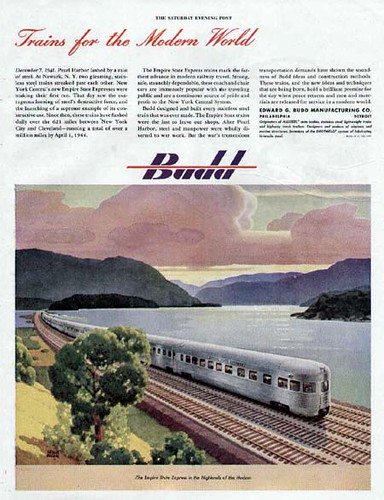
I am reading a lot now about transportation for a paper (the reading is letting me know how much I don't know about the field, the volume of writings is incredible) and the U.S. was widely considered to be the world leader in streetcar technology as late as the 1940s. Certainly, the country's locomotive manufacturers and railroad system builders were once in a similar position. (Will F. has pointed out that the foundation of Bombardier's diesel motive unit technology is the old Budd Company of the United States.)
Budd ad

Labels: , , ,