I have to admit that 10 years ago, I was much more hardcore about transit vs. cars. While I am still pretty hardcore about shifting trips from motor vehicles and supporting the sustainable mobility platform, the reality is that the transportation system is a system and it's best to approach it in that fashion, rather than to be almost exclusively focused on one particular mode.
From the standpoint of a multi-modal transportation system functioning at multiple scales--and in the case of freeways at multi-state, regional, and metropolitan scales--I can see the utility of adding roads, recognizing that in the US transportation system motor vehicle use is privileged and we must fight to ensure that sustainable modes are prioritized and at the very least, simultaneously addressed when major road projects are proposed.
Besides the scale at which various proposals need to be considered, what needs to be focused on in such proposals is the land use context, whether the project extends "sprawl," AND complementary mobility network improvements, especially in terms of other modes.
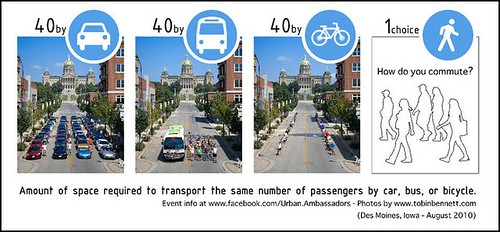
One of the best ways to "expand capacity of the road network" is to shift trips from cars to transit and biking, and walking. Even marginal drops in traffic of 5% to 10% can result in significant capacity and throughput improvements.
But what happens is that the throughput improvement leads people to make more trips, ultimately using up the capacity. This is why many smart growth advocates talk about "induced demand" and argue that adding roadway capacity just gets "used up," so why bother? It's also why some economists argue for tolls, so that there are costs associated with taking trips, and therefore capacity is less likely to be absorbed "frivolously."
-- "
What’s Up With That: Building Bigger Roads Actually Makes Traffic Worse,"
Wired Magazine
-- "
Some Like It HOT: High-occupancy toll lanes work best on high-traffic roads. Without congestion, drivers have little incentive to pay the toll<," Brookings Institution, 2002
Yesterday, Maryland's Governor announced a major program to add high occupancy toll (HOT) lanes to I-270, I-495--the Capital Beltway in Montgomery and Prince George's Counties, and the Baltimore Washington Parkway, which currently is controlled by the National Park Service ("
$9 billion highway project would widen 3 major Maryland roadways with toll lanes, Hogan says,"
Baltimore Sun).
From the article:
Maryland Gov. Larry Hogan on Thursday proposed a $9 billion plan to add express toll lanes to the routes of three of Maryland’s most congested highways — the Interstate 495 Capital Beltway, the I-270 spur connecting Frederick to D.C., and the Baltimore-Washington Parkway between the two cities. ...
The highway expansions would add two express toll lanes each way to roughly 100 miles of roadways in Maryland’s densely populated central region. Existing lanes on each road would remain free to drivers.
The massive undertaking involves persuading the federal government to give the Baltimore-Washington Parkway, now controlled by the National Park Service, to the Maryland Transportation Authority.
The price tag for the Baltimore-Washington Parkway would be $1.4 billion. It’s dwarfed by the size of the combined $7.6 billion project to widen I-495 and I-270. Those new lanes would be built and maintained by private companies through public-private partnerships, or PPPs, in what the governor said would be the largest highway public-private partnerships in North America.

HOT lanes add capacity through the private sector, which builds lanes in return for revenues from toll charges, usually on very long contracts--50 to 99 years in duration.
The argument is that the public sector can't afford to add capacity on its own and that the addition, even if less democratic because people have to pay to use it, leads to throughput capacity improvements for all the lanes.
These arrangements are called "public-private partnerships," but I don't think they meet the definition of a partnership. They are contractual and financing agreements guided completely by contract provisions. The contracts are difficult to change. There isn't a sense of mutuality.
In short, the state is desperate for someone else to pay for road expansion, and the operator wants to maximize their financial return. The party with money has more power and advantages within the relationship.
There can be problems with HOT lanes in terms of how to get scofflaws to pay and public oversight of the process of penalizing non-payers.
One advantage of HOT lanes is that they tend to be well run in terms of maintenance and "accident clearance," because of performance standards within the contract.
Sometimes, because use projections have been too robust, the projects go into bankruptcy, and either the project is refinanced, acquired by another operator, or sometimes acquired by the public sector.
HOT lanes are big in Virginia. The are expanding in the I-95 corridor and will be extended to the I-66 corridor (
66 Express Lanes website).
They function in Northern Baltimore too, on I-95, where they are run by the state ("
I-95 toll lanes set to open north of Baltimore,"
Washington Post), but it isn't clear that the system needed the capacity expansion as much as they were a political priority of the Ehrlich Administration, which also approved the creation of the Inter County Corridor toll road in Northern Montgomery and Prince George's Counties.
There have been some complaints, which I think are reasonable, that the HOT lanes for 495 in Virginia would work better if they were integrated with Maryland roads.
Definitely that makes sense for the I-270 corridor, which needs a broader corridor management approach as I wrote about last year ("
Transportation network interruptions as an opportunity: Part 2" and "
Transportation network service interruptions part 3: corridor/commute shed management for Northwest DC and Montgomery County, Maryland"), but I argued that if HOT lanes were extended to I-495/American Legion Bridge and I-270, they should be accompanied by simultaneous transit improvements.
Along those lines, I came across an article about the integration of toll lanes in the SR-91 corridor--a corridor management plan--for both Orange and Riverside Counties. The toll lanes started out in Orange County, but were extended by Riverside County for 8 miles, to better manage the road resource and add capacity ("
91 Express Lanes in Orange County paved way for new toll lanes opening Monday in Riverside,"
Orange County Register).
While each county will keep the tolls it collects, the lanes are managed and operated jointly across the two counties. This is a big deal because such agreements typically are handled by "joint powers authorities" operating at a multi-county scale.
My concerns about the Maryland "Traffic Relief Plan"
1. The road expansion proposals are mode-specific and aren't part of a complete and integrated multi-modal proposal.
Virginia's
Atlantic Gateway project ("
What to expect from Virginia's Atlantic Gateway projects,"
Washington Post) is a good example of what is missing in the Maryland proposal.
Maryland is proposing roadway expansion only. While Virginia is focusing on roadway expansion, they are also working on large scale transit improvements at the metropolitan and regional scales.
Although there is justifiable criticism that transit service (long distance bus) was supposed to be included in the 495 Express Lanes project and it wasn't. (It is supposed to be a significant element of adding tolling to I-66.)
The Atlantic Gateway considers how to simultaneously improve other modes and shift trips away from the automobile when it is efficient and cost effective to do so. The Maryland HOT lanes proposal does not.
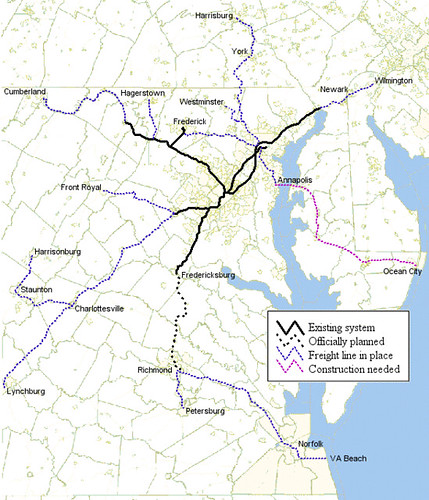
Maryland already has an expansion program for MARC, the passenger railroad system, but for the most part it isn't moving forward, with the exception of work towards extending service on the Penn Line to Delaware.
According to the
Wilmington News-Journal ("
Maryland trains to Newark inch closer"), either MARC could extend from Perryville to Newark, or alternatively, SEPTA could extend from Newark to Perryville. Service could start in about three years.
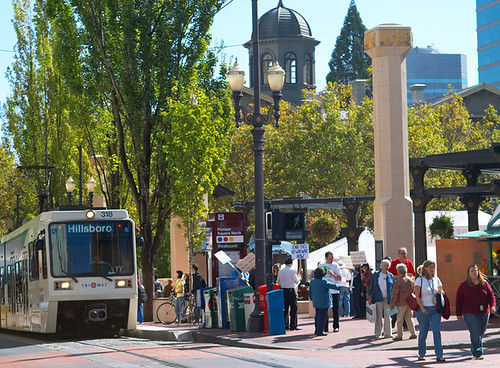
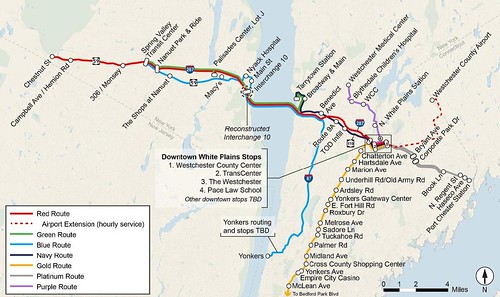 Lower Hudson Transit Link proposed bus service, Westchester/Rockland, New York
As another example of providing integrated transportation improvements using a corridor management approach, the new Tappan Zee Bridge in New York State, which primarily serves automobile and truck traffic, is accompanied by a program of transit and traffic improvements called the
Lower Hudson Transit Link, targeting the I-287 corridor, although the new bus service connecting Westchester and Rockland Counties won't open until next year with the opening of the Bridge's second span (and the final service program will be truncated, as it originally anticipated providing service as far south as the Bronx ("
Street Beat: A New Bus For A New Bridge. TZx–>LHTL," Nyack News and Views).
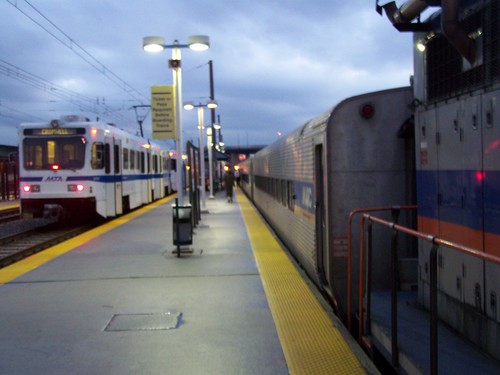
Light rail and MARC train, Camden Yards Station, Baltimore
MARC expansion more generally, my idea for beginning to merge the MARC and VRE systems ("
A new backbone for the regional transit system: merging the MARC Penn and VRE Fredericksburg Lines"), and ideas expressed in this post, "
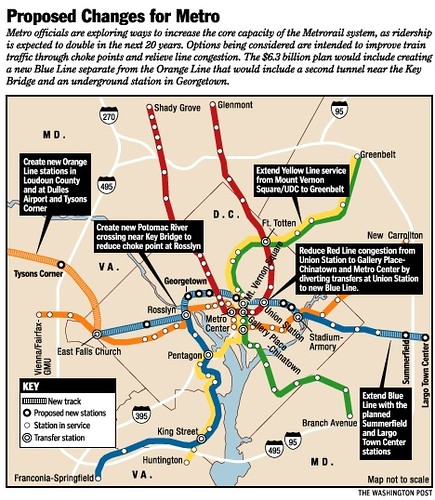
Setting the stage for the Purple Line light rail line to be an overwhelming success: Part 2 | proposed parallel improvements across the transit network," proposing complementary transit network improvements simultaneous with the creation of the Purple Line light rail line are the kinds of things missing from the Maryland
transportation infrastructure expansion HOT Lanes expansion initiative.
2. Too much money sloshing around in financial markets favors HOT lane projects.
Because there is a lot of money out there to finance toll projects, these kinds of road construction projects ends up making states like Maryland more focused on expanding roads, rather than considering road expansions as part of a broader set of transportation system improvements, including long distance transit (railroad and commuter bus), medium distance transit (subway, light rail, bus), and short distance transit.
Separately, this problem, the availability of financing and revenue generating capability driving transportation "planning," is endemic to the various proposals by the Trump Administration for investment in "infrastructure" ("
The Many Problems With Donald Trump's Infrastructure Plan,"
Newsweek Magazine).
3
. There's no way that Maryland will be able to negotiate an agreement with the Federal Government/NPS on a short time frame to be able to get control of the Baltimore-Washington Parkway.
The Baltimore-Washington Parkway is owned and operated by the National Park Service. NPS doesn't willingly give up programs, especially when the change is likely to be accompanied by changes that aren't congruent with natural resource preservation, conservation, and management principles.
Even in situations where the federal government wants to give up property, it takes years. For example it took about 5-6 years to transfer the deaccessioned Walter Reed Army Medical Center to the DC Government.
Although various proposals over the decades have put forth transferring the road to the State of Maryland, but for various reasons such a change was never consummated. Similarly, issues concerning the Parkway and various use matters have been top of mind for awhile ("
B-W Parkway Upgrades: How, When?: NPS, FMA Discuss,"
BizMonthly), including a proposal to widen the road initiated by a Baltimore-area Congressman, Dutch Ruppersberger ("
Plan to widen BW Parkway concerns local officials,"
Washington Examiner).
The announcement by Governor Hogan wrt the Parkway illustrates that such initiatives tend to have very long histories.
4. However, it would be a good idea for NPS to get out of the road operation business.
First and foremost, the National Park Service should be focused on park management and operations. While parkways in the Washington-Baltimore area run by the NPS do connect various park installations, for the most part these roads serve transportation purposes. Roadway operation that is not park related diverts scarce funds from parks.
It would be better for NPS to give up financial responsibility for this and other parkways in the DC-Baltimore area, and reprogram monies spent on these roads to other NPS priorities, given their gargantuan maintenance backlog. See the 2016 blog entry, "
The National Park Service shouldn't be on the hook for basic roadway infrastructure in the Washington Metropolitan Area."
5. The parkway is a particular type of long distance road treatment that is "park like" in conception. Adding HOT lanes to the Baltimore Washington Parkway completely changes its context, negatively.
There's something to be said for roads that aren't "traffic sewers," that are park-like. For example, according to a
History of Pelham Parkway in the Bronx borough of New York City:
The parkway is lined with trees on both sides and had a strict building code. Nobody was allowed to build within 150 feet of the center. No railroads were allowed to cross over the parkway; this is why the roadbed of the New Haven Railroad had to be laid in a tunnel underneath the parkway which is now the Dyre Avenue subway line. Bars and hotels are also prohibited from being built alongside the parkway.
Baltimore Washington Parkway as a scenic entry to Washington, DC. NPS photo.
It would be a shame to lose the park-like elements of the BWI Parkway. Although granted, it can be full of cars now and isn't the kind of experience that was intended by the parkway's creators.
While there are many "parkways" that are freeway-like in terms of the volume of traffic, they are still park-like in design. I doubt there are any HOT lane projects with a parkway-like design, and I can't imagine that is a concern of the Hogan Administration.
If NPS would even agree to the change, if Maryland were to take this road over and change its context, in return significant mitigation benefits in terms of park and transportation system (bikeways and trails and transit improvements especially) should be provided, something that is unlikely to be received warmly by the Hogan Administration.
Labels: corridor management, freeways, public finance and spending, sustainable mobility platform, tolls and toll roads, transportation infrastructure, transportation planning, urban design/placemaking

.jpeg)
.jpg)