Rebuilding Place in the Urban Space

"A community’s physical form, rather than its land uses, is its most intrinsic and enduring characteristic." [Katz, EPA] This blog focuses on place and placemaking and all that makes it work--historic preservation, urban design, transportation, asset-based community development, arts & cultural development, commercial district revitalization, tourism & destination development, and quality of life advocacy--along with doses of civic engagement and good governance watchdogging.

Sunday, December 13, 2020

Winter biking promotion: San Diego

Road conditions can be the primary motivating (or demotivating) factor for winter cyclists. PHOTO BY ALLEN MCINNIS /Montreal Gazette

I've written about promoting bicycling all year round, including in winter--meaning winter with snow.  And planning for it systematically.


Minneapolis' great bicycle plan has an element on maintenance, including the winter season.

And I recommend doing commercial district revitalization planning by daypart and season ("Events and programming in a systematic manner").

For example, Montreal has a winter cycle route program, which prioritizes snow clearance on those routes, which is a subset of the routes supported during temperate months ("Winter biking in Montreal? No sweat," Montreal Gazette).  Calgary does too.

The Winter Cycling Federation sponsors the Winter Cycling Congress, linking cities from snowy climes, and some cities have organized a Winter Bike to Work Day or Week, like Boulder, and related programming.  Fort Collins, Colorado offers a "Winter Cycling" workshop.

-- "Winter preparedness, planning and the Walking/Biking/Transit City," 2019

International Winter Bike to Work Day is the second Friday in February.


Granted San Diego is temperate, but their "Winter Wonderland Week" of events and initiatives is a good model for promoting biking during the winter season.

One of the events is a self-guided bike tour event around the city, called the Joy Ride, with pit stops.  That's a great idea too.


Granted it's not all fun and games.  For example, bicycle sharing systems that operate year round have protocols that shut the system down when weather conditions are particularly bad.

But still, as long as conditions are not super icy or polar vortex cold, it's possible to bike in the winter in many places, so long as you dress appropriately and have the right gear like rainpants and face masks ("Tips for winter biking," REI, "How to Ride Your E-Bike All Winter," TreeHugger).

Labels: ,

Thursday, December 03, 2020

(Revisiting) A canal skateway in Georgetown, DC?

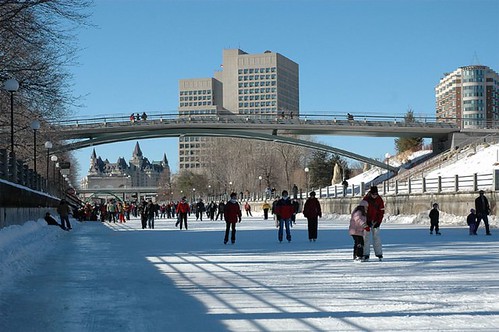
Rideau Canal, Ottawa.

A few years ago, Will Handsfield, then with the Georgetown BID, wrote a piece, "Could Georgetown’s C&O Canal become a winter skateway?," in Greater Greater Washington, about the possibility of a special winter use of the C&O Canal, as skateway, modeled after Ottawa, Ontario (and in a way, the Bentway, an under-freeway skateway in Toronto, "Under freeway ice skating track opens in Toronto").

Also see the Georgetown Metropolitan blog entry, "Skating on the canal is legal."

I and others commented, and the general consensus was that it is a cool idea, but because Washington tends to be relatively warm in the winter, it would be hard to pull off.

But as pointed out in "Planning programming by daypart, month, season: and Boston Winter Garden, DC's Holiday Market, etc.," it's important to look more systematically, even without a pandemic ("Planning for winter outdoors in the wake of coronavirus"), at winter as a season and how to program it from a placemaking and activation standpoint.

Flickr photo by ermakov of the VDKNh ice rink in Moscow.

I saw an AP photo of the linear section of probably the largest ice skating rink in the world, in Moscow, which is part of the VDKNh--Exhibition of Achievements of National Economy--and is about 200,000 s.f., and organized into various different icescapes.

It made me realize like how I had to get over my thinking that we can only have large pedestrian districts or malls, modeled after Europe  ("Why doesn't every big city in North America have its own Las Ramblas?"), that instead we should be focused on starting small, with a block or two ("Diversity Plaza, Queens, a pedestrian exclusive block," "Planning urban design improvements at the neighborhood scale: Dupont Circle, DC" and "Revisiting pedestrianizing the 1500 block of 19th Street NW in Dupont Circle"), and work to extend that success over time, the same thing is true of a skateway on the C&O Canal. 

Yes, it will never be able to be like Ottawa's Rideau Canal which is much colder.  But it would still be cool, even much smaller. 

C&O Canal photo from Georgetown Metropolitan.

Start with one block, make it successful, and build out from there.

It would be great to implement such an initiative by pairing it with the wonderful winter Georgetown Glow outdoor light-based public art exhibition.

Although yes, there is already an ice rink at Georgetown's Washington Harbour development.

Labels: ,

Wednesday, January 10, 2018

Under freeway ice skating track opens in Toronto

=====
Revised with new date because of the addition of video
=====


Video of the ice track from the Toronto Star, "The Bentway makes magic in a hostile urban space beneath the Gardiner."

From the article:
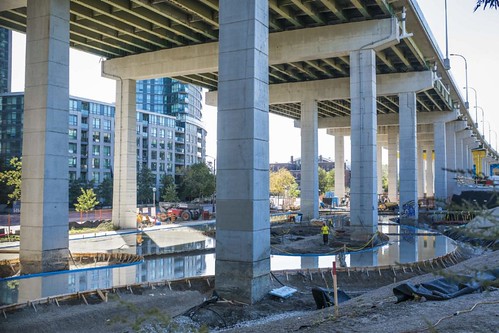
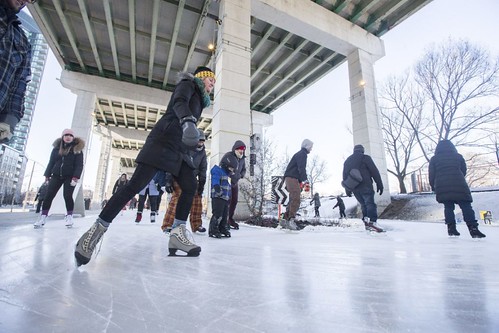
The skating path itself is roughly a figure-eight shape surrounding landscaped patches of earth dotted by plants and public art pieces. It sits near the entrance of the Fort York Visitor’s Centre, surrounded like the rest of the eventual park by the “bents” — the inverted-W-shaped concrete pillars — that hold up the highway. The effect is of a cozy space framed by the square geometry of the infrastructure and lined to the south across Fort York Boulevard by condo buildings whose residents will have the park as their new backyard.

For this opening season, the skating rink will feature a lighting installation in late afternoons and evenings that will project skaters’ shadows onto the concrete pillars and use the images to create a video project. During opening weekend, events are planned: an opening party Saturday beginning at 11 a.m. that includes skate dancers, singers, DJs; Mayor John Tory is hosting a skating party Sunday from 1 to 4 p.m. when skate rentals and hot chocolate will be free.

========

Various under and adjacent freeway park initiatives (and other re-use projects focused on capturing industrial infrastructure for parks and public uses), prove that space under freeways can be used in public space supportive ways, not merely as parking or otherwise seemingly abandoned.

The High Line Network is a banding together of a number of these initiatives.

Yesterday, the Bentway skating track opened in Toronto. It is placed under the otherwise controversial Gardiner Freeway--some city residents want the freeway to be removed but the Mayor bowed to suburban interests and has committed billions to its rehabilitation ("Tory won't reopen Gardiner repair debate despite $1B cost spike," Toronto Star). The Bentway "park" is about 1.75 kilometers between Strachan and Spadina Streets. The skateway track is 220 meters long and has opened in advance of most of the park, which will open in June.

-- The Bentway Conservancy

Bentway ice skating track under construction, Toronto
Bentway track under construction. Photo: Eduardo Lima, Metro News.

Bentway ice skating track, Toronto
Bentway skating track on opening day, January 6th, 2018. The dead zone from Strachan Ave. to Bathurst St. has been transformed into a looping rink called The Bentway, a reference to the concrete “bents” that carry the weight of the Gardiner overhead. Photo: Bernard Weil, Toronto Star.


The Bentway initiative is not limited to the winter ice track, but a full program of year-round activities and improvements for the space under the freeway, which otherwise would go unused and is a negative condition imposed on the abutting neighborhoods. The project was launched in 2015, with a $25 million (Canadian) donation by Toronto philanthropists Judy and Will Matthews.

See "Philanthropists’ vision reflected in looping skating rink beneath the Gardiner," Toronto Star; "Why the area under a Toronto highway will define the next wave of urban public spaces," Toronto Globe and Mail).

From the TGM article:
... while it's counterintuitive, the Bentway also represents a new generation of public space: a mix of recreation, culture and social spaces that serve the needs of an evolving city while reusing tough scraps of the urban fabric. ...

Can people enjoy spending time under an expressway? Yes: Once you've seen the space that is becoming the Bentway, it's clear that they can. Under the Gardiner Expressway on the west side of downtown Toronto, it's an outdoor area that is somewhat shaded, spacious – the highway is more than 15 metres off the ground – and surprisingly peaceful. It runs alongside the Fort York National Historic Site, cutting through a dense and fast-growing neighbourhood of residential towers. The Bentway is planned to stretch 1.75 kilometres; there are, the designers say, 70,000 people within a 10-minute walk of this zone. ...

The "how" of this project is important. Sleath's employer is the Bentway, a non-profit that has been set up to administer and program the space. While the corridor will be public and open 24/7, it is not technically a park. That structure allows the Matthews' money and influence – Judy Matthews is trained as an urban planner – to help the project move quickly and nimbly. "The entire modus operandi of this city for the last 50 years has been pulling things apart," Public Work's Nicklin says. "We've had to put them back together in six months."

It also allows the project to push the city toward unfamiliar goals, and to create a sort of public life that would have been unimaginable a decade ago.
Canada is known for a plethora of outdoor skating rinks and skating and other winter programming on the Rideau Canal in Ottawa, as a key element of public space and parks planning.
Rideau Canal, Ottawa, ice skating
Rideau Canal, Ottawa

With the current cold it seems as if DC would be ripe for a similar treatment on the C&O Canal, which was discussed in a GGW post by Will Handsfield last year ("Could Georgetown's C&O Canal become a winter skateway") and there is a community design initiative focused on the C&O Canal currently ("A first look at design concepts for the C&O Canal," UrbanTurf).

But generally, the area isn't cold enough consistently over the course of the winter season to be able to do this without a refrigeration assist.

There are various public outdoor ice rinks in the DC area, including in Silver Spring, on the National Mall in the National Gallery Sculpture Garden, in Georgetown at the Washington Harbour, and in the new Wharf development on the DC Waterfront.  Although unlike the Bentway, they are not free to use.
Ice skating rink, daytime, Silver Spring Veterans Plaza
The ice skating rink in Downtown Silver Spring is a key element in the development of a seasonally-focused programming mix.


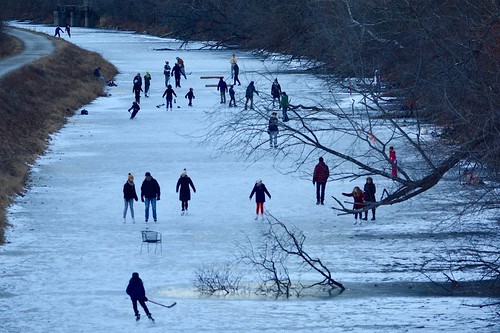
WTOP even ran a story earlier in the week about people skating on the C&O Canal in Maryland ("A frigid DC tradition: Ice skating on the C&O Canal").
Ice skating on the C&O Canal in Maryland
Droves of people young and old carve into the frozen surface of the C&O Canal on Tuesday, Jan. 2, 2018. For many families, ice skating in the national park is a tradition that goes back generations. (WTOP/Dave Dildine)

Labels: , ,

Monday, November 16, 2015

Lampshades for streetlights in Quebec City: an architectural lighting installation by Lightemotion

Lightemotion is an architectural lighting firm based in Montreal.  One of the three Illumination Awards they received this year in the program sponsored by the Illuminating Engineering Society of North America is for an installation of night-lighted lampshades for streetlights on Cartier Avenue in Quebec City.

Commissioned by the city and the Quebec Tourist Information Bureau, as conceptualized and suggested by Lightemotion, the lighting project is now an element of the city's plan to brand itself as the winter capital of North America, and was piloted on Cartier Avenue in association with the Montcalm commercial district revitalization program.

Working with the Musée national des beaux-arts du Québec, they featured work in the style of Québcois artists Alfred Pellan and Fernand Leduc on 34 different "lamp shades" fashioned after Chinese lanterns.

The artworks can be changed out annually and can feature different artists.  The intent is to expand this program to other streets in Quebec City.

Labels: , , , , ,

Tuesday, October 07, 2014

Preservation Tuesday: Maintaining Historic Windows

=====
I am going to try to start featuring a historic preservation story each week, on Tuesdays, as a way to maintain focus on the topic.

The inaugural piece is on historic windows vs. replacement windows, especially vinyl, given the big marketing campaigns by replacement window companies ("Thompson Creek carves niche as Washington home town window-maker," Washington Post, but favorably), the fact that vinyl windows tend to fail within 20 years, and how as winter approaches, we're thinking more about windows, cold air leaks and weatherization.

Note that tomorrow night, Historic Takoma (which serves historic districts in both DC and Maryland) is holding a workshop on repair of historic windows. From their website:

Wednesday, October 8, 7-8:30PM - Neil Mozer of Mozer Works demonstrates how to restore your historic windows. In the Takoma Park (Maryland) Historic District, window restoration is eligible for a combined County and State tax credit of 45%.

Later this month, a follow-up Tuesday historic preservation piece will list DC-area historic window repair and restoration services suggested by participants from the HistoricWashington e-list (yahoogroup).

=====

By Ana Lopez for Right Path, a New York City-based windows restoration company

One of the first things that comes to mind when thinking of Manhattan are the famous brownstones and pre-war buildings. These gorgeously detailed historic homes found in coveted NYC neighborhoods such as Brooklyn Heights and the Upper East Side feature some of New York City's most elegant architecture and significant landmarks. With several of these buildings dating back to mid-1850s, some even earlier, how is that the oldest buildings in New York City and all other cities for that matter, keep up their appearances? Well, through restoration, of course. Though restoration is important for all aspects of a historic home, one of the most important conservation points for an older home are its beloved windows.
Brownstones in Harlem
Brownstones in Harlem by Apostolis Giontzis, on Flickr.

According to the editorial staff on Old House Journal, thirty percent of windows being replaced are less than ten years old – these windows have problems like failed seals on insulated glass units or the issue of being fogged up – historic wood windows don’t have these problems. A positive thing about older homes is that historic windows work better and cost less than replacement over the long term. These windows are more durable than their plastic, newer counterparts.

So what are some other notes to consider when repairing the windows for a historic or older building? Here are four things to keep in mind:

1. Uniqueness – Not all windows are the same in older buildings. It’s important to inspect and prescribe treatment for them individually.

2. Authenticity – These windows are the eyes to the soul of your historic home. Characteristics like original mold profiles or old wavy glass won’t be found much elsewhere, so it’s crucial to pick restoration techniques that maintain a home’s “personality.”

3. Upkeep – Do some research and find out the type of upkeep your windows need. Texas window restorer Pam Rodriguez knows that historic windows can be made to last 50 to 100 more years with proper restoration and full refurbishing, but small maintenance tweaks can also increase the life of a window for 10 to 20 more years.

4. Energy efficiency – Old windows have the potential to be energy efficient, if they are upgraded properly. Simple and cheap techniques -- such as exterior storms, interior air panels and curtains, and even roller shades -- can meet current energy-saving standards and maintain architectural integrity without the costs of replacement.

Refreshing the windows in historic homes through removal and board-up, restoration and rehabilitation, reproduction, finishes, and re-installation can make a surprising difference in overall operability and aesthetic.

These small, affordable changes can make a noticeable difference when a historical building or home is undergoing a restoration. You might even opt for historic embellishments on the inside of your home to match the vibe.

Historic windows often look nice accompanied with plantation shutters or lace curtains (appropriateness depends on regional variations in historic practices, for example shutters were not typical in DC or Brooklyn, but were in the South).

Not really a do it yourselfer? Window restoration should go through at least the inspection process with a professional.

The windows in this NYC institutional building were restored by Right Path.

Right Path, a window restoration company in New York, has extensive experience with historic wooden windows and offers a variety of services for historic homes. Whether it’s help with hand-carved details or custom historic weight and chain wood window fabrication that your home needs, let a pro help enhance your old homes and landmarks to their former splendor.

Labels: , ,

Thursday, February 06, 2014

Rideau Canal Skateway, Ottawa, Ontario

The Rideau Canal Skateway is just under 5 miles in total length. National Capital Commission photo.

In today's earlier entry on skating rinks, Alex B. and Charlie comment, rightly, that DC tends to not sustain temperatures cold enough to freeze and maintain ice rinks without refrigeration. 

Charlie mentioned the C&O Canal as a possible option. In Ottawa, it being much colder, they do use their frozen canals as winter open spaces.

-- Rideau Canal Skateway, National Capital Commission


Labels: , , ,

Expanding winter use of public park and playgrounds: ice rinks?

Besides the animus towards yoga in a public park in Echo Park, Los Angeles, mentioned yesterday, something else to think about it terms of DIY and better use of space in public parks and recreation centers, would be "what about building neighborhood ice rinks in park space across the city?," depending on the interest and demand in specific neighborhoods. 

This is inspired by the mention that the Columbia Heights public plaza was supposed to be outfitted for ice skating when it was first designed--although the space seems small to me and it would be hard to accommodate a rink there.

Instead, why not do it in park space or school playgrounds not typically used in the winter?

Right:  the "Joyce Rink" in Seabrook, NH, courtesy of Shane (submitted to Boston.com).

I'm sure there are all kinds of liability and other issues, but those should be addressable.

Anyway, this Boston Globe story, "Build your own backyard ice rink: Boston dad-approved tips," is more about backyard ice rinks, but covers the same ground.  It can be done for a few hundred dollars and some extra money each month for water.

Labels: , , , ,