Rebuilding Place in the Urban Space

"A community’s physical form, rather than its land uses, is its most intrinsic and enduring characteristic." [Katz, EPA] This blog focuses on place and placemaking and all that makes it work--historic preservation, urban design, transportation, asset-based community development, arts & cultural development, commercial district revitalization, tourism & destination development, and quality of life advocacy--along with doses of civic engagement and good governance watchdogging.

Thursday, April 30, 2015

Baltimore, riots and revitalization: distressed neighborhoods are more vulnerable to extraordinary shocks to the system

Fox News has a great article, "Riots rattle Baltimore homeowners, merchants key to urban revitalization" about the reaction of middle class residents living in various Baltimore neighborhoods in a variety of stages of revitalization to the riots and their willingness to stay the course. From the article:
The rioting and looting this week in Baltimore has homeowners and merchants crucial to the city's ongoing revitalization efforts worrying that the violence may have a chilling effect on future investments.

For decades Baltimore has relied on newcomers willing to buy and rehabilitate dilapidated -- and often abandoned -- property to power the rebound of the city's more distressed neighborhoods.

But like in many mid-sized cities across America, the revival -- captured a decade ago with a simple one-word campaign, "Believe" -- is fragile.
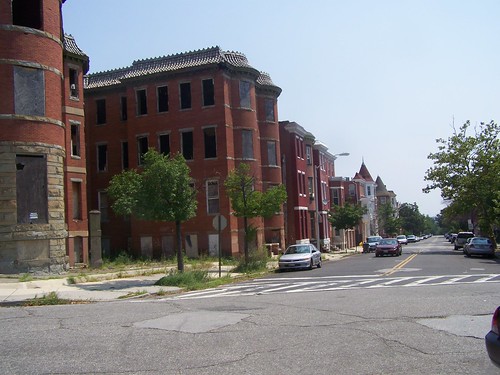
Vacant properties, Reservoir Hill neighborhood, BaltimoreVacant properties, Reservoir Hill neighborhood, Baltimore.

What the issue is has to do with achieving a critical mass of people committed to, invested in, and capable of investing in revitalization, neighborhood by neighborhood.

DC uses a four stage typology to rate neighborhoods: distressed; emerging; transitioning; and healthy.  Some cities use 6 or 7 stages, which I believe allows for more fine grade evaluation.

I used this model, but rating the commercial district separately from the residential area, to argue why the transportation investment in the Barracks Row commercial district of DC's Capitol Hill neighborhood seemingly had hyper velocity (see "Systematic neighborhood engagement").

But while at the time the Barracks Row commercial district significantly lagged the residential area, and was high emerging or low transitioning, the residential area was decidedly "healthy", hence speedy improvement of the commercial district, once the commitment to public investment was made. I also argue that you can rate places block by block, and apply specific interventions to improve those areas.

By contrast, most of the neighborhoods undergoing revitalization in Baltimore are at best emerging from the standpoint of the typology and therefore much more susceptible to changes in economic, social, and political conditions at the neighborhood, city, metropolitan, and state and national scales.

Baltimore's Patterson Park is a great example. It's a great area, anchored by a large park.

The Patterson Park Community Development Corporation engaged in portfolio investment, rehabbing a couple hundred properties, and either selling or renting them.  But with the financial crisis of the 2008 financial crisis, they went belly up, and the neighborhood was wracked with foreclosures.

-- "Patterson Park, senators celebrate redevelopment of a city," Baltimore Sun, 1999
-- "MICA students moving to East Baltimore will face a mostly blank canvas," Baltimore Brew, 2010
-- "Unusual opportunity near Patterson Park," Baltimore Sun, 2009

Similarly, I was struck by a comment by an ANC commissioner in Anacostia quoted in a 2011 Washington Post article about changes in that neighborhood.  I wrote about it in "Revitalization in stages: Anacostia." From the Post article:
Dasher and the community's other entrepreneurs are not without their critics. Anthony Muhammad, an Advisory Neighborhood Commission member who is Muslim, was concerned that Uniontown would be serving alcohol and challenged Dasher's liquor license, delaying the restaurant's opening by several months.

In an interview, Muhammad raised concerns that Dasher, who signed a 10-year lease, and some of the younger professionals who are moving into the area were not sufficiently committed to the area.

"We've seen people come and go before," Muhammad said. "I just would like to know how long she will be in this community . . . and whether this is the type of business, one that serves alcohol and is surrounded by four churches and a school, we need to embrace."
In a blog entry, I wrote this:

People do come and go.

Part of it has to do with the attainment of critical mass and the ability of a group of people to overcome the inertia and force of disinvestment. People leave when they don't feel these forces can be overcome. (The article discusses factors that have contributed to the development of critical mass, without using that term.) But not understanding what contributes to this ebb and flow [of change] is a failure in part of the leadership capacities of people like Mr. Muhammad.

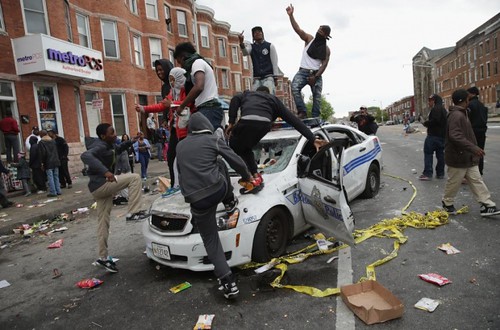
Riots in BaltimoreRiots in Baltimore.  Photograph: Chip Somodevilla/Getty Images.

In distressed and emerging neighborhoods, being "an urban pioneer" is really really hard.

It takes a lot out of you. You are likely to experience as many setbacks (be a victim of crimes etc.) and failures as successes, and success is in part a function of how many other people are trying to do the same thing. The whole is greater than the sum of the parts.

Some people aren't cut out for it and leave, making it that much harder to achieve critical mass. It takes a long time.

In DC, it took about 40 years to reach the critical mass necessary for revitalization momentum to continue "on its own" with limited government investment.  Malcolm Gladwell calls such points "tipping points" is his book on the subject of innovation diffusion.

It happened that point was reached coincident with other factors that significantly accelerated what had been a comparatively slow process.

Marion Barry no longer Mayor as of 1999, and the new Mayor focused on improving the quality of municipal services, and crime--which had hit record peaks in the mid-1990s, started to drop.

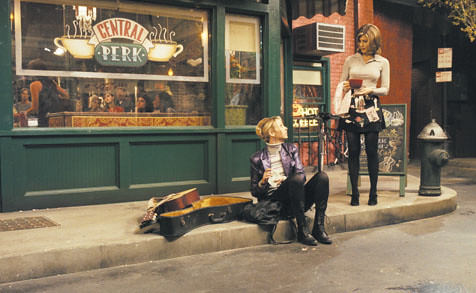
Outside Central Perk, from the tv show FriendsOutside "Central Perk," the coffee shop featured in the Friends tv show.

Another important change was that living trends began to support living in the center city, after many years favoring suburban choices.  I believe this was stoked in part by television shows like Friends and Seinfeld showing living in the city as a cool thing.

The city's investment climate changed because of the election of Anthony Williams as mayor, and then with the big post 9/11 federal spending--although more in the region rather than in the city proper--the city got another economic charge.

Baltimore hasn't been so lucky. And so its improvement is much more subject to fits and starts, despite all its great assets

Labels: , , , , ,

Independent Bookstore Day, Saturday May 2nd


Bookstores are what Ray Oldenburg calls "third places" and like libraries, are part of the informational and intellectual glue that support more intelligent participation in society.

In the right settings, books too can be a "social bridge" just like dogs and children, sparking interaction between people who might not otherwise know each other.

Bookstores too are part of the declining cultural infrastructure that Scott Timberg writes about in Culture Crash: The Killing of the Creative Class ("'Culture Crash' examines the crisis in the creative industry," Los Angeles Times).

Timberg makes the point that since so many cultural workers pursue creative endeavors without making much money, they've worked on the side in places like record stores, book stores, restaurants, etc., and as those businesses fade away, people lose the means to support their creative efforts.

In line with Record Store Day, which was a few weeks ago, and Small Business Saturday, the holiday shopping day held the first Saturday after Thanksgiving, and aimed at getting people to do holiday shopping at small, locally owned, independent businesses, last year's California Bookstore Day has gone nationwide and expanded into this year's Independent Bookstore Day.

More than 300 stores are participating across the country, including Upshur Street Books in the Petworth neighborhood of DC.  The store opened last summer, and just received a nice write up in the Washington City Paper ("How a Dead Tree Bookstore Survives in Petworth").

They'll be opening early on Saturday, and have a number of deals and special events scheduled.

Upshur Street Books is "unusual" in that it is a retail offering delivered by a restauranteur.  But he is able to leverage business acumen across multiple properties, and by having it close to other operations, presumably there are some business economies of scale which help to reduce operating costs.

In the past blog entry "Food co-ops as potential anchors of "ethical commercial districts"," I discussed how the Weaver's Way Food Co-op in the small Mount Airy commercial district in Philadelphia anchors the district in a manner which supports other independent retailers who may have a hard time surviving in a normal market, but have advantages co-locating by a business that relies on "ethical" or values-motivated customers.

One of the stores there is the Big Blue Marble Bookstore, which while a bit bigger, is similar to the store on Upshur Street.  Restauranteurs like Paul Ruppert, "making a stand" in a particular location could have a kind of comparable anchoring impact to a food co-op, especially when they extend their operations to non-food retail.


Labels: , , , ,

Park bench air monitoring station at Smithsonian National Zoo and city sensor networks

DC's Department of the Environment Air Quality Division and the US Environmental Protection Agency have partnered to install a park bench in the Kid's Farm section of the National Zoo which will display air quality and weather information.

The bench product is powered by solar and wind power and has been created as part of EPA's Village Green Project, which is developing and introducing products that make information about the environment more accessible through installations in public places.

According to the DDOE press release the bench:
provides real-time reliable readings on levels of fine particle pollution (also known as particulate matter), ozone, wind speed and direction, temperature, and humidity—all of which are important factors for understanding local air quality trends.

“These new solar-powered air monitoring park benches provide minute-by-minute data that can help citizens better understand air quality,” said EPA Administrator Gina McCarthy.” Our EPA researchers used the latest science to build the air monitoring systems in park bench stations, empowering people to get involved and learn more about air quality in their neighborhoods and better protect their families."

To build the air monitoring systems, EPA researchers used air sensors, miniaturized and low-power computer technology, solar panels, and other instruments. In addition to providing environmental assessment tools, the bench is made from recycled materials. It includes a built-in monitoring station equipped with solar- and wind- powered components that charge a battery, which runs the entire system.
So far there are stations in Durham, NC; Kansas City, MO; Philadelphia; and Washington.

City sensor networks. I have been thinking about city sensor networks and the display of this kind of information for awhile, starting with public bike counters, which we all know from Copenhagen, but increasingly are being installed in the US.

Image from Arlington County MobilityLab.

For example, many jurisdictions collect bike and pedestrian information, but Arlington County also has a public counter physical display in Rosslyn, which they call the Bikeometer.  They provide a dashboard that allows for online access to the data also.

I've started seeing articles about street lights as information points ("Will Streetlamps Become Information Hubs for Cities?," Government Technology), because as the lights are replaced with LED systems, the capacities and capabilities for how the lights can be used and the poles networked becomes much greater.

Smart Citizen sensor networks in Amsterdam, Barcelona, and Manchester are open source citizen developed public networks which measure different elements of the urban environment: Carbon Monoxide; Nitrogen Oxide; Temperature; Humidity; Light; and Sound.

Another topic area for which public display of information would be good is water quality.

I wonder if something like the Rosslyn Bikeometer but for water quality could be installed in association with the 11th Street Bridge Park and the Georgetown Waterfront Park.

Counters displaying information on river water quality could be installed on those highway bridges that cross rivers.

This is relevant to efforts to make rivers swimmable (e.g., Plan for a Fishable and Swimmable Anacostia River) and increasing public awareness and support and the necessary behavior changes to improve local water quality.

Labels: , , ,

Wednesday, April 29, 2015

Neoliberalism and DC's Capitol Hill, where residents continue to express opposition to a proposed affordable housing project for seniors

I joke that the more I learn about real estate development, the more I become an intellectual Marxist.

However, while Marxism is great for understanding the motivations of capital, its proscriptions for change don't work so well, and in any case, the system of capitalism is not likely to be overthrown any time soon.

But sometimes, the actions of citizens in throes to capitalism, and to neoliberalism, which is focused on the privatization of government action and property make me even more sympathetic to the Marxist position, although my "pro"-development approach likely brands me a conservative by many even though I term myself a progressive.

This comes up in Capitol Hill, where for some reason residents including their representatives on the local Advisory Neighborhood Commission, prefer that a city-owned property be converted to market rate housing, instead of being redeveloped as a senior housing building offering less than market rate rents.

I wrote about this before ("Senior housing needs vs. "the market" and government involvement: Part 2 - Capitol Hill and ANC6B's opposition to senior housing").  But it comes up again as Capitol Hill Corner reports on the latest developments ("Hill East Neighborhood Coalition Pushes to Reopen Bidding on Boys and Girls Club").

Former Eastern Branch, Boys and Girls Club, located at 261 17th St. SE.  This property came under city control when the Boys and Girls Club organization downsized and sold many of their properties.  The city stepped in and acquired them.  Photo from Google Maps.

They criticize the senior housing project as "requiring subsidies," implying the funds would come from local government funding sources, but instead the monies would come from the use of federal tax credits, with no impact on the local budget.

And they argue against the project because the local senior aging in place initiative, Capitol Hill Village, isn't a proponent.

The proposed apartment building would offer single floor living and an elevator-served building, as opposed to multi-story rowhouse living and/or having to go up stairs to enter the building.

I don't totally love this design, but I can't knock the value of the project. 

Note that the Vida Senior Residences building on Missouri Avenue NW in Ward 4 is a project very similar to the one proposed for Capitol Hill.  See "With Vida Senior Residences, abuelitos get a new lease on their golden years," Washington Post.

This webpage describes the complicated financing required in raising $8.6 million to construct the building, which is operated by a local senior service organization.  Such complications are pretty typical for a non-market rate housing development.

The kitchen-dining area in the Vida Senior Residences building.  Images from Dantes Partners.

Vida Senior Residences has 36 furnished studio apartments, and rents range from about $290 to $850 per month, depending on income, and significantly below market rate for new housing.

By contrast, at the new Station House apartment building, studios start at $1,710 per month, although the building is in a better and more connected location, and has skee ball among other amenities.

1.  Capitol Hill isn't suffering from the lack of market rate housing.  According to the Neighborhood Info website, ANC6B, where the site is located, has 9.680 housing units as of the 2010 Census and a home ownership rate of 55%, and the median sales price (half above/half below) for a house is $670,000 as of 2013.

Although it should be noted that there are a number of public housing projects in the ANC6B geography, more likely than any other ANC with similar high income demographics.

2.  The Aging in Place initiative by Capitol Hill Village is not the only way to support senior living options. In fact it can be argued that such initiatives also encourage "overhousing" and underutilization of scarce housing resources, and economic stagnation within local commercial districts ("It's impolitic to say but no property taxes for older senior citizens is a bad idea").

3.  Offering subsidized rents expands to lower income demographics the ability to live in quality neighborhoods.

4.  The proposed project in Hill East is also in line with the various city policy objectives concerning the expansion of affordable housing.

Labels: , , , , ,

New apartment buildings continue to escalate the battle of over the top amenities

When the now AvalonBay apartment building opened at 1st and M Streets NE, it took apartment building community amenities to the next level with a bunch of elements that no one else had:

- a section of the building was designed to accommodate dogs, with a side entrance to make it easier for taking the dog out for a walk
- a dog grooming lounge
- a large refrigerator at the front desk, for holding grocery deliveries
- a couple of band/music practice rooms with appropriate sound dampening to minimize impact on other areas of the building
- they were also supposed to be putting in a bike maintenance "lounge" too, although I never doubled back to see if it had been installed--it hadn't been at the time I went on the tour.

Since then, AvalonBay's AVA brand has added new community lounge elements and the ability of residents to do some in-unit customization, including painting--and AVA will provide the paint.

Image from HillNow.

While Notions Capital calls our attention to the opening of Station House (with an actual place-related name, since it's across the street from the Union Station complex) at 701 2nd Street NE because of the irony of the headline of the HillNow story, "Bowser Touts Affordable Housing in Luxury Building Near Union Station," this building's package of amenities has some new elements that take amenities offerings to another level also:

- a game room, including skee ball and ping pong tables
- a demonstration chef quality kitchen
- they have the requisite rooftop pool, but also a rooftop garden with sitting area
- and apparently a dog walking area on the roof as well

along with 10 electric car charging stations in the garage and other stuff.

Of the building's 378 apartments, 28--fewer than 10%--are set aside to be offered at "affordable" rental rates.

Labels: , , ,

Tuesday, April 28, 2015

Baltimore: riots, the coercive power of the state, and public reaction

Washington Post graphic showing locations of rioting in Baltimore yesterday and last night.

In 2008, on the occasion of the MLK Holiday, I wrote this:
I have been meaning to write about the Barack Obama-Hillary Clinton debacle over "it takes a president, not a village, to get things done."

The reality is that change is a process.
As I have written before in terms of the writing by John Friedmann in terms of creating radical planning discourse, government is oriented to system maintenance and a wee bit of change and innovation.
Transformation efforts, and the Civil Rights Movement was the biggest social and political transformation effort/movement in U.S. society in the past 60+ years, start from outside government, with the people. (Revolutionary movements challenge governments and the entire political system.) 
Sure, laws are only changed by elected officials, but it takes thousands, millions of individual efforts before the point of legislative and/or executive branch change within government is reached, and eventually (if ever) realized.
Riots are expressions of anger and feelings of abandonment and hopelessness.

And expressions of anger are typical when citizens are increasingly disconnected from those institutions that are supposed to be representing and hearing from them.
Riots in Baltimore
Demonstrators took over the streets. Photograph: Chip Somodevilla/Getty Images.

But while riots can push change forward--for example the Department of Justice review of the system of criminal justice and policing in response to the public outcry over the death of Michael Brown in Ferguson, Missouri led to a number of top level resignations of key officials including the police chief and city manager--in terms of "place effects," riots are hyper destructive and make urban improvement that much harder, if not impossible.

For example, on H Street NE in Washington, DC, it has taken between 40 and 45 years for the commercial district to show serious signs of recovery since the 1968 riots, which on H Street and elsewhere destroyed most of the city's independent retail businesses--which is why the state of independent retail in the city is still comparatively underdeveloped.
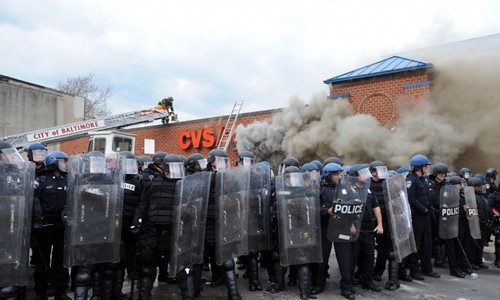
CVS burning at North and Pennsylvania Avenues, Baltimore
Looting and rioting broke out at North and Pennsylvania Avenues where a CVS was set on fire. Photograph: TNS/Landov / Barcroft Media.

But H Street NE in Washington DC is now part of a one of the strongest real estate markets in the US, while Baltimore and comparable cities still lag.  Most areas in Detroit affected by the 1967 riots have never recovered.  In fact, Pennsylvania Avenue in Baltimore has never recovered from the twin blows of the 1968 riots there, and the post-riot urban renewal process.

And often, groups can be incited to riot by people who for whatever reason, want violence to occur.

Once the spark is lit, the track of the outburst is unpredictable and unmanageable.

On the other hand, the power to use coercion and force on the behalf of the state comes with great responsibility.  Clearly, the Baltimore City police officers whose actions led to the death of Freddie Gray failed to acknowledge their responsibilities to citizens.
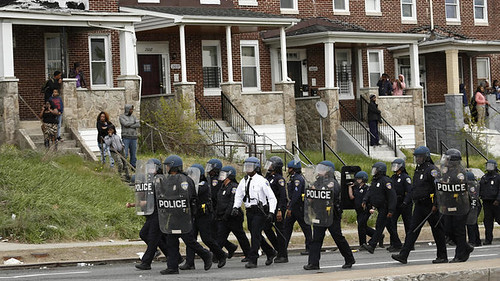
Police line marching toward protestors on Reisterstown Road, Baltimore
Drew Angerer, Getty Images.  Baltimore police officers walk in formation on Reisterstown Road near Mowdamin Mall as they advance toward protesters on April 27, 2015.

Baltimore's situation also gives me some perspective on one of the reasons that DC has more local police officers per capita than any other US city.  This doesn't even take into account the federal and other police departments that operate within DC.

DC has twice the number of local police officers than Baltimore.  But Baltimore has more poverty and is somewhat larger.

Labels: , , , , ,

Historic Preservation Tuesday: Saving buildings vs. "the right to petition to redress grievances"

I joke sometimes that one of the problems of the rights enumerated within the First Amendment of the US Constitution:
Congress shall make no law respecting an establishment of religion, or prohibiting the free exercise thereof; or abridging the freedom of speech, or of the press; or the right of the people peaceably to assemble, and to petition the Government for a redress of grievances.
is that when people learn of "the right to redress grievances" they believe that a petition in and of itself is action, and that signing a petition is action.

But it depends.

A petition is a call to action, but it isn't necessarily an action because many issues are addressable only through defined processes, when laws and regulations provide for "remedies" depending on the nature of issue.

With historic preservation, if you have the right laws and regulations in place, you can work to prevent a building from being demolished.  You may not win, but you have the chance.  But you must follow a specific process, it's not a matter of signing a change.org petition,

Image from the Ghosts of DC blog.

In the case of DC, to prevent a building that is not located in a historic district from being demolished, the only remedy under DC law is to prepare and file an application to designate the building as a historic landmark.

I bring this up because the Ghosts of DC website is promoting a petition to save the house at 3400 Massachusetts Avenue NW from being demolished ("Save this historic DC home").  But instead, they ought to be preparing a landmark nomination.  A petition has no legal standing in the matter.

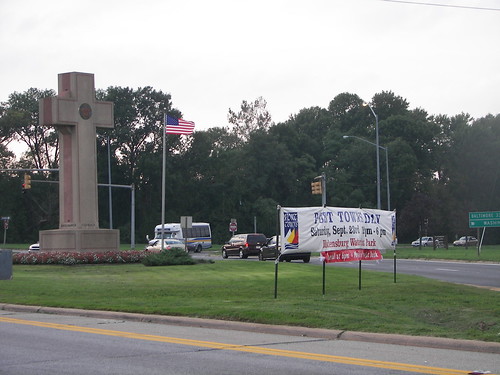
Port Towns Day banner and the Peace Cross2.  Preservation laws are complicated.

For one thing, people think that a building listed on "the National Register of Historic Places" protects the building from any and all circumstances.  

That isn't the case.  Listing on the NRHP only protects buildings from "federal undertakings" and requires a review, which could still end up with loss of the resource.  (Federal laws concerning preservation include the National Historic Preservation Act and the National Environmental Policy Act.)

This comes up with Peace Cross in Prince George's County.  According to the Gazette ("Woman fights to save Bladensburg Peace Cross through film"):
[Renee] Green, 52, of Annapolis is producing a documentary called “Save the Peace Cross,” and is the sponsor for the World War I memorial’s nomination to the National Register of Historic Places. Green grew up in Prince George’s County and visits Bladensburg regularly as a board member of the Elizabeth Seton High School alumni association.

The documentary is a direct response to a lawsuit by the American Humanist Association, which argues the Peace Cross is a religious symbol on government land that appears to only honor Christian servicemen. ...

With assistance from the Maryland Historic Trust and the county’s Historic Preservation Commission, Green completed the National Registry paperwork for the Peace Cross. She said the memorial’s age, integrity and significance meet all of the registry’s qualifications — the Peace Cross is more than 50 years old, it looks fairly the same as it did when it was erected, it is associated with a historic event and it is significant to architectural history, as it was designed by craftsman John J. Earley, who developed a process for producing exposed aggregate concrete.

“If it had been in there before, you can’t have it removed. You can’t have it destroyed,” Green said. “I don’t think this lawsuit would have gone anywhere.”
but that isn't really the case as it depends on the local laws and whether they provide protections for local undertakings.  If the County wants to get rid of the memorial, it could.

In fact, the realization that listing on the National Register didn't protect buildings from local undertakings, and the demolition by a church of buildings it owned in the Capitol Hill Historic District for a parking lot, led to the creation of a strong local law.

3.  The point is that to protect resources in most instances, there need to be local laws addressing the actions of local property owners, and local governments.  Most jurisdictions have preservation laws and processes, but they vary in how strong they are.

4.  Most jurisdictions provide elected officials with either or both the privilege of final approval or withdrawing recognition.  In those places, it's pretty common that economic and political choices contravene historic preservation considerations.  And the preservation board will often make decisions based on those considerations as well, trying to keep decision making within the bounds of the expectations of the "higher authorities."

Image from Preservation Arlington.  Note that judging by the photo, there are definitely integrity issues that militate against a hardcore decision on saving this building as is.

This has come up in Arlington County and the decision to demolish the historic Wilson School building, because of the cost of preservation and the desire for economic growth in a county that is increasingly pressed economically.

According to the Washington Post story "Arlington won't call 105-year-old Wilson School historic":
More than a dozen residents, including an 85-year-old woman who attended the school between 1936 and 1942, pleaded with the board to designate the building a local historic district as a way of forcing the school board to incorporate the red-brick structure into its plans for a new 775-student school. But opponents argued that the distinctive portico, columns and cupola were removed from the school in 1963 and that it would cost millions to retrofit the structure to meet today’s building codes.

“It would cost a fortune to do it right . . . and we have a lot of needs in this county,” said board member Libby Garvey (D), pointing out that the county has saved several other historic schools. “There’s a time in life when you have to let go of things.”
5.  By contrast, DC's preservation laws are significantly stronger than other jurisdictions in the US.  (a.)  Owners don't have to approve designation for it to occur.  (b.) Organizations with appropriate standing can submit landmark nominations on properties they do not own.  (c.) the Historic Preservation Review Board makes decisions on whether or not resources are worthy of historic designation.  (d.) while the decisions are subject to certain levels of review, the Mayor or City Council cannot intervene in the process* or overturn decisions.

(* The Mayor does have some powers of suasion and can ask board members to resign or decide to not reappoint members if displeased by certain decisions..  But otherwise, the Executive Branch and the Legislative Branch can submit testimony just like anyone else.)

6.  But with this level of strength in the law also comes heightened responsibility.  There is a process for overturning decisions, through administrative law procedures and the courts, but such decisions require a high bar.

Also, given the strength of the actions they take, the HPRB is forced to be clear about its decision-making processes.  They follow the law and regulations very closely, making determinations on architectural, archaeological, and historic grounds, and so, in the case of "landmarks," which have to meet a higher level of significance than "contributing buildings" in a historic district, the HPRB is not likely to rule favorably on designating an average building with limited architectural or historical significance.

7.  To summarize, to save a building from demolition--if it is even possible--you have to follow the rules specific to your jurisdiction.  In most cases, National Register listing is immaterial to the threats typically faced by historic buildings and sites.

Labels: , , , , , ,

Thursday, April 23, 2015

Local parks planning, the USDA's National Arboretum, and the Friends of the National Arboretum

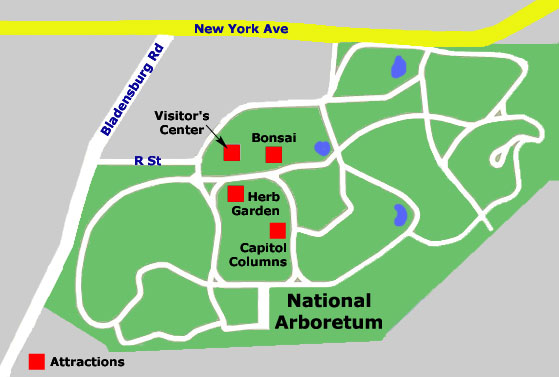
The National Arboretum in DC is located on the edge of the city, on the Anacostia River.  It's a bit hard to get to without a car, with an entrance off Bladensburg Road NW, not far from New York Avenue not quite one mile from the DC-Maryland border.

It's about 2/3 of a square mile and according to Tom Costello, director of the Friends of the National Arboretum, it's 2% of the city's land mass (part of the third of the city that is federal or campus lands) but provides 7% of the city's carbon capture and is an important "lung" for the city.

Image from FONA.

While the Arboretum functions as a park, with 500,000 visitors annually, the reality is that its primary function is as a research facility, part of the network of research facilities run by the USDA's Agricultural Research Service.  Many plants and trees that we take for granted have been developed at this facility, which also studies plant diseases.

According to the unit's Strategic Plan, 2013-2017, the National Arboretum is one of the top 10 most visited public gardens in the US, but this reality is somewhat out of sorts with regard to its mission and organizational reporting relationships.

The ARS isn't in the business of funding parks, and as federal budgets have shrunk since the recession and "sequestership," the National Arboretum cut back its hours, closing three days/week.

That is another example of the need for contingency planning as an element of local parks master plans, when a community has parks installations within its borders over which it does not control.  Not to mention that the park has 500,000 visitors and there is potential to leverage this visitorship, using garden tourism principles.

-- Garden tourism (2013)
-- Garden Walk Buffalo (2013)
-- European Garden Festivals  as a model urban planning initiative
-- DC has a big "Garden Festival" opportunity in the Anacostia River

Back to a full schedule.  Recently it was announced that the Arboretum is back to a schedule of being open every day ("US National Arboretum To Re-Open to the Public Seven Days A Week," USDA press release).

But none of the articles mentioned how much this costs.

The move back to a full schedule has come about because of FONA, which through various fundraising efforts, has committed to paying the $100,000/year that the Arboretum needs to stay open to the public.

Think of it, $100,000!  That's not even a rounding error in DC's $10 billion annual budget.  But the lack of $100,000 meant that one of the nation's most visited public gardens has for the past few years, been closed three days each week.

If the city had a public parks master plan and if it would include contingency plans for the possibility of the closure of federal installations, then this situation could have been addressed a few years ago.

FONA and fundraising.  Thursday through Saturday is the organization's annual Garden Fair and Plant Sale.  Sales from the event help to fund the open hours program.  Members get exclusive access to sales today, while public hours are Friday and Saturday.  Six nurseries will be selling plants, a number of nonprofits will be exhibiting, and some food and other vendors round out the event.

And June 9th is the annual fundraiser, decidedly not black tie, the Great Arboretum Cookout also known as "Cookout Under the Stars."  Last year's event had 550 attendees.

Coordinated Garden Tourism as an opportunity for DC.  As I mentioned in the Earth Day entry, there is an opportunity to have a spring street festival in the city focused on green and sustainability issues, along with flower and garden elements.

Leesburg Flower and Garden Festival image from NBC4.

DC already has a major garden tourism event with the National Cherry Blossom Festival, which has expanded its activities beyond the traditional cherry blossom walk by the Jefferson Memorial, sponsoring the new Anacostia River Festival, cherry tree plantings throughout the city, etc.

But like the Garden Festival and Garden Walk activities in Buffalo--the organizations are merging this year--the various garden tourism elements in the city, starting with the Cherry Blossom Festival, could be organized into a more purposeful "network" of events and programs throughout the year that are cross- and co-marketed.

-- National Garden Festival in Buffalo, June-August, 2015

Such activity would not only serve visitors, it would build the knowledge base of participating residents and in the long run, contribute positively to the beauty of the city.

I still remember the visual power of these stamps which came out in the late 1960s, associated with the beautification agenda pushed by then First Lady, Lady Bird Johnson.

-- Lady Bird Johnson Beautification Program, PBS
-- How the Highway Beautification Act Became a Law, Federal Highway Administration

Labels: , ,

National Park Week, April 18th-26th

The National Park Service launched National Park Week by offering free entry over the weekend to those parks where a fee is normally charged.

But almost 3/4 of national park sites are free anyway--only 128 of 407 installations charge fees.

While most people think of national parks as the big wilderness parks such as Yosemite or the Grand Canyon, a number of NPS parks and sites are in urban areas.

Yet for the most part, the urban parks are managed the same way as wilderness parks, at least in DC, and this creates issues around "activation."

Rules designed for the operation of a big national park are applied to the various parks of all sizes in DC, making it impossible to "sell food" in a park like Dupont Circle or to have a dog park in an otherwise under-used "neighborhood" park.

For DC, I've argued two things.  First, that local park and recreation master plans should provide guidance on "national parks" in the city to represent citizen interests for those parks which function as local parks regardless of federal (or state or county or other) ownership.  See "Federal shutdown as another example of why local jurisdictions should have more robust contingency and master planning processes."

Second, within DC there should be a typology of NPS and other federal "park" installations in the city, making determinations of what parks are truly "federal' and those parks which could be turned over to the city and managed as local parks.

... then again, the city doesn't want the financial responsibility.

Another example of the general point about local communities having parks plans which provide guidance for county, state, and national lands within their borders is important when financial circumstances change, and states consider closing parks.  Right now, this is an issue in Louisiana, as the state faces a deficit of more than $1 billion ("Louisiana parks will have layoffs, closures due to midyear budget cuts," New Orleans Times-Picayune) and is closing three historic sites as part of budget cuts.

Labels:

City branding and the Las Vegas sign

Betty Willis, who designed the "Welcome to Fabulous Las Vegas" sign, died at the age of 91.  See "To Betty Willis, Las Vegas was forever 'Fabulous'" from the Las Vegas Sun.

Granted a sign isn't a brand, but that particular sign helped to capture the essence of what Vegas has to offer, presenting the brand and its message in a fun and clear manner... which she did also with other signs for hotel and entertainment properties.

-- Civic Tourism (2005)
-- Town-City branding or 'We are all destination managers now' (2005)
-- "Toronto: The brand," Toronto Star


Labels: ,

Earth Day

1.  Remember that denser cities are actually much more "green" than the suburbs.  See the book Green Metropolis.

2.  There are a bunch of interesting articles out there, including one by Jonathan Franzen in The New Yorker about climate change ("The Other Cost of Climate Change"), how individual action at the micro scale is seemingly meaningless, which makes it hard to engage people in "doing things to reduce greenhouse gas emissions.

He mentions two small-scale projects in Peru and Costa Rica, to "save places" by actively engaging local residents in managing those places and reaping sustainable economic value from their activities, which incentivizes taking care of those places rather than abusing them.

Still, I suppose then that it is easier to go to a concert over the weekend than to take specific and meaningful actions at the household or community scale.

3.  WAMU-FM/NPR had a nice story on DC's capturing of hazardous wastes ("D.C.'s Last, Best Stop For Electronic Junk And Household Wastes").

And Marketplace reported on something that I have been meaning to write about, that glass bottle recycling is problematic.

Also, plastics recycling is becoming less viable economically because the drop in oil prices means that the cost of new plastic is much cheaper than it had been.

4.  Problems with glass recycling support the concept of bottle deposit laws.  It's not that there isn't any substantial market for recycled glass, but that people put so much stuff in with glass that isn't recyclable, making the cost of sorting astronomical ("High Costs Put Cracks in Glass Recycling Programs," Wall Street Journal). From the article:
Curt Bucey, an executive vice president at the company, said that when used glass arrived at its plants 20 years ago, it was 98% glass and 2% other castoffs, such as paper labels and bottle caps. These days, some truckloads can include up to 50% garbage, he said.

“Now what comes with the glass are rocks, shredded paper, chicken bones people left in their takeout containers, and hypodermic needles,” Mr. Bucey said. The company has had to invest in expensive machinery to separate the glass from the trash, then has to dispose of the garbage, making recycling a much costlier equation.
By contrast, in those states, like Michigan or California, where there are "bottle deposit" laws, so most glass is recycled through collection points rather than through curbside recycling, there is much less contamination of the bottle waste stream.  (Although it's still expensive to ship glass because of the weight.)

5.  Yesterday there was a conference on toward a zero waste agenda for DC, which I forgot about, caught up in the massive rewrite of my transportation wish list for 2015.  I hope that it was recorded.

6.  And DC also released the 2015 Sustainable DC Progress Report.  A couple of weeks ago the City of Los Angeles released it's first sustainability plan.  But I learned at the New Partners for Smart Growth Conference in February, that Santa Monica was one of the first cities to adopt a sustainability type plan, in the mid-1990s.
7.  On Sunday, the City of Takoma Park--sponsored by Main Street Takoma and the Takoma Park Food Co-op, had a very good small "Earth Day" Festival, with a mix of for profit vendors, activities for kids, and nonprofit and government agency exhibitors.

I was impressed that one of the exhibitors was Communities for Transit, the advocacy group formed to support Montgomery County's bus rapid transit program.   (Note that there is a disconnect with their logo.  The organization promotes BRT, but the logo is designed around fixed rail transit.)

One of the for profit vendors, Razar Sharp, had a micro-electric lawn mower and an electric-powered chipper-shredder, which I have my eye on.

8.  It's the kind of community outreach and capacity building event that I wish DC would do more often.

The closest DC gets to these kinds of events is a street festival.  Leesburg had their Flower and Garden Festival the weekend of April 18th, but we weren't able to get to it.

So--except for the vagaries of the weather--there is a "hole in the market" for a spring street festival around Earth Day to early May, focusing on green, environment, home and garden type activities.

By co-branding a flower-garden-home festival as a "green" and "Earth Day" type event, I think it could become quite successful.  (I aimed to create a home type event in Brookland when I was the Main Street manager there, but didn't think about the potential for a green-Earth Day tie-in.)

9.  Takoma Park is a semi-finalist participating with 49 other cities in the Georgetown University Energy Prize contest.   They have a variety of neighborhood and citizen engaging programs underway as part of the competition, and as a way to implement sustainability programming.

-- Takoma Park sustainability program

For example, the Takoma Park Library allows people to check out energy use meters, to gather information on their appliances and electronic devices.

One of the programs is modeled in a way after the Certified Wildlife Habitat program of the National Wildlife Foundation.

There are two levels, and participants can get a sign to put in their yard.  It's a Green Home Certification program, which has three levels of certification: light; medium; and dark green; and two categories, for multifamily and single family housing.

I like how Takoma Park uses their city logo as the design foundation for logo designs for initiatives and agencies.  It brings a consistency and reiteration to their communication efforts that other communities often lack.

Serious behavior changes, financial outlays, and outreach to neighbors have to be made in order to get the highest level of certification.

DC does have the RiverSmart Homes program, but this Green Home certification program in Takoma Park is even more impressive.

10  I wish that the US would adopt some best practice promotion practices of the European Union.

One relevant to Earth Day is the "European Green Capital" program, where cities compete for the designation based on their sustainability and environmental practices.

Each year, one city is selected to present a year-long festival of green related actions and activities.   This year the Green Capital is Bristol, England--which is a fascinating city beyond this year's Green Capital event.

11.  Voting day for the UK election is about three weeks away and there is a good chance that Bristol may elect the nation's second Green Party Member of Parliament ("Bristol West: Painting the Town Green," New Statesman).  Candidate Darren Hall ran the application process for the city's candidacy as Green Capital. The city has 6 Green Party Councillors as well.

Labels: , ,

Wednesday, April 22, 2015

Historic preservation journal access through April 26th from Maney Publishing

From Maney Publishing:

Over 20,000 articles free to read

All online content, including all 2015 issues, for all of the journals we publish in archaeology, conservation and heritage is free to read and download for two weeks, between 13 - 26 April 2015. No sign up required!

This includes content in 18 different subject areas spanning over 100 years, from 1869–2014.

-- Archaeology, Conservation & Heritage Journals, Maney Publishing

Labels:

Transportation Wish List, 2015: part two, new ideas

Thanks to Will Handsfield for touching off this thread.

Center City, Metropolitan and Regional Transportation Vision and Planning

This is a new category, separate from items concerning basic city transportation planning at the end of this entry.

1.  It is time to rebuild and re-codify the regional and metropolitan consensus on the delivery of transit.  I have been writing about this since 2009 in great detail.  These two recent entries bring the argument up to date, and in terms of funding issues:

-- WMATA and two types of public relations programs
-- What it will take to get WMATA out of crisis

2016 is the 40th anniversary of the opening of the first leg of the Metrorail system and anniversaries can be good hooks for both looking back and planning for the future.

2. My thinking on metropolitan scale planning and the federally designated "Metropolitan Planning Organization," the Transportation Policy Board of the Metropolitan Washington Council of Governments took a new turn after the original list.

Responsibility for metropolitan transportation planning should be placed within the MPO, rather than within "WMATA", laying out network breadth and depth preferences, and Level of Service (LOS) and Level of Quality (LOQ) standards, with a separate contracting for services.

-- King County, Washington Metro (Bus) Service Guidelines

Because WMATA only plans for subway and regional bus service, there are significant gaps in metropolitan transportation planning.  Plus network breadth and depth and standards of service often are satisficed for budget reasons.

Hamburg Germany offers a better model, where HVV integrates transit service planning and operation across multiple modes (subway, commuter rail, bus, regional rail, ferry) operated by 35 different operators, serving the city-state of Hamburg and a number of the districts in the neighboring states of Lower Saxony and Schleswig-Holstein.

Transport for London and San Francisco's MTA operate similarly, although SFMTA doesn't do any contracting of transit service. TfL contracts out bus service, runs the underground, and coordinates rail planning within the region, even if it doesn't run the service.  The London Overground suburban railroad service has reorganized railroad service comparable to how the Underground runs, which has resulted in significant ridership increases.  Unlike HVV, TfL and SFMTA are responsible for roads and have oversight authority for taxi service.

-- Metropolitan Mass Transit Planning presentation

The MPO as currently configured doesn't have the capacity to pull this off.

3.  Last year, Councilmember Cheh suggested that the city's transportation functions be split across three different agencies, some new, some old.

While it doesn't seem as if that proposal is going anywhere, it's still a bad idea and shouldn't be supported.  It's important enough to mention here.

-- Proposed changes to DC's transportation agency structure as another example of acting without solid planning: Part 1, the problem
-- Proposed changes to DC's transportation agency structure as another example of acting without solid planning: Part 2, what should happen to DDOT
-- How other cities deliver transportation functions (Part 3 of the series, Proposed changes to DC's transportation agency structure as another example of acting without solid planning)

4.  Despite the fact that the city's competitive advantage within the region rests on Metrorail and other transit services, for the most part, the city's elected officials and other stakeholders fail to acknowledge this, even though development around transit is one of the main drivers of the local economy.  The city needs to become a national leader in urban transportation and transit policy and practice in reality, not merely by default.

The recent wacked discourse about the value of streetcar service in the city--and note that streetcar service isn't even one of my top priorities--is an example of a massive intellectual and policy failure.  How can leaders of the city question the value of transit to the city and its current success.

While this entry from 2006 is about development at the Takoma Metrorail station, the opening discussion within the piece is probably my most succinct sum up of the link between transportation, land use and urban success:

-- Comments on Proposed EYA Development at Takoma Metro Station.

Transit First planning policy is a part of San Francisco's City Charter.  Here it waxes and wanes depending on who is mayor.  Since most of the city's mayors and Ward Councilmembers have come from the Outer City (see "DC as a suburban agenda dominated city"), they tend to be automobile-centric, even if they've served on the WMATA Board of Directors.

Funding/Land Use

Increased property taxes and other revenues from development adjacent to transit is one of the returns on investment from investing in transportation infrastructure, so funding and land use policy are linked in this section.

5.  Increase the height limit, primarily downtown, where the demand and best transit connections are located. Use the increased property value-bonding authority to pay for transportation (and certain other) infrastructure expansion in the city -- in addition to the transit withholding tax,

-- DC Height Study Public Meetings This Week and the long term implications for transit expansion in DC

6.  There should be a density bonus for development at transit stations, beyond what is available within the planned unit development process (a 20% boost).  Outside of the core of the city, transit station adjacency isn't being fully realized.

Good examples of reasonable size are at Brookland, Petworth, and Columbia Heights Metrorail stations, while developments at Fort Totten and Rhode Island Metrorail stations are good examples of leaving density opportunity off the table.

7.  I don't think it's worth pursuing a congestion charge, independent of participation by the surrounding jurisdictions.  Otherwise, other jurisdictions will recruit DC-based businesses and organizations, using a congestion charge as a club.

But the Virginia Secretary of Transportation is proposing tolls for I-66, so maybe this could be in our future.

-- "On I-66 Inside The Beltway, Tolls First, More Lanes Later," WAMU-FM/NPR

Fixed Rail Transit (Was: Subway, Streetcar, and Railroad Expansion)

If ferries/water taxis were a significant element of the region's transportation system, the section would be titled Fixed Rail Transit and Ferries.

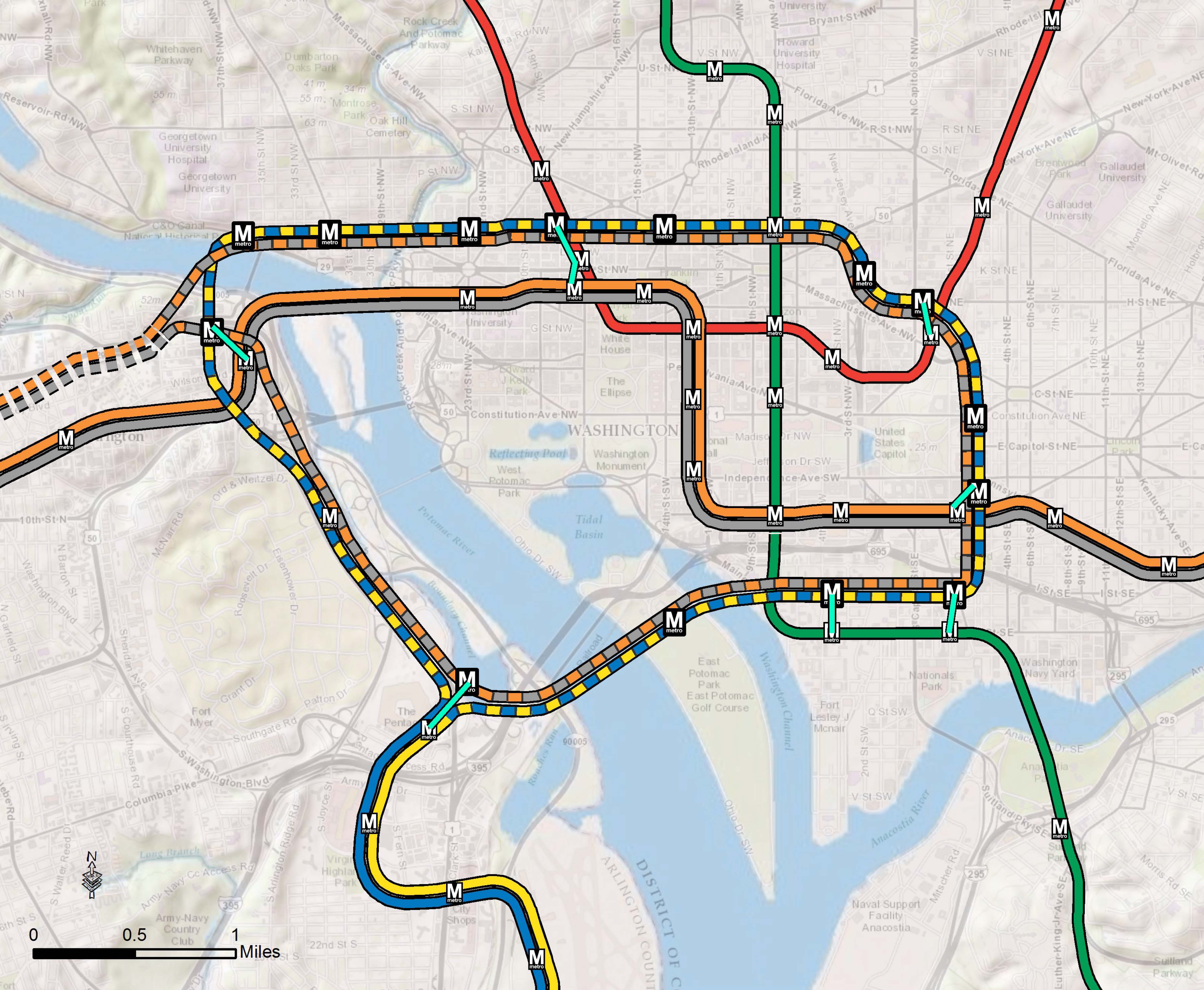
8.  Since the discussion about the separated blue line in the 2008 entry, in the WMATA Momentum plan, they have introduced a hybrid additional line that combines part of a separated blue line with part of a separated yellow line (pictured at right).

I favor the previous separated blue line proposal and not the Momentum plan proposal. 

However, maybe besides connecting to the blue line around Oklahoma Avenue NE ("Bring back the Oklahoma Avenue Metro Station: infill transit"), have another leg that goes up Bladensburg Road to Fort Lincoln and maybe beyond (if Prince George's County wants to pay for it).

9. I wrote about tunnelizing the Metropolitan Branch. It's not realistic so it should be dropped.  However, if the area had the kind of density of New York, London, or Paris, it would be worth pursuing, as a way to double railroad and subway capacity on a goodly portion of the red line subway as well as the MARC Brunswick line.

10. Add a separated yellow line with two legs, one goes up Georgia Ave., another could split from Fort Totten going out New Hampshire way into Montgomery County, at least to White Oak. The latter would be more for MoCo, so they should pay for it.

But both would interdict commuter traffic, which should be one of the primary planning principles of DC's transportation system, to improve neighborhoods by reducing the negative impact through traffic on streets that serve as both neighborhood and regional arterials.

11. I didn't discuss the Purple Line light rail program in the original list, which is mostly suburban-supportive, but still will provide benefit city residents by providing inter-links between various legs of the subway system.
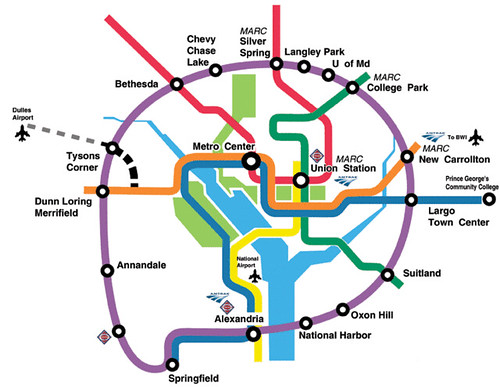
Purple Line Map  DC MetroHowever, the original concept for the Purple Line is as a circumferential line, and the current Purple Line project will provide routing only between Bethesda and New Carrollton.

Planning for extensions west from Bethesda to Tysons, and west from New Carrollton to Alexandria need to go into the planning phase now.

I do think that the implementation of the Purple Line could be accompanied by an unprecedented economic development, urban design, and equitable development initiative, were they to take the initiative on ideas I've discussed here, which call for the creation of a TIF funded bi-county development authority for the Purple Line transit shed:

-- Quick follow up to the Purple Line piece about creating a Transportation Renewal District and selling bonds to fund equitable development
-- Purple line planning in suburban Maryland as an opportunity

12.  WRT creating an integrated passenger railroad service for the region, I stand by the RACER concept, but think that Union Station could play an outsize role in facilitating merger of the local services.

-- Dual powered diesel electric locomotive and implications for long range regional railroad planning in DC, Maryland, and Virginia

13.  Since the original list, MARC has added weekend service to the Penn Line, which is a bonus, and more recently, added bicycle accommodation to the weekend service.

MARC should offer reverse commuting service on the Brunswick Line from DC to Germantown, and maybe to Frederick.  Apparently this was offered in the 1990s, but ceased after a train crash that was the fault of an inadequate signaling system.

Note that separately, VRE is expanding also, with an extension to Spotsylvania and a proposed branch line to Haymarket.  However, VRE doesn't offer much in the way of reverse commuting services and no weekend service.  This should be explored.

-- "VRE kicks off major expansion plan with new Spotsylvania station," Washington Post
-- "VRE proposes fare hikes, outlines long, long-term expansion," WTOP Radio

14.  The discussion on transit networks and subnetworks at the metropolitan, suburban, and center city scales should include focused discussion on "intra-district" vs. "inter-city" transit.

-- Making the case for intra-city (vs. inter-city) transit planning
-- STREETCARS ARE ABOUT TRANSIT, just in a different way from how people are used to thinking about it
-- The argument that streetcars are "imperfect transit" but "good enough" is flawed

which is particularly relevant to the current discussion on streetcars, including Arlington's cancellation of their streetcar plans.

Visitor transportation services 

This is a new category, and combines some transit expansion with visitor services.
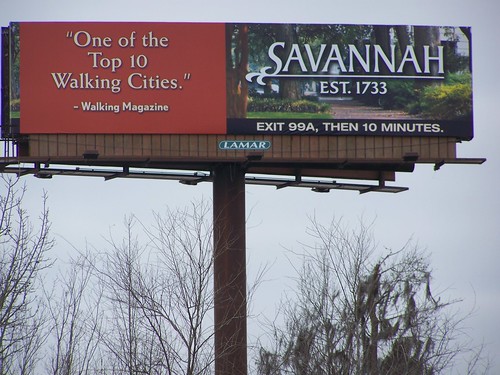
Savannah: One of the Top 10 Walking Cities billboardNote that the Passaic County, NJ Transportation Plan raises the idea of treating historic transportation corridors as opportunities for historic interpretation and cultural tourism, and they have further developed the  concept as part of the county's Heritage Tourism Plan.

Relatedly, Savannah promotes its walking city urban design elements as a part of the city's tourism program.

The Federal Elements of the Comprehensive Plan have an element on Visitors, but while for many years I've suggested creating a tourism element in the local plan the city has not done so.

15.  In response to the National Coalition to Save Our Mall's proposal for a big parking garage for visitors under the National Mall, and comments I had submitted on the Visitor Element of the Federal Elements of the Comprehensive Plan, I wrote a piece on creating an integrated visitor transit and parking system centered around the National Mall, complemented by visitor centers at a new Jefferson Memorial Yellow Line station and Union Station.

-- A National Mall-focused heritage (replica) streetcar service to serve visitors is a way bigger idea than a parking garage under the Mall

16.  I have ideas on how Union Station could be a 21st century transportation and visitor center, beyond what "Amtrak" is thinking. (Amtrak, more than Union Station, is driving the master planning process.)  I would include a transportation-urbanism museum (at least an exhibit or two, and exhibit space) and a big visitors center.  New developments in airport terminal development are another source of ideas.

17. I'm fine with the Georgetown BID's proposal for an aerial tram.  It's complementary to streetcars, and tightly integrates Rosslyn's Metrorail station into Georgetown.

An aerial tram station at Key Bridge and M Street could also include a visitor center and community museum.

18.  Water taxi services should be moved to this category, recognizing that such services are more about tourism because the placement of activity centers-primary destinations relative to the Potomac and Anacostia Rivers and limited draft capacity on the Anacostia River east of the 11th Street bridges isn't conducive to adding water taxi or ferry services to the metropolitan area's transit system.

19.  Wayfinding systems need to be upgraded and expanded, including better use of transit stations to deliver wayfinding and visitor information.

20.  The Metropolitan Planning Organization needs to step up and shape better transportation planning and visitor services at the area's airports.

-- Night moves: the need for more night time (and weekend) transit service, especially when the subway is closed
-- More on airport-related transit/transit for visitors
-- More on transportation to the DC area airports

21.  This would be aided by the development of a comprehensive airports plan for the region.  The DC and Baltimore MPOs could work together to create such a plan for the region.  Dulles and National Airports are in the DC MPO while BWI Airport is in the Baltimore MPO.
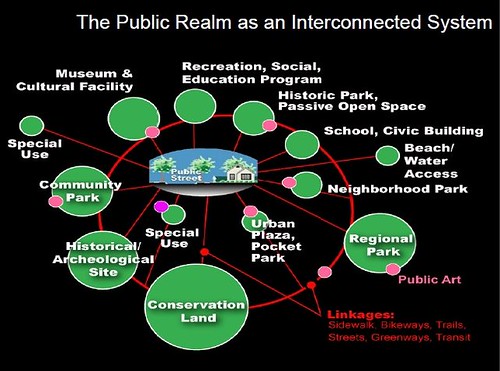
Public Realm as an Interconnected system, Slide from presentation, Leadership and the Role of Parks and Recreation in the New Economy, David BarthConcept by David Barth.

Streetscapes and transportation infrastructure as an element of civic architecture (new category)

Note that as parklet programs have exploded across the country, DDOT is finalizing regulations to bring a similar program to DC.

22. To the discussion on placemaking, I would reshape the "streets as places" argument around my "Signature Streets" concept, which I need to round out as a full blown concept paper.

It would include discussion on transit and placemaking along the line of past writings, based on the same point, that transportation infrastructure has fundamental civic architecture and amenities qualities that need to be acknowledged and enhanced.

A key point is that transit stations are entrypoints to neighborhoods and districts and that the transit system needs to acknowledge this and plan and manage the function more directly.

HafenCity University subway station, Hamburg. 

Since I wrote the piece on transit and placemaking I've realized that design elements of European underground transit, e.g., the subway stations in Hamburg, or the art nouveau? influenced stations in Moscow and St. Petersburg, etc., are good models too.

My point about planning the bridges over the Anacostia in an integrated fashion could go in here as an example, that hideous "sculpture" on the NY Ave. bridge over the railyard as a counter-example, etc.

-- Anacostia River and considering the bridges as a unit
-- "Author Carves History Out of Sculptures," Washington Post
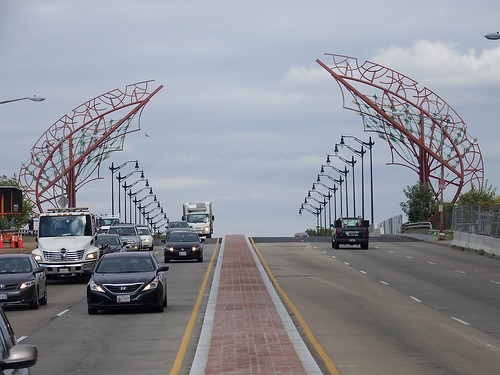
Gateway Wings, New York Avenue Bridge Gateway, designed by Kent Bloomer Studio
Considering the history of the city in terms of classical architecture and sculpture spearheaded by the City Beautiful Movement, this sculpture on the New York Avenue bridge is an embarrassment.

LA's People Streets and San Francisco's Livable Streets initiatives are good models too.

-- The Case for Parklets: Measuring the Impact on Sidewalk Vitality and Neighborhood Businesses, University City District BID, Philadelphia

23.  Transportation departments have chief (traffic) engineers,  Transportation departments should also have a chief placemaking architect (who could be either an architect or landscape architect, but probably not a civil engineer, although there are some exceptions), with co-equal authority to the chief engineer, in charge of assuring that quality of place elements are engineered into projects rather than value engineered out.

Mill Avenue Bridge at night, Tempe, Arizona. Photo: Studio Laurent.

24. I've been meaning to put out as a proposal, architectural lighting of the Metro canopies in a blog entry since the summer, as an element of neighborhood branding and placemaking.  But this concept can be extended to other forms of transportation infrastructure.
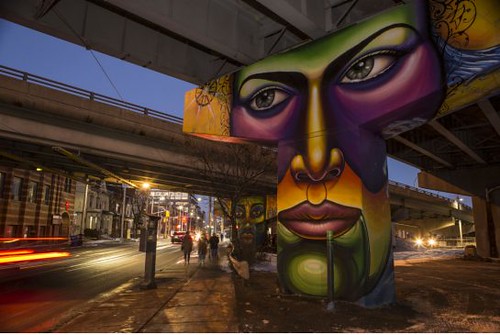
Corktown freeway underpass pylon murals, TorontoCorktown freeway underpass pylon murals, Toronto.  Toronto Star photo.

Roads, streets, parking

25.  This is partly a transportation infrastructure and quality of life point, but I do think we should interdict surface commuting traffic by constructing tunnels for certain arterials.  I wrote about this a few years ago, using an example of a tunnel project in Haifa that is tolled, but was done in order to address a major traffic problem posed by a mountain--the tunnels save drivers from 24 to 44 minutes over the previous situation.  Another way to think of it would be an RER--the suburban commuter railroad system for Paris that is underground--for roads.

These roads can have significant negative impacts on the abutting neighborhoods. Besides the proposal in the New York Avenue transportation study which proposed undergrounding the through traffic elements of that street, I'd do the same thing for North Capitol/Blair Road, and maybe 16th Street.  Such tunnels should be tolled.

-- Tunnelized road projects for DC and the Carmel Tunnel, Haifa, Israel example
-- Carmel Tunnel, Haifa

26.  DC should develop a public database for Pavement Condition of the city's streets, comparable to Los Angeles, and use this information to plan roadway improvements systematically.  More money should also be budgeted annually for road improvements.  The system is too ad-hoc now, and only $10 million per year is budgeted for local road improvements not part of "federal highway" agreements.

-- "Grading Los Angeles' streets," Los Angeles Times.  LA's road condition database provides A to F grades for 68,000 different road segments.

27.  Similarly, DC's self-heralded "Green Alleys" program isn't standard practice and isn't a normal part of the capital improvements planning and budgeting process.  The Green Alleys program should be systematized in a manner comparable to a renewed road improvement program.  Melbourne's "Love Your Laneway" program addresses five laneways (alleys) each year.

-- Another example of DC Government's failure to engage in sustainability practice
-- Living Alleys Toolkit, San Francisco
-- An Action Guide to Greening Austin’s Alleys, Austin, Texas
-- Alley Network Project, Pioneer Square Neighborhood, Seattle
-- Love Your Laneway Project, Melbourne, Australia
-- Laneway Project, Toronto

28.  The earlier list didn't discuss disabled parking issues. Industry analyses of disabled parking permit use find about 40% of passes are used illegally.  I propose replacing placards/permits with transponders comparable in function to those used for EZPass,

29.  Some jurisdictions, such as Miami Beach, charge for visitor parking passes in residential areas. Since DC's visitor parking pass system is abused likely at rates comparable to the abuse of handicapped parking permits, DC should move to a paid visitor parking pass system.

Parking signage, Essen, Germany. 

30.  DC should integrate privately owned parking facilities into the parking planning process and implement an integrated parking information signage system in major business districts and activity centers comparable to that in many cities in North America and Europe.

Digital applications aren't enough, as people need multiple information touchpoints.

Biking, walking and traffic safety (new category separated out from Roads, streets, and parking)

31. Vision Zero traffic/safety recommendations should be incorporated into this category.  These recommendations cover most of the gaps concerning pedestrian matters.

-- DC and Vision Zero revisited

32. Because the original list started out focused on transit, it didn't discuss biking very much.  There are many needs, including the creation of an integrated bikeway network at two scales, within jurisdictions, in this case within DC, and at the metropolitan scale as well as planning to achieve bike mode split to 20% of all trips.

But rather than delineate "everything" that needs to be done (and the city is doing a lot and should be commended for it), it's probably time for me to update separately the 2008 piece, Ideas for making bicycling irresistible in Washington DC, which was written after the original wish list.

When I did the pedestrian and biking plan for Western Baltimore County (2009-2010), I came up with six scale typology for planning sustainable transportation infrastructure:

- one mile radii from schools and transit stops
- three mile radii from activity centers
- 3-9 miles along corridors, connecting activity centers (there, they are "town centers")
- between corridors
- intra-jurisdictional trails network
- connections between jurisdictions

Note that Smart Growth America considers the Baltimore County ordinance on biking and walking to be among the strongest in the country.  The ordinance is based on my plan.

Relevant writings on expanding biking as transportation include:

-- Best practice bicycle planning for suburban settings using the action planning method
-- What should a US national bike strategy plan look like?
-- Are developers missing the point on eliminating parking minimums?: it's to promote sustainable transportation modes
-- Best (or at least better) practices bike parking and bicycle facilities
-- Revisiting bicycle (and pedestrian) planning and the 6th 'E': equity

33.  DC should develop better practice for safe routes planning for schools, parks, commercial districts, transit stations and stops, and other civic assets.  In other words, the concepts of "safe routes to schools" need to be extended to neighborhoods and to different times of day, especially night-time.

-- Night-time safety: rethinking lighting in the context of a walking community
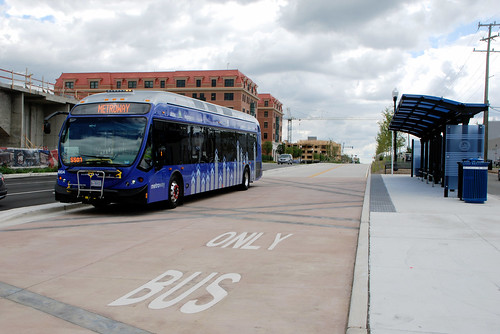
Potomac Yard Transitway
The Metroway bus line includes dedicated transitways.  Photo by BeyondDC.

Surface Transit System Improvements

34. The failure to include a recommendation for a transitway network for buses in the city was a big omission on the previous list.  (I haven't yet ridden on the "Metroway" transitway in Arlington.)

It turns out 40 years ago, there was a network of dedicated busways in DC and Virginia, but for the most part these lanes were given over to cars.

-- "We had bus lanes a half century ago and we can again," PlanIt Metro.

Busway map, 1976.  Busways were recommended in the 1950 Comprehensive Plan.

35.   The new bus arrival information boards provided at certain bus shelters aren't very impressive.  A digital screen based information system would be a useful upgrade. (The screens used at Metrorail station kiosks are a good example of what should have been done.)  They are an example of how slow procurement practices within WMATA make true innovation difficult.

Transit Marketing

36.  I stand by the recommendations in the previous wish list, although they were expanded and better codified in two later entries:

-- Making bus service sexy and more equitable (2012)
-- Transit, stations and placemaking (2013)

Other Transportation Planning Issues

37.  DC should integrate taxi planning into DDOT. Taxi planning and oversight, car sharing, ride hailing could be incorporated into one functional area.  Note that the city's comprehensive plan doesn't even mention taxis.

Labels: , , , , , , ,