Rebuilding Place in the Urban Space

"A community’s physical form, rather than its land uses, is its most intrinsic and enduring characteristic." [Katz, EPA] This blog focuses on place and placemaking and all that makes it work--historic preservation, urban design, transportation, asset-based community development, arts & cultural development, commercial district revitalization, tourism & destination development, and quality of life advocacy--along with doses of civic engagement and good governance watchdogging.

Monday, February 06, 2012

Intra-city sprawl: Baltimore edition

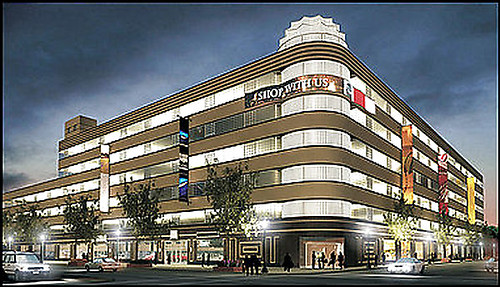
First image: current headquarters, Constellation Energy, 750 E. Pratt Street. Source unknown. Second image: future site of Constellation Energy on the Baltimore Harbor Waterfront. Photo: Nicholas Griner, Baltimore Business Journal.

I write about intra-city sprawl that I see happen in DC from time to time. Generally, it's of two varieties: (1) DC Government relocating its agencies from the central business district to locations spread out across the city (usually for purported economic development reasons) but in places where transit service is less efficient or not available, compared to the places the agencies or leave; or (2) greenfield-grayfield redevelopment, with significantly different development that may generate significant numbers of trips, without adequately investing in transit expansion in advance.

Baltimore has a different problem. It has so much excess property--so many beautiful buildings--in its central business district that it's downright tragic. Although many of the buildings are no longer Class A buildings, but the real problem is demand. Baltimore just doesn't have as many Fortune 500 and regional headquarters anymore, or the businesses that remain moved out to the suburbs (e.g., McCormick Spice Company).

But real estate interests like Edwin Hale, formerly of the First Mariner Bank, who developed new buildings in the Canton area, and John Paterakis, owner of H&S Bakeries, a regional baking company behemoth (e.g., they do all the baking for Giant Supermarkets) with lots of property in the area between the Inner Harbor and Fells Point, have been developing new properties, and this puts further pressure on "Downtown" because the new projects end up being more like a game of musical chairs, with Downtown being the loser.

This is further complicated by companies that want trophy buildings, such as Exelon, which is acquiring Constellation Energy, and will still have a large presence in Baltimore after the merger. See "Exelon's move to Harbor Point to reshape downtown Baltimore" from the Baltimore Business Journal and "Exelon picks Harbor Point for future headquarters: Project led by bakery magnate, developer John Paterakis Sr." and the editorial "Stretching Downtown" from the Baltimore Sun.

They are going to build in the "Harbor Point" area, the area between the Inner Harbor and Fells Point, to a building being constructed by Paterakis' Harbor East Development Group LLC. It will be built on the site of the old Allied Chemical Plant. And this will release 350,000 s.f. of office space Downtown and lead to a significant amount of vacant property, making "revitalization" just a little more difficult.

Of course, offering incentives to companies to move from one in-city site to another is probably a mistake.

From the BBJ article:

The decision will remove 2,000 Constellation (NYSE: CEG) workers from Baltimore’s traditional downtown and empty about 350,000 square feet of office space at 750 E. Pratt St. and 111 Market Place.

“It’s just disappointing,” said Terri Harrington, a vice president for Mackenzie Commercial Real Estate Services, which represents 1.5 million square feet of space in the city’s so-called commercial business district. “This additional square footage that’s going to be added to the market is just going to be really tough for landlords north of Pratt Street to absorb.” ...

Not only is Exelon moving into a trendy waterfront development, but the company also will benefit from a state enterprise zone in which companies get an 80 percent property tax reduction for five years, as well as declining tax breaks for five more years. The enterprise zone also includes a $1,000 credit per new employee.

Labels: , , ,

Thursday, October 20, 2011

The Reeves Center Myth re-revisited

In honor of the City Paper article, "14th and Blue," about the Reeves Center I am reprinting this entry from January 2006, in response to this section of the City Paper article:

When Barry’s administration pushed to construct the building in the 1980s, the goal was to help spur the redevelopment of U Street, which had been devastated in riots in 1968, then left mostly ignored for more than a decade. The Reeves Center, and the opening of Metro’s Green Line, helped do the trick. The neighborhood is booming, with condos, fancy bars and restaurants, and boutique shops galore. Now, 25 years after it opened, the District’s own parcel of real estate feels like it’s been left behind.

(Although one could argue that the Reeves Center was a key element in the revitalization process of that area, if you look at it as a process over many years--decades.

I would argue that the area improved despite the Reeves Center, not unlike how I make similar arguments about the H Street CDC constructed office buildings on the 600 block of H Street NE.)

Also see these two pieces from 2005, "(Why aren't people) Learning from Jane Jacobs" and "Office buildings won't 'save' Anacostia."
----------------
Reprint
----------------

I was going through some of the archives and I came across something I wrote in response to suggestions that WMATA move to Anacostia (hmm, why Dan Tangherlini is now the director of WMATA might have other dimensions).

It's worth reprinting because City Council Chairman and Mayoral candidate Linda Cropp was at a community meeting recently where she talked about the Reeves Center as a perfect example of city-initiated and city-sparked development. This has been bugging me since I read it, but I didn't get around to writing about it. See this article "In Ward 8, Anger Over Stadium Deal," and this quote (of course Councilmember Barry was in the audience, so she must have felt obligated):

"Our visionary mayor, Marion Barry, put the Reeves [Municipal] Center up on 14th and U streets because it acted as an incentive to bring about economic development that changed the area," Cropp said.

From August 2005 but expanded slightly:

Re-reading the Post article ("Williams Proposes Moving Metro Offices to Anacostia") it quotes Mayor Williams as saying he was inspired to suggest this development at the Anacostia Metro Station by the actions of Mayor Barry's building of the Reeves Center.
Reeves Center
The Reeves Center is pretty typical of the urban brutalist DC urban renewal projects from the mid-1970s onwards.

IT IS A MYTH that the Reeves Center sparked the revitalization of U Street. It is an urban brutalist monster that sucks the life off of the street. Many of the retail businesses in the Reeves Center have failed--most leaving lease debts in the hundreds of thousands of dollars--debts that the District government had to eat.

------------
Note: the building is just bulky, it's not really an example of urban brutalist design.
------------

The other three corners of the intersection have fast food places or a vacancy. AND, it took more than 10 years after the Reeves Center before "revitalization" started happening--much of it being sparked by the opening of the Green line subway stations. (Granted, the construction of the Metro on U Street contributed to the problems.)

And still, the area around Reeves Center is a vacuum. What life around it has it engendered?

Why is learning from Jane Jacobs and other practitioners of urban vitality so difficult?
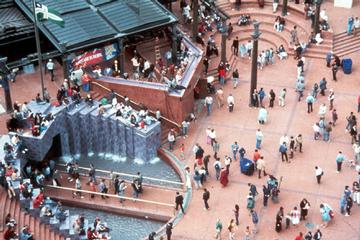
Pioneer Courthouse Square, Portland, OR
Pioneer Courthouse Square, Portland, Oregon. Photo by PPS.

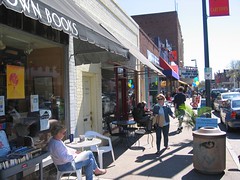
Carytown uncropped (Richmond)
People on the street in Carytown, Richmond. Photo by Steve Pinkus.

Labels: , ,

Monday, April 05, 2010

Urban vs. suburban development paradigms for the city

The whole point of the New Urban Transect is that appropriateness of building form is dependent on land use context.
Illustration from The House Book by Keith DuQuette (resized)
Illustration from The House Book by Keith DuQuette communicates the basic idea of the transect.

The Smart Transportation Guidebook uses the same basic concept about land use context and "regional" vs. "local" serving roads and lays out tables for appropriate roadway design, roadside design, and desired operating speed according to land use context and the use type of the road. (See pages 37-39.)

In cities, it is still a struggle to keep building regulations focused on maintaining urbanism, because for one, most zoning codes are oriented to the car, and two, the real estate development industry has focused on automobile accommodation since the end of World War II. Suburban large tract subdivisions such as Levittown are one example, typical shopping centers--malls, big box, strip shopping centers--are another example.
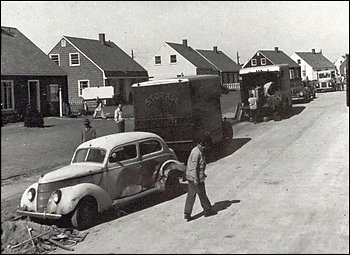
Levittown, 1947
New residents move into their Levitt homes in Levittown, N.Y., in this file photo from October 1947. This prototypical suburban community, known for mass-produced housing that went up for soldiers coming home from World War II, is again trying to standardize a way of life for its residents. This time, they want everybody to go green. Local private businesses like oil companies and light bulb manufacturers are teaming up with nonprofits and the government to canvas all 17,000 homes in the community, trying to encourage residents to reduce its carbon footprint. (AP Photo/Levittown Public Library, File)

The Post has an article about a new development about to break ground on the parking lot at the Rhode Island Metro Station, "Incentives, investment dollars headed for R.I. Avenue."

"Shockingly," the article fails to mention that the key difference in this project is that it is supposed to be urban appropriate, whereas most of the "new" developments along Rhode Island Avenue over the past 25 years have been car oriented. It should be no surprise that compared to more urban parts of the city, car oriented development patterns along roads such as Rhode Island Avenue NE and Georgia Avenue NW, haven't been that successful.
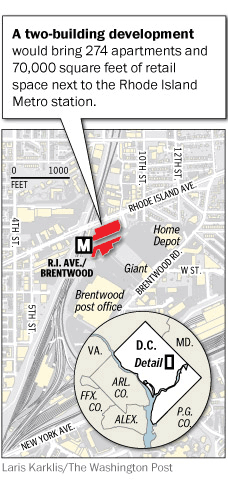
GR2010040404796
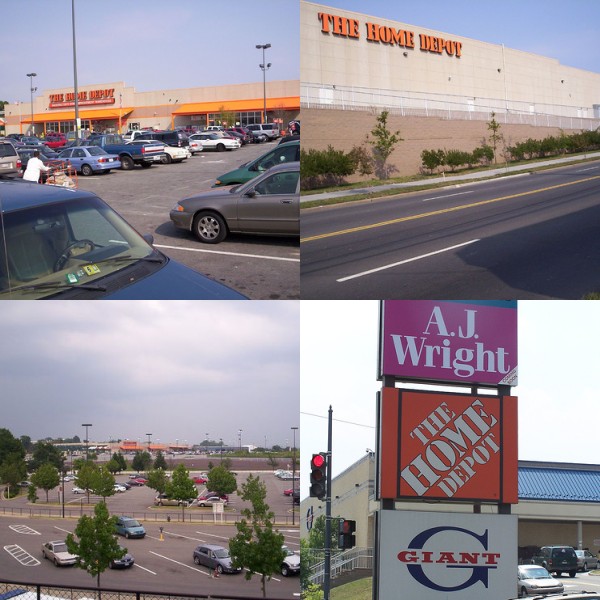
One of the massive failures of vision in terms of promoting the car over urbanism and over transit proximity was the Rhode Island Place development. Also known as the "Home Depot Shopping Center," it is a classic example of suburban design but in the city.

But I think the relative failure of the shopping center at 4th and Rhode Island NE, where stores like Ames, Safeway ("Edgewood mourns loss of anchor Safeway: Some question commitment to black community" from the Post) and National Wholesale Liquidators have failed over the years, is a function of the same phenomenon. The shopping center is set back from the street, counter to typical urbanism.
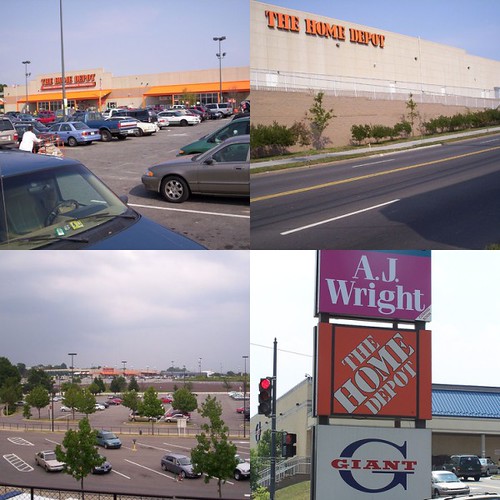
Home Depot mosaic

Some people call this "inward suburbanization," and I call it a form of "inner city sprawl." The problem is not unique to DC.
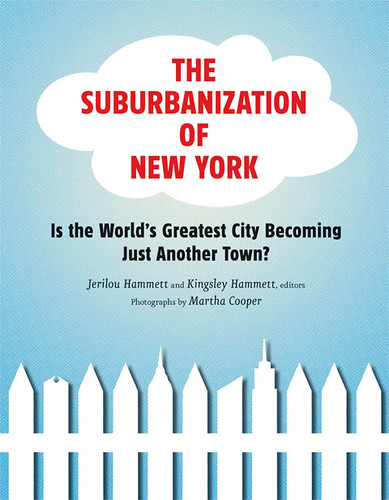
The Suburbanization of New York: Is the World's Greatest City Becoming Just Another Town?; Edited by Jerilou Hammett and Kingsley Hammett; Princeton Architectural Press; $24.95.

Note that the DC/USA shopping center at Columbia Heights, which is in a neighborhood with more density and somewhat better demographics, has been developed in a distinctly urban fashion, and it is far more successful in terms of shopping, and less so for the car as the 1,000 space parking garage (something I opposed to no avail about 5 or 6 years ago) experiences minimal use.
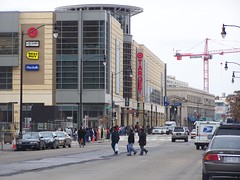
DC/USA, 14th Street, Columbia Heights

Another aspect of inward suburbanization is the reforming and reproduction of place according to suburban lines. A couple weeks ago, there were articles about the "new" Capital Riverfront District in both the Express, "From Frontier To Focal Point: Capitol Riverfront's Growth and Potential," and the Washington Post, "People flock to live in D.C.'s Capitol Riverfront area despite commercial stall." For the most part, construction in that district is all about the new, in multiunit boxy buildings. Most of the original construction in that area has long been since demolished, although that process started with the creation of the Southeast-Southwest Freeway, which had massive negative impact on the quality of life in that area.
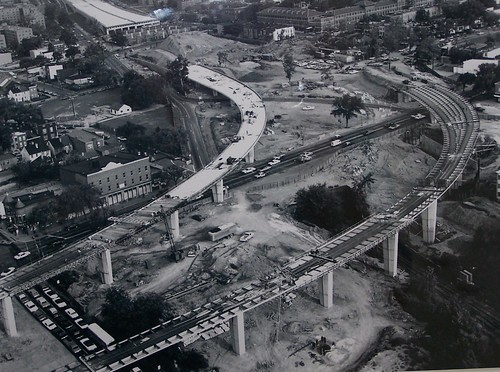
SE-SW Freeway under construction near the Marine Barracks, 1971
SE-SW Freeway under construction near the Marine Barracks, 1971. DDOT photo.

But I was struck by one of the quotes in the Express article, and how the person referred to he and his fellow residents as "urban explorers." I laughed out loud for a considerable period of time on the train while reading this, struck by the irony that this person is comfortable exploring urbanness in a more spiffy cleaned up de-racinated less authentic manner. From the article:

For now, residents are hunkering down on their little slice of the frontier. The residents share a sense that they are early settlers on a new, unfamiliar patch of Washington real estate. This mentality has evolved into an infectious spirit of community. Says Bolden: "My neighbors are my friends. We call ourselves urban explorers. And we stick together."

Frontier? Their biggest problem is that they have to walk blocks to a restaurant. Where were they when people with choices didn't want to live in the city at all? When living in the city was a statement counter to all the prevalent trends in American Society. When "frontier" meant dealing with dozens of murders in a "pioneering" neighborhood. Etc.

I was watching one of those buying a house shows on HGTV on Saturday--it's interesting to watch these shows both for insights into what motivates and interests people as well as to see different types of houses, floor plans, etc. The person, a 30s aged woman living in the suburbs of Philadelphia, wanted to buy in the city, because she worked in the city and most of her friends lived in the city. But 2 out of 3 of the houses she looked at were relatively new construction, and the historic house was nixed because it was in a mixed use situation--although I probably would not want to live across the street from a BP station either.

But I was struck by the same sense that I received from the articles about the Capitol Riverfront District, that it's fine to consume the "urban" experience if it's made more palatable, more processed, more produced, and less historic.

Anyway, Ken sends us this article from the Sacramento Bee, "Sacramento council OKs environmental report for Curtis Park infill project," which discusses how the neighborhood may sue the city because they believe the project is too suburban, while the local Councilmember is happy for some development.

We see this phenomenon all the time in the city. People are so happy for some investment that they don't care or don't understand that there are appropriate and inappropriate types of development.

Do we have to remake the city into the suburbs in order for cities to thrive again in the 21st century?

From the article:

A potential lawsuit by the Sierra Curtis Neighborhood Association over the project's size and character remains possible. Association leaders told the council Thursday the project's 522 houses and 259,000 square feet of retail space are still too suburban and car-oriented for their early 20th-century neighborhood south of downtown.

The SCNA showed the council 1,200 neighborhood-area signatures backing them. "Please don't view the neighborhood as being against this project. We want a better village. We want an urban environment," said Andrea Rosen, SCNA board member.

Debate among the council and a crowd of 250 ran nearly four hours, with supporters citing their neighborhood's "underserved retail environment" and hopes of seeing a vacant eyesore improved.

Or should we focus on intensifying urbanistically, without dramatically destroying historic fabric and authenticity, focusing on transit, walking, and bicycling rather than the automobile, and promoting the ability to innovate in relatively cheap reusable spaces?

In the meantime, people in the Sierra Curtis Neighborhood Association in Sacramento ought to be commended.

(P.S. It's always amazing to me when I write a planning study for a community and then I hear indirectly about when aspects are getting implemented, exactly as I laid out. I hear that Cambridge, Maryland is writing urban design guidelines for Route 50, and in the study I said that the way Route 50 looks is a scourge on the community which shapes how it is perceived and influences people to not venture inward to the city... I don't understand why it is so hard to do the right thing in DC.)

Labels: , , , , ,

Friday, June 12, 2009

Parking Policies Can Reduce Car Use

is an entry from the Daily blog of the Pacific Northwest organization, the Sightline Institute. Read it.

Also read "Seattle's Lagging Density is Making it a 'Suburb'." The entry is in part, a response to this piece, "Does 'smart growth' also create more sprawl?," from Crosscut.

The basic points are that just because a center city is a city, doesn't mean that prima facie, urban land use and development policies and practices are better than sub-urban land use and development practices in the suburbs.

In particular, DC does many things that I call "intra-city sprawl" (Stu Sirota has an alternative term that I really like, "inward suburbanization.")

A couple examples:

1. Land use policies don't promote strengthening extant areas, such as neighborhood commercial districts, over new development.

2. Land use policies don't promote urban urban design versus suburbanization. Perfect examples are the Rhode Island Place shopping center adjacent to the Rhode Island Avenue Metro Station, or the new shopping center in Congress Heights. Both are very much automobile, therefore, "suburban," in orientation.
Home Depot mosaic
Home Depot in Brentwood (Rhode Island Place).


3. DC does not have a policy for siting government facilities that is necessarily congruent with urban design or urban policy practices, including siting facilities based on access to robust transit. In other words, capital investment decisions aren't made with an eye to promoting what are called agglomeration economies.

Labels: , , ,

Monday, March 16, 2009

Government diseconomies

On Saturday, I was sad to learn that the DC Office of Planning and DC Dept. of Consumer and Regulatory Affairs are going to end up in the SW quadrant of the city, at the development that is being built on the site of the old Waterfront Mall (it's classic government strategy to prop up developers by leasing lots of office space from them).

The terrible thing about this is it will likely increase the time required to travel to and from these offices, by moving them from relatively convenient center city locations to distant places located a significant distance away from other activity centers. (Govt. officials usually tout this as an economic development strategy, but you need tens of thousands of office workers to begin to have significant impact on daytime retail and service offerings.)

Definitions:

Agglomeration: The association of productive activities in close proximity to one another, as in a major specialized industrial region or in a large town or city (Dictionary of Human Geography). Clustering of activities in space.

Agglomeration Economies: Savings or benefits firms realize by clustering together (The World Economy: Resources, Location, Trade, and Development). Frequently associated with the collective use of the infrastructure of transportation, communications facilities and other services (Dictionary of Human Geography).

I call the practice of moving DC government agencies all around the city without adequate regard to clustering and the utilization of transportation infrastructure "intra-city sprawl."

This is another instance of how siting decisions for DC Government agencies should be required to be based in part on transportation demand management principles.

Labels: , ,

Monday, March 09, 2009

Another problem with the DC Comprehensive Plan not requiring transportation demand management (except in one instance)

Bloomingdale (for now) reports, in "update on government agency hypocrisy" about proposals to locate the DC Department of the Environment in a deaccessioned school building in LeDroit Park, but not having enough parking to accommodate the workers.

The DC Comprehensive Plan should require TDM planning for all DC Government agencies. Mode shift away from automobile trips should be the priority.

The Comp Plan should require DC Government agencies to locate within 1/2 mile of subway stations.

Preferably, rather than locate the agencies all across the city, they should be located in proximity to each other (a form of agglomeration economies) to increase connection and reduce trips. This should be in the Comp Plan too.

Otherwise, we are doing a form of what I call "intra-city sprawl." (Also see "inward suburbanization."
_____________

Note: the one requirement for transportation demand management planning in the DC Comprehensive Plan is for matters relating to Planned Unit Development zoning requests (see the Transportation Element of the Comp Plan).

In all the Comp Plan drafts, it was suggested this could be done, but it was not required. Because of my frequent testimonies about the various "failures" in the transportation element, the final version of the Comp Plan saw a change in this provision, from optional to required.

Labels: , , , , ,

Sunday, September 21, 2008

(Not) Understanding that DC's competitive advantage rests in part on non-automobile transportation infrastructure

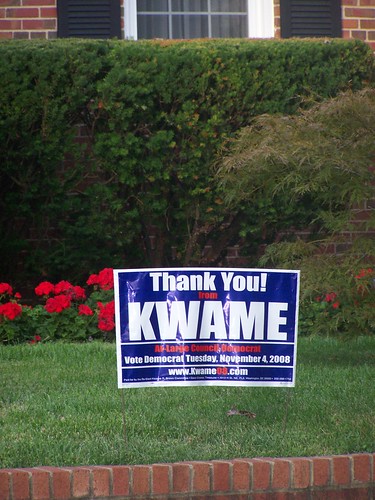
Thank you, Kwame Brown Election sign
I frequently cite what I consider to be the city's five competitive advantages, which collectively support the city as a place to live, to work, and to visit.

They are:

1. historic residential building stock (that is attractive to people with decent incomes who have choices on where they decide to live)
2. an urban design (at least in the core of the city) that favors compact development, mixed use (locating amenities and civic uses close by), walking, and transit
3. history, identity and authenticity
4. a rich transit infrastructure that allows for efficient mobility without having to be automobile-dependent
5. the steady employment engine of the federal government.

So anything the city does that diminishes the value and quality of these competitive advantages is a bad thing. And ideally, the elected and appointed officials would always consider the impact on the city's competitive advantage before they make boneheaded announcements on policies.

DC claims to want to be a green city. And granted, I know I need to write a short paper (not that I would expect an elected official to read it) on (cities,) transportation and competitive advantage to provide some foundational understanding about why DC's competitive advantage rests upon strengthening and extending the transit infrastructure, rather than encouraging automobile use.

In short, this is a reaction to the report in the Northwest Current on page 3 of the current edition (dated 9/18/2008) that Councilmember Kwame Brown, who chairs the Economic Development Committee of the DC City Council and who is up for reelection, that he recommends that the old Hecht's Warehouse on New York Avenue could be remade into a mall for car dealerships--6 car dealerships to be exact.
Hecht's Warehouse redone as a shopping center by you.
Patriot Equities marks the 70th anniversary of historic landmark Hecht's Distribution Center in Washington, D.C., announcing plans for the first ever Mixed-Use redevelopment of the 775,000 square foot warehouse at 1401 New York Ave. Heralded by the Smithsonian as one of the most significant industrial Deco buildings in the world, and further acknowledged by the late Sen. Millard Tydings of Maryland as a monument to the business genius which has made America the country it is, the 15.5 acre site will be transformed into Patriot Yards, a mixed-use development consisting of industrial distribution, flex, and retail space.

(For more, see "Old Hecht's to be bought, redeveloped by Pa. firm" and "Store's warehouse well-stocked with art deco treats" from the Washington Business Journal.)

While I can understand why it might be okay to encourage people to buy Smart Cars if they are going to buy a car, because they take up much less space, instead of car ownership (and DC tags people with high registration fees whether or not the car is bought in DC proper), _urban economic development policy for DC_ should promote alternatives to the automobile, including carsharing, transit, and bicycling.
A Smart Car in DC!, 500 block Pennsylvania Avenue, SE by you.

I wish that more people, especially elected officials, understood the difference between "building a local economy" and "economic development."

The Discovering Urbanism blog reminds us that we all need to read the book Sprawl Costs: Economic Impacts of Unchecked Development.

But we have to remember that the only kind of unchecked development isn't really sprawl, but automobile-centric sprawl. You can have intra-city sprawl, and many of the economic development priorities of both the Executive Branch and the Legislative Branch show this. Sadly, DC proves that the suburbs do not have an exclusive on poorly thought out prioritization of various types of land use.

Labels: , , , ,

Monday, March 24, 2008

Agglomeration benefits and the location of city offices

I write not infrequently about "intra-city sprawl" being fomented by the City Government and its practice of relocating government offices hither and yon across the city--to revitalize neighborhoods is the stated purpose...

But this reduces the agglomeration benefits from having the offices, especially those offices where people are likely to have interaction, nearby. And for other reasons, primarily the limited business effect as office workers have limited demand for retail and limited interests (convenience goods mostly) supporting 2 s.f. of retail and 5 s.f. of restaurant/carryout space each.

Can you imagine riding a bike on an office trip during work hours, from DCRA at 941 N. Capitol NE or from the Office of Planning at 800 N. Capitol NE to the Department of Housing and Community Development, currently located at 800 N. Capitol NE, but being relocated to 1800 Martin Luther King Jr. Avenue SE. (Of course, now you can just walk to the building from those buildings...)

According to Mapquest, the distance from the current location to the new Anacostia location is 3.52 miles.

This entry is inspired by this article, "Workers to put pedals to metal" about the new bike fleet (Paul DeMaio's term) to be utilized by city employees in Long Beach, California. Article from the Long Beach Press-Telegram.

Labels: , , , ,

Thursday, May 03, 2007

Brief comment on the height limit

Within the last couple months, there was a forum somewhere, the Building Museum I think, about DC, and Christopher Leinberger, a fellow at the Brookings Institution, and involved somehow in teaching real estate at the University of Michigan, commented about the height restriction in DC, that it should be lifted.

Yesterday, the Post (see "Growth Machine") ran a follow up story about this, "High-Level Debate On Future of D.C.," subtitled "With Land in Short Supply, Scholar Says Taller Buildings Should Be Permitted."

A small bone to pick would be calling Mr. Leinberger a scholar. He's a developer, who's always had a scholarly bent, writing quite prolifically as you'll see if you check out his website. But he's not quite the "independent" objective academic, he's part of the real estate industry. Granted that the Brookings website identifies him as a scholar, but Mr. Leinberger's own website describes himself as a "Urban Land Strategist and Developer."

Nevertheless, he raises a legitimate point, that the city's economic competitiveness is impacted by the height limit. This was mentioned in the O'Cleiricain (spelling) report from Brookings in the early 1990s about the structural problems with the DC budget, that the height restriction limits property tax revenues, and leads to higher rents (due to reduced supply and increased demand).

It's one of many reasons that justify the federal payment to DC, in response to revenues foregone in many ways (non-taxable land, non-sales taxable transactions, exemptions on the ability to tax certain businesses, such as Fannie Mae, etc.)

The reality is that submarkets in the region like Rosslyn, Bethesda, Tysons Corner, and Alexandria, which seems to specialize in attracting nonprofit associations, etc., can underprice DC rents because their buildings are taller, and therefore the cost per square foot is less when compared to DC.

However, Patti Gallagher, director of NCPC, reflects the concern of many in her quote in the article, referring to the important viewshed corridors afforded to the prominent buildings in the city as a result of the height restriction. You can see buildings and structures such as the U.S. Capitol and the Washington Monument, as well as the Basilica of the National Shrine of Immaculate Conception or the Washington Cathedral, or even well-located schools such as McKinley Tech or Cardozo High School from many points in the city because of this law.

Even so, buildings in certain locations are impinging views that I once took for granted. For example, the new condominiums at Senate Square--and I like the design quite a bit--obscure views of the Capitol from north of Florida Avenue.

Nonetheless, I think that the height restriction could be surgically modified. But the number of places where it could likely be done would be limited.

Go up to a prominent point like the grounds of McKinley Tech and look around the city from that point, and you'll see what I mean.

On the other hand, letting the traditional Downtown, formerly known as the "Central Business District" now being renamed and expanded and called the "Center City" could probably go up to 160 to 180 feet wouldn't have that much negative impact.

But I wouldn't necessarily say this about the adjoining areas that are being amalgamated into the "Center City." NoMa, M Street SE, South Capitol, because of their proximity to the Capitol especially, should retain fealty to the height restriction.

(Note: smaller buildings also contribute to the intra-city sprawl phenomenon that I have been writing about.)

Labels: , , ,

Wednesday, May 02, 2007

How the Growth Machine promotes DC intra-city sprawl

Food Vendor

The Washington Business Journal, in their editorial "A New Lease" in the 4/13-19/2007 issue writes that DC Government faces a challenge because over the next three years, 41% of the property leases the city holds will expire and that the city faces potential lease price increases of up to 51%.

Therefore, the editorial argues that moving agencies around to "less-expensive parts of the city" is an "opportunity."

1. Why sell city properties so often, if the city leases so much property?
2. Moving offices around the city, to less expensive places, has other costs including inducing intra-city sprawl and an inefficient utilization of the transportation infrastructure.
3. Not to mention the deliberate diminishment of the agglomeration economies that arise from propinquity.

Plus, for a variety of reasons, moving office workers around isn't the kind of "jump start" to neighborhood revitalization that Growth Machine types including business newspapers and journalists believe.

Office workers have limited needs, food and service retail, and you need many many workers to have any sort of substantive impact, especially on retail.

A typical office worker supports 2 square feet of retail and 5 square feet of restaurant space.

My joke for many years about the locating of DC DOES and DC DHS offices is that the economic effect was one to two hot dog vendor carts. (It started with two but dwindled to one.) No substantive support of local business (other than resale of food stamp benefits and related entrepreneurial efforts) ever really obtained.
DC Dept. of Health, H Street NE, DC
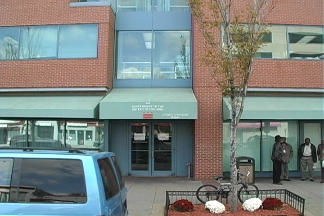
DC Department of Health at 641 H Street NE

At best the 600 workers would have supported 1,200 s.f. of retail--one store--and eventually even the CVS moved--and 3,000 s.f. of restaurant--although that never happened.

Plus people drove to work, not riding the subway, and definitely not riding the X or D or 90s buslines. So the city paid for parking for the employees, rather than having them get to work on their own.

Part of it too is perception, as the Post reported in this short, "EEOC Is Moving On; Fast Food and a Dicey Neighborhood Await," workers often look askance at having to work in revitalizing places. The caption of the photo accompanying the article states "Some at the Equal Employment Opportunity Commission fail to see the upside of moving from downtown Washington to Northeast. The new headquarters' neighbors will include 'one of the largest open-air drug markets in the region'" and the article doesn't get much better:

The Equal Employment Opportunity Commission is in an uproar over a decision by Chair Naomi C. Earp to move its 500-employee headquarters from fine offices in downtown to a "developing" -- but not quite arrived -- area in desolate Northeast near the old Woodie's warehouse on New York Avenue.

At a hostile meeting yesterday to quell a growing rebellion, Earp told several hundred employees -- and others viewing on closed-circuit television -- that "the determining factor is price" in her decision and that employees "should not overreact to concerns about safety."
NA-Loop
Empty lot at 131 M Street NE. Photo by Kevin Clark, The Washington Post. I will say that H Street had this kind of feel back when DOES and DHS moved to H Street in the late 1980s.

I mention the Growth Machine, because as the abstract of the paper, "City as a Growth Machine: Toward a Political Economy of Place," states:

A city and, more generally, any locality, is conceived as the areal expression of the interests of some land-based elite. Such an elite is seen to profit through the increasing intensification of the land use of the area in which its members hold a common interest. An elite competes with other land-based elites in an effort to have growth-inducing resources invested within its own area as opposed to that of another. Governmental authority, at the local and nonlocal levels, is utilized to assist in achieving this growth at the expense of competing localities. Conditions of community life are largely a consequence of the social, economic, and political forces embodied in this growth machine. The relevance of growth to the interests of various social groups is examined in this context, particularly with reference to the issue of unemployment.

Labels: , , , ,