Rebuilding Place in the Urban Space

"A community’s physical form, rather than its land uses, is its most intrinsic and enduring characteristic." [Katz, EPA] This blog focuses on place and placemaking and all that makes it work--historic preservation, urban design, transportation, asset-based community development, arts & cultural development, commercial district revitalization, tourism & destination development, and quality of life advocacy--along with doses of civic engagement and good governance watchdogging.

Tuesday, March 07, 2023

Revisiting St. Louis revitalization planning in the face of population shrinkage

 KMOX radio reports ("Here's what could happen if the population of St. Louis dips below 300,000") that St. Louis is depopulating still, with a risk of going under 300,000 population, which would render it ineligible for certain types of funding made available to larger cities.

In response to a feature in the Washington Post about Tishaura Jones, Mayor of St. Louis, in 2021 I wrote a couple pieces outlining what I would do were I in charge of revitalization planning there.

-- "St. Louis: what would I recommend for a comprehensive revitalization program? | Part 1: Overview and Theoretical Foundations"
-- "St. Louis: what would I recommend for a comprehensive revitalization program? | Part 2: Implementation Approach and Levers"

1.  A big point is merging the city and county, which would immediately increase the city's population, maintaining its eligibility for large city funding opportunities.  That's been sputtering for awhile ("City, county and residents weigh in on merging St. Louis entities together," KMOV-TV).

The population of the county as a whole is just under one million.

2.  And further investment in transit, which might be moving forward ("Reduce crime in St. Louis? Mayor looks to transit, investment in north side," St. Louis Post-Dispatch).

3.  Obviously, the city's number one priority needs to be neighborhood stabilization and resident recruitment to staunch the population lossesLive Baltimore is one of the nation's best practice examples of how to do residential recruitment.

Later I wrote a couple of other relevant pieces on urban revitalization:

-- "Social urbanism and equity planning as a way to address crime, violence, and persistent poverty: (not in) DC," 2021 
-- "Black community, economic and social capital: the Englewood neighborhood of Chicago/Chicago," 2021
-- "Pontiac Michigan: a lagging African American city in one of the nation's wealthiest counties," 2022

Interestingly, Mayor Lori Lightfoot of Chicago, who just lost her bid for reelection, had a revitalization initiative for the South and West parts of the city, called Invest South/West.

-- "Mayor Lori Lightfoot’s signature Invest South/West program is 3 years old. But some of its big projects were already planned when she took office," Chicago Tribune
-- "Invest South/West program remains mostly a vision, without a single project under construction after three years," Crain's Chicago Business 

Even though I wasn't particularly impressed by Mayor Lightfoot, the reality is that it takes a lot longer than three years to move a revitalization plan forward in significant ways.  

I'm not holding DC up as a great example, but it took about 20 years to start to see movement on the redevelopment of the Skyland Shopping Center, and H Street's revitalization hit in the 2000s once trends favored urban living, and after the city announced plans to add streetcar service to the corridor--leading to $1 Billion in new development--but the city had been working on revitalization of that riot scarred corridor since the late 1970s

Labels: , , , , , ,

Wednesday, September 06, 2017

I don't think DC's tax reform is an exact model for the US

DC is the nation's only "city-state."

By that I mean that DC is a fully urbanized place (no rural or exurban land), a city with close to complete taxing power, including income taxes--with the huge exception that the city can't tax nonresident income, which among other effects means, unlike every other jurisdiction in the US, DC can't assess nonresident income tax on professional athletes (which is one way cities and states collect additional monies after subsidizing sports facilities).

Last week, the New York Times columnist James Stewart suggested ("For tax reform lessons, Congress needn't look far") that DC would be a great example for Congress to consider as a model for how to go about "tax reform" -- although tax "reform" if by reform you mean improvement seems to be off the table in favor of a tax cut for the rich.

From the article:
... in 2014 the council cut corporate and business taxes, reduced individual rates for everyone earning less than $1 million and broadened the tax base by eliminating many loopholes.

In the ensuing years, economic growth and tax receipts have surged, enabling the city to accelerate cuts that were being phased in. The legislation was not revenue neutral, in the sense that broadening the tax base offset the reduction in rates. It was a tax cut. But in a development that would surely warm the hearts of pro-growth Republicans, the economic lift was so strong that tax receipts increased, and last year hit a record.
Tax cuts were simultaneous with significant growth.  The problem with the argument is that DC's economy and population have been growing significantly over the past ten years.  It's easy to "cut" taxes when your economy is growing.

In the last nine years--despite the 2008 Great Recession--DC's population has grown by slightly more than 110,000 people ("D.C. population reaches four-decade high," Washington Post), an increase in population of almost 20% over the base number of 570,000 residents in 2007.

From 2014 when the tax cuts were approved and 2016, the population increased by about 3%, from 660,000 to 680,000. 

New condominium and apartment buildings continue to open and plans for large mixed use developments continue apace.

Income tax and property tax revenues were already increasing at an increasing rate.  Most of the new residents, excepting children, are paying out plenty in terms of income and sales taxes, and property taxes for home owners.

It's easy or at least comparatively easy to cut income taxes when the number of earners is growing and it's easy to cut property taxes when the number and size of buildings is growing, along with property values and assessments.

Plus, DC's property tax base is insulated somewhat by the inclusion of a hefty tranche of highly valued commercial property, primarily but not limited to Downtown DC.  DC's commercial property is highly valued in part as a safe place to park money from overseas, generated in countries with lower economic returns and/or more unstable economies.

Expanding the range of sales taxes had limited impact on revenue.  Complementing tax cuts by expanding somewhat the range of goods and services being taxed is likely a minimal proportion of the total revenue mix compared to the large increase in the number of people paying income taxes and rising property tax revenue from residential and commercial property.

Kansas as a lesson.  Although DC's economy is much stronger than that of Kansas, which has been wrecked by Governor Brownback's application of classic Republican supply-side tax cuts, which decimated state and local government funding, especially for schools because there was no increase in "animal spirits" and tax revenue in response ("Why Sam Brownback's tax cuts failed to make Kansas thrive," Bloomberg View; "The Kansas tax cut experiment," Brookings Institution), many of us worry about the tax cuts because of potential threats to the local economy that are out of the hands of the local government.

The economic winds buffeting DC are not favorable, and this will continue through the entire Trump Administration.  First, local employment and commercial building activity is very much susceptible to the vagaries of federal government policy, which these days is focused on reducing government spending, not increase it--except for the military.  This has a disproportionate effect on the regional economy of Washington ("Uncertainty in Washington is hurting D.C.'s job market, economists say, Post).

For example, a neighbor down the street works for a unit of the Labor Department, where next year's budget proposal calls for the unit to be downsized by 80% and hundreds of people will be fired.  Extend that example across most government agencies and you can see a tremendous negative impact on the local economy.

And the increase in military spending won't impact DC that much, because most of the local beneficiaries would be located outside of DC, in Maryland somewhat and Virginia especially.

Second, the commercial office sector is slowing anyway as federal agencies move out of DC proper,  law firms merge and contract, and as more companies reduce the amount of space per worker, leading to reduced need for commercial office space.

-- "Implications of a Trump/McConnell/Ryan Administration on DC's commercial real estate market," 2016
-- "Why Mayor Bowser is right to be leery of systematic lowering of taxes," 2015

Third, because the city's population is growing there is a greater demand for civic amenities, infrastructure expansions and improvements, and clamoring for various social programs such as an increased amount of services for the homeless and expansion of the amount of affordable housing.

-- "Town-City Management: We are all asset managers now," 2015

But this comes as the city's debt financing cap is close to being exhausted.

Conclusion.  Fortunately the city is in a much different place than Kansas.   The city is much smaller, urban, with fewer economic responsibilities.  But imagine the impact on risk management, predictability, and perception if there is a federal government shutdown, or Congress refuses, if only for awhile, to not raise the debt cap, and long term plans by the Republicans to shrink the federal government with its catastrophic effect on the local economy?

Then it's not out of the question to make the assessment that these tax cuts were foolish, that the city failed to plan for severe exogenous economic shocks that were foreseeable.

Labels: , , , , , ,

Thursday, December 29, 2011

Has DC reached revitalization critical mass, so that local government missteps don't matter?

People on the street at 555 Massachusetts Ave. NW
555 Massachusetts Ave. NW.

Most of the local pundits, such as Gary Imhoff and Dorothy Brazil at DC Watch, are focused on the various ethical failures in the city, as Imhoff writes in the latest issue of themail, the twice weekly e-letter on good government:

The year began, at least for me, with great hope that the obvious corruption in the Fenty administration — the favoritism in awarding city contracts, the appointing of obviously incompetent nominees to boards and commissions, the ignoring of community and citizen input in running the public school system — which had been overwhelmingly rejected in the 2010 election, would be cleaned up by the new administration. But then the Gray administration not only didn’t clean up the corruption of the Fenty administration that Vince Gray had campaigned against. Gray embraced that corruption itself, ignoring the Inspector General’s and DC Auditor’s reports condemning Allen Lew’s mismanagement of the school construction and renovation program, and rewarding him for it by naming him his City Administrator. Gray named a series of appointees of dubious ability, some tainted by nepotism. Councilmembers were involved in scandals involving misappropriating their campaign funds and city tax funds, misspending their “constituent service” funds for their own personal and political purposes, and engaging in conflicts of interest between their legislative duties and their outside employers.

And granted, the local schools situation isn't very promising in terms of long term attraction and retention of families with school-aged children, although charter schools and certain high quality and magnet programs in certain DCPS schools provide some hope. (Basically, what people call the "reform" process that started with Michelle Rhee could be more accurately described as school destruction--robust systems needed to be created in order to address and mitigate "achievement gaps" but instead personnel has been roiled by too frequent changes of principals and a focus on firing teachers.)

But according to last Thursday's Post, the "Number of District residents skyrockets."

The District has gained more than 16,000 residents since last spring, growing at a pace that outstripped anything seen in the boom years preceding it.

Census figures released Wednesday estimated the city’s population was 618,000 in July, up 2.7 percent from the census figure in April last year. The current growth spurt is so rapid that the District is on track to draw more newcomers in two years than it did in the entire decade before.

The District’s expansion is all the more remarkable when compared to the rest of the country, which is experiencing its slowest growth since the end of World War II.

The District’s population figures cap a decade of success in maneuvering a turnaround in the city’s fortunes, and its image. Barely 15 years ago, the District had a widespread reputation for having streets that wouldn’t get plowed after a winter storm and that were crime-ridden in any season. Now, the District routinely shows up on lists of cool cities where young people gravitate, and it is drawing as many young adults as ultra-hip Austin and Portland. Three in four newcomers in recent years have been between the ages of 18 and 34. They have zero interest in the suburbs.

Why, in the face of an almost meltdown in local government ("Can D.C. council go back to legislating?" Post) not to mention over-reach ("Is D.C. overgoverned? Or undergoverned?" Post) is the city's population continuing to grow?

Sure DC has a lot going for it:

• (expensive) historic housing stock in attractive neighborhoods (saved in the down years by historic preservationists now reviled as holding improvements back);

that are walkable and bike-able ;

• plus bike lanes, a developing network of cycletracks and trails, and bikesharing;

• a decent (but declining) subway system complemented by Metrobus service for the transit dependent, and Circulators for people afraid of or find it too difficult to navigate Metrobus service;

new multiunit housing units in interesting already urban areas such as Downtown, 14th Street, Columbia Heights, U Street, and H Street NE;

re-created urban areas such as Capitol Riverfront, NoMA, and the Southwest Waterfront District;

• some interesting (Dupont Circle, Georgetown, Adams-Morgan) or revitalizing (H Street, 8th Street SE, U Street) entertainment-commercial districts;

improving retail Downtown ("Downtown Land Baron Doug Jemal Thinks F for Fashion Street" from the City Paper), including at CityVista (Busboys & Poets, 5th Street Hardware, a very nice Safeway), mostly steady retail in Georgetown and Friendship Heights, a Target and BestBuy at DC/USA and a Best Buy and Container Store in Tenleytown--who cares that Sears is closing 100+ stores, they closed their department stores in DC almost two decades ago;

the relatively steady employment engine surrounding the federal government--especially for contractors, lobbyists, and lawyers, although the picture isn't as bright for career government work;

• a location on the East Coast not too far from New York City (and Philadelphia and Boston);

• a bunch of new (Harris-Teeter, Safeway) or significantly refurbished(Safeway, Giant) supermarkets;

• a baseball team, stadium, and big convention center (mostly built with public funds);

• and soon, 6 Walmarts.

One reason is that comparatively speaking, housing in DC will hold its value more when compared to other cities in the country. Because even when the governance function of the federal government is doing "badly" ("Politicians in denial," Post) people still work for it, bills are paid, etc., so that creates a high positive equilibrium for the housing market ("DC housing market one of two in nation's top 20 to post price increase," Examiner). Although, with federal government gridlock and a focus on budget reduction and contraction, this growth and steady state position is going to diminish somewhat, but still, compared to most other locations across the country, DC in particular (and the region as well, depending on local conditions) will remain attractive.

And during the recession/Depression since 2008, for the most part, housing in DC has held its value, especially compared to most other markets nationally.

Sure, the stratospheric price escalation stopped--you aren't finding neighborhoods like Petworth or Manor Park or Brookland where flippers are trying to get $650,000 to $700,000 for a house that now sells for $400,000-$450,000.

But you don't have the kind of price drop in DC where houses are selling for under $200,000. Even in Mount Rainier, Maryland, just across the border with DC, houses there are selling for half or even less of what they would sell for in DC (depending on the neighborhood), because of the big inventory of foreclosed houses in Prince George's County.

But the big issue, at least, is that the wave of new in-migrants to the city are young, and how the city runs--except for public safety and access to cool restaurants and taverns--doesn't matter all that much to them, now.

One of the advantages of the push over the past 8-10 years to build multiunit housing in neighborhoods where it didn't exist before in a substantive fashion is that it adds significant diversity to the housing stock, and enables more people with a variety of incomes and household types to participate in the housing market, when before, when most housing in the city's neighborhoods has been comprised of single family attached or detached housing, many potential housing market segments had been closed out of the market.

Interestingly, on H-URBAN, the e-list for academics concerned with urban history and urban studies, there is a discussion about DC's population from 1940 to 1950. While the city's highest population as of the decennial Census is 802,000 in 1950, according to annual population estimates published year-to-year in the Statistical Abstract of the United States, DC's peak population was 899,000 in 1946. (The thread is accessible from the H-URBAN webpage.)

DC Population figures (estimates from 1941-1949)

1940 -- 663,000
1941 -- 758,000
1942 -- 817,000
1943 -- 891,000
1944 -- 881,000
1945 -- 876,000
1946 -- 899,000
1947 -- 888,000
1948 -- 840,000
1949 -- 807,000
1950 -- 802,000.

The trick will be to maintain and/or grow population as household types change--singles to marrieds, marrieds to marrieds with children, etc.

As you age and as your household status changes, so too changes what matters to you, where schools don't matter now, and access to craft beer salons does, over time, that flips, and the quality of municipal services, schools especially, and governance begins to matter more, especially for those people who own houses, condominiums, co-ops, and flats.

Has DC reached critical mass of positive trends (see the entry from yesterday, "The fifth phase of center city revitalization (reprint)") so that population will continue to grow despite the ethical cloud that hangs over the city's governance class, or will the failures within local government reverse the current positive trends?

E.g., the bandwagon for Walmart isn't the kind of policy action that typically is attractive to the young creatives moving to cities like Washington.

Going forward, the District's leadership is going to need to be more conscious of managing for the future rather than pandering to the past.

From "2012 resolution tips for D.C.'s newsmakers" by Mike DeBonis in the Post:

Vincent C. Gray, mayor: Look alive. A year into his mayoralty, Gray (D) has pretty well figured out it’s tough to be top dog. Try as he does to tout new economic development projects, reduced unemployment, improved city services and a growing population, he has yet been unable to animate his administration with anything more inspiring than his threadbare “One City” mantra. Filling the vacuum instead have been blown vettings, dismal approval ratings and a strange, scorned employee in sunglasses. A new cadre of top staffers have been brought on to help, but will their boss ever get the “vision thing”?

Bikesharing +1 | Walmart -1
Online gaming -1 | Food Trucks +1
Etc.
A Cabi bicycle sharing bike, North Capitol and Massachusetts Avenue NW, Washington, DC

Labels: , , , ,

Tuesday, April 26, 2011

The future of center city population retention and quality neighborhood schools

In the long blog entry I wrote a couple weekends ago, "The future of mixed use development/urbanization: Part 1, Housing," I probably buried the lead.

I wrote this:

Note that I do not fully buy into the belief that the housing market will totally and completely change in face of the onslaught of Gen Y.

It is true that a majority of the Gen Y cohort prefer to live in urban (Dupont Circle, Columbia Heights, Georgetown), "urban lite" (Capitol Hill, Friendship Heights, Clarendon, Ballston, Bethesda, Rockville), and maybe Silver Spring is "urban middle," locations when they are younger, while Gen X still was fine with living in the suburbs in their young adult phase and stay in the vicinity as their household changes over time.

But I do wonder as Gen Y ages, if their housing preferences will devolve to the mean somewhat. As they age and their household type changes (from single to married, from married without children to married with children) will they move to less connected, quieter locations, which could be in the city (e.g., moving from Dupont Circle or U Street to Brookland, Shepherd Park, or Takoma) as well as the suburbs. And that is independent of the phenomenon of moving to the suburbs when children are ready for school, because of poorer quality education options in the center city.

E.g., as people get older, they age out of hipper places to live like the Warehouse District in Cleveland and maybe U Street NW in DC, because they get tired of the noise etc. See the past blog entry "Daypart and age-group planning in mixed use (commercial) districts" from 2009, which discusses this.

It might be that Gen Y people will move, but with a greater preference for center city neighborhoods outside of the core, while previous cohorts expressed a stronger preference for suburban locations.

------
A few weeks ago I ran into a planning professional, who was openly derisive when I told him/her where I lived--the person couldn't believe that I wouldn't want to live in an active, amenity rich neighborhood like Dupont Circle, or up and coming places like Columbia Heights or H Street. Well, the fact is, I don't have enough money to live in Dupont Circle or Columbia Heights, and I have burnout with regard to living in a neighborhood like H Street or Trinidad--it takes a lot out of you to work on revitalization in places like that over time.

The fact is, although I don't have children, we can type neighborhoods according to household type and age. Capitol Hill is for older people, while Columbia Heights, Adams Morgan, U Street, etc. are for younger people, especially singles and people in group house situations.

So what happens when people's households change, when they pair up? When they have children? As people age, if they stay in the city, they move to different neighborhoods better situated to satisfy changing needs. E.g., Brookland, where many of the houses have big backyards is great for children. Capitol Hill is pretty quiet at night, unlike U Street, and is better for people who are done with the hustle and bustle, etc.

Planning should have greater focus on how different neighborhoods satisfy different household types, and should work to ensure that the quality of the amenities desired actually meet and satisfy the expectations.

Easter eggs
Over the weekend, I went to a neighborhood easter egg hunt for some of the households on or near my block. There were 8 children representing 5 different households. Of course I eavesdropped (and participated in) various conversations concerning what to do as the children get older and the quality of the schools they have access to and attend becomes of paramount concern. (A bunch more households with children didn't participate as it was a somewhat last minute thing.)

Two of the households specifically discussed moving to the suburbs.

As I have been mentioning, I understand why school improvement is a key urban issue, not just in DC, but in cities such as Chicago and New York City as well. Each of the cities now have mayoral control of the school system and mayors in other cities clamor for it. Baltimore also has a school improvement initiative, although it is half local and half state control.

I have advocated a third way on schools. I understand why Mayor Fenty and Michelle Rhee thought it was important to address school improvement. But I thought that their approach was completely and totally misguided and flawed* (* flawed is the other "f" word). Of course the social and community capital available to improving the public schools in DC is further dissipated amongst charter schools and the voucher movement.

(Note that the "enrollment increase" for DC schools this year was all in Pre-K preschool programs, not at schools in the elementary, junior high, and high school levels. Plus, for budget reasons, the school system is cutting back on successful initiatives such as Montessori education, because they don't want to have to pay for accredited Montessori teachers and the higher costs of maintaining the program.)

In my discussions on offices of planning, I make the point that for the most part, most of these agencies are really offices of land use, because they aren't responsible or seen as the lead agency and chief coordinator and director of all of a jurisdiction's planning activities. (This is a bit different in a community like Montgomery County, where the planning agency also does transportation planning, not just land use, as well as parks planning, but I am not sure how much schools planning they do.)

This is definitely the case in Washington, DC.

The schools improvement effort, and especially the maintenance of quality neighborhood schools in each neighborhood, should be seen as the foundation of the most important building blocks in neighborhood stabilization and improvement, resident attraction and retention, community building, etc.

The Office of Planning should be heavily involved in these decisions, and especially the decision to close schools. But I think for the most part, school siting decisions are out of the hands of the planning department.

My immediate neighborhood has three schools. The former Rabaut Junior High School has long been since given over to charter schools, which open and close over the years. It's two blocks away. Whittier Elementary School is about 5 blocks away, and Coolidge High School is about 6 blocks away.
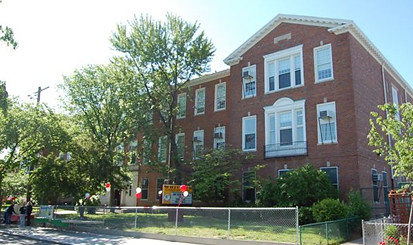
Whittier Elementary School, DC
Whittier Elementary School. Photo from the school website.
Coolidge is underperforming. It has fewer than 700 students with capacity for 2,000 or more. Meanwhile the Friends of Bedford Charter School wants to create a charter high school for Ward 4--with limited demand, how could this even be considered?

Whittier, I am not sure about the quality, I do know the enrollment is quite low. But judging by the number of families in the area, if the school captured more than 50% of the neighborhood children, enrollment would be much higher.

If these schools were uniformly excellent, the myriad of young families with children wouldn't be faced with the conundrum of "having to leave the city" as their children enter school, because we would have great neighborhood schools in our neighborhood, and every neighborhood of decent size in the city.

And the problem in my neighborhood is repeated across the city.

Because we can't count on neighborhood schools in DC, and in many other cities, I do not believe that the Gen Y preferences for urban living can necessarily be maintained if urban schools do not improve in lockstep with center city in-migration. Retention of families with choices will not happen if schools don't improve.

On the other hand, maybe all that matters is good pr. People think that Rhee improved the schools when she didn't. Although when it comes down to the level of the individual school, people aren't fooled. They try to get their children into the best schools, through out of boundary lottery procedures, or in charter schools. But even the best charter schools have limited capacity. Then, people think about moving...

Labels: , , , , ,