Rebuilding Place in the Urban Space

"A community’s physical form, rather than its land uses, is its most intrinsic and enduring characteristic." [Katz, EPA] This blog focuses on place and placemaking and all that makes it work--historic preservation, urban design, transportation, asset-based community development, arts & cultural development, commercial district revitalization, tourism & destination development, and quality of life advocacy--along with doses of civic engagement and good governance watchdogging.

Monday, June 28, 2021

Great Marketing of Passenger Railroad Service: Grand Central Station, Chicago

 Grand Central Station in Chicago was constructed by the Baltimore & Ohio Railroad and then acquired by Chesapeake & Ohio Railroad when they bought B&O.  It was built in the late 1800s and demolished in 1971.  I had never heard of it, but happened to come across some images today when I was doing a search for something else.

Not only did the station have a great campanile/clock tower, it had great and large neon signage for the railroad, and a huge marketing billboard that was frequently updated.


I argue that today's transit systems should do similar kinds of marketing.  Other favorites include

Denver, both signage and architectural lighting.

King Street Station, Seattle

Portland's "Go By Train" sign has been the inspiration for other mobility marketing signage in the city

Flickr photo by James House.

Salt Lake's Union Pacific and Denver & Rio Grande Western Railroad stations had great signage, which is still extant, even though the buildings no longer function as railroad stations.

Labels: , , , ,

Sunday, October 06, 2019

Society of Environmental Graphic Design as a resource | Seattle Children's Research Institute street signage project

A few years ago, when I did an entry on wayfinding signage, a blog commenter mentioned the Society of Environmental Graphic Design and all the great resources they have.

I am working on a project where signage in terms of both wayfinding and identification is one of many issues, so I am doing some image research on "market" signage and I came across an SEGD article, "Seattle Children's Research Institute Neighborhood Visibility Project."

It's about how the Seattle, Children's (Medical) Research Institute used neon signage with particularly creative messaging to enliven the street frontage of what would normally be a closed off "office building", drawing on the great history of neon signage in Seattle, especially for the interior and exterior of Pike Place Market.

Of course, the Breakthrough sign is particularly appealing to me, since I believe, perhaps fulsomely, that the kinds of ideas, concepts, analysis and frameworks for best practice  presented in this blog are usually "breakthroughs."

(My joke is that I endeavor to do so, including providing references, because I don't want other people to be able to savage my writings the way I can in response to other pieces elsewhere.)

I often worry about becoming "stale." 

But my stale is still a lot better than most people's creative. 

Then again, my insights are always further developed, extended, and improved by interaction with others, which is why I appreciate the regular commenters I do have, and wish I had more.

Labels: , ,

Saturday, December 09, 2017

Signs and marquees as public art and landmarks

I am a fan of outdoor signage as an urban design element of commercial districts and communities more generally.  Although some quarters, such as the group Scenic America, look at most forms of outdoor advertising as a desecration of the public space.

Sure, places like Times Square in New York City, Piccadilly Circus in London ("Advertisers set to fight to have their name in lights at Piccadilly Circus," London Evening Standard), or sign-marked urban arterials in many cities can be somewhat cacophonous, but they also acknowledge, even celebrate commercialism in the context of the buoyant capitalism that marks the United States as the USA.

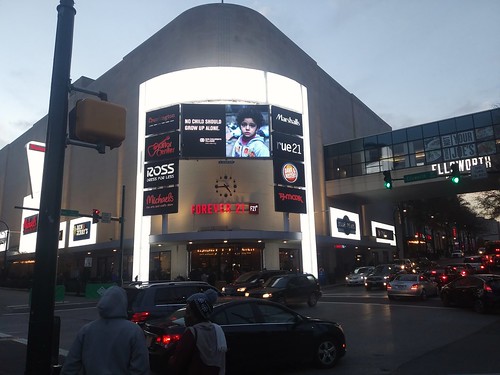
In DC, there is some billboard signage around Gallery Place and the Capital One Arena but it pales vis a vis NYC.  The Downtown Silver Spring district in Montgomery County has developed a kind of Times Square effect, on a much smaller scale, with signage on one shopping center complemented by the neon signage of the cinemas across the street.
Ellsworth Place night time signage, Downtown Silver Spring, Ellsworth Avenue and Fenton Street
The Downtown Silver Spring night time signage is more bright than it is an artistic and aesthetic element of the streetscape.

Three recent sign type projects, although one is in Canada, are noteworthy, as they involved serious historic preservation and restoration efforts.

Two wrinkles with signs are (1) the old signs -- neon and electric -- tend to be more novel, but as other forms of advertising supplanted place-based advertising (signs and billboards), these types of signage fell out of use generally, replaced by back lit signs originally and now digital signs, and specifically, as companies went out of business; (2) defunct companies matter in terms of maintaining signage not only because they were motivated and successors are not, but because building regulations typically require the removal of the signs of defunct businesses regardless of the artistic and historic merits.

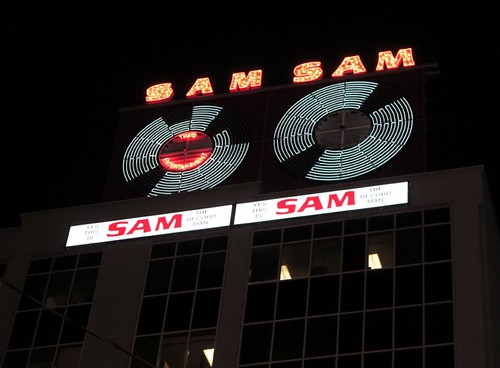
1.  The Toronto Star reports ("Sam the Record Man sign lights up Yonge Dundas Square") that the sign advertising the original location of Sam the Record Man has been restored, after being out of commission for more than 10 years.

sam_sign.jpg.size-custom-crop.0x650
Jaren Kern, Toronto Star.


2. The Los Angeles Times reports ("Rare vintage electric sign lights up Sunset Boulevard again after a restoration") about the restoration of the Jensen's Recreation Center moving sign, which shows a bowler throwing strikes. From the article:
Considered groundbreaking technology at the time of its installation, the sign is controlled by a series of electric motors that switch the 1,300 red, green and white light bulbs on and off to give the appearance of movement.

The sign was mostly dark for about 50 years but has just been restored by new owners Vista Investment Group. ...

Animated incandescent signs predated neon signs, which became popular in the 1920s, said Eric Evavold, former board member of the Museum of Neon Art in Glendale. The Jensen’s sign is one of the largest such vintage, operable signs left in the world, he said.

“It’s incredible that this sign was just sitting there in the middle of the city for so long,” Evavold said. “This is a special jewel in our illuminated sign history.”


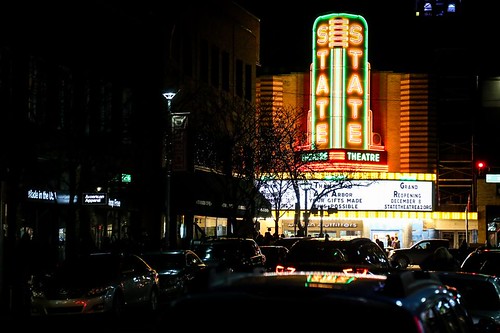
3. In Ann Arbor, the owners of the State Theatre building -- the top is still used for events, the bottom of the building has long been rented out as a separate retail space -- have restored the marquee ("Ann Arbor's newly restored State Theatre marquee more dazzling than ever," Ann Arbor News) as part of an upgrade to the entire property. The State Theatre is where I saw movies like "Purple Rain."

Restoration of the State Theatre marquee, Ann Arbor
The State Theatre's marquee was relit after a period of renovations in downtown Ann Arbor on Friday, December 1, 2017. The State Theatre will officially reopen on Friday, December 8. Hunter Dyke | The Ann Arbor News


For a long time the separate Michigan Theater has been a nonprofit, showing films, concerts, etc. for decades, while the State Theatre had generally owned by regional cinema chains. 

At some point, the Michigan Theater Foundation also acquired the State Theatre.  Since the buildings are located within a block of each other, this kind of joint operation (not unlike what the Playhouse Square Foundation does in Cleveland -- "PlayhouseSquare stars in its own real estate revival," Cleveland Plain Dealer) makes sense.

The Ann Arbor combination of the State Theatre with the Michigan Theater is an illustration of my point about BTMFBA ("BTMFBA: the best way to ward off artist or retail displacement is to buy the building"), if you want to control the space and retain it as an element of the network of a community's civic and cultural assets, most often you're going to have to buy it yourself.

By contrast, DC's Takoma Theatre is slated to become a clinic facility for Children's Hospital, when at one point it was the most intact extant neighborhood theater property remaining in DC.

Labels: , , , , ,

Sunday, June 24, 2012

Signs, signs revisted

This image of this ugly signage-awning on H Street NE, from H Street Great Street blog, illustrates points made below.

Because Suzanne isn't up yet, I have the leeway of being able to watch the DC government television channels right now, and I just saw part of the hearing on the proposal for expanding the ability to have digital signs on the Verizon Center.

Interestingly, property owners of adjacent buildings aren't favorable, seeing the signs as a potential distraction to tenants and viewsheds, and may reduce somewhat the value of their properties and the ability to re-rent space as tenants leave.  The testimony I caught was by people affiliated with the building across the street.

An interesting sidebar is that apparently the lead tenant of the building, a law firm that does business with the Verizon Center owners, told Councilwoman Alexander that they were fine with the signs--why would they tell her that they disagree with a major client?  And the building owner made the point that if and when the law firm moves, then the building is left with-encumbered by the potentially negative effects of the sign changes.

Terry Bellamy, Director of the DC Department of Transportation, supported by Alice Kelly, who works on public space policy, testified about an intragovernmental task force on updating the city's sign regulations.  Apparently this is in part an initiative spurred by concerns expressed by the Federal Highway Administration, that signs on certain streets do not meet regulations concerning roads funded in part by federal transportation monies.

I didn't know about that task force, but it does remind me of some testimony/writing related to the approval of the H Street commercial district zoning overlay specifically, but it is based on the general point that achieving quality signage in traditional commercial districts in the city needs to be a higher priority, that sign design needs to be regulated and reviewed more carefully than it is (basically it isn't at all, except in historic districts).

---------------------------------
Reprinted from March 2005
---------------------------------

The neighborhood organizations in the H Street NE area are considering the matter of the creation of a Neighborhood Commercial District Overlay to help guide changes and improvements in the commercial district. The text is online here: Proposed: H Street Zoning Overlay courtesy of ANC6A.

The basic zoning proposal is decent, but both ANC6A and ANC6C raised a number of points. I raised the issue of signs, and both ANCs are endorsing a recommendation that sign guidelines be added to the zoning overlay. Below I offer language on why signage guidelines are important, a specific request for their addition to the proposed NC Zoning Overlay for H Street, and mechanisms for providing guidance and review.

Thank you to Nancy Metzger, Emily Paulus, Derrick Woody (for writing Thrive) and others I probably have missed, for assistance in preparing this recommendation.
____________________

Storefronts are the most prominent feature of buildings in traditional neighborhood commercial districts and play a crucial role in a store's advertising and merchandising strategy. The functional and decorative features of storefronts are key to defining the overall character of the building and contribute to the coherence and distinctiveness of the commercial district as a defined destination with a sense of identity and place. The DC Office of Planning has acknowledged this importance through the publication of Thrive: A Guide To Storefront Design In The District of Columbia.

Throughout the city's commercial areas, signs play a major role in creating either a positive or negative visual image. Signs should make a positive contribution to the general appearance of the street and commercial area in which they are located. As stated in Thrive, "The character of your storefront signage and that of your neighboring businesses contributes tremendously to how your business and your business district are perceived."

Guidelines are in place for commercial storefront improvements, outdoor seating areas and commercial signs on historic buildings or in historic districts. But unlike the existing NC Overlay Districts, H Street NE is not a designated historic district, although the pre-1955 building stock is eligible for listing on the National Register of Historic Places.*

Because the neighborhood is not designated, overall design guidelines that normally pertain to buildings in the other NC districts are not applicable to H Street NE. This accounts for the special design provisions in Section 1324 of the proposed overlay.

Because of the importance of signage to the perceptions of residents, visitors, and current and prospective customers, and because of the impact on investment by other business proprietors, property owners, and other stakeholders in the commercial district, Advisory Neighborhood Commission 6C recommends that sign guidelines be added to Section 1324 "H Street Northeast Commercial Corridor Design Requirements" of the the proposed NC Overlay District for H Street NE.

This is recommended because the Sign Regulations that exist as part of 12DCMR, "The Building Code" administered by DCRA, are not concerned with or intended to achieve overall quality signage environments where individual signs:
  1. are integrated into the particular architectural character of the building and neighborhood;
  2. follow historical precedent of a particular building or of historic District of Columbia architecture generally, in form and in placement on the building;
  3. are primarily pedestrian oriented;
  4. are designed with lettering, colors and materials that complement and fit into surrounding architectural context and character of the H Street commercial district;
  5. approximate the quality of materials, designs, and workmanship of surrounding architecture; and
  6. where the lighting of signs is to be considered as part of the aesthetic illumination of the overall display and/or architecture. The illumination should be subtle, pedestrian oriented, and not in competition with adjacent illuminated signs.
ANC6C recommends that Section 1324.14 be added to include sign guidelines. This section could refer to a specific resource with more specific criteria detailing these requirements.
Model guidelines include:

(1) The Historic Preservation Design Guidelines of the DC Historic Preservation Review Board/DC Office of Planning Historic Preservation Office, particularly the section on "Signs on Historic Commercial Buildings;"  [note that since this was written, signage guidance by DC HPO has been codified in the document Design Guidelines for Historic Commercial Buildings]

(2) The Barracks Row Main Street Sign Guidelines;

(3) or Storefront Guidelines currently being developed by the ReSTORE DC program of the Office of the Deputy Mayor for Planning and Economic Development.

Further, we recommend that such guidelines be administered through the design review procedures currently in place through the DC Historic Preservation Office. It is our understanding that design review services for designated Main Street programs are made available through that office via funds provided by the Deputy Mayor's Office. The proposed HS NC Overlay District is also a designated Main Street district recognized by the ReSTORE DC DC Main Streets program and is therefore eligible for such services.
_____
Notes

* Two buildings, 1365 H Street, site of the H Street Playhouse, and 1333 H Street, the address for the Atlas Theater complex, have been designated as landmarks by the DC Historic Preservation Review Board. By being listed on the National Register of Historic Places, the Atlas Performing Arts Center is able to take advantage of Federal Historic Tax Credits, which will contribute upwards of $4 million towards the $14 million required to finish the renovation project.

Labels: , , , , ,

Friday, January 04, 2008

Baltimore art banner project

Banner, Baltimore Urban Forest Project
For two months, about 200 banners produced by local artists, will be hung in various districts near some Baltimore city parks, including Druid Hill and Patterson Parks. Afterwards the banners will be converted into bags and sold.

For more information check out the website for the Baltimore Urban Forest Project.

From the Chesapeake Sustainable Business Alliance:

• Join members of the sustainable design team Tilt Studio, Inc.and Tilt Studio Foundation, Inc to hear about a dynamic project to beautify the city and support our local forests. The Urban Forest Project will display local artists' artwork on banners and highlight our local parks. The banners will then be recycled into handbags and marketed locally.
• Myra Broisus of Baltimore City Department of Recreation and Parks will also speak on the TreeBaltimore program and doubling Baltimore's tree canopy one tree at a time.

Join a lively mixture of people from NGOs, academia, government and business are welcome and encouraged! This is an opportunity to share information, network and find out about who is doing what in the Baltimore area.


WHEN: Monday, January 7th 6pm-8pm

WHERE: Rawlings Conservatory in Druid Hill Park, 3100 Swan Dr. in Druid Hill Park Baltimore, MD 21217, 410-926-4195 directions

INFO: 410-342-1482 or email info@csballiance.org

COST: $5.00 admission includes glass of wine

Labels: , , , ,

Wednesday, March 28, 2007

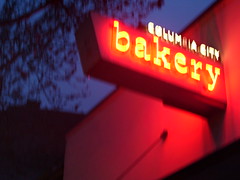
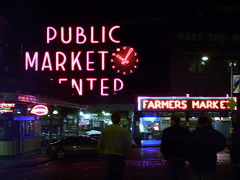
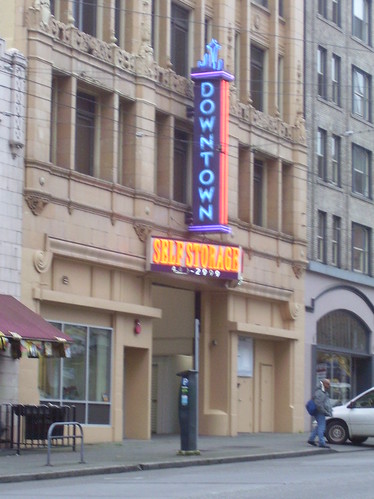
Some Seattle neon

Showgirls neon sign, First Avenue, Seattle

Columbia City Bakery

Pike Place Market sign

Downtown Self-Storage, Seattle

And I scored a copy of Kevin Lynch's The Image of the City for $3 at a used bookstore in Columbia City!

Labels: ,