Rebuilding Place in the Urban Space

A community’s physical form, rather than its land uses, is its most intrinsic and enduring characteristic. This blog focuses on place and placemaking and all that makes it work--historic preservation, urban design, transportation, asset-based community development, arts & cultural development, commercial district revitalization, tourism & destination development, and quality of life advocacy--along with doses of civic engagement and good governance watchdogging.

Wednesday, January 31, 2007

Merger of two organizations: Coalition for Smarter Growth and Washington Regional Network for LIvable Communities

From a press release:

New organization expands operations, programs, and influence

Coalition for Smarter Growth and Washington Regional Network for Livable Communities (WRN) are proud to announce the completion of a merger. The merger of two of the region's most innovative and effective smart growth organizations creates a more powerful voice addressing the region's key issues of where and how to grow.

"This merger allows us to consolidate our long-time partnership with WRN and ensure that housing choices are fully addressed in local and regional decisions about how and where we grow," said Stewart Schwartz, Executive Director of the
Coalition for Smarter Growth.

The merged organization, under the name
Coalition for Smarter Growth, will incorporate WRN's programs and its focus on equitable development into the Coalition's regional work to ensure that transportation and development decisions are made with genuine community participation and allow the region to accommodate growth while revitalizing communities, providing more housing and travel choices, and conserving our natural and historic areas.

"WRN's board of directors determined that our mission can best be achieved by combining efforts formally with our close partner, the
Coalition for Smarter Growth," said Cheryl Cort, Executive Director of WRN. "I am excited about this change and look forward to being even more effective as we are able to marshal the substantial resources of the Coalition for Smarter Growth to achieve our joint goals and vision."

Created in 1991 by leaders on environmental, bicycle, pedestrian, transit and urban planning issues, WRN shared a similar mission with the Coalition, but served as the regional leader on equitable development, including affordable housing, transportation equity and helping urban communities capture the benefits of smart growth.

WRN's Affordable Housing Progress Report in 2004 spurred Northern Virginia jurisdictions to greatly increase their funding commitment to affordable housing. WRN has also been a key leader in DC's Affordable Housing Alliance and helped lead the successful effort to secure an inclusionary zoning policy in Washington, DC. WRN's focus on safe pedestrian access to Metro stations on the region's east side has led to policy, planning and investment changes. WRN has also clarified the connection between affordable housing, access to jobs, and lower transportation costs.

The region's leading environmental and community organizations founded the
Coalition for Smarter Growth in 1997, to serve as a central coordinating agent, an advocate for community-oriented development, and voice of smart growth in Metropolitan Washington.

In ten years, the
Coalition for Smarter Growth has shifted the regional debate to a point where voters across the region are supporting better management of the location, pace and design of growth. This vision isc aptured in the Coalition's Blueprint for a Better Region, a visual depiction of how transit oriented development and corridor redevelopment can provide more housing andt ransportation choices while also protecting neighborhood parks and our surrounding agricultural and rural landscape.

"As part of the merger, we are launching an Equitable Development Campaign to raise the visibility of WRN's ongoing programs in affordable housing, transit-oriented development and transportation equity. We will also expand our leadership in the District of Columbia and on smart growth and regional housing policy efforts. And together, we will proudly continue the Livable Communities Leadership Award started by WRN," noted Schwartz.

WRN's Executive Director, Cheryl Cort, has been named Policy Director for the
Coalition for Smarter Growth.

As part of the merger, a new website will be launched this Spring incorporating the programs and issues of both organizations.

Labels: , ,

The Real Congestion Coalition

Matthew Clark draws our attention to this article from the Pittsburgh Tribune-Review, "Decongesting America." From the article:

Q: Who is the "Congestion Coalition," as you call them?

A: The Congestion Coalition is a group of special-interest groups that really are hostile to automobile travel and want to promote public transit even though that means it will take longer for people to get where they want to go and they are going to waste more time stuck in traffic. What we have seen empirically in the United States is that in order for people to use public transit, they need to live in very congested urban environments. That is the most effective way that public transit can compete with the automobile. The result is, transit agencies are in favor of congestion because as long as it takes longer for us to drive our car to work, that means people are more likely to get on a bus or train. There also are environmental groups that are just hostile to the automobile and professional planning groups that are hostile to the automobile because they think it's anti-social. They believe congestion is a good thing because it's more likely to force people off the road.
GE Streetcar ad, 1940
GE Streetcar ad, circa 1940.

The interview is with Ted Balaker and Sam Staley, the same authors of the piece that ran in Sunday's Post Outlook section, "5 Myths About Suburbia and Our Car-Happy Culture."

As I said before, pro-mobility, pro-mode shift, pro-transit think tanks need to be more focused on generating the same kind of op-ed campaign.

I wrote this to Matthew:

The Pittsburgh Tribune-Review is an interesting paper. As you probably know, it's owned by Richard Scaife, who through the Sarah Mellon Foundation, funds a lot of signficantly conservative organizations. These organizations include those that promote the sprawl agenda, although termed in favor of property rights (and usually supported by the Growth Machine).

The real congestion coalition are the organizations they support. However and ironically, Mr. Scaife is a strong supporter of historic preservation, and has been a strong supporter of the Pittsburgh History and Landmarks Foundation. So he isn't fully terrible.

Back to the other, remember those numbers?:

one lane of road can move in one hour about 2,000 cars, about 6,750 people on buses, 10,000 people on bus rapid transit, and 15,000-60,000 people on light rail to heavy rail.

I am taking a class on Transportation and Land Use taught by one of the co-authors of a book of the same title, and as an economist he makes the point that people individually make sound decisions to drive due to the relative time efficiency, but that in the aggregate, what works for individuals doesn't work collectively. The reality is that lane capacity is constrained, and automobiles don't measure up in terms of efficiency on the road, or in terms of the use of land when parked.

Labels: , ,

Use value of place and closing schools

The January 15th issue of the New Yorker has an article by Katherine Boo (ex-Washington CIty Paper) called "Expectations" about school reform efforts in Denver, and the closure of Manual High School due to persistent failure, the impact on the children, and the reform agenda of the school superintendent, Michael Bennet.

I realized when reading this article that I have been too quick to support closing schools, without thinking of the negative impact on families and the children--even though I have considered and written about the impact on neighborhoods more broadly. Declining enrollments mean schools must be closed. However, I realize that the discussion of "use value of place" by Logan and Molotch in Urban Fortunes: Toward a Political Economy of Place, is completely relevant when thinking about and planning to ameliorate the negative effects.

While not citing this work, in Root Shock Fullilove makes the same kinds of arguments on the destruction of community and social networks as a result of urban renewal.

Types of Use Values*

Daily Round: The place of residence is a focal point for the wider routine in which one's concrete daily needs are satisfied.

Informal Support Networks: Place of residence is the potential support of an information network of people who provide life-sustaining products and services.

Security and Trust: A neighborhood also provides a sense of physical and psychic security that comes with a familiar and dependable environment.

Identity: A neighborhood provides its residents with an important source of identity, both for themselves and for others. Neighborhoods offer a resident not only spatial demarcations but social demarcations as well.

Agglomeration Benefits: A shared interest in overlapping use values (identity, security, and so on) in a single area is a useful way to define neighborhood.

Ethnicity: Not infrequently, these benefits are encapsulated in a shared enthnicity... When this occurs, ethnicity serves as a summary characterization of all the overlapping benefits of neighborhood life.

(* From chapter four of Urban Fortunes: Toward a Political Economy of Place.)

Labels:

DC Neighborhood College Fellowship Program

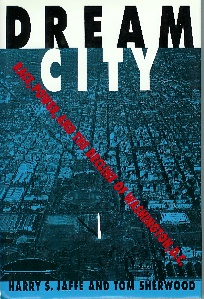
Dream City
From a press release:

The D.C. Neighborhood College, in partnership with The George Washington University Center for Excellence in Public Leadership, is now accepting applications for its 2007 civic leadership development program. The free 12-month program seeks to develop effective grassroots leaders and is open to residents from the District's eight wards. Applications are due February 16, 2007, by 3:00 p.m.

"Participating in the D.C. Neighborhood College was a great experience for me," said graduate Karen W. Cooper. "The college gave me the skills I needed to be an effective leader in the community and in my professional life as a manager. I use the knowledge I've gained about economic development, project management, and leadership skills on a daily basis." Cooper is a 2003/2004 Neighborhood College graduate from Ward 4, and founder and chair of the Friends of Petworth Recreation Center.

Since 2002, D.C Neighborhood College has graduated 53 local leaders and was awarded $500,000 from the Office of the Mayor. The college provides local residents with the tools to make a difference in their neighborhoods. Tackling complex issues such as social justice, workforce development, affordable housing, and job creation, graduates are taking strides to build sustainable D.C. communities.

Participants range in age from the early 20s to late 60s. All D.C. residents with a commitment to personal development and positive change are encouraged to apply. Interested applicants should contact Karima Morris Woods at (202) 994-5384. The program takes place three times a month, beginning March 8, 2007, at the Thurgood Marshall Center. Applicants will be asked to complete a form listing their background information, interest in the D.C. Neighborhood College program, and community leadership involvement.

The District of Columbia Neighborhood College, a public-private partnership managed by the
Center for Excellence in Public Leadership at The George Washington University, provides civic development training for District neighborhood leaders to become more effective change agents and advocates. Established in 1997, the center's mission is to develop public leaders who make a positive difference in their organizations and in the lives of the people they serve.
---------------------------
The program doesn't train people along the lines that I would--way more detailed information about how the world really works in DC (and beyond) and how to address it would require exposure to:

-- the book Dream City, especially chapter 4 on development in the city (see this blog entry)
-- the journal article "City as a Growth Machine: Toward a Political Economy of Place" by Harvey Molotch, which explains the agenda of local elites in a meta fashion (reading the full book, Urban Fortunes: Toward a Political Economy of Place, wouldn't hurt either
-- Kathy Sinzinger's award-winning article about the Federal City Council, "THE DISTRICT'S POWER BEHIND THE SCENES,"
-- training in placemaking such as the "How to Turn A Place Around" workshop by the Project for Public Spaces (for three years or more I've argued that people working as Neighborhood Services Coordinators for the Mayor's Office should be trained with this program--I'd like to bring it to DC annually as a training-capacity building endeavor)
-- serious training in the development of truly neighborhood and citizen serving negotiating skills such as with this handbook, Community Benefits Agreements: Making Development Projects Accountable
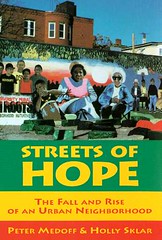
-- probably a read of the book Streets of Hope, about a truly ground up neighborhood revitalization effort in Boston, the Dudley Street Neighborhood Initiative.
streets_of_hope_cover.jpg
This should be complemented by:

-- the development of an information resource center to support citizen involvement and deliberative engagement, such as the Urban Information Center at the Dallas Public Library
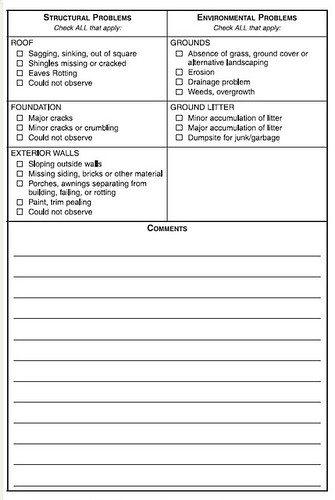
-- such an information center should include data and software tools such as the field based tools developed by Pittsburgh's Community Technical Assistance Center and the University of Memphis Center for Community Building and Neighborhood Action
Problem Property Audit, page 1 - University of Memphis
Problem Property Audit, page 2 - University of Memphis
-- an ongoing training program beyond the year to build the capacity of members of civic organizations and ANCs (See for example State of Massachusetts Citizen Planner Training, Neighborhood Revitalization Planning/Minneapolis).

Further complemented by legal clinic assistance such as that performed by the city-developed Neighborhood Law Corps in Oakland, California.

Labels:

Tuesday, January 30, 2007

Abe Pollin wants more

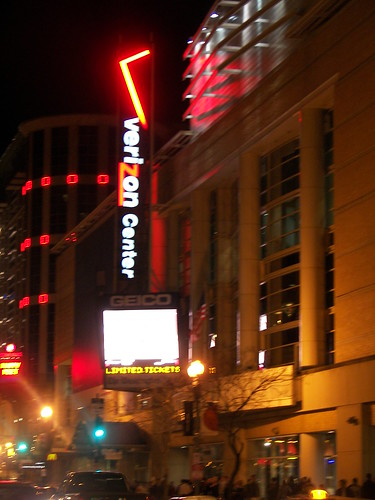
Verizon Center at night

(The title is inspired by the Sisters of Mercy song, "More.")

Saturday's Washington Post reports that Abe Pollin wants $50 million to upgrade the luxury boxes and do some other stuff at the Verizon Center. See "Pollin Asks D.C. to Pay for Verizon Center Renovations."

With the hugely expensive baseball stadium under construction, and with all this talk of public funding for a soccer stadium, along with the absolutely insane talk about trying to attract the Washington Redskins football team back to DC, I am sure Mr. Pollin, who spent $220 million of his own money to build his arena, is feeling unloved.

From the article:

Wizards owner Abe Pollin, who built the $220 million sports arena with his own money in Chinatown nearly a decade ago, wants the extra money to upgrade all or some of its 110 luxury suites and replace its outdated scoreboard, District officials said. Those and other improvements would be designed to attract special events, such as championship basketball and hockey games.

Pollin's company argues that the city should give the arena a financial boost as a reward for its role as a catalyst of the downtown renaissance, city officials said. The 20,674-seat Verizon Center has served as the anchor of the Chinatown area's revival, a transformation into a bustling hub for restaurants and night life.

As people know, I argue that while the Verizon Center truly contributes to the vibrance of the Gallery Place area, and it is an anchor, it is not the sole or only cause for the positive changes.

We need an independent authority, comparable to New York City's NY Independent Budget Office or the late lamented Congressional Office of Technology Assessment, that "pro-science" then Speaker Newt Gingrinch didn't see fit to fund, to provide a fair and transparent evaluation of the costs and benefits of such investments, the kind of evaluation that the city doesn't provide when considering such projects.

Peter Angelos has a clause in his contract with the Maryland Stadium Authority that anything that the football team gets in the way of stadium upgrades, that the Authority has to provide the same upgrade to the Camden Yards stadium.

This never ends. The city opened up the treasure chest of public financing of sports facilities with baseball stadium, and now perhaps, we are doomed to continue funding other similar projects forever.

Colbert King, the Saturday columnist who most often writes about DC issues, covers this broad issue, focusing on talk and plans for funding a soccer stadium, in the piece, "Another Bite Out of D.C.'s Hide?"

King writes:

Victor B. MacFarlane, the majority owner of D.C. United's operating rights, said at a news conference, "We would love to help make soccer the sport that African Americans and other children of color first look to for recreation and entertainment." Toward that end, MacFarlane, himself African American, pledged to build a youth soccer field in Ward 8, which is home to D.C. Council member and former mayor Marion Barry. MacFarlane speaks from the heart, I am sure. But I wouldn't be surprised if development rights to that juicy piece of land surrounding the proposed stadium didn't also draw the team owners to the deal.

Here's how the project might develop: The city would prepare the tract's infrastructure (worth millions of dollars) and turn it over to the MacFarlane group. The developers, in turn, would build the stadium and an adjacent complex with a hotel, shops, offices and condos, recouping their investment with the profits that would flow from such a worthy civic endeavor. The District would tell taxpayers they have never had it so good, because tax dollars from the complex will flow into city coffers. That, city officials will say, represents a win-win outcome for the District and D.C. United's owners.

Oh, yes, the new soccer stadium and development rights could be awarded to MacFarlane without competitive bidding.

Moneypile
Green for the owners.

Flushing money down the toilet
Green for the citizens and city coffers.

... are more likely colored by the same sentiment that put Andrew Young and Robert Johnson in bed with Wal-Mart.

Labels:

Ideology and reality in planning and living in real places

Well, I just wrote a great post about these three articles, but Blogger--the new Blogger, out of beta, "ate it." Oh well.

1. Sure there is the more hardcore advocacy from Transportation Alternatives and Streetsblog, but as I've written before, those of us not in New York City think it's the best place in the United States for people and transit vs. the car. The reality is that it's all relative; just because you're good doesn't mean that you can't be better; and you always have to be vigilant because the forces that favor anti-places are strong.

That puts this op-ed from the Sunday New York Times, "The City That Never Walks," by Robert Sullivan, into perspective. From the article:

FOR the past two decades, New York has been an inspiration to other American cities looking to revive themselves. Yes, New York had a lot of crime, but somehow it also still had neighborhoods, and a core that had never been completely abandoned to the car. Lately, though, as far as pedestrian issues go, New York is acting more like the rest of America, and the rest of America is acting more like the once-inspiring New York....

FOR the past two decades, New York has been an inspiration to other American cities looking to revive themselves. Yes, New York had a lot of crime, but somehow it also still had neighborhoods, and a core that had never been completely abandoned to the car. Lately, though, as far as pedestrian issues go, New York is acting more like the rest of America, and the rest of America is acting more like the once-inspiring New York. ...

One reason New York is losing its New York edge may be that the city’s revival is partly based on a strange reversal: the city is the new suburb. Families have returned to the New York that was abandoned years ago for lawns and better public schools. They’ve brought with them a love of cars. A new study by Bruce Schaller, a local transportation consultant, shows that half the drivers in Manhattan are from the city — and that more city residents than suburbanites drive to work every day.

This is the same problem we face in DC. New residents, frequently from the suburbs, unwilling to change or just unthinking when it comes to challenging the automobility paradigm. There are so many SUVs with DC license plates that it boggles the mind.
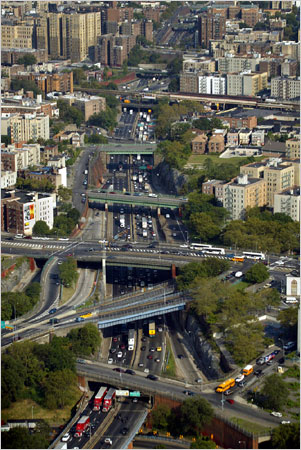
The Cross Bronx Expressway
Cross Bronx Expressway. Photo by Andrew Moore.

2. The Times had another troubling story, about the rehabilitation of Robert Moses, the urban renewal and "big project" planner who "inspired" Jane Jacobs and the publication of the urban planning classic Death and Life of Great American Cities. From "Rehabilitating Robert Moses":

FOR three decades his image has been frozen in time. The bulldozing bully who callously displaced thousands of New Yorkers in the name of urban renewal. The public-works kingpin who championed highways as he starved mass transit. And yes, the visionary idealist who gave New York Lincoln Center and Jones Beach, along with parks, roads, playgrounds and public pools.

This is the Robert Moses most of us know today, courtesy of Robert A. Caro’s Pulitzer Prize-winning biography from 1974, “The Power Broker,” which charts Moses’ long reign as city parks commissioner (1934-60) and chairman of the Triborough Bridge and Tunnel Authority (1946-68)....

But according to the Columbia University architectural historian Hilary Ballon and assorted colleagues, Moses deserves better — or at least a fresh look. In three exhibitions opening in the next few days — at the Museum of the City of New York, the Queens Museum of Art and Columbia University — Ms. Ballon argues that too little attention has been focused on what Moses achieved, versus what he destroyed, and on the enormous bureaucratic hurdles he surmounted to get things done.

There is an interesting discussion of why the revisionism, and how Robert Caro, author of a magisterial biography of Moses, is barely included in the exhibitions.

I think it has to do with the continued degradation and diminishment of citizen involvement and civic engagement and the continued focus on big urban renewal-like projects as the dominant municipal economic development paradigm. New York City is particular enthralled with such planning and projects, from the proposed Jets Stadium to the Atlantic Yards-Brooklyn Nets Stadium redevelopment project.
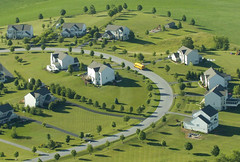
Sprawl-type suburban subdivisions (large image)
Suburban Baltimore, Baltimore Sun photo by David Hobby.

3. There was a nasty op-ed in the Post Outlook Section by Ted Balaker and Sam Staley of the Reason Foundation. I was a bit disappointed because my previous dealings with Dr. Staley have always been fruitful. I've always appreciated his focus and analysis (this must have something to do with my strain of libertarianism?) . But this piece, "5 Myths About Suburbia and Our Car-Happy Culture," uses straw man type arguments and under-formed analysis to denigrate transit and to promote the car-centric deconcentrated land use and planning paradigm that has dominated the United States since after World War II.

According to Balaker and Staley the "myths" are:

1.Americans are addicted to driving.
2.Public transit can reduce traffic congestion.
3.We can cut air pollution only if we stop driving.
4.We're paving over America.
5.We can't deal with global warming unless we stop driving.
-----------------
1. Maybe Americans aren't addicted to driving, but there is no question that the land use and resource planning paradigm that prevails in the U.S. promotes automobility and deconcentration in ways that are extremely costly to quality of life and local and state government budgets, as well as to national economic, military, and foreign policy.

Many of the pieces in the Richmond Times-Dispatch by Barton Hinkle about Virginia's transportation "crisis" focus on the fact that every new mile of road that is constructed must be maintained in perpetuity, and therefore even more money will be required for maintenance.

2. Public transit can reduce traffic congestion. It does already. Certainly in places that are relatively dense, with job and residential centers connected efficiently by public transit, traffic is reduced. Focusing on national averages is misleading. What matters is how transit and automobility works within specific regions. In the Washington region, the core of the center city, and Arlington County, Virginia have much less in the way of traffic compared to other jurisdictions in our region, because of how the subway system and the complementary bus system serve many people relatively efficiently.

In areas that are much more deconcentrated (a/k/a sprawl), transit is less efficient, taking a long time and many stops to get places.

3.We can cut air pollution only if we stop driving. Hmm, Air pollution is a problem in cities and it usually isn't a function of industry, but from cars. There is no question that urban areas suffer asthma and other respiratory diseases at higher rates. (However, this isn't an issue that I direct much attention to myself. But it matters.) But this isn't necessarily one of the top five arguments against sprawl and automobility anyway.
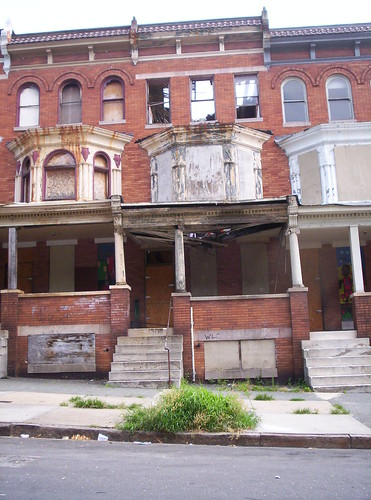
Opportunities abound in Reservoir Hill
Vacant houses in Reservoir Hill, Baltimore. Goetze argues in Understanding Neighborhood Change, that cities depopulated because overproduction of suburban housing made urban housing less desirable and valuable.

4.We're paving over America. We are. Even if the U.S. "has only developed 5.4% of its total land" there is no question that metropolitan regions are considerably more developed and deconcentrated with the sprawl pattern of land development. Detroit once had 2 million residents in approximately 160 square miles. Today, 1.2 million of those residents have dispersed over close to 3,000 square miles of an ever expanding region.

Similarly, at its peak, DC had 802,000 residents in about 60 square miles (less if you subtract federal land). Fairfax County takes about 400 square miles to house 1 million residents.

National averages are meaningless when looking at this question.

5.We can't deal with global warming unless we stop driving. Maybe. Transportation uses comprise 70% of the oil consumed in the United States. But it's true that industrial use contributes greatly to global warming. Again, this aspect of automobility and the land use paradigm isn't relevant to my day-to-day work on the broad issue. I focus on quality of life and placemaking. Places for people are much different than building places for cars.
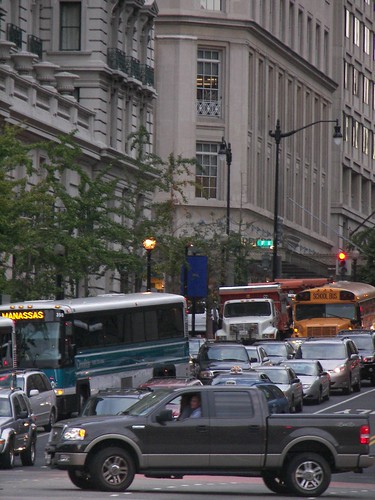
14th Street NW in the evening
14th Street NW during the evening commute.

As the pro-car, suburban sage of how DC should be operated, Len Sullivan of NARPAC said once in a report about the K Street busway, "Pedestrians are a hindrance."

As long as we attempt to rebuild the cities over for the car, we will lose and destroy those competitive advantages that the center cities possess:

1. Walkable places;
2. Interesting, beautiful places;
3. and a city where people are not dependent on cars for mobility.

In any case, pro-transit, pro-placemaking people and think tanks need to be doing more in the way of writing op-eds!
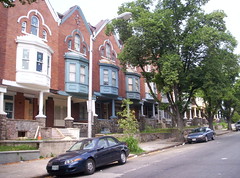
Across the Street, other opportunities (Baltimore)
Across the Street in Reservoir Hill. This block is being "homesteaded" in a concerted way through the TechBaltimore program, see this article from the Baltimore City Paper.

Labels: , , ,

Can't see the forest for the trees

The Washington Post has a much easier time seeing "cozy ties" between developers and public officials in Loudoun County, for example as discussed in the editorial, "The Sleaze in Loudoun," subtitled "Insiders get rich, and the public stays in the dark," than it does in DC when discussing the Federal City Council, or various business and development issues in the City of Washington.

From the editorial:

In two revealing articles, The Post's Michael Laris and David S. Fallis detailed the cozy ties between Loudoun's real estate interests and public officeholders. Local prosecutors have launched a probe into some of the dealings to determine whether any laws were broken, and the FBI is investigating as well. Even if not illegal, some of these activities emit the distinct aroma of conflict of interest and ethical tone-deafness.

Sure would be nice to see such tough words about DC. Then again, there's that quote, "Consistency is the hobgoblin of small minds."

See for example, "Williams Joins Investment Firm," subtitled "Former Mayor Becomes Chief of FBR's New Real Estate Unit." I'm not necessarily criticizing our former Mayor, I think this is a matter more of being like-minded about how to do economic development and financing rather than him doing dastardly things in order to get a good job once he was out of office...

Labels:

Now I'm in for it

Painting on the 3500 block of 12th Street, west side
New painting on the 3500 block of 12th Street NE, west side, Brookland.

I am officially the interim program manager for the Brookland Main Street program in Washington, DC. If I want the job permanently, I will have to re-apply for the position, as it will be posted.

But, I'm in for it, not just locally, but nationally, because I opine plenty about how people should be doing commercial district revitalization.

Just recognize, urban revitalization takes a fair bit of time, as Neal Peirce points out in this column from 2004, "MAIN STREET NICHES IN A MASS SALES WORLD."

To get a sense for the foundation of my approach, see these posts:
-- The soft side of commercial district competition
-- Nurturing independent businesses through creatively reducing capital requirements
-- Commerz in the 'hood, part three
-- To get independent businesses you need to rebuild the supporting infrastructure

which are undergirded by my thinking about the Reilly Law of Retail Gravitation which focuses on measurable indicators--the number and mix of stores in particular shopping destinations. The Law is that with factors being roughly equal (travel, etc.) people will choose the shopping center/option that is better (more and more interesting stores, variety of product selection, etc.). Obvious huh? In the urban context especially, factors that people mull over when deciding between shopping destinations include comfort and perceptions of safety, physical condition of the commercial district, etc.

This is why I joke about Main Street principles #9 and #10 (there are officially only 8 principles)--knowing what you have (or not) and being honest about it; and making the hard choices you need to make in order to improve.

As long as a particular urban commercial district is deficient compared to nearby shopping alternatives, it won't be able to attract new customers, until it starts providing some decent options. That's why I always write about the importance of restaurants, places like Banana Cafe on 8th Street SE, which seeded revitalization by attracting patrons to the corridor despite its negatives, and the existence of few other retail options, because of relatively inexpensive but decent enough food in a comfortable enough atmosphere.

On that note, see Richard's Rules for Restaurant Driven Revitalization.

There's no question that this job is going to reduce my blogwriting...

I hope to organize a Baltimore field trip for Board Members and volunteers in March. In my not so humble opinion, for neighborhood commercial districts that aren't regional shopping or entertainment destinations, south of Philadelphia, Hampden Village and Federal Hill are probably the most successful Main Street commercial districts around (other than Carytown in Richmond, but that's just too long of a drive).

I want to take them to the Waverly Farmers Market, a short jaunt on Greenmount Ave. including a peek into Pete's Diner, maybe up to Belvedere Square, and then a serious walk and presentation in Hampden. (I don't think we can fit Federal Hill in on this tour, because that would be an 8 hour day...)
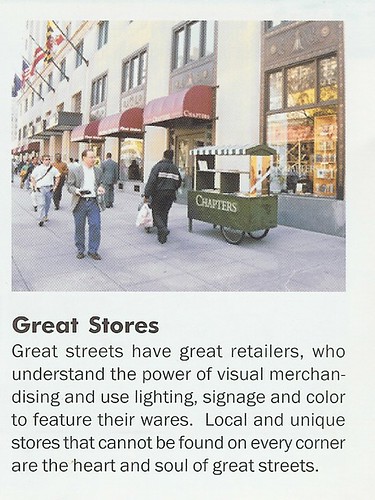
Vibrant Retail Streets: Great Stores
(From a now out-of-print publication by DC's Downtown BID.)

Labels: ,

Breaking the chains that bind us (transit)

Creeps & weirdos GM ad against transit
Jane Willkom writes from San Diego:

I can’t tell you how much that ad pisses me off! OK, yes, I used to ride the X2 everyday and that was quite a show, but I’ve since moved from 8th/H NE to San Diego and the buses here can only be described as delightful from my perspective. I’m astonished that virtually no “white collar” people are on the buses. When I tell people that I don’t have a car, they literally think that there’s something wrong with me. DUI? Seizure disorder? Car repo’d? Well duh, the bus stop is ½ block from my house and in 15 minutes, drops me off 1 block from my office, but this doesn’t at all register as an sensible choice for my inquisitors.

In the end, there just isn’t enough traffic around here to get people out of their cars and on public transportation.

P.S. Thx for the
Flexcar tip (free 1 yr membership). I signed up this week. However, it is more expensive out here because they don’t have Zipcar to compete!

Bob Bruninga's letter to the editor from last Saturday's Baltimore Sun pairs nicely with Jane's:

Don't overlook option to ride bus

I was explaining to my kids one day that we should be using public transportation, but that in America it is impractical because we all live in sprawling suburbs spread out over hundreds of miles. My family lives, works and goes to school along Route 2 between Glen Burnie and Annapolis. We have been happy driving back and forth, especially with the convenience of services along the route. But with two teenagers now driving, much of our lives revolves around scheduling the logistics of sharing the family's two cars among four drivers.

About two weeks ago, I was lamenting to my son about how he was going to have to get up an hour early and take me to work the next morning. Then it slowly dawned on me, as I sat behind the No. 14 bus, that when I leave in the morning, I am behind the bus, when I drop the kids off at school, I am behind the bus, and when I pull into work, I pass the bus in Annapolis.

I am now kicking myself around the block in my blindness to the No. 14 bus, which, over the last 16 years, could have saved me untold headaches. For $1.60 a ride, I now get a professional driver and a warm, comfortable ride that takes only 10 minutes longer than the 25-minute drive. However, that is not time lost but time gained, because I get to use that entire 35 minutes reading The Sun or grading papers instead of cowering in my coupe between monster SUVs.

I just wish I had thought of this 16 years ago.
-------------------
I think it was in themail that someone was derisive about WMATA's plan to put strobe lights on buses to help reduce pedestrian-bus accidents--a number of pedestrians die each year from such accidents. (See this short, "METRO SAFETY: Strobe Lights To Be Installed On 100 Buses," from the Washington Post for more on this.)

I am a pedestrian, bus rider, bicycle rider, subway rider, and occasional driver, so I maintain multiple perspectives on this issue.

As a bus rider, I always marvel at how damn hard it is to drive a bus, given all the traffic and the frequent unwillingness of cars to "give way." My driving skills aren't the greatest, and I admire the concentration--not to mention the frequent friendliness and helpfulness--of WMATA bus drivers.
Many DC bus lines still follow 1950s streetcar routes
Washington Post photo by Gerald Martineau.

Labels:

Density by Design (Presentation)

Thursday, February 1, 2007
DC Builds/National Building Museum
Density by Design
6:30–8:00 pm
$12 Museum members and students; $20 nonmembers.

Moderated by Ellen McCarthy, former director of the DC Office of Planning, David Dixon, FAIA, principal-in-charge of planning and urban design at Goody Clancy, Christopher B. Leinberger from the Brookings Institution, and Harriet Tregoning, director of the DC Office of Planning, will explore the heated topic of “density.”

The discussion will consider the economic, social, environmental and cultural benefits of higher-density development, as well as the feared neighborhood impacts of additional traffic, parking pressure, and soulless architecture. This lecture is presented in collaboration with the DC Office of Planning and held in conjunction with Washington: Symbol & City, which will be open for viewing.

---------
I've never heard Harriet Tregoning speak. Now might be the time. David Dixon and Chris Leinberger are excellent presenters.

Labels: ,

Monday, January 29, 2007

A certified organic restaurant

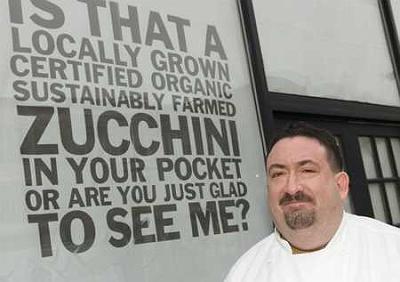
'Chef
Chef Michael Altenberg stands outside the site of his new organic restaurant "Crust" at 2056 W. Division in Chicago. (Jon Sall/Sun-Times)

According to "Wicker Park to get first organic pizzeria," in the Chicago Sun-Times, the Wicker Park neighborhood in Chicago will be home to one of only four certified organic restaurants in the U.S. From the article:

At Crust, a restaurant slated to open next month in Wicker Park, the menu will read like this: Flatbread pizzas made with organic mozzarella, organic Italian sausage and organic wheat. Organic lettuce drizzled with organic Thousand Island dressing. Organic milkshakes and organic soft drinks. For martini drinkers -- organic vodka.

But to chef and owner Michael Altenberg, long a champion of sustainable agriculture, that's still not enough. So he's going further, pursuing organic certification for the entire restaurant. If successful, Crust will be the first eatery in the Midwest -- and only the fourth in the nation -- with that status.

Labels:

Sunday, January 28, 2007

Co-optation

From the Free Online Encyclopedia:

co-opt (k-pt, kpt)
tr.v. co-opt·ed, co-opt·ing, co-opts
1. To elect as a fellow member of a group.
2. To appoint summarily.
3. To take or assume for one's own use; appropriate: co-opted the criticism by embracing it.
4. To neutralize or win over (an independent minority, for example) through assimilation into an established group or culture: co-opt rebels by giving them positions of authority.
[Latin cooptre : co-, co- + optre, to choose.]


From the Baltimore Sun, "Minority bank to lease at Wal-Mart":

Urban Trust Bank, the Bethesda financial firm formed by Black Entertainment Television founder Robert L. Johnson, has struck a deal with Wal-Mart Stores to lease space for branches in the giant retailer's outlets in large cities. ...The deal marks a significant step forward for a bank that's less than a year old and has just two branches but with an ambition to forge a national franchise.

See these articles from the Black Commentator:
-- Wal-Mart and the Economic Destruction of Black Communities
-- A ‘Movement’ Against Wal-Mart?
-- Why Black Leaders Are Stone Silent on Wal-Mart Abuses.

Index Keywords: ;

What is not tradition is plagiarizing (copying, repeating, imitating)

Madrid. Photo by Stefanos Polyzoides

You Gotta Have Community Building

Slide from Presentation by Peter Bruun
Slide from Presentation by Peter Bruun, Art on Purpose.

I have written before about a Detroit Institute of Arts promotion campaign that I still remember from my childhood, "You Gotta Have Art." It was pointed out to me that this campaign likely was a takeoff of the Richard Adler song "You Gotta Have Heart."

Anyway, appropo of the ongoing discussion about art, public art, professional artists, tourism, and community building, not to mention graffiti vs. murals, yesterday I attended with some other Washingtonians, the Baltimore "Art and Neighborhoods" symposium.

It was an excellent presentation, something they should do annually, and something we should do annually in DC. (I'll try to launch this idea in association with something else I am planning, but more on that, maybe, later.)

Presentations were made by Mindy Fullilove, author of Root Shock, Liz Lerman of the Liz Lerman Dance Exchange!, Kumani Gantt of the Village of Arts and Humanities in Philadelphia, Jay Cohen, an artist leading the Rebuilding through Art project in Baltimore's Midtown Edmonston neighborhood, and Peter Bruun of Art on Purpose.
100_6238
Real City, Dream City is a multi-faceted project involving ten Baltimore City Neighborhoods. April to June 2006 photo workshops led to community exhibitions that had residents vote on images to become postcards. A Postcard Dialogue Project held in each neighborhood August through September 2006 led to specific ideas for change, action, or advocacy.

The presentations were excellent, some provocative. But in the context of the broader conversation within the blog and outside of it, in the various projects I am involved in, it makes me realize that we are talking about different things.

The projects covered in yesterday's session were really about community building through art, not really about arts-driven revitalization such as is occuring in Paducah, Kentucky, in Western Massachusetts, or in Pittsburgh with the Penn Avenue Arts Initiative. Baltimore has two arts districts, Station North and Highlandtown. And just over the border in PG County, there is the Gateway Arts District.

Public art projects to promote art are different from public "art" projects to promote tourism, and mural projects pushing community building within neighborhoods are different from mural projects that are more about art.
Chicago Cow Parade, Irish Boxer Cow'
The Chicago "art" cows were one of the first examples in North America (the first place to do this was a town in Switzerland) of tourism campaigns utilizing artist decorated fiberglass constructions. Flickr photo by Travis Church.
'
The Sioux Falls SculptureWalk is much different from the fiberglass constructions, featuring sculptures produced by professional artists. "Pas de deux," by Shari Hamilton, Westhope, ND. Location - On east side of Phillips Ave. , middle of the block between 9th & 10th Streets. Photo by Paul Schiller.

Something relevant to this thread is the work that I do with history and historic preservation. The methods are the same even if it isn't about "art" per se. Anyway, at the Main Street conference last year in New Orleans, our colleagues from Shaw Main Streets made a presentation about the Shaw History Trail among other things.
BlackHistoryDC2
From the African American History Trail marker outside the Thurgood Marshall Center in DC's Shaw neighborhood.

An inquiry from the audience was looking for proof about how that project is generating visits, and increasing economic returns from tourism. Listening to the question, I realized that the trail signs are more about community building vs. broader objectives, the same kinds of things discussed in this entry about "Civic Tourism."

Anyway, community building is different from arts-based revitalization, or cultural tourism, and we need to be clear about the distinctions.

Labels: , ,

Alexandria Virginia also has a good transit-mobility website

The Alexandria Rideshare website is produced by the Office of Transit Services & Programs of the CIty of Alexandria Department of Transportation & Environmental Services.
Alexandria Dash About bus, painted to promote tourism
Alexandria Dash About bus, painted to promote tourism.

Index Keywords:

Friday, January 26, 2007

DC Board of Education to Present Alternative School Governance Proposal

From Audrey Williams (202) 535-2647; (301) 351-6259 evenings/weekend, for the DC Board of Education:

WHO: Robert Bobb, President and members of the Board of Education
WHEN: Monday, January 29, 2007 at 10:00 am

WHAT: An emergency meeting will he held to consider and vote on the Board’s legislative proposal to improve student achievement in the District of Columbia and provide an alternative to Mayor Adrian Fenty’s plan to take control of D.C. Public Schools

WHERE: McKinley Technology High School, Room 150, 151 T Street, NE

BACKGROUND: The Board will hold its emergency meeting first and once the meeting is adjourned, will take questions from the press immediately following the meeting.

Index Keywords:

Why I really hate graffiti

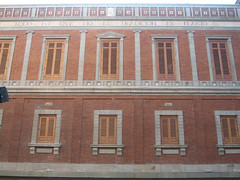
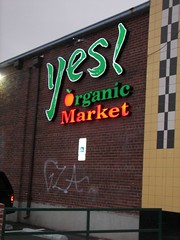
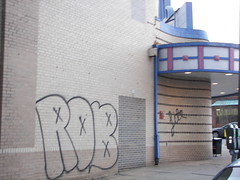
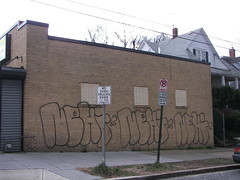
I'm starting a new job, and one of the things that I have to deal with is the Wednesday night tagging of 12 buildings on Brookland's 12th Street NE commercial corridor.

It's not art, merely vandalism. And I will end up spending most of today dealing with it, and not dealing with all the other things I was supposed to address.
Graffiti on Yes! Organic Market, front (west elevation)
Newly opened Yes! Market, 8,000 square feet.
Graffiti on Yes! Organic Market, front (north elevation)
Graffiti on CVS
CVS, formerly the Newton Theater, entered on to the DC Inventory of Historic Sites in April, 2006. Great art deco detailing including the brick.

Graffiti on Newton Food Market
Newton Food Market

Graffiti on the Nail Salon
Across from Newton Food Market. Ironically, I've always thought this wall is a great opportunity for a mural.

Index Keywords:

Thursday, January 25, 2007

The inalienable privilege to buy a 40...

spock
"That is most illogical, Captain."

The City Paper has an excellent article, "Take It Inside: Authorities target outdoor drinking on a booming stretch of H Street," about a proposed moratorium on the sales of "singles" at neighborhood Class A and B licensed establishments.

But I have to say I love the delicious illogic of this quote:

At the Red & the Black, patron Simon van Steÿn said, “I don’t like to see the footprint of gentrification making a dent on how people have lived here for so long.” Van Steÿn, who was drinking a whiskey (“I bought it here. I didn’t bring it in.”) says he could envision himself being a victim of the proposed moratorium. “The worst thing is that it could affect me one night if the crowd at the Rock and Roll Hotel was too big and the price was too exorbitant and I wanted a drink. I’d be cursing the city.”

So he's gonna go buy something at a local convenience store and stand outside and drink it, tossing the empty on the street, and then pissing in a bus shelter or some other public place?

A couple previous entries on this topic:
-- Report on London's night time economy
-- Creating the "new new" thing: commercial district revitalization
-- Think police equines for nightlife crowd control
-- Does a restaurant selling alcohol create a pernicious environment ...

Index Keywords:

John Catoe takes the wheel as Metro’s new general manager

Creeps & weirdos GM ad against transit
Controversial anti-transit ad by GM car dealers in British Columbia. The ad was pulled after public outcry

is the title today of Steve Eldridge's column in the Examiner. It's a good piece summing up the issues going forward with the WMATA system, ranging from funding to service.

Steve did write something that deserves amplification though:

Are there efficiencies that can be realized in the bus system? The new general manager has a history of working some magic with this form of transit, and that is one of the big reasons he was brought on board. Can he figure out a way to serve this region without eliminating routes because of their underperformance? Is this heavily subsidized form of transportation worth investing in further?

It's important to think of this issue jurisdiction by jurisdiction. I happen to be riding buses more lately, because I am going to areas without direct subway service.

DC-based bus routes tend to have high ridership. I can't speak to buses in MD and VA as much, other than the Rte. 1 corridor in Maryland.

Part of the issue is to build ridership in the other jurisdictions. It's harder though because the distance people travel is greater, and bus service, with somewhat meandering (but necessary to maximize utilization) routes, can be less time efficient. Of course, if you are transit-dependent, that doesn't matter, but it does matter to people with choices.

Bus ridership, October 2006, avg. weekday

DC
X2 Benning road, 14,483
L1, L2, L4, Connecticut Ave., 4,104
H2, H3, H4, Crosstown, 7,247
52, 14th Str., 14,244
42, Mt. Pleasant, 8,017
70s, Georgia Ave., 17,216
30s, Pennsy. and Wisc. Aves., 20,000
S2, 16th St., 15,540
90s, U St., Florida Ave., 8th St. NE, SE, 22,600 (four lines)
B2, Bladensburg, 8,168
(there are additional high ridership routes, these are just the routes with which I am the most familiar )

MD -- there are only 4 Metrobus routes with ridership greater than 6,000 daily riders.

VA -- there are 5 Metrobus routes with ridership between 4,000 and 6,800 daily riders.

Note that VA and MD jurisdictions also have their own bus services. Unfortunately, ridership statistics for these systems weren't provided in the materials distributed at the WMATA 2006 Regional Bus Conference. (Something I rued at the time by the way.)
Bus signs
Photo from Beyond DC.

And, by way of comparison/1, Pittsburgh:
Pittsburgh Bus Routes

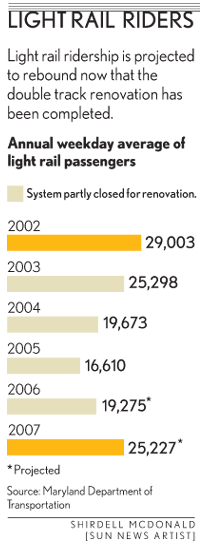
By way of comparison/2, almost as many people ride the 30s buses or the 90s bus routes, as ride the Baltimore Light Rail system.
Baltimore Light Rail ridership

Index Keywords:

Request for Applications: Smart Growth Implementation Assistance

From Kevin M. Nelson, AICP, U.S. EPA: Office of Policy, Economics and Innovation:

Free technical assistance available!

Are you trying to encourage specific smart growth techniques like transit-oriented development? Or direct your state department of transportation investments to better support smart growth? Are you looking to use smart growth to reach economic development goals? Do you need help analyzing guidelines for school investments that best fit your state or community? Do you need to retrofit a commercial corridor? Or coordinate your community's smart growth design with an active aging program?

The
Development, Community, and Environment Division in U.S. EPA's Office of Policy, Economics, and Innovation is responding to this need by issuing a request for applications for the Smart Growth Implementation Assistance program. Through this program, a team of multidisciplinary experts will provide free technical assistance to communities, regions, or states that want to develop in ways that meet environmental and other local or regional goals.

Communities, regions, and states around the country are interested in building stronger neighborhoods, protecting their environmental resources, enhancing public health, and planning for development, but they may lack the tools, resources, or information to achieve these goals. EPA can help applicants overcome these roadblocks by providing evaluation tools and expert analysis.

EPA is soliciting applications from communities that want help with either policy analysis or public participatory processes. Selected communities will receive assistance in the form of a multi-day visit from a team of experts organized by EPA and other national partners to work with local leaders.


Applications will be accepted until March 8, 2007.
Click here for
more information and application materials.

Index Keywords: ;

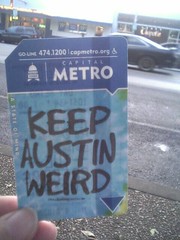
100 coffee shops


keep austin weird
Originally uploaded by yi.
(I don't like the "Keep Austin Weird" slogan as it relates to retail, because it implies that independent retail is strange. It isn't. But as a slogan it certainly encapsulates the importance of identity and authenticity.)

From "10,000 coffee shops* -- *Well, 50 this week, 50 next week. The caffeine makes it feel like more," in the Austin American-Statesman. From the article:

One hundred coffee shops.

Only six represent national chains. Four were selected from local conglomerates. The rest — true blue independents. Independent coffee shops are oases of personal expression in great deserts of chain-ification. They cluster in the city, but serve even more vital community and entertainment functions away from downtown.

During our 100-shop tour, we found that, in the urban core, baristas tend to be twentysomethings. In the suburbs, they are teens. In the exurbs, they are just as likely to be retired free spirits.

We can confirm that, despite the silence of the laptoppers, coffee shops are not libraries with espresso machines. It's safe to talk. (If you don't, nobody will, in some places.) And it's not a true coffee shop if anyone raises a penciled eyebrow of disdain because you've commandeered a table for three hours.

This week, we describe the first 50 shops, Austin Java through Jollyville Java, alphabetically speaking. Next week, Jo's Hot Coffee through Zoombaz.


Index Keywords:

Wednesday, January 24, 2007

Celebrating civil rights and transit

Aboard an Annapolis Transit bus, Chanica Massey (right) talks to Shawana Williams after handing her a brochure
Aboard an Annapolis Transit bus, Chanica Massey (right) talks to Shawana Williams after handing her a brochure containing tips on resolving conflicts peacefully. (Sun photo by Kenneth K. Lam)

From "Message of nonviolence is spread to honor King," subtitled "Volunteer bus riders stress peaceful conflict resolution," in the Baltimore Sun:

Maroulla Plangetis marked the Rev. Martin Luther King's birthday on an Annapolis Transit bus. Over a four-hour period Monday, the Annapolis High School senior and more than a dozen other volunteers rode in circles around the city, handing other passengers brochures with tips on how to solve problems peacefully. ...

In honor of the King holiday, the city did not charge bus fares Monday. Each bus had a sticker on a window near the front honoring Rosa Parks, the woman who sparked the bus boycott in Montgomery, Ala., in 1955 when she refused to give up her seat to a white passenger.

Both are good ideas.

Index Keywords:

More transit advocacy opportunities in Maryland

Chris Carney, in the Sierra Club Metro DC Action Update newsletter, writes:

Speak up for more public transit - the ICC is a bad deal, not a done deal!

Montgomery County Council Town Hall
Meeting on Transportation Priorities
7:30 pm, Thursday, January 25
Rockville, MD
Location: Montgomery County Council Office Building,
100 Maryland Avenue, Rockville (10 min. walk from the Rockville Metro Station)

Come out to show support for real solutions---like fixing Metro and building the Purple Line---instead of wasting billions of tax dollars to build the ICC. Sign up to testify by calling Delphine Harriston at (240) 777-7931. Leave a message if needed.More information – call Chris Carney at 202-237-0754 or Mike Harold at Audubon Naturalist Society at (301) 652-9188 ext. 22. Spread the word!

Prince George's County - Town Hall Meetings on Transportation Priorities

Come out to show support for real solutions---like fixing Metro, and building Rail on the Wilson Bridge and the Purple Line---instead of wasting billions of tax dollars to build the Intercounty Connector.

7 PM, January 31, 2007
City of College ParkCity Hall – Council Chamber
4500 Knox Road, College Park, Maryland

7 PM, February 1, 2007
Town of Morningside Municipal Building
6901 Ames Street
Suitland , Maryland

And stay tuned for details on a public forum about putting Rail on the Woodrow Wilson Bridge
February 22 – Prince George’s ACT
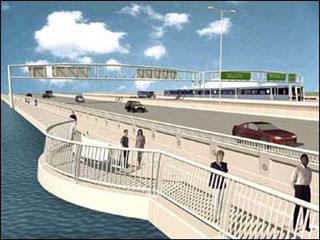
Rendering, pedestrian walkway and WMATA subway line on Wilson Bridge
Groovy Wilson Bridge rendering from the Sierra Club.

Index Keywords:

Building the capacity of civic involvement and good government

We've got to start pushing the envelope more in DC, building a base for quality and constituencies to support "beauty" and quality public spaces and policies (the reference to beauty is a nod to the book by Howard Gillette, ).

1. I planned to go to the Maryland Historic Preservation Legislative Breakfast today, organized by Preservation Maryland, just to see how they do it, but at the last minute I couldn't go.

2. Tomorrow night is the business meeting for the Anacostia Trails Heritage Area, and I do plan to attend that. (I am a member.) Being in Riverdale, it's a lot easier to get there.

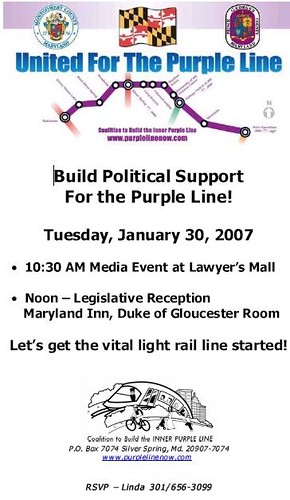
3. On January 30th, the Purple Line Now advocates are holding a rally and reception in Annapolis.
United for the Purple Line
4. Washcycle, the area's preeminent blog about bicycling, reports about the Maryland Bicycle and Pedestrian Symposium, on February 9th, in Annapolis. Click here for the schedule.

Here's what they say about the importance of the program:

Come and learn about bicycling and walking in Maryland. Learn about Bicycle Friendly Communities, Complete Streets, Recreational Trails Program, Transportation Enhancement Funding, trails being built and planned, and legislation that will affect you as a bicyclist and pedestrian.

Network with others who are working to make Maryland a better place for bicycling and walking.

Discuss bicycle and pedestrian issues with planners, other advocates, legislators, their staff, and visitors. Increase the General Assembly's awareness of walking and bicycling in Maryland.

Meet your legislators. Let them know that bicycling and walking are important in their districts.

---------------
We've got to do events like this in DC:

-- to increase our own knowledge and capacity,
-- to build our constituencies
-- to lobby and advocate

The developers and other forces are doing this.

Until we* begin to do so ourselves, policy and decision-making will continue to be dominated by back room dealing that most citizens never have access to.

For something I wrote about the necessity of constituency building, see "Rebuilding Place in the Urban Space: Main Street and getting schooled in politics, constituency building, and building support for your program."

* "We" is defined as those advocates concerned about place and placemaking and all that makes it work--historic preservation, urban design, transportation, asset-based community development, arts & cultural development, commercial district revitalization, tourism & destination development, and quality of life advocacy, plus deliberative civic engagement and good governance watchdogging.

(The DC Preservation League 35 year anniversary gala is tomorrow night, but at $200/ticket, it's more a fundraiser.)

Index Keywords:

How many drug stores does a community "need"?

Roy Rogers, CVS, La Plata, Maryland
After the Roy Rogers restaurant in La Plata is torn down, a Walgreens will operate across the street from a CVS. National chains have been drawn by the town's growing population and above-average percentage of older residents. "A town of that size doesn't need eight drugstores," a retail analyst said. (By Mark Gail -- The Washington Post)

Remember my complaint last year about the DC Economic Partnership's glee in attracting Walgreens, the chain pharmacy company, to DC? I mean, DC already has about 50 CVS stores, and about 8 Rite Aids, and a handful of independents. See the blog entry, "Something is terribly wrong with DC's retail business development priorities."

While it's true that for all intents and purposes, such "pharmacies" function more like a convenience store--except for the fact that they don't sell coffee--there is a limit.

According to the Southern Maryland Extra edition of the Post, La Plata, which has 5 pharmacies now, is slated to get 3 more. See "In Little La Plata, Pharmacies at Every Turn." From the article:

La Plata, population 8,500, has five pharmacies within about two miles and is poised to add three more. At that count, the Charles County seat would boast more pharmacies than drive-through fast-food restaurants and grocery stores -- combined.

There are so many pharmacies in La Plata that the town's planning director, Catherine Flerlage, had trouble listing them all. "There's one in the Wal-Mart, there's one in the Safeway. There's CVS, there's good old County Drug. Of course, Target will have one within their confines. Oh yeah, Rite Aid. And then perhaps the new Walgreens." And she left out the Giant.


All the more reason that every community should have zoning regulations that include provisions with regard to "formula businesses."

To get a better understanding than that possessed by the people quoted in the Post article about why this happens, check out the blog entry from 2005, "Why the future of urban retail isn't chains."

Index Keywords:

Substantive ways to address the high cost of housing for workers

1. "UW hopes to build hundreds of condos for faculty," according to the Seattle Times.
University of Washington to construct faculty housing
2. In the UK, a few years ago, the supermarket chain Tesco realized that they had land resources in their supermarket sites, worth a good deal of money in redevelopment opportunity for the creation of mixed-use development, including building housing above stores. See "Tesco seeks cheap staff homes," a 2003 report from the BBC. From the article:

A recent report, sponsored by Tesco and the Housing Corporation, said more than 10,000 homes could be built on supermarket sites in London. Tesco has already built more than 200 homes above its supermarkets in London.

Last week, Tesco announced specific plans, according to the BBC, in "Tesco to build homes for workers." From the article:

The UK's largest supermarket has allocated 13 of the 250 flats it is building alongside the Streatham store in south London to staff... If the trial is successful, the chain intends to incorporate staff housing into further developments.

A spokeswoman for Tesco said they hoped the scheme would be "beneficial for staff retention" in London, where they suffer from a high turnover of workers. She added: "It is being led in London because there is more need for affordable housing... the sites in London are more constrained so you need to be a lot more imaginative." ...

The flats will be sold to a housing association and staff will not be treated any differently to other tenants, retaining the right to stay in the property even if they stop working for the supermarket giant. However, if flats become vacant, staff will be offered them first. Key workers, who are often priced out of the London housing market, are intended to benefit from the pioneering project, in addition to Tesco employees.

This certainly puts my complaint about the missed opportunities in the development of the Brentwood Shopping Center in perspective. (Check out this City of London report, "Making Better Use of Supermarkets.")
Brentwood Shopping Center, DC
Brentwood Shopping Center, DC.

Index Keywords:

Instead of moving farther out, just split off into a new municipality

Remember during the tail end of the Barry years, when there was talk of Ward 3 splitting off and being reabsorbed by Maryland? Idle talk, not worth the effort. In Greater Atlanta though, it could be a different story.

According to the AP story, "Suburban Atlanta breakaway may put 'blood on the walls'," predominately white areas of Fulton County would like to split off and form their own county, Milton County. (Hmm, the discussion of the creation of municipalities--areal expressions--to promote Growth Machine objectives is extensively discussed in Urban Fortunes.

From the article:

Legislation that would allow the suburbs to split away and form their own county was introduced by members of the Georgia Legislature's Republican majority this month on the first day of their annual session. 'The only way to fix Fulton County is to dismantle Fulton County,' said state Rep. Jan Jones, the Milton plan's chief sponsor. 'It's too large, and certainly too dysfunctional, to truly be considered local government.'

This is an illustration of the point I make that people move further and further away, rather than stay and work to stabilize and improve communities.

Although I do understand the sentiment of being fed up with the status quo and difficulties of making positive change occur. It's very very hard.

Also see "More changes on horizon for shape of Fulton," from the Atlanta Journal-Constitution, which discusses how many areas of Fulton County have incorporated into recognized cities over the past couple years, severing certain funding streams that had previously been managed and spent by the County Government.

Apparently Milton Couny was merged into Fulton County in 1932, because of financial problems arising from the Great Depression. This effort aims to revert this change.

Index Keywords: ;

Transit first Olympics planning in Chicago

From "With or without the games," subtitled "Daley plans new land, housing even if we don't get Olympics," in the Chicago Sun-Times:

With 15,000 fewer seats than originally planned, the stadium-in-a-park includes a partial roof, 117 luxury suites, and club seats to generate even more revenue. Two-thirds of the seats would be located in a temporary grandstand. The stadium would be wrapped in photographs of Olympic heroes to cover an otherwise mundane temporary skin. There would be no parking, putting a premium on an Olympic transportation system to be developed in conjunction with CTA.

The article has a slide show with various renderings of the waterfront, Olympic Village, and the temporary stadium.

Index Keywords:

San Francisco railway boots up redesigned Web site

From Progressive Railroading:

San Francisco Municipal Transportation Agency recently launched a redesigned Web site. The site integrates all services offered by the agency and Department of Parking and Traffic, and features meeting and service updates on the home page, and links to the city’s online payment services. In addition, the new site includes a more prominent “new rider” section, readable text for visually impaired site visitors and links to www.511.org, which provides information on all transportation services in the bay area.
----------------
I don't absolutely love it, but I do like the clickable tabs at the top of the page. They're a useful way for organizing and tapping into people's predominate interests. Although listing parking as park is unnecessarily confusing. Below are the major organizational categories for the site:

- Transit
- Walk
- Bike
- Park(ing)
- Traffic
- Livable Streets
- About Us

Index Keywords:

Acting before the fact

While I make clear my sentiments about speed bumps vs. re-engineering of streets, I still like the point of this comic. Don't forget to involve yourself in the DC Pedestrian Master Plan process.

Of course, also check out the Arlington County Master Transportation Plan, and note its completeness, with these elements...

Master Transportation Plan Overview 2nd Draft
MTP Glossary 2nd Draft (203 Kb )
Complete Findings of On line survey (55 Kb )
Elements

Parking and Curbspace Management 2nd draft (651 Kb ) On-street parking and curbspace are two of Arlington County’s most valuable resources. The supply of curbspace is essentially fixed – at the same time that growth and urbanization are placing new demands on the limited supply. This document provides a master plan for proactively managing the County’s parking resources. It also recommends actions which follow-up on the County’s 2003 Parking Symposium.

Bicycle Element 2nd Draft This is the central planning and policy document that guides development of bikeways and bicycle transportation programs throughout the County.
Bicycle Appendices 2nd Draft (904 Kb )Appendices to the Bicycle Element above.
Bikeway Network Map (2.4 Mb )Existing and recommended routes.(Colors match current bike map).

Transit Element 2nd Draft (2.23 Mb )This document includes recommendations to maximize the potential of the existing transit system− including the development of incremental improvements to enhance local transit service, and to address needed improvements in regional service.
Transit Modal Plan Appendix A (19 Kb )This document details Metro funding
Transit Appendix B-Specialized Services 2nd Draft (321 Kb )This document includes paratransit and senior transit services.

Transportation Demand Element (TDM) 2nd Draft (1 Mb ) Transportation Demand Management (TDM) Element provides a master plan for proactively managing the travel demand generated by residents, employees, and visitors to maximize the efficiency and effectiveness of all elements of Arlington’s transportation network.TDM strategies typically include: managing parking and pricing; marketing transit and providing commuter subsidies; promoting walking, bicycling and ridesharing; and encouraging telework and flexible work strategies.

Streets Element 2nd Draft (3.2 Mb ) Arlington has an extensive network of streets and highways that includes federal interstates and parkways, state primary and secondary highways, arterials, and local residential streets. These facilities serve and connect the neighborhoods and urban village centers within Arlington and provide connections to the surrounding cities andcounties. Since Arlington is at the core of the metropolitan region, these streets also provide passage to and through Arlington for the many people that live and work all around it.Managing streets using this holistic point of view is a complex and often highly charged task. The purpose of the Streets Element of the Master Transportation Plan is to provide a framework for addressing and managing these often conflicting street uses.
Streets Appendix A 2nd Draft (677 Kb ) Street funding.
Streets Appendix B 2nd Draft (128 Kb ) New Streets as Adopted by MTP Amendments.

Pedestrian Element 2nd Draft (1.4 Mb ) This document provides a master plan for accommodating pedestrian travel throughout the County and updates the Arlington County Pedestrian Transportation Plan adopted in 1997.
Pedestrian Appendix A (188Kb ) This document both consolidates existing County policy and establishes new policy for pedestrian accommodation in the transportation network and pedestrian facility design.

Arlingtonians can comment on the Second Draft Revisions by February 9, 2007 to: Ritch Viola (Click Here)

DC Needs a complete and comprehensive, Master Transportation Plan as well!

Curtis by Ray Billingsley, 1/20/2007, frames 1 and 2
Curtis by Ray Billingsley, 1/20/2007, frames 3 and 4
Curtis by Ray Billingsley, 1/20/2007. © King Features Syndicate.

Index Keywords:

Demonstrating civic engagement

It's never too late to demonstrate
SENIOR BERKELEY LEADERS (left to right) Shirley Dean, 71, a former mayor, Betty Olds, 86, of the Berkeley City Council, and Sylvia McLaughlin, 90, founder of Save The Bay, gather atop a historic oak tree Monday morning because they want to save the grove that is slated to be removed by UC Berkeley to make way for a new $125 million sports training facility. (Ray Chavez - Staff)

Just the other day I was talking with someone that I am working with on preparing a panel presentation and she was talking about how non profit leaders are concerned that there isn't necessarily a next generation preparing to move up and into nonprofit positions. That there isn't the groundswell of interest in this kind of contribution and participation.

And later I was talking with someone else about the difference in going to college at a school like the University of Michigan (or Harvard, or Wisconsin, or Berkeley, or Columbia or Yale). Why is it that civic participation, engagement and protest, at least on national issues, is more likely to occur at "the best schools"?

How do we work to build the culture of engagement everywhere? (Well, one of my ideas is that all school classes, starting at some point in elementary school, should have to do class projects of some sort "in the community." See the idea of the Eagle Scout project as a model, recounted in this article from the Gazette, "Flowers student earns Eagle Scout award.")

These civic leaders from Berkeley, California are an inspiration. See "It's never too late to demonstrate: Longtime Berkeley civic leaders make climb, join protest to save oak grove," from the Oakland Tribune.

Thanks to DC1974 for the heads up on this article.
---------
Also see the AP story, "Materialism spikes in a generation" from the Washington Times.

And this environmental leadership development opportunity for high school students, "Trash Free Potomac Watershed Initiative Student Action Committee."

Index Keywords:

I don't know what's worse for New Orleanians

The tragedy of Hurricane Katrina
Mid-September in Mid City New Orleans
Washington Post photo by Nikki Kahn.

or the tragedy afterwards?
The New Orleans Recovery Process explained
The New Orleans Recovery Process explained. Graphic © 2006, Mark A. Folse.

If anything, the planning and reconstruction process in New Orleans demonstrates the value of good government, top notch elected officials, and the importance of stellar planning processes and personnel.

Too bad that New Orleans lacks many of the "basic" elements of governmental infrastructure. And the State of Louisiana and the federal government isn't necessarily stepping up to the plate to lend a hand in ways that build capacity and a way forward.

The Think Nola website-blog-advocacy organization has an entry on the latest Community Congress number 3, "America Speaks: A Civic Humiliation." They aren't fond of America Speaks, the public participation consulting firm engaged to assist New Orleanians in this process.

I have written before about America Speaks, in terms of my impressions (negative) especially around the Public Library Planning Process and the "listening sessions." The sessions were set up so that they would only listen to the answers to the questions they offered--discourse outside of the questions was not sought out and only acknowledged on a limited basis.

See:
-- DC Library Planning and Listening Session: A Bit on Last Night
-- Can't seem to face up to the facts... or citizens/public meetings as "arm candy"
-- Disconnected public officials (Alaska and Virginia)
-- John Hill, DC's new "Reading Teacher"?

This troubled me for some time. Then I had an aha! moment...
aha
Image from Badsey Publications.


...while reading some from Planning in the Public Domain (a somewhat difficult book about developing a radical planning discourse).
Basic Concepts, Planning in the Public Domain
This diagram from the book outlines the basic concepts of understanding the process of change within a political system. (Click through for a larger image.)

I wrote this up in "Tyranny of Process in New Orleans." But here is the gist:

Friedmann differentiates between system maintenance, system change, and system transformation (significant change).

Maintenance is about bureaucracy and keeping things as they are. Transformation is about challenging the way things are, by working through political means. But ultimately, all change is about maintaining the political system, which occurs through the integration of change.

At first proposals are radical but get bounded and mediated in the process of getting adopted. In the end, radical becomes bureaucratic! (Reading Friedmann often depresses me because I joke to myself that I am merely working to reduce the most blatant excesses of the system and the Growth Machine.)

It occurs to me that America Speaks and similar organizations are more about mediating discourse, and limiting the possibility of transformation. Most of the elite see little need for transformation and radical practice. (In Friedmann's model, radical practice challenges the status quo, but unlike revolutionary practice, it doesn't challenge the state as the ultimate expression of the people.)

Unless they insist on a commitment to unconstrained participation in their terms of engagement, by "working within, taking orders from, and legitimating the powers that be" public participation firms usually assist in the narrowing of discouse, constraining the parameters of democracy, and certainly limiting creativity and innovation and the possibilities and vision that should be on the table. But in the end, the contracting agency still gets to check off the box for public participation.

Index Keywords:

Asphalt Nation: The Next Generation (reprint)

FORD PLUG IN
A Ford plug-in hybrid Edge cruises on Capitol Hill. Ford Motor Co., showcasing its advanced technology to key policymakers, is unveiling a new battery-powered plug-in hybrid vehicle coupled with a hydrogen fuel cell that generates zero emissions and plenty of potential. (AP Photo/Manuel Balce Ceneta)
Bush visits gas station that sells hydrogen fuel for cars - 05-25-05.jpg

Pablo Martinez Monsivais / Associated Press. President Bush removes the fuel cap off a Hydrogen powered compact vehicle during his visit to a Hydrogen Fueling Shell Service Station, in Washington. (5/25/2005).

Except for the photos above and this link to an article in yesterday's Post, "Getting Hydrogen Cars To Live Up to Their Hype," this blog entry is reprinted from March 27, 2005

This Shell gas station in Washington, D.C., is the first in North America to include a hydrogen pump, seen here next to a General Motors fuel cell vehicle. Photo: Shell Hydrogen. Posted by Hello

In "New push to make guzzlers hydrogen sippers: The oil-price spike boosts transformation of the auto industry, but huge obstacles remain," the Philadelphia Inquirer's Robert Boyd writes (emphasis added):

"The soaring price of gasoline is giving new momentum to President Bush's dream of a nonpolluting FreedomCAR powered by hydrogen, the most common element in the universe. Twenty years from now, if scientists and engineers can make the dream come true, motorists would be able to drive to a nearby hydrogen service station, fill their tanks, and travel as far as 300 miles without a refill. The only byproducts of the hydrogen fuel would be oxygen and water - no noxious, smog-causing, global-warming exhaust.

But the cost of delivering a hydrogen-powered car to market is a major obstacle, as is the cost of converting tens of thousands of service stations from gasoline to hydrogen. Despite its abundance in nature, producing hydrogen in a usable form costs three to four times more than refining crude oil into gasoline. What's more, while burning hydrogen is nonpolluting, generating the electric power needed to produce it, say, by splitting water into hydrogen and oxygen, could produce more pollution.

Enormous technical problems also stand in the way of converting from gasoline to hydrogen. They include how to produce, store and distribute the flammable gas safely and efficiently; how to design and manufacture hydrogen-burning fuel cells made of novel materials; and how to build hydrogen cars that people can afford and will want to buy. 'This is really the leading edge of applied science,' said Ed Wall, head of the FreedomCAR office in the Energy Department. 'We're engaging the scientific community very heavily.'

'Fundamental breakthroughs are needed in the understanding and control of chemical and physical processes... at the atomic and molecular level,' said Raul Miranda, a program manager in the department's Office of Basic Energy Sciences. 'Such breakthroughs will require revolutionary, not evolutionary, advances.'

The target date for deciding whether a hydrogen-fueled car is practical is not until 2015 - long after Bush leaves office. Critics contend that his hydrogen plan is a retreat from less ambitious proposals to raise mandatory mileage standards and improve the efficiency of gasoline engines. Meanwhile, multimillion-dollar preliminary hydrogen development contracts have been let, and more are coming this spring."
__________
Hydrogen sounds like an energy "cure" not so much for oil dependency but to ward off challenges to the sprawl paradigm of more and more development farther and farther out. Rather than develop a planning and transportation paradigm that is more sustainable, it appears as if hydogen is touted as the next generation fuel to power the cars that fill the ribbons of roads that make up our asphalt nation.

More on hydrogen and hydrogen cars from AP. There is an article about the Shell hydrogen station on Benning Road in the July issue of the neighborhood newspaper Voice of the Hill on page 22, featuring an interview with a Capitol Hill resident who is a staffer with the National Hydrogen Association.

Index Keywords: ;

Casualties from radio format changes

While it was never a good thing that WETA-FM changed its format from classical to all news, because WAMU-FM was (and is) already providing that kind of format, two good programs that came out if it were Out and About, a cultural affairs program, and The Intersection, a daily regionally oriented current affairs show. (See the Post coverage of this story: "Radio Stations Harmonize On Classical Music," subtitled "WGMS Ditches Its Old Format But Helps Orchestrate Its Revival On WETA.")

While it appears as if Out and About will continue, The Intersection is dead.
The Intersection radio show logo
While expensive, this would have been a great daily tv program (not that I watch tv), the kind of program that could make NewsChannel 8 into a more interesting product and a better contribution to local discourse.
wetafmepisode_140_84cc461b0f_photoday2006-12-22
Staffers: The Intersection radio program. (WETA photo.)

Index Keywords:

Tuesday, January 23, 2007

Rally against gentrification

gentrification.jpg
Old Tom Toles editorial cartoon when he was at the Buffalo News.

I am not gonna get into my point about distinguishing between neighborhood investment and displacement, other than to refer people to these blog entries:

-- More about Contested Space--"Gentrification"
-- Community Preservation and Gentrification
-- Gentrification article in USA Today (about Lance Freeman's work)
-- David Nicholson's Outlook Piece on Gentrification
-- The Onion on the process of neighborhood change
-- Historic Preservation in Low Income Neighborhoods.

In short, it's complicated...

From Parisa Norouzi, Empower DC:

CALL TO ACTION : SOLIDARITY ACTION AGAINST GENTRIFICATION!

Miami Activists Join DC Residents to Protest tat U.S. Conference of Mayors Winter Meeting & Gala

Date / Time: 4:30PM, WEDNESDAY, January 24th
Target: Mayors of DC and Cities Across the Country!
Location: National Building Museum, 5th & G sts, NW
(Judiciary Sq Metro)

Miami based organization Power U Center for Social Change has been in a long term fight against the City of Miami because its leadership continues to give away public land to rich developers. Miami is in a housing crisis (certainly not unfamiliar to most of us) and as these city officials continue to give away land, dollars, and process to rich developers for luxury condo’s poor black and brown residents are DISPLACED.

The US Conference of Mayors is an opportunity to shame city of Miami Mayor Manny Diaz and any other Mayors in front of their peers and in the press. We believe we must continue to put pressure on the city and increase our power to claim what is OURS; our community, our housing, our LAND.

By joining us on Wednesday, January 24th at 5pm you will be participating in solidarity against gentrification with Power U Center in Miami, Florida, Jobs with Justice, DC and South Florida; Tenant and Workers United, Virginia; Miami Workers Center, Miami, Florida; ONE DC; National Organizers Alliance, DC; Empower DC; Hill-Snowdon Foundation, DC; Youth Education Alliance, DC… COME JOIN US SO WE CAN INCREASE OUR POWER IN THIS FIGHT!!

There are opportunities to join us for poster making Wednesday, January 24th 1pm -3pm at the ONE DC office, a dinner and debrief at 7:30pm Wednesday, Busboys and Poets; a breakfast gathering on Thursday, January 25th.

If you can attend any or all of these events or have questions please call:
Bernadette Armand, Power U Center organizer 954-709-7386
There Goes the Hood Views of Gentrification from the Ground Up, Lance Freeman (book cover)
I still haven't read this book.
Stop Gentrification
Flickr photo by Urban Pioneer.

Index Keywords:

I'm shocked, shocked at reportings in the Post

Reading on the Metro
Baltimore Sun photo by David Hobby.

I am only tough on the Post because I her...

They say that newspapers are the first draft of history, but why does the writing too often have to be so a-historical and a-sociological?

On Sunday and Monday the Post ran a special report on the links between planners and developers in Loudoun County. See:
-- "Influence of Developers, Allies Runs Deep"
-- "Official Backed Plans Of Business Connections" subtitled "Former Planning Chief Had Ties to Companies."

Don't you just love the headlines? It reminds me of the line "I'm shocked, shocked to hear that there is gambling on the premises" from the movie Casablanca.
Lies
It ranks up there with the Post analysis of the Inter County Connector... ""More Intense Development Likely With Md. Connector". After their favorable editorials of course. See these blog entries:

-- More on the Maryland Growth Machine
-- What's Driving the Intercounty Connector?
-- Interesting difference of opinion between the Baltimore Sun and the Washington Post on the Inter County Connector

And of course, the Loudoun articles are really no different than the response of Ward 8 residents to the Ward 8 business establishment's support of trickle down development proposed via the Poplar Point soccer stadium development. See the Post article "In Ward 8, Residents Voice Skepticism of Poplar Point Plan," subtitled "Many Say Stadium, Hotel and Housing Will Displace Poor." From the article:

Among the features mentioned yesterday were a 27,000-seat stadium for D.C. United, a hotel and conference center, 2,000 housing units and a 70-acre park, said Skip McKoy, vice president of the Anacostia Waterfront Corp., a quasi-independent city agency. The plans are tentative, McKoy said, subject to change as officials receive more feedback. But even before the crowd of several hundred people was invited to break into discussion groups, residents began objecting to elements of the plan.

They said they feared the high-priced development would keep them from benefiting from the jobs, housing and other opportunities on the Poplar Point site. "This is gentrification at its best, the restoration of urban property by the rich that will result in the displacement of lower-income people," said D'Angelo Scott, a neighborhood activist, drawing applause from the crowd. "All the billions of dollars that will come from the stadium and the hotel -- is any of it going back to the low-income people who might disappear?"

Another man drew more applause when he loudly yelled, "Who plays soccer?" as city officials were explaining the stadium's benefits.

While regular readers know that I rail against what I call the tyranny of neighborhood parochialism, residents are making good points about cui bono (who benefits?).

Now I have written plenty about Anacostia, for example these blog entries:
-- Enclave development won't "save" Anacostia
-- Arson as a(nother) redevelopment strategem
-- Poor Anacostia, so far from God, and so close to the United States (Government and the Washington Post)
-- Office buildings won't "save" Anacostia
-- Falling up -- Accountability and DC Community Development Corporations

How can you be shocked that people like Councilmember Barry favor the stadium plan, after all he set the stage for the success of the Growth Machine 20+ years ago.
Dream City
If you haven't read the book Dream City, particularly Chapter 4 on construction and development, you have no business reporting on the subject, or advocating on the subject. After you read that book, then read "City as a Growth Machine: Toward a Political Economy of Place" by Molotch, and you'll begin to understand how things work.

Until then, you're a baby in diapers. To get potty trained check out this blog entry which references a review of Dream City from the Washington Monthly.

Also see these blog entries:
-- If You Don't Get it you don't get it
-- Unholy alliances: The Growth Machine, simple-minded leftist folks, and the Comprehensive Plan
Urban Fortunes.jpg
Read this!

Labels: ,

Alky

Speed Bump  by Dave Coverly, 1/5/2007
Speed Bump by Dave Coverly, 1/5/2007

I had a long letter to the editor in the Washington City Paper about alcoholic beverages and how their sale is regulated. See "City on the Drink."

In short I think that Class A and B establishments (package sales) should be regulated differently and more stringently from neighborhood oriented restaurants (and taverns) and those located in mixed-use commercial districts, and that nightclub oriented places need a different level of regulation as well.

Just so people know my position: I have no problem if you want to get totally s******, just don't do it in the public spaces, throwing your empties out on the street, harassing people, and urinating in public.

OTOH, people who drink in public tend to not see the difference between their activity on street corners vs. people drinking on a restaurant patio in the public space. The difference of course has to do with personal behavior management...

Because singles tend to be consumed in ways that have extranormal negative impacts, extranormal regulatory means are required. (Note that ANC6A is pushing for a moratorium on single sales on the 700-1400 blocks of H Street. Check out their website for details.)

As far as the recent outcry over the tragic murder of a 17 year old girl at a nightclub on the 1700 block of 9th Street NW, I do think that while all-ages facilities are desirable, it is reasonable to restrict the presence of minors in adult establishments--not so much to limit their ability to be entertained but to protect them from the predatory behaviors of others.

See:
-- the Police Department press release Homicide Inside 1919 9th Street, NW
-- "D.C. Teen Is Killed at U Street Area Nightclub" subtitled "Victim, a Bystander, Is Shot in Scuffle" from the Post
-- "Nightclub Shooting May Beget Legislation" subtitled "Bill Would Restrict Minors' Presence" from the Post
-- and finally, "D.C. Police Say They Know Club Suspect's Nickname," also from the Post

For now, maybe have all ages events that have to end before 9 pm. On the other hand, as events from the Market Inn show from this past summer, it's not about the time of the event, but the propensity of violence amonst the attendees. See this Post article, "Pulse of Go-Go, Promise of Peace Mingle at D.C. Dance Event for Youth."

There's been some good discussion of this issue on the Columbia_Heights yahoogroup. People say that a limitation unduly restricts places to do all ages shows, and someone pointed out that the kinds of problems associated with go go and all ages shows don't appear to be experienced at different clubs and different music genres. Maybe it's in part management. (I think it also has to do with target audiences and a propensity or at least willingness to express violence, and the way this breaks out amongst the various demo- and psycho-graphics of music goers. See Elijah Anderson's Code of the Street for an extended discussion of my point.)

Index Keywords: ;

Current Newspapers story on the Florida Market

---------------------
This blog entry is reprinted from the Capital City Market blog
---------------------
Kevin West, blogmaster of A Portable Snack, writes:

My wife and I go to the Capital City Market all the time. The new blog is terrific! I recently wrote a piece for the Current Newspapers (Georgetown Current, Dupont Current, etc.) about the Capital City Market. Unfortunately, they don't have an online edition, so it's not posted anywhere, but I've attached it for you to do with as you please.

I also blogged about the market on my blog, "
New Town/Capital City Market Redevelopment."

Current Newspaper article (at 3/4 size, eventually I'll scan the article at full-size), from 12/13/2006:
Current story about Florida Market by Kevin West, page 1 (12/13/2006)
Page 1

Current story about Florida Market by Kevin West, page 2 (12/13/2006)
Page 2

Index Keywords:

The smallest choices have big consequences

The Politics of Oil
In the letter to the editor, "Hung Out to Dry," Elizabeth Oldaker of Culpeper explains why the United States "is behind the barrel" when it comes to energy use, writing:

I must take issue with Jan. 15 letter writer Stefan Hochhuth's manly assertion that "no household consumer product could be replaced as easily as a clothes dryer." Since many neighborhoods forbid outdoor clotheslines, should we hang all our clothes and undies over the bathtub? Our sheets across the living room? I harrumph in Mr. Hochhuth's general direction.

Many years ago, I remember a book published by a local press, Seven Locks Press, about linking the local to global issue--Bridging the Global Gap : A Handbook to Linking Citizens on the First & Third Worlds.

You wouldn't think challenging your homeowners association about hanging up the wash outside would have global implications, but it does both in terms of (1) U.S. energy policy; (2) U.S. military intervention and force projection overseas; (3) balance of payments and trades and international finance; and (4) climate change, global warming, and the environment.
Baldo
Baldo comic strip, 12/2/2006.

Ms. Oldaker clearly isn't attuned to the implications of her willingness to accept the status quo. Meanwhile, "Bombers Strike Central Baghdad" appears on the front page of the verysame paper containing Ms. Oldaker's letter. According to the article "Dozens killed, more than 140 wounded after two explosions hit market area of Bab al-Sharji."

Things are tough all over.

My energy efficiency expert friend disagrees with Amory Lovins, who believes that we can get to energy independence profitably through rethinking how we use energy. But I think the article in last week's issue of the New Yorker (not available online), which discusses some of Lovins' work, is worth reading.
Baldo, 12/2/2006, frames 3 and 4
Especially in the light of this very chilling reprint in the Independent of the first chapter of the book, Half Gone: Oil, Gas, Hot Air and the Global Energy Crisis, by Jeremy Leggett. From the piece:

We have allowed oil to become vital to virtually everything we do. Ninety per cent of all our transportation, whether by land, air or sea, is fuelled by oil. Ninety-five per cent of all goods in shops involve the use of oil. Ninety-five per cent of all our food products require oil use. Just to farm a single cow and deliver it to market requires six barrels of oil, enough to drive a car from New York to Los Angeles. The world consumes more than 80 million barrels of oil a day, 29 billion barrels a year, at the time of writing. This figure is rising fast, as it has done for decades.

The almost universal expectation is that it will keep doing so for years to come. The US government assumes that global demand will grow to around 120 million barrels a day, 43 billion barrels a year, by 2025. Few question the feasibility of this requirement, or the oil industry's ability to meet it.

They should, because the oil industry won't come close to producing 120 million barrels a day; nor, for reasons that I will discuss later, is there any prospect of the shortfall being taken up by gas. In other words, the most basic of the foundations of our assumptions of future economic wellbeing is rotten. Our society is in a state of collective denial that has no precedent in history, in terms of its scale and implications.

Of the current global demand for oil, America consumes a quarter. Because domestic oil production has been falling steadily for 35 years, with demand rising equally steadily, America's relative share is set to grow, and with it her imports of oil. Of America's current daily consumption of 20 million barrels, 5 million are imported from the Middle East, where almost two-thirds of the world's oil reserves lie in a region of especially intense and long-lived conflicts.
Energy bill a disappointment, and opportunity, for wind, solar and biofuel boos
Every day, 15 million barrels pass in tankers through the narrow Straits of Hormuz, in the troubled waters between Saudi Arabia and Iran. The US government could wipe out the need for all their 5 million barrels, and staunch the flow of much blood in the process, by requiring its domestic automobile industry to increase the fuel efficiency of autos and light trucks by a mere 2.7 miles per gallon. But instead it allows General Motors and the rest to build ever more oil-profligate vehicles. Some sports utility vehicles (SUVs) average just four miles per gallon. The SUV market share in the US was 2 per cent in 1975. By 2003 it was 24 per cent. In consequence, average US vehicle fuel efficiency fell between 1987 and 2001, from 26.2 to 24.4 miles per gallon. This at a time when other countries were producing cars capable of up to 60 miles per gallon.

Most US presidents since the Second World War have ordered military action of some sort in the Middle East. American leaders may prefer to dress their military entanglements east of Suez in the rhetoric of democracy-building, but the long-running strategic theme is obvious. It was stated most clearly, paradoxically, by the most liberal of them. In 1980 Jimmy Carter declared access to the Persian Gulf a national interest to be protected "by any means necessary, including military force".

This the US has been doing ever since, clocking up a bill measured in the hundreds of billions of dollars, and counting. With such a strategy comes a disquieting descent into moral ambiguity, at least in the minds of something approaching half the country. The nation that gave the world such landmarks in the annals of democracy as the Marshall Plan is forced by deepening oil dependency into a foreign-policy maze that involves arming some despotic regimes, bombing others, and scrabbling for reasons to make the whole construct hang together.

America is not alone in her addiction and her dilemmas. The motorways of Europe now extend from Clydeside to Calabria, Lisbon to Lithuania.

Of course, clothes dryers are just a small piece of the puzzle.
Sprawl vs. Green Urban

Index Keywords:

Sunday, January 21, 2007

Speaking of design and engineering of streets

Crosswalk on 14th Street NW
I saw this crosswalk last weekend on 14th Street NW. It stands out better than the pedestrian signs such as this one on 8th Street SE, and it helps to promote the idea of arts, to my way of thinking, given the presence of theaters, a music club, and a number of galleries in the "Mid City" district.
Pedestrian Sign, 8th Street SE, Washington, DC

Index Keywords:

Pittsburgh Transit cuts

Dangerous bus stop on Liberty Avenue near the Strip District, Pittsburgh

From "Getting Around: 10 bus and 2 T routes carry 37 percent of transit riders," in the Pittsburgh Post-Gazette:

Elsewhere in today's PG ["Full house expected for first transit hearings"], I wrote an article about the overwhelming public reaction to changes and how the proposals might be modified before the authority's county-appointed, nine-member board votes on a plan in March. At the end of the article, instead of writing about the worst performing bus routes, I compiled a list of the Top 10 based on November ridership results.
Pittsburgh Bus Routes
Then it hit me. Average weekday ridership for the Top 10 bus routes was 64,790. Then I looked at light-rail, where the average weekday ridership for the two main routes was 24,092. That came to 88,882 rides, or 37.1 percent of 239,405 total rides a day.

Wow! If only 10 bus and two light-rail routes can provide 37 percent of all ridership, why is the Port Authority keeping the other 206 routes? Besides, the Top 10 bus routes serve some of the poorest neighborhoods and communities while the T serves Downtown, Station Square and the South Hills.

I took the notion a step further. If every rider paid a flat, one-way $2 fare, as has been proposed, the authority would collect $46.2 million a year from weekday ridership alone. With 50 percent matching state money, weekend service could be free and the Port Authority would be solvent. Allegheny County could pocket its $25 million annual subsidy to the authority and use the single largest item in its budget for other purposes. Pittsburgh bus on the Move
Pittsburgh bus on the "Move."

I know what you're thinking. Has Mr. Know-it-all gone completely out of his mind? Is he off his rocker? Over the hill? The numbers are enlightening, if for no other reason than they suggest how poorly many of the other 206 routes are performing by comparison.

Tomorrow's first two of nine public hearings on the Port Authority's route-gutting proposals gets under way at 10 a.m. at the Pittsburgh Hilton Hotel. You're more than welcome to listen in. But come by bus, trolley, incline or paratransit.
Bus advertising in a street kiosk, Pittsburgh
Kiosk ad promoting bus service in Oakland, Pittsburgh.

Index Keywords:

Speaking of urban design

1. Before, project for the 600 block of H Street NE as first proposed at community meeting in August. Photo by David Klavitter
Proposed redevelopment, south side of the 600 block of H Street NE, Washington, DC

2. After hundreds of hours of community involvement, including a very contentious set of hearings before the Board of Zoning Adjustment.
Building, 600 block H Street, north elevation
Maybe it's just a matter of achieving mediocrity, I don't know. Compared to buildings like 400 Massachusetts Avenue NW, or 1 Mass Court, I wish we could have done better. On the other hand, you can only expend so much energy.
Mass Court Apartments, 300 H Street NW, Washington, DC
Mass Court Apartments, 300 H Street NW. Photo by Dan Malouff, Beyond DC.

Condominiums at 400 Massachusetts Avenue NW, Washington, DC
Condominiums at 400 Massachusetts Avenue NW. Architect: Phil Esocoff. Photo by Dan Malouff, Beyond DC.

ANC6A's Drew Ronneberg (the building is in ANC6C but within the 200 foot boundary of ANC6A) took the lead on getting this project to adhere to H Street's new design guidelines as part of the Neighborhood Commercial Overlay Zoning District for the street. (The H Street section is not yet included in the previously cited material.)

Whoever says that urban design doesn't matter and shouldn't be the leading element in the Comprehensive Plan... well, I beg to differ. Urban design and architectural design quality is very difficult to achieve under the current regulatory regime, which accords almost no notice of quality design, and provides little in the way of requirements and inducements.

As to the question "Is this the best you could do?," well, yes, given the current regulations. And compared to other neighborhood commercial districts lacking design guidelines (other than H Street, only historically designated commercial districts require design review), H Street has an opportunity to achieve better design.

However, it is held hostage to a lack of knowledge generally, the amount of time required, and the failure of most neighborhood organizations to step up and demand more and better.

How do you think this compares to this approved design of a development on the 200 block of K Street NE, which as a PUD, did have a modicum of design review?
Rendering, 200 K Street NE, Washington, DC
Rendering, 200 K Street NE.

Expecting to get a group of citizens that are knowledgeable and able to spend 600 or more hours for each new building/site planning project is unreasonable and unrealizable. There were a few really great people (some new to these kinds of processes) that came together to address the 600 H Street NE project. That kind of civic talent is uncommon and not easily identifiable in every nook and cranny of the city.

Index Keywords:

Addressing the blank wall problem

1. Urban design is the best way to address blank walls in commercial districts. The short answer is to disallow them.

2. But dealing with extant problems, maybe Eric Grohe is the solution.
Shopping Center blank wall, Niagara, NY, mural by Eric Grohe
Shopping Center blank wall, Niagara, NY.

After, Shopping Center, Niagara, NY, mural by Eric Grohe
After, Mural by Eric Grohe.

Detail, Shopping Center, Niagara, NY, mural by Eric Grohe
Detail, Mural by Eric Grohe.

Index Keywords: ;

Speaking of retail cooperatives

A man enters the Main Street Market in Anita, Iowa
A man enters the Main Street Market in Anita, Iowa, Dec. 20, 2006. Like hundreds of farm towns across the Midwest, tiny Anita, Iowa, was about to lose its grocery store, a victim of familiar adversaries: a declining population and a Wal-Mart a dozen miles away. But residents decided life in Anita wouldn't be the same without the Main Street Market, so they formed a cooperative, sold shares worth $40,000 and gave the store new life. In the past 40 years, the number of markets in Anita has dwindled from five to now the single grocery. (AP Photo/Kevin Sanders)

Smaller towns, facing the loss of locally owned grocery and other stores given declines in population as well as increased competition from chain stores, are organizing cooperatives to retain retail businesses in their towns. See "Town market turns co-op" from the Salt Lake City Deseret News.

Also see "Making Merc work: When Powell, Wyo., lost its main retail clothing store, residents rolled up their sleeves and opened their own" and the related sidebar within the story, "Western towns sell it their way," which recounts a number of other instances of small communities opening up cooperative retail ventures to maintain a retail presence. And, "Community-Owned Stores" from Yes! Magazine, and "Powell Pulls Together, When Going Gets Tough In This Tiny Wyoming City, Tough Get Going" from CBS News.
The Merc (antile) Dept. Store, Powell, Wyoming
CBS photo. The Merc (antile) Dept. Store, Powell, Wyoming.

This can be a model for lower income urban communities too, however there are serious organizational and social capacity issues that make such ideas somewhat difficult to implement successfully.

Index Keywords:

Saturday, January 20, 2007

Finding your favorite restaurant

Lucky Cow by Mark Pett, 1/20/2007, frame 1
Lucky Cow by Mark Pett, 1/20/2007, frame 2

Lucky Cow is a comic strip that I learned about because the Post tested it a couple years ago. I still don't understand why the Post didn't keep it. It's much better than the strip that they recently added. (I wish either the Express or the Examiner would pick up this comic strip.)

Index Keywords:

Friday, January 19, 2007

Strategy vs. tactics in providing government services

This isn't a knock, just something I've been thinking about because of the change in administrations in DC, Virginia, and Maryland, although I am thinking about this the most vis-a-vis DC. Click here for Mayor Fenty’s action plan.

Strategy or focusing on structures, systems, and innovation, is different from tactics and incrementalism. For those of us who believe in the power and professionalism of comprehensive planning and innovation, incrementalism is anathema.

Speaking of incrementalism, according to this webpage, "Bureaucratic Theory: Or why No One runs the government":

Hugh Heclo, in his classic book: A Government of Strangers, sets fourth six reasons for incrementalism in government and other intstitutions. But before we bash government for only changing slowly ask yourself, is incrementalism part of your life? The same six reasons governments (really all institutions) can only change incrementally are the same six reasons most humans only change incrementally.

1. No one can take "time off" to really stop and evaluate what they are doing.
2. The fairly well accepted notion that "it's safer to stick with what works, even if it only sort of works."
3. "Sunk Costs." Those are all the time, effort, money, brain power and all the other resources (human and other) that went into whatever is the policy now. If you change it, all those costs are lost.
4. If you want real change, you have to admit what you were doing was wrong.

5. We can't agree on long term goals.
6. Risk. We all act like we are maximizing our potential outcomes (taking risks), but in fact we first seek to minimize our potential negative outcomes.

Still, if you focus on incrementalism, you don't accomplish much in the way of fundamental and forward progress. You do stuff though--like groundbreakings, ribbon cuttings, etc.

To me, it appears that many of the points in the Mayor’s action plan are tactics, and in fact, things that the government should be doing anyway. I don't believe there is much power in trumpeting the "ordinary," as accomplishing the expected only matters when you're not doing it. See Hertzberg's Motivation-Hygiene Theory:

We have basic needs (hygiene needs) which, when not met, cause us to be dissatisfied. Meeting these needs does not make us satisfied -- it merely prevents us from becoming dissatisfied.... These are also called these maintenance needs. There is a separate set of needs which, when resolved, do make us satisfied. These are called motivators.

Speaking of tactics, a new DDOT and DPW initiative, outlined in the press release, "DPW, in Conjunction With DDOT's Traffic Calming Measures, Adds Extra Muscle to Rush Hour Enforcement," strikes me as tactics too. Steve Eldridge likes it, see "Adios, illegally parked cars," in the Examiner, because it will allow quicker driving times for commuters.

That's why I don't like it. Too often, speeding cars, particularly on streets that function as neighborhood streets (such as Constitution or Independence Avenues) or commercial district streets ( H or 12th Streets NE) don't function very well for residents or merchants and their customers, because the roads become dominated by cars.

And I don't like speed bumps and speed tables because they are incremental solutions not directed to the real problem, the fact that cars and roads are engineered to allow for very high speeds, regardless of posted limits (where unposted, the speed limit in DC is 25 mph).

We can't re-engineer cars. But we can re-engineer roads. Go Belgian Block!
Belgian Blocks, Monument Avenue, Richmond
Monument Avenue, Richmond, Virginia.

Streets paved with Belgian Block cost more, but cars tend to be driven at much lower speeds because of the tactile and aural nature of Belgian Block vs. concrete or asphalt road surfaces.

Index Keywords: ; ;

Transportation roundup

1. The Commuter Page Blog and Steve Eldridge's column in the Examiner ("FlexCar, ZipCar offer area an alternative to owning") report that Flexcar has a special promotion this month--one year free membership, a $35 value.
flexcar
Check out their webpage for more details. Offer expires 1/31/2007.

2. Speaking of WMATA getting a handle on costs, overtime costs are sky-high. As mentioned in this blog entry, "What do we do about funding our transit system? (Updated)," part of the problem is that pension benefits are based on wages including overtime, so workers are encouraged to game the system and they do. See this article, "Metro seeking answers to overtime problem," from the Examiner for more.

3. The Virginia Republicans propose transportation funding by borrowing rather than increasing taxes. Is it better to tax and spend or spend and borrow? Too soon to see how this develops.

4. Governor O'Malley commits to "smart" growth, which was repudiated to a large extent by Gov. Ehrlich. (When top political executives change, they tend to ascribe particular political initiatives to "the party" and "ideology," which is unfortunate.) See this AP story,"O'Malley to revive Smart Growth: Glendening initiative returns to favor under incoming administration."

From the article:

"O'Malley plans to revive the Office of Smart Growth, and he will create an office to plan for military growth, spokesman Rick Abbruzzese said. O'Malley also plans to look into more mass transit, including the possible extension of Washington's subway system to Baltimore/Washington International Thurgood Marshall Airport. 'It's important that the state play a role with local jurisdictions in planning for growth,' Abbruzzese said."

Still, my take is a little different. I mean, it's good for regional transportation to extend the green line to BWI. Is it smart growth? I guess so, compared to the alternative of building out there without it. But in the context of focusing on compact development and the utilization of extant infrastructure, it's not where transit investments should be directed, at least right now.

5. The Post writes that WMATA safety is better than its peers, in the article "How Safe Is Your Ride?" subtitled "Metrorail Holds Its Own Against Other Systems." But that misses the point. At least the WMATA system is well managed, but an aging system will have an increased number of problems unless we continue to invest in maintenance of the system. WMATA planners raised this as an issue more than 10 years ago. Click here for a Post graphic comparing safety records among transit systems.

6. Check out the comments on this blog entry, "How do we encourage people to use different forms of transport?." People are writing great stuff.

Index Keywords:

New Orleans update

From Alan Gutierrez of the ThinkNOLA blog and advocacy organization:

The Infrastructure Lottery
Who’s going to win the infrastructure? More importantly, how will it be decided?
At Community Congress 2, AmericaSpeaks framed three of the six questions asked as questions about areas of the “Greatest Need”. With “Greatest Need” everyone could have their own interpretation of what they were being asked.


Of course, those questions have been thrown out as useless. Unfortunately, the infrastructure question was one of them.

Exactly how will community input decide how funds for infrastructure are allocated? You can leave the answer in the comments of The Infrastructure Lottery.

Neighborhood Crime Boards
The march on City Hall, as much a March of No Confidence as anything else, has produced a lot of activity, and a lot of response. People are concerned that time is of the essence, but I can assure you, we’re not going to lose that momentum.


Consider this series to address issues of crime. Staring with Citizen’s Crime Boards at Think New Orleans. You can read how Bart Everson has responded to his new role as spokesperson at his blog in Like It Or Not.
New Orleans residents march towards City Hall during a protest against violent crime
New Orleans residents march towards City Hall during a protest against violent crimes in New Orleans, January 11, 2007. (Sean Gardner/Reuters)

Principles of Public Housing
The chain-link gates around St. Bernard opened this week. Last I heard people were still occupying the public housing. There were bloggers there who helped gut housing and told some of the story. They’re showing up everywhere now aren’t they?


The residents of Planning District 4 have created the Principles of Public Housing. A solid document. Residents of New Orleans care about public and affordable housing.

First the City, Now the State
Melanie Ehrlich updates us on the progress of CHAT and its efforts to clean up the Road Home program in
First the City, Now the State. Citizen’s research on the Road Home is changing policy.

Thank you all for making this a busy week. Civic participation is reaching new heights. 5,000 of us have marched on City Hall. Everyone I’ve met this week is motivated and moving forward. The momentum is growing.
------

The Principles of Public Housing are particularly good, deserving of wider distribution and consideration beyond the specific conditions of New Orleans.

And it was interesting to read the Post Sports section article about the New Orleans Saints football team as a unifying force because the article quoted Bart Everson and Michael Homan, people I feel like I know through online organizing. See "The Joy of the Saints Is Tempered by the Pain of a City in Ruins."

Index Keywords:

40 year mortgages

This New House, part one
Images from Mother Jones magazine.

Have you heard my joke -- "polygamy is going to be legalized...because it takes 3 incomes to buy a house."

I've been thinking that one way to deal with workforce housing and housing around transit (in addition to the The Location Efficient Mortgage product) is to offer 40 year mortgages, based on income and household size (means-tested).

Since it's deductible, does it really matter if it's a longer term? This way people can live closer to where they work and/or would prefer to live.

(Speaking of incentives, the mortgage interest deduction should be capped at some amount beyond what is justifiable by social policy objectives (means-tested). It'd have to be weighted by Metro area, just like the salary adjustment program for federal workers. The way it's set up now is one of the contributing factors to the increase in size of the average house over the last 30 years.)
This New House, part two

Index Keywords:

Thursday, January 18, 2007

Seeking Family-Owned/Run Historic Restoration/Preservation businesses for new TV series

Somehow this ended up in my e-box.

From Amy Rapp, NorthSouth Productions:

If you work with your family in a historic restoration/preservation business, if you and your family have outgoing personalities, a fun dynamic, interesting projects, and would like to be considered for a new television series, read on.

NorthSouth Productions is looking for the above for a new TV series in which we will document on camera your day-to-day business. Each episode will chronicle you and your team of workers from the start of a historic restoration/preservation project through completion, offering information on the construction and the history. Important to our cause is to find people who won't be camera-shy and who have fun personalities.

If you are interested in being considered, please reply to this email with the following information:

- Name
- Age
- Contact information
- Description of your business
- Description of who you work with, what they do, and their personalities.
- Description of what you do and your personality
- Sample project description
- How long does each job take?
- What do you love most about what you do?
- How is it working with your family?
- Send a photo of you and your family/co-workers.

No phone calls please. DEADLINE TO APPLY: Sunday, January 21, 2007.

Index Keywords:

Retail and authenticity: continued

Arundel Mills
Arundel Mills, Maryland. Baltimore Sun photo by Lloyd Fox.

A roundup of sorts. First, the ongoing discussion of the need to rebuild the capacity of independents. I talk with officials and developer representatives about this every chance I get, but they aren't ready to focus on the systemic issues. Until we do so, nothing will really change.

A couple best practice examples show a way forward, the Historic Downtown Los Angeles Retail Project and the Neighborhood Restaurant Initiative in Boston.

Apparently my presentation in Arlington County in early December still resonates. We'll see what develops there. I'll pop in to the Clarendon Alliance annual meeting in February and do some more proselytizing.

To rebuild the infrastructure I think we need to reach out beyond individual municipalities, because too many communities are too small to have the scale necessary to make this work. I would hope that the National League of Cities or similar associations of municipal governments could focus on this.

Second, there have been some great articles lately about the angst involved in chaining up.

-- Adam Gopnik wrote in the New Yorker, in the piece "Gothamitis" that:

It is the sense that the city’s recovery has come at the cost of a part of its identity: that New York is safer and richer but less like itself, an old lover who has gone for a face-lift and come out looking like no one in particular. The wrinkles are gone, but so is the face. This transformation is one you see on every street corner in Manhattan, and now in Brooklyn, too, where another local toy store or smoked-fish emporium disappears and another bank branch or mall store opens. For the first time in Manhattan’s history, it has no bohemian frontier. Another bookstore closes, another theatre becomes a condo, another soulful place becomes a sealed residence. These are small things, but they are the small things that the city’s soul clings to.

... Only twenty-five years ago, a walk from Tribeca to SoHo and the Lower East Side would show as many kinds and classes—rich, aspiring, immigrant—as it had a century before; now that walk is likely to show only the same six stores and the same two banks and the same one shopper.

New York, as generations have been taught by the late Jane Jacobs, is a self-organizing place that fixes itself. But let the additional truth be told that though the life of the block is self-organizing, the block itself that lets life happen was made by the hand of a city planner. As the Mayor said, and knows, what we want the city to look like in 2030 will depend on the rules we make now.

(Thanks to Reid for sending me this article.)

-- this sentiment is also being expressed in Paris, as reported by Der Spiegel in the article "Champs Elysées Risks Losing its Soul." From the article:

Now this symbol is facing a new danger -- the rampant onslaught of cheap stores is eating away at the avenue's charm. Cafés and bistros have given way to pizzerias and fast-food joints; astronomical rents -- between €5,000 and €10,000 per square meter, are pushing out traditional restaurants and cinemas. Instead the street is dominated by luxury shops, like the pompous Louis Vuitton store, or giant mega-stores for the Gap, Nike or Adidas. "The Champs Elysées is being colonized," a Paris blog exclaims, "and the French aren't lifting a finger."

Will all of Paris soon be in the inescapable stranglehold of international brands? Perhaps not, now that the left-wing city government has openly declared its opposition.

The city government recently commissioned a study by a London consultancy, Clipperton Development, and were alarmed by the results. The urban planning gave their diagnosis for Paris: A dangerous monoculture was developing on the avenue -- 102 of the 332 shops were only selling clothes. If the onward march of fashion centers, huge sports stores and high street clothing chains wasn't halted, then the British experts warned that the Paris landmark risked becoming just a "banal supermarket."

-- relatedly, the New York Times has a piece on upscale chains moving from Manhattan into Brooklyn and Queens. The article, "Now, Big-Name Retail Chains Will Take the Other Boroughs, Too," has a great map of Steinway Street in Astoria, Queens, which really shows the impact of chains. And Manhattan, Brooklyn, and Queens have incredible independent retail. (Granted they've had chains, especially supermarkets and department stores, for decades too.)
A 'Mall' on Steinway Street
Third, Kennedy Smith reported on an e-list that the hottest retail areas in the U.S. have a retail mix of about 15% chains. If we did similar studies in DC, comparable to what the Times did in Astoria, or the study commissioned by the Paris government of the Champs Elysées, what would we find?

Fourth, speaking of chains, despite the profit repatriation issue, I am not inalterably opposed. For example, what about trying to attract this new American Girl store concept--more entertainment and interaction--to the area in L'Enfant Plaza around the forthcoming National Children's Museum. It might be too much of a retail desert. But it could complement the Museum, and benefit from proximity to the National Mall and the Smithsonian Museums. Especially if additional children's related retail could be garnered. See "American Girl to Open New Retail Concept in Dallas, Atlanta" from Design and Display Ideas.

Index Keywords:

DC Preservation League: Most Endangered Places in Washington for 2007

700 block of 8th Street NE, west side
This building slot was once a building roughly identical to the houses on either side. (700 block of 8th Street NE, west side)

From Paige Wojcik, DC Preservation League:

The DC Preservation League, Washington's citywide organization promoting historic preservation of our built environment and landscape, is accepting nominations for its annual list of Most Endangered Places in Washington for 2007. Nomination forms can be found online and must be postmarked no later then 5pm on Friday, March 2, 2007. The announcement of this list will be made in May 2007.

This list, issued annually since 1996, has included historic resources such as St. Elizabeths Hospital, McMillan Reservoir, Martin Luther King Jr., Memorial Library and Washington’s Symbolic Core. The Most Endangered Places in Washington are chosen by the Board of Trustees of the
DC Preservation League from nominations submitted by concerned individuals and organizations. These sites are chosen based on the severity of the threat of destruction to the buildings and landscapes in question, whether through demolition, neglect, or inappropriate
alteration. The list can include buildings, parks or other landscaped areas, or even vistas and other aspects of the city's unique planned history. All Most Endangered Places listed are located in the District of Columbia.

Detailed descriptions of each site listed in past years including information about the threats motivating their inclusion on these lists can be found on our website.

The
DC Preservation League invites volunteers, civic associations, District government, and other groups to partner with the League in preserving and protecting these endangered places. For more information, contact the DC Preservation League at 202.783.5144 or info@dcpreservation.org.
---------
On an e-list, Steve Rynecki suggests nominating all unprotected but "historic" neighborhoods as a group. I think it's an excellent idea.

Another idea might be windows--since many are replaced, even under historic preservation guidelines--or historic porches, doors, and stone retaining walls, although these would be encompassed under the idea of calling attention to the unprotected neighborhoods more generally.

Index Keywords:

Wednesday, January 17, 2007

Trip generation statistics: Mixed use, TOD and Infill

Louis Meuler writes on another list, in response to a query:

I researched, over the Internet only, the subject of adopted trip generation rate assumptions used by various jurisdictions about two years ago. At the time I found very few places that had conducted local research and had adopted and use local rates that were different than ITE's trip generation rates for mixed-use areas or infill areas that where not a part of a Central City area. Most places seem to use ITE's figures for required traffic studies and impact fee calculations.

San Diego is one place that has adopted different rates than standard ITE figures. These were generated by a detailed local study.

-------
I have added a link to the San Diego Trip Generation Manual. It's pretty great. Check it out. Interesting that they find that typical subdivision housing generates 12 trips/day--Virginia says 9, Jeff Tunlin of Nelson Nygaard says as many as 15--but multiunit housing generates 6 trips/day if the density is 20+ units or greater. I think that's a reasonable assumption for rowhousing...
-------
The current practice for most places seems to be:

1. Most places use ITE as a base because they have not conducted or thought to conduct a local study. I have found that most of the traffic (pro auto mobility) engineers I have worked with do not understand or have not thought about the relationship between the ITE numbers and its effect on urbanism. The ITE numbers that appear to be generated by only observing suburban development are now being used to review both suburban and urban projects that are outside of a central city area. Urban infill and mixed-use development has generally had less detailed national study on reductions of auto trip generation.

2. As a result of 1. most projects are required to use the sub-urban (auto dominated) standards found in ITE unless they can argue (usually through a detailed study) that they can or will achieve different trip generation rates based on other modes of travel or reduced auto travel because of good urbanism. This is often negotiated at the local level.

At my jurisdiction we often have to coach the private traffic study engineers (they must mostly work on suburban projects) to use the flexibility (reduced trip generation rates) found in ITE numbers even in the Central City areas. Many times the private engineers seem to forget that there are different rates outlined in ITE for more urban areas.

Here is
a link to a local project (includes links to traffic studies) that ended up being able to justify some reduction in assumed trip generation rates because of its infill location and efforts to integrate with bus transit and a potential future trolley system.

Index Keywords: ;

Now here's a tradeoff I'd be willing to make

In that meeting I mentioned, one of the speakers is unwilling to accept a tradeoff of having streetcars with overhead catenary. In the "Old City," DC streetcars were powered from an underground electricty infrastructure. In fact a law required/requires it. Today, the technology isn't there to support electricity-based streetcar service without an overhead wire infrastructure.
Trolley on Lincoln Park
Streetcar by Lincoln Park, DC, no wires. Joe Testagrose Collection.

I've mentioned that Alstom is testing an in-ground power system of their Citadis Light Rail system in Bordeaux, but it is experiencing teething problems. They haven't introduced it anywhere else.
Citadis Tram (in-ground power), Bordeaux
Photo: Kenneth Sislak, DMJMHarris. No wires.

Frankly, I'd be happy to wait a couple years before launching streetcars in the DC region, if it'd be possible to go to in-ground powering. But I'm willing to have the streetcar system sooner at the price of the catenary. In Portland, it's doesn't look that bad...I think it's a reasonable tradeoff.
Portland streetcar at bulbout, allows parking
Portland streetcar at bulbout, allows parking. Click for a larger version and squint at the catenary. Photo by Laura Hall.

In today's Washington Post, columnist Robert Samuelson writes an amazing column," Seven Tough Choices We Will Not Make." He lists 7 great ideas, assuming "that Democrats and Republicans actually intended to address our dependence on foreign oil and our budget deficit."

Two I really like, one I don't, but the one I don't like, oil drilling in the Arctic Wildlife Refuge, I'd be willing to accept in return for the ones I really like (it's called "compromise"). Here goes:

• Enact an energy tax equivalent to $2 a gallon on gasoline -- introduced over six years, or about 33 cents annually. The purpose: to increase tax revenue and induce Americans to buy more fuel-efficient vehicles.

• Raise federal fuel-efficiency standards for cars from the present 27.5 miles per gallon to 40 mpg by 2020 and make similar increases for light trucks and SUVs. If fuel-efficient vehicles are to be favored, they must be available.

• Open the Arctic National Wildlife Refuge to oil production. This would help offset declining U.S. output elsewhere.
Metropolis Magazine.jpg
Kimberly Viviano, Viviano + Company. "People Powered." The Big Idea: A system of signs posted along Chicago's lakefront would inform drivers and bicyclists of the human, financial, and environmental benefits of riding a bike to work versus driving a car. From Metropolis Magazine.

Index Keywords: ;

How do we encourage people to use different forms of transport?

Transit rider demographics, Washington DC region
Transit rider demographics, Washington DC region. Washington Post graphic.

C4bl3Fl4m3 (Cableflame) wrote a long response to an earlier entry today, and it deserves wider readership, so I am extracting and reprinting it. I will say that I think that it's not just "making transit cheap, efficient, convenient & easy-to-use," it's also making driving more expensive, less efficient, less convenient, and harder to use."

Most transportation and land use planning decisions cater to drivers. I take the hard core position because most people argue so vociferously in favor of the car.

Here goes:

Ok, it's pipe dream time.

By making transit cheap, efficient, convenient & easy-to-use. The best solution will not be a 1 or 3 "things different" solution, but a wide variety of changes all working together towards a common goal.

Under cheap goes reasonable fares, but also goes cheap parking at suburban stations.

Yes, I know that we're supposed to be discouraging the use of the car, but if you want people to take Metro, you need to make it cheaper to park at Greenbelt (or Shady Grove or where ever) and take the Metro in than it is to drive downtown and park there.
-------------
I think the response is how to make it easy and cheap to get to subway stations, without necessarily encouraging driving. Having a car sit in a WMATA-built and paid for and maintained parking lot or structure is a lousy use of transit system capital. Better that people get shuttled to transit systems by deep and convenient bus systems from stops located an easy walk from home--how it's done in Montgomery County for example. Although people have complaints about frequency, especially outside of rush periods.

See these early blog entries from March 2005:
-- Dr. Transit's Prescription for Fairfax County Transportation Planning: More Openness, More Creativity
-- Maybe the Virginia Railway Express and Fredericksburg can learn from Ride On?
---------------------
Yes, I know that advocates of transit are usually some form of anti-car, but we're not going to get people to give up their cars 1.) by making them pay MORE to take transit and 2.) by not easing them into transit. The better solution is to give incentives to take transit (cheaper than driving) and to encourage them to give up their cars by gradually easing them into taking transit. Start with part of the trip, work towards the entire trip. (Yes, I know, we urban folks don't want to subsidize suburban usage of transit. But let's be honest... do we want them to take transit or not? If so, it's time for us to put our money where our mouth is.)
-----
It's good to subsidize transit, regardless of location... remember that roads are subsidized to the tune of 50% too.
-----
Yes, I know that we like to promote urbanity and discourage suburban life on this blog, but we need to be realistic... many MANY people live in the suburbs and it's those people that are (probably) doing the most driving. And telling them to move to the city and sell their car is asking for too radical of a change. Baby steps, everyone.

Let's see. Other things that need to change. Clear information about DC's busses. I'm a regular bus user and even *I* don't have my head wrapped around our bus system. I'd love to know how to get to, say, Gallery Place/Chinatown from Dupont Circle via bus. The WMATA Ride Guide is one of the best things since sliced bread. I have no idea how people in other cities with extensive bus systems survive w/o it. (I'm looking @ NYC, Seattle, and even Rochester.) Also, the new bus maps in the shelters are a start, but I find them confusing... and, once again, I'm good at using transit information. (I think that the Commuter Store really has the right idea when it comes to transit info. I just wish that they existed for DC and MD).

If you want more people to take the bus, you need to have the busses actually run on time. I can't take the 70/71 to Silver Spring from Juniper St NW and Georgia Ave NW if I need to get somewhere at a certain time because it RARELY is on time. Part of what's needed for this is a revamping of the schedule to reflect actual arrival times and also what's needed is greater instruction on proper usage of the bus. (So many times have we been held up by a passenger trying to dig money out of their pockets or by a prospective passenger trying to convince the bus driver to let them on w/o proper fare.)
-------
I have been riding the bus more lately and I find it a very interesting experience from an ethnographic standpoint. There is a greater likelihood of kinship systems developing on buses, especially if you ride the same bus and begin recognizing people. People are more likely to offer directions without your asking if they overhear you mulling how to get somewhere. The bus drivers are more likely to let someone slide on a quarter if they are short (at least in the NE quadrant/PG County buses).

(This all reminds me of the discussion of use value of place in Logan and Molotch's Urban Fortunes. See "Highest and best use" where I list the six use values of place that they outline.) This rarely happens on the subway.
-------
Many DC bus lines still follow 1950s streetcar routes
Washington Post photo by Gerald Martineau.

The people who ride the busses I ride most of the time are poor people of color. It seems that the bus in America is thought of as what the poor people use... it's thought of as lower class transportation. We need to work to get past that image, and part of that work is to actually have the bus 1.) be well taken care of/be clean and 2.) arrive on time. The ad campaign with one of the well known writers for the Post saying "Why do I take the bus? Have you seen me drive?" was a start, but that's it. A START. Middle and upper class people won't take the bus if it's inefficient, unreliable or unclean. Make these things your top priority and ridership WILL go up.

And back to the poor people and the holdups because of people not having fare/trying to dig their fare out. I've noticed that most poor people don't have a SmarTrip card. Perhaps they can't afford the $5. But I've found that the SmarTrip card can actually HELP when you're low on cash. 1.) it'll automatically give you a transfer if you're still within transfer time, limiting the times you pay when you really don't need to (if you say that the paper transfers usually give you more time [and I've found they can], fine, ask for a paper transfer too) and 2.) you can go into a negative balance with them. Handy when you only have 30 cents and you still need to take the bus to work.

These are distinct advantages for poor people... and yet, I don't see them being marketed to poor people. I also don't see any information on SmarTrip in other languages, like Spanish or French or Korean or Chinese. (I could be missing that, however. Correct me if I'm wrong.) If everyone got a SmarTrip card, it would certainly help out a lot of people, as well as it would make boarding the bus MUCH faster (and would probably help the 70 /71 run closer to on time, too). If Metro (or other pro-transit organizations) was serious about getting poor people to use SmarTrip, they could offer subsidized cards and/or have a period where they give out free cards.
------
Good points. Instructions on London's Oyster Card are offered in 12(!) languages: Arabic, Bengali, Chinese, French, Greek, Gujarati, Hindi, Punjabi, Spanish, Turkish, Urdu and Vietnamese! And when Chicago ended their system of paper transfers, they offered smart cards for free for a certain period of time for this reason.
------
Another way to get people to use transit is better bike lockups in more locations. I don't know WHO designed those bike racks, but they're a horrible design. Because I'm a small woman (5'1"), I use a youth bike. My bike doesn't fit properly in those racks. Also, I was reading how to use them properly to lock down your bike, and you're supposed to use a standard padlock. I know of NO ONE who uses a standard padlock to lock down their bike... everyone has either a cable lock or a U style lock. And how about making the bike lockups be in a sheltered place not too far out of the station and public view? It would discourage crime.

Oh, and better service to the far off suburbs (Howard County, Anne Arundel County, etc.) would be nice. Commuter service is ok, but have reverse commuter service too. And if you REALLY want to have people use transit, run it late into the evening so that people who go into the city for nightlife can use transit to get them back and not just there.

Oh, and that thing about nightlife service? That applies to more than just far off suburb service. That applies to everything. You want people to take Metro to their destination? Have Metro still run to take them home when they get out of the club at 4 am.

I guess in short, transit needs to have more of a "use-centric" view. Figure out what uses people would have for transit, figure out what it would take to get them to use transit for those uses (efficiency, ease-of-use, reliability), and then give it to them. And if you're serious about getting suburban ridership, then you have to give the suburbs a good reason to use transit. 'Cause suburban minded people are also car minded people. They don't give up using their cars easily. You have to make the alternative even better.
Desired Metrobus improvements

Index Keywords:

Building community capacity

1. There is an interesting email on a Ward 7 e-list about a presentation by Ginnie Cooper, the relatively new director of the DC Library system. The note-takers reported that Ms. Cooper said:

Community engagement: acknowledges library has not been transparent and forthright with any decisions on policy, spending, decisions, etc.; one way to improve communication is an improved website.

The need is for a lot more than an improved website...

2. An interesting contrast is a recent conference held in the City of Chicago brought to our attention by DC1974. According to the World Changing website in the article "Massive Change and the City":

In conjunction with the Massive Change exhibit that recently ended in Chicago, the Museum of Contemporary Art and the City of Chicago Department of the Environment organized a one-day symposium that brought together experts in urbanization, energy, evolution, information, wealth and politics. The symposium explored the impact of urban life around the world, and laid out visions for a sustainable urban future. Sustainable cities will be built from a mix of the disciplines these changemakers are armed with. We asked each of them the same question, and they gave us a really diverse, yet complementary set of answers.

The page features discussion from a number of the speakers.

Talk about trying to move issues forward and build people's knowledge-base. Too often I think things move forward without much in the way of research, thought, reflection, or consideration.

It's the nature of bureaucracy and administration to be narrowly focused, but it doesn't lead very often to substantive improvements, merely incremental fixes.

Index Keywords:

Do you need bike lanes to ride a bike in the city?

Many bicycles on 19th  Street NW
Photos of bicycles parked on 19th Street NW between L and M Streets.

One of the people at the aforementioned meeting asked a question about putting in bike lanes on K Street, opining that more bicyclists use K Street than any other street in the city--because of couriers.

Now I was probably the only person who had ridden a bicycle to the meeting--maybe there were 40 people there. And I was thinking "I don't need no stinking bike lane" which reminded me of Anne Lusk's dissertation Guidelines for Greenways: Determining the Distance to, Features Of, and Human Needs Met by Destinations on Multi-Use Corridors.

Mentioning a book by Untermann and Lewicki, Accommodating the pedestrian: adapting towns and neighborhoods for walking and bicycling, and their research on the various segments of bicycle users, she writes:

Bicycle advocates tend to segregate into extremes and lobby for different facilitiesx based on physiological capabilities and purposes for the trip...characteriz[ing] the bicycling populations as 'commuters,' 'recreationists,' and 'learners.' The first group can include children who commute to school but this group is primarily comprised of individuals who commute to work. Principally athletic white young to middle aged educated males, these individuals prefer to bicycle in the road, function as a car, obey traffic regulations and push 'share the road' policies in which cars share the road with bicyclists."

This gets back to the chicken and egg of transit and alternative mode promotion. Do you build it and they will come--and this includes increasing transit frequency beyond certain base numbers (my own sense is that a bus coming every 15 minutes is pretty good, something you can count on--for the most part)--or do you wait for signs of demand--overcrowding etc.--and then add facilities. (Sort of like how the University of Michigan residence hall system didn't turn on the heat in late fall until a certain number of complaints were registered--at least that's how we students thought the system worked.)

Some of the basic provisions to accommodate bicyclist-commuters should be done whether or not you add bike lanes--have secured bike locking facilities, preferably indoors if parking is extant in the building anyway, places to lock bikes on the street, ideally lockers and showers--and this type of "infrastructure" should be provided in Downtowns and major secondary business centers anyway, and could be provided collectively (like the bike facility in Chicago's Millennium Park), or by working with fitness facilities like the YMCA, YWCA, and the DC JCC which are unlikely to register heavy usership during morning commuting hours.

For commuters, I think services like that need to be pushed over bike lanes, at least initially. Although that could be my commuter bicyclist segment biases showing. Here's a run down on the Chicago facility:

The 16,448-square-foot heated facility includes free indoor parking for 300 bikes, showers and lockers, bicycle rental and repair, and a café. The Chicago Police Lakefront Bicycle Patrol Unit is also stationed in the facility.

The $3.1 million bicycle station serves not only bike commuters and recreational bicyclists, but also runners and inline skaters. It is the nation's first bicycle parking commuter station serving a major event venue (Millennium Park) and multi-model transit center (Metra's Randolph Street station and the McCormick Place Busway connect to the Millennium Park garage).

Bicycle parking spaces are available free of charge. Cyclists can pay a small fee to use the locker rooms and showers with bike parking. Other amenities include bicycle rental, snack bar, an internet station and guided bike tours. Monthly and annual memberships are also available.

Millennium Park Bicycle Station; Click Memberships for details.
Many bicycles on 19th Street NW

Index Keywords: ;

Curb lane vs. median lane placement of surface-based rail transit

I was in a meeting today and one of the things discussed, if streetcars do go up and down K Street NW--which they are supposed to as part of the conversion eventually of the Downtown Circulator to a streetcar system, and the connection of this line to the H Street streetcar proposal--they should be on the curb lane rather than in the middle of the street.
DC Streetcar vehicle proposed paint scheme
Curb lane good, disconnected medians bad and ugly. Case in point: City of Portland, Oregon vs. Canal Street in New Orleans.
Portland_Streetcar_21_sm.jpg
Portland Streetcar.
Pioneer Square, Max Light Rail, Protestors, at Lunchtime.jpg
Portland's light rail is also "surgically" inserted into the street fabric in a manner that complements the spaces around, without creating disconnected islands. Photo by Miles Hochstein: Portland Ground.

New Orleans Streetcar
This AP Photo by Chitose Suzuki doesn't do justice to how ugly the Canal Street streetcar system, a concrete island in the middle of the street, really looks. (He must be an excellent photographer.)

I say curb lane. Putting them in the middle of the street is designed to aid automobility by reducing the likelihood of the reduction of street-based parking spaces. Although, transit people argue this is done to increase speed. On the other hand, throwing pedestrians in the middle of the street isn't all that great, and it diverts potential customers from street-side spaces to retail-less islands.
Espresso Window, Nordstrom Dept. Store, Pioneer Courthouse Square, Portland, Oregon
Even Nordstrom's, across the street from Pioneer Courthouse Square (a stone's throw from the light rail stop shown above), understands the value of catering to potential customers on the street.

Index Keywords: ;

Signs at the Hine School polling site

(I supported Tommy Wells, this is merely an illustration of the point I just added to the blog entry on firefighters and parking.)

Index Keywords: ; ;

Speaking of privileging parking

(When you use language like "privileging X" or "reproducing space" you are talking like a sociologist... I really would rather get a PhD in sociology...)
Teacher Parking Only
Signs offered on ebay by Sign Sealed Delivered.

Wendy from the Coffee in the Square blog in London, UK, writes in response to another blog entry, but it serves as a perfect response to the firefighting-teacher-Councilmember-Congressman desire for privileging car ownership...

I know you guys in the states were born at the steering wheel, but the solution to parking problems is -don't take your car. In London UK, where parking fees in the central area are upwards of £25.00 a day and the congestion charge of £7.00 adds another layer of cost and a great dissincentive to people to drive into the centre. The result is that since the congestion zone was introduced in central London traffic has reduced by 17%, but speaking as someone who lives right by Oxford Circus, I reckon that traffic has reduced by 25%. The result - the streets are inhabited by people, not cars making them safer and less polluted.

The question we must all ask ourselves is how do we encourage people to use different forms of transport?
Congestion sign, London

Fire Fighter Parking

Parking for Redheads Only

Index Keywords: ; ;

Council ponders reserved parking for firefighters

Most firefighters live in the suburbs and commute to work in Washington. They work a 24 hour shift every four days.

I have no problem in providing accommodations to firefighters, but there needs to be a focus on what the problem is--(1) their driving (2) to work (3) in the city (4) mostly from the suburbs, (5) then needing a place to park (6) for 24 hours.

Why should their living far out of the city being subsidized by providing special parking privileges? (And for many firefighters this isn't an issue of people living out of the city because of the cost of housing inside the city. People choose to live farther out, because their work schedule accommodates this. I know of firefighters who live way out in Maryland and even West Virginia...)

This is an example of how DC government agencies should have to do transportation demand management planning first. Perhaps the accommodation offered by Councilmembers Brown and Cheh, as discussed in the Washington Times article, makes sense. But how can we know when no other options are presented?

From the article, "Council ponders reserved parking for firefighters":

The D.C. Council is considering legislation that would reserve up to 60 feet of curbside parking near fire stations citywide for the exclusive use of firefighters. Council members Kwame R. Brown, at-large Democrat, and Mary Cheh, Ward 3 Democrat, introduced the Firehouse Parking Exception Amendment Act of 2007 on Jan. 9. The bill would allow transportation officials to designate parking areas along the curbside of a fire station for fire and emergency personnel only, making them off-limits to the public.

"We wanted to ensure that our firefighters and first responders who are protecting us have an opportunity to have a parking place when they come to work," Mr. Brown said.

But you know the saying "shoot first, ask questions later?"

Too often that's how we do legislation in the city!

Write the legislation, don't ask any questions. By the time hearings come around, it's usually too late to change much. Maybe ask questions then.

With this legislation, transit advocates will be gun shy about testifying against it, because it's a matter of assisting "first responders."

Note that I had the same reaction when it was proposed in Columbia Heights that teachers have a similar kind of parking privilege. (Why should driving always be subsidized?)

FIRST, discourage driving, provide other options. Then consider special accommodations.

BUT, make them pay for it.

I'm willing to testify on this one. Although at best 60 feet will accommodate 4 cars or 3.5 SUVs.
------
Addition: of course, this is a losing argument. The firefighters union is a big supporter of winning Council candidates. Among other ways of supporting candidates (other than donations), they provide bagged lunches to campaign workers of various (annointed) campaigns on election days.

Index Keywords: ;

More WMATA projecting

The Rethink College Park blog has another idea for WMATA subway system expansion, outlined in the blog entry "Visionary Metro Proposal - Seeing Purple, Silver, and Green."
WMATA expansion idea by Eric Fidler
WMATA expansion idea by Eric Fidler for Rethink College Park.

Granted, its intention is different than say mine, which is a focus on repopulation and revitalization of the center city, not the suburbs. (See the discussion of polycentric transit system organization as discussed in Steve Belmont's Cities in Full.) However, I do appreciate their interest in remaking ""College Park as a major Maryland Transit Hub within a greatly expanded regional transit system."

Note that they should consider another idea of mine that I haven't diagrammed. In the context of DC's streetcar studies, there is a cross-town line proposed that starts up Woodley Park way and terminates in Brookland. I propose a "University Line"--starting with spurs at Georgetown and American University, proceeding cross-town to skirt Howard University, and continue across to the Washington Hospital Center (the #1 destination in the city without subway service), Trinity University and Catholic University.

Rather than terminating in Brookland, the line could be extended out Michigan Avenue, Queens Chapel Road, and Adelphi Road into the University of Maryland campus (also providing service to a PGCC campus on the way), over to the College Park green line station and back through south campus to Adelphi Road and back.

Also, I suggested a ninth streetcar line up Rhode Island Avenue, from the metro station, to as far as Laurel. This idea started in terms of thinking about the Gateway Arts District and the University of Maryland and the revitalization of the Route 1 corridor, but Peter Shapiro (ex PG County Councilmember) made the point that service to Laurel would be worth considering...

Other WMATA expansion ideas come from Howard County. See this blog entry "Transit for Howard County and Rethinking Sprawl and Refocusing upon the Core."
Proposed heavy rail for Howard County, from the Howard County blog
Proposed heavy rail transit system for Howard County, from the Howard County blog.

And there is the idea of a truly regional railroad system as diagrammed by Dan Malouff of Beyond DC.
Proposed map of a Washington-Baltimore regional rail system

This brings me back to something I've been mentioning for most of the last year, that transit advocates in the region--from Northern Virginia to Baltimore, and perhaps as far south as Richmond--need to organize an annual conference that would alternate locations amongst the regions and build a common advocacy "platform" and work to get it accomplished.

There are issues that will make consensus difficult:

1. Centralization vs. decentralization in transit (e.g., many of the beyond the Beltway rail expansion proposals are more about enabling more development--sprawl?--rather than compact development).

2. As Dan M. points out, extant railroad systems makes it possible to provide service to some areas more easily by rail than by building new heavy or light rail systems. (Such as service to Annapolis from Baltimore and Washington.)

Still, perhaps the energy of students such as those at the Rethink College Park site can be harnessed to get this conference off the ground. I know that the increasing number of responsibilities I have make it impossible for me to take this on in 2007. And this needs to happen sooner rather than later.

Index Keywords:

Quote of the day

The problem with architects who treat cities like modern art galleries:

"You cannot make a city with avant-gardist architects, because an avant-gardist architect is continually trying to do something new, and to stand out. The problem is that modern architecture at this moment -- avant-gardism -- is expressionist. It's all about shapes and spikes and articulation, materials, and elbowing away things, and you can't make a city out of it. You can make some great buildings: avant-garde architects are really good these days, no question. But you can't make a city."

From "Andrès Duany, Riverfront Gambler: Planning guru guiding Vancouver's East Fraserlands fends off critics. A Tyee interview."

As the first sentence in the header says: A community’s physical form, rather than its land uses, is its most intrinsic and enduring characteristic.

Index Keywords:

Tuesday, January 16, 2007

Last Little Tavern in the Washington region closes

Last Little Tavern Closes
A sign on the Little Tavern on Route 1, Laurel's oldest restaurant, says it is closed for renovations. The business is likely to be converted into a bakery/doughnut shop. Photo By Joe Murchison. Laurel Leader.

Recently, Blake Gopnik wrote about the possible demise of the Waffle Shop, the last extant "old" diner type restaurant left Downtown. See "Fast-Order Classic," from the Post.

The Laurel Leader reports that the region's last Little Tavern is closed, and unlikely to be reopened, in "Eatery's closing is end of era." From the article:

The last Little Tavern hamburger shop in the Washington area -- Laurel's oldest restaurant -- closed last weekend on Laurel's southbound Route 1. The restaurant, one of about 50 Little Taverns that operated in the Baltimore-Washington area during the past century, is likely to be converted into a "bakery/doughnut shop," said city planning director Karl Brendle, who has talked to the facility's new operator.

The Maryland Historical Trust has listed the Little Tavern on its Maryland Inventory of Historic Sites. With the closing, "there are -- count 'em, two -- operating Little Taverns left on the planet Earth," said Jerry McCoy, president of the Silver Spring Historical Society. Both are in Baltimore.

Little Tavern buildings are extant in many neighborhoods such as on H Street NE (a nail shop), Pennsylvania Avenue SE (The Lil' Pub), and in Georgetown (part of Paolo's restaurant).

Index Keywords:

"If you leave developers alone, they're like hogs"

While it makes sense to reduce recreational space requirements for multiunit buildings in particular places in the city, such as downtown (see "D.C. drops rule for builders" from the Washington Times, it doesn't make sense to (1) not make any provisions for recreational space for downtown residents at all; or (2) not do broader planning for recreational amenities for residents in dense areas; and (3) require developers pay into a common fund for the creation and maintenance of such amenities.

Recreational space is a collective good, and it makes sense to provide it collectively. It just doesn't make sense to let developers off the hook in terms of funding.

Vancouver, BC, not DC, knows how to do this right. From the article "“Living First” in Downtown Vancouver":

Organizing Principles for Downtown Housing Vancouver’s “living first” success, however, is not just the result of favoring housing and changing the zoning to allow it to happen. Nor is it just the result of a vibrant market. The secret lies in a comprehensive integrated strategy: pushing for housing intensity; insisting on housing diversity; structuring for coherent, identifiable, and supportive neighborhoods; and fostering suitably domestic urban design and architecture.

Lacking few contemporary examples to emulate, Vancouver has framed a made-at-home urban model founded on basic organizing principles for downtown housing...

Another basic principle has been to develop a complete neighborhood unit at a pedestrian scale with mixed use, an infrastructure of necessary utilities and amenities, an associated local commercial high street, and phasing to make ancillary amenities available as people move in and need them. It was necessary to include what sociologists call the essential “third places,” after home and work, where people gather to create the tangible society of their neighborhood. ...

A related principle is that open space and green linkages bring both amenity and image to each neighborhood. A high park standard has led to 65 acres of new parks being added in the Downtown Peninsula over the last decade. Everything is tied together by a spectacular walkway/bikeway system. The water’s edge must be dedicated to the public, at the time of zoning approval, and must be delivered fully developed for recreational use. This is Vancouver’s single most popular civic initiative, now stretching over 20 kilometers, out from the core.

It is absolutely necessary to ensure that the cost for public utilities and facilities will be borne primarily by the development that must be served. In principle, the city avoids burdening the existing taxpayer with the costs of this growth. Otherwise, we would have seen a taxpayers’ revolt, closing the door on housing growth.

-------
Provision of public recreational space should have been considered as part of the planning process for the old Convention Center site. Other spaces should have been identified as well.

Instead, the Zoning Commission only addresses 1/2 of the issue--that providing recreational space on a building by building basis can be inefficient--not looking to broker a solution to provide recreational space overall in an efficient and logical fashion.

Also see "Graceful growth in Vancouver," from the San Francisco Chronicle. From the article:

"If you leave developers alone, they're like hogs," says Nat Bosa, a Vancouver member of the breed. "They need discipline. Rules have to be enforced." ...

"I have a tremendous respect for developers," says senior central area planner Michael Gordon, a self-described socialist known for arriving at public hearings on a skateboard. "As long as you lay out clear, strong rules, they can be very creative. Their ego's involved."

And hey: They're picking up most of the tab for the amenities everyone loves. "When you're talking density, more people, the cost of enhancing the public domain becomes relative," says Richard Henriquez, one of Vancouver's leading architects. "It's a small investment that improves the quality of life of the entire neighborhood."

Index Keywords:

Walking in DC, Walking in DC, more people should walk in DC

The walking environment
The Walking environment. Image: City of Portland, Oregon.

From the ANC6A e-list:

Neighbors -

DC has begun a year long study of the walking conditions in the District.

If you care about walking in the District, brick sidewalks vs. concrete, motorists running stop signs, speeding traffic, dangerous intersections, than please take a look at this
web link.

There is a link on this page to participate in a 10 minute survey where you can provide input into the issues.


I work for this company, and I can assure you, that on every one of the projects we work on, we read every comment. Your comments can lead to improvement projects and policy changes that can happen very quickly.

For example - if everyone complained about the intersection of 7th and North Carolina at Eastern Market - it is highly likely that improvements would be targeted to that intersection.
-------
This weekend I did some walking on Rte. 1 from Eastern Avenue to College Park. Talk about an inhospitable environment for walking. We are fortunate in DC with the environment that we have, which, of course, can be and should be improved.

Index Keywords:

Disruptive innovation

MinuteClinic inside a CVS pharmacy in Potomac
At the MinuteClinic inside a CVS pharmacy in Potomac, Rachel Herman, 6, checks in with nurse practitioner Anne Pohnert. Rachel's sore throat is typical of problems seen at retail-based clinics, which are gaining in popularity. (By Preston Keres -- The Washington Post).

1. Ever since the quick health centers have been discussed in the trade press starting in 2005, I mentioned them as a model for rethinking how to provide community-based health services on the part of government agencies, similar to school-based clinics.

Today's Post has an article about Minute Clinic and other limited, quick care health services offered by pharmacies such as CVS. Extend the model to government. See "Is 'Quick' Enough?," subtitled "Store Clinics Tap a Public Need, but Many Doctors Call the Care Inferior."

The point is to think about these clinics in terms of providing limited care, and wellness services, but not thinking of the clinics as full replacements for doctors or emergency care services.

There's an article in the December issue of Harvard Business Review about this kind of thinking, and I was having a hard time fully understanding it. This idea is a perfect illustration. See "Disruptive Innovation for Social Change."

This is based on the work of Clayton Christiansen, on Disruptive Innovation.

2. Yesterday's blog entry about rethinking WMATA subway line routing sparked interesting discussion in the comments. Dan of BeyondDC suggests that the blue line in Virginia could be replaced by an extended yellow line, and that the forthcoming Silver Line could provide service to Largo Town Center.

Worth thinking about. (I'm hoping we can get Dan to do a graphic image outlining how this would work... like his proposed MD-DC-VA--with smatterings of PA and WV--regional railroad passenger system map.)

3. Speaking of Virginia and transit planning and promotion, Reid points us to a graphic simulation of the proposed streetcar on Columbia Pike, suggesting that DC needs to be better at marketing what it intends to do with streetcars. Check out this very large video download.

I hadn't mentioned this article about the DC Streetcar planning process that appeared in the New York Sun last month, "Washington Plans $25M Project To Bring Back Its Trolley Cars." Fortunately, it does discuss the more expansive view to routing that was on the table during the original DC Transit Future study process, before routing got slimmed down to four lines during the Comprehensive Plan process.

Labels: , ,

Condo market slowing down, New York Times tells us

Awash in Condos in the Nation's Capital
in "Buyers Scarce, Many Condos Are for Rent." That the housing market is slowing down isn't news. For example, in the H Street neighborhood, Senate Square is moving forward (Old Children's Museum and new construction). It seems as if the 300 block project is still on board. And the developers on the 600 block are moving forward, partly because some buildings are still going to be leased as office, and apartments are a possibility. Other projects are stalling.

The number of condo projects on the books is pretty high. The places that are the best located and not stratospherically priced will be attractive to people who actually want to live there. Places expensive and less well located will not be as attractive. Investors will not participate as much in the market, which means that prices won't continually be pushed higher as a result of forces outside of the market of residential buyers. Plus, this will delay projects. I guess that banks don't like to release funds until the projects are 50% sold. So this will scrap condo projects, or lead to their conversion.

The wild card will continue to be units purchased as second or third homes by people with their primary residence outside of the region. Have you ever looked up at a downtown condo building in the evening and seen very few lights on? Second and third home buyers have the effect of pushing up demand in ways that are counter productive compared to people looking for a place not just to buy, but to inhabit.

Yes, some projects will go forward, but as rental. Other projects will be delayed, especially those located outside of downtown, the eastern end, and the 14th and U Street corridors. And eventually, the market will pick back up.

See "The Cairo: Tower of Style And Elegance," from the Washington Post in 1996, 10 years ago. Then units cost about $120,000.

This Craigslist ad from last week seeks to sell a Cairo unit for $250,000.

Index Keywords:

Monday, January 15, 2007

Local news, communication and monetization

Today's Post has a story about the teething problems of hyper-local web-based information services, "For Local News Site, Model Just Didn't Click."

The problem as I see it is the atomization of market segments. Every media economics textbook starts out with the sentence "the business of media is to provide audiences to advertisers." The smaller the market segment in terms of audience: (1) the more expensive it is to produce content; and (2) the harder it is to sell advertising.

Now wrt (1), you could argue, well, it's not expensive to produce content if people do it for free (= bloggers, participants in community forums, etc.). But it's still expensive in terms of time. Many people are willing to do this for other reasons such as having a forum, and/or for other benefits (including developing consulting opportunities), etc.

A flip side with local forums, or narrow-casted content is the difficulty of getting discussion off the ground and maintaining discussion once it starts. Neighborhood e-lists need a number of participants, as well as quality participants to maintain discussion. And the world is full of blogs that are updated only intermittently.

Anyway, I noticed that a beta-web service Outside In, has added this particular blog to their feed, so I poked around the site a little.
Outside.in feed

I find the site's principles to be interesting.

1. The natives know best.
2. The post's location is more important than the blogger's location.
3. Neighborhoods are more important than maps.
4. Geo-tags are only the beginning.
5. Local news often has a long-shelf life.

The website founder writes:

We set out to create this experience for one overarching reason: to date, online neighborhood information has been a divided space. On the one hand, there is a great surplus of data out there: the hyperlocal bloggers, review sites like Yelp and Judysbook, city government sites, and traditional media. The problem is: there's no single place that unites all those different voices, that grounds them all in specific locations. With help from you -- suggesting and tagging neighborhood data, and suggesting ways that we can better organize the web geographically -- we think outside.in can help unify the divided space of hyperlocal content. And in doing so, hopefully we can make our neighborhoods even more interesting places than they already are.

What do you think?

Index Keywords:

March on Washington, 1963

March on Washington, 1963
This photo and the next: Library of Congress: U.S. News & World Report Magazine, Warren K. Leffler
March on Washington, 1963

March on Washington for Civil Rights, 1963
Carl T. Gossett Jr./The New York Times Photo Archives

March on Washington, 1963, Scurlock Studios
Scurlock Collection, Smithsonian National Museum of American History.

Index Keywords:

"Art & Neighborhood" Symposium

Art and Neighborhoods
From Peter Brunn, Art on Purpose:

In partnership with the Baltimore Museum of Art, Baltimore Office of Promotion & the Arts, Greater Baltimore Cultural Alliance, Mayor's Office of Neighborhoods, Neighborhood Design Center, and Parks & People Foundation, Art on Purpose is pleased to be a co-presenter of a half-day symposium on the role art can play in improving neighborhood life.

The event will be held at The Baltimore Museum of Art, 10 Art Museum Drive, and is free, though pre-registration is required. To do so, please visit this link: REGISTER HERE

"Art & Neighborhood" will be held Saturday, January 27, from 8am to Noon. It will feature a keynote address by Mindy Thompson Fullilove, author of Root Shock and nationally renowned advocate of those displaced by urban renewal, followed with a response by Liz Lerman, MacArthur "genius grant" winner and Founding Director of Liz Lerman Dance Exchange. The symposium will also include three "case study" presentations on how art can have a positive impact in neighborhoods: Kumani Gantt, Director of Village of Arts & Humanities; Jay Wolf Schlossberg-Cohen, an artist working in Baltimore's Midtown Edmondson neighborhood; and Art on Purpose's own Real City, Dream City project.

Complementary breakfast and lunch will be included, and symposium attendees will have the opportunity to network among themselves -- neighborhood to neighborhood, artist to neighborhood, artist to artist.

Agenda.

----------------------------------
In an earlier comment, Will opined that public art should be produced by professionals. HIs extended comment must have helped direct me to a book I found today in the Maryland Book Exchange, entitled Did Someone Say Participate. The chapter "The Museum of the Future," by Peter Weibel discusses "the crisis of competence" when "'everyone is an artist' and 'everything is art'"

Index Keywords:

A way to get around the Rosslyn Tunnel capacity program

Possible way to increase subway system capacity to get around limitations posed by the Rosslyn Tunnel
Washington Post graphic by Nathaniel Vaughn Kelso.

Reid suggests that this past weekend's re-routing of subway travel in the region could be considered more permanently as a way to deal with capacity issues for the subway. He writes:

"A quick and cheap short term solution to the Rosslyn tunnel problem."

We've discussed on the blog before the idea of doing an Arlington Cemetary shuttle between Rosslyn and the Pentagon, since the station is lightly used, and changing the line routing along the lines of what WMATA just did...

This is one of those issues of making necessary, hard choices.

(Graphic as presented is modified somewhat from the image included with the Post article, "Arlington Cemetery Station To Close for Maintenance," subtitled "Metro Rerouting Three Lines and Offering Shuttle Service.")

Index Keywords:

Sunday, January 14, 2007

More on parking

A bunch of people sent me a link to the article in the New York Times about parking rage in San Francisco, "San Franciscans Hurl Their Rage at Parking Patrol."

On the Urbanists e-list, Dan Zack, a planner on the West Coast, made some excellent points. His post is reprinted here in its entirety:

This link will take you to a youtube documentary made about parking rage in SF.

The article and video really illuminate the importance of effective parking management. One poor guy was even killed over a parking space. Policies in SF, and in many cities, are literally driving people insane. Obviously we don't want to over-park everything, because that hurts the urbanism. On the other hand we don't want to just torture people, because that hurts urban/New Urban areas' ability to compete with CSD. We must provide a good experience, and people don't usually consider a $30 parking ticket-or, worse yet, dealing with a towed car-to be a good experience. So we must effectively manage a tight supply of parking.

In San Francisco there are many factors that are causing people to assault each other. One, obviously is a deficit of parking spaces. Well, it is a dense city, so what are you going to do? Unfortunately, however, the transit isn't perfect and if you want to do certain things in a reasonable amount of time you just have to drive.

Then, once you get there, you are confronted with a tough choice. Do you try to find a space in a garage or on the street? Almost everyone prefers the street because ingress and egress is quicker, it is usually much closer to the destination, your car feels safer because of "eyes on the street," and some people are just creeped out by parking garages. So already you have a major bias toward street parking. Then, on top of that, the street parking (the GOOD stuff) is CHEAPER! Often, the garages (less desirable) are 50% more expensive, and often they are double the price of the curb parking. This gives people a huge incentive to fight over the curb parking and to violate the time limits once they are there.
-----------------------
This is a hugely important point. Curb parking spaces need to be priced much higher than currently.
-----------------------
Instead, cities should charge the "market rate" for parking. Street spaces should usually cost much more than garages and lots, and all should be priced high enough to keep about 15% of the stalls open in every area. In suburban downtowns and NU town centers, this might mean $0.75 or $1 per hour on-street parking. In big cities who knows what the market rate might be for curb parking. $5/hour? $10/hour? $20? It sounds crazy, but why not? Why is it okay to charge outrageous prices in the garages, but the streets must be a bargain? Professor Donald Shoup is the master of this philosophy. Click here to read an article by Prof. Shoup.

Here in Redwood City we are now charging market-rate pricing and we have eliminated time limits. You can park all day if you want, but you'll pay for it. Lots and garages are cheaper, luring the bargain hunters there, and we offer employees cheap monthly permits getting them off of the street. This is much friendlier than forcing turnover with strict time limits of 15, 30 or 60 minutes and enforcing it with expensive parking tickets.
-------------------
This is also an excellent point, to keep parking on the street available to customers, discourage employees and employers from using those spaces by providing extremely inexpensive alternatives.
------------------
How can you possibly put $10 worth of quarters into a parking meter,you may ask? New multi space meters take bills and credit cards (as well as coins), making higher rates very easy to pay. West Hollywood, CA has good ones, for example and dozens of cities across the nation have added them. Ours go in later this month.

Cities like SF which have parking deficits could use the extra money generated by market prices to either lower parking demand (add a streetcar line or improve bus frequency, for example) or to increase parking supply (build a neighborhood parking garage), whichever makes the most sense. Suburban downtowns or NU town centers which have enough parking could use the revenue to fund extra police, extra sidewalk cleaning, new street trees, special events, or whatever they may need. Professor Shoup's article linked above includes the compelling story of how Old Pasadena used this strategy to help turn itself from a slum into a vibrant urban district. San Diego also used this strategy, and we aredoing it in Redwood City, too.

Parking is destiny, and if we want our cities, suburban downtowns, and NU town centers to compete with the parking simplicity of the 'burbs we must completely re-think parking management. It is not a problem that you can build your way out of.
-----------------
San Francisco is launching a new light rail line, which I am not ready to write about, but while looking at some articles in the SF Chronicle, came across a piece about the SF Muni system and its financial troubles, "Muni deficit is projected, but fares will hold steady."

One of the points the article makes, again, about pricing anomalies, is that a residential parking permit costs $60 annually, but a monthly pass to ride transit costs about $545.

Residential parking permits need to be a lot more expensive.

Transit first for the city!

See these blog entries for a discussion of a transit first planning orientation:
-- Comments on Proposed EYA Development at Takoma Metro Station
-- Transit First Mobility Policies and Planning Paradigms
-- An example of housing illustrating a transit first land use policy

Index Keywords: ; ;

Friday, January 12, 2007

Music-based entrepreneurialism

There aren't a lot of opportunities for entrepreneurialism in impoverished areas. One that comes to mind is the informal economy of product sales, including food. Hip-hop influenced clothing stores is another. The no longer open Imagine U Unique on H Street is one example. So is Universal Madness (I love the name) on Georgia Avenue NW in Petworth. (See this story, "Clothing Stores Boast A Unique Style," from the Howard University student newspaper. and "Tempest in A T-Shirt," from the Post.)

Another is music, recording studios etc. In the past few months, including the current issue, the Washington City Paper has had cover stories on music-related entrepreneurialism in the area. The current piece, "Breaking the Code," discusses this through the rubric of black and white and normally opposed gangs coming together. The other article was about a group selling bootleg CDs. See "Repro Men by Sarah Godfrey, from 10/6/2006 (payment required for access).

Now overlooking some of the negative aspects (counterfeiting music, intellectual property, etc.) this screams opportunity to me. It's clearly an area that our entrepreneur support programs in the region ought to thinking about.

Index Keywords:

Stadia mania


FedEx Field
Originally uploaded by kmccarthy27.
(This is how a football stadium looks most of the time: EMPTY!)

While I am still not happy about Marc Fisher's column a few weeks ago about a historic preservation matter in Mount Pleasant, last week (in "A New Engine, But No Machine ") and this week ("Next 2 D.C. Stadium Deals Might Smell a Bit Sweeter") he wrote supra-hard hitting columns about DC issues.

Yesterday's column reminds me of the line "There's a cold wind coming in" from the movie Terminator, knowing what would happen down the road. That column looks at upcoming stadium efforts.

We know about the Soccer Stadium. The new owners of the team have made no bones about the fact that it's a real estate play far more than a sports play. Certainly, David Beckham's going to the LA Galaxy has to do with increasing average attendance at games, which averages 8,000 across the League! See "Another savior," from the Washington Times. (It sure makes little sense to provide government subsidies for such paltry attendance figures.)

But Fisher also disclosed that Dan Snyder is talking about relocating the Redskins to the RFK Stadium area.

I didn't get involved in the baseball stadium anti-advocacy because I figured it was a done deal and if done properly (not that I fully expect that it will) a district can be created in the stadium area so that there is more than a modicum of benefit.

Football stadiums are a total waste. They are used maybe 20 days/year. 8 days for sure for games. (Although many ticket holders tailgate without spending money on local stores.) Maybe a couple more games if the team makes the playoff, and a few mega-concert dates.

That leaves 345 days EMPTY! A scar on the earth. Last fall, a few students at UMD's GIS Class in the Planning program did their class project on the impact of the FedEx stadium, finding a positive impact (although arguable) in but a small portion of the area impacted by the stadium. (The analysis looked at the area in three bands, near, middle, and outside the beltway.)

According to the PG County Executive's Office, the FedEx Stadium generates $5 million in tax revenues. (See my November blog entry on this, "Municipal economic development.") The issue is how could the land be better used to generate the same or greater impact.

FURTHERMORE, if you want to do a revitalization plan for that area, do one, and don't develop it around football. How would 20 days of events generate much in the way of rooming nights or conference facility usage? Just produce and execute a great plan, without sports.

Remember, because of the tailgating demand, football teams like lots of parking lots around the stadium, rather than mixed use structures including parking.

Let Snyder spend his time figuring out how to fix Six Flags Amusement Parks, and let DC figure out how to best make money from the land in and around RFK Stadium. (See "Six Flags sees 2006 loss, but 2007 starts strong.")

Also see these debacles, I mean articles, from the San Francisco Chronicle:, which discuss how the San Francisco 49ers are leaving San Francisco for Santa Clara, and how the Oakland A's are leaving Oakland for Fremont, because the teams believe that they can make more money, in part through ancillary real estate development, in the other places.

This Chronicle article, "49ers, A's look south," puts it best:

FROM A regional perspective, the newly unveiled plans of the Oakland A's to move to Fremont and the San Francisco 49ers to Santa Clara make little sense. Then again, owners of professional sports teams rarely show much regard for what is best for a region. "What's in it for me?" seems to be the guiding mantra.

But these are good too:
-- SANTA CLARA - 49ers set 'principles' for new stadium - Team to meet with Santa Clara officials, but Migden bill throws wrench into potential move
-- League's stadium fund about dry
-- Public coffers, not lawsuits, often end stadium disputes
-- 49ERS ON THE MOVE? - Economics - Football-only stadiums rarely pay off for cities, experts say
-- Tale of two stadiums
-- KEEPING UP WITH JONESES - The 49ers and the NFL want a new stadium soon
-- Why talks on 49ers stadium fell apart City and team misunderstood each other's positions

and in the baseball realm
-- A's ready to move to Fremont - Team expected to announce plan next week to get rights to land for a baseball-only stadium -- Cisco likely to be big sponsor
-- You can't spell antsy without A's
-- A's announce plan to buy land, move to Fremont
-- Name the subsidy (about both baseball and football)
-- Oakland hopes to gain from A's move - City already looking at ways for Coliseum to make money

You know the line, "fool me once, shame on you, fool me twice, shame on me?"

Shouldn't we know by now that this is about the sports team and its owner(s), not about the city?

Index Keywords:

I do not like bus shelters without two side walls

New NYC bus shelters
Theo Coulombe for The New York Times. One of the first of New York’s 3,300 new bus shelters. Its seating is still to come.

I suppose they are designed this way to limit loitering and unpreferred use by homeless people, but given rain, wind, and occasionally snow, I think that 2, rather than 3 sided bus shelters dis-serve transit customers.

See "Sleek They Are. But Will They Make the Cut?" from the New York Times about the city's new bus shelters.

Boston's Silver Line stations may be sleek, and like the Soviet bus shelters, indicate where the bus stop is, but they provide no protection from the elements.
Bus shelter, Silver Line, Boston
Photo by Steve Pinkus.

Index Keywords:

Much of the congestion in NYC comes from New Yorkers

Who Drives to Manhattan?
In October 2003, I wrote something in themail about the city's "campaign to attract 100,000 new residents," specifically about mobility and transportation:

Second, if we attract 100,000 people that want to drive and park a car everywhere, rather than walking places and/or [using] public transportation or other forms such as bicycling, then we will be destroying the quality of life of our city. In other words, if we attract 70,000 new households with 105,000 or so more vehicles clogging our streets (especially SUVs which take up about 1.5 parking spaces compared to regularly sized cars), owned by people who believe that it is their right and privilege to drive and park their vehicles in the public space — [virtually] for free — we may well ruin the character of our city. Let's not suburbanize Washington, DC!

Enhancing public transportation in all ways should be the foundation of the “City Living” campaign — enhanced bus services (including maps and marketing), the reinsertion of trolleys in major transportation corridors, continued expansion of heavy rail and the creation of “infill” stations, requiring office buildings to develop transportation demand management programs (like Arlington County), support of Metrochek, etc. -- are a piece of the puzzle.

A “transit city” must keep growing its transportation infrastructure and expanding pro-transit policies and development. If we cede the city to the car, then we will give up all that makes the city livable.

(The piece lists 7 other areas that needed to be addressed as well.)

So this puts into context today's report in the New York Times, "In Traffic’s Jam, Who’s Driving May Be Surprising," that finds most of the congestion in parts of NYC are generated by NYC residents.

I do think it's different in DC. After all, 70% of the jobs in the city are held by non-residents and a majority do not take public transit to get to work. If you pay attention to the license plates on major commuter routes in the morning and at night (which I do from time to time) depending on where you are, you see many Maryland or Virginia plates--but true, a not small number of DC plates (often on SUVs!?).
A Smart Car in DC!, 500 block Pennsylvania Avenue, SE

The Ford F-350 is wider than the typical Capitol Hill rowhouse

Index Keywords:

Soviet era bus shelters (Meet the Flintstones...)

Soviet bus shelter

Paul Johnson points us to this webpage from Polar Inertia, "Soviet Roadside Bus-stop." The photos show some fantastic (in all of the word's interpretations) bus shelters, which don't seem to provide much in the way of shelter.

Index Keywords:

Better that Wal Mart change its business model

As I've discussed before, the difference between Wal Mart and the old department store as an "anchor" in a commercial district is that the department store never expected to capture 100% of the retail business. That's why it was called an anchor. The department store served as a destination, and customers shopped other businesses around the commercial "district" that grew up around the department stores.

Wal Mart doesn't want a customer to shop anywhere else. And its sourcing policies and business model has brutal effect in a wide variety of sectors of the global economy.

Furthermore, according to research reported in Stacy Mitchell's Big-Box Swindle, each Wal Mart that opens results in an overall reduction of 180 jobs.

So the fact that Wal Mart announced and is now implementing a strategy to "help" local businesses in urban communities seems designed more to limit opposition rather than to build successful commercial districts. See "5 West Side businesses to get marketing boost from Wal-Mart," from the Chicago Sun-Times.

From the article:

Wal-Mart pledged last year to help small businesses located near its first store inside Chicago's city limits as part of its new urban strategy. The pledge also was designed to counter criticism that the discount megastore destroys small independent businesses. Wal-Mart opened its 142,000-square-foot store at 4650 W. North Ave., in the Austin neighborhood, on Sept. 28.

The businesses are B&S Hardware, Active Auto Parts, Dandridge Hardware Center, Dream Bag and Curlie's Bakery. The companies will be featured in Wal-Mart's in-store advertising and in advertisements in local newspapers.

Local Wal-Mart store managers will choose seven small businesses every three months for the "Small Business Spotlights," to receive the advertising support.

Wal-Mart's announcement Thursday was the first step in its pledge to give $50,000 to chambers of commerce on Chicago's West Side and to buy $100,000 worth of advertising space for nearby businesses.


Also see "Evolution of the Shopping Center by Steve Schoenherr, Professor of History, University of San Diego.

Index Keywords:

Thursday, January 11, 2007

Arts-based revitalization

Artist-based revitalization tends to be different than opening art galleries. It's something that happens when an area has a great amount of vacant property and needs a strategy to absorb it. Artists move in because the price is right. And provided there are a lot of other complementary positives, particularly location, historic building stock, and people with high household incomes willing to follow, neighborhood improvement occurs--often with displacement.

I think the issues in Anacostia are somewhat different. Crime and safety is an issue. There is underutilization of retail properties but not necessarily of residential properties. Furthermore, there aren't the kinds of large buildings that normally seed arts-based revitalization and the creation of formal or informal "arts districts."

My take anyway, in response to the Post article today, "Making a Place for Art in Anacostia," subtitled "A New Gallery Wants to Give SE a Boost, But Not Everyone Paints a Rosy Picture." From the article:

It's progress, a bright spot in the neighborhood. Or is it? Does Anacostia need to be saved by art? That depends on whom you're talking to.

Gallery organizers believe it can revitalize the neighborhood, as the Torpedo Factory Art Center did for Old Town Alexandria. Says Honfleur's Duane Gautier: "The big thing is, can we get a Starbucks or a Caribou. Then we'll know we've made it."
Artmosphere Cafe, Mt. Rainier

The Gateway Arts District in lower Prince George's County Maryland is probably a better example of how to go about doing this. They're seeding arts organizations that engage people, such as Joe's Movement Emporium. They built live-work housing for artists, offering relatively cheap rents to help build demand. On the ground floor is a kicking cafe, Artmosphere, not as big as Busboys and Poets on 14th Street NW, but with a great vibe. They sponsor artist studio tours and other events and resources, including a Glass Studio in Hyattsville. Although doing something like this costs more than the $50,000 to be spent on the Honfleur Gallery in Anacostia...

See for example:
-- Penn Avenue Arts Initiative in Pittsburgh, including this article from Pop City, "Recreating a Neighborhood through Art."
-- Social Impact of the Arts Project homepage at the University of Pennsylvania, and this related article "NYC INC: PERFORMING MIRACLES: Guess what has helped preserve Philadelphia's low-income neighborhoods? Small community arts groups."

Right now, I am reading The Creative Community Builder's Handbook. (I am trying to line up the author for a presentation in DC in late Spring.) This webpiece "Tools you can use: Tapping Local Arts and Culture to Revitalize Communities," summarizes the book's thesis:

Economic Development Strategies

1. Create Jobs: Nurture artists and small cultural organizations as businesses and microenterprises to increase employment
2. Stimulate Trade through Cultural Tourism: Create the right conditions for, and engage in, cultural tourism to bring new resources to the community
3. Attract Investment by Creating Live/Work Zones for Artists: Support artists and artist live/work spaces as anchors around which to build local economies
4. Diversify the Local Economy: Cluster arts organizations as retail anchors and activity generators to attract and support other enterprises
5. Improve Property and Enhance Value: Leverage the proximity of cultural amenities and the artists’ touch to improve property and increase its value

Social Development Strategies

6. Promote Interaction in Public Space: Engage people in public spaces through public art and collective cultural experience
7. Increase Civic Participation through Cultural Celebrations: Strengthen connections between neighbors through cultural celebrations and festivals
8. Engage Youth: Include young people in civic affairs and enterprises through meaningful work and activity
9. Promote Stewardship of Place: Develop civic pride and responsibility through good “place making” and design practices
10. Broaden Participation in the Civic Agenda: Expand involvement in civic issues and governance through community-centered arts and cultural practices

Index Keywords:

Guess what, We're all wrong, Portland, Oregon really sucks

portland ground Bagdad, Portland.jpgThe commercial district in Portland's Hawthorne neighborhood is anchored by the Baghdad Theater, which is complemented by local stalwarts such as two branches of Powell's Books and the Pastaworks fresh-made pasta operation, and a variety of other stores, along with some national chains. Portland probably has more functioning neighborhood movie theaters than any other U.S. city outside of NYC. Photo by Miles Hochstein, Portland Ground.

At least according to the conservative urban planner Richard Carson, in his piece "Another Tale of Two Cities," that lamentably appears on the Urbanicity website associated with the UN Habitat program. He claims that Portland, Oregon is on the verge of bankruptcy and that people are moving in droves to Vancouver, Washington, just across the border between Oregon and Washington States (the Columbia River).

I can hardly claim to be an expert but I've been to both places. Something interesting is that Oregon doesn't have sales tax, and Washington State doesn't have income tax. So it is true that people in that region do like to live in Washington State, but buy their retail-purchased goods in Oregon.

So Vancouver's "downtown" is pretty limited, a few blocks, a small amount of retail--a decent pizza place I recall. Portland over the last 20 years has added population, somewhat more than 160,000 people, unlike most every other center city in the United States.

On the other hand, Vancouver has grown from a population of 42,000 in 1980 to over 142,000 in population, so it too is experiencing a great deal of success. But as far as a community with a breadth of amenities, the two cities are very different.

Portland has a great transit system, riding is free on all modes (light rail, bus, streetcar) in the core of the city. It has one of the most thriving independent retail business sectors in the United States, especially for a city of its size. It has many thriving neighborhoods, thriving neighborhood commercial districts, and a wide variety of amenities.

The Portland economy does have issues. Historically, the region was based on manufacturing and extractive industries, which are trending downward, there and across the country. And even computing-related manufacturing that arrived in the 1970s and 1980s is declining there as well. Although the economy has tremendous entrepreneurial energy, in part based on extant production-manufacturing expertise.

It does rain a lot. But Portland shares that fact of life with Vancouver.

Conservatives like to rail on the Portland region, because it is the only region in the United States with regionally elected government (as well as local government), and it has strong land use and transportation planning practices, amongst the strongest in the U.S., as well as the famed and controversial "Urban Growth Boundaries."

While I am happy living in Washington, DC, Portland would be a great place to live. For me, while I like Hyattsville a lot for what it is, Vancouver felt more like Hyattsville vis-a-vis Portland, rather than a co-equivalent city with a (relatively) thriving Downtown and 500,000+ residents.

The Portland Bridges website describes Vancouver thusly: "As a place to live, Vancouver might be divided into three areas: downtown/uptown, some fairly new, sprawling suburbs on the outskirts of town, and in between."

That's what it comes down to, what kind of city or community do you want to live in? If you want a more suburban experience, I suppose that's fine, but you shouldn't have to tear down the center city to justify your choice.

Check out great photos of Portland, Oregon at Portland Ground.

Index Keywords:

Atlanta/U.S. Tourism Promotion: Police officer says he is a good representative of the city

Brand Atlanta
I don't know if you ever saw the movie Robo Cop 2, where the original Robocop was paralyzed by having inputed into his firmware hundreds of directives on how he should do his job. Police officers, given guns, tend to operate with a limited set of directives, with a predeliction for force.

Last year I wrote about the Brand Atlanta campaign, not being too fond of the logo. (See "A lesson (good and bad) in city-regional branding.")
Welcome to AJC!  ajc.com.jpg
Atlanta Journal-Constitution image.

The arrest of an Oxford professor for jaywalking, which I mentioned the other day, has made the Independent (London) and presumably other British newspapers. (Blog entry: Historian at convention arrested, jailed for jaywalking in Atlanta.")

Yesterday's Atlanta Journal-Constitution, in the article "Officer disputes jaywalking professor's story," reports the police officer's side. From the article:

The Atlanta police officer being investigated for his treatment of a prominent British historian said Tuesday that Felipe Fernandez-Armesto is not the innocent abroad he claims to be. The Tufts University professor, who was arrested last Thursday and charged with disorderly conduct, contends he was assaulted without provocation for merely jaywalking across Courtland Street. But Officer Kevin Leonpacher insists he is no rogue cop and suggests perhaps the professor is a bit of a scofflaw. ...

Leonpacher insists he was a good representative for the city. He was working a part-time job that day -- with police consent, his superiors confirmed-- for the Hilton Hotel, trying to direct pedestrians to use crosswalks. Police describe the street as one of downtown's most dangerous for pedestrians. ...

"It looked rather pathetic," said Lisa Kazmier, a professor of history at Drexel University in Philadelphia. She witnessed the arrest. "I definitely felt sorry for the guy. It was like he was Osama Bin Laden or something. It seemed so bizarre seeing this helpless looking guy on the ground like that." But Leonpacher said Fernandez-Armesto has no one to blame but himself.

I can't imagine this is the brand identity Atlanta or the U.S. wants to be sending to potential visitors. They need to take their slogan: "Every Day is an opening day;" to heart.

Also see the previous blog entry, "Re-branding America."
Arrest for jaywalking in Atlanta
Arrest of the professor. History News Network photo.

Index Keywords:

Time to raise the gasoline excise tax

From "Energy: Time to tax?," an editorial in the Seattle Post-Intelligencer:

Tuesday crude oil fell to its lowest price in 18 months -- an ideal time to raise gas taxes. We'd like to see an incremental gas tax, one that raises revenue, reduces consumption and (for the moment at least) is hardly noticed by consumers.

Index Keywords:

New California vocational education standards/programs: a best practices approach

Vanna Lee sets up a table saw as she makes a jewelry box for her class in manufacturing technologyVanna Lee sets up a table saw as she makes a jewelry box for her class in manufacturing technology at Laguna Creek High School. Lee, a senior, is planning to move on to college and study engineering. If adopted, new standards in the state's career classes would combine math, science and English in a way that helps students gain the skills employers demand. Sacramento Bee/Jay Mather.

Something we don't think about much is how vocational education--and the California programs discussed in "Hands-on education: The state's policymaking board is voting today on how schools can teach vocational skills while reinforcing math, science and other academic standards," from the Sacramento Bee more directly intertwine vocational and academic learning--undergirds entrepreneurialism and the development of independent businesses. Most big businesses start as small businesses. And most big businesses don't move to communities (sure, manufacturing plants such as a Toyota plant in the south are exceptions) but grow within regions.

From the article:

The board's vote on about 500 pages of documents that detail how schools should teach skills related to 15 growing industries will mark more than an administrative hurdle, educators say. It will establish, for the first time in California's schools, a systematic approach to teaching occupations -- the kind students can enter right out of high school as well as those that will require more training in college.

Previously, when it came to vocational training in the state's public schools, "there were no strategies or suggestions or ways to implement what you wanted to teach," said Jack O'Connell, the state superintendent.

Also see "Training the new work force," about manufacturing technology training programs in western Massachusetts, from the Berkshire Eagle. That area is one of the birthplaces of the U.S. plastics industry.

Index Keywords:

Wednesday, January 10, 2007

Prize Money Available for Female Entrepreneurs

From the Montgomery Extra section of the Post:

Rockville Economic Development Inc. is organizing the fourth annual StartRight! Women's Business Plan Competition. The contest aims to honor the best business plan submitted by female business owners in Maryland, the District and Virginia. Businesses must be at least 51 percent owned by a woman and have been operating for two years or less. First prize is $10,000, followed by $5,000 for second place and $2,500 for third place.
-----
Since 2003, I have suggested that DC do a similar program for retail business development in our neighborhood commercial districts and Downtown. According to research on business plan competitions, you really need at least 100 participants to make it work. Therefore, doing this just for a particular Main Street program is likely to not make sense.

See "Do-it-yourself Silicon Valley: Using business plan competitions to spur economic development," from the McKinsey Quarterly.

Index Keywords:

Peeling the layers of the onion

Given the extremely close relationship that Councilmember Jack Evans has with the real estate interests in the city, one needs to consider that frame of reference when considering the news in the Examiner that "Evans’ bill would end 2 agencies."

According to the article:

D.C. City Council Member Jack Evans, D-Ward 2, is seeking to dissolve two public organizations charged with major redevelopment work in sections of the District, including work along the Anacostia Waterfront.

Evans, who chairs the finance and revenue committee, introduced legislation Tuesday called the National Capital Revitalization Corporation and Anacostia Waterfront Corporation Reorganization Act of 2007. The bill seeks to transfer the assets of both organizations back to the District and would revert all of their power to the mayor’s office. Council Member David Catania, I-at large, signed on as a co-sponsor.

Catania and Evans complained the agencies have become barriers to getting things done in the District, saying the organizations have too often clashed or engaged in what Evans referred to as “turf wars.” Evans also accused the agencies of being unresponsive to the council, adding that the legislative body should have more oversight.
--------
There is a greater likelihood with openly tendered contract opportunities that non-DC-based firms can win contracts. Probably local developers figure they can get their way more working with Council and the Mayor. After all, the odious bill that resulted in a public-private "partnership" with the Florida Market sailed through Council--after being tacked on to another unrelated bill.

Tacking bills onto other bills without renaming the legislation in this fashion is illegal in Baltimore. We need to make it illegal in DC.

Note that the bill, which didn't call for a public proposal and contract review process, would have been illegal had it been contracted as written through normal DC Government procurement laws, regulations, and practices.

I'm all for more oversight, but it appears as if oversight takes a back seat to deal-making in situations such as these.

Granted, I think that we need to ensure that instrumentalities like the Anacostia Waterfront Corporation and the National Capital Revitalization Corporation have public meetings, oversight, and fair and transparent contracting practices.

For the most part they do. And when it comes to contracts they are likely to handle these situations more fairly than City Council. If City Council would adopt the same kinds of contracting standards adhered to by the instrumentalities, maybe it'd be worth considering this bill.

That doesn't mean that I love what the instrumentalities do. And there needs to be a way to have citizens that are "less connected" involved in the boards of these organizations.
--------
Note that this is the same kind of tension of government instrumentalities and the political process that has existed ever since the first such corporation was created to build Central Park in the 1860s.

Index Keywords:

Transport for London issues 10 millionth Oyster card

Kissing at Bank StationPhoto: Adam Taylor, Reuters.

From the website 24Dash. The Oyster Card is the London version of DC's SmarTrip transit card. From the article:

Around three quarters of all Underground and bus payments in London are now by Oyster card. In the three years since the introduction of Oyster card, the proportion of cash payments on London's Underground and buses has fallen to just five per cent.

According to TfL, the benefits of Oyster card payments in speed on the transport system are huge. Almost three times as many passengers can pass an Underground payment gate using Oyster card as can using printed tickets - 40 a minute compared to 15 a minute. Even greater time savings exist on buses of Oyster card payment compared to cash.

But cash users keep getting tagged for big fare increases. See "Londoners 'misled' over fare rises." From the article:

A report by the London Assembly's Budget Committee in September showed that the lowest socio-economic groups account for a quarter of London's population, but account for only 12 percent of Oyster pay-as-you-go users. This means that many Londoners on low incomes are not getting the advantage of the cheapest fares for public transport and will be hardest hit by today's cash fare rises.

The Budget Committee's report recommended a number of ways the Mayor and Transport for London could increase the take-up of pay-as-you-go Oyster cards by low income earners – even if it means waiving the deposit and giving them Oyster cards for free to get them started.

Click here for the London Assembly Budget Committee materials:
-- Tube and bus fares report
-- Tube and bus fares written evidence

Index Keywords:

New Orleans

1. Earlier in the week, the Post ran an AP story, "Ninth Ward Fairly Sound, Study Says," subtitled "Planners Find Much of Area Can Be Rebuilt Without First Demolishing It," which reported that contrary to previous reports, most of the Ninth Ward, the hardest hit from levee breeches as a result of faulty construction challenged by Hurricane Katrina, is recoverable. From the article:

Only about 20 percent of Ninth Ward residents have returned home, the survey found. It cited bureaucratic and financial hurdles. "That data shows that it can be rebuilt, and rebuilt in a cost-effective way. What is lacking are the resources," said Andrew Rumbach, a Cornell planner.

Many people in the Ninth Ward did not have flood insurance, and government rebuilding aid has been slow in coming. A lack of schools, day-care centers, businesses and public services, as well as high rents, are also keeping people away.

Of course, there is the issue of contraction--with my urban planning hat. Can all of New Orleans be rebuilt, given its weak economy, and the continued leakage of residents and businesses out of the city and out of the region.

(Also see this article from the New York Times, "Lessons for Homesick Evacuees on How to Be Houstonian." From the article:

Hurricane Katrina evacuees take note: You’re not in New Orleans anymore. It’s time to “think like a Houstonian.” That is the message from two displaced New Orleanians in a lighthearted new video prepared by Houston social agencies to help survivors of the 2005 hurricane find work and establish new roots here in the nation’s fourth largest city.

Video: Think Like a Houstonian)
Pre-demolition of St. Frances Cabrini Church in New Orleans
Demolition of stained glass window, St. Frances Cabrini Church. Photo by David Gregor.

2. From Aimee Charbonneau, Preservation Resource Center of New Orleans:

Subject: Historic District Landmarks Commission Agenda - Gentilly properties

The following properties will be heard before the HDLC at 9:30 a.m., Friday, Jan 12. Please contact me if you have any questions or concerns.

*5500 Paris Ave.** **-NOMINATED LANDMARK-* Request to address the Commission on the matter of St. Frances Cabrini Church.


Index Keywords: ;

Public art vs. historic preservation

Capture-01-10-00002
For a larger image of this Washington Post graphic click through to the article.

Yesterday's Post has a story about a proposal to put murals in various locations in the Annapolis (Maryland) Historic District, "'Wall Huggers' Fend Off Artists In Annapolis," subtitled "Building Can Tell City's Story Better Than Photos, Preservationists Say." From the article:

To the arts community, it seemed like a simple plan: Celebrate Annapolis's 300th anniversary by hanging huge pieces of history-themed art in public places around town. Public art, history, featured in one of the nation's most historic cities -- perfect.

Then the plan hit the wall. Specifically, the parking lot's wall. Preservationists called its scarred surface -- full of cracks, graffiti and mismatched layers of faded brick -- a rich tapestry of history. Artists, looking to cover it with photos, had been calling it something completely different: ugly.

Now the proposal to install art in the parking lot and five other sites has split the city's cultural elite, pitting the art community against historic preservationists. The controversy, both sides say, has prompted questions about the town's very purpose: whether it exists to preserve or to create.


This is a tough issue, pitting my historic preservation sensibilities vs. my support of public art.

Just yesterday I wrote (edited):

But we have to figure out what our marketing message is. Our challenge is to figure out what the messages are with history in all its manifestations and how to touch people in terms of their deeply felt values.

I don't think we've done it yet, or we wouldn't be having the problems we're having... I mean, in a couple weeks the National Archives is sponsoring a presentation about the rise in public museums (On January 18th, click here for the calendar) yet, the Archives just massively reduced night-time and weekend access hours because of a $6-$8 million budget cut...

Why do house museums, museums, cultural institutions, libraries and archives, and historic preservation efforts have such difficulties resonating with people generally and with elected officials, who most often provide funding?
---------
I think part of it is that we aren't "marketing" or communicating very well why these resources matter and how they impact people. The University of Florida has just released a pathbreaking study on this as it relates to Florida. I haven't started reading it yet, but I have downloaded many sections. We need to be thinking about this issue constantly.

So I think it's worth considering temporary murals on the sides of buildings (where appropriate) in historic districts, having a good historic marker program that communicates to a community why particular properties and sites have special meaning (most places do this already, DC doesn't), etc.

While the artists "shouldn't" have called the wall ugly, recognizing its value as a layered piece of history, an artifact, the mural project needs to be considered in the context of achieving broader aims in support of historic preservation. The murals aren't permanent and they call attention to the value of history.

In the slide show that accompanies the online Post article one of the images is captioned thusly:

Commissioners argue that the art could create precedent for other large-scale displays. Others just want the content to be changed. They would prefer for the photos to be of buildings and landscapes rather than people.

I always joke that I prefer buildings and landscapes to people, and that the buildings will be here long after we're gone. BUT, people relate to stories, to narrative, and people connect us to the places. People not just buildings, give meaning to places.

Think strategically about this issue, and communicating about the value of history and historic preservation, always.

(Also see the blog entry "Main Street and getting schooled in politics, constituency building, and building support for your program.")

Index Keywords: ;

Another museum story

Paul Johnson comments in his Bosconet blog on a recent Baltimore Examiner story, "Crime a stumbling block for city’s tourism industry." (Note that I discovered that on Saturdays the Baltimore Examiner does distribute papers to at least some of their news-stand boxes. The DC Examiner doesn't do this--at least not in the areas I habituate.)
Baltimore Examiner Saturday distribution
For one, the headline is bad. The story is about fall off in patronage of the Sports Legends Museum specifically, even other examples provided in Baltimore didn't experience a drop in attendance. So the hadline needs to refer only to the Sports Legend Museum. Plus the article's evidence doesn't support the argument about crime.

Paul writes, in "Crime as an excuse":

1. The location is removed from the inner harbor and most of the other traditional tourist destinations people think of when they think of Baltimore.

2. Attendance is probably directly affected by attendance to home Orioles games. (and this is mentioned in the article as a problem. Since the O’s continue to perform poorly attendance has suffered and the Sports Legends Museum says this is a contributing factor to reduced attendance)

3. The audience the museum appeals too is somewhat limited (it focuses on Baltimore sports).

Plus it's likely that the audience that the museum appeals to skews to men (remember the great movie "Diner," speaking of Baltimore) who are less likely to attend museums. Plus, how does the museum work to attract attendees the 275 days of the year that they aren't proximate to football and baseball games (not to mention that the number of people willing to pack in a museum visit plus a game day experience is probably smaller than you think).

On the other hand, the Senator John Heinz Pittsburgh Regional History Center, added a large permanent exhibit on sports history (baseball, football, hockey), the Western Pennsylvania Sports Museum, and experienced attendance increases of up to 40% compared to the previous footprint of the museum. (In fact this is something I am pondering while considering issues around the revivification of DC's City Museum.)

I think this is an issue of placemaking and connectedness, about the layering of attractions, which I discussed in the context of the Gallery Place-7th Street NW-Verizon Center-Reynolds Center area of the city last month, in the blog entry "Layering, location, and business failure as an indicator," as well as marketing.

Index Keywords: ;

Tuesday, January 09, 2007

Cultural resources planning in DC: In the land of the blind, the one-eyed man is king
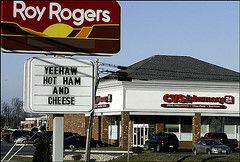
Lincoln Theater, U Street NW
Today's Post has an article about the possible imminent failure of the Lincoln Theatre, because an expected allocation of $500,000 from the DC Government does not appear to be forthcoming. See "Storied Stage Could Go Dark," subtitled "U Street Venue Close to Broke, Director Says."

This has the feel of a broken record. See:

-- City Museum on Shaky Ground: After 14 Months, Visitors and Cash Are in Short Supply" (Post article from 2004)
-- Debt-Ridden Source Theatre Closes, Plans to Sell Building (Post article from 2006)
-- Racing to Save a Victorian Gem (Heurich Mansion, Post article from 2006)

Since these articles were published, the original iteration of the City Museum ceased operations, the Source Theatre building has been sold to the Cultural Development Corporation, although the organization had signed a contract to sell it to a restaurant company and I believe the theatre company is folding, and the Heurich Mansion managed to stave off foreclosure through a successful emergency fundraising campaign.
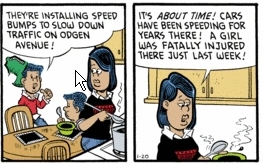
Gateway sign on Rhode Island Avenue NE, entering DC from MDDCist Source Theatre Goes Dark for Good.jpg
(Source Theatre photo source unknown.)

When the same kind of thing keeps happening over and over, it's an indicator that there is a problem with the system of supporting (or not) cultural resources more generally within the City of Washington.

Relatedly, after the Washington Sculpture Center and the Washington Glass School were displaced by the Washington Nationals Baseball Stadium, these organizations did not relocate within the city. The Sculpture Center has ceased operations and the Glass School is moving to Arlington County. See "D.C. Seizes 16 Owners' Property for Stadium" from the Post.
Washington Glass School
On the other hand, Montgomery County, Maryland, faced with the imminent sale of the house with the attached building that likely served as the home for the person who inspired the anti-slavery novel Uncle Tom's Cabin, took only two weeks to come up with the money to purchase the building. See "Unique Montgomery Property for Sale: Uncle Tom's Cabin," from December 2005 and "Public to Glimpse 'Uncle Tom's Cabin'" from June 2006 both from the Post.
Exterior, Uncle Tom's Cabin, Montgomery County, Maryland
Exterior, Uncle Tom's Cabin. AP photo.

Or contrast this to how Arlington County supports cultural affairs, such as their expanding the Shirlington branch of their library to include a theater and space for the Signature Theatre, see "Shirlington Redevelops Its Character," subtitled "Flagship Building Will House Innovative Signature Theatre," from the Post. Another theater company resides in the theater at the Arlington County combined facility, the Thomas Jefferson Middle School and Community Center.
Shirlington Branch, Arlington County Library + Signature Theater, Virginia Sign, Thomas Jefferson Middle School & Community Center
And this is an issue all across the country. In fact, it's being discussed now on an national e-list that I'm on, and I'm trying to organize a session on the broad topic of supporting cultural resources for this fall's annual meeting of the National Trust for Historic Preservation.

Because of the systemic nature of the problem within DC, it happens that I wrote a memo about this in September. It hasn't been widely distributed because it is very much an early draft, something I work on from time to time in between other activities.

But there's a need to distribute it more widely given the "deja vu over and over again" that we are experiencing in the city in terms of supporting our cultural organizations.

The funding stream for cultural resources cannot rely strictly on admissions fees. Just as roads are subsidized to the tune of 50%, or schools are paid for out of tax revenues, history is the social and cultural infrastructure of our society and warrants public funding.

But we have to figure out what our marketing message is. The "building public will" session at the Portland Trust conference is really pathbreaking. Our challenge is to figure out what the messages are with history in all its manifestations and how to touch people in terms of their deep, felt values (as the presenter put it).
Framework for Building Public Will
(Image from the Metropolitan Group website. Their link to the actual paper is not working at the moment.)

I don't think we've done it yet, or we wouldn't be having the problems we're having... I mean, in a couple weeks the National Archives is sponsoring a presentation about the rise in public museums (On January 18th, click here for the calendar) yet, the Archives just massively reduced night-time and weekend access hours because of a $6-$8 mi