Rebuilding Place in the Urban Space

"A community’s physical form, rather than its land uses, is its most intrinsic and enduring characteristic." [Katz, EPA] This blog focuses on place and placemaking and all that makes it work--historic preservation, urban design, transportation, asset-based community development, arts & cultural development, commercial district revitalization, tourism & destination development, and quality of life advocacy--along with doses of civic engagement and good governance watchdogging.

Tuesday, February 12, 2013

Historic preservation isn't just a designation, it's also a tool of revitalization

---------
Update: Dan Reed reminds me that I should have mentioned the Flower Theatre Project, which is a community effort focused on revitalization of the theatre in the context of the area's revitalization program.
---------

So the Gazette has a piece, "Long Branch redevelopment plans spur continued feedback," (also see the 2012 entry from GGW, "Silver Spring's Flower Theatre could bloom once again") about revitalization planning in the Long Branch sector of Montgomery County.  This area is considered comparatively impoverished compared to other areas of the county, and has been the subject of a great deal of planning and investment.

The area will also be served by a station on the proposed Purple Line light rail line, so it will be impacted by having better and greater access to high quality transit service, which will in turn affect the neighborhood, leading to a variety of changes, and providing new and different opportunities for development, change, and the repurposing of currently underutilized buildings.

Left: Photo of the Flower Theatre.  Image from an entry by the Silver Spring Singular blog.

David Rotenstein, a historic preservation consultant and someone who I would term a historic preservation purist, is quoted in the piece as saying the building is unremarkable. I think that's a really inconsidered statement. From the article:

Speakers also disagreed on the plan’s recommendation for the historic designation of the Flower Theatre and Shopping Center, which some supported, while others argued it would limit redevelopment efforts.

Leslie Miles, chair of the county Historic Preservation Commission, said the commission recently voted in favor of the theatre and shopping center’s designation, support that was echoed by Mary Reardon, vice president of Montgomery Preservation Inc., and Marcie Stickle, advocacy chair for the Silver Spring Historical Society.

Historian David Rotenstein — who has studied the property in the past — said, however, the shopping center is “a common and unremarkable example of postwar architecture” and does not deserve historic designation.

Others discussed the theater’s potential role.  Amanda Hurley, of Silver Spring, said the Flower Theatre, “a beloved local landmark,” has been the subject of studies and recommendations and could become a “community anchor.”

What is the purpose of historic preservation?

Compared to every other building in the United States or other cinemas or other shopping complexes or other art deco buildings, the Flower Theatre shopping complex may be "unremarkable."  Although I would not agree.

In any case, that is not the scale at which historic preservation designation decisions are made.  What matters in this instance is the significance of the building on at least five dimensions:  (1) architectural and use; (2) neighborhood-cultural-social; (3) countywide; (4) regional and/or state; and (5) nationally. The building can be significant and worthy of designation on one or more of these dimensions and it isn't necessary to meet the criteria of significance for each in order to be designated.

Many people still believe that the point of historic preservation is the preservation of particularly worthy buildings and sites associated with key people, architecture, and events--like Mount Vernon, President George Washington's plantation, or Independence Hall in Philadelphia, where the Continental Congress met and the Declaration of Independence was signed, etc.

That I think is the sentiment expressed by Mr. Rotenstein with regard to his comment about the Flower Avenue Playhouse, that the building isn't particularly memorable, when compared say to the Washington Monument or to the finest examples of art deco architecture still extant nationally.

This is the case even though the architect of the building, John Zink, was a regionally and nationally significant architect because of his work designing many theater buildings that were constructed throughout Maryland, Virginia, and DC, and many of his theater buildings (including the Senator in Baltimore, and the Newton in the Brookland neighborhood of DC) have been individually designated or are designated as part of broader neighborhood historic districts (the Takoma Theatre in the Takoma neighborhood of DC).

... and despite the fact that the Flower Theatre is a relatively rare example of somewhat untouched art deco architecture in Montgomery County.  Silver Spring's downtown was the site of many art deco buildings, but many have been demolished or changed significantly from their original design.

Neighborhood and commercial district historic preservation 

But since the 1920s, with the development of the movement to create a "neighborhood" historic district in Charleston, South Carolina, preservation has also been about preservation of the vernacular and community, not just great buildings.

I call this kind of historic preservation preserving the nexus of architecture (mostly buildings), place (including urban design), and history (people). Another way to think about this is in terms of the concept of the cultural landscape.

This is the type of preservation most often associated with the creation of neighborhood historic districts or the designation of key buildings that are significant within neighborhoods particularly, even if there are other similar types of buildings present elsewhere in the locality.

Two concepts are key: (1) the period of significance--the time period for which the history of the neighborhood, including the predominant architectural styles, is significant in terms of preserving and recognizing the neighborhood; and (2) the context of the built environment.

Thematic historic preservation and the scale at which preservation is practiced

Another element is the preservation of particular types of buildings in the context of a nation, state, region, county, or community.  This is tougher because there are big gaps in how preservation decisions are made, and planning at these various scales is hard to do generally, and really hard to do when you are crossing jurisdictional boundaries.  For example, to have a good representation of theater and cinema buildings in the Washington region, you have to deal with the policies of three different states and many separate jurisdictions.  As a practical matter this never happens.

That being said, the Flower Avenue Playhouse to which the article is referring to is, in the context of the history of movie presentation in the Washington region, quite unique with regard to the ouevre of cinema buildings constructed in Montgomery County.  (See Robert K. Headley. Motion Picture Exhibitions in Washington, DC: An Illustrated History of Parlors, Palaces and Multiplexes in the Metropolitan Area, 1894-1997. H-Net book review)

It's one of the only theater buildings constructed around or before 1950 that was built in an area that wasn't a key town center (like Silver Spring, Bethesda, Rockville, or Gaithersburg) in Montgomery County.  It was one of the last of these types of buildings, as cinemas came to be built in places that were more accessible by the car, on arterials rather than in more traditional commercial districts, and then mostly within shopping centers.

This is another reason why historic designation for the building is reasonable.

(Note that the concept of state and national designated "heritage areas," based on the organizing framework of the cultural landscape, addresses heritage preservation over a large district sharing a common identity, history, and theme.  The Alliance of National Heritage Areas is a support organization for state and nationally-designated heritage areas.)

Purple Line routing and station mapState and federal historic preservation tax credits are often the difference between revitalization and continued disinvestment in weaker real estate markets

Finally, perhaps the most important reason to designate the Flower Theatre is to be able to provide financial assistance to the revitalization effort, through tax credits.  A designated building is eligible for tax credits.  An undesignated building is not.  And as discussed above, on a comparative basis, the Long Branch area (graphic of the Purple Line routing, including a station in Long Branch, above, from the Washington Post) of Montgomery County is less successful, and providing inducements for improvement is something that the County is already doing.

Federal (up to 20% of the cost of the rehabilitation), State of Maryland (20% to 25% of the cost of the rehabilitation); and Local (10% of the cost of rehabilitation) historic preservation tax credits are available to buildings that are historically designated in Montgomery County, Maryland.  That is up to 55% of the cost and that can make a significant difference financially in whether or not to rehabilitate.

I am shocked that Mr. Rotenstein doesn't think that is a significant reason to move forward with designation as well.

Historic preservation as a regulation/rule/law

Another important concept is what does historic mean?  For many people, especially real estate developers, it is a legal definition.

If a building or neighborhood is legally designated historic, then it is historic and is to be protected. If the building or neighborhood is eligible for designation as historic, but isn't designated, is the building or neighborhood worthy of stewardship, or just a bunch of buildings able to be altered beyond recognition?

To most developers, lack of historic designation means that the building has no historic significance, even if it does, but hasn't been designated.

Although there are many developers who seek out historic preservation tax credits when appropriate, or pursue projects that can only be realized through the provision of preservation and other tax credits and other incentive programs.

Conclusion

For many reasons, historic preservation designation is a useful technique as part of the toolbox of  neighborhood and community stabilization and improvement strategies, and should be considered as a desirable strategy with regard to the improvement of the Long Branch neighborhood of Montgomery County Maryland and the revitalization of the Flower Theatre, an art deco cinema building and shopping complex that is a key and distinctive element of the commercial district in that neighborhood.

Labels: , , , , , ,

Thursday, January 10, 2008

Parking is the KING of development

From the article "D.C. Council votes to expand tax relief for small biz," in the Washington Business Journal:

The D.C. Council also passed bills that would accelerate a number of real estate deals, including a boost for the planned Constitution Square development, in the North of Massachusetts (NoMa) area. The council passed a bill that would provide $7 million in funding to build underground parking for the project, which would enable Stonebridge Development to attract a 50,000 square-foot grocery store.

CONSTITUTION SQUARE IS IMMEDIATELY NEXT TO THE NEW YORK AVENUE METRO STATION.

After spending $120 million on creating the NY Avenue Metro Station, of which $40 million was money from DC Government (the other $80MM was split between property owners through a tax increment thing, and the federal government), the city leverages its investment in the transit system by subsidizing parking at the subway station?!

Similarly, tens of millions of dollars of city-controlled funds were "invested" in building parking facilities immediately adjacent to the Columbia Heights Metro Station at DC/USA and Tivoli Square.

See the website for the Constitution Square project, this testimony from the Office of the Chief Financial Officer about the economic impacts of the subsidies (presumably some aspects of the bill were changed afterwards), "B17-344, "Constitution Square Economic Development Act of 2007," and this Business Journal article about the sale of the property to the current ownership group, "NoMa's Constitution Square property sells for $122M."

Labels: , , , ,

Monday, January 07, 2008

Learning From Portland, Oregon: Creating Vibrant Cities

From the Coalition for Smarter Growth:

A Conversation with Rex Burkholder, Oregon Metro Councilor
Tuesday, January 15

6:00pm Refreshments, 6:30pm Program
National Capital Planning Commission
401 9th Street, NW - North Lobby, Suite 500, Washington, DC ( Metro Center/Gallery Place /Archives Metro stations)

Portland, Oregon, wasn't always the walkable, streetcar riding, bicycling community it is today. Counter to all other transportation trends across the country, driving miles in Portland are actually declining as more and more people find better ways to go about their daily routine. What are the keys to creating such a successful region? How can the DC Metro region learn from Portland’s experience? Join us to discuss how Portland transformed into a national model for smart growth and balanced transportation. Hear from Councilor Rex Burkholder, long time bicycling & walking advocate, and Councilor on Portland Metro Council, the regional planning and transportation agency for Portland.
------------
Also see this past blog entry "A summary of my impressions of Portland, Oregon and planning (reprint)" originally published in October 2005. A key point: Portland had a plan, a plan focused on maintaining the value and primacy of the central business district. That drove a variety of linked land use and transportation planning policies and initiatives. From the entry:

Portland Oregon's Downtown Plan (from material distributed for a walking tour)

The Downtown plan, adopted in 1972, was intended to maintain and strengthen downtown's central role in the city by reinforcing its mix of uses--including office, retail, cultural, governmental and residential. The major concepts included:

1. Creating a North-South spine of high density offices served by public transit. The (bus) Transit Malls on SW 5th and 6th Avenues, completed in 1978, provides this spine and supported private office developments.

2. Creation of an East-West retail spine along Morrison Street that would lead the city back to the river. The MAX light rail line and rebuilt streets on Morrison and Yamhill implement that concept.

3. Recognition and support for the subdistricts in downtown. The Skidmore and Yamhill Historic Districts are two premier examples of those subdistricts and zoning regulations were modified to protect them and funds were invested by the public and private sectors for rehabilitation.

4. Emphasis on transit and alternative modes for downtown access and limitations on parking. The plan prohibited new parking unless associated with new development and it prohibited the demolition of historic buildings for parking lots.

5. Design regulations to promote active street level storefronts--with retail space, public lobbies, and other pedestrian features typical of historic commercial buildings.

6. Policies to maintain the historic, fine-grained street grid and blocs. Vacating streets to form larger blocks and skybridges are rare in downtown. This helps to maintain an active street life.

7. Policies and programs to protect and promote fragile uses like housing, retail and hotels through public and private investments and regulation.

For great photos of Portland, check out Portland Ground.

Labels: , , , ,

Wednesday, January 02, 2008

Top Planning Issues of 2007

from Planetizen:

1. Congestion Pricing and Road Tolling
2. Light Rail/Streetcar Surge
3. Drought Planning
4. Cities Taking Lead on Environment
5. Crumbling Infrastructure
6. Bikeability
7. Fall of Citywide Wi-Fi
8. Subprime Meltdown Fallout
---------------

I guess I would add another, the continued failure of the federal government to consider energy policy in concert with foreign policy and local development policies. I.e., gasoline excise taxes, policies that continue to encourage the use of oil, without being clear about the link between balance of payments, the fall of the dollar, and the cost of war overseas.

Every soldier that dies in Iraq (or Afghanistan) dies for Sprawl.
coffin
Source: Unautremonde

Exxon Ad

Labels:

Wednesday, December 26, 2007

What we're really talking about is compact, connected development

Nigel sends us a link to a blog entry from a neighborhood association in Northampton, Massachusetts, "Financial Incentives Distort Smart Growth Debates." This piece is by Randal O'Toole, an intelligent anti "smart growth" advocate. The association says that it:

supports Northampton's efforts to discourage unmanaged sprawl. However, compact growth must not come at the expense of urban quality of life. It must be carefully managed to avoid disruptive changes to neighborhoods, surges in property taxes, crime, congestion, loss of greenspace, noise and pollution.

Yet it supports the anti-compact development positions of O'Toole.

The problem with "smart growth" is that the concept is one of marginal improvement.

The "smartest growth" is infill development that makes little substantive demand on extant infrastructure. (Where the marginal increase in demand is met by extant infrastructure.)

Typically, smart growth projects are greenfield development, so added infrastructure at the project and district level is required at a minimum. Relatedly, typical new urban projects are greenfield projects. They promote walkability at the neighborhood scale, but at the scale of a district or county or region, such projects add to sprawl.

This is true for a couple reasons. Typically, the projects are far from the core of the region, and the ability to provide efficient (cost and time) transit is remote. DC is resurging because it is compactly developed already, and the addition of fast transit infrastructure (the subway system) re-monetized the value of compact urban design.

Anyway, back to the piece. It focuses on incentives provided to "smart growth" projects. The real issue is that most if not all new developments in the suburbs and exurbs are incentivized directly or indirectly. Without looking at that, whether or not a specific project is "smart growth," misses the most important point. (In the old days, subdivision developers paid for infrastructure and expanded infrastructure. The holder of the streetcar franchise built Connecticut Ave. NW for example.)

Similarly, there is a letter to the editor in yesterday's Lancaster (PA) Intelligencer Journal about the negatives of "density," that losing farmland in Lancaster County damages the local economy.

I found this interesting because the writer equated sprawl with "density." Downtown Lancaster is an amazing place. It is a definition of compact development, with buildings predating 1900 that are larger and attached compared to most neighborhoods in Washington, DC (the height of buildings in the core of Lancaster is comparable to Georgetown and Dupont Circle, although some of the DC buildings are bigger and/or more ornate).

They have a thriving local economy based on agriculture, industry (some being employee owned), and tourism. They have bus-based transit service. Plus, and this is worth a masters thesis level exegesis, the amount of locally owned retail is incredible--including independent supermarkets, selling food at prices better than most chain supermarkets in DC and its suburbs! (Lancaster's Central Market, a public market similar but much larger than DC's Eastern Market, kicks!)

Compact development, connected by transit, will save farmland. Farther out (we are staying near the border of Lancaster and Berks Counties) there are blots of compact development, such as old Adamstown, but they are surrounded by new subdivisions with large houses on big lots.

That's what's taking up farmland, not "density" places like the core of Adamstown or Ephrata or the core of Lancaster City.

Smart growth is too broad a term. We need to talk about compact development (the size of buildings and lots and urban design) and connected development (linked to extant infrastructure including transit).

If it adds to sprawl, it isn't smart, regardless of the incremental improvements over conventional forms of housing and retail development.

Whether it is "smart growth" or "new urban," sprawl is sprawl.

Labels:

Tuesday, December 18, 2007

Accessibility planning

In the Netherlands, it is a way of linking land use to extant infrastructure in a more direct manner than is typical of most jurisdictions in the U.S. All uses are rated for the amount of transportation demand they produce. And all sites are rated for the presence of transportation infrastructure. Uses are directed to sites where transportation demand can be accommodated.

It appears that if growth management in Florida has some similarities. The business section of the Florida Times-Union lists the way sites-proposed projects are permitted in a manner that seems very different from DC's come as they go "matter of right" system which treats all uses as equal within a use zone without paying any attention to the transportation issue. From the "Pipeline" feature:

Informal concurrency: reports whether property can support a project with available infrastructure like roads, drainage and affordable housing.

Conditional capacity availability: Temporarily reserves infrastructure capacity for proposed development on a first-come first-served basis.

Concurrency reservation certificate: issued to developers for projects that will not reduce city's adopted level of service standard for surrounding infrastructure.

Jacksonville Planning and Development Department review: preliminary review of large development proposals, including buildings larger than 40,000 s.f., schoos, housing subdivisions, apartments and condominiums.

I mention this because of article in the Sunday Post about the impact of military base relocation on the various counties in the region. For the most part, the BRAC process removed military installations from locations of high quality transit-based infrastructure to locations with limited transit access. This induces sprawl in a number of ways, including pushing demand for transit service to farther and farther locations where providing service is more expensive and less productive and inefficient. See "A Costly Shuffle." From the article:

Heralded as an economic boon, the Pentagon's base realignment plan will be an expensive game of musical chairs for the Washington region, with more than 90 percent of the region's 30,000 new military jobs coming from somewhere else around the Capital Beltway.

Political leaders, especially in Maryland, rejoiced two years ago when the Pentagon recommended consolidating thousands of military and civilian jobs at the region's bases. Now those leaders, concerned about strain on an already stressed road network, are scrambling to come up with billions of dollars in road and other infrastructure improvements needed for the job shifts coming in 2011.

The seeming savings for the federal government are based on offloading infrastructure costs to state and local governments. Perhaps the overall costs are greater than they would be if the agency/unit hadn't been moved in the first place.

(I wrote about this a couple years ago.)

Labels: , ,

Friday, December 14, 2007

Car-based mobility

Remember the series on commuting around the world in the Toronto Star? Christopher Hume writes, in "Looking beyond gridlock":

Whatever the appeal of the car may be, mobility has little to do with it. The truth of this lies not just in the extreme congestion and epic commutes documented this week by Star correspondents, but as they also made clear, in our mind-boggling capacity to put up with it.

That's why efforts to control car use are doomed to failure as long as they're based on attempts to replace it with alternate forms of transportation, especially public transit.

Of course, subways, streetcars and buses are important, even crucial, but the majority choose not to use them despite the fact they're cheaper, more efficient and sustainable. The better way is, don't forget, the better way. The fact remains, however, that there's nothing rational about why people in the hundreds of millions, perhaps billions, hop into their vehicles every morning and evening for the daily commute.

I don't fully agree with him. Yes, there is no question that driving a car, for an individual is often more efficient and effective. It's also costly. And in a city, a car is difficult to park. But for getting lots done in a short period of time, especially if there is more than one person (for one person, a bike is a superb means for mobility), cars can be easier. If you rely on public transportation, likely there are some trips you decide not to make, just because of the logistics.

But when destinations/activities are close by and close to each other, you are less likely to make special trips to accomplish tasks, instead you accomplish tasks (going to the post office, dry cleaners, grocery store) as part of your normal activities going to and from work and elsewhere.

But for transit to work, it has to be part of a compact development land use scenario, and the "amenities" or quality destinations and services, have to be present. In such a scenario, home and work aren't too far apart, and the means of getting from place to place are pretty simple--subway, bus, streetcar, walking, or bicycling.

As long as automobile-based mobility is the foundation of land use planning--separated uses, low density, with great distances between types of use, free parking--it's almost impossible to make transit "be competitive" because transit isn't operating under the same set of conditions. It's like setting up a foot race between able bodied people and those with no legs (who aren't allowed to race using wheelchairs).

In the city, it's a different situation, where transit is favored. And if car use wasn't subsidized too, in terms of not charging higher prices for residential parking permits for parking on the street, and for more than one car in a household (the average rowhouse is about 15-18 feet wide, so parking in front of a rowhouse is equal to one car, when you put space in front and back, the typical car is probably about 14 feet long), then there would be even fewer cars clogging up the streets in the city.

AND, if transportation demand management plans "required" certain kinds of stores or shopping centers to provide delivery services, that would reduce the demand for cars even more, at least in the city.

Putting transit in places with low densities, when people travel very far to get to places misses the basic point, that home, work, school, retail and services, etc., need to be proximate. This is how such destinations were placed within communities as part of the Walking and Transit City eras of urban design (from 1800-1920).

Now I have no answer (as of yet) to the difficult question of equity. How do we keep such communities diverse and accessible and home for people of limited means, in a market-based economy where demand drives up the prices for places of quality in a manner that prices out all but the most economically able?

I have some ideas, but no definitive answers. I don't really think that Jane Jacobs ever expected how strong the velocity would be for global capital, and the impact on center cities in strong markets. I don't think she ever imagined that the "large stock of old buildings" would ever get depleted.
----
Links to all the Star articles in the series are present within Christopher Hume's column.

Labels: , , ,

Thursday, December 13, 2007

Shopping by bike is patriotic...

The Urbanist blog tips us off to a commercial for Miller High Life beer that promotes bicycling as patriotism by reducing the need to import oil through "man"power.


Of course, SABMillerCoors, the producer of the ad, is a majority South African-based company. But then, capital is international-global anyway.

And speaking of bicycling, I thank the Drunk Cyclist blog for a recent mention and the resulting large number of hits from your readers.

Labels: , ,

Monday, December 10, 2007

Transit as a way of life vs. a way to get to work

"In spite of the need to move urban traffic, many urban highway programs have been stalemated for one reason or another. In Washington, DC there has been an effective, organized citywide drive to curtail highway construction. The Washington program includes an Inner Loop Freeway which would serve the purpose of bypassing through automobile traffic and permit the citizens who live in the outlying areas to have greater accessiblity to the downtown area. The opponents of this program have succeeded in persuading Congress to hold in abeyance the necessary appropriations until a study regarding the need for a subway and rapid rail transit system is completed. Such a program for Washington, DC, is obviously not feasible from an economic point of view and would servce no useful purpose. Metropolitan Washington is a 'lateral' area. As a result, there is little, if any, heavy concentration of people in a given suburban area. If they were to use such a rapid transit system they would be requited to drive considerable distances to the pick-up stations... states that motorists would continue to shun public transit if they were paid to ride it."

-- Executive Director's Report by William C. Barr, Parking (the journal of the National Parking Association), Fall 1962, p. 9 .

Ironically, this was published about 7 months after the streetcar system was abandoned as a result of an order by Congress, in legislation passed in the 1950s.

This weekend DC1974 sent me a link to a piece on the light rail system in San Jose, "Roadshow tracks the trolley: Light rail has grown in 20 years," from the San Jose Mercury News. He makes the point that it is an extensive system, but that it doesn't have much in the way of substantive ridership--fewer than 40,000 daily riders, in large part because it is commuter focused, not compact development focused.

DC has resurged because in the core of the city, with Van Ness and Brookland on the north, Foggy Bottom on the west, and Stadium-Armory on the east, there are 29 subway stations in about 15 square miles.
Subway stations at the core of the city of Washington
Subway stations at the core of the city of Washington.

Similarly, Arlington is resurging because of how they are redeveloping the county around transit.
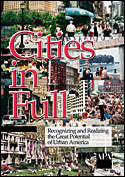
Cities in Full by Steve Belmont
Steve Belmont discusses the importance of recentralizing commerce, housing, and transportation, in the book Cities in Full. Interestingly, there is a piece in last week's Financial Times, about Fred Smith and the creation of FedEx. He makes the point that using linear programming, network planning, and agglomeration economies (not his words), that the overall system can be optimized by the hub and spoke system that they created. See "The man who reinvented the wheel."

I was thinking that this is the same argument for compact development. Overall efficiency is optimized, even if certain trips, considered only on their own terms, are less efficient.
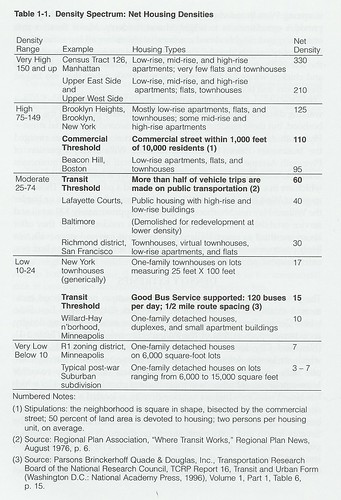
Density requirements for successful transit -- Belmont
From Cities in Full.

But if your transit "system" is oriented to bringing in suburban commuters to jobs in the city, the system isn't likely to have the kind of transformative impact that the subway system is finally having in DC.

It's about transit for getting to work vs. transit as part of your way of life. As Steve writes:

I just walk down tree-lined townhouse-filled 19th Street to get to work and back. It's about 30 minutes if I don't stop at Kramerbooks or make a detour to Whole Foods.
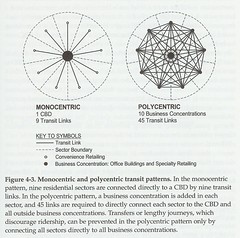
WMATA polycentric rail system -- Belmont
Belmont is critical of the WMATA system as being polycentric and commuter oriented. He's right, but because of the density of stations at the core of Washington, Washington itself has a monocentric section of the subway system, akin to how BART in the SF Bay region is the commuter railroad, while the (overburdened) MUNI System within SF focuses on getting people around within San Francisco is a "relatively" efficient manner.
Monocentric and Polycentric transit patterns -- Belmont
The Development-Related Ridership Survey by WMATA found that within 1/2 mile of Metro stations, the total transit use for residents ranged from 36% of all trips (1/2 mile away) to 55% (0 miles away), and for work trips, the use of transit ranged from 13% (1/2 mile away) to 46% (0 miles away). Note that many of the catchment areas studied were in the suburbs, in-city compactly developed areas show the highest numbers.

Labels: , , ,

Friday, December 07, 2007

Eco-density

Ryan sends us a link to the Vancouver BC Eco-density initiative. There's a lot to go through on the site but it looks pretty interesting.

They define the process as being led by sustainability, driven by affordability and livability.

Labels: , ,

Tuesday, December 04, 2007

The future of railroads is not in the U.S.

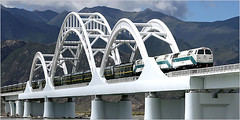
Bridge, rail service between Beijing and Lhasa,
Agence France-Presse — Getty Images. The year-old rail service between Beijing and Lhasa, the capital of Tibet, is one of China’s ventures in rail technology, an industry that is expanding around the world.

From "Eastside rail: We just don't get it," in the Seattle Times, a commentary by Alfred Runte, director of special projects for All Aboard Washington, a rail-advocacy organization, and the author of Allies of the Earth: Railroads and the Soul of Preservation:

... Ask Europe and even China. Railroads are the way to the future. Nor is the problem just global warming. Annually, urban sprawl costs the United States up to 3 million acres of open space. Highways encourage all those losses. At that rate, an area the size of California will be gone — paved over — in less than 40 years.

Still, our elected officials — now including those at the Port of Seattle — tell us how wonderful a bicycle trail can be. "Someday" the Eastside rail line will be needed. That someday just isn't now. Paraphrasing a popular movie, "The American President," I used to think our politicians just don't get it. Finally, the historian in me understands. The deeper problem is that no American gets it, having lost all sense of what railroads do.

It started with the big lie of American culture: Railroads are out of date. Consider that while Europe and Japan launched high-speed rail service in the 1960s, we spent the decade tearing our railroads up. Why? Because the highway lobby convinced Congress to ignore our railroads, while paving companies, oil companies and vehicle manufacturers became the big campaign contributors.

Now the irony cuts like a knife. The 1960s also launched American environmentalism — when young activists like Al Gore got their start. However, in his documentary, "An Inconvenient Truth," railroads are out of sight. Between speeches, we find him lamenting global warming in an airplane — or a chauffeured limousine.
Image of Eastside railroad line, Seattle
Image of Eastside railroad line, Seattle, from All Aboard Washington

Labels: , , , ,

Wednesday, November 28, 2007

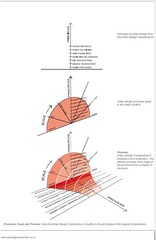
Principles of Urban Design


Principles of Urban Desigh
Originally uploaded by rllayman
This image is from the second volume of the Urban Design Compendium, Delivering Quality Places.

One of the biggest problems in community planning is a lack of felt foundational principles. Sure, they are there, written in comprehensive plans and the like, but they aren't lived.

These principles are pretty complete for all planning, even though they focus on urban design. I guess I would add a second principle on "Mobility, Throughput, and reducing automobile use" to make these a set of overarching guiding principles for planning.

It's the basic problem with the current effort to make the Zoning regulations in DC more linked to the Comprehensive Plan.

I just don't think if you read the Comp Plan (I only have a printed copy of the July draft sent to the Council, not the finally produced version) that you would say that the point of planning is to make a great city greater and to make quality, livable places.

Without that as the starting point, people get hung up on maximizing value of individual plots of land. And too often that has nothing to do with building better places.

Elizabeth's comment in an earlier entry about the committee drawn up to reconcile the Zoning regulations with the Comp Plan is all too telling:

"One of my jokes that the previous planning director didn't like is that DC has an Office of Land Use, not an Office of Planning."

And an even bigger joke is the fact that she, the former Chairs of the Zoning Commission and BZA, and a few other rubber stamps for the Growth Machine have been appointed by our politicos to the Zoning Regulations rewrite taskforce. Hold on to your wallets!!

They aren't putting people on the committee with the kind of perspectives expressed by yours truly, even though some advocates are on the panel.

More things to think about:

1. John Silber (yeah, I know) has a new book out on architecture and design and the importance of connectedness, Architecture of the Absurd: How 'Genius' Disfigured a Practical Art, which is discussed in this piece from the Boston Globe, "Silber's architecture shocker."

2. (I keep meaning to write a blog entry about Bilbao, because there was a good set of letters in the Financial Times about how the city's success is about the realization of broad-based planning objectives, not just one signature building.)

3. There is a piece in the arts magazine Believer about how new museums around the world are mostly the same, like chain stores or airports, with little in the way of any local culture or experience. See "NON-PLACES, MEGAMUSEUMS, AND DEMOCRACY." It's an article that we'll have to buy, but it seems definitely worth it.

Labels: , , ,

To the Would-Be Presidents: Don’t Forget the City Issues

The title comes from a piece by NYT columnist Clyde Haberman. On some elists people are writing about "smart growth" policies of the various presidential candidates. Not that I would likely vote for a Republican, but Mitt Romney did create a coordinated state-level agency to coordinate planning within the state, called the Office for Commonwealth Development, which provided incentives for local governments to make better planning decisions. (This was an initiative comparable to that undertaken by Parris Glendening, when he was Governor of Maryland. Today, Gov. Glendening is considered one of the political deans of the Smart Growth movement.)

Anyway, here are a couple things to think about:

1. In maybe 2002/2003, I wrote about the need to create in a presidential candidacy initiative around urban issues and sustainable land use and resource planning. (That interests me more than "smart growth".) This wasn't necessarily to produce a winning candidacy, but to bring focus and attention on urban-city issues. I created the Urban Agenda blog to lay out this kind of case, but it was always intended to be a group blog, and I've never found enough people who would be willing to write about this a few times a week...

It lives on in the blogger label "."

2. A couple days ago I was thinking about this broad issue in terms of national planning in the UK and their various PPG (Planning Policy Guidance) memos, and how in the 1920s you had the Model Building Code and the Model Zoning Ordinance created by the US Dept. of Commerce as guides for localities.

There is room for EPA/HUD/USDOT to do this still--to provide strong guidance about planning issues to states and local municipalities, instead of having the wild wild west scenario as preferred by the Growth Machine.

But it would require support and political coverage from the President and from a cabinet Secretary, say from HUD to really care.

Labels: , ,

Where's Planning

Where's Waldo image
Image from the "Where's Waldo?" series of children's books.

One of my jokes that the previous planning director didn't like is that DC has an Office of Land Use, not an Office of Planning, otherwise all the various planning efforts underway by various DC Government agencies would be coordinated, reviewed, and perhaps managed by an expanded Office of Planning.* At the time I made that crack, the Library System, Schools, and Parks departments all had planning efforts underway. Plus there were planning efforts or reviews of the EMS department as well as plans to create a hospital in Ward 6.

From "Fenty, Rhee Plan to Close Schools and Reduce Staff," in today's Post:

Mayor Adrian M. Fenty has told the D.C. Council that he and Schools Chancellor Michelle A. Rhee intend to close schools and eliminate teaching positions next year and that they need $31.6 million until those savings can be achieved.

In a Nov. 19 letter to Council Chairman Vincent C. Gray (D), Fenty did not say how many or which schools would be closed or the number of positions to be cut. But the mayor's correspondence was the first public indication from Fenty and Rhee that they will continue former superintendent Clifford B. Janey's plans to eliminate millions of square feet of space that is unused because of declining enrollment. Since last summer, the system has operated 141 school buildings while enrollment has dropped from 55,000 to an estimated 49,600 students this school year. ...

In his letter, Fenty made clear that he and Rhee plan to take a different tack to shutting schools than Janey's staggered plans to close 19 underenrolled schools over several years. "The intent is to rightsize the facilities inventory to match enrollment through a single, unified consolidation plan instead of a multi-year approach," Fenty wrote. "The mayor and chancellor are committed to rightsizing the DCPS as soon as possible."

The closures could save the school system an estimated $23.7 million in costs associated with utilities, operational maintenance and staff, including principals, custodians and clerical employees, according to the mayor's letter.

Don't get me wrong. I think the rightsizing approach makes sense. But certainly the impact on neighborhoods, the utilization of public assets, the possibility of creating co-located programs, etc., ought to be considered and planned, and likely won't be.

-----
* one of my criticisms of a possible "Planning Commission" as has been advocated for by many citizen groups, and a proposal I probably favor myself, is that if a Planning Commission doesn't have oversight of the planning efforts of all the various DC Government agencies, then what they do in large part won't really matter.

Labels: , ,

Tuesday, November 20, 2007

Disruption

Someone I was talking with at the post-lecture reception said that a lot of us were already at the place that Professor Sennett is talking about. I think that's true, but not so many, otherwise you couldn't have Ford Motor Company advertising about the green SUV. (See "SUVs Are Not Cool, Unless They’re “Hybrid Hybrids”," from Streetsblog.

The point isn't driving more green, it's living more sustainably.

For awhile I used the term Sustainable land use and resource planning (SLURP), because I really don't like the term smart growth, although in some sense I suppose the best term is compact development. By definition, compact development has work and residential destinations located within, and mobility is optimally oriented to non-automobile forms.

The reason I get so tired of people talking about green buildings is because the real point is energy use overall, and as long as you drive to and from your green building, does it really matter?

I am thinking that "green" is the new "new urbanism"--meaning terms that have become so overused and mis-calibrated so that they end up not meaning that much.

E.g., as long as new urbanism is mostly about building new subdivisions on previously undeveloped land, it adds to the problem.

As long as green buildings are located in areas where they add to the automobile load, they don't add much benefit to the system.

Just like the Center for Science in the Public Interest, with regard to health behaviors, says "the most important health behavior you can change, after not smoking, is to eat less fat," the most important sustainable living behavior you can adopt is to (for the most part) not drive an automobile.

Next would be to not use materials that consume tremendous amounts of energy in order to be created,

Labels: , , ,