Rebuilding Place in the Urban Space

"A community’s physical form, rather than its land uses, is its most intrinsic and enduring characteristic." [Katz, EPA] This blog focuses on place and placemaking and all that makes it work--historic preservation, urban design, transportation, asset-based community development, arts & cultural development, commercial district revitalization, tourism & destination development, and quality of life advocacy--along with doses of civic engagement and good governance watchdogging.

Friday, August 31, 2018

Making "Downtown Silver Spring" a true open air shopping district by adding department stores
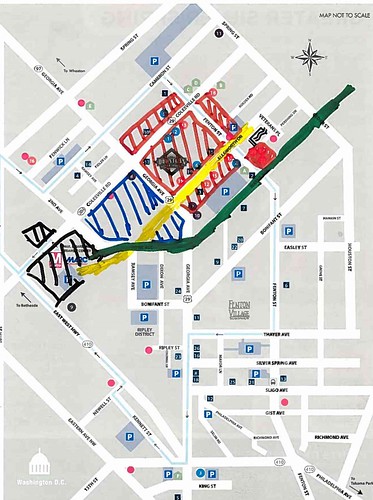
Map, Downtown Silver Spring

On this map of the Silver Spring core:

Hatched Red = retail district
Solid Red = retail district with potential for intensification (redevelopment of parking lot)
Blue = Discovery site
Black = Metrorail
Yellow = pedestrian path current and potential for extension (darker yellow)
Green = future light rail


I am still way behind in writing based on my trip to Liverpool and London.  Overlaid with trips to Essen and Hamburg, one of the things that I intend to write about is pedestrianizing more places in cities, but not so much in terms of creating big districts, but starting "small," with the creation of small one or two block pedestrianized areas where we know they can be successful.

I wrote about big open air shopping districts as pedestrianized city centers, focusing on Liverpool and Essen, and specifically using the Liverpool One shopping center, but applying the concept to North Miami-Dade County, "Learning from Essen and Liverpool and applying it to Miami: Shopping "malls" in the city center."

Liverpool One is an open air shopping district anchored with public spaces and two department stores, John Lewis and Debenhams.  In the US, we'd call this a lifestyle center, although most lifestyle centers in the US don't have department stores ("What exactly is a lifestyle center and is it just a dressed up shopping mall," City Metric).

Different from lifestyle centers in the US, Liverpool One deliberately abuts and connects and extends Liverpool's pedestrianized city center, and contributing more broadly by making a pedestrian connection between it and the city's waterfront, making the core city pedestrian district even larger.

Typically US lifestyle centers, even in urban locations, are more disconnected from the rest of the city ("Lifestyle centers vs. traditional commercial districts," 2006).

Liverpool pedestrian shopping district

As opposed to the enclosed shopping mall which for a long time dominated the retail landscape, there are some still extant open air shopping districts in the US, but not very many compared to malls.

I am sure there are many examples of which I am unaware.  By this, I mean where there are still department stores as anchors.  One is the Bal Harbour Shops in South Florida.

Another, and I can't believe I didn't mention it, is the Friendship Heights shopping district in Chevy Chase DC and Maryland.  And the Union Square district in San Francisco, which has six department stores within a three block radius, four on the street and two in an interior mall.

Bloomingdales in Union Square, San Francisco

Bal Harbour is set up for walking once you get there, while Friendship Heights has a Metrorail station and other transit service, sidewalks and four department stores--Lord and Taylor off by itself, behind the Mazza Gallerie, which has a Neiman-Marcus, and Bloomingdales and Saks have standalone stores on Wisconsin Avenue on the Maryland side--but it's still a district dominated by the car and it's very disjoint because its mostly a creation of private property owners with limited planning coordination with and between the local governments, necessary because it is a cross-border district.

(Unlike Bethesda Row or Downtown Silver Spring, it's clearly an area that hasn't been working on enhancing its open-air nature in a concerted way.)

Fifth Avenue in New York City and the Magnificent Mile in Chicago are examples of shopping streets.  State Street in Chicago too was once a great example until recently--now all the big department stores are gone.  (Of course, most cities had such streets at one time.  In Detroit it was Woodward Avenue, in DC it was 7th Street NW, in Baltimore, Lexington Street, etc.).

State Street, Chicago, c. 1960s

Some smaller "market towns" have or had standalone department stores as anchors to their commercial districts.  Typically these were independent stores, such as Jacobson's in Ann Arbor, Crowleys and Jacobsons in Birmingham, and Crowleys in Grosse Pointe, all in Michigan, or how a Macy's still anchors Downtown Walla Walla, Washington.

The regional department store chain Boscov's, based in Reading, Pennsylvania, has two traditional downtown stores in Wilkes-Barre, Pennsylvania and Binghamton, New York.

Macy's Walla Walla

Michigan market towns lost out big time when the state's two independent companies went out of business in the 2000s, because there are fewer department store companies to begin with, and because these firms typically favor mall locations.

All of these forms are "unenclosed" compared to the typical shopping mall experience.

In an attempt to compete with the suburbs, some cities built interior-focused urban shopping malls during the urban renewal era.  Examples include the Mall at Steamtown in Scranton, Pennsylvania anchored by Boscov's, Newport Center, in Norfolk, Virginia anchored by Dillards, and the Shops of Grand Avenue in Milwaukee, anchored by the now closing Boston Store, a division of Bon-Ton.

The failure of the Bon-Ton Department Store chain will cause many malls and some city centers, like Milwaukee, to lose key anchors.  Although some of the locations--a handful--that remained successful despite corporate troubles are likely to be picked up by companies like Von Maur or Dillards.  The Charlotte-based company Belk is taking over a Bon-Ton location in a mall in Hagerstown, Maryland, etc.

Silver Spring's opportunity to counter-program its commercial district as outdoor focused.  Montgomery Maryland which borders DC, is one of the nation's wealthiest counties.  Like other wealthy suburban areas, it has a bunch of shopping malls, but as a set of inner suburbs, the success of the county's shopping centers varies, and some malls and shopping centers are being redeveloped, others sputter, and some are wildly successful.

The county has invested a lot of money in Silver Spring's revitalization, in the face of economic decline typical to what are referred to as inner ring suburbs.  In Bethesda, "Bethesda Row" is a national best practice example of new "urban" shopping streets, and a similar kind of redevelopment is happening with Rockville Town Center and in the White Flint/North Bethesda district.

Ellsworth Avenue, Silver Spring

Montgomery Mall is one of the nation's more successful upscale malls, while Wheaton Plaza remains successful, but with more of a middle-market orientation.  White Flint Mall no longer exists, except for the lone Lord and Taylor store, while Lake Forest Mall in Gaithersburg continues to languish.

In the days of market towns, Silver Spring was the location of the DC-based Hecht's first suburban store, along with a branch of JCPenney.

-- Richard Longstreth, “Silver Spring: Georgia Avenue, Colesville Road and the Creation of an Alternative `Downtown’ for Metropolitan Washington,” Streets: Critical Perspectives on Public Space, Berkeley: University of California Press, 1994

These stores closed in the 1980s losing out to the more dominant shopping mall.  Over time the shopping district has been revitalized but with smaller stores like H&M, Burlington Coat Factory, Ulta, and Michaels, complemented by restaurants, and civic and cultural uses.

Even so, Silver Spring still must compete with Wheaton Plaza, which is less than four miles away, and is anchored by Macys, Sears, JCPenney, Target, and Costco.

Arguably, "Downtown Silver Spring" has become the region's most successful night-time destination, with its walkable nature anchored by a short pedestrianized street, Ellsworth Avenue, and a large civic plaza at this street's intersection with Fenton Street. The area is home to farmers markets, festivals, and other activity, including a large cineplex, an art theater, and a concert facility.
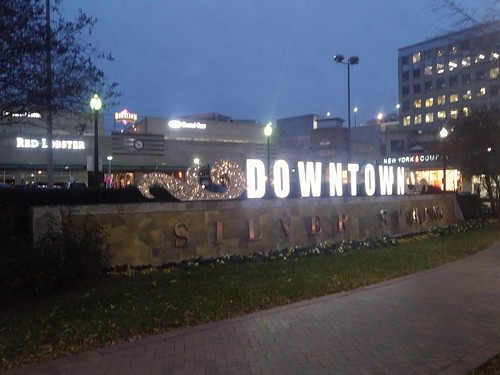
Downtown Silver Spring gateway sign lit up at night

This area is two blocks from the Silver Spring Transit Center and Metrorail Station, and in between the two districts like a fortress is the Discovery Channel headquarters building.  But after a merger, the company is leaving the area.


In my series of articles on how to make over Silver Spring as an "innovation district" by leveraging the coming addition of light rail to the area's transit mix, there are many recommendations for how to strengthen the area's placemaking qualities.

-- PL #5: Creating a Silver Spring "Sustainable Mobility District"
-- Part 1: Setting the stage
-- Part 2: Program items 1- 9
-- Part 3: Program items 10-18
-- Part 4: Conclusion
-- Map for the Silver Spring Sustainable Mobility District
-- (Big Hairy) Projects Action Plan(s) as an element of Comprehensive/Master Plans [now I all these "transformational projects action plans"]
-- Creating the Silver Spring/Montgomery County Arena and Recreation Center

One recommendation was the creation of a more focused retail recruitment plan, making the point that the County shouldn't rely completely on the private sector for this kind of work, because there can be a mismatch of priorities.

There needs to be a "second phase" to retail planning there, to keep Silver Spring's retail district successful and relevant in the face of greater competition elsewhere in the county and the metropolitan area.

Given my experiences in Liverpool, Essen, and Hamburg, and the already open-air orientation of the Silver Spring shopping district, albeit it's anchored also by the Ellsworth Place interior focused mall (refashioned from the old Hecht's store, while the old JCPenney's is now the Fillmore Concert Hall), it occurs to me that Silver Spring needs to go "long" and continue to plan for the intensification of the retail offer of the district.

But by further emphasizing, strengthening and extending its outdoor nature.

Retail sector is bifurcated and some companies remain successful.  In the face of e-commerce, competition, and financial engineering, the retail industry is going through significant consolidation, with many firms going out of business.

That being said, even though as a sector department stores are having problems too, some department store companies continue to succeed. Even as many stores close, new stores do open here and there, depending on local economic circumstances.

Capturing the Discovery Channel building as a way to extend the retail district and connect it to the Metrorail site.  The Discovery Channel is vacating a very large building that is sited between the Metrorail station and the commercial center.

The building is very much interior focused and doesn't contribute positively to activation and the placemaking qualities of the streets surrounding it, although there are some public garden and plaza spaces on the Wayne Avenue side of the site, which can be opened up and better integrated into the streetscape.


The coming redevelopment of that block offers a great opportunity to strengthen and extend the retail district and connect it more directly to the transit station.  Transit stations are the hubs of successful retail districts all over the world.

Foulger-Pratt, developer of Downtown Silver Spring along with Peterson Companies, is buying the Discovery Building ("Discovery building gets new buyer," LocalDVM).

Why not redevelop that site to be way more open and connected to the street instead of closed off from it, to connect the Metrorail Station to Downtown Silver Spring, by extending it, by adding a retail to the ground plane of the block bounded by Wayne Avenue, Colesville Road, and Georgia Avenue, which is currently occupied exclusively by the Discovery Channel?

One way to do this is through the addition of a department store, further strengthening Downtown Silver Spring as a regional shopping destination.

It's counter intuitive, given that in general the department store sector is shrinking, but there are still successful firms operating in this market segment.

Options for a department store.  I see four possible options.  First we must dispose of the unlikely options. Silver Spring isn't upscale enough for Nordstroms, which already has a location at Montgomery Mall. Similarly, Bloomingdales has a store in Chevy Chase, and Lord & Taylor seems committed to their stand-alone location in White Flint, and their Friendship Heights location is too close to justify a close by store in Silver Spring.

Macys has stores at all the major malls and with some exceptions of large legacy stores in big cities like DC, New York, San Francisco, and Chicago, they are a suburban mall oriented company.

Boscov's.  The company that comes to mind foremost is Boscov's, based in Reading, Pennsylvania.  First, they have three urban stores in their portfolio, which is atypical. Second, they have stores elsewhere in Maryland including as close as Frederick, less than 40 miles from Downtown Silver Spring.  The firm is still family owned, and expanding at the rate of about one new store each year.

Boscov's, Binghamton, NY.

I actually reached out to their director of real estate development about this idea. He made the point that Boscov's is merchant driven and community focused, and that if they can make the right community connections to make a store successful, they will consider it.

Yes, their stores are mostly in malls, but urban locations will still be evaluated when conditions are favorable.  Store managers have a fair amount of flexibility to develop a program of store-specific promotional activities.

In terms of tax incentives, he said that deals are a transaction between a developer and the company, and the local government isn't involved directly, although they may provide incentives to the developer to facilitate the entry of a department store.

Primark.  Is a firm based in Europe. Given that reality, a preponderance of their stores are in urban districts.  That's the case in cities like Liverpool, Hamburg, and Essen.  They are expanding to the US, albeit they are moving slowly and mostly with stores in malls.  Their store in Downtown Boston is in Downtown Crossing, another example of an open air shopping district.

Primark's store in Downtown Boston

Primark store on Gran Via in Madrid

So far, Primark has limited their expansion to the Boston and New York areas, but given the firm's DNA is based on city center locations, it'd be worth approaching them.

Dillards.  The firm continues to expand, often by taking over other companies or locations that have been abandoned.  Their closest stores are in Richmond.  The DC area is demographically attractive.

The firm doesn't seem to have much interest in urban locations, although they did open a store in the mid-2000s in Atlanta's Atlantic Station urban redevelopment. Abutting Midtown, it's the redevelopment of a former steel mill site, and while the building was new construction, it "feels" older.


Belk.  Belk used to be family owned but is now owned by private equity interests.  They serve the South and are based in North Carolina and serve the South.  They do have stores in the outskirts of the Washington region in Fredericksburg and St. Mary's County in Maryland.  They have many other stores in Virginia, and they are taking over a Bon-Ton location in a shopping mall Hagerstown, Maryland.

But they seem to have little interest in urban locations, and taking on the DC market might be a stretch.

Map, Downtown Silver Spring


Recommendations

1.  Make as planning priority strengthening and extending the character of the Silver Spring core as an outdoor-focused retail and entertainment district.

2.  Approach Foulger-Pratt about bringing retail to the lower floors of the Discovery Channel building.

3.  Develop a phase two planning program for strengthening the Silver Spring retail district.  A key element is  extending the pedestrian-centric path of Ellsworth Avenue currently from Fenton Street to Georgia Avenue from Georgia Avenue to the Metrorail Station.

4.  Develop a retail recruitment plan, including the possibility of adding one or more department stores, as part of the redevelopment program for the Discovery site.

5.  But regardless, create and implement a broader retail plan for the broader district to seize on other opportunities and to fill evident holes in the current retail mix (more apparel, books, since Borders left, etc.)

6. Approach Boscovs and Primark.  Be prepared to offer incentives. Sound out Dillards and Belk.

7. Ideally get both Boscovs and Primark, put one in the Discovery Building, and the other somewhere around Fenton and Ellsworth, east of Fenton, to further extend and strengthen the district (I would do this by intensifying the site shown in the map in dark red, currently the location to Strosniders Hardware, CVS, and Whole Foods).

8.  Although make recruiting departments stores a two-phase plan too.  Focus on redeveloping the Discovery Channel block to connect the Metrorail station to the Downtown Silver Spring District, making it seamless.  Being successful with one department store and enlivening the currently dead space between the Metrorail Station and Ellsworth Avenue, makes it more possible to land a second store, after determining there is enough market demand to support both.

Labels: , , ,

Thursday, January 05, 2017

Macy's store closings include two important downtown locations in Portland and Minneapolis

Today Macy's announced their list of definite store closings, following up an announcement last fall that in 2017 they will be closing 100 stores, in response to declining sales.  Thus far they have listed only 68 of the projected total of 100 stores (note that not all are full line department stores, some are specialty operations).

They've been closing stores for awhile now, as more commerce migrates online, and as shopping malls become less attractive places to shop ("Macy's woes could doom a third of America's malls," Chicago Tribune). Macy's has an interesting method for considering which stores to close, including the impact on e-commerce sales and other channels ("Here's how Macy's decides which stores to close," New York Business Journal). From the article:
... Macy's then looks at which stores are underperforming and tries to model out the cash flows going forward, including the sales it would lose from closing the store as well as merchandise that was previously purchased but will inevitably be returned, regardless of whether it's online or at another nearby store, she said.

Hoguet also noted that when a retail location closes, Macy's sees a corresponding drop in sales on macys.com and bloomingdales.com. She speculated that part of the dip in online sales could come from consumers not having a convenient way to return merchandise that doesn't fit or that they don't like.

"We then model out the cash flows going forward and compare that with the cash flows associated with closing – any proceeds if we own the store, working capital, et cetera – a nd look at the two together and decide if the value to operate is greater or less than the value to close, and we proceed," Hoguet said.
The Macy's store in Downtown Portland is representative of the very large multi-line department stores dating to the late 1800s and early 1900s typical of any major city.  Oregonian photo.

The list includes sites in Downtown Portland ("Macy's closing downtown Portland store: 'A bit of," Portland Oregonian) and Downtown Minneapolis ("Macy's sells downtown Minneapolis store, will close it in March," Minneapolis Star-Tribune), although the Portland closure was announced last November.

Both stores had been the flagship locations of regional chains (Maier & Frank and Dayton's respectively) that eventually were amalgamated into Macy's.  Such large stores are fundamental anchors in multi-faceted commercial districts such as a Downtown ("The Uncertain Fate of the Downtown Department Store, Next City; "Despite subsidies, downtown department stores still disappearing," Milwaukee Journal-Sentinel).

I argue that department stores can still be a "killer app" for Downtown retail districts, but they need a lot of support and most department store chains--and there aren't that many anymore, given the consolidation within the industry over the past 15 years especially--aren't particularly interested in managing and promoting grand experiential oriented stores, unlike the big department stores in say London, Paris, or New York City ("For Macy's, a Makeover on 34th Street," New York Times), even if large center city stores are part of the company's portfolio.

In a book from the late 1980s, Living City by Roberta Gratz, she describes how a regional department store chain in Pennsylvania, Bon Ton, had a practice of buying small independent stores, usually with just a couple branches, an original town store, and at least one "suburban" store that developed in the post-war period, and had a systematic process for de-emphasizing and later closing the center city store.  By contrast even today, the Reading-based Boscov's chain still focuses its resources on center city (albeit smaller cities) locations.

DAVID BREWSTER – STAR TRIBUNE. Laura Schara, fashion director looked over a lineup of clothes on models on Macy's 12th floor in preparation for the Glamorama fashion blow-out at the Downtown Minneapolis Macy's. Events like these are experiences typically not offered at suburban mall stores, except at Class A+ malls.  

The closure by Macy's of downtown locations continues a multi-decade trend, but it is interesting that these stores are closing in a period where all the industry pundits say special stores and a focus on creating experiences will matter much more going forward (I still remember as a child going to the downtown Hudson's Department Store in Detroit to see Santa) along with the increased attraction of living in center cities.

-- The Evolution of Experience Retailing, Oracle
-- Shifting from consumption to experience, EY
-- Experiential Retail is the Retail Sector's Safest Bet These Days, Ten-X

New York City is one place where new high-value brand department stores are being opened ("A Department-Store Comeback in New York City," Wall Street Journal.  The Manhattan Macy's store has a dedicated branch of the city's tourism information center.

It may well be that such stores will be the province only of the largest cities,  like New York, Chicago, and San Francisco, with cities like Portland, Pittsburgh, and Minneapolis being too small to support large stores with active promotional and programming calendars.

Labels: , , , ,

Friday, January 09, 2015

Another indication of the decline of Detroit and "the mall" and inner suburbs: the decline of the Northland Shopping Center/Macy's to close

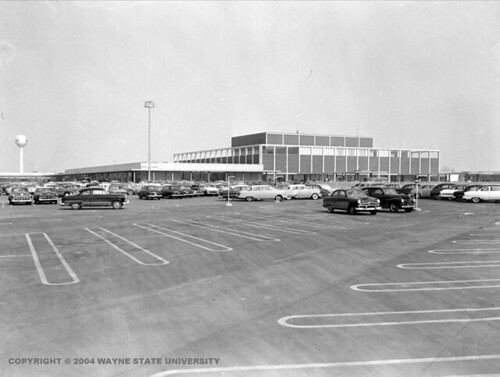
Northland Shopping Center, Southfield, Michigan, 1954
Northland Center (above) was the first post-WWII shopping center built in the Detroit Metropolitan area, in Southfield Michigan, and one of the earliest suburban shopping centers in the US.  (Note that the Hecht Company's Parkington Center opened in Arlington County, Virginia three years earlier.)

It was built by JL Hudson Company, the city's pre-eminent department store company, and was the first of a bevy of shopping centers ringing the center city including Eastland, Westland, and Southland.

Note that especially in the Chicago region, in the 1920s and 1930s it was not uncommon for department stores to open branch stores, not shopping centers, outside of the big downtown stores, but that practice was atypical elsewhere in the country.  Mostly, residents went to the Downtown in the center city to shop. (In the DC region, what is now called Ballston in Arlington County, was the first suburban shopping center built by the local chain, Hecht's, after they opened their first branch store in Silver Spring, which stayed open until the 1980s.)

Northland aimed to serve suburban residents by bringing Downtown to them.

The complex was designed by Victor Gruen, a German-American architect famed at the time for retail store design, who then went on to design many shopping centers across the country, along with city master planning ("The Terrazzo Jungle," New Yorker Magazine) and even some work for Disney.

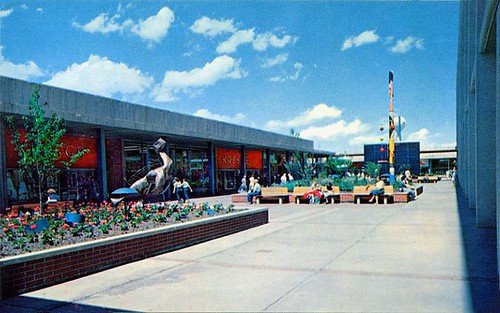
Northland was open-air, with a four-story Hudson's at the center.  But after the creation of a fully enclosed Southdale Center in Greater Minneapolis a couple years later by the Dayton Company, which was associated with Hudsons and later the companies merged, after Northland, later Hudson's-built shopping centers were built from the outset as enclosed spaces and Northland was eventually converted. (I do have memories of the center in its open-air days.)

Hudson's, merged along with Daytons into Chicago-based Marshall Field's by 2001, was one of the many regional department stores that became part of Macy's over the course of the 2000s.

Macy's is the nation's largest department store chain, which was created through the amalgamation of a large number of regional department store chains.  Eventually all of the regionally significant store names (Hecht's, Filenes, Jordan Marsh, Rich's, Broadway, etc.) were dropped in favor of the Macy's name, and the company repositioned as an integrated national company rather than regional brand.
Northland Center, 1960 (Southfield, Michigan)

Thursday, Macy's announced that this year, it will be closing 14 stores (and opening 3 new stores).  One of those stores to be closed is at Northland Center, ironically, one of the first suburban department stores ever built.

-- "Officials Say Mall Key To Economic Future In Southfield," WDET-FM

Apparently, the other anchor store at the mall, a Target, will be closing next month, leaving the center with no anchors.

Northland, in Southfield, immediately north of Detroit, along 8 Mile Road in Oakland County, was a harbinger of doom for Detroit as a center city. The construction of the center and the opening of the Hudson's store was the leading sign of population outmigration from center cities and the rise of the suburbs more generally, it is ironic that this particular mall is losing its foremost anchor ("How a mall set the tone for Detroit's decline," letter to the editor,  Detroit Free Press).

That being said, Oakland County is still one of the nation's wealthiest counties as discussed in this entry ("The rise of Oakland County is built upon Detroit's fall").

But we must be judicious with the Northland Center story, as it's easy to overgeneralize from the experience of Detroit and its inner ring suburbs, although few cities in the US have fallen quite as far as Detroit.  Part of the story is demographic change, as Southfield changed from a Jewish-majority city to an African-American majority city, in an otherwise very white conservative Oakland County.

And Northland has other issues arising from its design (see shopping directory sign at left).

The center was built originally by Hudson's to highlight Hudson's as the sole anchor department store, so the shopping center was built with Hudson's at the center, with smaller stores surrounding it, making it difficult to fit other anchors onto the site.

Later designs for shopping centers put department stores at the outer edges, with a department store at the end of each wing.

Such design issues were typical of shopping centers built by department store companies, as these firms were unaccustomed to having to share store space with others ("The Mixed Blessings of Success: The Hecht Company and Department Store Branch Development after World War II," by GWU professor Richard Longstreth).  Eventually, independent developers became the primary force for developing the shopping mall, and sharing customers with other department stores in the mall became common practice.

Also see "Turnabout is fair play: why Topher Matthews/GGW is wrong about TIF incentives for a department store in Georgetown..." from 2012, which discusses incentive practices as they relate to department stores (and supermarkets) as retail anchors.

Labels: , ,

Friday, December 30, 2011

Downtown and the Department Store as key "public" spaces

Last month I blogged about DC's Central Library and proposals to "co-locate" commercial space on the library site, to generate revenues to pay for renovations and expansions. See "The DC Central Library, the Civic identity and the public realm."

I mused about the key civic assets in a community, how they define the community, and whether or not communities would allow such key buildings as the City Hall, Courthouse, Main Library, or main public park to be commercialized.

As mentioned in the entry, some "public spaces" are in fact privately owned. I mentioned the railroad station--although these days for the most part these are publicly owned facilities--and while I didn't mention the primary Downtown commercial district specifically, I did mention the buildings that are/were there, such as the city's department stores, majestic theaters, signature restaurants, and other retail.

Of course, these shopping districts have long since been supplanted by the suburban shopping mall.

The Boston Globe opines about the loss that derives from the way retail shopping has changed, how department stores and the city's main shopping district have long since been supplanted, in "What is Christmas without the department store?"

For those of us with memories of the department store Santa--for me it was at Hudsons, in Downtown Detroit, but every city has its own examples, this of course resonates. Also see "How J.L. Hudson changed the way we shop" from the Detroit News.

Other resources

-- Going shopping: consumer choices and community consequences
-- Harvard Design School guide to shopping (Chapter 4 makes the point that the history of shopping is also in part about the history of women. After all, about 70% of retail transactions are conducted by women. And department stores were created to make shopping like theater.)
-- English Shops and Shopping
-- Downtown America

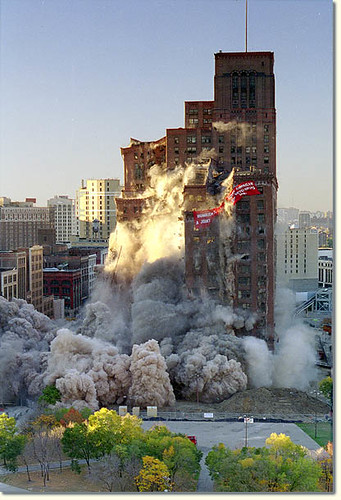
Demolition of Hudsons Department Store
"Final Sunset" The Requiem for Hudson's Suite, Lowell Boileau 1998. Demolition of the Downtown Hudsons Store, Detroit.

Labels: , , ,

Wednesday, September 14, 2011

Department stores and the center city

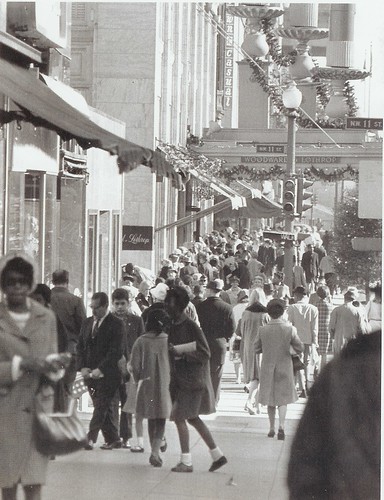
11th and F Streets NW, Washington, DC, December 1968
People outside of Woodward & Lothrop Department Store, F Street NW, Washington, DC, 1968. Washington Star photograph.

In the old days, cities typically had upwards of a half dozen "local" department store chains. (Actually, "back in the day," a number of local department store companies affiliated on a national basis, through either Allied Stores or Federated Stores, in addition to various other companies in the industry.)

Over the past couple decades, four of those companies have been "rolled up" in various transactions into what is now Macy's, which is roughly coast-to-coast (805 stores), after Macy's went through a period of co-branding with the stores that weren't originally Macy's stores, and then just rebadging all the stores as Macy's.

In some regions of the country, Dillards (308 stores) is also active, with about half the number of stores. There are a limited number of upscale chains active in a number of markets but with only a handful of stores (Saks Fifth Avenue, Bloomingdales, Lord & Taylor, Neiman-Marcus), plus Nordstroms (116 stores), which is also a "national" chain.

Of course, Sears (926 full line stores) and JCPenney (1,126 stores) are still active, although Sears has been on a downward trajectory for 30 years. Neither company is active in opening new stores in center cities, although JCPenney has opened a store in Manhattan, and has stores in the other boroughs.

And in a number of markets, particularly in the midwest, there are still active regional department store chains, such as Bon-Ton, with various banners (65 stores) and Van Maur (25 stores), Belk in the Southwest (305 stores), and Bealls in Florida (about 75 stores).

What this means is that if you want to fill up large retail spaces in center cities you have limited choices, especially if Macy's is already there, and Dillards isn't active in your market. Nordstroms is very picky about adding new locations, as is Macy's about locations for Bloomingdales (41 stores), and Barney's New York (15 stores).

That's why there is attention on Target (which was originally a discount division of a department store chain, but grew to take over the company, and the department stores were spun off) and even Walmart, to help fill up large spaces.

Boston is looking to Target to fill the Downtown Crossing space that was once home to Filene's Basement (Filene's Basement started as the "discount store" operation of the Filene's Dept. Store company--most local department stores had such operations--but it became successful in its own right, and split off when Filene's was acquired as part of a larger transaction by Robert Campeau). See "TARGET MIGHT FULFILL VORNADO’S DOWNTOWN CROSSING DREAMS" from Retail Traffic Magazine and "Target eyes Downtown Crossing: Retailer wants flagship store in former Filene’s building" from the Boston Herald. Target is already planning to open a store in Chicago, in space in the old Carson, Pirie & Scott Department Store, and using the same smaller "CityTarget" format of about 125,000 square feet, in Seattle, San Francisco, and Los Angeles as well. See "Target Goes Urban with Smaller Format" from Home Furnishings News.

And Target, which has opened a very successful store in DC as part of the DC/USA center in Columbia Heights (see "A Rapid Renaissance in Columbia Heights," from the Washington Post) is considering a store in the Georgetown Park Mall in the Georgetown section of DC, although the property owner would much prefer Nordstroms, which has looked at the space before.

----
One thing that it took me a long time to accept is that department stores expect financial incentives to open stores.

The reason it's reasonable to do this--with an exception for Walmart--is the stores truly are draws, bringing people to commercial districts and the people shop, eat and do other things in the area, spending money that the store doesn't get. Since they spend lots of money on advertising, which draws customers in, the department stores believe they deserve financial consideration for this effect.

The reason I argue that this is less reasonable for Walmart is that there business model is designed to capture 100% of the customer's retail transaction on each trip, leaving no money for other businesses. Therefore, they don't deserve recompense. Plus they don't advertise very much either...

In successful center cities, I believe that department stores, done right, do quite well, as does the Macy's store in Downtown DC, which was always the centerpiece of the former Hecht Company.

I just wish there were more choices for cities. Sears and JCPenney aren't really active for center city locations, Nordstroms is very picky, and in most of the successful places, Macy's is already present. That means Target and now, Walmart (Wal-Mart's push into US cities" from BBC News).

If they don't pick Georgetown, which Georgetown Metropolitan says is a possibility, then Georgetown Park Mall has very limited options, because it needs a department store to absorb the individual small spaces that exist there, because store spaces on the inside of the Mall will never be successful, because people don't go to Georgetown to stay inside a building, they go to experience the vitality of being on the street.
People walking on M Street NW, Georgetown

Labels: , , , ,