Rebuilding Place in the Urban Space

"A community’s physical form, rather than its land uses, is its most intrinsic and enduring characteristic." [Katz, EPA] This blog focuses on place and placemaking and all that makes it work--historic preservation, urban design, transportation, asset-based community development, arts & cultural development, commercial district revitalization, tourism & destination development, and quality of life advocacy--along with doses of civic engagement and good governance watchdogging.

Tuesday, December 19, 2023

WMATA Chief says it’s time to talk about a regional tax to help fund Metro (DC area)

Is an interview with WMATA CEO Randy Clarke (NBC Washington).

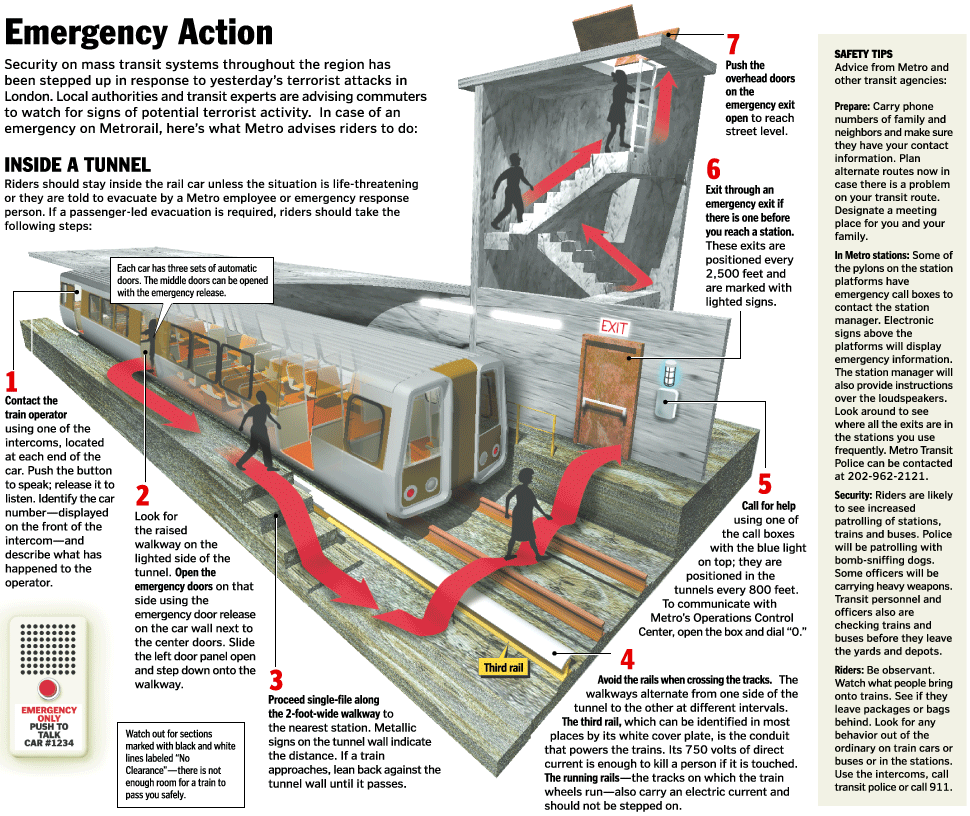
This pamphlet was an advertising supplement inserted in the Washington Star, 3/21/1976.

I get a kick out of this because this has been raised on and off for 20 years, such as in these reports from 2004-2006.

-- Washington Metro: Deficits by Design, Brookings, 2004
-- Keeping Metro On Track: The Federal Government's Role in Balacing Investment With Accountability at Washington's Transit Agency, Brookings, 2005
-- "Mass Transit: Issues Related to Providing Dedicated Funding for the Washington Metropolitan Area Transit Authority, GAO, 2006

Also a statement by a transit safety commission board member:

-- "DC area transit commission board member thinks he has a brilliant idea on how to fund Metrorail: sales taxes," 2022

It's not new.

In 2009 and a couple times afterwards, I said it was necessary for WMATA to rebuild the regional/metropolitan consensus about support for transit.  And later about various funding mechanisms.

-- St. Louis regional transit planning process as a model for what needs to be done in the DC Metropolitan region, 2009
-- "WMATA 40th anniversary in 2016 as an opportunity for assessment," 2014
-- "Funding WMATA by a regional sales tax," 2017

I also wrote that the best time to ask for money is when you're successful, not in crisis (e.g., "Creativity Helps Rochester's Transit System Turn a Profit," New York Times).  

The best time would have been in the 1980s, when the system ran well and was still expanding.  Although sales taxes aren't a cure because they fall during recessions.

Regardless of Rahm Emanuel's point about not wasting crises, my observation is that governments aren't good at decision making generally, and are particularly bad during crises.  So given there's been talk about this for at leas 20 years I'm not holding my breath.

WMATA has even more issues because if either Maryland or Virginia have Republican Governors, it makes it very difficult to develop consensus support for such a tax, because they see it, justifiably or not, as helping DC disproportionately.  Right now, Virginia has a Republican Governor.  But even Democrats like Terry McAuliffe weren't super helpful.

=== From past entries:

Transit financing.  I've written a lot about WMATA and financing.  It has a big problem in that the jurisdictions appropriate money on a year-by-year basis, not as a matter of course.  Yes, this does make it harder for the agency.  Especially because jurisdictions will put off capital expenditures as long as possible.  Many people make the point that lack of dedicated funding is why the system is in failure mode.  I disagree.

-- Getting WMATA out of crisis: a continuation of a multi-year problem that keeps getting worse, not better (2015)
-- What it will take to get WMATA out of crisis (2015)

As I've argued, the federal transit pass has historically disproportionately funded the system, alongside the practice of charging fares by mode--most systems charge one fare for a bus+rail ride.  Not WMATA.  They charge two.  And pass products lowering the overall cost of transit have historically been a low priority.

This let the system get sloppy in terms of finance, budgeting, and understanding why "WMATA is so successful at funding operations from farebox revenue."

My solution: Step 1: creating a regional transport association.  The fact that there are so many "mobility" services, even beyond transit (taxis, car sharing, bike sharing, scooters, etc.) is why I've argued that the DC area should adopt the German form of regional transport association (called a VV, Verkehrsverbund), which links planning, budgeting and operation into one overarching organization, even if many different entities provide actual transit service.    They have an integrated planning and transit fare media system.  But there are over 20 operators of the various services, including private operators of bus lines.

Step 2: Separate planning from budgeting.  Too many transit services in the DC area make planning subsidiary to budgeting.  I understand why this happens, but if there were true "mass transit planning," we would define the breadth and depth of the network that we want.  And then come up with the funding to make it happen.

Transit operators would come back and say: you've defined the network breadth and depth (level of service) as X.  But the funding won't support that.  Then there would have to be a discussion of how to address funding shortfalls in terms of raising revenues or cutting service.

Step 3: Fix the Funding.  Yep, it needs to be done, but not just for Metrorail, for all of the regional transit services.  

Step 4: WRT WMATA, declare force majeure, and contract out operation of the heavy rail system to Hong Kong's MTR.  Start over.  Force majeure allows the abrogation of all contracts and starting over. 

Note: WMATA seems to be getting its act together under Clarke.  Maybe this is no longer necessary.

Funding options.  I have other pieces about options for funding.  

-- "Metrolinx Toronto: 25 potential tools to fund transit-transportation infrastructure," 2013

suggests a more structured process for identifying funding than an interview published in the Post.

The best would be a transit withholding tax.  But if the federal government refused to participate, it would significantly reduce the revenues from it.  In France, this tax is key, called the versement transport.  But MTA in New York State, and a couple other transit agencies do a form of it as well.

The future of transit in citiesI don't know.  Work from home has torn apart the transit business model.  Most major cities have seen a reduction by half in transit users.  And systems like WMATA have reached a ceiling in how much they can charge.  Suburban jurisdictions now truly see helping transit as helping the city at their expense, since many of their workers have been able to significantly cut back on commuting to the center city.

DC doesn't have the budget to be able to take on the full responsibility of WMATA, but that would allow it to manage it in a way that benefits the city.

Although federal agencies leaving the city for sites poorly connected by transit, and maybe sports teams too, doesn't help the transit financial model either.

Labels: , , , , , ,

Monday, November 27, 2023

Community radio as an element of local cultural planning

 I have a bunch of entries on radio:

-- "Local music used to define communities: today with radio chains and national music distribution systems, not so much," 2021
-- "Culture planning and radio: local music, local content vs. delivery nodes for a national network," 2019
-- "Thinking anew about supporting community radio," 2019
-- "Revisiting community radio," 2020

And on various elements that I think should be in community cultural plans, but usually aren't, such as:

-- "What would be a "Transformational Projects Action Plan" for DC's cultural ecosystem," 2019
-- "Cultural plans should have an element on culture-related retail," 2018
-- "Should community culture master plans include elements on higher education arts programs?," 2016
-- "Culture planning at the metropolitan scale should include funding for "local" documentary film making," 2016
-- "Another example of why local culture plans need to include an element on retail/dealing with for profit elements of the cultural ecosystem: Nashville's Tubb Record Shop," 2022

Salt Lake's community radio station KCPW just went out of business.  The station was originally owned by another nonprofit, and sold off to a different nonprofit a few years ago.  But for $3.5 million, and evidently that was too much, and the station wasn't able to successfully compete for donations for operations as well as loan payments, as they faced KUER-FM, the NPR affiliate owned by the University of Utah.  (The area has another low power community radio station, KRCL-FM.)

KCPW had a 31 year run.  It ended up being bought by KUER ("KCPW FM-88.3 is sold — to KUER and PBS Utah," Salt Lake Tribune) and for the time being it will rebroadcast the NPR Spanish feed, Radio Bilingue.  While Salt Lake County has a fair number of Hispanics, they make up only 1/11 of the area population.

A loss for community-based radio programs.  KCPW was noteworthy in that it was based on the campus of the main branch of the Salt Lake City Library ("The Salt Lake City Central Library is absolutely incredible," 2013) as part of pathbreaking mixed use functions in the library and they had a feedline between the library auditorium and the station so that programs there could be broadcast live or recorded.  

The station provided a fair amount of independent programming, partly because they couldn't afford NPR dues and because the area probably can't support two NPR stations as the population is relatively small.

The community benefited from having two very different public radio stations.  KCPW being absorbed by the University of Utah reduces the diversity and programming opportunities within the community in very significant ways.

It's unfortunate that radio isn't covered in local cultural planning.  

Monitoring the health of local cultural organizations in case something goes wrong.  One of the things I argue is that there should be a "distant early warning network" in the cultural community to identify the potential for organizational failure, and there should be the creation of funding and other systems to be able to step in and help.  Although I imagine most cultural professionals in the Salt Lake area are likely to think the acquisition by KUER was a good outcome.

A potential funding source (but too late now).  Salt Lake County was an early adopter of a sales tax to support "the arts."  It's called ZAP and it covers three areas: the Hogle Zoo, Parks both the County system and projects by the various cities, and funding for cultural organizations.  

The tax had to be approved by the Legislature originally and is renewed every ten years.

(Summit County where Park City is then developed a similar tax, called RAP, Recreation, Arts and Parks.  I don't know if other jurisdictions elsewhere in Utah have done the same.)

While it is a pathbreaking initiative, at the same time, it's static in that it is a funding source extremely difficult to modify for supporting "new" programs, because it requires the State Legislature to change the enabling legislation.  

I'd argue that community/local radio independent of large organizations like the University of Utah should/could be an element of that funding stream. But the time to change that is not when an organization is about to fail, but long before.

Also see "A comprehensive list of funding sources for arts and culture," 2019.

Labels: , , , , ,

Monday, July 18, 2022

Anaheim considers asking voters for 2% ticket tax on Disneyland, other venues

 -- "Anaheim considers asking voters for 2% ticket tax on Disneyland, other venues," Orange County Register

From the article:

With Anaheim planning to balance its budget with borrowed money for the next few fiscal years, Councilman Jose Moreno wants to let city voters decide whether to put a 2% tax on tickets to theme parks and other large venues – a move that could potentially raise from $55 million to $82 million a year for city services and projects.

That money could mean building a second public pool, restoring seven-day-a-week library services, hiring more police and firefighters, or building and staffing a dedicated senior center to serve residents, Moreno said.

He’s been trying to get the council to look at a “gate tax” for several years; with the May resignation of former Mayor Harry Sidhu – who with majority support blocked discussion of the issue – now he can. The potential tax measure is on Tuesday’s meeting agenda.

But Anaheim never having charged such a tax before, that it would require voter approval, and that it would need five of the six council members to agree to even put it on the fall ballot, doesn’t point to a clear path forward for the proposal.

While it looks like there are many barriers to success, that Anaheim hasn't been collecting such a tax clearly has cost it a great deal of opportunity for serving its citizens, especially as local jurisdictions in California are seriously hindered in terms of property taxes as a revenue source because of Proposition 13 limits on property valuation for tax purposes.

Traditionally, taxes on accommodations, rental cars, parking, restaurant meals, and other amusements have been seen as an easy way to collect revenues, mostly at the expense of nonresidents.  OTOH, operators of those types of businesses argue that they are excessively taxed and that high prices deter patronage overall, cutting revenue and hurting economic development overall.

In general, admissions taxes are a way for local jurisdictions to cover the costs of dealing with venues, and as a form of economic return for subsidies, etc.

For example, Prince George's County Maryland would net zero off the Washington NFL team and FedEx Stadium, without an admissions tax on tickets.

Unfortunately/1, the admissions tax on events at Capital One Arena in DC isn't a revenue stream for DC but a funding source for arena improvements.

Unfortunately/2, nonprofit cultural institutions often advocate against admissions taxes on ticketed events because they say it makes the price too high, even though such institutions often benefit from grants and other public monies and investments. 

Parking taxes to support community improvements.  Years ago a neighborhood association in the Hill District of Pittsburgh suggested creating a parking tax that would go towards funding local community projects as a mitigation program ("A dollar a car for the Hill," Hill District Consensus Group). 

I think that's a great way to provide mitigation monies to the neighborhoods where such facilities are based, in return for their bearing the brunt of game day problems.

In general, I believe that jurisdictions not charging admissions taxes when they have major event facilities within their communities are definitely missing out to the point of "foolishness" and bad policy making.


Labels: , , , ,

Thursday, August 19, 2021

Tulsa Vision 2025 sales tax initiatives for economic development projects

I just found out that Tulsa has a sales tax add on program, modeled after Oklahoma City's pathbreaking Metropolitan Area Projects program, which has funded a variety of placemaking, economic development, and infrastructure projects over the past 25 years ("Change isn't usually that simple: The repatterning of Oklahoma City's Downtown Streetscape").  

It took a couple of tries before the referendum was finally passed, which is not a surprise.  Early iterations called for funding specific tax incentive projects, like to retain an American Airlines maintenance facility. But later phases included funding improvements to universities and schools, and parks.

But it's not nearly as visionary as MAPS. But the most recent vote in 2016 made the funding stream permanent. And it's possible that over time, the vision component can grow.

-- Tulsa Vision 2025

The current slate of projects are more focused on creating civic assets with long term value ("Invested in downtown': Tulsa Arts District improvements among $816M in new projects," Tulsa World) such as the Oklahoma Museum of Popular Culture and the Greenwood Rising History Center, which recounts the sad history of the Tulsa white riot eradicating the Greenwood neighborhood in 1919.

In turn these investments are sparking private investment in housing, mixed use, and office projects, helped surely, by Tulsa's position in the fossil fuels economy.

Tulsa Remote Worker Recruitment Program.  Something I haven't written about but have been meaning to for a couple years is Tulsa's worker recruitment program ("Do you work remotely? This program could pay you $10,000 to do so from Tulsa," CNN, "The Great Tulsa Mobile Worker Experiment," Bloomberg), which was started before the pandemic. 

Not unlike the artist recruitment program in Paducah, Kentucky ("In Paducah, Artists Create Something From Nothing," NPR), the idea was to recruit workers who didn't have to work onsite, who might be attracted by Tulsa's lower cost of living, especially of housing.  Since then more communities have created similar programs.

Called Tulsa Remote, and funded by the George Kaiser Family Foundation, a locally-focused foundation with funds derived from oil and banking, it provides a $10,000 "move in" bonus, and a variety of support programs aimed at easing the transition, promoting new business development, etc.

While The Atlantic writes that such programs aren't particularly successful ("Moving Incentives Are Overhyped"), I'd argue that it doesn't cost much and it's always good to recruit people with talent to your community.  Of course, one challenge is then to be able to be open to their ideas and be willing to reshape the revitalization agenda accordingly ("Downtown Tulsa resident campaigns for food co-op," 2News Tulsa).

But it's true that not every place has the right conditions to support this.  People look at what Paducah did and say "people can work from anywhere."  But that's the wrong lesson.  Paducah focused on attracting artists who sell the bulk of their work at summer art fairs.  And Paducah is well located in the midwest, with great freeway connections within a day or two of many major fairs such as in Louisville, Ann Arbor, and Suburban Chicago.

---------

Best practice flooding mitigation. I have written about Tulsa's proactive response to its last major flood in 1984, resulting in 14 deaths--the city is centered upon the Arkansas River.  

They created an active disaster mitigation and resilience program, including buying out housing and other buildings located on flood plains ("Some innovative disaster planning initiatives in Tulsa, Santa Fe, San Francisco, and Davenport Iowa").  

Flood waters cover the parking area of River Spirit Casino Resort on the Arkansas River on Friday, May 24, 2019. TOM GILBERT/Tulsa World

Since then they haven't avoided flooding, after all the effects of climate change seem particularly pronounced compared to 1984, but the impact has been significantly reduced because of their previous active steps in disaster planning and management.  

Certainly, no deaths (cf. "2 dead, 20 missing after severe flooding in North Carolina," USA Today).

Labels: , , , , , ,